Living sustainably with what eat 

What does sustainability look like in daily life? I thought I would share our (that’s me and my husband) experiences. What we cook and eat and where we shop, has been shaped by three principles. 

  1. First there is the LOAF principle, a useful nemonic devised by Green Christians. It is a guide for choosing what food to buy and eat.  https://greenchristian.org.uk/loaf-church-resources/

L is for local: locally produced food, which can include things grown or produced in one’s immediate locality and things where local can mean the UK rather than abroad. For example in East Sheen we can buy honey that comes from Richmond Park. We can buy coffee beans roasted across the river in Chiswick. We can have breakfast in Putney enjoying porridge or eggs Benedict made on the premises. We can choose to buy strawberries from Kent as opposed to imported from Spain. Equally we can eat strawberries grown in our back garden. We buy beans and pulses, seeds and grains such as quinoa, from Hodmedod whose produce is all UK grown. 

O is for organic: organic food has a less damaging impact on the planet than non organic food. Indeed it’s effect can be positive, with soils improved with vegetable matter rather than being stripped of its micro-organisms by fertilisers, with pollinators encouraged rather than being killed by pesticides, with livestock well cared for rather than being routinely treated with antibiotic prophylactics. We buy organically grown oats, and flour that comes from farms in Cambridgeshire and which is milled in a windmill!

A is for animal friendly: animals that live as near a natural life as possible (often organically raised). If we buy eggs for my husband we opt for free range, organic ones (although at the moment no eggs are free range owing to restrictions around bird flu). At Christmas the festive bird for my husband is a cockerel that has enjoyed a whole year of life unlike most of chicken meat which comes from birds that live may be 6 – 8 weeks (up to 12 for organically raised birds).

F is for fairly traded: the Fair Trade mark is well known as measure where production has guaranteed a  price above the market minimum, where the work force receive fair wages and where provision is made for services such as schooling and health care. We buy fair trade bananas, chocolate and tea which are now widely available. We buy coffee beans that have been ethically sourced from small scale producers who grow top quality beans, appreciating that the higher cost reflects their value.  

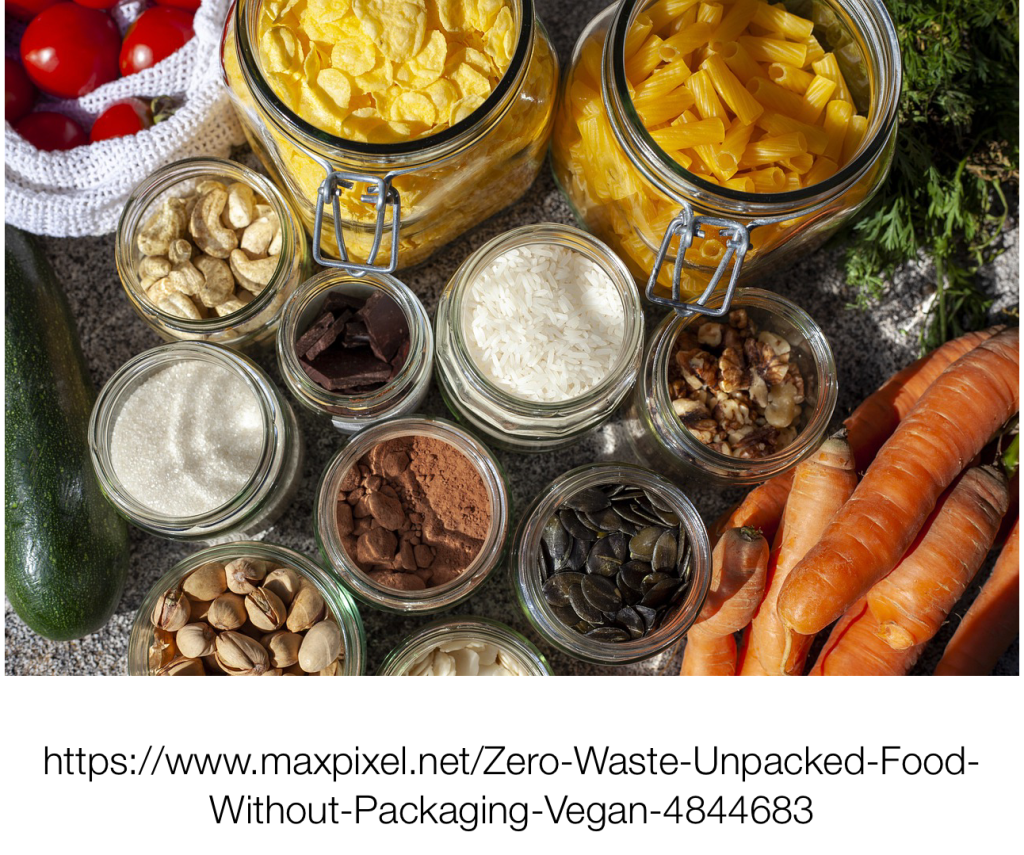
2. Secondly we avoid excess and plastic packaging, a habit we learnt through a zero waste experiment. We buy dried fruit and nuts, and dry goods such as rice, baking powder and bicarbonate of soda, spices, sugar, cocoa, millet and polenta from local refill stores where goods are dispensed into paper bags – often ones we have brought to reuse. We also buy refills of olive oil, soy sauce, maple syrup, tahini and peanut butter, taking our own jars and bottles to refill. Milk – both oat and dairy – comes in reused glass bottles on the milk round. Since we cook meals from scratch we avoid lots of single use plastic boxes. Likewise making our own cakes and biscuits reduces the amount of waste we generate. Jam jars are reused when we make jam, marmalade and chutneys and when we bottle summer fruits. Deliveries from Hodmedod come in paper or compostable bags, flour and oats come in bulk in paper sacks. 

3. Thirdly we seek to reduce the carbon footprint of what we eat. Most meals are vegan – Paul enjoys cheese in his sandwiches and dairy milk on his cereal. A vegan diet can save in the region 400 and 900 kgCO2 a year. Even with a vegan diet there are ways of being more or less carbon efficient. By  choosing locally produced food, food that is in season and cutting back on food waste (other vegetable leaves, tea bags and coffee grounds all go into the compost bin whilst apple cores go to make cider vinegar) we aim to minimise our carbon footprint. We have a weekly fruit and vegetable delivery from OddBox which collects fruit and vegetables from farmers and suppliers that would otherwise go to waste – because supermarket demand has dropped, crops have been larger (or sometimes smaller) than expected), crops have ripened too quickly/ slowly, or items are too small/ big/ misshapen for general sale. OddBox by preventing food from going to waste, saves some 11,000 tonnes of CO2 a year.

Living sustainably with electricity 

22nd June 2022

What does sustainability look like in daily life? I thought I would share our (me and my husband) experiences. We buy our electricity from a green supplier – Ecotricity – as well as producing our own from solar panels. We are currently investigating installing batteries so that we can make greater use of what we generate.

Living sustainability with electricity is about not using it unless needed. 

  • no dishwasher and no tumble dryer – clothes dry on the line outside or a clothes horse inside when wet – and no freezer
  • Hand turned burr coffee grinder  
  • Hand whisk 
  • Broom and dust pan for most floor cleaning and vacuum bedroom carpets
  • Hand sewing machine
  • When we buy appliances – fridge, washing machine, cooker – we look for those with AA ratings. For a television we also opted for small rather than large screen. 
  • Ditto small rather than large fridge
  • Our regular wash cycle is the 20 minute express programme with 10 minute extra soaking time.
  • Only washing clothes when needed – a shirt will last 4 or 5 days, trousers and jumpers even longer.
  • I use an iPad rather than a laptop and an iPhone and where possible charge them when our solar panels are producing energy. Ditto for recharging bike lights.
  • Only filling the kettle as needed and only heating to the temperature needed – 94C for coffee.
  • Plan baking bread and cakes to fill the oven. Use these days for an oven baked dinner
  • Planning meals to minimise number of hot plates needed. Turning hot plates off before cooking finishes to use the residual heat.
  • Using the microwave to cook porridge, vegetables and fruit
  • Turning off lights when not in use and using low energy bulbs
  • No electric garden tools

Our metered electricity consumption for the last 12 months was 1542 KWh

Living sustainably while heating our homes.

What does sustainability look like in daily life? I thought I would share our experiences.

About ten years ago we installed double glazing, put solar panels on the roof, installed cavity wall insulation and fitted two wood burning stoves in an effort to reduce our carbon footprint. The cavity wall insulation and the double glazing produced an instant effect with the house feeling much warmer. The stoves, when we use them, warm the whole house. We have burnt wood from two trees felled in our own garden (both had grown too large) plus wood collected from a local tree surgeon. All reducing our heating costs and carbon footprint. Both stoves were chosen for their clean burn credentials but current scientific advice suggests we should not use them because of the contribution they make to air pollution. 

Otherwise our main source of heat is a gas condensing boiler. To minimise our gas consumption and carbon footprint, we limit the hours when we run the boiler to an hour or so around breakfast time and for about four hours in the evening, turning the heating off about an hour before we go to bed. We heat only the rooms we use in the day time – kitchen, living room, study – plus the bathroom. We keep the thermostat at about 16C and wear several layers of clothes as necessary! Once the sun sets we draw the curtains in all the rooms, and these have thermal linings. In bed we have hot water bottles. 

The boiler also provides hot water. When we upgraded the house’s insulation, we also replaced the bath with a low powered shower – think light rainfall. Over the last year we have cut back on daily showers, replacing them with a wash in the handbasin. The distance from the hot water cylinder to the kitchen sink is such that to get hot water, you need to draw several litres of colder water. As this ultimately waste hot water left in the pipe, we use a kettle to heat water for washing up. This saves about 5 litres of hot water a day. 

This summer, given that we shower once or twice a week, we are cutting back further on gas by turning off the boiler. Instead we use the electric emersion heater when we do need hot water for showering. As we have solar panels, we aim to run the emersion heater when the sun is shining. 

Our annual gas consumption for the last twelve months has been 6739 KWH and for electricity 1542 KWH.

Welcoming Garden Birds

The sparrow is still the most commonly observed garden bird but we have not seen one for about 20 years in our garden.

Can we do more to encourage bird populations that frequent our gardens?

  • Fresh water – provide a bird bath, pond or shallow bowl of fresh water for both drinking and bathing. Bowls and baths should be regularly cleaned and topped up with fresh water. 
  • Food – providing food is an easy way of attracting birds. Commercially produced bird food offers a wide range of seed and fat based foods. Some are specially adapted so that spilt seeds do not sprout so preventing a mini grain field growing under your bird feeder. Different foods can attract different birds. For example nyger seeds are popular with goldfinches. 
  • Growing bird food – you can provide bird food by growing it in your garden. Goldfinches like eating the seeds from dandelion heads, from teasels and from lavender bushes (leave the ‘dead’ seed heads in place). Blackbirds like apples. Starlings like the berries from the mahonia bushes and yew trees. Blue tits and great tits like eating aphids and other insects that congregate on plants stems and shoots.
  • Hygiene – birds can be killed by germs that multiply when bird feeders become fouled by bird droppings and by stale/ rotting food. Regularly cleaning bird feeders is important, as is removing stale food. The ground underneath bird feeders can also become foul so it is good to regularly move their positions and to clean the area underneath them.
  • Shelter – hedges and shrubs provide welcome places of shelter especially for small birds such as wrens and sparrows.  Bushes can provide a safe place from which birds can check out the safety of a  bird feeder before darting out. 
  • Nesting boxes provide a particular form of shelter. Different birds have different requirements. Blue tits need boxes with only a small opening, whilst robins prefer a wider opening. Swifts and martins need high level nesting places. Hygiene again is important: winter is a good time to clean  old nesting boxes ready for the new season. 
  • Variety of habitats – by learning more about different bird species, we can understand better the habitats they prefer and how we can shape our gardens to better meet their needs. Black birds for example are ground feeders. They eat grubs and worms that they pull from the soil. Short, rather than long, grass makes this easier. Black birds can’t hang from bird feeders but they can perch on bird tables. Sparrows and wrens like hedges. Starlings like tall trees where they gather and survey the land.

Gardens as nature reserves

4th April 2022

Gardens are our very own nature reserve right on our doorstep!  

There are many ways in which we can boost their biodiversity and make them even more environmentally friendly (space permitting).

  • Let your garden grow wild at the edges
  • Choose plants so that there is always something in flower throughout the year.
  • Create different habitats with trees and shrubs, ground-cover and climbers
  • Maintain plant cover over all the soil to protect; have different layers of planting. 
  • Use intercropping techniques, sowing fast growing vegetables between those that need more space, eg radishes between cabbages, or eggplant daises between leeks. 
  • Install a water butt 
  • Leave seeds heads and dead stalks in place over winter
  • Use hand tools rather than power tools 
  • Plant some soft fruit bushes or strawberries or rhubarb

P

  • Plant a fruit tree

Spring Cleaning

Why spring cleaning? Because the hours of day light are longer and the sun brighter and we can see the dust and dirt more easily. With warmer weather we open doors and windows more readily  which feels conducive to create and removing dust. And there is the psychology of spring being the time for a fresh start! 

Spring cleaning – or indeed any cleaning – contri to the advertising of the

supermarkets, does not need a basketful of sprays and polishes, creams and scourers, nor a cupboard full of newly bought cloths – eco or otherwise. More useful are time and elbow grease. 

  • Use old/ worn thin towels and flannels, tea clothes and t-shirts/ vests. The soft material of an old vest is greater for picking up dust. Towelling is good for cleaning floors, sinks, tiles and other hard surfaces. Ex-cotton or linen tea towel are good for giving a polish to a surface. Old vests and socks are good for applying silver and brass polish and for buffing. 
  • Old toothbrushes are good for getting dust or dirt out of small crevices. (They are also good for cleaning bikes).
  • Water is good all round cleaner, especially for floors and tiles. Vinegar helps if surfaces are greasy. 
  • For washing windows use water with a splash of vinegar. Soap really isn’t needed.
  • When dusting a little vegetable oil helps pick up the dust but buff the surface after to remove excess oil to which further dust or dirt may stick. 
  • Vinegar is an acid. Acids dissolve lime scale so can use vinegar on taps etc – do a small check first that the taps haven’t been given a surface coating that can be damaged by an acid. 
  • In toilets vinegar may be insufficient to tackle lime scale. Try using instead citric acid which you can buy for cleaning purposes (cheaper than food quality citric acid) and you can improve the efficacy of the citric acid by first pouring a kettle of hot water into the toilet.
  • You can also use citric acid to descale kettles. Boil a kettleful of water, unplug and then add a little citric acid and leave to soak. Rinse well before using!
  • In line with reducing plastic products, wooden toilet brushes are a good alternative. Ideally they should have a hook so that you can let them drip dry over a suitable pot – eg a plant pot holder/ large jam jar.
  • Bicarbonate of soda is an alkaline which becomes a mild bleach when added to water. You can use bicarbonate of soda to clean your toilet – adding hot water will aid this. You can buy bicarbonate of soda for cleaning purposes from Robert Dyas or similar retailers. Again it will be cheaper than food quality bicarb)
  • Use a mixture of  bicarbonate of soda  and water to soak dish clothes to help keep them clean.
  • A mild solution of bicarbonate of soda and warm water is good for cleaning the inside of the fridge.  
  • Mixed together in water, bicarb and citric acid will react and fizz. You can use this to clean sink and shower drains. For best effect use 2 part bicarb to 1 part citric acid. This also works well in toilets. 
  • You can also use this to clean your washing machine.
  • Use bicarbonate of soda to clean sinks and baths by mixing the powder with a little water and apply with a cloth. Rinsing clean with vinegar will remove any residue.
  • As it is a mild bleach, you can also use bicarb to remove tea stains from mugs. Put a small amount in the bottom, add hot water and leave to soak. 
  • Although you can use a vacuum cleaner for hard floors, a brush doesn’t need any electricity and is much easier to put away. When you need a new brush, investigate non plastic options.
  • Brooms can be used carefully to remove cobwebs from ceilings or use a pole with a duster fixed to the end.
  • A regular quick clean prevents any build up of dirt which ultimately can be harder to shift.

Fairly traded

24th February 2022

This week is the first half of Fairtrade fortnight when the Fairtrade Foundation draws our attention to the their work in protecting and supporting farmers, farm workers and small businesses in developing countries. For products to gain the Fairtrade mark a thorough investigation of trading practices is made, standards attained and goals established. Products with the Fairtrade mark often command a higher price which consumers are willing to pay knowing that the extra supports the wellbeing of those involved in its production and of the environment.  

These principles are clearly ones one would wish to apply in every circumstance. As consumers we can make the effort to find out about workers pay and conditions, the effects of production on the environment, of safe guards and sustainable practices, company practices, shareholder remuneration and the payment of taxes. It is not just in developing companies that one should desire fair trade practices, but here in the UK too. Being better informed we can chose to support those companies which trade fairly. The following groups/ foundations etc offer standards and identifying logos that help inform us as consumers. 

  • Fairtrade is a system of certification that aims to ensure a set of standards are met in the production and supply of a product or ingredient. For farmers and workers, Fairtrade means workers’ rights, safer working conditions and fairer pay. For shoppers it means high quality, ethically produced products. Choosing Fairtrade means standing with farmers for fairness and equality, against some of the biggest challenges the world faces. It means farmers creating change, from investing in climate friendly farming techniques to developing women in leadership. With Fairtrade you change the world a little bit every day. Through simple shopping choices you are showing businesses and governments that you believe in fair and just trade. https://www.fairtrade.org.uk/what-is-fairtrade/ 
  • The Rainforest Alliance is a global leader in sustainability certification. Farms, forest communities, and businesses that participate in our certification program are audited against rigorous sustainability standards based on the triple bottom line: environmental, economic, and social well-being. More than two million farmers follow our agriculture standards in 70 countries around the globe. Our programs focus on coffee, cocoa, tea, bananas, and many other important commodity sectors facing urgent environmental and social challenges.  https://www.rainforest-alliance.org/approach/
  • The Living Wage Foundation is at the heart of the independent movement of businesses and people that campaign for the idea that a hard day’s work deserves a fair day’s pay. They celebrate and recognise the leadership of responsible employers who choose to go further and pay a real Living Wage based on the cost of living, not just the government minimum. They coordinate the announcement of the real Living Wage rates each November, based on the best available evidence about living standards in London and the UK. We also provide advice and support to employers and service providers implementing the independently-calculated Living Wage rates. This includes best practice guides, case studies from leading employers, model procurement frameworks and access to specialist legal and HR advice. They offer accreditation to employers that pay the independently-calculated Living Wage rates to all staff in London and the UK, or those committed to an agreed timetable of implementation, by awarding the Living Wage Employer Mark. https://www.livingwage.org.uk/living-wage-foundation  
  • The Fair Tax Foundation was launched in 2014 and operates as a not-for-profit social enterprise. Our Fair Tax Mark accreditation scheme seeks to encourage and recognise businesses that pay the right amount of corporation tax at the right time and in the right place. We believe companies paying tax responsibly and transparently should be celebrated, and any race to the bottom resisted. Tax contributions are a key part of the positive social and economic impact made by business. The growth of tax havens and unethical corporate tax conduct have become prominent concerns across the world. Aggressive tax avoidance negatively distorts national economies and undermines the ability of responsible business to compete fairly, both domestically and internationally. https://fairtaxmark.net/  
  • Certified B Corporations, or B Corps, are companies verified by B Lab to meet high standards of social and environmental performance, transparency and accountability.B Lab is the non-profit network transforming the global economy to benefit all people, communities and the planet.  It was created in 2006 with the mission to inspire and enable people to use business as a force for good. There are B Labs across the globe (forming the B Global Network) including Australia, East Africa, mainland Europe and North and South America. B Lab UK is a charity that launched in 2015.  As part of this international network, B Lab UK leads economic systems change to support our collective vision of an inclusive, equitable and regenerative economy. Our purpose is to redefine success in business through building a community of engaged businesses, raising awareness of the B Corp Movement and influencing change in the UK economy. Together, we are shifting our global economy from a system that profits few to one that benefits all: advancing a new model that moves from concentrating wealth and power to ensuring equity, from extraction to generation, and from prioritising individualism to embracing interdependence. https://bcorporation.uk/about-b-lab-uk/  
  • The Soil Association is the charity that digs deeper to transform the way we eat, farm and care for our natural world.Why do we do this? Because we want to live in a world which is in balance with nature. In a future with good health and a safe climate. For the last 75 years, we’ve worked with citizens, farmers, policy makers and businesses, supporting them to explore the vital relationship between the health of soil, plants, animals and people. Because the only way to solve the issues we face is to understand that they are all connected – and that food, farming and forestry are a vital part of the solution. Any product sold as ‘organic’ in the UK has to comply with organic regulation requirements written into a set of Standards. The Soil Association acts as a certification body and its symbol is a recognised and trusted international mark of organic certification internationally.  https://www.soilassociation.org/who-we-are/  
  • The Marine Stewardship Council (MSC) is an international non-profit organisation on a mission to  stop overfishing. For over 20 years, they have been working with fisheries, seafood companies and scientists to help protect the oceans around us, and safeguard seafood supplies. The blue MSC ecolabel is the world’s most recognised label for sustainable seafood. It is found on retail products and in restaurants identifying fish and seafood that has been wild-caught in a sustainable way and is fully traceable. The blue MSC ecolabel is only awarded to well-managed fisheries that meet the MSC’s independently verified standards for sustainable seafood production. https://www.msc.org/ 
  • The Forestry Stewardship Council, the original pioneers of forest certification, has 25 years of experience in sustainable forest management. They use their expertise to promote the responsible management of the world’s forests, bringing together experts from the environmental, economic and social spheres. 12 Irreplaceable Forest Products in Our Daily Lives: paper, toilet paper, books, cardboard, paper packaging, wood, furniture, musical instruments, charcoal, rubber products such as condoms, balls, tires, fruits and berries, and  medicines – A lot of medicines have important ingredients that come from the rainforest. While there are not any FSC-certified medicines (yet!), the standards set by FSC for responsible forest management protect the forests where these ingredients come from, thus ensuring that we will have access to them for future generations. Next time you add them to your shopping bag, make sure they are sourced sustainably by looking for the FSC logo.  https://fsc.org/en  
  • In 2008 The Round Table on Sustainable Palm Oil developed a set of environmental and social criteria which companies must comply with in order to produce Certified Sustainable Palm Oil (CSPO) in response to the ever-urgent need and growing global concern that commodities are produced without causing harm to the environment or society. Sustainable palm oil is responsive to increasing global food demand, supports affordable food prices, supports poverty reduction, safeguards social interests, communities and workers, and protects the environment. All organisations in the supply chain that use RSPO certified sustainable oil products are audited to prevent overselling and mixing palm oil with conventional (or non-sustainable) oil palm products. https://www.rspo.org/certification

Zero Waste 

27th January 2022

“One summer we set ourselves a zero waste challenge – we would try and live

for two weeks without producing any waste – i.e. nothing that goes into the dustbin. Whether it be food stuffs we used in the kitchen, cleaning materials around the house or tubes of toothpaste, the aim was to only use things that do not produce any non-recyclable waste. No bought bread unless the bag it came in could be recycled; no pre-packed fruit and vegetables unless all the packaging – including the film around the recyclable plastic box could be recycled – no mouthwash unless all the packaging including the plastic wrapper around the lid could be recycled.

In preparation we had reviewed how things we bought were packaged and what things usually went into our dustbin. Some things that were not waste free we decided we could do without for a couple of weeks. For things we did want we hunted for alternatives. The latter in itself proved an rewarding experience. 

Tea whether bags or loose, often comes with an inner plastic wrapper. Seeking alternatives sources of tea we came across a tea shop, My Cup of Tea, where without blinking an eyelid, they weighed out the tea and tip it into our tea caddy. A number of coffee roasters are similarly happy to pour their beans into our tin. Each time there is an interesting conversation about waste free living. Where we couldn’t find a waste free alternative, we learnt to make our own. Pasta almost invariably comes in plastic or plastic-lined packaging, so had fun we brushing up our pasta making skills.

Week one and our un-recyclable waste was limited to: the plastic seal from under the milk bottle top, a blister packs from medication, a sticking plaster, the plastic film from a pack of pate, several mars bar wrappers, the plastic seal from an jar of instant coffee, a plastic envelope from a greeting card, and a plastic lined bag for coffee beans.

To achieve this level of zero waste we had had to make compromises on other principles. Whilst supermarkets do sell some loose fruit and vegetables, their organic produce is nearly always is pre-packed in plastic. Whole Food sells loose nuts,  dried fruits, grains and pulses but not from fair trade sources. 

The zero waste experiment prompted us to look at the life cycle of daily objects such as toothbrushes which routinely go into landfill. We bought bamboo ones which can be composted. It is made us think about the costs of recyclable waste. Is the single use of a bottle that will then be recycled – taken by lorry to a separating plant and the possibly shipped across to Asia for reprocessing before being made into a new container – really good for the environment? Should we instead look for reusable packaging? A durable bottle filled from the tap instead of a plastic bottle of water from the shop, a washing up liquid bottle that can be refilled, refillable ink cartridges,  a fountain pens…..?”

The above is a reflection of my family’s experiment with zero waste some four years ago. It is interesting to note that some of the things that were going into our refuse bin then, we would now recycle. Blister packs for pills go to the recycling collection point at Superdrug, and the plastic film and wrappers would now go to the soft plastic recycling point at the Coop or Tescos. Only the sticking plaster would still go into the refuse bin. 

 More important has been how the experiment changed the way  shopped. We discovered that with the zero waste experiment, not only did we put less in our refuse bin, but we also put less in our recycling bins too. We had been actively looking for unpackaged goods, and that mindset continues with us today. 

All packaging incurs a cost financially and with respect to the environment, and a further cost when it is either thrown away as refuse or is recycled as new sources of raw material.  Consuming less packaging is almost invariably a good thing!

Tips for swopping to a zero waste lifestyle:-

  • Make a commitment to trying the zero waste approach for a fixed short term period.
  • Plan for the time period in advance: Do a survey of  your refuse bin: what things are you routinely throwing away?
  • What things might you have to do without for your agreed fortnight/ month? 
  • What alternatives could you buy instead?  Check  out local markets and smaller independent shops –  often they are are more flexible in what they expect of customers.
  • Search for local bulk stores – also known as refill stores – where you decant
  • from large dispensers the ingredients you want to buy, filling up your own containers or paper bags etc. The range of items on sale is quite surprising, from powder turmeric to pasta, from olive oil to chick peas, from oats to cocoa nibs, from ground almonds to hair shampoo.
  • Ready made foods often have more packaging to protect them in their finished status: could you buy the raw ingredients with less packaging and make your own? Have a go at making your own biscuits, bread, pastry etc? 
  • Buying in bulk may reduce the proportionate amount of packaging. I bake bread and buy flour in 6kg sacks. A 500ml pot of yogurt has less packaging than 4 individual tubs – or make your own in reusable glass jars.
  • Fruit and vegetable box schemes often use minimal packaging.
  • Change your mind set: if you normally reach for plastic snack bar  to keep you going, get the habit of having a banana or a handful of nuts instead.  If you need a packed lunch, make a sandwich to take or buy a bread roll rather than opting for the plastic-packed ready made sandwich. If you’re going out for an ice-cream look for one that is served fresh in a cornet rather than one that’s pre-packed in plastic. Develop an aversion for crisps and individually packed biscuits. 
  • And if you feel that something you buy is over packaged, send the packaging back to the manufacturer with a query about its necessity. 

These tips focus primarily on food, but the same issues apply to other things too – roles of sticky tape and sticks of glue that come in plastic packaging; paper, cards and note books wrapped in plastic; pants and socks in individual plastic bags etc.

Advocates of zero waste lifestyles are often as keenly focused on following  a plastic free lifestyle too. Friends of the Earth have list of ideas to change to a zero plastic waste lifestyle – https://friendsoftheearth.uk/plastics/living-without-plastic

Rainwater retention to reduce flooding

There are a number of small ways in which we as householders, and more especially those of us with gardens, can increase the amount of rainwater our domain can retains. This can reduce the risk of flooding in two ways.

  1. By keeping water out of, or by delaying the water entering into, the storm water drains we can help prevent them from overflowing – a common cause of flooding in urban areas. 
  2. By increasing the water absorbency of our grounds, we can delay the time and speed with which rainwater enters  local streams and/ or the water table. This will reduce the pressure on the capacity of local streams and rivers, so reducing the risk of flooding. 

How can we do this?

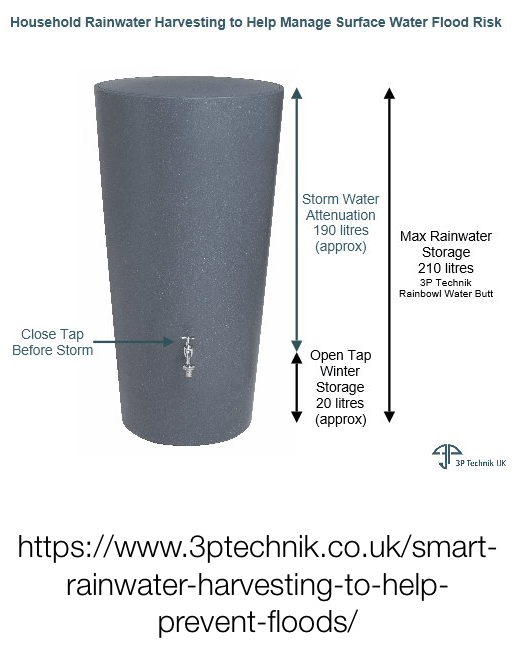
  • Install water butts. These collect water before it enters either the ground of storm water drains. If, advance of heavy rainfall, the butts are empty, then corresponding volumes of water can be held back from entering the ground or drains. Whilst one single butt may not make difference, a 1000 water butts each with a capacity of 200litres can hold back 200,000 litres – 200 cubic meters – of water. This does require some focus by the householder on rain forecasts. A less precise solution would be to leave the water butt tap half open or it to a leaky hose. Either way it is important that you ensure the empty butt is weighted down to stop it blowing over – either leave some water in the bottom or put in some bricks or out a heavy lid on top.
  • The RHS suggests using rainwater from butts to wash cars and paths in the winter and plants in the summer.
  • Avoid areas of bare earth. Ground that is covered with plants will slow the passage of rainwater into the water table. Rainfall will be interrupted by leaves and rainwater will absorbed by roots and by any mulch covering the ground. 
  • Compacted soil is less able to absorb rainwater – where the ground is regularly trafficked create a path that uses porous materials – eg gravel, bark, stepping stones.
  • Ensure a range of planting so that there are always some plants covering the ground and some plants with leaves.
  • Cover areas of bare earth – eg before planting begins or in the autumn after harvesting  – with a mulch or with a quick growing green crop – otherwise known as green manure – such as alfalfa, clover, mustard.  https://www.rhs.org.uk/soil-composts-mulches/green-manures
  • Avoid hard surfaces if possible. Where a hard surface is needed (as a patio, for car parking etc) you can opt for a porous hard surface such as gravel or paving stones spaced out with gaps for drainage. You could also incorporate a soak-away to catch and collect water that runs off the area. 
  • If you have a pond, keep it filled up with rain water. Run a hosepipe from a water butt so that when it rains the pond benefits from rain gathered over a larger area. 

Recycling

Paper and card: fold and flatten and place in recycling bin. In the Borough of Richmond, this is the blue box. Cardboard and paper should be clean with plastic tape removed. It should be dry and  free from paint and glue etc – although Richmond’s recycling company says small amounts are not a problem.

Glass: jars and bottles should be rinsed clean before going into the recycling box. In Richmond this is the black box. Lids can be left in place.

Tins: steel and aluminium tin food and drinks can all be recycled. Clean and flatten them (if possible) before placing them in the recycling bin. Again in Richmond this is the black box. You can also recycle aerosol cans. Aluminium foil can also be recycled. Ensure it is clean and squash the foil together to make one lump. This prevents small pieces of foil getting lost.

Batteries and light bulbs: these can usually be recycled at the stores where they are sold. In East Sheen batteries can be recycled at Waitrose, Boots and Robert Dyas and the latter also recycle light bulbs.

Plastics 

Milk cartons and bottles, shampoo and laundry/ cleaning liquid bottles,  ice-cream and margerine tubs, food trays, and yogurt, dessert or cream tubs: these should be cleaned and flattened before being placed in your recycling box. In Richmond this is the black box.  

Plastic bags: these can be recycled at most supermarkets along with other thin plastic wrappings such as from around magazines and toilet rolls, bubble wrap, bread bags and bags for frozen foods.

Scrunchable or soft plastics: these can be recycled at some supermarkets including some Tesco and Sainbury stores and most Co-ops. Local to East Sheen this includes Tesco Metro in Richmond (ask at the customer services desk) the Coop store in Putney and the Coop service station at Roehampton Vale. These plastics include biscuit and sweet wrappers, crisp packets, cling film, plastic bags for salads, pouches from both food and cleaning products, as well as the previously described plastic bags.

Blister packs from medicines etc: these can be recycled at Superdrug – ask at the pharmacy counter.

Polystyrene and plastic foam: these plastics cannot currently be recycled.

Compostable plastic-looking bags: some manufactures pack their newspaper, magazine, dried goods etc in bags made from corn starch or similar. This is not plastic and must not go in with plastics for recycling. It will be clear.y marked as compostable and should go into your garden compost bin or your food recycling bin. Domestic compost heaps don’t reach high temperatures and these bags may take a couple of seasons to break down – be patient!

Compostable cutlery, cups and bowls etc: these may look like plastic, especially the cutlery. They should be marked as compostable and should go into your garden compost bin or your food recycling bin.

Pens: worn out pens including felt tip pens and highlighters are recycled via TerraCycle and can be dropped off at your local Ryman store. 

Postage stamps: you will probably get more of these at this time of year. They are often collected by charities as a means of raising funds. Eg RNIB https://www.rnib.org.uk/donations-and-fundraising/fundraising-your-community/stamps-appeal  and Against Breast Cancer https://www.againstbreastcancer.org.uk/recycling/used-stamps/