“You have heard that it was said, ‘An eye for an eye and a tooth for a tooth.’But I say to you, Do not resist an evildoer. But if anyone strikes you on the right cheek, turn the other also; and if anyone wants to sue you and take your coat, give your cloak as well; and if anyone forces you to go one mile, go also the second mile. Give to everyone who begs from you, and do not refuse anyone who wants to borrow from you. Matthew 5:38-42
The above comes from the Beatitudes: Jesus’s teaching to the crowds on the approach to life that would bring its own blessings.
An eye for an eye and a tooth for a tooth sounds very mercenary. A contractual arrangement in which neither side looses out. A fair’s fair deal that leaves no space for argument not for generosity. It has the feel of a fixed price market. Anyone who tried to pay more than the asking price would be a fool. Yet Jesus invites the listener to be that fool. To pay more than the asking price. To give more that is required or demanded. To act in a way that undermines the normal way of doing business. It is a radical counter-cultural way of being that will bring its own blessings.
In the world of the climate crisis, old ways of doing things will have to change, old traditions and old norms will be replaced by new ways. Heating homes with gas will be history; the supermarket run in the car and the lift to school will disappear; holidays won’t start at the airport; strawberries will be a treat for the summer not Christmas.
Change like this can be hard to accept. After a life time in which cars have become the default means of transport, it is hard to rethink in terms of walking times. After a life time in which air travel has become part and parcel of the holiday package, it is hard to rethink in terms of trains and local destinations. After a life time in which seasonal food describes food linked to sporting/ social events, it is hard to re shape our eating round a annual cycle of what is currently in peak production: raspberries in June, plums in August, avocados in February.
Change can be expensive as new practices, new products are scaled up and developed. The bonus of economies of scale take time to kick in, the benefits of lower energy bills will be felt gradually over the years whilst the initial cost of new equipment – heaters, electric cars, solar panels – may be steep.
Following Jesus’s teaching, we can become trend setters, living a new lifestyle, adopting ways that will curb GHG emissions and restrain the climate crisis. We can lead by example and do things that are not the norm, that are not (yet) fashionable. We can choose to walk or cycle that bit further than usual rather than going by car. We can refuse to buy the plastic wrapped fruit or sandwich. We can explore the UK rather than the world. We can decline avocados in summer and strawberries in winter.
Those of us with money can invest in carbon neutral technology, we can buy the eco friendly products and services, and we can do so generously, supporting producers as well as the climate. Train travel can be more expensive that going by car or plane, but we can choose the climate friendly option. Organic food may be more costly – now – but we can choose it over cheaper products that are less environmentally friendly.
Jesus asks that when we choose how to live, that we choose to think of the needs of others and be ready to meet their needs first. The results? A transformed world!
Governments and businesses do certainly exert control over various aspects of what can and cannot do, yet we may be surprised how much we can do to reduce our individual – and therefore to our national – carbon footprint.
The WWF estimates that the production and consumption of food accounts for 20% of the UK’s green house gas emissions which currently equates to 82 million tonnes a year – say roughly 1.5 tonnes per year person. By changing how we eat and shop, we can substantially reduce these emissions.
Reduce the amount of meat and dairy products you consume. Globally 58% of GHG emissions for food arise from the production of meat and dairy items. Agricultural animals have to be fed, and to ensure good productivity, their food is nutrient rich including items such as soya beans. Large amounts of land and water are used in providing food and grazing, all of which comes with its own carbon footprint. Farm animals are also GHG emitters in their own right. Each cow emits 70 – 129kg of methane per year. Removing meat and dairy products from your diet can reduce you GHG emissions by 0.6 tonnes per year (Carbon Independent Calculator).
The alternatives to meat and dairy are to be found in eating beans, pulses and nuts as sources of protein and numerous minerals. Soya beans which are particularly rich in protein have traditionally been fermented to produce foods such as tofu. Soya beans – as well as almonds, hemp, coconut, oats etc – are also used to create dairy replacement items: milks, butter, yogurts, cream, ice cream etc as well cheeses. Ideally one wants to buy products that are locally produced. Hodmedod specialises in selling beans and pulses, seeds (chia etc) and grains (including quinoa) that are grown here in the UK. There is a growing number of UK based producers of plant based milks. Milk and More, a reinvention of the traditional milk delivery service, sells freshly bottled oat milk that comes from Lancashire.
Choose organic foods. Organic food production because it avoids mineral fertilisers, ensures improved soil conditions such that the soil retains a higher proportion of carbon than do other soils. This carbon sequestration reduces the carbon footprint of organic foods vis a vis non organic ones. Choosing organic foods can reduce your GHG emissions by 0.7 tonnes a year. It can be difficult deciding between organic vegetables from Europe versus local non organic items,
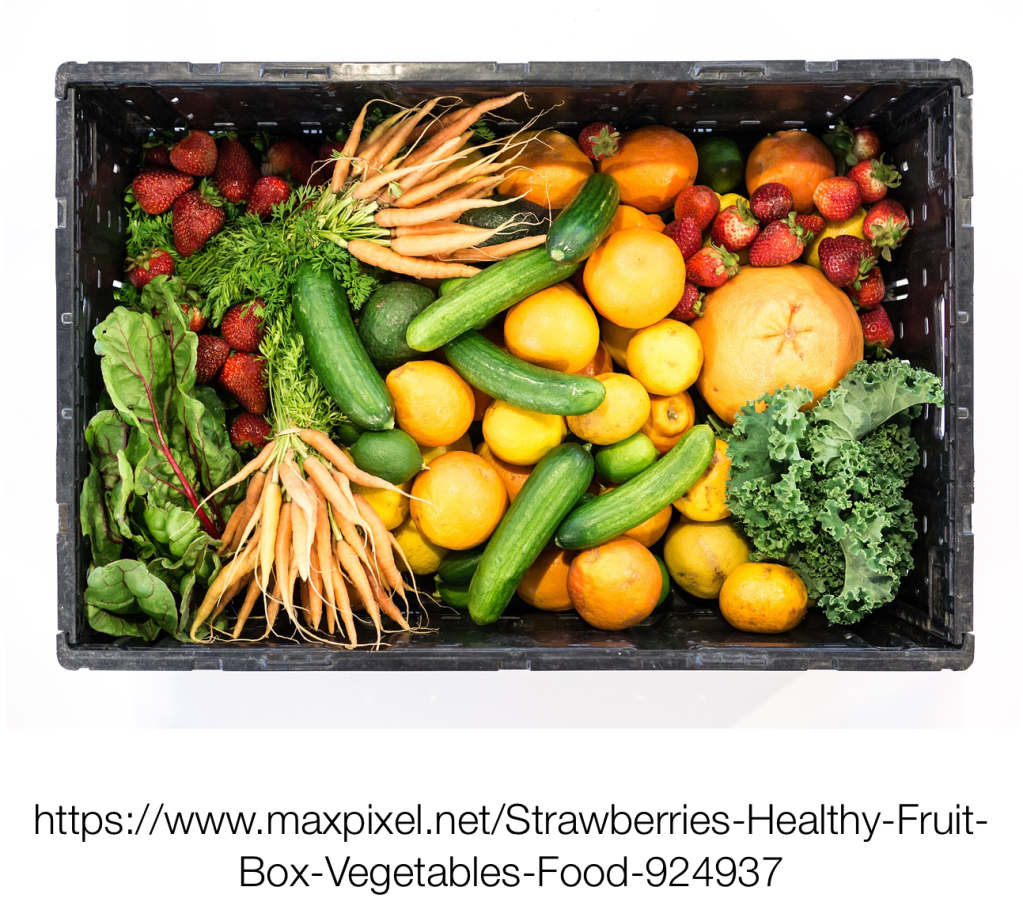
Buy locally grown food – or eat home grown food. Locally grown food has a lower carbon footprint because the distance the food is moved is less and therefore transport inputs are less. This is especially true when food stuffs are imported by air and often includes the import of out of season foods from the Southern Hemisphere such as asparagus and blue berries. Eating locally produced food can reduce your GHG emissions by 0.4 tonnes per year. There is a growing number of veg box schemes where farms make a weekly delivery of vegetables straight from the farm to your front door, which reduces transport emissions and food waste. OddBox specialises in fruit and veg boxes that collect together fruit and vegetables that would otherwise go to waste either at the farm or in the wholesale market.
Avoid food processing and packaging. Ready meals packed in plastics can have a disproportionately higher carbon footprint than meals freshly made from raw, unpackaged ingredients. Reducing the amount of packaged and processed food you consume can reduce your GHG emissions by 0.5 tonnes.
Minimising food waste. Throwing away food rather than eating it is obviously wasteful and a misuse of GHG emissions. Planning daily or weekly menus, using a shopping list, only buying and cooking the portions you will eat, careful storage of food etc are all ways fo reducing food waste. (For more details see the Eco Tips post of 9th August). Cutting food waste can reduce you GHG emissions by 0.5 tonnes per year. If you compost food waste such as the outer leaves of cabbages, banana skins and tea bags you can reduce your GHG emissions by a further 0.2 tonnes.
How you cook your food will also impact on your carbon footprint. Putting on the oven to bake one potato is more carbon intensive than boiling or pan frying the same potato in a pan. This aspect of your carbon footprint will be considered in a later post looking at household energy consumption.
We often say we are what we eat. If we eat with a conscience for what is good for the planet, and what is good for human and animal welfare, we will be part of the growing movement creating a better world for all.
In many religious and cultural traditions there is a practice of saying thank you before or after a meal. This recognises our dependence upon others for what we eat, whether that is the cook, the farmer, the retailer or above all, God as creator. Saying Grace at meals is one way of being more aware of the providence of the food we eat.
As we sit to eat this meal, we give thanks for all have been involved in its preparation.
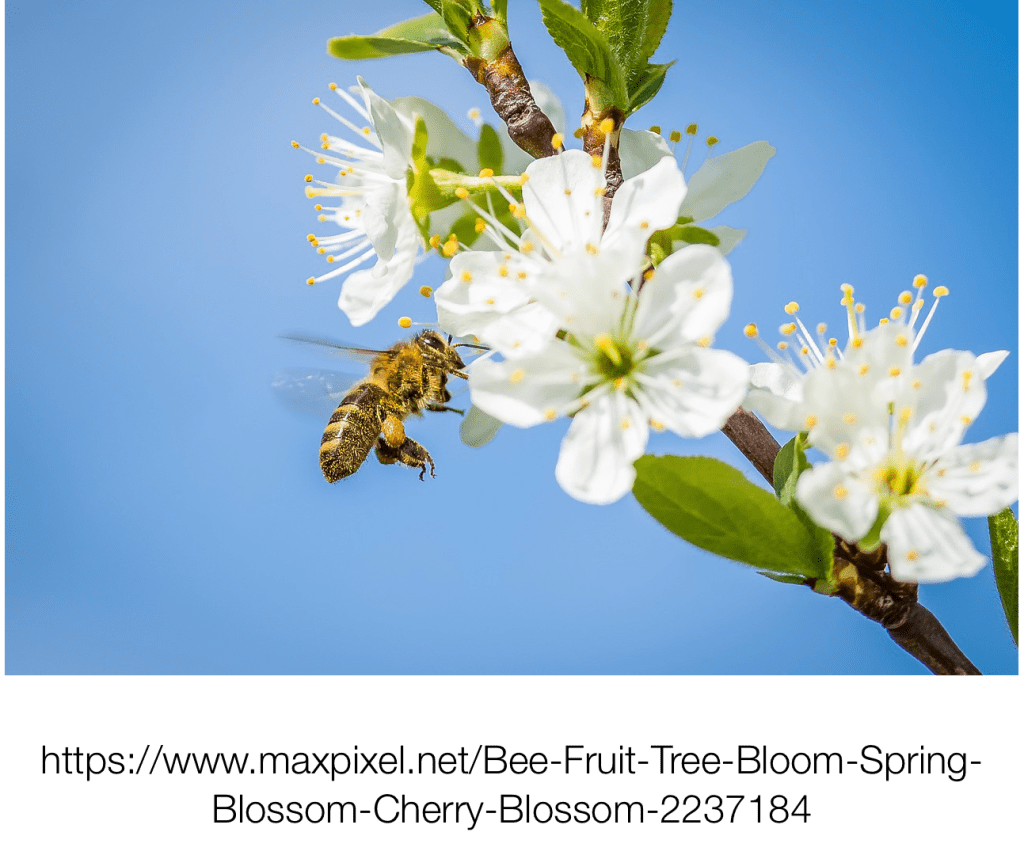
For the farmers and the worms, bees and pollinating insects, for shelf stackers and retailers, for those who cook and those who wash up,
and for the bountiful diversity of our God-given world. Amen.
NB I have swopped between the terms carbon footprint and green house gas GHG emissions as if they are the same thing which they aren’t. Strictly speaking our carbon footprint measures our carbon emissions whereas GHG emissions includes all gas emissions but of which carbon dioxide is the largest.
The ongoing global climate crisis arise because human activities and lifestyles
are putting carbon dioxide into the atmosphere at a faster rate than this gas can be absorbed by the planet. The resulting increasing levels of CO2 in the atmosphere insulates the planet so that year on year average global temperatures are rising. This impact of human activity on the planet is termed our carbon foot print. The word conveys the idea that what we do each day is leaving a mark, a footprint, on the face of the earth. We can measure the carbon footprint of different activities eg cycling, driving a car, skiing or hiking. We can measure the carbon footprint of different products eg a book, a DVD, a litre of milk, a dozen eggs, a wooden jumper, or a pair of trainers. We can measure the carbon footprint of a household or a business, of a person living in a flat or medium sized estate agents, a supermarket or a hospital. We can compare the difference between the carbon footprint of a typical resident of Nepal and the typical resident of Norway. We can compare the difference between alternative modes of transport, alternative methods of farming, or between a range of land uses.
The average per capita carbon footprint for the UK (adjusted to include emissions relating to what we import) is 7.1 tonnes (2023) (1)
The Carbon Independent and the Carbon Footprint websites both offer a detailed on line footprint calculator which includes inputting the amount of electricity, gas, petrol etc that you use each year.
The simplest way of reducing our carbon footprint is to look at individual aspects of our lifestyle and see how in practical terms we can reduce our carbon consumption. To some extent we will be limited by factors outside our control. For example if we choose to travel by train we cannot decide which railways lines are powered by electricity and which rely on diesel engines (although we can press Network Rail and our government to address this). If we shop at Waitrose, part of our food footprint is linked to the carbon emissions of Waitrose’s operations (Waitrose’s aim is that their entire operation should achieve net zero by 2035). On the other hand we can make positive choices to use businesses that are carbon neutral. For example, Kiss the Hippo’s coffee roasting business is carbon negative.
And God said, “Let there be lights in the dome of the sky to separate the day from the night; and let them be for signs and for seasons and for days and years, and let them be lights in the dome of the sky to give light upon the earth.” And it was so. God made the two great lights—the greater light to rule the day and the lesser light to rule the night—and the stars. God set them in the dome of the sky to give light upon the earth, to rule over the day and over the night, and to separate the light from the darkness. And God saw that it was good. And there was evening and there was morning, the fourth day. (Genesis 1:14-19)
The writer of Genesis tells us that the climate and its seasons, shaped by the sun, is a key part of the world God created. Both creation stories in Genesis give humankind a key role in occupying and caring for and tending the world that God created. Humans are given a role of responsibility vis a vis the fish of the sea, the birds of the air and all living things that move on the earth. They are given the task of cultivating the land and the plants which God intended should transform the earth from the bare form with which it began. And they are instructed to multiply and be fruitful ensuring generations of humans to come.
Have we looked after all the fish, the birds and living things? The decline in biodiversity with a third species threatened with extinction, suggests not.
Have we cultivated the earth and maintained its greenness? The expansions of deserts, the destruction of rainforests and temperate woodlands, and the loss of native plants suggest not.
Have we provided for the well being of generations to come? Currently the world is on track for an increase in global temperatures of some 3 to 5°C by the end of the century which would render large parts of the earth uninhabitable for humans – so no!
If we were to hold up a plumb line to measure how upright our living on the earth has been, we would see a world that is on the verge of collapse, a world which will be in a worst state than when we inherited it, and a world in which life for our children and grandchildren would be very bleak.
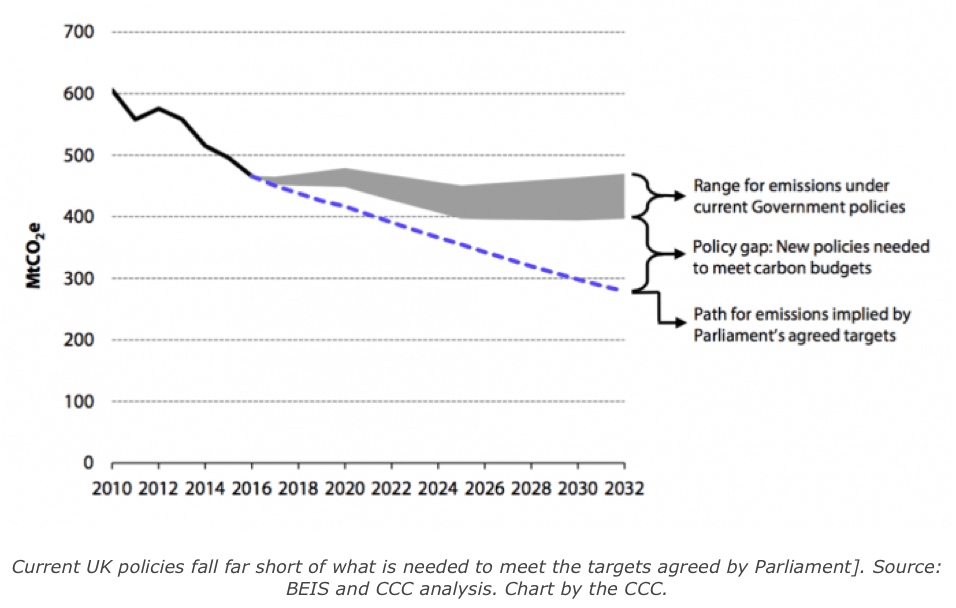
The diagram below is the equivalent of Amos’s plumb line. It was put together by the government’s Climate Change Committee an independent, statutory body established under the Climate Change Act 2008) is part of their review of the progress being made tickling the climate crisis. It shows with a blue dotted line the target reduction in carbon emissions agreed by Parliament. The grey band shows the levels of emissions that current policies will achieve. The gap between the two is the shortfall where new, firmer polices are needed. Just as plumb line measure how true a wall is, so this diagram shows how adrift we are of doing what is right for the climate and the world.
Prophets like Amos and Jeremiah called out to those in power when they were not meeting God’s standards. They also called out examples of wrong behaviour by merchants/ business leaders and those who abuse their power to oppress the vulnerable. They also called out those who falsely prophesied that all would be well and that no one need to repent and amend their patterns of behaviour!
Climate justice requires us to call our government and business leaders to account when policies and actions fail to address the climate crisis and rather allow the state of the earth to decline. We can write to our MPs and our local councillors asking what they are doing to avert the climate crisis, asking not just for wishful statements, but for concrete actions with measurable results. We can write to businesses, both multi nationals and our small, local businesses and ask what they are doing to achieve net zero carbon by 2050. We can sign petitions, and join one of the many campaign groups such as Friends of the Earth, Green Christian, Christian Climate Action, Greenpeace etc.
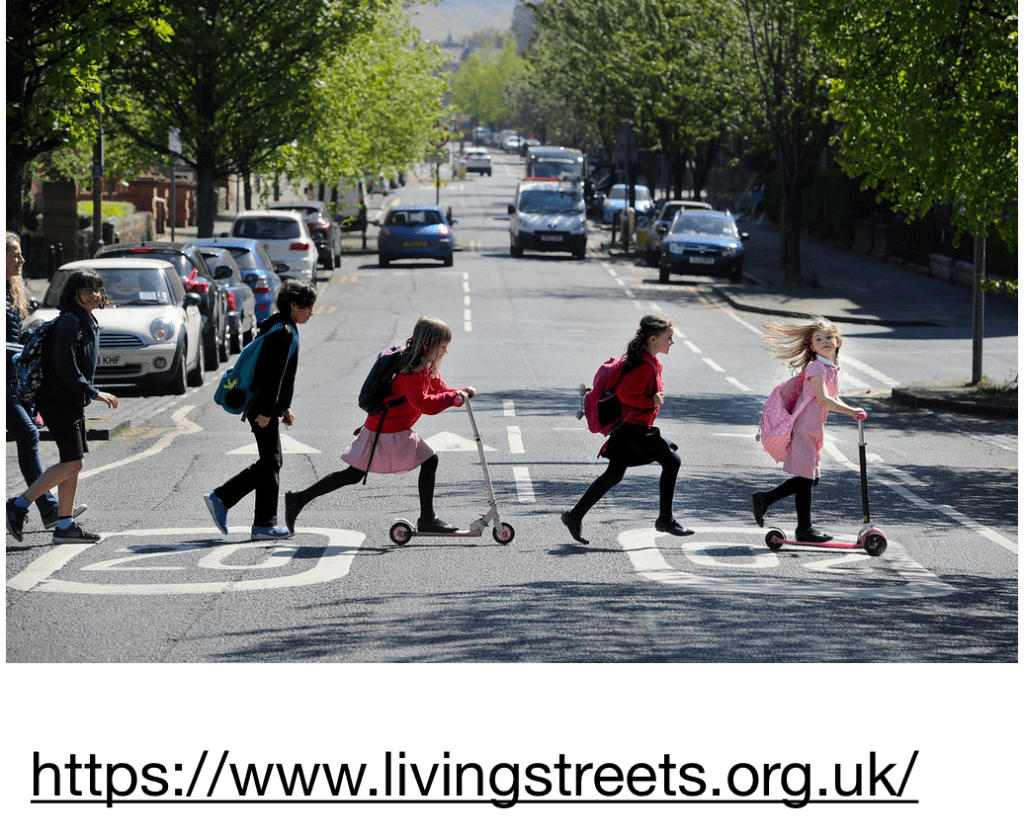
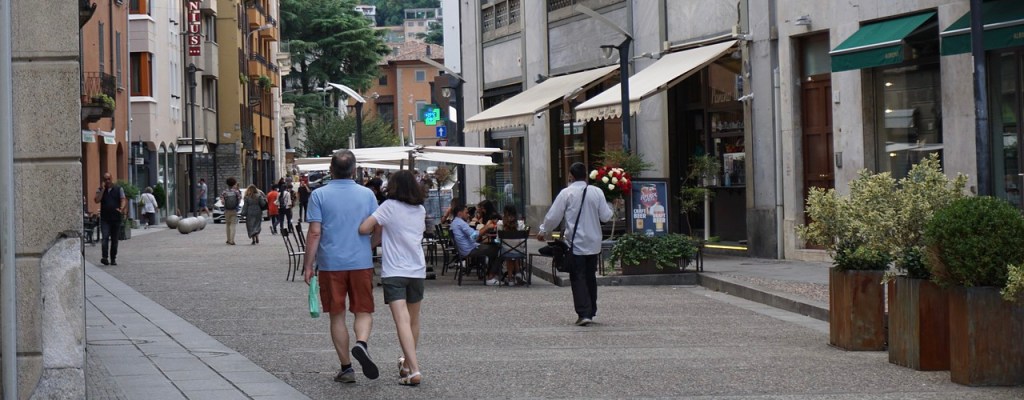
Imagine living in a neighbourhood where everything one needed on a daily basis lay within a fifteen minute journey – on foot or cycle – of one’s home. A neighbourhood where you can safely walk or cycle to the shops, school, medical centre, park, gym, swimming pool, office, cafe, the pub. A neighbourhood with (largely) traffic free streets, where children can cycle safely and those with impaired mobility/ sight/ hearing can easily cross the road. A neighbourhood where you know your neighbour, the barista at the cafe, the coach at the gym. A neighbourhood where you know you are part of the community.
How far can you walk in 15 minutes? 3/4 or even a full mile.
And by cycle? – maybe 2 to 4 miles.
Could you get much further by car?
The average speed of traffic in London is around 7-8mph, suggesting one could travel 2 miles in quarter of an hour. But then one would have to find somewhere to park, so the distance you could travel by car might well be much less than 2 miles.
Imagine a whole city made up of such neighbourhoods and you have the Fifteen Minute City. This concept is being a actively pursued in Paris by the mayor, Anne Hidalgo. Hidalgo proposes to have a cycle lane in every street and to remove 60,000 parking spaces for private cars whilst at the same time spending €1b per year for on greening both streets and school playgrounds. She has already added some 50km of cycle paths and banned high polluting vehicles. Similar projects are being trialed in Milan, Madrid, Seattle and Ottawa, whilst Melbourne and Edinburgh are pursuing twenty minute neighbourhoods.
What are the benefits?
Benefits social cohesion and community strength.
Supports local business and enterprise.
Less time spent commuting. Fewer traffic jams.
Less air pollution. Reduced CO2 emissions.
Option to repurpose road space as green spaces. Greater biodiversity.
Improved levels of mobility for everyone. Better health.
Increased quality of life.
If you want to hear about the Fifteen Minute City from its creator, Carlos Moreno, tune into the following YouTube episode:-
Can we as individuals go some way to creating our own fifteen minute neighbourhood? We can choose to patronise local shops and businesses, use local leisure facilities and green spaces. We can choose to walk or cycle to each destination, and we can seek out routes that green and interesting – and perhaps discover paths we didn’t know existed!
If we become accustomed to walking or cycling 15 minutes on a day to day basis, we will find we can transfer to a lifestyle that doesn’t need a private car. For those longer but less frequent journeys we can as easily walk to the station and take the train, or book a taxi or hire a car. If that becomes the norm just imagine the effect it will have on local neighbourhood and on carbon emissions.
This pictogram shows my 15 minute neighbourhood: why not have a go at drawing one centred on your home?
Transcript of a talk a church group about my experience of being arrested during an XR climate crisis uprising.
Micah 6: 1-8 (abbreviated)
Hear what the Lord says: Rise, plead your case before the mountains, and let the hills hear your voice. Hear, you mountains, the controversy of the Lord, and you enduring foundations of the earth; for the Lord has a controversy with his people, and he will contend with Israel. “O my people, what have I done to you? In what have I wearied you? Answer me! …”
Has he not told you, O mortal, what is good; and what does the Lord require of you? Do justice, love kindness, and walk humbly with your God.
But what is justice?
That is a question I would like you to hold in mind, and I will ask it again at the end.
I have always had a Christian faith and a concern for justice. As a teenager I restricted my diet to 1000 calories a day in solidarity with women in India. When I was at university in the early 80s I was aware that human production of green house gases plus our excessive use of raw materials was damaging the world’s environment. That knowledge together with my Christian faith has shaped the way I lived. As a family – Paul and I have three children, now all grown up – we have constantly been adjusting our lifestyles to try and mitigate the damage we were causing to the earth.
As the internet age developed, so I have signed more petitions, written to and spoken with our local MP, joined marches and protests. Yet nothing seems to change. The world is continuing to grow warmer, extreme weather events occur more frequently, ecosystems are being destroyed, the poor are being disadvantaged – and yet the human output of carbon dioxide and other greenhouse gases continues to rise. I felt that nothing was going to stop this crisis.
In the spring of 2019 I went to Cornwall with my daughter to walk the Celtic Pilgrim Way. We returned on Good Friday when the XR Easter uprising had begun and we stopped off at Marble Arch. Pitched tents, crèche, a stage, workshops, a welcome desk, sunshine, smiling people, even the drivers of vehicles whose routes had been diverted were cheerful. The same in Waterloo Bridge which had been transformed into a garden bridge with trees and pot plants, a skate board ramp, sofas and easy chairs, and story-telling circles. It was all a vision of what the future could be!
When I heard that the October uprising was to include a Faith Bridge I wanted to be a part. The Faith Bridge was conceived as a coming together of different faiths – Buddhist, Muslim, Jewish, Quakers, pagans, Christians – to express our joint concern for the well-being of the earth. We were to occupy Lambeth Bridge for the duration where we would set up a tepee for worship (which would be led by the different faiths throughout the day) a stage for talks and music and drama, places to meet and share with others our hopes and fears, and as the centre piece a large wooden ark.
To secure the bridge we would need a small group of people willing to be arrested whilst a larger group of people set up these bases. Drawing inspiration from both my Christian faith and from the example of the Suffragettes, I volunteered to be an arrestable. For this XR provides training and on going support.
The first day of the uprising dawned – literally -as we gathered by Lambeth Bridge. Initially we blocked the slip roads leading onto the bridge. Another group of protesters were doing the same at the other end. Once the traffic had been brought to a standstill we moved onto the bridge itself. The police had pre-empted us. They were massed in lines across the bridge such that each group of protestors was confined to small area at opposite ends of the bridge. At the same time another group of police saw the ark being delivered in its flat pack state and confiscated each part as it was unloaded.
I am in the blue coat sat in front of the green banner
Undaunted we sat on the tarmac surrounded by banners and prayer flags, facing the police line. We were a mixed group – all ages, backgrounds and faiths – and together we sang and prayed and shared our stories. Faith leaders and CEOs of charities and NGOs came and told us their stories as to why the climate crisis was such a critical issue. And still we sat and sang and prayed. It was a uniquely special experience of being in the presence of God.
Around mid afternoon, the police gave us the option of joining our fellow protestors at the other end of the bridge – provided we walked round the long way, via Westminster Bridge. We gathered up our banners and flags, our musical instruments and the remaining box section of the ark and set off along the road past St Thomas’s hospital, singing as we walked. We must have looked like the Israelites setting off for the promised land. Having negotiated our way through the blockades on Westminster Bridge and we’re almost in sight of the north end of Lambeth Bridge, we were stopped by another group of police who wanted us to divert with the ark to Horseferry Road. Negotiations took place. Whilst we waited we sat and we sang. Then a whisper spread round and looking behind us, a double line of police officers were advancing towards us. On arrestables drew back, the rest of us sat firm holding onto the ark. Arrests began. A police officer tried to persuade me to let go, and when I did not, I was physically lifted up and back, ending up on my back in the road – time send to stand still. Them everyone was crowding round. The police officer cautioned and handcuffed me. The XR legal observer wanted my details. People were shouting abuse at the police; others were cheering and applauding those who were being arrested. My mind went into a blur and my body into shock. My arresting officer was considerate and concerned and helped me across to the pavement where I joined others who had been arrested. We sat there for a couple of hours with our arresting officers whilst police stations were contacted to find spare cells. Four of were loaded into the cage compartments in the back of a police van and taken to Walworth. And still the wait continued, as we waited to be processed by the custody officer. Finally I was put into a police cell, given a vegan meal and a blanket.
At 2 in the morning I was released pending further investigation having been charged with obstructing the highway and causing a public nuisance. As I left the police station I was greeted by an XR volunteer who offered me chocolate and looked up the night bus time table so that I could get home and to bed!
My day in court was delayed by Covid. After numerous postponements, the case was heard in March of this year at the City of London Magistrates Court. I was represented in court by a barrister – the cost of both the barrister and the lawyer were met by XR funds. I could have pleaded guilty – I had indeed been obstructing the highway – but as a matter of principal I wanted to present the counter arguments: that I had been exercising my right of peaceful protest; I had done something that would ordinarily be criminal but in the circumstances it was necessary to draw attention to a greater danger vis the climate crisis. The example usually given is that one would not be prosecuted for breaking a window in order to sound the alarm for a fire. I also wanted to explain that my actions were motivated by my Christian faith and my belief that I – we – have a duty to care for and protect the earth.
The court staff were helpful and courteous. The XR observers were encouraging and supportive. Only the three magistrates seemed to be set against my defence. I was found guilty, fined and given a conditional discharge of 9 months.
Whose rights should have prevailed?
My right to protest or the road users right to use that particular public highway? Had I merely sat on the pavement would anyone have taken notice?
Do road users have an unlimited right to use use the roads? What if the volume of vehicles on the road causes an obstruction either to other vehicles, or to cyclists? What if the volume of vehicles prevents emergency vehicles getting through? What if the volume of traffic creates levels of pollution that endanger people’s lives, or increases the risk of dementia? What if the volume of traffic increases CO2 emissions such that global temperatures keep rising? What then of the rights of people both here and in other parts of the world to live lives not affected by rising sea levels and extreme weather events?
To return to my original question, what is justice?
Organic September, Movember, Veganuary, No-Mow May and now, Plastic-free July. Most months have a focus on changing habits to create a better future. Plastic-free July advocates remove all plastic from our daily lives – from the tooth brush in the bathroom, the plastic fruit packet from the supermarket to the once ubiquitous plastic carrier bag. The tax on plastic bags – now at 10p per bag – has significantly reduced their use: 212 billion plastic bags were sold by retailers in 2016-17, and only 496m in 2021-22. It is likely that it has not been so much the cost of the bags that has led to their decreasing use, but the change in expectation and habit that the original introduction of the tax engendered. Cotton reusable bag in all shapes and sizes are now widely available (often as freebies) and to carry one is the social norm.
Why is it desirable to get rid of plastic?
Plastic is made from oil, one of the main sources of carbon dioxide emissions causing global warming. Producing one tonne of plastic generates up to 2.5 tonnes of carbon dioxide (Material Economics, 2018). As the world’s use of plastic rises, so does its consumption of oil. In 2019 we the world produced 460 million tonnes of plastic, up from 313 million tonnes in 2010 and is likely to,triple by 2060https://ourworldindata.org/grapher/global-plastics-production
One way of reducing the carbon footprint of plastic is to reuse existing plastics. Some items such as PET bottles, widely used for soft drink, can be recycled repeatedly. This is closed loop recycling meaning that the plastic is recycled to create an identical replacement item. (Open loop recycling recycles plastics but produces a lower grade plastic for which an alternative use must be found). To be effective closed loop recycling depends upon consumers ensuring that they do put their plastics – washed and clean – in the correct recycling bin and upon manufactures using exclusively that recycled plastic. In the UK only 30% of plastics are recycled!
Plastic rubbish pollutes our streets, rivers, woodlands, and oceans. It doesn’t naturally decay and instead remains intact for 100s of years. Plastic that does tear and break down into smaller and smaller pieces still doesn’t decay. Micro plastic particle have been found polluting glaciers and icecaps, and polluting oceans where it is being ingested by sea birds and fish. Micro plastics are also found in the air we breathe and in the water we drink. Micro plastics can be found lodged in our lungs and in our blood.
Current estimates suggest that 8 million tonnes of plastic end up in the oceans every year adding to the 150 million tonnes already there. Projects are now being set up to remove plastic waste from the oceans. In 2020 a 48 day expedition by the Ocean Voyage Institute removed 103 tons from the Great Pacific Garage Patch. Other projects are being developed to process such waste into reusable plastic based materials: Patagonia uses recycled marine polyester in its clothes, Parley Ocean Plastics supplies material for Adidas shoes and Waterhaul in Cornwall uses marine plastic to produce sunglasses.
This is till only ‘a drop in the ocean’! The better solution is not to use the plastic in the first place. Hence Plastic Free July! Why not start now?
Plastic Free July’s own web site is a good starting point as is that of Friends of the Earth and City to Sea. You will also find plenty of web sites looking to sell you plastic-free products – and possible more than you need! Our own personal experience of shifting to a – largely – plastic free lifestyle began by collecting all the plastic that came into the house over a two week period. Then for each item we looked to see if there was a plastic free alternative for the product itself or of buying the same product without the plastic packaging, or whether we actually could manage without the item altogether. Over the next few months we looked for tried different ways of shopping – going to farmers’ markets, refill stores, buying in bulk, taking our own washable box to the butchers or coffee jar to the roasters – until we found the best fit for our lifestyle. Even today we are still making adjustments as new options become available. We have also written to suppliers asking them to use plastic free packaging. Whilst I don’t often have anything positive to say about Amazon, they have developed a simple straightforward cardboard packet for their deliveries!
Our own shift towards plastic-free and zero waste living has reduced both the amount that goes into our recycling bins as well as what goes into our dustbin. The latter is currently needs emptying twice a year.
In Alan Stoppard’s play Jumpers, George Moore, a philosophy professor, muses that at some point in history, the balance of believers versus non believers tipped from the former being the majority to the latter. He suspected it was the decline in woollen socks in preference for nylon ones that precipitated this tipping point: woollen socks kept the wearer in mind of the link between nature and daily life and thus a link between a divine creator and daily life.
We have seen a number of social issues reach a tipping point: the acceptability or not of smoking, the acceptability or not of drink-driving, the use of plastic bags versus reusable versions, and most recently the wearing of face masks. At some point social pressure, social acceptance and/ or social understanding shifted in favour of a new status quo. Social norms are not fixed and what interests me is what initiates and sustains the sequence of changes that lead us to change our patterns of behaviour and belief.
The Intergovernmental Panel on Climate Change is increasingly concerned that the current rate of global warming could reach a number of tipping points. One such scenario centres on the Arctic. As temperatures increase so the frozen soil have melted – not just the surface levels which is ‘normal’ but also the deeper levels of the permafrost. As they melt they release methane locked away for thousands of years ago. This flammable gas has led to outbreaks of wild fires across the Arctic destroying large areas of the tundra’s flora and fauna. Methane is one of the greenhouse gases and has a warming effect on the climate 80 times that of carbon dioxide. The melting of the permafrost in the Arctic disproportionately adds to the heating of the global environment and to the consequential further melting of frozen soils as well as sea ice. In other words the rise in temperatures that allows the Artic to thaw triggers a sequence of events that leads to a further upward spiralling of temperatures.
Other tipping points have also been observed: in Greenland where the more the ice-sheet melts the faster is the rate of melting in subsequent years, leading both to rising sea levels and a likely reversal of the Gulf Stream; in the Amazon the loss of rainforest (due to commercial felling) is expanding the area of land covered by Savannah grass lands causing rising air temperatures and depleting levels of rainfall which both threatened the natural regeneration of the rainforest; in the tropics rising sea temperatures bleach coral reefs as plant and animal life grows more slowly or dies off completely. As these living forms die so they absorb less carbon dioxide which in turn compounds rising air and sea temperatures.
Worryingly the danger presented by such scenarios doesn’t become apparent until the tipping point has been reached! This means preventative action needs to be taken before the affects of the danger are felt. We have in recent months learnt the lesson that the way to limit rocketing covid infections is to follow lockdown procedures before the number of cases becomes unmanageable. Can we do the same to prevent the extreme effects of climate change? Can we as individuals rapidly decarbonise our lifestyles now to safeguard the future for ourselves and our grandchildren? Can we create the social groundswell needed to make a carbon neutral lifestyle the norm? Can we create the popular groundswell to change the direction of our political leaders?