This morning Wild Card handed both a petition with 122,000 signatures and an open letter signed by nearly 50 high profile individuals and organisations, including, Green Party leader Zack Polanski, former Archbishop of Canterbury Dr Rowan Williams, former chair of the IPBES and IPCC Sir Robert T Watson, Green Christian and Christian Climate Action, to Sarah Mullally the soon to be arch bishop of Canterbury . The petition took the form of a beautiful crafted paper model of the Ark, covered all the names, and which was carried aloft (by dignitaries that included Chris Packham and Helen Burnett who both made eloquent addresses) accompanied by an eagle, a beaver and a salmon, a whole host of flags and banners and well wishers wearing an assortment of decorative hats and tokens of the natural world.
The petition and the letter asked the Church Commissioners undertake to rewild 30% of the land that they currently steward on behalf of the Church corporate. (1) This land totals 108,000 acres of land (the equivalent of 60,000 football pitches) and that is separate from land owned by individual parishes and dioceses (which interestingly is an almost equivalent amount).
The United Kingdom is one of the most nature depleted nations in the world. Recognising the extent of this and its adverse impact on our wellbeing, the UK government has joined with others in 2022 in signing up to the international Global Biodiversity Framework (2), undertaking to restore and protect 30% of land and sea by 2030. Currently only 2.83% (3) of land in England meets the desired nature-rich standard so there is clearly a lot of ground yet to be covered in the next four years! The area of land under the control of the Church Commissioners makes the Church part of the 1% that owns 50% of the land in the UK.
Wild Card is raising awareness about the necessity of rewilding – the natural environment is our life-supply system providing us with fertile soils, pollinators, fresh air, clean water, carbon capture and flood protection, as well as enabling food production and medicines, mental wellbeing and recreation – and calling on major landowners to step up to the mark and and rewild – restore and protect for nature – 30% of their land.
Surely the Church as a Christian organisation, with the God-given commands to cherish and protect the Earth and to love our neighbours, should be at the forefront of this campaign and leading by example?
Sadly no one at St Paul’s Cathedral would receive the Ark nor allow its entry into that place of worship. Instead a phalanx of security personal ensured that no one trespassed onto the steps of that august building.
In the story of Noah and his Ark you may notice all sorts of things but the bit that always bugs me is that Noah’s wife doesn’t get a name……………
So, let’s start this morning by celebrating loud and clear what a delight it is to be addressing Sarah Mullaly first ever woman to hold the post of the Archbishop of Canterbury
At the helm as the Archbishop of Canterbury , she will become our very own 21st century Noah and inherits a precious ship that must not sink.
We pray that she will not be overwhelmed by the floods that threaten us, but that instead, she will read the signs of the times and have the courage to save the biodiversity of this land – that she will do all she can to advocate for wilding church land and to act as a bulwark against the biodiversity and nature crisis of our times
Bishop Sarah’s first words to a waiting world were so encouraging –
‘ In the apparent chaos which surrounds us, in the midst of such profound global uncertainty, the possibility of healing lies in acts of kindness and love.’
Our hope this morning is that it will be kindness and love for our ‘other than human’ kin that will move Bishop Sarah to do all that she can to steer and shepherd us through these times,
to lead the church with the urgency of Noah building the ark,
and to act now to use church land for healing, regeneration and restoration.
How amazing would it be if the Church of England, through pressure on the Church Commissioners, could be the dove that bears the olive branch of hope, setting a tide change for other major land holders to wild their land.
Bishop Sarah also said ……..
‘In parishes across this nation, I see faithful clergy and congregations worshipping God and loving their neighbours.’
In my tiny little parish, we have a church yard where we are trying, through careful land management to bring back species of flora and fauna lost to the Surrey Hills.
We have created a wildlife corridor the length of the boundary wall between us and the neighbouring agricultural land.
In our small way we are seeking to restore, and so, I call upon on our new Archbishop to join us on our journey of messy churchyards and No Mow Mays to let nature do it’s healing even when it doesn’t look tidy??? Even when it doesn’t fit the financial portfolio to do so.
Imagine 200/108,000 acres of wonderful untidiness and what that could do – could church, like the ark be a beacon of hope to a world in crisis ?
Today we implore Bishop Sarah to include in her new vocation, the vanishing wildlife of our precious land,
And I say this directly to her, “as the first female Archbishop of Canterbury unlike Noah’s wife you will have a powerful voice with which to advocate for all species and you do not even need to build an Ark !”
In this role you have the power to guide and shepherd the Church Commissioners and the broader Church to recognise that ecological collapse and climate crisis are intertwined issues that need to be addressed with the urgency of Noah.
In the words of the recent vision statement from Christian Climate Action we appeal for the Church of England, to find its courage, cease doing harm and return to its roots, to Stop Crucifying Creation and to be a place of resurrection.
The church commissioners could cease doing harm by simply dedicating one third of their land to biodiversity restoration , yes, this would take courage but it would represent a return to the roots of a radical living out of the faith that honours all things and sees all creation as sacred. Today, as a lover of God’s creation and member of her clergy I want to thank Bishop Sarah for her words in Canterbury cathedral:
‘Hope’, she said, ‘is made of the infinite love of God, who breathed life into creation and said it was good’
That goodness now lies precariously close to collapse , can she give us back that hope and be the Noah we need to steer our ark through the biodiversity crisis towards that moment when we can, once again, see in the distance the dove bearing an olive branch?
“Plastic is a useful everyday item but has grown to become a global problem. Every year the world produces over 460 million tonnes of plastic, 90% of which pollutes almost all areas of our planet, it can be found at the bottom of the ocean, and on our tallest mountains. This pollution can cause harm to habitats and wildlife, impact livelihoods of people around the globe, and carries growing risks to human health. At the current rate, global plastic pollution could triple by 2040 unless we act now” – a quote from WWF. (1)
Could the answer be ‘more recycling’?
Yet last week an article in the Guardian reported that “in the past two years 21 plastic recycling and processing factories across the UK have shut down due to the scale of exports, the cheap price of virgin plastic and an influx of cheap plastic from Asia, according to data gathered by industry insiders.” (2) The UK now exports 600,000 tonnes of used plastic – making it the third largest in the world. Rather than being recycled within the UK, this plastic ends up in countries with neither the infrastructure nor the legal safety constraints to ensure that it is recycled without injuring either the environment or the local populace. The plastic is typically either burnt or allowed to build up in huge waste heaps where it invariably finds its way into rivers and oceans. Much of the UK’s plastic waste is exported to Turkey where, the Guardian reported two people are crushed, ripped, or burned to death in this work every month.
A combination of legislation to end the export plastics waste and taxes to discourage the use of virgin instead of recycled plastic is clearly needed. Rather than letting them close, recycling facilities should be seems as essential parts of the UK’s infrastructure: “If we were to stop exporting plastic waste, and we were to meet our increased recycling target of a 65% recycling rate for municipal waste by 2035, we would need to build 40 new factories across the UK – 20 of them would be sorting facilities and 20 would be processing facilities turning the material back into products,” said an industry source.
Or could the answer be ‘make less plastic’?
Earlier this year, an international gathering sought to agree a global plastics treaty. Work on this treaty began back in 2022 when growing scientific evidence highlighted the risks posed to humans (and other living organisms) by the toxic chemicals that can leach out of plastic as it breaks down. The ambition was not merely to ensure higher levels of recycling, but to to curb in absolute terms the amount of plastic produced globally each year. Plastic production had risen from 2 million tonnes in 1950 to 475 tonnes in 2022. However the treaty was successfully opposed by the large oil-producing nations and members of trade associations representing plastic producers. (3)
What if plastic pollution is a health problem too?
This week there was another newspaper article this time reporting on the spread of plastic into our bodies. “Microplastics have been found almost everywhere: in blood, placentas, lungs – even the human brain. One study estimated our cerebral organs alone may contain 5g of the stuff, or roughly a teaspoon.” (4)
What are micro plastics and where do they come from?
Microplastics are fragments of plastic that is between 1 nanometer and 5 millimetres wide. They come from two main sources:-
plastics specifically manufactured as microbeads which are added to face ashes, shower bells and other personal care products – they make the liquid both smooth and sufficiently thick that it does run off like water. Think of the difference say between an antiseptic hand spray and an antiseptic hand-gel. These are known as primary microplastics.
Plastic particles that derive from the disintegration of larger plastic items – eg plastic film and wrapping, takeaway containers, synthetic clothes , care tyres, paints and plastic turf etc.. These plastic particles may be shed as drinking from plastic bottles and take away cups (more plastic is shed when heat is present such as with hot drinks or microwaved food), from wearing and washing clothes, from friction between roads and tyres etc. These are known as secondary microplastics. (5)
Both types of microplastic can pass into water systems, can be present in the air we breathe, and can pass into the food chain and so into the food we eat. Microplastics are to be found all over the world – from the hops of mountains to the depths of the oceans and everywhere in between.
Nanoplastics are even smaller – less than 1,000 nanometers in diameter, or 100 times smaller than the diameter of a human hair. They are small enough to slip through the walls of the cells in our bodies and can be found in our blood, lungs, brains, bones, the placenta and breast milk. (6)
Do these pieces of plastic harmful?
We don’t yet know whether having such buts of plastic in our bodies is good for us (unlikely), neutral or harmful. Nor do we know whether there is a limit below which they are not harmful but above which they might be. It is possible that they may aggravate complaints such as asthma, dementia, cardiovascular disease, cancers etc. (7) The issue is further complicated as plastics contain toxins such as bisphenols (BPA), alkyphenols, and phthalates and dioxins etc, which are also thus passing into our bodies.
It is not just human bodies that maybe adversely affected. Micro and nanoplastics are already known to be adversely impacting the health wild life – eg damaging the gut biomes of seabirds, increasing the number of pathogens present and reducing antibiotic resistance. (8)
Should we panic?
No. We don’t yet know enough to know how dangerous, or not, micro and nanoplastics are. We don’t know whether or not our bodies have a way of eliminating such particles from our bodies. And realistically there is no way we can avoid ingesting these particles given their presence in very part of the environment.
In many instances using plastics can be lifesaving with benefits outweighing the – as yet unclear – disadvantages. For example the use of plastic syringes to give vaccines, plastic pipes to provide clean drinking water, plastic bags for collecting blood donations, waterproofing coats that keep us warm and dry.
But we could cut back on our use of plastic
We can reduce our exposure to plastic particles by reducing the amount of unnecessary plastic we have around us and by adjusting how we use those plastics. For example we might use a reusable water bottle and a reusable cup when out and about (and often cafes give discounts when you bring your own take away cup). You might use glass or metal dishes for storing food and wax wraps or foil instead of cling film. You might use wooden spoons and chopping boards rather than plastic one; metal colanders and metal washing up bowls etc. Equally you might avoid body care products with microbeads and use solid or liquid alternatives. You could try a milk delivery service and get milk in glass bottles rather than plastic cartons. And following that line of thought, you may have a local refill store that allows you to buy various food ingredients and household items without the need for lots of plastic packaging.
However we should remember that not everyone can afford the plastic alternatives – a metal drinks bottle can cost more that a plastic one. A sliced loaf in a plastic bag will be cheaper than it paper wrapped alternative.
What about changing the system?
If we are going to be fair for everyone and everything – wildlife, ecosystems, future generations, then the whole system needs to be changed.
Nations need to agree on a workable plastics treaty that will cut the amount of plastic produced. The plastics industry needs to develop alternative safe and sustainable substitutes. Governments need to implement a combination of legislation, taxation and investment to ensure that the changes needed do actually happen.
We can advocate for change by supporting groups like Friends of the Earth and Greenpeace, and we can raise awareness about the issue by talking with others – particularly if they are intrigued about the efforts we are making to reduce our use of plastic!
A frequent comment addressed to activists is, that rather than disrupting the public by walking down a road or blockading an oil refinery, they should use the ballot box to effect the change they want to see. But is that possible? Does our democracy pay attention to us as citizens?
I frequently write to my MP about issues such as the CAN Bill and the Rosebank oil field, asking her to support the former and oppose the latter. But mine is only a small voice amongst many, and even though in principal she does support the CAN Bill, that has not been enough to see the Bill pass into law – it was widely opposed by the Labour Party.
Many people voted for the Labour Party in 2024 and the party won a substantial majority. In their manifesto Labour’s biggest spending commitment was to be an additional £23.7bn for green measures (a figure already cut back from an earlier promise of £28bn a year). Once in government that sum has been cut back again and again. For example the £13.2bn to be spent on upgrading the nation’s homes will now include £5bn of loans nor grants. And of the £8bn pledged for GB Energy, £2.5bn is in now going into Great British Nuclear (conveniently renamed GB Energy – Nuclear). (1) Manifesto promises are not binding: they may suggest the sort of things the party will pursue when in power but that is all. As individual voters our only remedy is to write to our MP or the relevant minister and ask that they adhere to their promises – or to take protest action! Otherwise we just have to wait another five years and hope the then government will be better at delivering on its promises.
So who does influence government policy?
Think tanks
Think tanks “are open organisations, built around a permanent base of researchers or experts, whose mission, on the one hand, is to develop analyses, summaries and ideas on an objective basis with a view to inform the conduct of private or public strategies in the general interest; on the other hand, to actively debate issues within their field of competence.” (2) Think tanks may be funded by private or charitable donations or from government funds. Some are transparent about their funding, others less so. Some are aligned to particular political parties, others are apolitical.
Based on research for the period 2015-2021, Overton identified the following as possibly the top ten think tanks cited in government policy documents. (3)
However there are caveats. Does measuring which think tank is most cited in government documents a good indicator of their ability to influence government policy? Some areas of policy making generates a higher proportion of publicly available documents – eg public health and welfare, whilst others – such as defence – do not. And you can’t count the number of citations in a document you can’t access. There will also be think tanks that have considerable influence but don’t produce reports that are cited. Not present in Overton’s list are think tanks such as the Institute of Economic Affairs and the Adam Smith Institute yet thwir ideas featured large during Liz Truss’s short term as prime minister.(4) One of the questions around the more extreme right wing think tanks is the source of their funds and to what extent their research is influenced by wealthy individuals. (5)
Certainly think tanks do influence government policy but they are not accountable to the ballot box.
Economists
Economists and economic theories certainly influence government policy making, either because the respective political party has grown up with a particular economic tradition or because its current leader and/ chancellor has a favourite economic model. Most think tanks will include economic analysis too. NB If you have read Kate Raworth’s book on Doughnut Economics, you may well question the value of much other advice that comes from traditional and neo-liberal economists.
Scientists
Scientists do advise governments especially in the area of climate change and biodiversity loss – eg members of the Climate Change Committee – and areas of health such as we saw during Covid when the Chief Medical Officer, Chris Whitty, who was directly advising the government. However, as Whitty later reported, his advice was then adjusted by the political agenda: “… he had been personally sceptical about making covid vaccination a condition of employment for some healthcare staff in England. He said that the policy was “100% a political decision” that was essentially about balancing two risks and rights against one another: “the risk to the person who is being cared for versus the risk to the individual that their right to essentially not have a medical procedure, or lose their job, is protected.” As a doctor, he argued that there was “a big difference” between a “professional responsibility” to protect patients from giving them communicable diseases, including vaccinating staff, and “legally mandating it so that you lose your job if not.”” (6)
Scientists who contribute to the work of the Climate Change Committee face similar problems. Their role is to present the scientific facts and suggest policies that will meet the demands of net zero but they cannot require government to follow a particular course of action. Whilst the CCC has repeatedly cautioned against expanding airports in the UK, because of their significant adverse impact on carbon reduction targets, they have not been asked to assess the carbon emissions arising from building additional ways at Heathrow and Gatwick, despite government announcements that these expansions would take place. (7)
Political advisers and civil servants
“Civil servants are government employees responsible for implementing and executing public policies… [setting] guidelines and regulations to address societal concerns… Civil servants possess valuable knowledge and experience necessary for the formulation and implementation of policies…They bridge the gap between elected officials and the implementation of policies, providing continuity and expertise throughout political transitions. Furthermore, civil servants provide valuable insights into the practical implications of potential policy changes, considering the administrative capacity, budgetary constraints, and legal framework.” (8)
Political advisers (known as special advisers or ‘spads’) are political appointees. Special advisers are appointed to provide a particular skill or fill a particular role on a short term basis. The appointment may be short term and, since they are appointed by the relevant minister loose their appointment when that minister leaves office. They are not bound by the same rules of impartiality as civil servants – however various codes of practice now exist regulate the powers they can exert. (9) Special advisers can significantly influence government policy -for better or worse. This following commentary comes from the New Statesman:-
“Dominic Cummings made Boris Johnson. Against all odds, he won him the 2016 EU referendum. He finagled a 2019 general election for Johnson when parliamentary opposition to Brexit was making a second referendum look increasingly likely. He won him that election by “flipping” scores of traditional Labour seats. It was a Faustian bargain. To achieve all that Johnson – formerly a liberal-minded, immigrant-supporting, pro-business mayor of London – had to sell his soul by lying, fanning xenophobia, fomenting ugly nationalism, undermining democratic institutions and embracing a crude and shameless populism. Cummings had no scruples about how he won.” (10)
As with think tanks, special advisers also have no accountability to the electorate.
Lobbyists
“Lobbying is the process of trying to persuade the government, or a political party, to change their policies. The term originates from the lobby of the House of Commons where you could go to try and persuade your MP to adopt a certain position. Lobbying is an important part of the British political process and is sometimes very controversial.” (11)
Lobbying takes two forms – in-house lobbying where charities, corporations or other organisations employ full-time lobbyists, and outsourced where similar groups will employ an outside firm of lobbyists to act on their behalf.
Historically lobbying was unregulated – it was equated with free speech – but the Lobbying Act (2014) does imposes some restrictions. However (!) these only apply to individuals or firms acting on the behalf of a third party whilst in-house lobbyists are not included. Some £2bn a year is spent on lobbying and the feedback from big businesses and other organisations such as the NFU, is that it works. Governments do adapt their policies in response to successful lobbying. (12) (NB Do watch this illustrative video clip about lobbying – https://youtu.be/04BlQh4du5I?si=bItDobvoZ3N40JJC)
An investigation by Global Witness revealed an increasing number of meetings between fossil fuel representatives and government ministers. “UK government ministers met with representatives from the oil and gas sector at least 343 times in 2023, according to Global Witness analysis of data collected by Transparency International UK.That’s equivalent to 1.4 meetings per working day of the year and marks an increase from the 330 meetings held in 2022.” (13)
Over this period 2022 and 2023 the UK’s reliance on fossil fuels led to rising fuel prices, increasing fuel poverty and rising profits for oil companies, yet the government consistently back-tracked on its climate commitments ! (14)
For those with money, lobbying is an effective tool to change government policy. An yet again it has no accountability to the ballot box.
Unions
Unions were established to improve their members working conditions and pay through lobbying their employers – and through nonviolent direct action such as striking. With increasing amounts of legislation surrounding employment rights and the powers of unions, unions are another group who lobby government to influence policy. In the autumn of 2024 a new bill – The Employment Rights Bill – was introduced, repealing and replacing the Trade Union Act 2016 which had been the latest development in restricting union powers. This Bill should receive Royal Assent and become law this autumn.
The following commentary from the TUC shows how think tanks and reports from economists, can influence government policy. “The move comes in the wake of growing evidence that a strong union workplace presence is good for workers and for the economy. Voices that previously promoted deregulation, such as the Organisation for Economic Cooperation and Development, have noted the benefits of collective bargaining for productivity, industrial change, equality and employment. A recent Cambridge University study of labour laws over the last 50 years found that strong employee representation laws consistently led to higher employment. Laws that protected rights to take industrial action meanwhile appeared to contribute to higher unemployment, productivity and to workers getting a higher share of national income. Likewise a NIESR study found that a strong union presence boosted productivity.” (15)
Unions do have power to influence government policy, and whilst not being accountable to voters generally, are accountable to their own members. Maybe groups such as environmentalists and climate activists should form the equivalent of a union to increase the power of their voice.
Public Opinion and the Media
Public opinion, according to Wikipedia, is “the collective opinion on a specific topic or voting intention relevant to society. It is the people’s views on matters affecting them.”
Public opinion is assessed through surveys and opinion polls. Professor Kuha professor in LSE’s Department of Statistics and an expert in survey methodology describes opinion polls as “a survey of public opinion from a particular sample group, and as such can be useful in informing politicians about the views of specific groups of people. In practice, pollsters need to balance the cost of polling a large sample against the reduction in sampling error, and so a typical compromise for political pollsters is to use a sample size of 1,000-10,000 respondents” and that “polls act as a feedback mechanism which could affect parties’ policy choices, whereas nearer to an election, they are feedback mechanism on how the campaign is going”. (16)
This suggests that, depending on who carries out the opinion poll (are they impartial or do they represent a certain viewpoint or position), what questions are asked and which sample group is surveyed, a degree of bias may appear in the poll. This article from YouGov explores some of the issues around the phrasing of survey questions (17)
Furthermore that bias may then serve to feed what underlies the initial bias. This feedback loop is often triggered by selective reporting by media outlets. This article from the Conversation, notes that the “traditional media selects which polls to emphasise from a large pool of results. Sometimes outlets do this with an eye to make interesting news or pander to the expectations of the public. The latter means that journalists may decide not to publish a poll showing an unexpected result, for example, even if they believe it to be true, out of concern that readers might see them as less credible.” (18)
Immigration is currently seen as a key public concern. Prior to the EU referendum concern about migration peaked as a top issue for 56% of respondents. Following the referendum this dropped steadily from 48% of respondents to just 6% in April 2020. Since then that figure has again been rising reaching 38% in October 2024. The Migration Observatory however also noted that “During this period, immigration has been prominent in the news, with record net migration figures hitting the headlines as well as irregular immigration and the issue of housing asylum seekers featuring large in the political agenda.” (19)
In response to this shift in public opinion, the current government and a number of small rightwing parties have shifted their policies to ones less sympathetic towards migrants. It would that public opinion polls and media interest can influence government policy. The opposite is also true.
21st April of this year (Environment Day) a global journalism collaboration – Covering Climate Now – released the results of a world wide survey to assess people’s responses to the climate crisis, revealing that, surprisingly, 89% of respondents were concerned and want their governments to take stronger climate action. From this they have launched the 89 Percent Project which seeks to explore why there is such a silent majority. (20) The Project will be releasing more findings later this month – but, nevertheless, it is not a issue that has made much headway in the media and nor has it made any impact (so far) on government policy in the UK.
Conclusion
Who gets to influence government policy? Those with the biggest lobbying budgets! Those who can get the attention of the media! Individual citizens can only hope to influence government policy if they can band together as a large, strong, well advised and vocal lobbying group.
This is not to undervalue the importance of voting at elections because each party does have at least mind a set of ideas it will implement if they are in power.
“Seek justice, love mercy, and walk humbly before your God” Micah 6:8
This has been a strange week. Last Sunday we went to Golders Green to sit shiva with the family of our son’s partner – their grandmother had died. It was lovely to be included in this family gathering, and to share in the prayers led by the rabbi. All our faiths are rooted in God and God’s word.
Yesterday we were worshipping with Christians for Palestine at the Bloomsbury Baptist Church before joining the Palestine Solidarity March. On the altar were three things – a sculpture of a violinist made from decommissioned weapons; a photo of Christ in the Rubble – the nativity scene created in the the Evangelical Lutheran Christmas Church in Bethlehem; and a coloured woodcut of Christ breaking an AK47 across his knees. In lieu of a sermon we watched a short film produced by Christian Aid entitles the Lord’s Prayer – Just Peace Reflection (1) in which we saw the demolition of people’s homes, water supplies and livelihoods by the Israeli forces, and heard the long suffering laments of members of the Palestinian community.
The March ended in Whitehall where speeches were given. One speaker was a British surgeon who volunteers some of his time working in hospitals in Gaza. He spoke of the many boys who they treated for bullet wounds. The Israeli soldiers shoot them as they collect food and water. This daily practice has become a game – one day the soldiers aim for the head or neck. Another day it will be the chest. Another day legs. Another day testicles.
It is hard to understand how a nation can inflict such cruelty on civilians living within their borders.
It is equally hard to understand how the UK government can wring it’s hands about the suffering and yet continue to supply Israel with arms and military support, continue to trade with them and enter into new deals with their arms manufacturers.
It is hard to understand how people can carry on their daily lives without expressing concern or anger about this continuing genocide. I know we all need to continue to live each day as it comes, to fulfil the demands of work, to attend to household chores, to love and care for our loved ones – and carry the burden of other issues such as the climate crisis, the war in Ukraine, the civil war in Yemen, the plight of refugees etc – but many of these are linked by the failure of governments and businesses to focus on justice and truth rather than popularity and profits.
Yesterday’s Palestinian Solidarity March was overshadowed by the Lift the Ban action in Parliament Square, demanding that the de-proscription of Palestine Action.
Palestine Action is a campaign group that uses nonviolent direct action to challenge the continued manufacture in this country of weapons by Elbit (an Israeli owned arms company) for use against Palestinian people – against men, women, boys and girls and babies. You can surely understand the outrage anyone would feel about such weaponry being manufactured here in the UK. Nonviolent action can be the last resort when governments ignore the issue – and rather continue to facilitate such companies. Nonviolent action can include blocking roads and access into manufacturing sites. It can include spraying paint. It can include breaking windows. It can include breaking machinery. Nonviolent action does not aim to injure or kill people. Nonviolent action is not terrorism.
Yet Palestine Action has been proscribed by Parliament as a terrorist organisation. (This was set before Parliament as part of a package in which a total of three groups were to be proscribed – Maniacs Murder Cult, Palestine Action and the Russian Imperial Movement. There was no option of voting on each individual case. A full list of proscribed organisations can be found on the Government website (2) where you can read a brief description of each one. Palestine Action stands out as lacking any intention of injuring or killing people. Further information can be found at, for example, Amnesty International –https://www.amnesty.org.uk/press-releases/uk-banning-palestine-action-disturbing-legal-overreach-uk-government-amnesty).
The legality of the proscription of Palestine Action is due to be reassessed as of a Judicial Review in November. In the meantime Defend our Juries has taken on challenging the proscription. There is a genuine concern that if Palestine Action is proscribed as a terror organisation, that other organisations using nonviolent direct action will also be targeted and that the right to free speech and protest will be curtailed even more than at present. Democracies depend on free speech and the right to protest.
Since the proscription of Palestine Action, thousands of people have taken action, risking arrest, to question to legitimacy and morality of this course of action by the government. They have each sat quietly holding a sign that says ‘I oppose genocide; I support Palestine Action.’ And has been noted by the press, the majority have been older people – some well into their 80s.
Yesterday some 1500 people sat in Parliament Square holding such placards. They were surrounded by well wishers and supporters ready to witness to what was happening. Those familiar with Parliament Square will know that those sat on the grass will have been under the gaze of the statues of Nelson Mandela, Mahatma Gandhi and Millicent Fawcett, all civil rights activists. A large scale police operation has been put in place to enable to police to arrest and take away these peaceful protestors. Areas around d Parliament Square were cordoned off for the initial processing before arrestees were pit in police vans and driven to various police stations around London. The process was slow and tedious because of the sheer number of people willing to oppose the ban on Palestine Action. Individuals were still being arrested one by one as dark fell – most of those taking action remained sat in place once the police had begun making arrests, rather than simply opting to walk away.
Outside the cordon a team of volunteers was there to encourage those being placed in police vans – an acknowledgment of their bravery in standing up for justice. A further team of volunteers took their places outside police stations (once it was known were the arrestees had been taken) waiting there through the night to welcome each arrestee as they were released on bail, providing them with phones to call loved ones, giving them food and warm drinks, big hugs where needed, and advice and help to get back to their homes.
Images courtesy of Jonathan Sterling.
So where does this leave those of us whose personal or family circumstances do not make the risk of arrest an option, or those those of us who were regrettably ignorant about the plight of Palestinian people, or ignorant of the threat to civil liberties?
Where does this leave those of us who do not want to stand by and do nothing? Do we want to be citizens of a nation whose government continues to sell arms to Israel, that continues to hold back on imposing sanctions against Israel, that continues to enter into trade deals with those perpetrating genocide?
Where does this leave those of us whose feel helpless in the face of the ongoing suffering and abuse?
As Christians, our ongoing response will include prayer. Prayers for peace, for justice, for reconciliation. Prayers for the perpetrators as well as the victims – including those still being held hostage and their families – and for all those who find themselves sucked into this tragedy.
We can sign up for emails with news, information and prayers from people on the ground, such as Embrace the Middle East – https://embraceme.org/
Even Friends of the Earth has produced a statement on the issue.
We can write to our MP asking for action. We can write to the Home Secretary, the Foreign Secretary and the Prime Minister Minister asking for action and express our grave concerns.
The rising temperatures we are now witnessing cone not just from the CO2 currently being emitted but also the accumulation of CO2 over the centuries. Carbon dioxide stays in the atmosphere for anywhere between 300 and 1000 years, constantly acting as a blanket keeping in the sun’s warmth. For humans and the environment that best suits us, the ideal amount of CO2 in the atmosphere is between 280 and 350 parts per million (ppm). That was the level prior to the industrial revolution when we began significantly increasing the emission of carbon dioxide beyond the Earth systems capacity to absorb the extra CO2. Carbon dioxide levels in the atmosphere now stand at 425 ppm, reflecting the continued and increasing emission of CO2.
Countries that industrialised first have been contributing to this problem for some 175+ years. Newly industrialised countries for a shorter time span. The amount produced by countries in both scenarios varies reflecting degrees of heavy industry, levels of consumer consumption, dependency on fossil as opposed to alternative fuels etc. Each country can be judged to have a ‘climate debt’ according to how much carbon dioxide it has cumulatively contributed towards global warming since industrialisation. The debt can be costed in terms of what proportion of the negative costs of climate change – its adverse effects on health, the cost of adverse weather events, etc.
According to the IMF’s report, Settling the Climate Debt (2023) “It can be argued that each global citizen has an equal right to an environment unaffected by climate change. This implies that countries with high climate debt because of their high emissions should compensate countries that have caused less damage to the environment.” (1) And clearly if countries fail to curb their emissions, that debt will be constantly increasing.
The report also attempts to put figures to show the scale of the debt. “Climate debt can be estimated based on actual and projected emissions and the social cost of carbon, which measures the economic damage per ton of CO2 emissions. We find climate debt to be extremely large—some $59 trillion over 1959–2018 (Chart 1)—and projected to increase by another $80 trillion during 2019–35. The size of each country’s climate debt reflects both the size of its economy (which is positively correlated with emissions) and how intensively it uses fossil fuels (thus generating emissions) for every dollar of economic output. The composition of energy use (for example, heavy use of coal) has an impact as well. As of 2018, the largest contributors were the United States ($14 trillion), China ($10 trillion), and Russia ($5 trillion). Beginning in 2018, developing economies will account for a larger share of climate debt, given their relatively higher economic growth.”
These figures are large. The report notes “Climate debt is substantial relative to government debt; in G20 countries, it is about 81 percent of GDP, compared with average general government debt of 88 percent of GDP in 2020.” Perhaps for this reason, the report does not suggest ways in which this debt might realistically be repaid to those who have suffered the impact of climate change – and perhaps that was not the purpose of the report.
Rather the report goes onto explore how countries through their Nationally Determined Contributions, mandated by the Paris Agreement, are in fact reducing their emissions and thus reducing the ongoing rate at which their climate debt is accumulating. The IMF feels hesitant about asking countries both to reduce their emissions (which does come with a cost implication in the short term at least) and asking them to repay their climate debt. The report surmised that “Instead, advanced economies may need to focus on reducing emissions over a longer time period or aggressively compensating developing economies for the damage caused by climate change, including through more generous climate financing.”
However the report does conclude: “Climate debt from CO2 emissions is large and unevenly spread across the world’s economies. The size of the debt—and its disparity among countries—portends contentious discussions on countries’ fair burden in slowing climate change and the level of assistance to developing economies to compensate for these differences.
“Climate debt per capita is projected to be much higher in advanced than in developing economies, even under full implementation of NDCs by G20 countries. This implies that advanced economies may need to make additional efforts to achieve fair burden sharing in the fight against climate change.”
So whilst there is no clear strategy as to how the climate debt should be repaid – and continue to be paid as the impact of our emissions continues – at least there is the acknowledgement that the current situation between those who contributed most to the climate crisis and those who suffer the most, is unfair.
Last week I was in eastern Switzerland. The alpine meadows were full of a rich diversity of flowers, butterflies of all colours & sizes, bees, beetles, and grass hoppers. It was wonderful! But then I pondered, was this a normal amount of insect life that simply highlighted the lack back at home? Checking out via the internet, it seems that Switzerland like the UK, is witnessing a sharp decline in biodiversity including insects, due to issues such as urban expansion, intensified farming and climate change. (1)
We tend to assume that we see is normal because why wouldn’t it be? Our perception of normal is generally based on our own experience, culture and what we read in the press.
When I was a child, buddleia bushes were nick-named butterfly bushes because their flowers attracted so many butterflies. In comparison when I look at our garden now, I’m saddened by the lack of butterflies – you can count them on one hand. However for my children that number of butterflies is normal: they have not known it otherwise.
Similarly as a child, I remember having to clean the car windscreen of a thick grease of dead insects – especially after a long journey – simply because there were so many flying insects around. My children have not had that experience, and for them, the current – small – number of insects is normal.
This experience of what is normal is termed the ‘shifting baseline syndrome’. It doesn’t just affect our assessment of normal levels of butterflies, but also our assessment of ‘normal’ temperatures – summers were on average cooler in the past, but we have become acclimatised to hotter summers and now 26C is not perceived as that hot, and 30C isn’t seen as a cause for concern.
The shifting baseline syndrome also affects our understanding of roads and cars. (2) We perceive having a car – or two – as normal, and that being able to drive anywhere and everywhere is not just normal but a right. We don’t remember the past when not everyone had cars, when most people relied on public transport, and when you could even use the railway to move your household contents! (3)
Another well known syndrome is that of the ‘boiling frog’. Because the water only warms slowly, the frog being a cold blooded creature doesn’t react to the grow in heat until it is too late. Until that point each degree of warming doesn’t signal a warning to the frog. Humans seem to react to climate change in the same way: we accept each degree of warming as either a pleasure or a mere inconvenience without any sense of the danger signals we should be responding to. Climate change is dangerous. It leads to life-threatening floods and heatwaves, life-threatening storms, poor harvests, food shortages, droughts, conflicts and mass migration.
If we don’t see the scale of the changes around us, and don’t perceive the risks we face, we are not going to take appropriate action to either protect ourselves or to prevent the worst from happening.
“Improbably funny US drama about Saint Clare of Assisi’s renouncement of worldly wealth” Time-out (1)
Earlier this week I went to see a performance of “Poor Clare”, by Chiara Atik, at the Orange Tree theatre in Richmond. It was a beautiful production set in 13th century period costume with a wonderful script that was conversely in the idiom of the 21st century. Clare and her sister Beatrice are like two teenagers preparing for a prom night.
“Okay so for the skirt, I’m thinking like a gold thread and then the cloth would be like … I don’t know, I’m thinking purple … or like … purplish blue…”
“I like that ‘cause it’s like … deferential.”
“What for you mean?”
“Blue is like, modest. It’s what Mary wore”
“For the bodice … like I want it to go to here-ish – very covered up, very classy.”
“K”
“In red”
“No”
“Just like, a cute lil’ red bodice.”
“Red? Mom would never let you!” (abridged) (2)
We see how theses two sisters are ensconced in the world of wealth, how wealth and class shapes what they can and can’t do. We see their acceptance of the status quo as they happily allow maids to do their hair and wash their feet.
Francis on the other hand we see as the born again idealist who is so caught up in his utopian dream of embracing poverty, that his thoughts run faster than his feet. Francis is acutely aware how wealth and the privilege both inflicts pain on those who don’t have it, and blinds those that do. He sees wealth and privilege as so utterly opposed to what God desires that he cannot for a second be compromised by living within its structures. As the story unfolds, he is casting aside piece by piece every part of his life that undermines his vision.
Francis of course is – or rather was – himself a rich young man. Is his decision to renounce the world something that only someone who is rich can do? We see Clare’s two maids debating the impracticality of doing away with wealth and class – Maybe if the poor had just a little bit more, then they wouldn’t be quite so poor? We also see the homeless ex-soldier and the down-and out beggar giving their take on the issues of redistributing wealth – Does a second hand doublet really fit the bill?
Piqued by Francis, Clare begins a journey of self exploration – does she truly deserve the wealth she has? Does it make her happy? Can she reconcile her good fortune with the plight of those she would rather avoid? Can she justify being wealthy if she were to be a bit more generous?
Clare’s mother understands the dilemma having travelled to the Holy Land many years before. There, she tells Clare, however much food they gave to the starving children that swarmed around, there always seemed to be more at the next pilgrim site. Her mother commends getting pregnant: Clare will be able to pour out all her pent-up love and devotion on her children; she will never need have a conscience about anything else.
Step by step Clare follows Francis’s example, divesting herself of the world. But of the two, I think she has greater certainty, greater confidence that she is doing the right thing. She has thought through each issue and knows that she cannot remained within a system which perpetuates such injustices and suffering.
The play left me feeling challenged: how can I be part of a system that I believe to be flawed? And yet how can I not be part of that system when there seems to be no realistic alternative? And that challenges me to look again at my vocation as a Franciscan tertiary and how it can enable me to live within but contri to the system of worldly wealth.
NB The first tertiaries/ secular Franciscans where in fact given their particular vocation and lifestyle by Francis himself in response to the large numbers of married couples who wanted to follow his example. They were to continue living in their own homes and yet still devote themselves to living according to the principles and objectives that Francis taught.
There are different groups of Franciscan tertiaries (Anglican) and seculars Franciscans (Roman Catholic) across the world.
Leviticus 25 explains that the land should have a sabbath rest every seventh year. In that year no crops would be sown and the people would live off the surplus of previous years. Farmers over the millennia have learnt that you cannot constantly expect the land to keep on producing crops year on year without fail. The land either needs to lay fallow (rest), or it needs to be sown with a restorative crop such as nitrogen fixing beans or clover, or it needs the input of artificial fertilisers (although we are now becoming aware that relying on artificial fertilisers may be a quick fix and not a long term solution), so that it may recuperate its productivity. It is a lesson we are sometimes reluctant to heed. The Dust Bowl disaster of 1930s in the USA destroyed vast acres of farm land because farming practices did not maintain the fertility of the soil.
It is not just soil that has to be maintained. Water systems too. If we drain more water out than is replenished by precipitation or the melting of glaciers (themselves replenished by winter snow) water supplies will diminish. The Aral Sea – an inland lake – was once the fourth largest area of fresh water in the world, but has now been reduced to nothing because more water has been extracted year on year – to irrigate local cotton crops – than the rate at which water flows were refilling the lake.
It’s hard to imagine, but we also need to maintain the atmosphere. The Earth’s atmosphere is a delicate mix of various gases, which in the right proportions maintain our climate at one with which we are comfortable. If we put too much of certain gases into the atmosphere it can upset that balance. Too much carbon dioxide, methane and other greenhouse gases, and the atmosphere traps more of heat within the Earth’s atmospheric envelope; global temperatures rise and the climate becomes more extreme and uncomfortable. We are experiencing this every year with floods, heat waves, wildfires and intense storms.
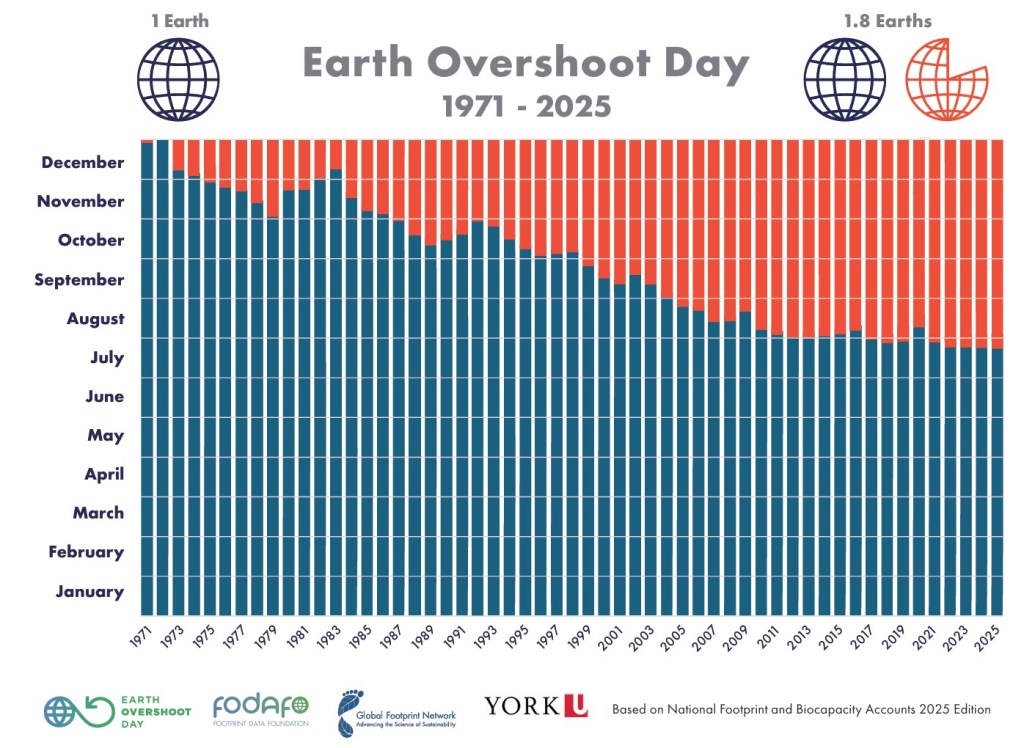
Ideally what we consume from the natural world – crops, timber, drinking water, clean air, energy – is balanced by the earth’s ability to regenerate. Prior to 1970 that was the case. Since then we have been using up the earth’s renewable resources at a rate faster than they are replenished. Scientists each year calculate that point when we pass from credit to deficit. This is called Earth Overshoot Day. This year the predicted date is 24th July. Seven months into the year and we have already – globally – consumed as much as the earth can replenish in one year!
Surely this state of affairs can not continue? What can we do about it and why aren’t we doing it?
Since 1970, Earth Overshoot Day has been falling earlier and earlier each year. Only in 2020 did it reverse: the reduction in world wide consumption came about because Covid gave the earth a three week reprieve. Consuming less has to be the answer which means consuming more carefully and more sustainably.
If we could do that in 2020 whilst coping with a pandemic, surely we could do it every year? What we must do is make sure that it is not the poor – who already lack a sufficiency – who are the ones who get to consume less; rather it must be the richer over consumers who need to change their lifestyles. And here is another caveat, to live more sustainably and fairly, will need a fundamental change in economic and political systems.
The Earth Overshoot website has details of various ways in which the global community could do this. https://www.overshootday.org/ Meantime we as individuals can make changes to our own lives and patterns of consumption. And we can ask or push for our churches, places of work, sports clubs, local authorities, museums, retailers, and government, to make similar reductions in consumption. We need change to happen at all levels.
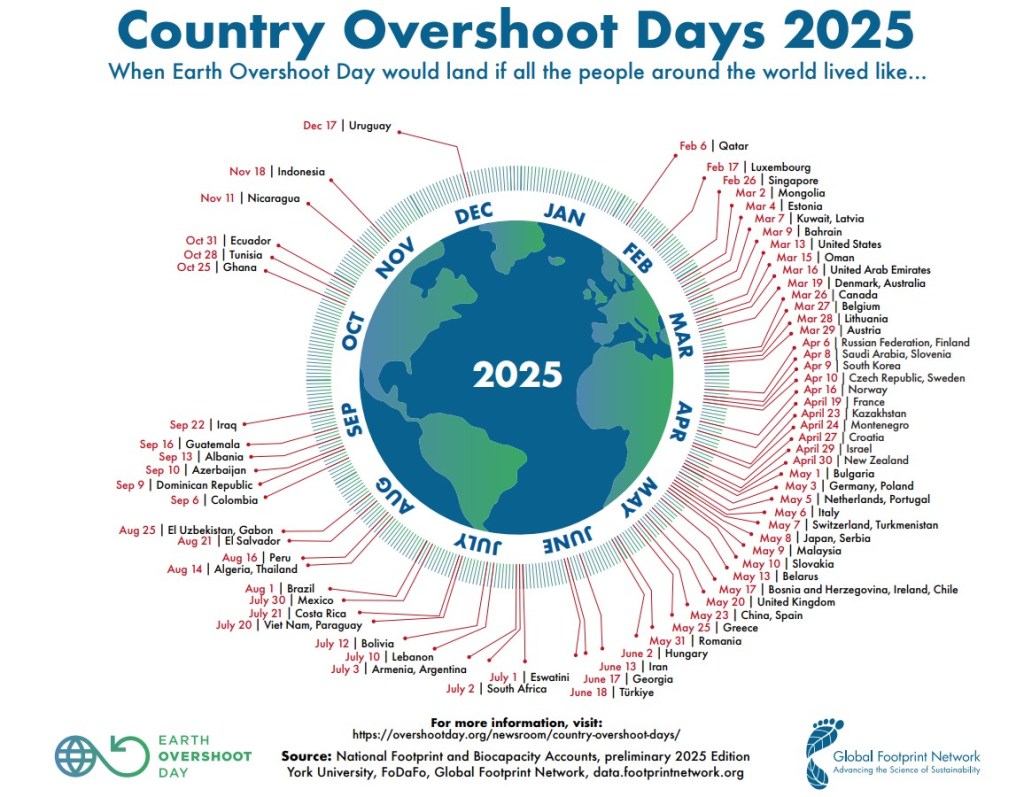
24th July is 2025’s Earth Overshoot Day at the global level. That date is the average of each nation’s own Overshoot Day. The overshoot dates for individual nations in the diagram below range from 17th December for Uruguay (ie Uruguay pretty much balances its books, consuming only slightly more than it can regenerate in a year) to 6th February for Qatar. What this diagram does not show are the many poorer nations who do not even use up their equivalent of one year’s resources each year – The UK’s Overshoot Day was 20th May. We would need three United Kingdom’s to satisfy our current consumption levels; in reality we consume resources of other countries to make up the shortfall. Reducing the Earth Overshoot problem requires cooperation and understanding at a global as a well as at local levels. The Earth is a shared life-support system.
On Sunday I reflected on the day’s gospel story of the Good Samaritan and the principle of integrity. Jesus and the lawyer are both in agreement that to love God with all your being and to love your neighbour is to fulfil the Law. The lawyer however wanted clarity so asks, Who is my neighbour? Jesus, rather than give an answer that would define ‘neighbour’ to a certain group of people or to a certain set of relationships, tells the story of the Good Samaritan and then asks who was a neighbour to the one who fell among thieves – to which the answer was the Samaritan. Jesus is telling the lawyer don’t worry about who your neighbour is, but rather think about what it is to be a neighbour. To be a neighbour is to show mercy – loving kindness – to the one in need. And that is clearly our calling as Christians. But does it still beg the question, which neighbours? Some or all of them?
Does Jesus really expect us to show loving kindness to everyone in need?
I guess there is the limitation that the commandment says to love your neighbour as yourself – which might mean love your neighbour with all your capacity but when your capacity runs out, then take a break and pass the loving responsibility onto a fellow neighbour.
And I guess another limitation would be the extent of your knowledge: it would be hard to specifically show loving kindness to the person one hasn’t heard of or whose situation remains unknown to you. But clearly from the parable, just ignoring someone in need does not put that person outside the relationship of neighbour.
So yes, I think Jesus does expect us to show loving kindness to anyone in need as far as we have teh capacity to act.
For decades, there have been individuals and groups who have been concerned for the plight of Palestinians in the former Holy Land. People who have been concerned for the lack of justice experienced by and shown to the Palestinians. For many of us, our understanding has been minimal. The issue had not been in the forefront of the news or in lessons at school or in the word on the street. Maybe we choose not to know. But since the terror attack in October 2023, the plight of the Palestinians in Gaza has been clearly visible – splashed across newsreel and newspapers. And increasingly so – but not as prominently – there has been some focus on the injustices being faced by Palestinians living in the West Bank.
These persecuted people – as much as the hostages held by Hamas – are our neighbours, all of whom we are called to love. There are clearly practical limits to helping people who live thousands of miles away, within national borders through which we would struggle to gain access. And our lack of knowledge of what help is needed would be an issue. Too often we in the West assume we know all the answers.
Nevertheless there are clearly things we can do. Prayer may seem an easy option out, but regular committed prayer Sunday by Sunday in our churches, day by day in our homes is an act of love. Donating to appeals organised by organisations such as Christian Aid and Oxfam is an act of love. Joining marches to show solidarity with the Palestinian cause is an act of love. Boycotting products produced by companies and organisations that support the persecution of Palestinians is an act of love. Writing to our MPs and government officials asking that our nation intervene to stop the fighting; asking that UK businesses should not continue to supply arms and infrastructure to support the aggression; asking that our government intervenes when international law is broken and when aid is withheld; asking our government to show support when international law is invoked – these are acts of love.
What if prayer led to a proposal that the Church of England should take action?
In 2021, “On Saturday 9th of October 60 members of the Church of England gathered together under the leadership of the Bishop of Carlisle, The Rt Revd James Newcome for their autumn Diocesan Synod meeting. Members included clergy and lay people. On their agenda was a motion passed by Solway Deanery, calling on the Church of England to be more proactive in its support and solidarity with Palestinian Christians.” (1) (For the full text of the motion see below).
The motion was passed unopposed.
Four years later the Kairos Palestine motion finally made its way onto the agenda of General Synod. In response to the change in circumstances between 2021 and 2025, a revised motion was put before the Carlisle Diocesan Synod. It was debated and was passed with a 59/7 majority. It was then also endorsed by Sheffield Diocese.
Subsequent to that vote by the Carlisle Diocesan Synod, the motion was dropped from the agenda for July’s General Synod, meeting in York. For those who knew this – and I’m guessing it wasn’t known of by the majority of church-goers – this was shocking and pointed to a lack of integrity by an organisation that seeks to follow the teachings of Jesus, and in particular the command to love our neighbour.
I joined a number of fellow Christians outside York University’s Senate House where the General Synod debates were taking place. We held a large banner “Love calls you to be in solidarity with the crucified Palestinian people.” We laid out on the pavement a series of photographs of Palestinians with brief comments and quotes. We arranged a keffiyeh on which we placed a candle and a cross, bread rolls, a dish of dates and a cup of water. We listened to readings and prayers. heard a recording of voices reading out some of the names of the dead. We observed a half hour silence under the midday sun. We handed out leaflets and spoke to passers-by.
Why was this happening? Why would the Church not even discuss this issue, let alone take action? Or was this just what people expected of the Church of England is? Aloof, unconcerned, focused on ritual and convention?
On the Sunday – again with banner and placards and leaflets – we gathered outside York Minster where members of the General Synod were arriving for the main Sunday’s Eucharist. Some acknowledged our presence, said thank you and even stood with us. Some took a leaflet en passant. Most smiled or looked away as they carried on passing by on the other side. A few openly challenged the validity of the protest.
When the service began we did go inside, wanting to pray and be part of this corporate act of worship. The preacher – Bishop Andrew from Hong Hong – took as the gospel as his theme, the Parable of the Good Samaritan, emphasising that our neighbour may even be our enemy. Did those who listened find this message prophetic or ironic?
Is it that the Church of England has reached the limit of its capacity? Is it trying to do too much? Or is focusing to much on things that are not important? Do its church members need to do more?
Appendix
The motion, presented by Solway Deanery member Valerie Hallard, read as follows:
That This Synod
Endorses the “Cry for Hope”[1] expressed by Palestinian Christians and the ‘Global Kairos for Justice’ coalition[2] (GKfJ);
Requests that the Faith and Order Commission produce a report which analyses and refutes any theological justifications, for example, those promoted by some Christian Zionists, for the oppression of Palestinians.
Instructs the Ethical Investment Advisory Group to provide guidance to the National Investing Bodies (NIBs) and Dioceses that will enable them to screen their investments and thereby make decisions regarding engagement with, and divestment from, companies which profit from the occupation.
The revised motion read:
“That this Synod responds to the call of Palestinian Christians to stand in solidarity with them and their fellow Palestinians in non-violent resistance to the ongoing occupation. We lament the loss of Israeli and Palestinian lives and the violations of human dignity and rights on both sides, as well as the displacement of population. We commit to a better understanding of the situation in Israel and the occupied Palestinian territory, seeking peace and security for all the peoples of those lands and pursuing that which leads to the establishment of a just and lasting peace.
In particular, we:
1.Reject anti-Semitism, anti-Muslim sentiment and all forms of prejudice based on religious affiliation and ethnicity.
2. Pray for all victims of the current conflicts in Israel and the occupied Palestinian territory and for a lasting peace;
a) Encourage the Church of England at all levels to engage with those documents as part of a quest for greater understanding of the situation;
b) Ask the the Faith and Public Life Division to commend resources that enable Dioceses and local churches to promote a full understanding of the situation and to respond through prayer, theological study, advocacy and practical support for the work undertaken by the Episcopal Diocese of Jerusalem and other Churches in the service of the people of Israel and the occupied Palestinian territory;
4. Call on the National Investing Bodies to review their investment policies in the light of the International Court of Justice Advisory Opinion of 19 July 2024 on the illegality of the occupation of Palestinian territory, and to:
i) disinvest from any entity or corporation with a persistent, on-going, and direct business involvement in severe human rights violations or violations of international law as part of Israel’s military occupation;
ii) provide advice and guidance to the Dioceses to review their investments; and
iii) report back to General Synod accordingly.
5. Ask His Majesty’s Government to work urgently for a lasting peace in Israel and the occupied Palestinian territory, that will ensure safety and security for all parties and the upholding of the rights and inherent dignity of all people.” (2)
Four years ago I wrote about the tipping points likely accelerate the climate crisis. In June 2021 the concentration of carbon dioxide in the atmosphere stood at 418.93 parts per million (ppm). As of May 2025 the concentration of carbon dioxide stands at 430.51 ppm (https://gml.noaa.gov/ccgg/trends/mlo.html) As the safe level of carbon dioxide lies somewhere between 280 and 350ppm, we were clearly in a danger zone in 2021, since when things have got worse rather than better.
Here is the 2021 article, below which is a comment from the Ecologist journal as to where we currently stand vis a vis the likelihood of triggering any or all of the global climate tipping points and another article from the Guardian.
In Alan Stoppard’s play Jumpers, George Moore, a philosophy professor, muses that at some point in history, the balance of believers versus non believers tipped from the former being the majority to the latter. He suspected it was the decline in woollen socks in preference for nylon ones that precipitated this tipping point: woollen socks kept the wearer in mind of the link between nature and daily life and thus a link between a divine creator and daily life.
We have seen a number of social issues reach a tipping point: the acceptability or not of smoking, the acceptability or not of drink-driving, the use of plastic bags versus reusable versions, and most recently the wearing of face masks. At some point social pressure, social acceptance and/ or social understanding shifted in favour of a new status quo. Social norms are not fixed and what interests me is what initiates and sustains the sequence of changes that lead us to change our patterns of behaviour and belief.
The Intergovernmental Panel on Climate Change is increasingly concerned that the current rate of global warming could reach a number of tipping points. One such scenario centres on the Arctic. As temperatures increase so the frozen soil have melted – not just the surface levels which is ‘normal’ but also the deeper levels of the permafrost. As they melt they release methane locked away for thousands of years ago. This flammable gas has led to outbreaks of wild fires across the Arctic destroying large areas of the tundra’s flora and fauna. Methane is one of the greenhouse gases and has a warming effect on the climate 80 times that of carbon dioxide. The melting of the permafrost in the Arctic disproportionately adds to the heating of the global environment and to the consequential further melting of frozen soils as well as sea ice. In other words the rise in temperatures that allows the Artic to thaw triggers a sequence of events that leads to a further upward spiralling of temperatures.
Other tipping points have also been observed: in Greenland where the more the ice-sheet melts the faster is the rate of melting in subsequent years, leading both to rising sea levels and a likely reversal of the Gulf Stream*; in the Amazon the loss of rainforest (due to commercial felling) is expanding the area of land covered by Savannah grass lands causing rising air temperatures and depleting levels of rainfall which both threatened the natural regeneration of the rainforest; in the tropics rising sea temperatures bleach coral reefs as plant and animal life grows more slowly or dies off completely. As these living forms die so they absorb less carbon dioxide which in turn compounds rising air and sea temperatures.
Worryingly the danger presented by such scenarios doesn’t become apparent until the tipping point has been reached! This means preventative action needs to be taken before the affects of the danger are felt. We have in recent months learnt the lesson that the way to limit rocketing covid infections is to follow lockdown procedures before the number of cases becomes unmanageable. Can we do the same to prevent the extreme effects of climate change? Can we as individuals rapidly decarbonise our lifestyles now to safeguard the future for ourselves and our grandchildren? Can we create the social groundswell needed to make a carbon neutral lifestyle the norm? Can we create the popular groundswell to change the direction of our political leaders?
“Multiple climate tipping points are likely to be triggered if global policies stay on their current course, new research shows.
Scientists assessed the risk of tipping in 16 different parts of the Earth system – ranging from the collapse of major ice sheets to the dieback of tropical coral reefs and vast forests.
Their most conservative estimate is a 62 per cent risk of triggering these tipping points on average, based on current policies and the resulting global warming.
However, more sustainable future pathways – with lower greenhouse gas emissions – significantly reduce the risk of tipping points.
The study, by the universities of Exeter and Hamburg, also found that carbon released by certain tipping points – Amazon rainforest dieback and permafrost thaw – is unlikely to cause enough warming to trigger other tipping points.
“The good news from our study is that the power to prevent climate tipping points is still in our hands,” said lead author Jakob Deutloff.



 The Green Tau