It has rained all night and I hope those outside have stayed warm and reasonably dry
5.40 I dress and pack last things in my bag. Bike lights on. Waterproofs secure. Go. The road is empty and sparkling with the combination of street lights and rain.
Like everywhere else, Parliament Square is sodden but the overnight vigilers are positive! We perform a tricky dance as we swop places, adjust rain clothes, fold and unfold umbrellas. With my ponchos spread like a tent I sit on a small camping stool. Inside a foggy warmth builds up – it keeps me warm if not dry. Waterproofs have a tendency to be less so as the wet persists!
Calm returns and Jonathan and I settle into the composure of vigil.
Jonathan reads a passage by Thomas Merton about rain in which he talks about rhythm and sound of rain. Parliament Square has its own sounds for a wet Sunday morning. There is the swish of car wheels against water. The gentle slap of running shoes – running on a Sunday morning is clearly popular come rain or shine. The illusive sound of wetness that seems to hang in the air.
There are few people walking by. Sunday is not a working day for many. There are no construction vehicles wheeling past, and few delivery vehicles either. Even the police presence is diminished.
The Square has both a daily rhythm and a weekly rhythm and even a yearly rhythm. Sit here long enough and you’ll become part of it.
On the far side of the expanse of flat green grass that fills the Square, a row of London plane trees provides a lacy edge to the sky, whilst in the rain their patterned trunks stand out proudly. In between at head height, way-farer palms trees look oddly out of place in a rain soaked London.
On the grass seagulls stab for food – maybe worms brought up by the rain. Picking up on yesterday’s thoughts, I greet Brother Seagull with a silent “Good morning”. His reply comes back, “Awk….awk…awk!”
The gulls are joined by a pair of Egyptian geese, their feathers glossy in the rain-washed light. “Good morning Mr and Mrs Goose!” Egyptian geese are known for their fidelity.
There are few tourists this morning. Sight seeing is a fair weather pursuit and only a few resilient Japanese walk past following their tour guide.
The rain which has blown both heavier and lighter, dwindles and fades away. Faint patches of blue appear in the sky and ten flags unwrap themselves from their flagpoles.
Wetter weather may well be a consequence of increasing temperatures: warmer air can hold more water. Adapting to wetter winters and drier summers is something we will have to embrace.
A pavement cleaner stops to talk. He’s seen our signs and is from personal experience deeply aware of the effects of the climate crisis and equally convinced that it is unlikely we will make changes to turn the situation around. He is 73 and comes from Bangladesh. Rivers that used to teem with fish – the key part of their diet and a source of income – are lifeless, the waters polluted with pollution from factories and cities. Children can no longer swim there – nor too do the dolphins. He despairs that it will never change – yet he tells us that whilst simply to pray will not achieve anything, to pray and act is a different matter altogether. And he prays all day – and as to working, his name, Abdullah, means slave of Allah. He left us feeling greatly uplifted. Somehow despite the odds, he radiated hope.
These are my experiences from 7.00 till about noon. Later in the day I know more and exciting things happened!
Walking over Westminster Bridge as Big Ben struck 7 a new day began. In front of the Carriage Gates three vigillers beamed as Sandie and I arrived. Peter and Anne were already folding up their bivvy bags whilst Ben was still snuggled down inside his sleeping bag. Greetings and a few photos and then it was goodbye as Sandie and I settled down behind the climate justice banner.
I pray of God’s holiness and the holiness of every created thing.
Watching the traffic, at 7 in the morning it’s mainly commercial vehicles – plus the ever-circulating buses – and specifically ones serving the construction industry. As the morning passes so the number of cars increases which is not to say that the construction vehicles were any less. Basically the road just gets busier! One was a cement lorry making a delivery to the works going on at Parliament, which claimed to be carrying eco-cement. Cement -which produces 622kg of CO2 per tonnes – accounts for about 7% of global total emissions. It maybe that as well as green cement we need to think twice about building new roads, tower blocks or even just drive ways.
I pray for God’s will, God’s rule – that God’s way of doing things would prevail in our hearts and minds.
During the morning others joined the vigil – a merry band of pilgrims! One had come only a short way – he worked for the Methodist Church. We talked about money. It seems more obvious to swop your pension to an ethical one because pensions obviously deal in investments. But greening your bank seems – initially – less obvious. They just look after your money, nothing more? I talked about CCA’s campaign to encourage charities and dioceses to move away from Barclays. He talked about working with the local circuits to discuss ethical banking.
I pray that God’s kingdom would come with its transformative ordering of the world. I pray for daily bread – how come we live in a world with food that goes to waste whilst many go hungry?
A mum from Birmingham had extended her visit to her son in London to be able to come. A woman from a UR Church in south east London joined the group. Then a group from a church in Sutton. And a then a fellow Franciscan tertiary. At one point we were accosted by a man asking why we were praying. He thought we should raising money for the scientists in white coats rather than praying to ‘a fairy in the sky’.
We knelt our ground.
The footfall, like the traffic changes through the day. Initially it is people going to work, streaming out of the underground and striding out down towards Millbank, coffee cups and lunch bags grasped in their hands. There is a slight lull before the tourists dominate the pavement – and large groups of teenage students being shown the Houses of Parliament and more frequently the companions from my night shift – Mandela, Gandhi and Millicent Fawcett.
There are more families than usual as it is still half term and several children carefully read our posters and ask their parents what we are doing. One young man spends several minutes filming and then interviewing us – he wants to understand more about the climate crisis.
I pray for forgiveness and healing.
Ten or so small toddlers walk by, each wearing Wellington boots and a small high viz vest and a wrist strap linking them to their respective nursery carer. Like puppies they don’t walk in a straight line and ver off wherever the fancy takes them. I think they’re going to the gardens between Parliament and Lambeth Bridge. Emmeline Pankhurst stands inside the gateway keeping an eye on all who come and go.
I took the night shift – we were a cheerful group of a half dozen. Melanie had emphasised the need for lots of layers to counter the cold so I had a sleeping bag inside a bivvy bag with a poncho on top to keep out the rain and my ski suit underneath. It was an unseasonably mild night so I was super super warm and had to remove hat and gloves to allow for some cooling! I took the night shift – we were a cheerful group of a half dozen. Melanie had emphasised the need for lots of layers to counter the cold so I had a sleeping bag inside a bivvy bag with a poncho on top to keep out the rain and my ski suit underneath. It was an unseasonably mild night so I was super super warm and had to remove hat and gloves to allow for some cooling!
Parliament Square in the late evening feels very different from early morning or midday. The traffic swings round faster headlights catching on the buildings. The pedestrians are night owls and theatre goers – they can saunter by as they have the full width of the pavement to themselves.
Traffic in and out of Parliament is still controlled by the police but the bobbies on the beat are replaced by teams of four armed police – rifles nonchalantly slung on their backs.
Across the square Nelson Mandela, Gandhi and Millicent Fawcett are more visible in the street light than their loftier companions mounted on much higher pedestals. They stand patiently but what was must be their desire to move and walk the streets again? What would they say to us? How would they encourage us to act?
Around midnight the view of sky became obscure and the rain came – not heavy but wet! With my overlarge poncho drooping over my face much of the light and certainly the view is cut out and my tired eyes close and open. Come on, I think, I’m meant to be praying! I squint across the Square at our vigilant companions – how long did they spend restricted by prison life, or pressing on against the odds with what might have seemed an unwinable cause? They strengthen my resolve.
I am feeling very tired, my stomach is rumbling and my legs feel stiff: I’m not sure I can do this. What if I bail out and go home? There are plenty of taxis circling the Square – but I have forgotten to bring a house key; I’d have to wake someone up.
I let my eyes close and doze.
Maybe I have actually been sleeping. Certainly I’m now feeling brighter. A couple walk over Westminster Bridge to make use of the toilets and the 24 hour Costa at St Thomas’s. The rain has eased and I am nice and warm inside my multiple layers. Someone shares some dates – nature’s toffees! This is beginning to feel manageable.
I watch the buses loop round on their various routes. Double decker buses are an amazing invention! Nippy despite their size, they provide bright warm transport for dozens of people – so much more efficient than those low slung, gas guzzling cars.
I’ve slept some more and wake to hear Big Ben striking. Its quarter hourly time check is a comfort. I forget to count and now I’m not sure if it’s 4am or 6 am. The sky looks lighter and I can hear birds singing.
It’s 4am. A digestive biscuit fills a gap. Our companions across the Square encourage my focus, whilst on either side of me, Sandie and Annette are gently singing hymns and Taizé chants.
Another shift of armed police set out. The night buses are still looping past, bright light shining out so their windows like mobile Advent calendars. Not so many passengers but already people are on their way to work. The first staff are going into Parliament behind us – cleaners and ancillary workers I guess. Someone has raised the flag on the Supreme Court. As the next hour passes the double deckers fill with people on early morning shifts. A resilient few are cycling past at great speed – or maybe they’re the fun loving one’s taking advantage of the clear roads. I hope they are paid well for their unsocial hours but I suspect not.
Soon it’s 6.30am. The dawn has crept up on us and the light is daylight bright. The traffic is picking up its day time pace.
7.00am and here comes Alison who will be taking the next shift. And – of wonderous joy – here comes my husband! He’s got up early to join us for breakfast at Gail’s!
in which I wrote “Maybe our penance – the penance for those who see the harm we have as humans have caused – is raise the cry, to sound the alarm, to be prophetic, so that others too can be called to account.”
This year Christian Climate Action, and other faith based and ecological groups, have organised a ten day – and night – vigil outside Parliament. Hour by hour, people will sit, stand or kneel, in prayer and reflection for the well being of the earth, for justice, for the preservation of life in all its forms, for human repentance for the harm we have done in driving both the 6th mass extinction of species and the acceleration climate crisis. If you are in the area, do come and join in; if not do nevertheless keep this focus as part of your Lenten discipline.
A business is an enterprise that sells something it makes or sells a service it provides. It can be a one person operation or a multinational employing thousands.
The business operation will incur costs and will remain viable provided it covers those costs. The business may need capital to get started or to expand it operation, and it may need loans to balance out peaks and troughs in its cash flow. Usually the business will over time earn more from what it sells than its costs and so makes a profit. Such profits are usually kept by the people owning the business. In some cases that might be some or all of the people who work in the business, in some cases it might be both employees and customers (eg a cooperative), and in some cases it might be external shareholders.
The success of a business is usually equated with its ability to make a profit. A successful business makes large profits, less successful businesses make smaller profits, and those that make no profit close down.
But is profit the only way of measuring success? What about customer satisfaction? What about being a good employer? What about the business’s contribution to the stability and wellbeing of the local community?
Thames Water makes high profits and has the worst for receiving complaints from customers. Might a more successful water company be one that best provides what customer need – clean, reliable drinking water?
Amazon is highly profitable company but many of its employees are both poorly paid and subject to stressful working conditions. Employees feel they are being constantly monitored and that even taking time to go to the toilet is counted against them. Might a successful company be one that provides long term secure employment that gives job satisfaction, wages that support comfortable living standards, and credible pension? It could be us or our neighbour or our children who are looking for gainful employment.
Small rural communities – and increasingly deprived urban communities – are finding that they have no local bank, fresh food shops, dental surgery etc as the pressure to maintain profits pushes business to leave an area or to downsize. This is not good for the local community and can become a spiral where the more businesses leave, the more quickly the area becomes depressed and the more other businesses leave. With the businesses go local jobs. The heart of the community is quickly lost. Might a successful business be one that adds vitality to its community, is valued by local people and keeps jobs and money circulating with the community?
Actually in all three of these scenarios one might feel that the customer’s wishes were not be valued by the businesses. What has happened to the understanding that ‘the customer is always right’? How often have you been held on a phone call to have the oft repeated – but barely credible – ‘Your call is important to us’ automatically relayed to you?
It does seem that the idea that the main purpose of a business is to make a profit does not benefit the consumer nor the community. Further what we are now increasingly seeing, is that the primacy of profit is also detrimental to the environment.
In Herefordshire the large number of industrial scale chicken farms has led to high levels of effluent running into the River Wye, polluting it with phosphorus and killing its wildlife.
In Spain strawberry growers have been abstracting so much water for their crops, that the Doñana national park – a renowned wetland area – is being depleted of water threatening the survival of many plants and creatures including flamingos, spoonbills and the glossy ibis.
Globally the burning of fossil fuel products has triggered an escalating climate crisis threatening all forms of life, whilst the fossil fuel companies have continued to make recording breaking profits.
One approach to this problem is to replace the traditional bottom line of ‘loss or profit’ with a ‘triple bottom line’ which measures the business’s impact over three area: economic, environmental and social – or the 3Ps: people, planet and profit. It is however harder to find ways of measuring the loss and profit aspects of people and planet, and of doing so in a way that allows for comparison across businesses. How do we put a price on community stability or clean air?
Suffolk Libraries commissioned a research company to assess the value of their libraries. Using surveys, focus groups and modelling, the researchers found ways of measuring the social impact of the services the libraries offered that translated into monetary values. They concluded that for every £1 spent, the social value gained was £6.07.
The environmental impact of a business might be measured in terms of carbon emissions, or in terms of the cost of making good damage to the environment. If the chicken farms in Herefordshire has to pay the cost of cleaning and revitalising the River Wye, it would make a significant impact on the bottom line of their businesses. In 2021 local MPs wrote to the government asking for £15 million to clean up the river.
One organisation that has developed a way of measuring better business
practices is B Lab. This not-for-profit international organisation has developed a certification system that “measures a company’s entire social and environmental performance. From supply chain and input materials to charitable giving and employee benefits, B Corp Certification verifies that a business is meeting high standards of social and environmental performance, transparency, and accountability.” Successful businesses become certified as B Corps. (For more info – https://bcorporation.uk/)
The campaign for better business practices is ongoing and seeks to include not just those businesses with a conscience, but to extend the expectation of good practice in all the 3Ps, to all businesses. B Lab UK and a coalition of more than 2400 businesses, is campaigning to amend Section 172 of the Companies Act. At present this section directs businesses should prioritise the success – ie the profitability – of the company for the benefit of its members – ie shareholders. The proposed amendment would direct that businesses should prioritise the purposes – ie the social, economic and environmental impacts – of the company. (For more info – https://betterbusinessact.org/ and https://thehumanbusiness.co.uk/better-business-act/)
Change in the way businesses operate is both possible and achievable.
The world – people, animals, plants, birds, economies, agriculture, water supplies etc – is already suffering from the effects of climate change and this is a crisis that will continue to grow (exponentially) unless action is taken. The major contributor of the greenhouse gases cause this, is fossil fuels.
The IPCC AR6 Synthesis Report (2023) states “Limiting human-caused global warming requires net zero CO2 emissions. Cumulative carbon emissions until the time of reaching net-zero CO2 emissions and the level of greenhouse gas emission reductions this decade largely determine whether warming can be limited to 1.5°C or 2°C (high confidence). Projected CO2 emissions from existing fossil fuel infrastructure without additional abatement would exceed the remaining carbon budget for 1.5°C (50%) (high confidence)”. https://www.ipcc.ch/report/ar6/syr/resources/spm-headline-statements/
In other words, our current production levels and use of fossil fuels will, cumulatively (because they build up and remaining in the atmosphere for generations), cause global temperatures rises in excess of 1.5C. (In 2023 the global temperature rise was 1.2C above the average for NASA’s baseline period (1951-1980))
The IPPC’s report goes on to to say “Finance, technology and international cooperation are critical enablers for accelerated climate action. If climate goals are to be achieved, both adaptation and mitigation financing would need to increase many-fold. There is sufficient global capital to close the global investment gaps but there are barriers to redirect capital to climate action.”
Finance is key but it will only be effective if it is targeting projects that reduce emissions. One would expect therefore to be seeing an ongoing g and rapid transfer of money away from fossil fuel projects and into the support of renewable energy. Yet in January 2023 Reuters reported “The share of bank finance going to renewable energy rather than fossil fuels has little changed in six years, raising questions about how fast lenders are pushing energy clients to become greener, according to research published Tuesday. Since 2016 renewable energy has taken 7% of a total $2.5 trillion in bank loans and bond underwriting for energy activities, according to a report commissioned by environmental groups including Sierra Club and Fair Finance International.” https://www.reuters.com/business/sustainable-business/bank-funding-renewables-stagnates-vs-oil-gas-report-2023-01-24/
A report, Banking on Climate Chaos, records that fossil fuel financing from the world’s 60 largest banks reached $5.5 trillion in the six years since the Paris Agreement, 2015, and 2022. Of these JP Morgan, the worst bank overall, financed $39 billion in 2022, so totalling $434 billion between 2016 – 2022. Top rating amongst the European banks was Barclays, which took seventh place in the league table, having $190.5 billion over the time frame.
Barclays provides finance to numerous oil companies including Exxon, Shell, BP, Chevron, Total, and Equinor. This is finance that supports both existing and new projects. Yet there is no space in the world’s carbon budgets for this continuing increase in emissions. “Potential emissions from fossil fuels already in production or under construction – the wells already drills or being drilled – already takes the world well past 2C of global warming… world cannot afford any fossil fuel expansion…” https://www.bankingonclimatechaos.org/
Not surprisingly a number of climate concerned groups are pushing for change – both of banks that they stop financing the fossil fuel industry, and of customers that they stop using these highly destructive banks.
It is often argued that moving one’s money out of Barclays will have no impact as it will merely be replaced by money from elsewhere. I’m not sure that that can always be true – there must at some point be a finite sum of money to be banked. But turning it round, the money you move can then be invested by a greener bank to support renewable energy and other beneficial projects – and this indeed might be money they would otherwise not get. And don’t worry of the amount you are banking with is small: for every £ deposited, banks will lend a multiple amount. Even if that multiplier was only 2 it would double the financial contribution that you money makes to green investments.
Here in the UK Make My Money Matter is calling on individuals to “green their money” as well as encouraging students and alumni to call on their universities to switch to sustainable banks – https://makemymoneymatter.co.uk/
Just Money offers another perspective on the issue, this time from a Christian view point, and has advice and resources for churches and charities wishing to switch to green banking.
And it is not just charities that are being asks to reconsider their banking arrangements. The same ask is being made of churches and dioceses. Christians are called to care for creation and to love their neighbour – which are actually overlapping vocations – and switching to a bank that does not pursue profit through the financing of fossil fuels, is one of the easier steps they can take!
The National Gallery began when in 1824 the British Government bought, on behalf of the nation, 38 paintings from the heirs of the late John Julius Angerstein, a business man and art collector. Thus it is that the National Gallery’s collection is owned by the government on behalf of the British public. Its constitution states “The Gallery’s aim is to care for the collection, to enhance it for future generations, primarily by acquisition, and to study it, while encouraging access to the pictures for the education and enjoyment of the widest possible public now and in the future.”
It goes on to describe it audience as:
Frequent and occasional visitors to the Gallery in London
Those who see its pictures while they are on loan elsewhere, both inside and outside the UK, and those who know the collection through publications, multimedia and TV
Those who live nearby as well as those who live further away in the United Kingdom and overseas
Every age group – from children to pensioners
The socially excluded and the privileged; the uninformed and the specialist; and those with special needs
The National Gallery certainly aims takes seriously its particular role of caring for a collection of art works that belongs to the British people, and making it fully accessible to them.
Like many museums and art galleries, the National Gallery undertakes a responsibility to facilitate and enhance the educational use of the collection for the benefit of people of all ages and backgrounds. It hosts exhibitions, school visits, workshops and talks, tours, musical events, sketching sessions etc as well as producing many publications relating to the collection. It makes full use of digital technology and the further opportunities that that affords.
Chris Michaels, the director of digital, communications and technology at the National Gallery, spoke at ‘greenloop 22’ – a visitor attractions conference focusing on sustainability – spoke about the practical steps the National Gallery is taking to respond to the climate crisis – such as making positive choices about which electricity supplier to use. He also spoke of ways in which the Gallery could go beyond such operational steps.
“It concerns thinking about how we, as storytelling institutions, can start to think about the future and make sure that the stories we tell live in that future the right way. To me, very simply, art finds new relevance in this time of crisis.”
He expanded on this with examples. “If you look at Canaletto now, if climate change progresses at the speed it is now, and if we don’t make things better, this Venice will disappear beneath the waters for good.
“If we think about artists even as recent as Monet, painting in the late 19th century, there is a picture he famously painted from when he was staying at the Savoy in London. The hazy skies in the picture were also products of climate change, even at that time. This landscape, too, will vanish as London potentially disappears beneath the waters.”
He concluded, “Climate change and the climate crisis, for museums, becomes a storytelling frame to understand the new relationship between art history and our futures. Those hazy skies and their meaning are something I keep coming back to in terms of the way they change our understanding of the past and of the future.” (2)
This September the first UK Museum COP was held at Tate Modern. It issued the following statement: “As leaders of the UK museums, we feel a responsibility to speak out about the current climate and biodiversity crisis and call upon UK politicians and businesses to accelerate action to mitigate this crisis before it is too late. We are already around or beyond crucial tipping points: global temperatures are higher than they have ever been since humans emerged as a species, and extinctions are occurring at around a thousand times the normal rate. There is an existential threat to the world we have become accustomed to.
“Museums are institutions with a long-term view. Many have collections relating to the Earth’s five previous mass extinction events, and we are now in the midst of the sixth, the Anthropocene. UK museum leaders feel they have an ethical obligation to take action to alleviate that damage.”
They went on “We will [u]se relevant collections, programmes and exhibitions to engage audiences with the climate crisis and inspire them to take positive action …” (3)
Clearly there is a growing awareness of the role that museums and art galleries can take in advancing the debate about climate change and in shaping how the public responds to this crisis. But is this growing awareness leading to action at a fast enough pace to be of use? Or are they likely to be overtaken by events?
In some instances they already have. The National Gallery, the Royal Academy, the Courtauld, and the Kelvingrove Art Gallery have all been targeted by Just Stop Oil activists have used popular paintings to make the point that very little – in proportion to the scale of the emergency – is being done to address the climate crisis. Their actions seek both to raise awareness in the wider public, and to call upon the art galleries themselves to demand action from the Government. Similar actions have also been carried by climate activists in France, Germany, Austria, Italy, Spain,Norway, Canada, and Australia.
What would happen if rather than closing down these actions, museums and art galleries choose to work with activists as they seek to press for responsible climate action? Several museums in Germany have done just this, working with the group Letzte Generation (Last Generation). At the Hamburger Kunsthalle, activists took over the foyer for a non-violent resistance, reading essays and conversing with visitors. Similar essays actions took place at the Ludwig Museum in Cologne, the Museum of Ethnology in Leipzig, the Zeppelin Museum in Friedrichshafen, the Rostock art gallery, the European Hansemuseum in Lübeck and the Museum for Communication in Nuremberg. (4)
Works of art, as well as have great value in inspiring thoughts and new ideas, often have spiritual values too. Indeed many were created for religious purposes to aid and encourage worship.
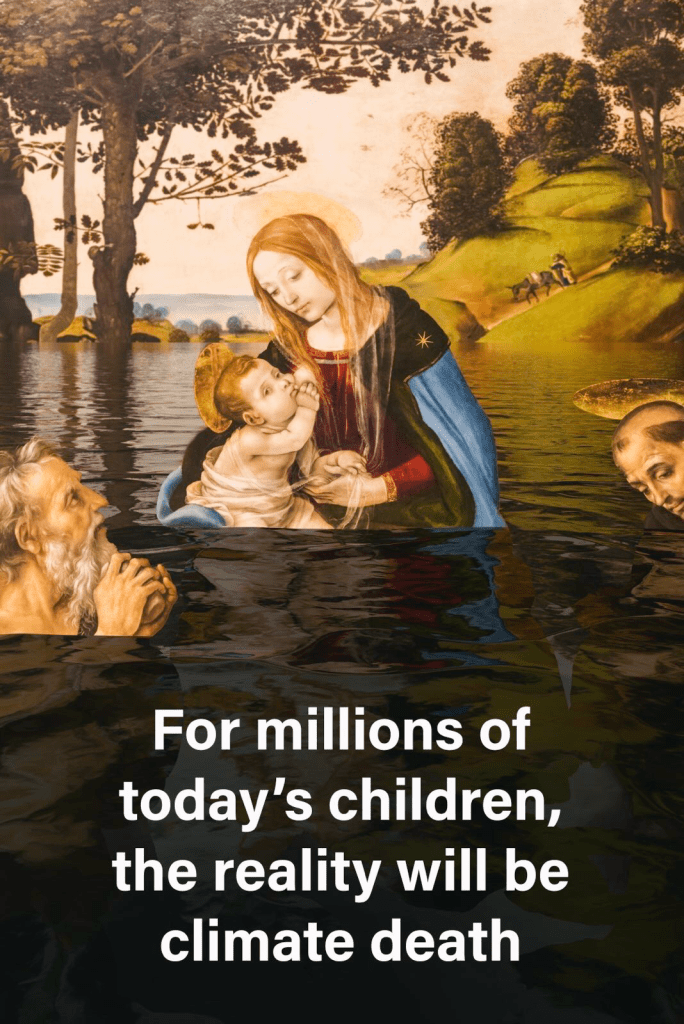
Last week I took part in an action at the National Gallery with others from Christian Climate Action. We gathered in front of a painting of ‘The Madonna and child with saints Jerome and Dominic’ by Filippino Lippi, where we unrolled a copy of the picture which had been digitally altered to show flood waters that half submerged the characters. This we held as a statement was read out describing how for many Christmas is not a time of joy, because their lives are threatened by the effects of climate change. As we knelt prayerfully we sang a version of Silent Night – the acoustics were wonderful.
“Why did members of Christian Climate Action gather prayerfully beside a nativity painting at London’s National Gallery, with a different picture to reveal?
“As Christians we celebrate the birth of Jesus, born in poverty as a refugee, to show us the way of love and peace, and justice which is love in action. Christmas is still for the children. But today, world leaders are failing them. As governments profit from weapons and from fossil fuels, babies are born into climate chaos as well as war. In this painting, the baby – like his mother but unlike Jesus and Mary – is white, but we remember those brown and black babies born in the Global South still waiting for climate reparations and most at risk of unliveable heat, hunger, drought, flooding and displacement. We honour those born into poverty here in the UK as inequality widens, and all the world’s children whose future is at risk while the adults in charge pursue yet more oil and gas. We grieve that after 28 COPs, world emissions in 2023 have reached a record high to match all the heat records broken month after month.
“Only with change for good can the young find hope. Christmas lights can’t dispel their darkness. Along with inflatable Santas, magical snowmen and red-nosed reindeer, art like this is hollow and fake. The altered image we held beside Lippi’s painting shows the terrifying reality children face. Sentiment, tradition and festivity won’t save us. The science is clear that new gas, oil or coal will accelerate climate breakdown. We can’t serve God unless we serve that truth. Unless we work for life, justice and peace – with love.
“One billion children – almost half of the world’s child population – live in countries that are climate-vulnerable. A third of the world’s child population is impacted by both the climate crisis and poverty.
“According to UNICEF, extreme weather has internally displaced at least 43 million children in the last six years – the equivalent of 20,000 children a day being forced to abandon their homes and schools.”
The Diocese of Chichester votes against divestment
On Saturday 18th November I joined a group of CCA people holding a vigil as members arrived for Chichester Diocese’s Synod which was to vote on whether or not to remain invested in fossil fuels. We were then invited in to observe the debate. What follows is based on the notes I made as people spoke.
The motion came from the Chichester Diocese Fund and Board of Finance (incorporated) and was as follows:-
“1. ETHICAL INVESTMENT Mrs Lesley Lynn (Chair) to move that “This Synod re-affirms that care for God’s creation is foundational to the Christian gospel and central to the church’s mission and, recognising
(a) the importance of working towards a future which does not depend on fossil fuels;
(b) the need to both develop alternative energy supplies and reduce the demand for energy before freedom from fossil fuels can be achieved; and
(c) the central role that large energy companies have to play in developing alternative energy supplies, agrees that it will continue to invest in Shell and BP only while those companies have a clear strategy aligned with the Paris Agreement goal to limit the increase of average global temperature to 1.5 degrees Celsius above pre-industrial levels.”
The first part of the motion states a positive green view of the Church’s values and calling. From this (a) and (b) are logical ambitions, and by inference so is (c) – which it is certainly not! There is a lot of published material that shows that fossil fuel companies like Shell and BP are part of the climate crisis problem; not the solution.
Yet Lesley was forthright in her views that continuing to investing in fossil fuels was a responsible solution to the climate crisis. Her main argument was that to address the climate crisis we must reduce energy consumption. At the same time she believed fossil fuels were essential to our daily lives for energy and transport. To reduce the availability of fossil fuel energy would be detrimental and would further impoverish the poor through higher prices.
This view ignores the facts that renewable energy is cheaper to produce; that the prices of both fossil, fuel and renewable energy are distorted by government subsidies and policies which favour fossil fuels over renewables; and that renewable energy can and will increasingly support our daily living needs as we transition to net zero.
A speaker against the motion, reminded us of the plea from the Churches of the South, who are calling on us, their brothers and sisters in the west, to divest because they are suffering unbearably from the effects of the climate crisis.
The actions the Church – in this case the Diocese of Chichester – carry with them a message that is heard far and wide, that proclaims our values. Divesting speaks of justice for those in the global south – as well as for the poor in our own communities. Divesting also speaks of care for the environment which is a message many young people and the unchurched in our society want to hear.
Lesley presented the argument that staying invested gave the Diocese a voice in the boardrooms and AGMs of Shell and BP, and thus the means to effect changes in the ways these companies addressed climate issues. She noted that the Church of England nationally no longer had this agency. A speaker against the motion pointed out that the National Investment Body NIBs had taken this view up until this year but has concluded that the rate of progress was too slow – given the urgency of the climate crisis – and that both Shell and BP had in fact changed direction and showed no intention of transitioning at a rate fast enough to be of benefit.
The motion put forward by Lesley asserted that large energy companies had a central role to play in developing alternative energy supplies. No evidence was given in support of this. In fact with regards to Shell and BP this is certainly not the case.
Global Witness examined Shell’s spending on wind and solar for 2021 and found it equated to just 1.5% of their capital expenditure. In March 2022 Shell announced it would spend £20-25bn over the next ten years in the UK energy system – a figure which shrinks when considered in relation to their annual profits for that year alone of £32bn. Further, of this proposed spend in the UK, only 75% would be on low and zero-carbon products and services, which while including offshore wind, hydrogen, also includes carbon capture utilisation and storage (CCUS) and electric mobility.
A smiliar picture exists with BP. Between 2016 and 2022 BP spent $3.2bn on clean energy compared with $84bn on oil and gas exploration and development. Since then Bernard Looney the CEO has been replaced as he was felt to be leaning too much in favour of green policies.
In terms of investing in renewable energy, Lesley said that if the Diocese did divest, they would not reinvest that money in renewables as the Diocese already had a sufficient spread of renewable in their portfolio.
The motion put forward by Lesley also had the proviso that investment would continue only so long as ‘those companies have a clear strategy aligned with the Paris Agreement goal to limit the increase of average global temperature to 1.5 degrees Celsius above pre-industrial levels.’
One research body that assesses the compliance status of companies is the The Transition Pathway Initiative Centre. This is the research body used by the Church of England. It finds that both Shell and BP are not compliant. However Lesley does not agree with their formulations and prefers instead those of the World Benchmarking Alliance. However even their benchmarking does not actually confirm that Shell and BP are Paris Aligned, just that there are relatively more ecological/ ethical than other oil companies, ranking 11th and 12th respectively. Lesley did add that as well as investments in Shell and BP, the Diocese has investments in Total (which ranks third on the World Benchmarking Alliance) and the Diversified Energy Company. (This latter, apparently buys old oil wells and revamps the infrastructure so as to reduce the emissions linked to the extraction process. This sounds like a positive but it does nothing to reduce the much larger emissions from when the oil is used).
Another speaker against the motion suggested that as the Church was capable of making ethical investment decisions not to invest in tobacco, arms, drugs or the sex trade, why could it not equally make the decision not to invest in fossil fuels? In reply, Lesley differentiated between them saying that if overnight all arms or drugs disappeared, the world would be a happier, safer place. But if oil disappeared overnight we would all be stranded.
Bringing the debate back to ethics and values was important, for the motion was linking investment decisions to the Christian calling to care for creation. Nothing in the debate supporting the motion suggested how continuing to invest in Shell and BP would achieve this. At a recent conference ‘Church Investment in Climate Solutions: Financing a Liveable Future’ (organised by Operation Noah and FaithInvest) the importance of having a clear investment policy that reflects faith values was emphasised. With such a clear policy, churches and faith groups are then equipped to go to their financial advisers and say these are the values we want our portfolio to reflect.
This is where I feel the Diocese of Chichester has failed. It has a adopted an ethical investment policy that is illogical, claiming in the one hand to care for creation whilst at the same time investing in companies whose main product is one that is destroying the planet. Further, having included provisos within its policy to limit the adverse effects of its investments on the climate, it is continuing to invest in companies that clearly do not meet the stated criteria.
The vote sadly went in favour of continuing investment in Shell and BP:
For 62 against 32 abstention 9.
Saturday was a sad day for the Diocese of Chichester, for the wider church, for Christian witness and for the wellbeing of creation.
Following on from last week’s Green Tau, it seems that Shell – and other oil and gas companies – have no intention of cutting back on the amount of fossil fuels that they plan to extract and sell. If this becomes a reality, then the planet faces a grim future with rising temperatures and increasingly violent weather patterns that will make large parts of the earth uninhabitable.
Is there anything that can be done to deflect and reverse this scenario? At present so many systems seem designed to perpetuate the profitability and financial attractiveness of fossil fuels.
For example, most buildings are heated via gas fired boilers, most vehicles are powered by petrol. Swopping to a different system of heating and powering vehicles is expensive, with the need for investment in new distribution networks, new manufacturing plants, newly trained staff both to make and maintain the new equipment – plus, of course, the need for customers to have sufficient resources to make the switch.
Whilst at the same time, oil and gas companies are huge, having grown over many decades into international corporations, dominating our economies and therefore command great influence in the financial worlds – far more so than say a new, still small renewables company.
There is also the inertia that comes from years practice. Customers, financiers, governments etc have been used to working with the oil and gas industry for so long, that change feels counter intuitive and difficult. The longer we have done something one way, the harder it is for us to imagine there being any other way.
Nevertheless there are ways of changing the system.
Government Action –
1. Remove government subsidies. Many governments, not just here in the UK, subsidise the fossil fuel industries, in part to keep their own economies competitive. But these subsidies are large and distort the market price of fossil energy. Recently 25,000 plus climate protestors in the Netherlands blockaded a motor way for ten days to persuade their government to review its continued payment of subsidies to the Dutch fossil fuel industry. (This is something we too should campaign for).
2. Increase subsidies to support renewable energy and so tip the markets away from fossil fuels. If governments can be persuaded to eliminate fossil fuel subsidies, it would be appropriate to equally ask that that money be diverted to both subsidise renewables, and to support those in our society who are suffering from fuel poverty.
3. Enforce stringent windfall taxes to recoup the money that the fossil fuel industry earns purely because of war and other global uncertainties. These events, because they lead to higher prices for oil and gas but have no effect on the cost of production, enable companies to receive increased profits at zero cost. Such windfall tax revenues should then be used to reimburse those vulnerable communities that have lost most because of the climate crisis.
4. Ban advertising for fossil fuels. Over recent years cigarette advertising has been banned to encourage consumers to make more healthy choices and to reduce the cost to the NHS of the health issues caused by cigarette smoke. Fossil fuels cause even more damage to health and an even greater costs to society as jobs, homes, infrastructure, farming etc suffer from the adverse effects of the climate crisis.
5. By the same logic there should be a ban preventing fossil fuel companies from sponsoring sporting and cultural events. Such sponsorship has the additional concern that it portrays the sponsors as worthy upholders of what we value as a society – where as in fact their businesses are destroying what we hold dear.
6. Agree and impose a global tax on aviation fuel. At present aviation fuel – unlike petrol and diesel is not taxed. It would be too easy for airlines to avoid the tax if introduced state by state, by refuelling at airports where no tax was imposed.
7. Pro-active government advertising to encourage consumers to reduce consumption of fossil fuels. Plus Government support to enable consumers to switch to green energy suppliers, to replace gas boilers with heat pumps, to replace car journeys with active travel (walking, cycling) or with public transport etc.
8. Government legislation to ban internal flights where railways can provide the same connections. The EU is already gradually introducing legislation to achieve this in Europe.
9. Pro active messaging from the government to show that they are committed to a speedy switch to renewable energy – certainty on the direction and speed of travel is important for the financial markets and those investing in green technologies.
10. Legislation to require all businesses and organisations to have a net zero transition plan that encompasses scope 1, 2 and 3 emissions. Government support, to enable small concerns to undertake this, would be necessary.
Businesses and organisations
1. Pro-actively engaging in drawing up and implementing net zero transition plans to reduce their consumption of fossil fuels and their green house gas emissions.
2. Refusing to promote or advertise fossil fuels companies and products. The Guardian newspaper for example does not carry adverts for airlines.
3. Cutting ties with companies that support the fossil fuel industries, such as banks, and insurance companies.
4. Supporting, developing and/or investing in renewable energy and zero carbon products. Seeking out alternative materials that can substitute for fossil fuels.
5. Giving support to activist groups seeking to persuade more reluctant organisations to adopt climate friendly policies.
Consumers
1.Wherever we can (depending on our financial position) to opt not to buy fossil fuel products – eg by switching to green energy suppliers, reducing petrol consumption by, for example, walking or cycling, using public transport, car sharing, using an electric car, by not flying, by replacing boilers with heat pumps etc, and by cutting back or avoiding products made from oil – such as plastics but also vinyl products, polyester etc. (For a comprehensive and amazing list see https://www.energy.gov/sites/prod/files/2019/11/f68/Products%20Made%20From%20Oil%20and%20Natural%20Gas%20Infographic.pdf)
2. Use our voting power to elect a government that is pro the wellbeing of the climate and environment and anti the damaging actions of the fossil fuel industry. This applies to local as well as national elections. In between elections, email your representatives if you feel they are not sufficiently supporting the well-being of the environment.
3. Target all companies with ties to the fossil fuel industry such as banking and insurance, to urge them to cut their ties and support instead the renewable energy sector.
4. We can as individuals and as campaign groups be vocal in telling the truth about emissions from the fossil fuel industry and so counter their green washing.
5. Switch our bank, pensions, insurance etc to companies who are not supporting the fossil fuel industry.
Yesterday Shell announced their interim profits of £5.1bn for the period July to September. This was up on the previous quarter but down compared with this quarter last year when their profits were over £7bn.
According to a report made by Reuters, in order to compete with its fellow oil producers, Shell will be aiming to increase its dividend by 20% and to make overall payouts of between 35-40% of its cash flow. To this end the new CEO Wael Sawan aims to maintain Shell’s oil output at 1.5 million barrels per day. While this is less than the 2.6 million bpd produced in 1998, Sawan’s plan is to maintain this 1.5 million bpd until 2030! With oil prices again rising due to the conflict in the Middle East, increasing profits and dividends seem secure – and Sawan has said that shifting to a low-carbon economy cannot come at the expense of profits. (1)
The Guardian has reported that Shell plans to invest $40 billion in oil and gas production between now and 2035, and between $10bn and $15bn in “low-carbon” products including biofuels and carbon capture. (2) Carbon capture is important to Shell as it aims to reduce its carbon emissions between now and 2050. However it must be noted that Shell only includes scope 1 and 2 emissions in these targets – ie they intend to reduce the emissions arising from the production of oil and gas, with for example carbon capture being used to offset emissions they cannot remove. What is not covered in Shell’s net zero aspirations are the emissions released by the oil and gas once they have been sold and used – scope 3 emissions. Other oil companies do the same, each competing to claim whose oil is least carbon intensive or greenest!
In 2022 Shell’s scope 1 and 2 emissions were 58 million tonnes CO2e, but its scope 1,2 and 3 emissions were in the region of 1.6 billion tonnes CO2e. Global emissions for CO2e are about 40 billion tonnes of which fossil fuels contribute about 37 billion tonnes. There is no getting away from the fact that fossil fuels are drivers of climate change. And equally that companies like Shell have no intention of phasing out oil from their business plans.
Meanwhile the International Energy Agency ( IEA) has said that if we are to achieve our net zero emissions by 2050 there must be no more development of new oil or gas. There is already enough fossil fuels available from the existing sites for the world’s economies to use as they transition to net zero.
However oil and gas typically produces a return of 10-20% whilst renewables only yield 5-8%. Our lifestyles are still deeply dependent on the oil economy and often it seems simpler to pay more for the fuel than to readjust tey way we live and work. Equally it would seem that the markets cannot reflect in their prices the risk and/ or cost of a climate catastrophe. Surely then it is time for the markets to be regulated for the benefit of everyone. Such regulations would need to be clear, precise and universal to be effective. Individual nations are unlikely to make such regulations in isolation. Hence the need for regulatory agreements to be reached at, for example, COP28.
It is also important that the nations at COP28 agree to a sharp and complete phasing out of fossil fuels. The agreement will need to clearly define when and how fossil fuel production is to be reduced to zero. It will effect some countries more than others – especially those who have previously become dependant on oil money. It will affect jobs, both those directly employed in the extraction of fossil fuels, and those employed in the processing of this raw material. It will also affect investment markets, potentially reduce the amount of funds accruing to pension funds, insurance companies etc. Ensuring a smooth and fair transition is important.
The IMF reports, “The end of oil thus makes economic transformation imperative. Oil-rich countries must diversify to become resilient to the changes in energy markets. An appropriate governance framework to manage proceeds from oil in good and bad times has always been important to fostering economic diversification. But with stranded assets a new risk, radical shifts in governance in oil-dependent economies are urgent. Dubai, for example, facing the depletion of its oil reserves, transformed itself into a global trade hub. Countries and businesses reliant on these markets must formulate policies to address this transformation, including the development of renewable energy.” (Arezki 2020) (4)
What does not and will not help, is prolonging the viability of oil companies. In particular the use of government subsidies should be withdrawn universally. Instead windfall taxes should be levied to fund reparations to communities disproportionately affected by climate change.
Last year Ethical Consumer reported “Currently, the UK’s tax regime makes it the most profitable country in the world to develop big offshore oil and gas projects. Most spending on oil and gas exploration can be offset against tax, as it is classified as ‘research and development’. Almost all spending on new fields can be offset in the first year of development, and companies can claim tax relief for decommissioning offshore installations. Since the Paris Agreement, the government has provided £13.6 billion in subsidies to the UK oil and gas industry. From 2016 to 2020 companies received £9.9 billion in tax relief for new exploration and production, including £15 million of direct grants for exploration, and £3.7 billion in payments towards decommissioning costs.” (4)
From research commissioned by the Liberal Democrats, the Guardian reported that since 2015, whilst renewable energy received £60bn in subsidies, fossil fuel companies received close to £80bn. (5) No wonder the investment returns on fossil fuels exceeds that from renewables!
And in 2022, Energy Voice reported that “Shell received net rebates of over $121 million (£92m) from the UK government last year, the largest total from any country in which it operates. In total, Shell received rebates of more than $131m (£100m) from HM Revenue and Customs, according to its latest Payments to Governments report, released Tuesday. This was offset by fee payments to regulators, including more than $10.5m (£8m) to the Oil and Gas Authority (now the North Sea Transition Authority), and over $120,000 (£91,000) to the Crown Estate Scotland.” (6) Is the UK government actively paying oil companies to damage our climate?!
The IEA reports “‘The IEA has long advocated removing or at least reducing fossil fuel subsidies because they distort markets, send the wrong price signals to users, widen fiscal deficits in developing economies, and discourage the adoption of cleaner renewable energies. Their expansion is particularly worrying at a time when we should be redoubling efforts to cut wasteful consumption and accelerate clean energy transitions. Reforming prices is a political challenge, but it is also economically and environmentally vital.” (7)
The overarching aim of the climate COPs is to limit the extent of climate change and its impact on the world. To this end numerous agreements have been made since COP21 in Paris in 2015, to reduce net emissions to zero by 2050. This scientists thought would keep global temperature increases below 1.5C. However it now seems that with emissions still rising, we may pass this threshold much sooner. Samantha Burgess, the deputy director of the European Union’s Copernicus Climate Change Service (C3S), noted that September 2023 would be one for the record books. “This extreme month has pushed 2023 into the dubious honour of first place – on track to be the warmest year and around 1.4°C above pre-industrial average temperatures.” (8)
The failure of governments and oil companies to phase down the production of fossil fuels is surely morally if not criminally wrong? In the next Green Tau I will be looking at campaigns and actions that aim to address this.



 The Green Tau