Green Tau: issue 65

6th March 2023

In the last Green Tau I wrote about Ash Wednesday and penance: ‘Maybe our penance – the penance for those who see the harm we have as humans have caused – is raise the cry, to sound the alarm, to be prophetic, so that others too can be called to account.’

Yesterday across the UK, Christian Climate Action held a day of action in which Christians around the country visited their local cathedral (Church of England and Catholic) to either thank their diocese for making a fossil fuel divestment commitment or ask them to do so as a matter of urgency.

I joined one such group attending the service at Southwark Cathedral. At the notices, at the end of the service, I got up and knelt on the dais steps and began to cut of my hair. (My son then took over the cutting). At the same time my husband went to the lectern where the sub Dean who was presiding at the service allowed him to read out a statement explaining the action (see below). Meanwhile others from Christian Climate Action stood on the dais with a long  banner that read:  “C of E Divest Now from Fossil Fuels.” When Paul finished the congregation applauded. We all walked to back of the cathedral whilst the sub Dean called for a time of silent prayer before giving the remaining notices. 

“Today Christian Climate Action is calling upon Southwark diocese to rid itself of all investments that finance the fossil fuel industry and its destructive activities, and instead to make investments which will safeguard the environment and benefit our neighbours.

As a member of Southwark diocese, Judith is cutting off her hair today as a sign of penitence, in this season of Lent. With grief and alarm Christian Climate Action members accept that we have been complicit in both causing the climate crisis and in benefitting financially from the profits of the fossil fuel industries. We have between us unsustainably eaten meat, driven petrol cars, taken air flights, and used gas central heating. We have variously had mortgages, received home insurance payouts and received pensions, all financed in part by fossil fuel investments.

And we repent. All our actions have contributed to the deep and widespread damage being caused to God’s creation. We have failed to love our neighbour – both here in London and as far away as the island of Vanuatu in the Pacific. We have failed to tend and care for the earth – the one role God gave us in the Garden of Eden.

Yet we believe God does not turn away from us. Rather God invites us to try again. Thank you for listening to this addition to today’s notices. We would be happy to meet and discuss further our urgent call for divestment from fossil fuels, both with the Bishops of Southwark and with other members of the diocese.”

Afterwards talking with the sub Dean, the  Revd Canon Michael Rawson

Green Tau: issue 64b

Ash Wednesday reflection

Ash Wednesday is the first day of Lent, the first day in a journey through the wilderness – through a landscape devoid of creature comforts, where the reality of who we are can be more keenly felt. We begin this journey in a state of grace – having had our sins forgiven – but also marked out as penitents, as those who must make recompense for the harm and injury they have caused. This mark takes the form of ash – the burnt remains of last year’s palm crosses – usually applied as a cross marked on one forehead but also – as I have experienced – sprinkled on top of one’s head as water might be applied in baptism. We are as Christians baptised into both the death as well as new life of Christ, and so are called to be ready to bear what sacrifice that may involve.

The words used tell us that from dust we came and to dust we shall return, reminding us of the second chapter of Genesis when God created the first human, the first earthling or groundling, using the dust of the earth,  and the Spirit of God which breathed life into that first being. God did not just make the first humans from the dust of the earth, but in the same manner every living creature, so that together this crowd of God-inspired beings might tend and till the earth, maintaining its life to the highest standards of God’s own planting in the garden of Eden. 

Ash Wednesday seems a very apt day for bringing to mind all the ways in which we as humans have harmed and damaged the living earth: killing wild and indigenous plants, replacing them with monocultures. Killing off the insects that we need to fertilise many of the crops that provide us with food. Killing directly and indirectly wildlife in such numbers that we are now the cause of the world’s 6th mass extinction. Polluting the soil, the air and the water. Over filling, many-fold, the atmosphere with CO2 and causing the first human induced climate change. Disregarding not just animal life but also the lives and well being of our human brothers and sisters across the entire globe. Maybe our penance – the penance for those who see the harm we have as humans have caused – is raise the cry, to sound the alarm, to be prophetic, so that others too can be called to account. So that others too can be offered forgiveness and the means of making reparation. Such penance is not easy but it can change hearts and minds. 

Let us be prophets this Lent. Let us be prophetic in action, prophetic in the minutiae of daily life and in the investments we make for the future. Let us be prophetic in actions that make God’s word made loud and clear. Let us be prophetic in our words. Let us be prophetic in our listening tuning into the what God is saying to us, both directly and through the voice of creation. And let us be prophetic in praising God, hopeful that in God’s wisdom the future will be full of joy and peace.  

Green Tau: issue 64a

Shrove Tuesday reflection

21st February 2023

Today is Shrove Tuesday. The word shrove derives from the Middle English word shriven meaning “to make confession; to administer the sacrament of penance to,” In the 15th century (and earlier) Shrovetide wasn’t just a Tuesday but was the three days before Ash Wednesday. Three days, including a Sunday, would have given more opportunity for people to formally confess their sins and receive their penance – what they must do to atone for the sins they have committed. 

Once shriven – absolved from sin – the penitent was ready to embark on the forty days of Lent: forty days of fasting and observing the penance they had been given. Fasting is holding back for pleasures and often includes food. Not ‘not eating’ but not eating certain foods, typically meat and dairy products. In many countries the days preceding Ash Wednesday are called Carnival. The name comes from the Medieval Latin ‘carnelevamen’ meaning to put away, to not eat meat.

Not wanting perhaps to waste food, or perhaps to enjoy one last pleasure before the fast began, the days before Lent have becomes days for feasting and merriment. Hence Carnival and shrove Tuesday pancakes! For those of us who are carnivores or vegetarians, giving up meat and dairy products for forty days could be a challenge. In the 15th century it may have been less so – Lent coincided with the lean time of the year when winter supplies had largely been eaten and spring foods had yet to appear. Fasting from meat and dairy products may have been a necessity rather than a choice. 

But now, as more people swop to plant based diets, the restrictions of Lent can seem less daunting. There is a growing range of plant based foods, recipes, cuisines etc that makes not eating meat no penance. What then is the purpose of fasting? Fasting can be a way of cultivating self discipline. It can be a way of focusing our awareness on the needs of others: some people opt to limit their food intake to the limited amount that many brothers and sisters ensure as a necessity. Some opt to eat only locally grown produce such as the Fife diet as a way of rooting their awareness of local food production. Some might concentrate on foods that adhere to Green Christian’s LOAF principles – local, organic, animal friendly and fairly traded.

Such fasting for Lent shows us how penance can be constructive. It helps us both to address the harm we have caused and to learn new habits to stop us from committing the same sins again. Fasting and penance need not apply just to food. Some people practice a carbon fast, cutting back on activities or use of equipment that has a high carbon footprint. Some might opt out fast from consumerism, and cut back on new purchases, cut out of retail therapy etc. some might fast from work – some of us put work and achievement as a priority in our lives and may wish to spend more time with friends, with family, with nature, with God.

In some cultures past and present, those who were penitent wished to make a clear statement of their decision – their need – to repent and would put on clothing made for sacking, would cut their hair, or go barefoot. Such action strengthened their resolve and was a witness to others for the need for repentance.

If we want to take Lent seriously as a time for re orientating ourselves towards the resurrection and life lived in Christ, then observing Shrove Tuesday as a time to confess our sins and to accepting a penance that will be make good at least some of the harm our sins, is a good starting point. However you may find yourself in a minority with most people deferring such reflection and preparation till Ash Wednesday. Even in the church, Shrovetide has been replaced by ‘pancake day’ and become a day in which to eat pancakes in all shapes and sizes and adorned with all manner of flavourings from the sweet sour lemon and sugar, to the meaty ones of bacon and maple syrup.

Ash Wednesday is the modern Shrovetide.

Green Tau: issue 63

4th February 2023

Imagining life in 2033 – an alternative scenario

By 2033 we should be at least half way to net zero. How will things have changed? What will daily life look like? 

A few weeks ago I wrote a piece imagining it as a letter from the future. That piece was positive and realistic about what we could achieve. But what if that optimism is misplaced? How will it be if everything that could have been done hasn’t? What if we don’t get on top of our net zero targets?

In many ways life in 2033 is not that different from in 2023. I still live in the same house, with the same husband and even the same – now rather elderly – cat. We had hoped to replace our equally elderly solar panels but  production of these is so limited that there is an 18 month waiting list. Similarly we are still waiting to upgrade our storage batteries. So like many people we still have to rely on our gas boiler for heating but this is expensive and as far as possible we rely instead on extra layers of clothing. I have finally managed to persuade Paul to wear leggings under his trousers – I assure him that they are not long john’s in another guise!  Everyone in our end of the street has an electric car now, as well as off street parking and recharging points.This allows us to use the car battery as an electric supply during peak periods (recharging off peak later) for which the National Grid rewards us. The only benefits those with off street charging points, which even  here in East Sheen is a minority.

What you will notice about East Sheen is the sparsity of combustion engines. Everyone has replaced their old car with an electric model, but just as with the combustion cars, each new model of electric car is wider, taller and longer than the last. The roads are just as congested as before and parking is even more a premium. The parking issue may push more people to use car clubs which would be a step forwards. With congested roads and a lack of investment in public transport and cycling infrastructure, average journey times are still increasing – although this is prompting some people to return to home working which is not part of the government’s plan!

The growth in electric vehicles has had a significant impact on energy costs. Powering all these vehicles as opposed to powering electric buses and trains (much more energy efficient per passenger mile) has not been matched by investment in electrical power plants and the laws of supply and demand have come into play. For those of us with financial capacity this is something we live with  but for people on low incomes, it has been horrific. In many part of the country – both urban and rural – there are many homes which are no longer connect to the grid as their occupants cannot afford either the per unit cost nor the standing charge. Instead such households use candles for lighting and camping stoves for a minimal amount of cooking. Heating is by body heat only, helped by fleece onesies and layers of jumpers. Schools open early and close late so that children can a) be some where warm, b) get a hot meal (the government was forced into providing all primary pupils with free school lunches in 2024), and c) have good light by which  to do their homework, and power to recharge laptops. 

The energy shortage has produced some interesting innovations. On street corners you can regularly find ‘electric’ bike stands. For a fee the rider pedal the stationary bike and by so doing recharges your mobile phone, laptop or battery pack!

As energy prices have risen so has the cost of rail travel. The government has been forced to provide low paid workers (not just minimum wage earners but teachers  and nurses) with free local bus passes to enable them to get to work! This was first introduced by Sadiq Khan for London in 2023. People don’t travel as readily or as far as we did in 2023. 

Health and social care continues to be an issue. We now have a divided health service – as good as you can afford if you can go private; second rate if you rely on the NHS. (By way of comparison think about how dental care worked  in 2023: if you had the money you could  have excellent dental care; if not then you had to wait for treatment and the treatments available were limited usually involving extractions rather than say a crown or implant.) A similar set up exists for social care, with families increasingly having to provide care for family members. 

Life expectancy rates continue to drop for the majority of people. For those in the most deprived areas, male life expectancy is now 69 years, and for females 75 years. However for those in the least deprived areas, life expectancy has plateaued at 83 and 86 years respectively. Major factors here are the affect of the high cost of living which for many people is unaffordable, and the adverse affects of the weather. Summers now consistently have heat waves when temperatures exceed 44C and with night time temperatures that don’t fall below  the mid 30sC. These can last from between just a few days to a fortnight – when they usually end with a cataclysmic downpour. These high temperatures, particularly when they combine with high night time temperatures have continued to cause fatalities amongst the young, the elderly and those with health issues. It is not unusual for excess deaths in these periods to measure more than 100 people  per day.  The flooding in the aftermath adds to the numbers of deaths we now accept as normal.

In the winter, the weather fluctuates between very mild spells, very cold spells, and in between days of storm force winds and torrential rain. The cold snaps are a major cause of deaths in winter – 15,000 a week is not unusual. And again this number increases when combined with flooding. 

Flooding is a recurring problem. It is not just from short spells of torrential rain, but from rising sea levels. A sea level rise of 15cm doesn’t sound like much but when that is added to higher tides, and stronger winds which effectively heap up the waves as they are funnelled into the valleys of river estuaries, it can actually be experienced as 75cm.  The Thames embankment walls have already been raised by 1m, using glass where there are tourist views to be preserved, but reinforced concrete elsewhere. Further upstream many householders can no longer get house insurance because of the increased risk of flooding. In East Sheen we have had 3 floods since 2023 when the water has reached the South Circular. 

Floods and heatwaves are not only adversely affecting human life but also wildlife, arable crops and farm livestock. Some farmers have switched from growing potatoes to sweet potatoes, from spinach to lambs lettuce, from wheat to sorghum and millet, as well as growing  chick peas, haricot and soya beans, Others are experimenting with planting trees alongside grass crops so that both the grasses and the livestock can benefit from the shade. Others are experimenting with hydroponic cultivation as a way of making best use of limited water supplies. In the southern half of the country there are a growing number of olive and pistachio orchards, whilst much horticultural farming has moved northwards – tomatoes from Newcastle, strawberries from Scotland. One thing everyone has noticed is the growing cost of producing, and therefore of buying, food. This is due not just to the difficulties of farming in the UK but also the climate induced crisis in agriculture across the world. Coffee is no longer grown in Kenya and Ethiopia, sheep are no longer farmed in Australia and wheat no longer comes from the American prairies. 

The crisis in agriculture is felt not just in rising food prices but also in conflict and migration. The war in Ukraine may have prompted a reassessment of our use of gas, but was not itself driven by climate issues. Since the we have seen conflict along the length of the Tigris and Euphrates rivers, and the Nile and its tributaries, as nations previously reliant on these waters compete to control its limited flow. Similar conflicts are also taking place along the Congo river where they are compounded by the desire to protect the oil supply now coming on tap for the same region.  All these areas of water shortages and armed conflict have produced an ever growing flow of people into Europe with a real focus of reaching Northern Europe where water security seems more likely. In the United Sates there has been an exodus of people from drought strike states putting increasing pressure on coastal states where there is another but smaller movement of people away from land inundated by rising sea levels. Australia ha a particular issue with pressure from the rest of the world that they should accommodate Pacific Islanders who have been rendered island-less. 

Life is much harder for everyone, but especially for those with limited resources. The UK is a much more divided nation. On the one extreme there are those who have no regular income and who are reliant on food banks, second hand clothes and warm hubs. Home is usually a single room with no provision of either kitchen or bathroom as these have become luxuries –  people’s cooked meals com from soup kitchens and laundering and washing happens in the equivalent wash and shower room at the local amenity centre. It feels as if we are returning to the Victorian model of boarding house. 

At the other end of the spectrum are those with jobs and/or income streams who can afford what ever they want and who can live lives completely separate from crisis. In between is a spectrum of those who can afford food,  and/ or accommodation, and /or heating, and/ or transport, and/or leisure activities. A lot of people find that they can afford some but not all of these, whilst some struggle to afford just one. There is an ever increasing number of people who choose to forgo parenthood so that they can afford other parts of life.

We are still asking ourselves if there is just enough time to keep global temperature increase below  below 3C. It seems to be human nature to always have hope despite the odds!

Green Tau: issue 62

20th January 2023

Imagining life in 2033

By 2033 we should be at least half way to net zero. How will things have changed? What will daily life look like? Imagine a letter from the future …

In many ways life in 2033 is not that different from in 2023. I still live in the same house, with the same husband and even the same – now rather elderly – cat. We have recently replaced the solar panels on our roof and are now not just self sufficient for energy but are regularly put electricity back into the grid. Talking of solar panels, every house in our street now has them, as does the local school and our church – and you have probably guessed, very few buildings now-a-days have gas boilers.

Other changes in our street include more trees, which provide welcome shade during heat waves, and fewer cars. Being an affluent area, most people have hung into their electric cars despite the rising ULEZ charge, but as in most urban areas many more journeys are now made by cycle or public transport. All main roads now have a dedicated cycle track wide enough for cargo and family bikes.  Buses and suburban trains have all been free for the last five years leading to less cars using the roads and, therefore, faster journey times for buses! Suburban trains run on a regular ten minute interval and trains on the mainlines operate on a ‘Taktfahrplan’ similar to the Swiss one, ensuring good connections on all routes. Most people opt for the half price rail card, especially families as children travel free.

Another change you might notice is the number of cargo cycles. They were certainly around in 2023 but the exception rather than the rule. Increases in road tax in 2025 saw a rapid expansion of delivery bikes, and electric ones regularly use the vehicle lane on the main roads where they can move at the same speed as other users – oh yes, I should have pointed out that in London the speed limit is now  20mph on all roads. The NHS has certainly benefited from the upswing in cycling. It has made us fitter and the reduced particulate pollution from tyres and brakes has helped reduce breathing problems. There is talk now of replacing buses with trams. 

You will be pleased to hear that we do still have a national health service. There were some dodgy moments when it looked like the system might collapse, but with the influence of a people’s assembly, the whole health and welfare system is being overhauled. There is a focus on preventative care and long term investment plan – improving the health of children (physical, mental and educational) will have profound benefits for our society but the financial savings may take 20 to 30 years to kick in. 

It has been surprising how much addressing the climate crisis has actually improved people’s wellbeing. All school and institutional meals are now all plant based, and I hope you are not surprised to hear that plant based dishes now occupy at least 50% of all restaurant menus. Vegan cooking is now mainstream although at the time the All Vegan Bake Off series in 2024 seemed radical. The change in our diets has not only improved our health but has changed the appearance of the rural landscape. With fewer livestock, those that are kept have a much higher welfare standard. And you will find that many farms and some of the larger rural homes keep a couple of sheep or pigs as outdoor pets. The UK is now self sufficient in growing wheat, whilst other arable land has been given over to growing a vast number of different fruits and vegetables. It has been a horticultural revolution with drip feed irrigation and small robots and drones making the work less back breaking. Work in this sector is now well paid and popular. Orchards have expanded and now encompass new trees such as olives, walnuts, pistachios and almonds, and are often intercropped with shade loving crops. The amount of trees in the landscape is perhaps the biggest change that you would notice. Not only have we seen orchards expand, but many areas have been rewilded with wide hedgerows, copses and new woodlands. The latest nature report has shown an increase in biodiversity in the UK. It is a revival that has had to be worked at but is now reaping rewards. Nightingales are now often recorded – but not necessarily in Berkeley Square! – and a new generation of children are listening out for the cuckoos in spring. Walks and trips to wildlife hides are increasingly popular as there is now so much more wildlife to see!

The Upper Richmond Road is still our main shopping area but it does look more attractive with more trees and well-stocked planters. If you want a few herbs, it’s a case of pick your own. I was going to say the traffic moves more slowly as back in 2023 the speed limit was 30mph. But now-a-days the traffic moves at a pretty constant 20mph which I’m sure is faster than it was then. I can remember sitting in the Artisan cafe watching the traffic remain stationary as the lights went from red to green and back to red. Traffic lanes are narrower now to make  space for the cycle lanes. Milestone Green has finally been revamped (that’s been at least ten years in the planning) with new seating, a water feature and a large chess board. 

There are a few different shops, such as The Splash – a bike wash coffee shop where customers enjoy a coffee and cake whilst their bike is cleaned, oil and tyres pumped. There’s the now standard repair shop, Repairs are Us, where can get virtual anything domestic repaired, and next to the Fara charity shop, is Tailor Tricks where they readjust any clothes you buy at Fara (or elsewhere) to fit. If you like a skirt but is too long or trousers that are too wide, they speedily make the adjustments. At the other end of the market is the made to measure fashion outlet. Video loops from the latest catwalks plus magazines and fabric swatches all entice you to try something new. Interactive screens show you what you would look like in these garments, and once you have made your choice, the workshop sets to work and within hours your made to measure outfit is ready. 

Of course there are more cycle shops – and cycle accessory shops. The pet shops still thrive as we are increasingly aware of the value of pets for our mental wellbeing. Another growth has been in plant shops as we increasingly enjoy filling our homes with living things – as well as a growth in companies offering plant care services. Sheen also has its own coffee roastery, brewery, two new bakeries and a nut-cheese delicatessen. The local council has made a real effort to promote local businesses with preferential rates for local businesses. 

Packaging has definitely changed. Initially it was the ending of single use plastic cups and boxes in 2023 that stimulated change. As suppliers adapted the packaging they produced, so supermarkets adopted this same packaging for ready meals, salads and pre-packed fruit. A year later reverse vending machines for bottles became obligatory – in supermarkets initially but quickly afterwards in all shops selling bottled goods. This included both glass and reusable plastic bottles, glass jars and reusable yogurt pots. All single use packaging is now either recyclable or compostable. The effect on refuse and recycling services has been marked. With less to throw into dustbins and recycling bins, most weekly collections have been replaced by fortnightly ones – a useful cost saving for councils.

As we have adapted to more extreme weather conditions so we have been adapting our buildings. Awnings that pull out are popular for both shops, houses and flats to provide shade in the summer but there can be problems if these are not safely retracted in advance of strong winds. The met office app usually provides adequate advance warning. Shops tend to have more substantial affairs that also provide protection from the rain. Keeping customers dry is a definite plus for trade!

Overhead there are far fewer airplanes – you might recall from the first covid lock down how surprised we were when the planes stopped and we could hear birds singing. Well that’s what we have now on a daily basis. There is a heavy tax to be paid for air flights (although there is an annual tax allowance that can put towards long haul flights). Air freight is gradually being replaced by rail freight and marine cargo vessels. Some capacity in the system has been freed up as we are no longer shipping oil, gas and coal around the world, and there has also been a sharp decline in the amount of animal feed and meat being shipped. Increasingly popular are cargo ships linking up with educational packages. You can take a ten day crossing over the Atlantic and use the time to engage in a fully immersive language course, learn to play bridge, or do a page to stage theatre production. 

Ten years on things have changed but it is not a totally different world nor a life lacking in comfort. If anything we have a healthier and happier lifestyle. 

Green Tau: issue 61

11th January 2023

Climate Action

In December I compared climate actions  with strike action. I noted how many people  had taken to the streets in previous years to protest to the Government against the poll tax  in 1990 when between 180,000 and 250,000 people march  to the Houses of Parliament, and against the Iraq war in 2003 between 750,000 and 2,000,000 people marched to Hyde Park. 

On New Year’s Day Extinction Rebellion made an unexpected announcement: “We’re quitting!” Certainly that was the phrase picked up by the media. Quitting what? The climate crisis arena? Activism? Public life? 

No. 

The group is quitting, for the moment, disruptive actions such as glueing to things, blocking roads or breaking glass, and instead sticking to such legal protests as are still permitted. “As we ring in the new year, we make a controversial resolution to temporarily shift away from public disruption as a primary tactic…This year, we [will] prioritise attendance over arrest and relationships over roadblocks, as we stand together and become impossible to ignore.” https://extinctionrebellion.uk/2022/12/31/we-quit/

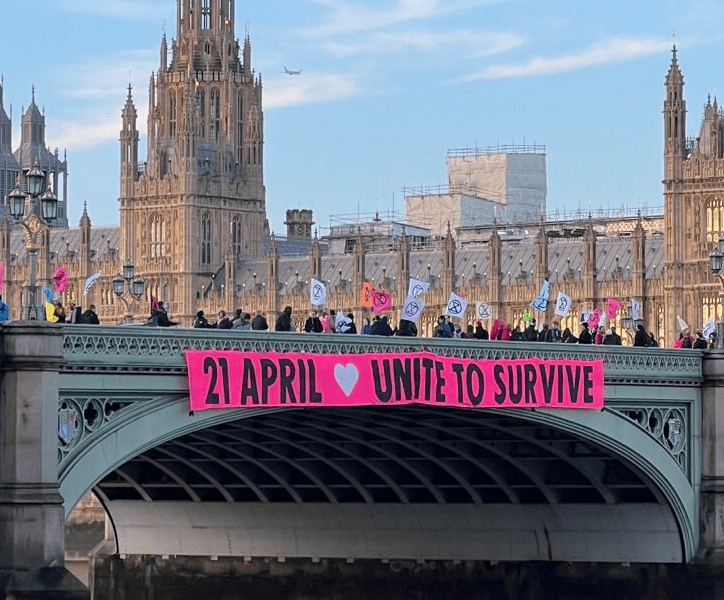
So this morning I joined a hundred people from XR with a hundred flags (or thereabouts) for the launch of 100 Days. A hundred days until the 21st April when everyone passionate about protecting the world from the further ravages of climate change is invited to unite in protest in Parliament Square.  

The message to the Government is that we need action now on the climate crisis to safeguard all our futures.

Green Tau: issue 60

21st December 2022

Climate Strikes

The UK is facing a stream of strikes, as nurses, ambulance drivers, railway staff, border control officers, ground crew and Heathrow, postal workers, Civil Servants,  and the National Highways staff, demand action on better pay and working conditions. Years of underinvestment in staffing and resources has come to a head. Many of those on strike would argue that the short term inconvenience to the public is outweighed by the long term improvement to services that will derive from better paid  and better resourced employees. Strikers hope that initially the threat of strike action and the inconvenience  it could cause, would prompt those who control the purse strings to engage in a constructive resolution of the issue. That taking striking action has a financial impact on those taking part, should demonstrate the degree of commitment – of self sacrifice – of the employees towards their cause. 

In many of these current disputes, it is the Government that is the ultimate controller of the purse strings. It is hard to find ways of directly  inconveniencing the Government so inevitably it is the public who are inconvenienced.  In 1990 between 180,000 and 250,000 members  of the public gathered in London to march  to the Houses of Parliament in protest to the poll tax. In 2003 between 750,000 and 2,000,000 members of the public joined a March to Hyde Park to protest against the Government’s decision to join the war against Iraq. 

Does such action constitute ‘strike action’ in so far as the public are withholding their willingness to support the Government? Would one classify the Extinction Rebellion protests as strikes, as strikes protesting against the Government for their lack of action in response to the climate crisis? Would one classify the blocking of roads by Insulate Britain as they called upon the Government to insulate people’s homes, as strike action? Would one classify blocking roads by Just Stop Oil as they called upon the Government to stop new oil developments, as strike action? 

Greta Thunberg has been widely celebrated and honoured as a climate activist. Every Friday she sat outside Parliament, deliberately absenting herself from school, demanding that her Government take serious and concerted effort to address the climate crisis. She named this as a School Strike.

Strikes, non-violent protests, marches, and signing petitions are all means by which we, the public, can  call on the Government to take action that is in the public’s interest. Yes such action may cause  the public short term inconvenience just as do other industrial strikes, but that inconvenience pales into insignificance when balanced against the ongoing and escalating inconvenience that the climate crisis will cause of action is not taken before it is too late. By 2030 the scientists tell us, our carbon emissions will need to have been halved, and by 2050 brought to net zero to prevent temperatures rising above the – barely safe – 1.5C limit.

Green Tau issue 59

13th December 2022

This Green Tau is a brief personal comment on the prison system in the UK followed by a statement from a climate activist who is currently in prison.

I have been a lightweight climate activist having only been arrested once as part of a protest trying to establish a responsible and practical response to the climate crisis. My daughter has been more physically active, with the support of her parents. She has taken part in a number of Just Stop Oil protests this year, blockading roads, oil refineries and petrol stations, and most recently climbing on to one of the M25 gantries. It is for this last action that she has been placed in prison on remand. Currently (mid December) she has been at Bronzefield Prison for four weeks.

For us as parents this is heart breaking as once in prison people are not treated as humans who have rights. In part this is the nature of the UK prison system and in part it is due to the underfunding of the system. Prisoners have little control over their lives and no recall when things that should happen do not. Heidi’s cell mate’s name was omitted from the meal list for 6 days during which time no meals were prepared for her. Heidi shared hers plus the kitchen staff gave them any left overs. 

If there are staff shortages, they may spend 23 hours in their cell. 

Books can be sent in but only from approved suppliers and there is usually a delay of a week between parcels arriving and being handed over. 

To access any activity such as using the library, the education department or the gym, permission must first be requested via a computer terminal, then approved and even then it is dependent on staff being available to collect and take the prisoner to and from their cell. 

Visits are more frequent for remand prisoners but still work out at an average of one a week.

Heidi, hopefully, will only be in prison for a short while – maybe three months; we are not sure. But for prisoners there on long sentences the experience must be soul destroying and can not in anyway be expected to improve people’s ability to live good and fulfilled lives. 

Personal Statement – AVS Russenberger

I am currently being held on remand at HMP Bronzefield, charged with ‘Recklessly and Intentionally Causing a Public Nuisance’.  This is slightly ironic, as the government’s reckless intention to license over 100 new oil and gas sites will lead to more than just a ‘public nuisance’; it will contribute to irreversible, catastrophic climate breakdown and the loss of millions of lives and livelihoods.

We saw the beginnings of climate breakdown this year.  Temperatures reached over 50ºC in Pakistan and India; 33 million people were affected by floods in Pakistan; climate induced famine in East Africa kills one person every 36 seconds.  In the UK, temperatures reached 40ºC resulting in 6,000 excess deaths; the London Fire Brigade had their busiest day since the Second World War; half of the wheat crops were lost and a projected one quarter of the potato harvest.

This will only get much, much worse. Small island states, low lying countries, and equatorial regions will become uninhabitable.  Devastating floods, wildfires, and drought will become commonplace.  Resources will become scarce, leading to conflict, and a rise in violence and abuse of women, girls, and the LGBT community.  Global crop failures will result in famine and soaring food prices.  We are struggling with the cost of living crisis now, but it is only going to get far, far worse.  But the government is more concerned by a ‘public nuisance’ than this global disaster.

I’ve signed petitions and letters, held placards, voted in every election I can, but the government has continued to pursue an immoral policy of issuing new fossil fuel licences.  More oil and gas will not reduce fossil fuel emissions or address the cost of living, it will only make it worse and threaten the lives and futures of people in the UK and abroad.  The media has been negligent and failed to inform the public of the scale and projected impact of the climate crisis, and has failed to hold the government to account.  I felt that the only option left for me was to continue to protest and refuse to be ignored, because human lives are precious, and worth more than a temporary public nuisance.

Green Tau: issue 58

30th November 2022

Who benefits from fossil fuel investment? 

The big oil companies are expanding their exploitation of gas and oil reserves in response to the short falls in supply from Russia. The rapid rise in gas prices is prompting some African nations to consider developing the gas reserves under their land. To  explore and develop these reserves investment is needed and, it seems, is  readily available from western investors. 

In some ways it is not illogical. If you are a company whose raison d’être is finding, extracting and selling oil, that if you hear of new oil deposits, you go after them. Ditto if you are an investment company that has always invested in oil because it has always earns large dividends, then that is what you keep on doing. People and companies are wary of change, or perhaps become so immersed in the comfort of where they are, that they don’t look outside their own silo to be aware that change is already happening. This can be short sighted. Vis a vis oil, there are two black clouds on the horizon. Peak oil – that point in. Time when demand for oil will start to drop and co to use to drop. Many commentators suggest that we have already passed peak oil back in 2019. The decline in oil use arises when cars switch from petrol to electrical power (something that is happening aster than expected), as more plastics are made from recycled plastic rather than virgin oil, as users of oil become more efficient in their use of an expensive raw material,  and as users find renewable energy is cheaper. The second dark cloud is the climate crisis. As concern about the crisis takes root more people, companies and countries are going to be cutting back on their use of oil in an attempt to limit global temperature rises. If such moves are not successful then the world will experience rising sea levels, widespread drought, extremes of weather and widespread loss of life and incomes. And this of itself will severely reduce demand for oil. Either way it seems that long term the future for the oil industry is not good – but for in the short term their dominance of the global economic systems shields them. This has been highlighted by the war in Ukraine.  So the oil industry continues to be heavily subsidised by governments. “Since the Paris Agreement, the government has provided £13.6 billion in subsidies to the UK oil and gas industry. From 2016 to 2020 companies received £9.9 billion in tax relief for new exploration and production, including £15 million of direct grants for exploration, and £3.7 billion in payments towards decommissioning costs.” https://www.ethicalconsumer.org/energy/paid-pollute-fossil-fuel-subsidies-uk-what-you-need-know

So we are seeing large numbers of oil companies and oil investors focusing on exploring and  extracting oil and gas from the African continent. Despite the long term risks of declining demand, these companies seem convinced that there is money to be made. The idea of making rich profits from oil is certainly seen as attractive by some governments in Africa – oil would seem to offer rewards in licence fees and taxes. But who will benefit? Possibly governments, big businesses, banks and the like. Probably not the ordinary person in the street, the small scale farm or business, and definitely not the rich biodiverse  natural environment. 

Given the high price of oil, the availability of more oil will more likely benefit the big users of oil in the western world, not the person on the street in Luganda or Accra or Windhoek, not the small farm and the rural villager, nor the small businesses. What they need is cheap and accessible electricity , electricity that can be produced locally without reliance on an expensive national grid, electricity that comes from local wind turbines and solar panels? What they need is a move away from polluting vehicles and power plants. What they don’t need is the pollution and disturbance caused by drilling for oil,  building pipeline and running oil refineries. 

What the nations of Africa do need is investment in renewable energy. Ideally not in large projects such as hydro electric dams but in multiple smaller scale projects that will connect to and supply local towns and communities. 

“The potential for wind and solar is 400 times larger than Africa’s total fossil fuel reserves and it comes pollution-free and creates more jobs, but there is finance gap…That is why there is so much attention at this COP to changing the global capital allocation system,” Mr Gore

What the nations of Africa need is protection for their remaining areas of natural habitat – rain forests, wetlands and savannahs. Again this is an area in need of large scale investment that will protect habitats and provide sustainable incomes for local people. 

 “The area of land allocated to oil and gas activity in Africa is set to quadruple, threatening critical forests that help combat climate change, according to a new report by two environmental groups. Rainforest Foundation UK and Sacramento, California-based Earth InSight used mapping technology to show that gas and oil blocks overlap with about 30% of the continent’s dense tropical forests and more than a third of the Congo Basin, the world’s second-largest rainforest after the Amazon. The Democratic Republic of Congo, which accounts for about 60% of the basin, launched a bidding round  in July for 30 oil and gas permits, several of which overlap with the basin. Congo, one of the world’s poorest countries, has defended its right to explore for oil and develop its economy.” KBloomberg UK 

Can the big fossil fuel companies reinvent themselves? Can they recalibrate their raison d’être as energy companies?  Can they become suppliers of renewable energy technology that can enable communities to control their own energy sources? Can they create new business models that can invest the money from our banks, pensions funds and insurers, to protect and enhance the natural environment? 

Green Tau: issue 57

21st November 2022

We’re in a climate crisis – will it get worse?

Global temperatures have risen by at least 1.1C, and possibly nearer to 1.2C, above the pre-industrial revolution norm. This is because of the increasing proportion of carbon dioxide in the atmosphere – as of October 2022 this measures 419 parts per million. Pre-industrial levels stood at around 280 ppm. At 350 ppm the world could maintain global temperatures at about 1C above pre-industrial levels. 

With a global temperature rise of at least 1.1C we are already in a climate crisis. 

Icecaps, and glaciers are melting and reducing in size. Melt water from Himalayan glaciers has been contributing to flooding in Pakistan, whilst across the world sea levels are rising and drowning low lying coast lines in places like Tonga, Kiribati and Vanuatu. 

Warming seas are killing off corals through the process of bleaching. They are shifting the location and breeding patterns of many marine creatures at a rate which is causing a steep decline in populations of many species including birds – and land based animals that rely on the oceans for food.

Warming seas and warming air causes increasingly heavy rainfall and strengthening tropical storms, monsoons and hurricanes. These extreme weather events have led to flooding and the destruction of homes, roads and other infrastructure, forests and mangrove swamps – these latter help prevent coastal erosion – across the globe.  We have also experienced exceptionally heavy rain and storms in the UK. In February of this year three storms hit the UK – Franklin, Dudley and Eunice – leaving  three dead and 1.4 million homes without power. Just this last few days storms have again bought flooding to the UK cutting of road and rail links and leaving another person dead.

Summers have become hotter and dryer. The hottest temperature of 40.3C was recorded this summer, whilst four of the five hottest summers in the UK have all occurred within the last 20 years. This summer’s series of heatwaves caused more than 2800 excess deaths. The same heat wave has been felt across the world with wild fires in the UK, Europe and North America. The hot weather has been accompanied by a lack of rain causing widespread droughts, some of which, for example in California and East Africa, have been ongoing for several years. The drought in East Africa is creating a widespread famine.

These are all examples of changes in the climate that we will have to live with both here in the UK and across the world. They are changes that are now built in because we cannot reverse the 1.1C  increase in average global temperatures.  As global temperatures rise we will have to come to terms with even more changes in the climate,  and will have to try and adapt to them. Ideally (or rather the least worse scenario is) our aim should be to do all we can to keep global temperature rises below 1.5C. 

Is this possible? Scientists and academics have been working on this for several decades now and the route map agreed in Paris in 2016 is that if we can reduce all carbon dioxide (and associated greenhouse gases) emissions by approximately half by 2030 and to net zero by 2050 we should be able to keep temperature rises to 1.5 or 2C. Calculations have been carried out to show that this would be possible if the appropriate plans are  put in place now and acted on. It is in everyone’s best  interests to follow the carbon emissions reduction plan.

Will we achieve this?

At present it doesn’t look hopeful. In fact this year carbon emissions are expected to rise by around 1% rather than fall. Following last year’s agreements at COP26, it was hoped that nations and parties would come back with revised plans showing even greater ambitions to reduce emissions to meet the 2030 and 2050 targets. We are still waiting for the final outcomes of COP27 but certainly the UK Government is not on track for the 2030 targets. And the Government’s willingness to grant new licences for exploring more oil and gas fields in the North Sea is definitely a regressive step. 

Can we be part of the solution? 

Yes. We can focus on reducing our own carbon footprints – by 2030 we should be aiming for about 2.7 tonnes of CO2 per capita in the UK which is about half of the current average. (There are a number of carbon footprint calculators on the web. The WWF –  https://footprint.wwf.org.uk/#/ – one is very easy to use whilst the Carbon Footprint Calculator is more in depth –  https://calculator.carbonfootprint.com/calculator.aspx?c=Full&h=ae20102bc28339fca671f85aed9a7be0) Knowing what your footprint is and what are its major components will enable you to,begin to work out how you can reduce it. As we work out how we can achieve this reduction we can put pressure on the companies we buy from – writing or emailing or simply asking in store for things/ services with a lower impact. We can also use our voices to call on the Government to create the system changes that are also needed – such as increased investment in public transport, in the insulation of buildings, completing the switch from fossil fuels to renewable energy supplies, and transforming the way we farm and the foods we eat. 

We also need our Government and big businesses to work with their colleagues across the world to achieve a just transition to a net zero world. The climate crisis is a global crisis and needs global cooperation, or, as The UN Secretary General put it, we will be condemning ourselves to a global suicide pact. We can use our voices writing to MPs and business leaders, joining action groups, signing petitions, and at election time, using  our votes. 

The future is in our hands.