Recently I took part in a peace vigil outside the DSEI arms fair being held at London’s ExCel centre. Setting aside for a moment the morals of using weapons, there is something deeply uncomfortable about the idea of an arms fair: the idea that just as one can a book fair, or an Ideal Homes exhibition, or a horticultural show, one can have a ‘jolly day out’ walking round stands full of weapons, admiring staged demonstrations, picking up samples and goody bags, whilst enjoying alcoholic and other beverages. There is equally something very disturbing about people making profits out of buying and selling products designed to inflict fear, maim and kill.
But on the other hand are weapons a necessary evil, things that do have at some point to be bought and sold? Would we have wanted the Ukrainians to be weaponless when the Russians invaded? Perhaps weapons are a necessary evil if we want peace not war?
The following is not based on academic research, but simply a reflection of wha has been going through my mind.
Is peace the opposite of war or vice versa? I think that peace is the opposite of war but that the reverse proposition is flawed. Peace is not simply an absence of war. It is far more.
Peace is justice and equality.
Peace is freedom.
Peace is contentment and fulfilment.
Peace is about the individual and the community.
Peace is about the present and the future.
This is a rigorous set of imperatives to meet. But does peace exist anywhere in the world? Here in the UK we are not at war, but do we enjoy the peace described above? I think not.
Justice is unevenly delivered. For those with money to pay for lawyers and the cost of court cases, there can be justice. Indeed for those with money to serve injunctions, injustice can be perpetuated. Justice is uneven delivered depending on one’s colour, race or faith. Activists seeking the right to protest can find their actions constrained by injunctions served on them by big corporations and institutions – and to compound the injustice, may then be billed for the injunction!
Equality is patchy – again depending on your wealth. The more you have, the more the system will work in your favour. If you can afford to go to a good school (whether by living in the right catchment area or paying fees) you will get better qualifications and better employment opportunities. If you can afford a better house – especially one you own rather than rent – you will be healthier, learn better and again have better employment opportunities. If you are homeless, the chances of being as healthy, of getting good qualifications and a job are much less. If you grow up in a household with two parents, if you grow up in a household where everyone is literate, if you grow up in a household where everyone has a job, then you too will have better educational outcomes and better employment opportunities. Then there are postcode lotteries that affect your access to schools and health care. There are geographical north-south divides that shape your opportunities.
Freedom often depends upon access to money. To be free to travel, you need to be able to pay for transport. To be free to take a holiday you need a higher enough wage – and/ or holiday pay – to cover your costs of living whilst on holiday. To be free to change career, you need sufficient money to cover re-training costs plus what is need to cover living costs whilst you study. To be free to live where ever you want, you need sufficient funds to match the great variation of costs across the country, from region to region, area to area.
Contentment and fulfilment will vary from person to person, and some may find them for a very low outlay, but for others the cost may be prohibitive. One may find fulfilment in hillwalking, but another in skiing. Neither ambition is inherently better but the latter may financially be unobtainable. If one’s contentment depends upon swimming, fulfilment may depend upon whether your local authority still runs to swimming pools or whether your local water company keeps your rivers clean.
Because of the inequalities so far highlighted, you can see that some individuals in the UK may achieve lives of relative peace, but that as a community, our achievements are limited.
Again, sadly, whilst we may have relative peace for now, the ongoing likelihood of such peace is in the balance. With underfunded health, social care and educational provision, the inequalities of access becoming increasingly dependent on money, seems likely to increase. And with the lack of investment in renewable energy, energy efficient infrastructure and in infrastructure (including things such as tree planting) to mitigate the effects of the already changing climate, many people’s hope for future contentment also looks bleak. Such is the state of peace in the UK. But what about more vulnerable countries?
What about Mali where rival militias tax or destroy rural communities? And where climate change is causing the loss of agriculture land with the expansion of the Sahara?
What about North and South Sudan and Uganda where control of the water in the Sudd wetlands and the White Nile, is leading to disagreement and conflict?
What about Pakistan where climate change is both melting glaciers and intensifying the wet and dry seasons, making agriculture less viable, and where rising sea levels are reducing the amount of available farm land? With limited opportunities to make a future at home, where can these farmers and their families go to seek a fulfilled life? Seeking refugee in Europe is increasingly difficult.
What about the people of the Democratic Republic of the Congo, where the race to mine copper and cobalt to make batteries, is driving many local people off their land, whilst at the same time polluting land and water supplies?
Across the world there are many instances where one can see that peace is not present. These are potential hotspots which could lead to internal or cross border warfare. My contention is that if the money that would be spent on the wars that are likely to erupt, was instead spent on removing the obstacles to peace, we would not need to be investing in the arms trade. Where war is already happening, I do see that a different response is needed, but that is still needs to be one that establishes peace on both sides of the conflict.
I can well imagine that rather than building up resources for future war, building up the resources for peace would be financially cheaper. This peace building would involve establishing justice and systems of maintaining justice – both internally within countries and between them. It would involve removing existing inequalities and rebalancing fairly access to resources and opportunities. It would involve valuing contentment and fulfilment as more important than GDP. It would involve valuing equally the needs of individuals and the needs of communities.
Not an easy task but one that is biblically mandated, perhaps, as in this passage from Micah.
And many nations shall come and say: ‘Come, let us go up to the mountain of the Lord, to the house of the God of Jacob; that he may teach us his ways and that we may walk in his paths.’ For out of Zion shall go forth instruction, and the word of the Lord from Jerusalem.
He shall judge between many peoples, and shall arbitrate between strong nations far away; they shall beat their swords into ploughshares, and their spears into pruning-hooks; nation shall not lift up sword against nation, neither shall they learn war any more;
but they shall all sit under their own vines and under their own fig trees, and no one shall make them afraid; for the mouth of the Lord of hosts has spoken.
For all the peoples walk, each in the name of its god, but we will walk in the name of the Lord our God for ever and ever. Micah 4:2-5
Here there is justice, for God arbitrates between nations and between peoples. Here there is equality such that everyone can sit under their own vines and their own fig trees. Here freedom is suggested for weapons have been turned into gardening tools, and no one makes anyone afraid. Here is (religious) freedom where people walk with their own gods. Here is contentment and fulfilment for all are taught the ways of God.
“Behold how good it is to dwell together in unity.” Ps 133:1
Recently I was sitting outside Parliament as part of the weekly Earth Vigil, praying for the wellbeing of the earth, for wisdom and discernment for those in positions of authority, and relief for those who are suffering. Parliament Square is a regular place of protest – especially on Wednesdays when PMQs takes place. Some protestors come weekly, others sporadically, and their concerns range from the welfare of women in Iran, victims of oppression in Armenia, lack of finance for special educational needs, anti – Brexit complaints, justice for fathers… This particular week the noisiest protest group were the Anti ULEZ campaigners. They came whistles and truck horns, an air raid siren, loud hailers, and – on the streets – a succession of old non ULEZ compliant vehicles which were driven noisily round and round Parliament Square. As well as being physically noisy, they carried placards which were visually ‘noisy’ calling named individuals as liar and rats, or claiming that Sadiq Khan had blood on his hands. They spoke of the toxic air lies and the death of democracy. They declared ‘Our roads, our freedom’.
Clearly a significant group of people felt aggrieved by the extension to the ULEZ boundary. How can this situation be remedied if we are to ‘live together in unity’? And what about the competing demands – rights – of those who suffer from the adverse effects of air pollution? Or of the need to reduce carbon emissions to forestall the worsening effects of climate change? Or what about the difficulties faced by those who cannot afford private transport and must rely on public transport? Who is standing up for their needs – their rights?
Dialogue has to be one way forward: being able to listen to the other and in return presenting a well constructed counter argument. And hopefully finding some areas of overlap, adjustment or compromise. (Although we may this hard if we are convinced that we are right).
In this instance, would the aim of the dialogue be to encourage the anti-ULEZ campaigners to see that there are other interests to take into account? Ie those with health issues, the young and the elderly who are more vulnerable to air pollution – and that taxpayers and society bears the cost of poor health caused by air pollution. (A study carried out in 2020 calculated cost of air pollution in London to be £10.32 billion a year. The research quantified the monetary value of premature death, hospital treatment, lost working days and other health costs caused by particulate matter, ozone and nitrogen dioxide. https://www.theguardian.com/environment/2020/oct/21/london-the-worst-city-in-europe-for-health-costs-from-air-pollution)
Would another area of discussion be to explore the use of private vehicles as part of an integrated transport scheme that would benefit more people? Here do I need to learn more about people’s dependency on private vehicles, the advantages this opportunity gives them, and, if this dependency were to change, how they could best be supported and what alternatives they would be seeking?
And likewise a discussion to explore how private vehicles and an integrated transport scheme can tackle the climate crisis, together with an exploration of how the increasing change in the climate is – and will increasingly continue – affecting people’s lives?
And might there be scope for discussing how decisions are made and how our political system could be improved?
Notes to self:
How easily can people get to my local hospitals by public transport/ active travel?
Ditto dental and GP surgeries
Ditto churches, crematoria and cemeteries
How easily can people get to local shops and supermarkets by public transport/ active travel? Do shops offer delivery services?
How easily can people get to local parks, recreation centres, swimming pools, green and blue spaces by public transport/ active travel? What about theatres and cinemas, and local visitor destinations – and is this true late into the evening too?
How easily can people get to local school, colleges, places of learning and libraries by public’s transport/ active travel?
How easily can people get to local places of employment by public transport/ active travel? And is this true late at night and early in the morning? How do people who work in the public transport sector get to work?
What facilities or provision would help tradespeople moving between jobs, or for carers moving between clients? Do we expect midwives to revert back to bicycles or should we see provision of an electric car for them as part of the local infrastructure?
If all these come back with positives for my locality, is the same true of other areas or do I live in a well-serviced area?
I live in an urban area but how would these questions play out in a rural setting?
If I am setting up an event or meeting, do I consider ease of access as an important criteria?
The importance of transition pathways to net zero: part 1 – local authorities
325 of the UK’s 409 local authorities (including counties, boroughs, districts etc) have, as of 2022, a climate action plan – most with a net zero target date. The Climate Change Committee comments that the Sixth Carbon Budget can only be met if Government, regional agencies and local authorities work together. Whilst local authorities only have direct control over 2-5% of local emissions, their influence, through regulations, provision of services, and influence over the activities and lifestyles of residents and local businesses is significantly higher.
Local authorities “…key power and duties are:
An overarching role to support the economic, health and social wellbeing of communities
planning powers over buildings and transport
Enforcement of building regulations
Powers to ensure buildings meet basic energy efficiency standards
Duties to prevent homelessness and prevent hazards in housing
Duties to manage risk including climate risks such as flooding
Duties and powers to protect the environment, wildlife and heritage
These give local authorities wide scope to control and influence emissions in their area and to achieve their net zero target dates at various levels:-
At the most basic level, local authorities can control the emissions over which they have direct control – ie from their own buildings and infrastructure – insulting council buildings, installing energy efficient lighting, including street lighting, and switching to a renewable electricity supplier, installing solar panels and or heat-pumps, installing water efficient showers, taps etc. And from their operations – eg ensuring successful reuse and recycling programmes; and from travel – swopping to an electric vehicle fleet including recycling lorries, street cleaning vehicles etc, as well as through encouraging and enabling staff to walk or cycle or use public transport for their commuting journeys.
B) local authorities through seeking out and specifying low carbon standards in their procurement processes, and through again specifying low carbon standards when commissioning work, they can reduce the carbon footprint of their operations. This might range from requiring all stationary to come from recycled sources, requiring all laptop and phone batteries to be both recyclable and recycled, to requiring that furniture be repaired rather than replaced as the default option.
C) local authorities can use their powers to ensure that transport infrastructure in their area supports active travel and public transport over private motorised transport. They can control developments in their area ensuring they enhance the sustainability whilst reducing carbon emissions. By so doing they will also enable other local organisations to reduce their emissions as regards customers and consumers travel patterns.
D) if the local authorities are doing all the above successfully, they can showcase how other organisations and groups in their locality can do likewise, sharing experiences and good practice.
E) local authorities can have a role bringing together people and organisations enabling them jointly to better address the issues of climate change and the means by which emissions can be reduced. and the means by which the affects of climate change can be mitigated.
F) They can inform and encourage local residents to adopt climate friendly lifestyles – for example promoting the reuse, repair and recycling materials; incentivising use of local services; promoting the installation of solar panels.
“As a trusted source of information, the Council can encourage changes in consumer habits, highlight practical information and advice that people can act on and be supportive of action that residents wish to take on climate change . The role of the community is key in dealing with the Climate Emergency. The wholesale change that is required in the way that the economy and society is organised cannot come simply through the local authority trying to shout loudly; it requires action from people to pressure all levels of government, as well as businesses and corporations big and small to change the way they operate.” https://richmond.gov.uk/media/19300/climate_change_strategy_report_2020.pdf
What actions have local authorities undertaken?
Retrofit homes to make them more energy efficient: “The Manchester Climate Change Framework 2022 estimates that housing makes up circa 30% of the city’s total carbon emissions. Retrofitting the city’s housing stock will also provide essential in lowering resident energy bills during the cost-of-living crisis, improving the health of our residents and improving standards in the city’s existing housing stock…To meet the city’s 2025 zero carbon ambitions, 84000 properties will need to be retrofitted in some way. The average cost of a full property retrofit programme could be between £25,000 and £30,000.…£83m has been spent on energy efficiency improvements to Council properties in north Manchester since 2005 leading to a 49% reduction in CO2 emissions (from 55,000 to 28,000 tonnes of CO2) in the homes that have received investment.…Investment in the Council’s own stock to date includes: external render and insulation for 1600 solid wall properties; ditto 14 high rise blocks of flats; 580 homes fitted with heat pumps; 2350 roofs fitted with solar PV systems; 8 retirement blocks with solar thermal panels; 300 blocks of flats with low energy lighting – high and low rise;11,000 homes with high efficiency condensing boilers; 11,900 homes with double glazing; 5,100 homes with cavity wall insulation; 7,000 homes with loft top-up insulation; £12m has been secured in external grants to help fund energy improvements since 2010.” https://www.manchester.gov.uk/news/article/9102/manchester_to_tackle_low_carbon_housing_retrofit_challenge
Nottingham City Homes has pioneered the Energiesprong approach in the UK, transforming 60 homes into warmer, more desirable places to live. This scheme is designed to unlock zero carbon retrofit at scale, paid for by energy and maintenance savings and delivered by a new high-tech industry with guaranteed actual performance, comfort and costs long term – resulting in warm, affordable, desirable homes for life. Homes are fully insulated using offsite manufactured wall and roof panels in conjunction with pre-assembled ‘energy pods’ providing low-carbon, high efficiency heating, hot water and renewable energy production. Gravesend Borough Council is exploring this scheme too. (https://www.energiesprong.uk/newspage/energiesprong-uk-supporting-new-kent-based-heat-pump-project-tackling-fuel-poverty-in-hard-to-retrofit-homes)
Local heating schemes: Swaffham Prior has led the way in the UK, to be the first village to develop a rural heat network. The mix of air source and ground source heat pumps have capacity to supply 1.7MW of heat to 300 homes located in Swaffham Prior. The Swaffham Prior Heat Network project was started by Swaffham Prior Community Land Trust, to address fuel poverty and local environmental issues caused by the village’s reliance on oil heating… Alongside the significant grant funding provided by Heat Network Investment Project and Heat Network Development Unit, Cambridgeshire County Council have made a strategic investment in the project and owns the energy company and heat network assets
Solar panels for leisure centres: “Work to introduce solar power to three Freedom Leisure sites across South Somerset was completed in 2022… [with] solar panels have been installed at Westlands Sports Centre (Yeovil), Wincanton Sports Centre and Goldenstones Leisure Centre (Yeovil). This work is part of a development plan which will see over £6 million invested across the three sites to improve environmental efficiency, customer experience, accessibility, services and facilities.” (https://www.somerset.gov.uk/environment-and-food-safety/climate-and-ecological-emergency/south-somerset/)
Enabling investment possibilities: “West Berkshire Council is the first local authority to issue a bond direct to the public – Community Municipal Investment (CMI) bond. The CMI allows residents and community groups to invest directly with the Council to fund green projects. Investments can be as little as £5 and investors will earn a return of 1.2% over a five year term, with the capital returned in instalments across the investment term.The scheme is attractive to bondholders because it facilitates their investment in local green projects in a way that involves only a small degree of investment risk, together with the potential to earn a return – which is why the Council is already seeing strong demand for the bonds.The money raised will be used to fund the installation of solar panels on Council owned buildings including at Greenham Common and local schools. These projects are part of West Berkshire Council’s ambitious plans to become carbon neutral by 2030.” (https://www.womblebonddickinson.com/uk/insights/news/wbd-advises-west-berkshire-council-uks-first-community-municipal-investment)
Divesting pension funds from fossil fuels: Waltham Forrest, Southwark, Islington, Lambeth, and Cardiff have all divested.
Reducing car use and traffic congestion: Nottingham City Council operates a Workplace Parking Levy payable by employers that provide 11 or more workplace parking places (ie for work vehicles, staff commuting to work, suppliers, or, for colleges, students). The cost per workplace parking place for 2023 – 2024 is £522. The funds raised (over £90m for the last 11 years) has funded improvements in public transport. (https://www.transportnottingham.com/policies/nottinghams-workplace-parking-levy-10-year-impact-report/)
Funding electric buses: Norwich is to have one of biggest full electric bus depots in England after Norfolk County Council secured funding for 70 electric buses together with the necessary infrastructure for the bus depot. (https://www.norfolk.gov.uk/news/2023/03/electrifying-funding-will-bring-70-zero-emission-buses-to-norwich) First Bus, the bus operator, is also working closely with Leicester City Council, City of York Council, the West Yorkshire Combined Authority, Norfolk County Council, Portsmouth City Council and Hampshire County Council.
Electric vehicle charging points: Birmingham City Council is providing an initial 394 fast (22kw) and rapid (50kw) charge points across the city, with a follow up to increase this to around 3,600 in 2022-3, in collaboration with the private sector charge point deployment on private land such as supermarkets, retail outlets and fuel stations.(https://www.birmingham.gov.uk/info/20013/roads_travel_and_parking/566/electric_vehicles/2)
Divesting pension funds from fossil fuels: Waltham Forrest, Southwark, Islington, Lambeth, and Cardiff have all divested.
Why not check what your local authority is doing?
If you feel that they are not doing enough, or if you feel that their policy is more about words than actions, or of their targets seem flimsy – “Objective: plant more trees …. Target: more trees planted” – then take the time to ask questions.
The following is an interesting insight into the power of activism.
“The growing activism of groups such as Extinction Rebellion (XR) and Friends of the Earth in relation to climate emergencies poses a risk to organisations in terms of reputation and litigation. Not aligning statutory strategies and key policies to climate declarations is not only contradictory, but also leaves an organisation open to accusations of green washing. Strategic reviews of how much work it would take to make organisational police ‘climate compliant’ should be done at the earliest opportunity when thinking about carbon neutrality.
The importance of transition pathways to net zero: part 1 – the Government
The spread of extreme heat waves across the globe only reinforces the urgency that surrounds climate action. These extreme temperatures which are affecting both land and sea are a result of greenhouse gases we have already released into the atmosphere. These extreme weather events are here to stay, and if we do not curb emissions, their frequency and intensity will increase. If life on earth is to remain tolerably liveable, then we must reach both the halving of emissions by 2030 and the 2050 net zero target, as established in the 2015 Paris Agreement. All nations who are signatories to the Agreement are expected to deliver. As part of that process there need to be transition plans or route maps or in the case of the UK, Carbon Budgets, that detail how to get from here to there.
In the UK the 2008 Climate Change Act set up the Climate Change Committee which is tasked with producing five yearly carbon budgets for the Government, and with producing an annual progress report. The budget as presented as advice for the Government to review and enshrine in law. So far all the CCC’s recommendations have been followed. The first three budgets (for 2008-23) were set in 2008 and the fourth (for 2023-27) in 2011. NB The twelve year lead in period is there to give those making investments time to respond. The fifth carbon budget was set in 2016. The original 2008 target was an overall cut in greenhouse gas emissions of at least 80 per cent by 2050, relative to 1990. However, in 2019 this was replaced with a target of achieving net zero emissions by 2050 and this is reflected in the more exacting sixth carbon budget issued in 2020. (https://www.lse.ac.uk/granthaminstitute/explainers/what-are-carbon-budgets-and-why-do-we-have-them/)
Currently then, we in the UK are embarking on the era of the Fourth Carbon Budget. At the same time we should be seeing investment already in place for the Fifth Carbon budget, as well as seeing new investment policies being put in place to meet the Sixth Carbon Budget. At anyone time the UK should be benefitting from emissions reductions arising from the current Budget, investing in the infrastructure for the next Budget/s, and developing policies to implement these Budgets.
To date the targets of all of the first three Carbon Budgets have been met. In part this was due to a reduction of economic activity over the period (most notably during the covid pandemic) coupled with rising fuel prices which depressed demand (again largely influenced by external factors such as the war in Ukraine). The pandemic has contributed a further plus factor in changing the commuting patterns and lowering to small degree traffic levels. In addition a number of the winters have been warmer than expected.
Meeting these targets has also been eased by a global shift towards renewable energy (sparked by the worries of oil running out and the ever increasing cost of oil and gas) and by a similarly motivated shift towards more energy efficient appliances and equipment (including more energy efficient vehicles). Hereon success in meeting future targets will rely far more on the skill with which forward thinking investments and comprehensive plans have been implemented over the last decade or more to attain these targets. Transitioning to a world where, for example, all energy comes from renewable sources, where every home functions like a passive house, where active travel is the norm and public transport provides a comprehensive service, does not happen overnight. It needs advance planning and investment. If energy is to come from renewable sources then wind farms needed to built. If homes are to upgraded to passive house standard, then a workforce is needed to install insulation and triple glazing. If active travel is to increase then safe cycle and pedestrian routes need to be put in place with nighttime lighting. If the public transport network is to be comprehensive, more bus routes need to be open up, buses bought and staff recruited. To achieve the transition we need, we are reliant on both the Government and business leaders.
Each year the CCC provides Parliament with a Progress Report. In the introduction to this year’s, Lord Deben wrote: “In this report, we comment on a curious situation. This year, the Government has published more detail on their climate programme than ever before, cajoled to do so by the Courts. But Ministers seem less willing to put that programme at the centre of their stated aims. Our confidence in the achievement of the UK’s 2030 target and the Fifth and Sixth Carbon Budgets has markedly declined from last year.” https://www.theccc.org.uk/wp-content/uploads/2023/06/Progress-in-reducing-UK-emissions-2023-Report-to-Parliament.pdf
This is concern is echoed throughout the report, for example: “However our confidence in the UK meeting the 2030 NDC [‘nationally determined contribution’ being each nation’s contribution to reducing global emissions in line with the Paris Agreement] and the Sixth Carbon Budget (2033-2037) has decreased since last year … whilst we would expect policies to be less developed for targets further away in time, the NDC is now only seven years away.”
The Report (pages 2, 28 & 31) lists the areas where the Government’s lack of planning and investment is materially affecting the chances of meeting the targets of Sixth Carbon Budget. For example:
Land use – the Government needs to formulate a policy framework, and there needs to be an urgent scaling up of land use mitigation measures such as tree planting and peatland restoration.
Buildings – rapid pursuit of zero carbon standards for new builds, and energy efficiency improvements for existing buildings.
Electricity – a commitment to the Government’s own plans to decarbonise the electric supply system by 2030 (giving confidence to would-be investors) and a rebalancing of the relative costs of gas and electricity.
Just transition – using fiscal and policy levers to ensure low-carbon choices are an affordable option for everyone.
Green workforce – this needs to be grown; a commitment to the green economy would be a string signal to the private sector.
Waste – greater emphasis needs to be given to waste prevention; equally reliance should not be placed on using waste as a source of energy.
Industrial emissions – these need to be reduced by 69% by 2035 relative to 2022. Government needs to be do more to accelerate decarbonisation- eg through accelerating the electrification of industrial heat (blast furnaces and similar).
Aviation – no new airport expansion.
Fossil fuels – no new oil and gas without stringent tests; presumption against coal.
This week as I was sat outside Parliament as part of the Earth Vigil, I was questioned, ‘What was it that we were asking of the Government’? A good question to which the simplest answer might be to do what it’s advisers, The Climate Change Committee, recommends.
July two years ago I wrote in the Green Tau about plastic being the pollutant we live with. In many ways not much has changed since then except that we are, globally, producing even more plastic every year and with global recycling rates at around 10%, the total volume of plastic in or not in use, is growing even faster. There is more than one tonne of plastic in the world for every person alive today – https://ourworldindata.org/faq-on-plastics
Plastic Free July seems to be even more important than ever! The problem of plastic could be viewed from three perspectives.
Firstly can we reuse the plastic we already have rather than creating more virgin plastic?
Secondly can we agree and enforce at governmental level an effective global treaty that will end plastic production in a way that is fair to all and not just the richest/ most powerful bodies?
Thirdly can we as individuals re-adapt to a plastic free lifestyle – albeit with all the advantages that bother new technologies have to offer?
Reusing plastic depends on several factors.
All used plastic is collected for reuse (ensuring it doesn’t get blown away into the oceans, side tracked into landfill, or diverted into an incinerator)
That it is properly sorted according to the different types of plastic
That it is sufficiently clean/ uncontaminated (this is where consumers need to act responsibly)
That where possible plastic items are reused rather than being recycled as the latter is more energy intensive. Bottles made of a sufficiently durable plastic can, for example, be refilled and reused.
That there are means of recycling each sort of plastic, ideally within a closed loop – eg that PET bottles are remade into new rPET bottles (the r signifying that the plastic has been recycled). This may need the input of grants for developing nations to ensure that they can afford the initial cost of recycling plants – in the long term this will benefit all global citizens.
Where closed loop recycling is not possible (even rPET will wear out), there needs to be processes that can recycle the plastic into a lower grade but still usable form: already playground equipment, outdoor seating, and shop fitting panels can be made from such material.
That all these processes happen close to where the original plastic ceases to be in use. At present plastics collected for recycling may travel half way across the world to be recycled.
That the cost of recycled plastic should be cheaper than the cost of virgin plastic – this may initially require the input of taxation on items of virgin plastic and at the same time support for poorer households to enable them to cope with the extra cost of some essentials.
That product designers and manufacturers consider reuse and recycling from the outset.
Can plastics previously consigned to landfill sites be ‘mined’ and reused?
Plastic alternatives – The long term goal would be to phase out the use of plastics, replacing plastic with non polluting alternatives such as paper and card, aluminium, glass, wood, cork plus the growing range of new materials as they are developed – eg straws made from seaweed, polystyrene substitutes made for. Mycelium, food packaging made from cornstarch, and various plant based plastic substitutes. All these new products need investment at the design stages and the. investment for scaling up to commercial production levels. It also takes time, and in the course of which the ‘mound’ of fossil based plastics will continue to grow. Removing non reusable plastic from the world is going to be a slow process, but the quicker we start addressing the issue the better.
A global plastic treaty is not now a dream but a work in progress. In June of this year, 180 UN member states agreed to start international negotiations on drawing up a global plastics treaty that could set rules for production, use and disposal of plastics. The talks were also attended by stakeholders including civil society groups, waste pickers and a coalition of scientists. Stakeholders used the talks to call for plans to manage microplastic pollution, regulate the thousands of hazardous chemicals baked into plastics, create a financial mechanism to support the transition, and protect the rights of people disproportionately exposed to plastic chemicals and waste. Many countries are calling for action to go beyond cutting plastic pollution and to curb production as well. At the same time oil- and plastic-producing nations, including Saudi Arabia and Brazil, together with fossil fuel and petrochemical lobbyists, were set on watering down the treaty.
UK government policies – Can the aims of the plastic treaty be supported by laws and directives from the UK government? Can the government do more to persuade businesses to be less reliant on plastic, to increase first the reuse and second the recycling of plastic, and to encourage we as consumers to adjust our habits too?
The plastic bag tax introduced in ….. has seen a substantial reduction in the number of plastic bags used annually. In the last few years it has become the social norm to take a shopping bag when we go out shopping – more so for daily necessities: new shoes and clothes are still usually carried away in the store’s own (paper) bag.
Since 2020 single-use plastic straws, stirrers and cotton buds have been banned, and this approach is being extended this autumn to include the ban of single-use plastic cups, plates and cutlery used takeaway outlets.
In France the use of plastic bags to pre-pack fruit and vegetables is being limited. As of the beginning of 2022 the sale of 30 types of fruit and vegetable in plastic bags has been banned, and this will extend to all fruit and vegetables by 2026. A similar scheme is being introduced in Spain. Here in the UK such schemes where they exist are voluntary, with Morrisons leading the way. This is an area where letters of complaint by customers might effect change, and can be followed up by boycotting pre packed produce.
A deposit return scheme is being formulated by the government and is due to be in place by 2024, with a likely deposit of 20p per item for all single use drinks containers including plastic bottles and metal cans. Whether this will also lead to the reuse of suitable bottles I am not sure. Such schemes do exist in Germany (https://www.dw.com/en/how-does-germanys-bottle-deposit-scheme-work/a-50923039) and Switzerland, and even here in the UK some individual suppliers operate such schemes or offer a refill service -eg Milk and More, the Source Refill Store etc.
Various pieces of legislation encourage companies to reduce the amount of packing – especially plastic packaging – that they use. Such legislation comes within the group termed Producer Responsibility Regulations. Certainly many Easter eggs now proudly proclaim that they are free of plastic packaging, and paper wrappers for Mars Bars are currently being trialed.
Household recycling provision varies from authority to authority with no consistency as to what is recycled in which bin and how often. The government is in the process of developing a policy to standardise recycling policies for all local authorities but this may have a knock-on effect as some local authorities will need to invest in new collection bins and vehicles. Nevertheless it has to be a good idea that will encourage a higher recycling rate.
Promoting a plastic free lifestyle is what Plastic Free July is all about. It is certainly easier for consumers of governments require businesses to provide plastic free packaging, but even if that is not the case, it is possible to make choices that reduces our consumption of plastic – whether that is not buying a pre-packed sandwich, using a keep cup rather than buying coffee in a takeaway cup, buying loose fruit and vegetables, or buying solid bar soap and shampoo. There are plenty of websites offering advice – you might visit Plastic Free July’s own web site – https://www.plasticfreejuly.org/ or visit the Friends of the Earth web site – https://friendsoftheearth.uk/plastics/living-without-plasticb – but don’t be bamboozled by websites that just want to sell you plastic free products.
As much as anything what is key is a change in mindset – automatically looking for the plastic free product. Once you are used to avoiding plastic packaging, look to use plastic-free goods too – the wooden toilet brush, the metal washing up bowl, a rubber and sisal yoga mat. It is not necessary to throw away plastic things; rather use and reuse them to maximise the usefulness of the plastic and then – finally – recycle it and replace it with a plastic free alternative.
Fo further articles on this blog about plastic see -https://greentau.org/tag/plastic/page/2/
Recently most of my backlog of articles on the icloud disappeared except bizarrely for the Green Tau issue no. 8 on 15 Minute Cities – so I thought I would revisit that topic.
At the time we were emerging from the experience of covid and covid lock downs. Many of us though that what we had learnt during the pandemic would irreparably change our lives and the shape of our towns and cities. Whilst some people do still work from home, we still live in cities where people commute some distance into work, where roads are still ultra congested during the rush hour (with noticeable peaks during wet or very hot weather, and during term time). What has gone is the queue of cars outside the supermarket car park as more and more items are bought online and delivered to our front door. The number of cafes, dog related shops, and barbers has increased. Maybe the time we are not spending in supermarket queues is now down time for a coffee.
Again a fruit of the pandemic, some areas now have more parklets, cycle paths and road calming measures reducing rat runs and making streets more accommodating for pedestrians. Here in Sheen closing the gate into Richmond Park to through traffic, has significantly reduced the amount of vehicles driving down local roads en route to the south circular.
More recently there has been an outbreak of (orchestrated) rage directed at the 15 minute city concept. In Oxford where narrow streets and historic buildings, and large numbers of tourists, give rise to traffic congestion and with it poor air quality, the Council, after consultation, proposed a series of local traffic schemes. These were designed to divert non local traffic away from local and residential streets, and at the same time, to encourage walking cycling and the use of public transport. However opponents ( of the scheme or of the authorities?) claimed the schemes were ‘climate lockdowns’ which would imprison residents in certain areas of the city and prevent free movement into and across the city.
It maybe that part of the anger comes from fear. At a time when the cost of living is rising steeply – including the cost of driving – and when jobs feel insecure, that anything that appears to make getting around more difficult/ more expensive or that might threaten the viability of local businesses and jobs, are such fears justified?
For example, do local traffic schemes, discourage people from using local services because they cannot drive straight there or cannot easily park? Do such schemes rather encourage people to drive to out of town centres with large, free, car parks?
No – rather encouraging walking and cycling, favours the use of local shops and business. A reduction in traffic makes a shopping street more attractive, makes it a place where people can enjoy a wander or enjoy sitting at a street cafe. With large shopping chores being done online, the smaller – more frequent – shopping trips are then easily made on foot. With people walking, rather than driving, past local shops they are more likely to make local purchases. As footfall increases, so more business may be encouraged to expand into the locality. Contrari wise, for people who cannot afford or do not have access to cars, gain from having livelier and better supported local amenities.
As local businesses thrive, so the opportunity for local jobs increases.
But do 15 Minute Cities reinforce the deprivation of deprived areas? If the amenities in a local area are already challenging (perhaps because of a lack of investment or because local incomes are limited), are the problems a) just compounded, and b) easier to ignore as being just a localised pocket of deprivation?
In London, Newham Council “is aiming to transform some of its most deprived areas through the creation of ’15-minute neighbourhoods’ – where people can access all basic needs within walking or cycling distance from their homes. This includes housing, grocery shops, childcare, schools, healthcare facilities, public open spaces, recreation, and frequent, affordable public transport.”
“We have a unique core strategic objective to create a local economy which places the livelihood, wellbeing and happiness of our residents’ as prime measures of Newham’s economic success. The [15-minute] concept links to our community wealth-building agenda, which focuses on supporting communities to create wealth and retain more of the benefits of economic growth emerging locally. It also supports our 50 Steps to our Healthier Newham health and wellbeing strategy”
The 15 minute concept becomes a focus for what a local community needs and should have, and become an impetus to introducing those things that are lacking. At present across the UK many communities lack local services such as bank, a GP’s surgery and a pharmacy. Establishing additional amenities in a locality creates local jobs and opportunities for local businesses, whilst at the same time keeping money circulating within the community. In Newham, the 15 minute scheme is expected to deliver benefits in the the region of £170 million.
Does the 15 Minute City diminish or threaten the traditional city centre? Will city centres become lifeless?
The amenities offered by a local centre – school, pharmacy, GP surgery, store selling food and other daily/ weekly necessities/ niceties, gym, park, railway station, post office etc – are not the same as those one expects from a city centre (unless you are a resident of a city centre). Rather the amenities expected of a city centre will include mainline railway and bus stations, national or regional museums and art galleries, national or regional theatres and cinemas, cathedrals, flagship retail outlets, specialist shops, significant cultural meeting places such as it provided by Trafalgar Square. This can be envisaged as a the central hub of a network of local 15 Minute cities. Maybe the 15 Minute City might be better termed a 15 Minute neighbourhood.
Does 15 Minute City concept ignore those who live in rural areas?
Is it an inappropriate concept with its reliance on walking, cycling and public transport? Or rather is it a challenge to central and local government to ensure that rural areas have an equal access to public transport – and to broadband? (This later is important if rural areas are to develop as places for remote working). There are alternative models of public transport that provide a more frequent and flexible service for remote communities.
The Department for Transport has a tool kit for demand responsive transport. This is a public transport service that instead of following a rigid timetable along a specific route, provides a service that picks people up at times and places of their choosing to take them to a range of destinations of their choosing. It is not a taxi service and passengers have to manage a degree of flexibility in terms of timings and routings: a passenger may have to leave a little earlier than they might choose and might go via a more circuitous route as other passengers are dropped off. Such schemes already exist for, example, with Dial a ride bus services but could be provided more widely and and more comprehensively in rural areas.
With public transport in place for amenities not immediately available in a rural community – such as say a dental surgery, cinema or swimming pool – can rural communities themselves grow by investing in and supporting local amenities such as a corner shop, primary school, gym, cafe, post office etc? Before car ownership became widespread, rural communities had many such or similar facilities. Might some services be provided in a mobile basis – mobile library, mobile bank, mobile takeaway pizza truck etc? (By mobile I means van that is converted into a library on wheels as opposed to a library in your mobile phone).
If the 15 minute neighbourhood became the accepted standard, would that provide the impetus to change, invest and develop such communities where ever people live – whether that is in towns, cities or villages?
Recent data from a YouGov survey shows string support for the concept. “New YouGov data shows that a majority of the public (62%)would support their local authority making it a target to make their area a 15-minute neighbourhood, including three quarter of Labour (73%) and over half Conservative voters (57%). However, many think this could be a challenge. Around half of Britons (48%) believe that it would be easy to make their area into a 15-minute neighbourhood, compared to 42% who think it would be hard, but this largely depends on how rural or urban an area they live in. Those describing their areas as “very urban” or “somewhat urban” are more likely to say that it would be easy to achieve in their area, at 65% and 57% respectively, compared to just 21% in “somewhat rural” areas and only 8% among “very rural” respondents.” https://yougov.co.uk/topics/society/articles-reports/2023/03/06/most-britons-would-their-area-become-15-minute-nei
Having written all this, and whilst appreciating the valuable input the national and local governments can make, the biggest contributor to creating 15 minute neighbourhoods comes from the will or mindset of individuals. Often we do have the choice as to whether to use our local shops or drive further afield. We often have the choice as to whether to use the local cinema/ library/ post office/ bus service etc. We often have the choice whether to walk to the local gym or drive, to walk or drive to church, to walk or drive our children to school. Maybe successful neighbourhoods are where 60+% of the people do make those choices.
Global temperatures have fluctuated considerably over the geological lifetime of the plants, and indeed in the past have been at much higher levels than we are currently experiencing. What is different now is the rate at which global temperatures are rising – far faster than at any previous time. The current rise in temperatures is not ‘natural’ but anthropogenic- human-made. The cause of this rise in temperatures has been the increasing quantity of greenhouse gases (principally carbon dioxide) that through human activity has been released into the atmosphere. These act like an insulation jacket on a hot water cylinder keeping in the sun’s heat.
The earth’s ecosystem can cope with a certain degree of fluctuation in global temperatures and still stay pretty much the same – with snow and glaciers on mountain tops, ice sheets at the poles, a stable Gulf Stream in the Atlantic and an equally stable jet stream in the high atmosphere – both ensuring reliable weather patterns. However there comes a point at which increases in global temperatures causes changes that are irreversible and/ or which accelerate further temperature rises.
A 1.5C temperature rise is one such tipping point. Exceeding this will likely lead to the loss of the Greenland ice sheet and the Western Antarctic ice sheet. Both will expose ground that unlike the ice sheet, absorbs rather than reflects the sun’s rays, and will thus accelerate rising temperatures. Whilst the sudden thawing of the northern permafrost which will release large amounts of methane which in the short term has an even greater greenhouse (warming) effect than carbon dioxide. The 1.5C tipping point is also likely to see the death of many coral reefs which would otherwise be absorbing carbon dioxide, again leading to further increases in temperature. These will all be irreversible events in our human timescale.
The need for action
For many decades scientists have been arguing for a reduction in carbon dioxide and other greenhouse gases – and this has not gone un-noticed by governments and communities. Here in the UK, the Climate Change Act was passed in 2008 and sets out legally binding emissions targets, initially aiming for an 80% reduction from 1990 levels by 2050. The Act also established a series of national carbon budgets, with a decreasing cap on emissions for succeeding five year time spans. (These budgets exclude emissions from aviation, shipping and from imported goods).
In 2016 nearly 174 nations plus the EU signed up to the 2015 Paris Agreement that tasked them with reducing emissions to a level that would keep the global temperature rise well below 2C and ideally no more then 1.5C. The agreed target was that the world – as represented by the parties at COP21 that had produced the agreement – should seek to half greenhouse gas emissions by 2030 and to cut them to net zero by 2050 (at the latest).
By this time there was a growing grassroots movement of climate activists calling on governments and institutions to take action. Across the world the demands from climate activists led to many institutions and authorities declaring a ‘climate emergency’. The first such declaration was made by the City of Darebin in Melbourne, Australia in 2016. Bristol City Council, in 2018, became the first local authority to do so in the UK, and in 2019 the UK Parliament itself declared an environment and climate emergency. This latter following 10 days of protests by Extinction Rebellion.
Terminology Net zero is the end reference point rather than absolute zero because it is recognised that there will always be some areas of human activity that produce carbon and other greenhouse gas emissions – simply breathing produces carbon dioxide – but that these can be offset by increasing activities that absorb carbon dioxide. Such activities includes creating maintaining woodlands, peat lands, sea grasses etc.
Carbon neutral is a similar term related to net zero. It is used when an organisation/ production process etc has neutral balance vis a vis carbon produced and carbon absorbed. Another term in use is carbon negative. This is when an organisation/ production process removes more carbon dioxide than it produces. A well maintained forest could achieve this. Net zero on the other hand assumes that as far as possible all greenhouse gas emissions have been reduced with offsetting only used to compensate for a small and impossible to remove residue.
Net zero for nations
Since 2016, more nations have signed up to the Paris Agreement, with now just under 200 signatories. Each nation is tasked with working out its own plan to achieve the global net zero by 2050 target, producing a quota that is their Nationally Determined Contribution. Each NDC is added to a register at the UN, and at each subsequent Climate COP, they are invited to review and ideally improve upon their NDC.
The UK chooses to distinguish between emissions produced from within the UK borders and those from without. The UK’s measure includes thus emissions produced by companies who export products from the UK (which are often in the form of financial services which tend to have a lower footprint) and excludes emissions produced elsewhere on items that are imported (which are often manufactured goods coming in from China, India etc). The UK’s measure has also excluded emissions from aviation and shipping, but this is going to being adjusted in relation to proposals for future decades.
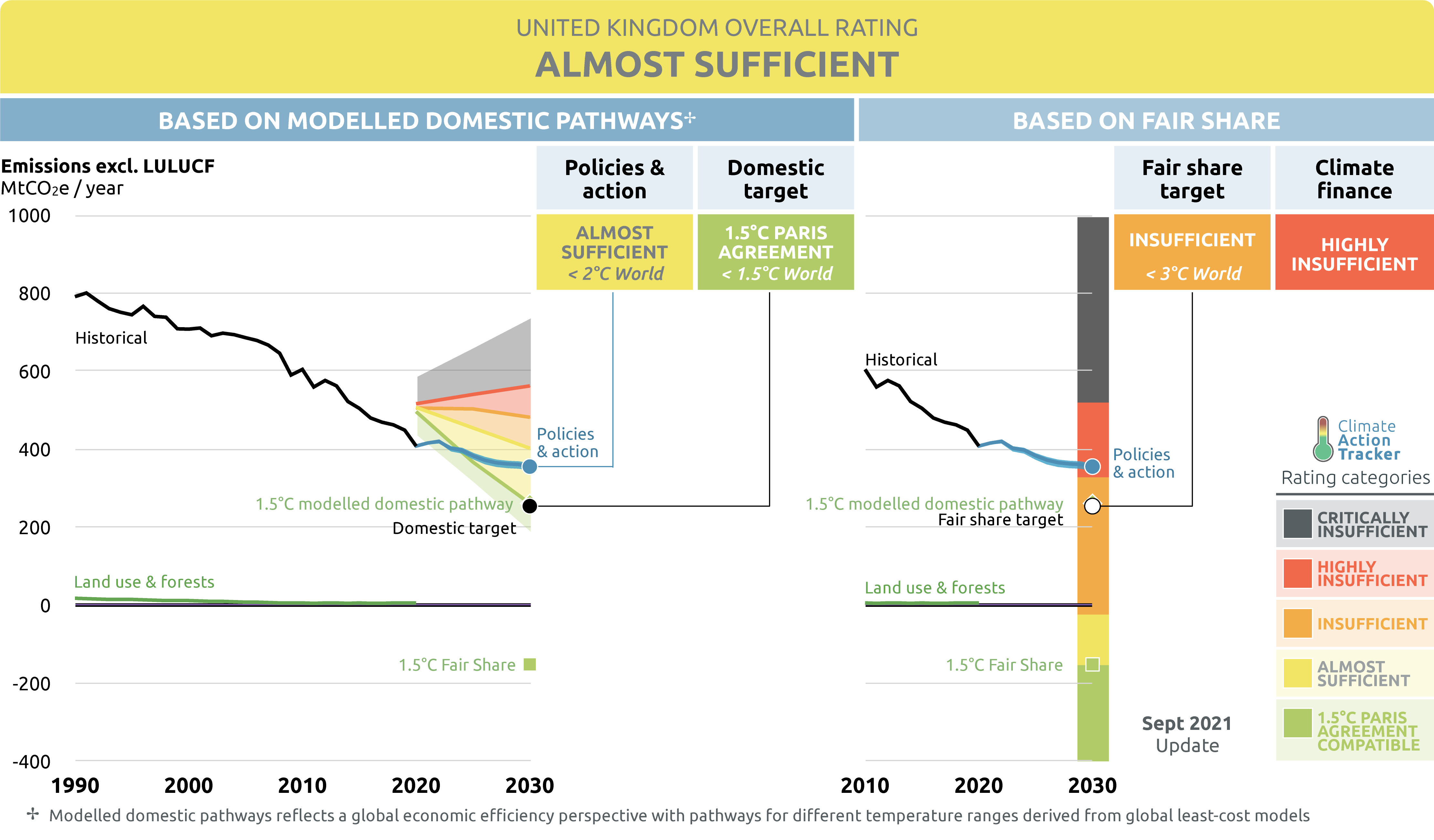
To help nations predict the effectiveness of their plans, and to enable their progress to be independently monitored, The Climate Action Tracker scrutinises nation’s climate actions and measures them against the globally agreed Paris Agreement aim of “holding warming well below 2°C, and pursuing efforts to limit warming to 1.5°C.” They report publicly the progress being made by leading countries. The most recent assessment grades the UK’s rating as ‘almost sufficient’. (Costa Rica has the same rating whilst New Zealand is rated as ‘highly insufficient’. https://climateactiontracker.org/media/images/CAT_2021-09_Graph_SplitSummary_UK.original.png
CAT also draws data together to give a global overview of policies to determine likely trends in temperatures over the coming century. For example in November 2022 CAT reported on the future shape of liquified natural gas production based on future projects (approved and proposed) and showed that the projected increase in production was well outside the scenario needed to keep with it the net zero target. https://climateactiontracker.org/press/dash-for-gas-a-serious-threat-to-the-paris-agreements-warming-limit/
Net zero policies in the UK
The 2019 Environment and Climate Emergency Declaration itself has no legally binding requirements, rather the legal obligation to reduce UK emissions lies with the 2008 Climate Change Act. This, in the light of the Paris Agreement, was amended such that the end target for 2050 is now set to be net zero. And action has been taken:- UK terrestrial (ie emissions that occur within the UK borders) have fallen from 800million tonnes of CO2 in 1990 to 424.5 Mt CO2e in 2021.
The 2008 Climate Change Act also set up the Climate Change Committee as an independent statutory body which advises the Government on achieving its emissions targets. To this end the CCC produces a five yearly carbon budget. The most recent, the Sixth Carbon Budget, covers the period 2033-2037. It includes the following four key steps:
Enabling people and businesses to choose low-carbon solutions, as high carbon options are progressively phased out. By the early 2030s road transport and home heating will be largely electrical. Industry too will shift to using largely non fossil fuel energy.
UK electricity production will be zero carbon by 2035 with offshore wind the main source. With new and expanding uses for electricity (arising from the above) electricity demand is likely to increase by 50%. Hydrogen production will also increase to fuel shipping and industry.
Reducing demand for carbon-intensive activities through insulating buildings, reducing air and car travel, and reducing meat and diary consumption. These will additionally improve health and well being!
Increasing the absorption of greenhouse gas through transforming agriculture, increasing tree planting and restoring peat lands.
The effect of these steps would be to reduce greenhouse gas emissions in 2035 to 20% of their level in 1990, putting the UK on track to meet the objectives of the Paris Agreement.
The Climate Change Committee is also tasked with reviewing and reporting back to Government the progress being made. The most recent assessment published in March 2023 covered the period of 2018 – 2023. The CCC stated that the “found very limited evidence of the implementation of adaptation at the scale needed to fully prepare for climate risks facing the UK across cities, communities, infrastructure, economy and ecosystems.” https://www.theccc.org.uk/publication/progress-in-adapting-to-climate-change-2023-report-to-parliament/
Net zero for businesses and organisations
However it is not just governments that have pledged to take action to achieve the net zero 2050 target. Educational institutions, businesses, health providers, local authorities, service providers, financial institutions etc too have drawn up climate action plans. As of 2022 75% of UK universities committed to net zero targets under scopes 1 and 2 (see below to learn more about scopes).
Unilever has a Climate Transition Action Plan which aims to achieve zero emissions by 2030 for their operations (eg manufacturing products – scope 1 emissions) and net zero across their supply chain by 2039 (scope 2 emissions) and are working on reducing the emissions arising from when their products are used by customers (eg when they consume energy having a shower or running a washing machine scope 3 emissions).
Of course it is in everyone’s long term interests to take such action. Every activity whether it’s teaching a class of 5 year olds, running a train service, or producing bread will become much harder as the climate crisis escalates. How do you teach 30 children when temperatures rise to 40C? How do you run a train service when floods and landslides block the line? How do you produce bread when high temperatures and extended droughts halve the wheat crop?
Monitoring emissions and what is included.
Just as the Government has it advisory committee, so businesses, institutions and others have advisers – some commercial, some not for profit and others operating as charities. The UN is backing the global campaign ‘Race to Zero’ helping companies, cities, regions, financial and educational institutions, to halve global emissions by 2030 and to net zero by 2050. https://racetozero.unfccc.int/ , and the Science Based Targets initiative (SBTi): The SBTi is a partnership between CDP, the United Nations Global Compact, World Resources Institute (WRI) and the World Wide Fund for Nature (WWF) that drives ambitious climate action in the private sector by enabling companies to set science-based emissions reduction targets: https://sciencebasedtargets.org/
About a third of Britain”s largest businesses have signed up for the Race to Zero campaign, pledging to eliminate their contribution to carbon emissions by 2050.
The UK government records its net zero progress by measuring greenhouse gases emitted within its borders. (This means incidentally that it does not include in its assessment emissions that arise from items consumed in the UK but produced elsewhere such as China). Businesses likewise have to determine which emissions they are going to ‘own’. To assist this, emissions are categorised as falling into three areas –
Scope 1 emissions which are directly related to their business – eg burning gas to smelt steel, burning petrol to run a bus.
Scope 2 emissions which are generated off-site such as electricity which is produced in a regional power station but which is used to power a café‘s coffee machine, the emissions generated when your staff/ pupils travel to work school.
Scope 3 emissions which includes emissions relating to the products you use upstream of your business – eg the emissions arising from growing, transporting and roasting the coffee beans bought by the café; the emissions arising from manufacturing the bus; emissions arising in extracting the iron ore that is used at the steel works – and those expended downstream – the emissions arising from recycling or otherwise disposing of used coffee cups, the emissions that arise from running a shower for someone using Unilever’s soap, or in the case of an oil refinery, the emissions arising when that oil is burnt to run someone’s boiler.
Of these, scopes 1 and 2 are relatively easy for businesses to identify and adapt to achieve a net zero target. It maybe that they will have to shop around and find alternative suppliers for some items – eg a green electricity supplier, someone who grows organic coffee beans etc, or provide staff with bicycles. Scope 3 emissions can be trickier to adjust, and may involve a lot of working with suppliers to change the carbon footprint of what they produce – a café might work with both coffee roasters and coffee bean growers to grow, roast and ship a bean with a smaller footprint – or may mean finding new suppliers. Equally a café might look at the waste they produce – paper cups, plastic packaging, used coffee grounds – and work out ways of ensuring that the resulting emissions are reduced by for example, replacing single use cups with reusable ones, replacing plastic packaging with paper bags, or finding ways of recycling coffee grounds.
There is obviously an overlap between the different scopes – scope 3 emissions from one organisation being the scope 2 emissions of another. Working together is a key part of achieving net zero targets. This includes us as individuals as we make choices about how to travel to work/ school, whether to bring a keep cup for our take out coffees, or how long we spend in the shower.
For some organisations such as fossil fuel companies, reducing scope 3 emissions can be a challenge to the raison d’être of the company: their whole business is all about extracting and selling greenhouse gas emitting products. One such company, Ørsted, faced this challenge head on: “In the late 2000s we were one of the most coal intensive power generators in Europe with an expanding oil and gas production business. But we took a strategic decision to become a green energy company, as we were convinced it was the right approach strategically, financially and environmentally. To drive our transformation, we invested heavily in renewable energy, particularly offshore wind; exited our fossil fuel businesses, and formulated our vision of creating a world that runs entirely on green energy. We are now one of the largest renewable energy companies by capacity globally and the leading offshore wind company. Financial performance has significantly improved whilst we have reduced our carbon emissions by 86%.” https://orsted.com/en/insights/white-papers/green-transformation-lessons-learned
Other fossil fuel companies however are trying to combine fossil fuels with renewables such that they can continue to extract and sell oil and gas (which still remain highly lucrative). Is this compatible with a net zero target? There are at least three ways in which this can be orchestrated.
One is to set the net zero target for 2050, and to sit lightly to any interim targets such as halving emissions by 2030. In theory a company could continue its high emissions production until 2049 and then cut all production in the last year and achieve its net zero target.
Second, it could mask its emissions in the interim by adding renewable energy production to its portfolio, and thus show a reduced intensity of their overall emissions without cutting back on fossil fuels.
Third it could invest in carbon absorbing projects – such as planting trees – or invest in carbon capture projects – where carbon dioxide emissions are trapped as they are produced and ‘locked away’ through physically storing the gas underground or by mixing it with other materials to store it as different chemical compound. The former take time to become effective: trees need to grow before they become efficient stores of CO2 and managed to ensure a long and useful life; whilst as regards carbon capture, much of that is based in untested technology that is not yet available at the necessary scale needed.
Net zero targets and green washing
Investopedia defines green washing as “the process of conveying a false impression or misleading information about how a company’s products are environmentally sound. Greenwashing involves making an unsubstantiated claim to deceive consumers into believing that a company’s products are environmentally friendly or have a greater positive environmental impact than they actually do. In addition, greenwashing may occur when a company attempts to emphasise sustainable aspects of a product to overshadow the company’s involvement in environmentally damaging practices”.
Reliable monitoring and certification schemes are critical if ‘green washing’ is to be avoided.
In 2022 the Uk government passed legislation that requires Britain’s largest companies to report on the climate risks they face and their strategies to overcome these. In other words they must have thought through climate transition plan that shows how they will transition to a low carbon future in line with the Government’s net zero target. As well as having a duty under the UK companies Act 2006 to promote the success of the company, company directors must also have regard to the impact of the company’s operations on the environment and the community. (For more info see https://www.allenovery.com/en-gb/global/news-and-insights/publications/risks-for-directors-in-the-spotlight-climate-litigation)
Having legislated for the requirement to disclose and for the directors’ responsibilities vis a vis the environment, it is now possible for interested parties (principally share holders) to challenge companies at law to prove that they are indeed shifting their businesses in the direction needed to address the climate crisis.
In February 2023, the environmental law organisation ClientEarth announced that it was taking Shell to court. ClientEarth. “The shift to a low-carbon economy is not just inevitable, it’s already happening.”But the Shell board is persisting with a transition strategy that is “fundamentally flawed,” Benson claims. He says it leaves the company seriously exposed to the risks climate change poses to their success in the future – “despite the board’s legal duty to manage those risks”. Shell says its ‘Energy Transition Strategy’ – including its plan to be net zero by 2050 – is consistent with the 1.5C temperature goal of the Paris Agreement. The company also claims its plan to halve emissions by 2030 is “industry-leading”. But ClientEarth says this covers less than 10 per cent of its overall emissions and independent assessments have found that Shell’s climate strategy is not Paris-aligned.
This year’s Shell AGM faced a shareholder vote backed by big pension funds and investors to set carbon emission reduction targets for 2030, while dozens of protesters called for an immediate end to fossil fuel production – https://www.theguardian.com/business/2023/may/23/shell-agm-protests-emissions-targets-oil-fossil-fuels However the level of objection was insufficient to win a resounding vote against the Shell board.
Interim conclusion
The pursuit of net zero targets by governments and organisations will continue to be live issue.
If I had a capital sum of £10,000 that provided me with an income of £1000 a year and provided my annual expenditure did not exceed £1000, I would be set up for life.
If however I spent £1500 a year, whilst I would not have a problem in the short term, I would in the long term. For to have £1500 to spend I would have to use £500 from my capital which would be fine in the first year. In the second year however my income would be only £950 because the capital driving it had been reduced. I would either have to curtail my living expenses or if I was less wise, extract more from the capital. If in year 2 my expenditure was still £1500, then in the following year my income would be further reduced £895. To maintain my expenditure at £1500 I would have to extract £650 from my capital sum, reducing it still further to £8905. In less than 20 years I would be bankrupt.
We are in the same situation here on earth. The earth represents our capital sum. Each year the earth produces resources (crops, minerals, clean air and water plus the ability to absorb unwanted pollutants) which is our income. If we live within our income then our lifestyles are sustainable. If we live beyond our means, drawing down capital as well as income, then we are heading towards bankruptcy.
Since the 1970s scientists at the Global Footprint Network have been calculating how much of the earth’s resources we are using. For millennia our human consumption of resources to feed and clothe ourselves, to build homes and cities, to travel and pursue leisure habits, has been well within the capacity of the earth’s resources. However since the early 1970s this has ceased to be so. We have so increased our consumption that we are eating into the earth’s capital reserves. As of 2022, we would require 1.75 worlds to satisfy our global needs. We don’t have any spare worlds, so we are, year on year, sinking further into the red.
Each year the Global Footprint Network calculates the day on which we will have consumed our full quota of available resources. This is known as Earth Overshoot Day. In 1971 Earth Overshoot Day was 25th December. In 2022 it was 28th July. The only year when the date when into reverse was in 2020 during the Covid pandemic when Earth Overshoot Day was 22nd August – which at least shows we can make a positive impact if we choose.
As well as calculating Earth Overshoot Day for the whole world, the Global Footprint Network makes similar calculations of each country. Some countries don’t even consume their full quota, but of those that do, their individual Earth Overshoot Days vary from 21st December for Mali, 11th November for Egypt, 31st August for Mexico, 2nd June for China, 13th March for the USA, 10th February for Qatar.
And the UK? Our Earth Overshoot Day falls next week, on 19th May.
Globally and as individual countries we need to be adjusting our lifestyles to ensure that they are sustainable and at the same time, restoring the depleted parts of the planet – restoring the fertility of soils, improving biodiversity, increasing tree cover on land and kelp forests under the sea, cleaning up waterways and seas, and reducing green house gas emissions.
This will need system change across the world, but it is also something we can effect as individuals. To explore how you might reduce your environmental footprint try the Global Footprint Network’s calculator. By playing around with the answers you give, you may find ways in which you could comfortably make positive changes to your lifestyle.
I have recently spent a few days away in Settle in North Yorkshire. Settle is a small and active town, located on the Settle to Carlisle railway so easily accessible by train. Whilst here we have enjoyed exploring the local area follow some of the numerous footpaths. The Yorkshire Dales are traditionally appreciated as vast expanses of open moorland, green fields crisscrossed with dry stone walls, and sheep! And that is certainly what you find here. Being spring, the fields are full of lambs – gambling about in pairs but still keeping in close proximity to mum.
But it hasn’t always been so. In the past farming was more diverse and included beef and dairy cattle, poultry, and arable crops, as well as the cultivation of trees such as willows for basket making. Diversity in farming lends itself to diversity in the environment. One writer commenting on current biodiversity in the Yorkshire Dales, noted that more diversity is to be found along the roadsides and verges than in the fields. From my observation that is true – on a roadside I might count as many as a dozen plants (I am no expert) in few meters, whereas in the fields I was seeing just the occasional dandelion and celandine amidst the short cropped grass. Sheep do eat everything! Even more rewarding where the sections of footpath, river and railway banks where all grazing animals had been excluded. Here there were bluebells, primroses, cowslips, violets, lady’s smock, buttercups, daisies, and wood anemones – and in large number!
Sheep farming has become a monoculture form of agriculture and it is to the detriment of biodiversity. In some areas, tree planting is happening which benefits biodiversity. Over the couple of days we were walking we saw only one pair of buzzards and they were circling above a copse (which may have been coincidental). Elsewhere we came across a notice telling us that trees had been planted on the banks of the Ribble to shade the water to mitigate the effects of rising temperatures. If water temperatures rise above 22C for a week or more fish die! The Ribble is currently still home trout and salmon.
Without sheep the landscape would return to a mix of grass and woodland – and would therefore also be a greater storer of carbon. Such a landscape would be as attractive for walkers. Walkers and tourism is an important part of the local economy, but can it bring in enough money to support a rich and diverse local economy? One of the things that sadden me as we walked, were the disused barns and farm houses. The smaller farms may have ceased to be economic some while ago, and equally with a shift from mixed farming to sheep farming with bought-in animal feed, many of these buildings are surplus to requirement and inconveniently placed vis a vis roads and services. Could they become homes for people who prefer to work remotely? This is apparently one way in which remote islands are gaining an influx of younger people. Or should we accept their decline as part of the natural cycle and see them as potential new habitats in the same way that dead trees support an ongoing stream of life as they decay into their locality?
Should we, as tax payers, pay farmers to become nature wardens? They could enable the rewilding of greater parts of the landscape, repair the dry stone walls – which are as a valid part of our heritage as ancient castles – maintain pathways and mark them at regular intervals to encourage people to use not just the well-known routes but the lesser used ones too. In essence such people would be employed to maintain the health of our environment and be as important as those in the NHS who maintain people’s health.
My husband is a railway enthusiast so we took the train to see the Ribblehead viaduct. Now embedded into its moorland environment, where the grasses and mosses have covered over any remaining marks of the building site that enabled its construction, it is a thing of beauty. It is an industrial artefact that has come to lend grandeur to an otherwise commonplace wild landscape. It is probably as much photographed as the nearby Three Peaks. I wonder if this windswept area could also absorb into its identity silvery white turbine blades. Wind farms could generate energy to support the local economy – and maybe too, an electrified railway line.
The Big One is this years demonstration of people power in support of the well being of our environment. Over the course of the weekend 21st – 24th April, Extinction Rebellion along with many other organisations – such as Christian Aid, Greenpeace , Ecotricty, Ecosia, the Quakers, the RSPB – will be gathering to allow people to share their passion for the wellbeing of the environment and justice, and to call upon the Government to take action to genuinely address the climate crisis.
There will be processions, talks, workshops, music and worship. The Saturday will have particularly festive feel with people in costumes celebrating Earth Day, and on the Sunday space will be made for the passage of the London Marathon. There will be welfare and first aid points and the whole weekend will be coordinated with the police ensuring its legality as a legitimate protest.
What is The Big One asking?
A citizen-led democracy to end the fossil fuel era.
A fair society that includes reparation.
Existing Demands – XR’s three core demands remain the same: Tell the Truth, Act Now, and Decide Together.
And a demand for an immediate end to all new fossil fuel licences – added in 2022 to recognise the need for definable action – also remains. https://extinctionrebellion.uk/the-big-one/
Faith groups will have a particular presence – look out for flags and banners pinpointing who’s where. From the Christian organisations there will be a big ‘No faith in fossil fuels’ service outside St John’s Waterloo at noon on the Friday with an onward procession to Parliament Square. Midday worship led by different groups will take place on the other days in the Faith Zone, plus a Catholic Mass or Eucharist at 3pm and a daily prayer walk at 5pm starting from the Mahatma Gandhi statue.
Do come along and add your presence to this demonstration of people power. A better world is possible.
‘We’re not going to disrupt the public, but together from 21st – 24th April, we will show the Government exactly what people power looks like’ – Extinction Rebellion.



 The Green Tau