Counting on … day 24

4th February 2025

Producers of products such as cocoa, coffee and bananas also face problems due to fluctuations in prices triggered by speculators. Fairtrade can help, by guaranteeing a minimum price but also be developing direct, long term relationships between producers and buyers.

“Many initiatives in the cocoa, tea, banana and flower sectors aim to improve the social, environmental and economic performance of producers. They typically focus directly on achieving change at producer and worker level ….[However] trading relationships can have an important influence on a producer’s economic viability and capacity to invest in sustainable practices. In the banana sector in Ecuador, for example,  more secure contracted volumes enable banana plantations to provide more stable year-round employment to their workers. Without these guarantees plantations are often confronted with cancellations in buying orders, making it too risky to provide job security to workers.” (1) 

Sustainable food systems need to protect producers and workers, and this does ultimately protect consumers by better ensuring a steady supply of food. 

  1. https://www.fairtrade.org.uk/wp-content/uploads/legacy/doc/The-Case-for-Fairness-in-Trade.pdf

Counting on … day 23

3rd February 2025

“Farmers are the backbone of our agricultural industry, working tirelessly to bring food to our tables. However, the practice of price manipulation in agricultural markets has severe consequences for these hardworking individuals. One of the most significant impacts on farmers is the financial struggles they face, coupled with a sense of uncertainty about their future.” (1)

Food waste can also be linked with capital waste. Farming requires capital inputs – seed, fertilisers, equipment – for which the return can be unpredictable. Crops may fail due to adverse weather or pests. Prices may fall because of changes in demand or because of the manipulation of the markets by  investors such as hedge funds. 

Recently there seemed to be a surge in demand for British grown fruit – apples, cherries etc. demand peaked and with inflation consumers (and supermarkets) opted for cheaper imports. What do farmers do who have invested in planting orchards? It can be years before the capital is repaid: should they grub up the new trees and cut their losses? 

Do we need more control over prices – limiting the role of investors who are simply playing the market, using subsides to guarantee prices for British grown produce?

  1. https://fastercapital.com/content/Price-Manipulation-in-the-Agricultural-Markets–Impacts-on-Farmers-and-Consumers.html

The Feast of Candlemas

2nd February 2025

Reflection with readings below

Today marks the end of the season of Epiphany with the nature of the baby Jesus made manifest in the temple by first Simeon and then by Anna. This child is God’s salvation – the light for revelation – that is to benefit both Gentiles and the people of Israel. But it is no easy task – no magic transformation. 

“This child is destined for the falling and the rising of many in Israel, and to be a sign that will be opposed so that the inner thoughts of many will be revealed– and a sword will pierce your own soul too.”

Salvation is a process, a process of change and of challenge. It will demand reassessing our inner thoughts. It will demand falling and rising, the crashing down of our selfishness and our raising up to  new life. 

Malachi tells us that the Christ, the one who will save us, will be like a refiner’s fire and like a fuller’s soap. Christ will refine our thoughts and actions to make them pure – if we accept the process. Christ will scour and cleanse us till our souls are without stain or blemish. Christ will – and does – persist in this task until we are able to ‘present offerings to the Lord in righteousness.’ 

Until all that we do, all that we have to give through our lives, is done in righteousness. 

This process of salvation – of refining and cleaning, of reforming and teaching – is clearly a work of centuries. It is an ongoing process in which each generation is called to accept the ways of God, to live according to God’s values, to work together in righteousness.

Last Sunday’s gospel gave us the passage where Jesus stands up in the synagogue and reveals that he is the one to proclaim the good news. What is this good news? That we all can be healed and changed and so be part of the year of the Lord’s favour. The gospel is not passive; it’s not just an acceptance that Jesus is Lord. It is active: it is ensuring plenty for the poor, freedom for the prisoner, sight for the blind and new life for the oppressed.

Simeon’s words remind us that the gospel message is not just one that is active in the response that it demands of us, it is also likely to be a task that will involve suffering. It will not be a simply ride. Yet like Simeon and Anna and Mary, we should be willing to accept this and still be ready to rejoice, for this is the salvation we have waited and desired. 

Malachi 3:1-4

Thus says the Lord, See, I am sending my messenger to prepare the way before me, and the Lord whom you seek will suddenly come to his temple. The messenger of the covenant in whom you delight– indeed, he is coming, says the Lord of hosts. But who can endure the day of his coming, and who can stand when he appears?

For he is like a refiner’s fire and like fullers’ soap; he will sit as a refiner and purifier of silver, and he will purify the descendants of Levi and refine them like gold and silver, until they present offerings to the Lord in righteousness. Then the offering of Judah and Jerusalem will be pleasing to the Lord as in the days of old and as in former years.

Psalm 84 

1 How dear to me is your dwelling, O Lord of hosts! *
My soul has a desire and longing for the courts of the Lord;
my heart and my flesh rejoice in the living God.

2 The sparrow has found her a house
and the swallow a nest where she may lay her young; *
by the side of your altars, O Lord of hosts,
my King and my God.

3 Happy are they who dwell in your house! *
they will always be praising you.

4 Happy are the people whose strength is in you! *
whose hearts are set on the pilgrims’ way.

5 Those who go through the desolate valley will find it a place of springs, *
for the early rains have covered it with pools of water.

6 They will climb from height to height, *
and the God of gods will reveal himself in Zion.

7 Lord God of hosts, hear my prayer; *
hearken, O God of Jacob.

8 Behold our defender, O God; *
and look upon the face of your Anointed.

9 For one day in your courts is better than a thousand in my own room, *
and to stand at the threshold of the house of my God
than to dwell in the tents of the wicked.

10 For the Lord God is both sun and shield; *
he will give grace and glory;

11 No good thing will the Lord withhold *
from those who walk with integrity.

12 O Lord of hosts, *
happy are they who put their trust in you!

Hebrews 2:14-18

Since God’s children share flesh and blood, Jesus himself likewise shared the same things, so that through death he might destroy the one who has the power of death, that is, the devil, and free those who all their lives were held in slavery by the fear of death. For it is clear that he did not come to help angels, but the descendants of Abraham. Therefore he had to become like his brothers and sisters in every respect, so that he might be a merciful and faithful high priest in the service of God, to make a sacrifice of atonement for the sins of the people. Because he himself was tested by what he suffered, he is able to help those who are being tested.

Luke 2:22-40

When the time came for their purification according to the law of Moses, the parents of Jesus brought him up to Jerusalem to present him to the Lord (as it is written in the law of the Lord, “Every firstborn male shall be designated as holy to the Lord”), and they offered a sacrifice according to what is stated in the law of the Lord, “a pair of turtledoves or two young pigeons.”

Now there was a man in Jerusalem whose name was Simeon; this man was righteous and devout, looking forward to the consolation of Israel, and the Holy Spirit rested on him. It had been revealed to him by the Holy Spirit that he would not see death before he had seen the Lord’s Messiah. Guided by the Spirit, Simeon came into the temple; and when the parents brought in the child Jesus, to do for him what was customary under the law, Simeon took him in his arms and praised God, saying,

“Master, now you are dismissing your servant in peace,
according to your word; 

for my eyes have seen your salvation,
which you have prepared in the presence of all peoples, 

a light for revelation to the Gentiles
and for glory to your people Israel.” 

And the child’s father and mother were amazed at what was being said about him. Then Simeon blessed them and said to his mother Mary, “This child is destined for the falling and the rising of many in Israel, and to be a sign that will be opposed so that the inner thoughts of many will be revealed– and a sword will pierce your own soul too.”

There was also a prophet, Anna the daughter of Phanuel, of the tribe of Asher. She was of a great age, having lived with her husband seven years after her marriage, then as a widow to the age of eighty-four. She never left the temple but worshiped there with fasting and prayer night and day. At that moment she came, and began to praise God and to speak about the child to all who were looking for the redemption of Jerusalem.

When they had finished everything required by the law of the Lord, they returned to Galilee, to their own town of Nazareth. The child grew and became strong, filled with wisdom; and the favour of God was upon him.

Counting on … day 22

31st January 2025

Sustainable use of land resource also extends to how we use finite water resources. Some crops use particularly large amounts of water – eg blueberries, strawberries – and realistically shouldn’t be grown in  areas where water is a scarce resource and should be reserved for critical crops and drinking/ sanitation. In Peru blueberries are grown in areas where local crops are at risk from lack of water. Almond trees need more water than pistachios and in Spain farmers are switching from almonds to pistachios in face of the increasing  prevalence of droughts. 

At the same time, such water rich-crops are often vulnerable to damage – strawberries and blueberries are very susceptible to damage and often have a short shelf-life. 

As consumers we can avoid buying foods that are grown with the unsustainable use of water.

Further reading – https://greentau.org/wp-content/uploads/2025/01/ff0ba-howfairisourwaterfootprintinperu_final_fulltechnicalreportdec2024.pdf

Green Tau: 102

31st January 2025

Why protesting about protest is important!

 Over a thousand people sat in the road outside the Royal Courts of Justice to protest at the deliberate  diminution of the right to protest in the UK. Inside the Courts an appeal was being heard brought by 16 climate protesters challenging the severity of the sentences they had been given. 

As we sat in silence on the road in three orderly lines back to back, police offices walked up and down the lines, stopping to address individuals asking them to move. ‘We recognise your right to protest but this is a live road’. ‘What can we do to make you move?’ ‘Please move to the designated protest area in between the church of St Clement Dane and the court house’. ‘A section 14 notice may be imposed on this section of road and then we may arrest you’. ‘You might spend hours in a police cell.’ 

This was a silent vigil so most chose not to respond to the police. Instead maintaining the silence with eyes downcast, we resolutely continued to sit in the road.

Yes we were blocking the road. Yes we were preventing vehicles from using that section. Why? Because – yes – this was a protest. And what is a protest if it does not cause some degree of disruption? 

The reason for any protest is to raise awareness – to draw people’s attention – to an issue in order to effect change. This the protest was about the failure of the system to allow justifiable and reasonable protest. 

Over the last few years the right to protest has been has been crushed and demonised by the government through new laws, by judges through punitive interpretation of laws and sentencing guidelines, and by corporate interests through their ability to drop quiet words into significant ears, and their ability to afford the cost of legal actions and injunctions.

Where once walking peacefully along a street was considered a valid means of protest, it is now designated as ‘public nuisance’. Where once sitting and blocking a road was considered a valid means of protest, it is now designated as a ‘disruption of national infrastructure’.  Have we reached a situation where you can only protest by staying quietly on the pavement, well away from anyone or anything you might disrupt? 

Protest is meant to disrupt. It is meant to irritate. It is there to draw attention to a situation that needs to change. Yes, protest has to be proportionate. Yes, protest has to target the appropriate audiences. Yes, protest has to be based on valid claims. 

The climate crisis is the biggest existential crisis that we humans have ever faced. A delayed car journey diminishes into insignificance compared with the potential loss of life of millions of people. 

The climate crisis has no favourites, it can and will continue to affect us all. There is no audience that can argue that it doesn’t threaten them.

The climate crisis is a scientifically hypothesised, modelled and proven crisis. There is no valid data that proves otherwise.

And yet since the rise of Extinction Rebellion in 2018, and subsequent groups such as Insulate Britain and Just Stop Oil, governments, judges and the Criminal Prosecution Service have gone out of their way in refuting that the actions being taking by these groups represents genuine protest.

Protesting about the right to protest is vitally important in an era when we face not only the existential crisis of climate change but also the threat of oppressive right wing politics that is beginning to dominate the world.

Counting on … day 20

29th January 2025

Food waste occurs at all stages between field and the fork. 

At the field end, waste may occur because the crop has not grown to a saleable quality which could because of drought or excess water, frosts or excess heat, infestation by bugs or diseases. Food waste may occur  because of delays in harvesting (due to adverse weather) or a lack of workers or equipment. 

The increasing occurrence of adverse weather events caused by the climate crisis is going to be an issue for decades to come. Even if we can curtail carbon emissions, it will be  many decades before global temperatures will reduce to a level such that weather patterns will revert to what we would consider normal.

As regards harvesting, much of the work is done by people on short term insecure contracts earning minimal  wages. This is not good for them nor is it good for our food system. Maybe as consumers we should be willing to pay a fairer price for our food. But equally it maybe others in the supply chain need to be taking a smaller profit. The following Guardian article is interesting. But it is not just a UK issue. Similar problems happen in Spain where ‘cheap’  seasonal labour  is brought in from North Africa – https://www.ethicalconsumer.org/ethicalcampaigns/agricultural-workers-rights-almeria

“Employment tribunal hearings are due to begin this week to decide their claims for unlawful ­deduction of wages, unfair dismissal, discrimination and harassment against Haygrove, a business which runs five farms in the UK growing ­strawberries, cherries and other berries.

“It employs more than 1,000 ­people to pick fruit and uses the seasonal worker scheme, a visa programme introduced after Brexit when fruit was left rotting in the fields because there was no one to pick it. Haygrove disputes the claims.

“McAndrew said there was substantial evidence of “widespread exploitation” of people on the seasonal worker visa. Part of the reason is that growers are under extreme pressure from supermarkets to drive down prices, and seasonal workers are usually employed through third-party agencies.

“Research by the Landworkers’ Alliance into the fruit supply chain found that for a £2.30 punnet of strawberries, the farm received 50p, of which just 5p was profit, while workers received just 18p after deductions for tax, visa and accommodation.” (1)

(1) https://www.theguardian.com/global/2025/jan/26/protests-by-fruit-pickers-and-farmers-put-spotlight-on-price-of-cheap-food-in-uk?CMP=Share_iOSApp_Other

Counting on … day 19

28th January 2025

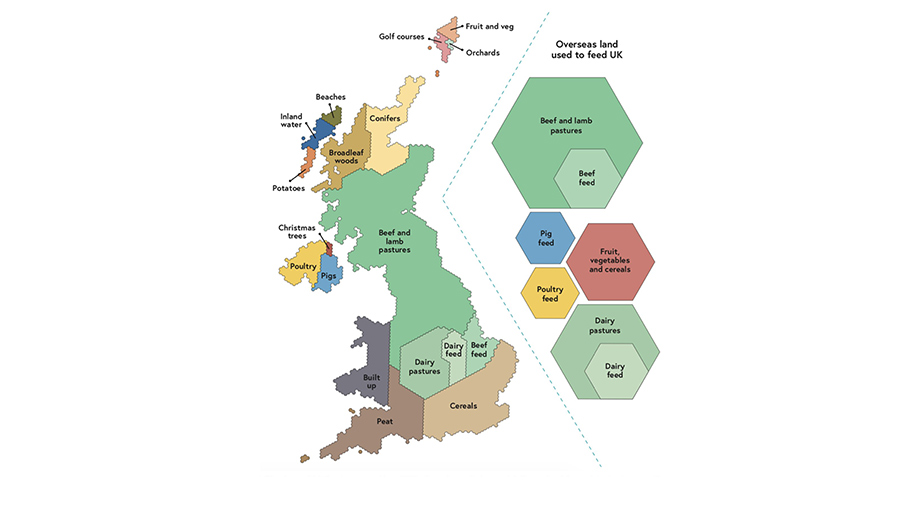
When we are thinking of food waste in terms of ensuring we use the Earth’s resources in a sustainable way, we might also want to consider how we use the limited amount of land we all share. Globally 77%of farm land is used to raise animals for meat and dairy products, yet this supplies only 18% of the world’s (human population) calories and 37% of their protein.

Here in the UK more than half our land is used to rear livestock for meat and dairy products. 

National Food Strategy landuse map

Counting on … day 18

27th January 2025

Last September the UN Climate Change News reported that “In 2022, a staggering 1.05 billion tons of food were wasted, while 783 million people went hungry and a third of the global population faced food insecurity…Food loss and waste account for 8-10% of annual global greenhouse gas emissions – nearly five times the total emissions from the aviation sector – and contribute to substantial biodiversity loss, using up almost a third of the world’s agricultural land.” (1) 

Reducing food waste is something we can all do that will help address the climate and biodiversity crises and improve global food security. 

Useful advice can be found here – https://www.ethicalconsumer.org/food-drink/climate-action-10-steps-reduce-food-waste

Third Sunday after Epiphany

26th January 2025

Reflection with Readings below

We are still in the season of Epiphany – a word that means to reveal or make manifest. In today’s passage from the Hebrew Testament we hear that Ezra, having called together all the people of God, reads to them the Law of Moses. This is a community of those who have returned from exile to rebuild Jerusalem – maybe it is the first time they have heard these words spoke in this holy city. They are overwhelmed by what these words reveals to them about God – God’s glory and God’s wisdom. It is an epiphany moment for them.

In today’s psalm it is creation that is revelling in and revealing the glory of God. And as in the words read by Ezra, it is the wonder of God’s law that is celebrated. Maybe creation is more consistent in praising God than we fickle humans.

Echoing the reading from the Hebrew Testament, the gospel tells of Jesus standing up to read the scripture to the people. It is a passage that reveals Jesus’ mission  – his calling – that he is the fulfilment of God’s will, that he is the one who will reveal to us the good news of God’s favour, not just through words but through action. Was this also an epiphany moment for his listeners?

If we were to read on we would hear how the people in the synagogue were amazed but also puzzled: wasn’t Jesus Joseph’s son yet here he was saying he was the fulfilment of Isaiah’s prophesy? And they  try and kill him. Is the truth too overwhelming for them to accept? Is it too impossible for them to believe that one of them – the carpenter’s son – is the messiah? 

Is that puzzlement, that unwillingness to accept what is revealed, what lies at the heart of Paul’s parable? Maybe some of the people in the church at Corinth find it hard to accept that a slave or a gentile – or a woman? – can be just as important, just as special as themselves. Or maybe some of the people in the church in Corinth find it hard to accept that they – be they a slave or a gentile or a woman – are just as important, just as  special as all the others in that community. 

In this season of Epiphany, it is a good time to be reminded that not just humans but nature too can recognise and rejoice in God’s glorious creativity and wisdom. It is a good time to be reminded that no one is more important – nor less important – than anyone else. And extending the parallel, to be reminded that humans are not more important than – nor less important – than the rest of creation. We have all been created for and are valued by God. God’s law that we should love our neighbour includes not just people like ourselves, but people of all backgrounds and places, and not just humans, but all beings that share this God-given existence.

Nehemiah 8:1-3, 5-6, 8-10

All the people of Israel gathered together into the square before the Water Gate. They told the scribe Ezra to bring the book of the law of Moses, which the Lord had given to Israel. Accordingly, the priest Ezra brought the law before the assembly, both men and women and all who could hear with understanding. This was on the first day of the seventh month. He read from it facing the square before the Water Gate from early morning until midday, in the presence of the men and the women and those who could understand; and the ears of all the people were attentive to the book of the law. And Ezra opened the book in the sight of all the people, for he was standing above all the people; and when he opened it, all the people stood up. Then Ezra blessed the Lord, the great God, and all the people answered, “Amen, Amen,” lifting up their hands. Then they bowed their heads and worshiped the Lord with their faces to the ground. So they read from the book, from the law of God, with interpretation. They gave the sense, so that the people understood the reading.

And Nehemiah, who was the governor, and Ezra the priest and scribe, and the Levites who taught the people said to all the people, “This day is holy to the Lord your God; do not mourn or weep.” For all the people wept when they heard the words of the law. Then he said to them, “Go your way, eat the fat and drink sweet wine and send portions of them to those for whom nothing is prepared, for this day is holy to our Lord; and do not be grieved, for the joy of the Lord is your strength.”

Psalm 19

1 The heavens declare the glory of God, *
and the firmament shows his handiwork.

2 One day tells its tale to another, *
and one night imparts knowledge to another.

3 Although they have no words or language, *
and their voices are not heard,

4 Their sound has gone out into all lands, *
and their message to the ends of the world.

5 In the deep has he set a pavilion for the sun; *
it comes forth like a bridegroom out of his chamber;
it rejoices like a champion to run its course.

6 It goes forth from the uttermost edge of the heavens
and runs about to the end of it again; *
nothing is hidden from its burning heat.

7 The law of the Lord is perfect
and revives the soul; *
the testimony of the Lord is sure
and gives wisdom to the innocent.

8 The statutes of the Lord are just
and rejoice the heart; *
the commandment of the Lord is clear
and gives light to the eyes.

9 The fear of the Lord is clean
and endures for ever; *
the judgments of the Lord are true
and righteous altogether.

10 More to be desired are they than gold,
more than much fine gold, *
sweeter far than honey,
than honey in the comb.

11 By them also is your servant enlightened, *
and in keeping them there is great reward.

12 Who can tell how often he offends? *
cleanse me from my secret faults.

13 Above all, keep your servant from presumptuous sins;
let them not get dominion over me; *
then shall I be whole and sound,
and innocent of a great offence.

14 Let the words of my mouth and the meditation of my
heart be acceptable in your sight, *
O Lord, my strength and my redeemer. 

1 Corinthians 12:12-31a

Just as the body is one and has many members, and all the members of the body, though many, are one body, so it is with Christ. For in the one Spirit we were all baptised into one body–Jews or Greeks, slaves or free–and we were all made to drink of one Spirit.

Indeed, the body does not consist of one member but of many. If the foot would say, “Because I am not a hand, I do not belong to the body,” that would not make it any less a part of the body. And if the ear would say, “Because I am not an eye, I do not belong to the body,” that would not make it any less a part of the body. If the whole body were an eye, where would the hearing be? If the whole body were hearing, where would the sense of smell be? But as it is, God arranged the members in the body, each one of them, as he chose. If all were a single member, where would the body be? As it is, there are many members, yet one body. The eye cannot say to the hand, “I have no need of you,” nor again the head to the feet, “I have no need of you.” On the contrary, the members of the body that seem to be weaker are indispensable, and those members of the body that we think less honourable we clothe with greater honour, and our less respectable members are treated with greater respect; whereas our more respectable members do not need this. But God has so arranged the body, giving the greater honour to the inferior member, that there may be no dissension within the body, but the members may have the same care for one another. If one member suffers, all suffer together with it; if one member is honoured, all rejoice together with it.

Now you are the body of Christ and individually members of it. And God has appointed in the church first apostles, second prophets, third teachers; then deeds of power, then gifts of healing, forms of assistance, forms of leadership, various kinds of tongues. Are all apostles? Are all prophets? Are all teachers? Do all work miracles? Do all possess gifts of healing? Do all speak in tongues? Do all interpret? But strive for the greater gifts. 

Luke 4:14-21

Jesus, filled with the power of the Spirit, returned to Galilee, and a report about him spread through all the surrounding country. He began to teach in their synagogues and was praised by everyone.

When he came to Nazareth, where he had been brought up, he went to the synagogue on the sabbath day, as was his custom. He stood up to read, and the scroll of the prophet Isaiah was given to him. He unrolled the scroll and found the place where it was written:

“The Spirit of the Lord is upon me,

because he has anointed me
to bring good news to the poor. 

He has sent me to proclaim release to the captives
and recovery of sight to the blind,
to let the oppressed go free, 

to proclaim the year of the Lord’s favour.”

And he rolled up the scroll, gave it back to the attendant, and sat down. The eyes of all in the synagogue were fixed on him. Then he began to say to them, “Today this scripture has been fulfilled in your hearing.”

Thanksgiving for food and meals

25th January 2025

Trust in the Lord and be doing good; dwell in the land and be nourished with truth.
 Let your delight be in the Lord and he will give you your heart’s desire.
Commit your way to the Lord and put your trust in him, and he will bring it to pass. Psalm 37:3-5

You Lord are the bread of life;

feed us with your wisdom.

Our meat is to do the Father’s  will.

guide us in all we do

Whenever we eat or drink

Let it be to the glory of God.

Reading Mark 6: 38-44 ( from The Message)

But he was quite serious. “How many loaves of bread do you have? Take an inventory.”

That didn’t take long. “Five,” they said, “plus two fish.”

 Jesus got them all to sit down in groups of fifty or a hundred—they looked like a patchwork quilt of wildflowers spread out on the green grass! He took the five loaves and two fish, lifted his face to heaven in prayer, blessed, broke, and gave the bread to the disciples, and the disciples in turn gave it to the people. He did the same with the fish. They all ate their fill. The disciples gathered twelve baskets of leftovers. More than five thousand were at the supper.  

Table Piece

Around the table, smallest to largest, 

youngest to oldest – comfortable and companionable.

Bread, first mixed and kneaded, 

shared together at the table.

Wisdom, debated and pondered,

gathered from around the table. 

Gentle chiding, loving acceptance, laughter –

differences reconciled at the table.

Thanks given, prayers said, hands clasped 

a place of worship at the table.

Kith and kin, friends – all welcome: love 

a community built around the table.

Prayers

We give thanks O Lord, for the food we have to eat, 

for the opportunities we have to eat together, 

for the times we gather to share and  learn, 

and for the joy of worshipping at your table. 

We pray Lord, for all who struggle to get food to eat, 

all who lack the companionship of friends and family, 

all who are exploited and all who are fall prey to disinformation, 

and for all who have yet to feel included at you table. 

Stir us Lord, to respond with generosity and determination 

to feed the hungry, 

to transform the inequalities of society, 

to reach out to those starved of love,

and to nourish all with your word.

Amen.