Counting on …. Day 1.175

19th September 2023

‘A just transition to a fossil free future.’

To transition is to move from one state to another from way of doing things to another. It can involve change that is not much more than a minor adjustment or it can involve change that is a complete turnabout. Swopping from incandescent to LED lightbulbs might be an example of the former. Swopping from air travel to flight free journeys, from meat-based to plant based diets, from drilling for oil to the building wind farms, more an example of the latter. Most recently we have seen in the  introduction of the expansion of ULEZ, a scheme  that whilst fair and just for most people (providing clean air for pedestrian, cyclists and car drivers) is unjust for a small number of people who are dependent on their – non compliant – vehicles but have insufficient funds to buy an alternative and in adequate public transport to remove the initial need for a car.

The transition maybe even more deep rooted. We may need to transition from our market economies where profit and monopoly power determines what is produced and who consumes it, to an economy based on the the common good, on the least polluting, on satisfying need rather than greed. For a just transition we might see the introduction of a universal basic income, free health and social care at the point of need, an inter grated public transport system in place of private cars, the elevation of food sovereignty over futures markets, the adoption of doughnut economics. 

To read the excellent first chapter of Kate Raworth’s book on doughnut economics follow this link – https://doughnuteconomics.org/tools/18

You might also read this Time article about Amsterdam’s decision to pursue doughnut economics – but be aware, the webpage is full of adverts encouraging your to buy more and thus contribute to the GDP model of economics! https://time.com/5930093/amsterdam-doughnut-economics/

Counting on … day 1.174

18th September 2023

What is the aim, the objective, of climate activism? 

Having pondered this, I wonder if it might be ‘A just transition to a fossil free future.’

‘Just’ that whatever course of action we and/or others take should be fair and just  to all: fair to the poor as well as the rich; fair to people in the polluting industries and to those in the restorative ones; fair to people in the global south and to those in the north; fair to animals, birds, fish, insects …. as well as to human; fair in the division of resources and responsibilities; fair in the distribution of  sacrifices and of opportunities.

Much of the suffering we see around us arises from injustice. Fuel poverty is going to be an issue this winter. Those with limited resources cannot afford to insulate their home, invest in more fuel-efficient heating systems, or in solar panels. Whilst those with ample  financial resources  can benefit from all these cost saving opportunities. To take action on this – to seek justice – check out this website https://www.warmthiswinter.org.uk/

and/ or watch this talk on the issue – https://youtu.be/7b1KS4pazw4?si=yR3eLepDiLT5hrC4

or this – https://energyforall.org.uk/


Creation-tide – Christian Climate Action and the prophetic role 

17th September 2023

Reflection (readings below)

To be a prophet is not a popular calling. Often the message you have been given by God is not exactly the message that people want to hear. The message is often contradictory, challenging the norm; it may ask for a life-style that is counter cultural, it may be a message that counters the way people  current live  – and are happily living in fact, ‘thank you very much!’

Jeremiah was certainly in that position. The message God asked Jeremiah to deliver was definitely not what the people of Judah wanted to hear. 

Nor was it the message the religious leaders wanted to hear.

Nor was it the message the political leaders, including the King, wanted to hear. 

How is Jeremiah going to get the people to pay attention, how is he going to get them a) to listen to God’s message and b) to respond to it positively?

In the passage we have just heard, Jeremiah takes an earthware jar – a large one I’m guessing – and throws it the ground. (Push a heavy book onto the floor) SMASH! That surely got their attention! And he gives them God’s message. 

Why am I telling you this? Because I see the role of the climate activist as being like that of a prophet. The climate activist has a message to deliver, a message that people do not necessarily want to hear because it is asking them to make changes in their lifestyle, to change the way they relate to other people, to change the way they relate to other creaturely beings, to change the way they relate to the entirety of God’s creation. 

Is the climate activist’s message a message from God or just a repetition of what the scientists are saying? From the very beginning we are told that the earth is the work of God, that God created all that exists in its beauty and diversity, and declared it to be good. And we are also told that God specially created humans to have a very particular role within creation: to tend and care for the earth, working with and for the wellbeing of the other beings that God has created. The unfolding drama of the Bible, especially in the books of the prophets, tells us that when we live in harmony with God’s will, the earth is a place of flourishing. And when we go astray and live in disharmony with God, then the earth becomes a place of desolation – crops fail, animals and people die, rivers dry up, and warfare and illness stalk the land. For the Christian climate activist, the message they bear is definitely one from God; it is based on prayer and on the study of both scripture and scientific research.

As a Christian climate activist, I endeavour to speak God’s truth, to call out injustice, and to call on people – whether as individuals or as organisations – to pay attention to the crisis creation faces and to reorientate their way of living – shaping it as God wills. Like the prophets, I have engaged in nonviolent direct action to get the message across. I have knelt in prayer outside Shell’s headquarters, I have petitioned my MP, I have marched on the streets, I have been arrested for obstructing the highway, I have written a blog, I have preached, I have knelt in the cathedral and had my hair cut off as a sign of penitence. Other Christian activists have gone further and even been sent to prison for the non violent disruptive actions they have taken in the cause of safeguarding creation. That is something Jeremiah also encountered. At one point he was even imprisoned in a pit by his opponents.

But is disruptive action in line with the teaching, the example, of Jesus? 

Think back to our gospel reading. Can you imagine the scene? Here is Jesus riding on a donkey – one that has been rather oddly purloined for him – riding slowly into Jerusalem whilst all around his followers are pulling branches from the trees and taking off their garments to cover the road. And all the time they are doing this, they and the crowd are shouting slogans, slogans that challenge the religious status quo and the political status quo! What is Jesus doing if not being disruptive? And does he stop when those in authority ask him to? No way! This is the word from God. Even if the people were to be silent, then the very stones would take up the message!!

This is one example, but throughout the gospels we see and hear Jesus carrying out actions that challenged the status quo. He healed the sick on the sabbath. He touched the unclean. He brought in the outsider. He preached a message which turned the economics of the day upside down. He fed the hungry. He inaugurated a meal that demonstrated that in him is the divine source of life. He provoked the authorities to seek his execution and even in death challenged them to see the world differently.

Prophets do not just highlight what is going wrong, they also point to what is possible, to the vision of how God wishes and desires things to be. John – the John who is named as the writer of the Book of Revelation –  knows of the evils and destructive habits of the world of which he is a part, but he is also aware that God envisages something far better – a new heaven and a new earth in which no evil resides, in which all live in harmony with God. Climate activists too have a vision to share of a new and possible future. A world of clean energy. A world of homes well insulated against the cold and the heat respectively.  A world in which there is enough good food for everyone. A world in which resources are shared fairly and used sustainably. Indeed a world where everyone lives in harmony just as God desires. 

To be a climate activist is a prophetic calling. It is, I think, a calling that is more widespread than many people would believe. But if one looks at the state of the world, the enormity of the crisis we face, the scale of social injustice being created, then actually we should not be surprised that God is calling more and more of us to take on the prophetic role and become climate activists.  Maybe this creation-tide you will find yourself moved by God to become a  climate  activist. 

Jeremiah 19:1-6, 10-13

Thus said the Lord: Go and buy a potter’s earthenware jug. Take with you some of the elders of the people and some of the senior priests, and go out to the valley of the son of Hinnom at the entry of the Potsherd Gate, and proclaim there the words that I tell you. You shall say: Hear the word of the Lord, O kings of Judah and inhabitants of Jerusalem. Thus says the Lord of hosts, the God of Israel: I am going to bring such disaster upon this place that the ears of everyone who hears of it will tingle. Because the people have forsaken me, and have profaned this place by making offerings in it to other gods whom neither they nor their ancestors nor the kings of Judah have known, and because they have filled this place with the blood of the innocent, and gone on building the high places of Baal to burn their children in the fire as burnt-offerings to Baal, which I did not command or decree, nor did it enter my mind; therefore the days are surely coming, says the Lord, when this place shall no more be called Topheth, or the valley of the son of Hinnom, but the valley of Slaughter. 

 Then you shall break the jug in the sight of those who go with you,  and shall say to them: Thus says the Lord of hosts: So will I break this people and this city, as one breaks a potter’s vessel, so that it can never be mended. In Topheth they shall bury until there is no more room to bury.  Thus will I do to this place, says the Lord, and to its inhabitants, making this city like Topheth.  And the houses of Jerusalem and the houses of the kings of Judah shall be defiled like the place of Topheth—all the houses upon whose roofs offerings have been made to the whole host of heaven, and libations have been poured out to other gods.

Revelation 21:1-4

Then I saw a new heaven and a new earth; for the first heaven and the first earth had passed away, and the sea was no more. And I saw the holy city, the new Jerusalem, coming down out of heaven from God, prepared as a bride adorned for her husband. And I heard a loud voice from the throne saying,

‘See, the home of God is among mortals.
He will dwell with them;
they will be his peoples,
and God himself will be with them;

he will wipe every tear from their eyes.
Death will be no more;
mourning and crying and pain will be no more,
for the first things have passed away.’

Luke 19:29-40

When he had come near Bethphage and Bethany, at the place called the Mount of Olives, he sent two of the disciples, saying, ‘Go into the village ahead of you, and as you enter it you will find tied there a colt that has never been ridden. Untie it and bring it here.  If anyone asks you, “Why are you untying it?” just say this: “The Lord needs it.”’  So those who were sent departed and found it as he had told them.  As they were untying the colt, its owners asked them, ‘Why are you untying the colt?’  They said, ‘The Lord needs it.’ Then they brought it to Jesus; and after throwing their cloaks on the colt, they set Jesus on it. As he rode along, people kept spreading their cloaks on the road. As he was now approaching the path down from the Mount of Olives, the whole multitude of the disciples began to praise God joyfully with a loud voice for all the deeds of power that they had seen, saying,

‘Blessed is the king
    who comes in the name of the Lord!
Peace in heaven,
    and glory in the highest heaven!’

Some of the Pharisees in the crowd said to him, ‘Teacher, order your disciples to stop.’  He answered, ‘I tell you, if these were silent, the stones would shout out.’

Counting on …. Day 1.173

15th September 2023

Yesterday I joined a multi faith group to hand over a letter to Lloyd’s of London asking them to cease insuring new oil projects. Whilst companies such as Lloyd’s finance/ financially enable oil projects, the exploration and production of oil will continue- and indeed will be seen as socially acceptable by the wider public. All parts of the fossil fuel industry need to be challenged and changed, if we as global community, are going to reduce carbon emissions to safeguard the environment.

For the text of the letter see – https://www.quaker.org.uk/documents/lloyds-of-london-faith-letter-2023-04-24 

Counting on … day 1.172

14th September 2023

On Wednesdays I kneel for an hour’s vigil outside Shell’s Headquarters. I first began this when the campaign group Fossil Free London held weekly pickets outside the building protesting at Shell’s continuing exploration and production of oil. At all stages of oil production damages the environment – whether that is the leaking of oil that has pollute the Niger Delta; the noise from underwater explosions that disorientates whales off the coast of South Africa; the flailing of oil wells that releases methane into the atmosphere ( a gas which rapidly increases global warming); leaks from pipelines and tankers that pollute the sea and coat seabirds an oily slick; the air pollution from diesel and petrol engines; the global warming from the release of CO2 when oil is burned as energy; and the pollution of all areas of our planet by fragments of plastic. We need on some many counts to press oil companies to rapidly phase out the production of oil and instead develop renewable energy supplies.

Green Tau: issue 78

13th September 2023

Is peace simply the opposite of war?

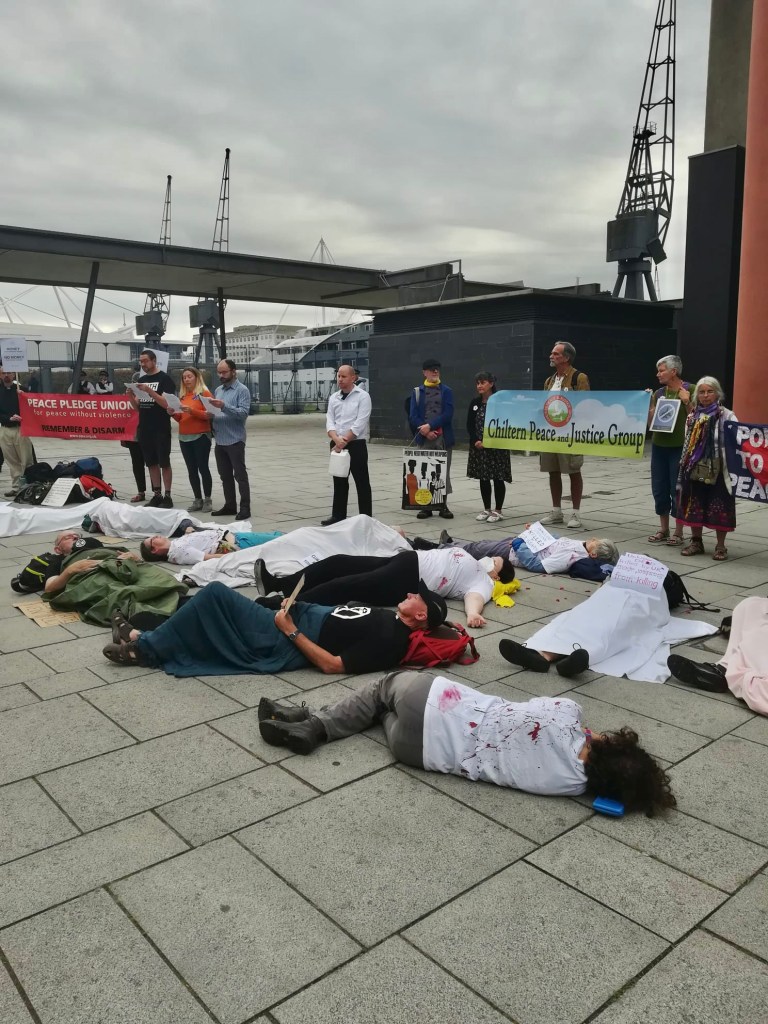
Recently I took part in a peace vigil outside the DSEI arms fair being held at London’s ExCel centre. Setting aside for a moment the morals of using weapons, there is something deeply uncomfortable about the idea of an arms fair: the idea that just as one can a book fair, or an Ideal Homes exhibition, or a horticultural show, one can have a ‘jolly day out’ walking round stands full of weapons, admiring staged demonstrations, picking up samples and goody bags, whilst enjoying alcoholic and other beverages. There is equally something very disturbing about people making profits out of buying and selling products designed to inflict fear, maim and kill.

But on the other hand are weapons a necessary evil, things that do have at some point to be bought and sold? Would we have wanted  the Ukrainians to be weaponless when the Russians invaded? Perhaps weapons are a necessary evil if we want peace not war? 

The following is not based on academic research, but simply a reflection of wha has been going through my mind. 

Is peace the opposite of war or vice versa? I think that peace is the opposite of war but that the reverse proposition is flawed. Peace is not simply an absence of war. It is far more. 

Peace is justice and equality. 

Peace is freedom. 

Peace is contentment and fulfilment. 

Peace is about the individual and the community. 

Peace is about the present and the future. 

This is a rigorous set of imperatives to meet. But does peace exist anywhere in the world? Here in the UK we are not at war, but do we enjoy the peace described above? I think not.

Justice is unevenly delivered. For those with money to pay for lawyers and the cost of court cases, there can be justice. Indeed for those with money to serve injunctions, injustice can be perpetuated. Justice is uneven delivered depending on one’s colour, race or faith. Activists seeking the right to protest can find their actions constrained by injunctions served on them by big corporations and institutions – and to compound the injustice, may then be billed for the injunction!

Equality is patchy – again depending on your wealth. The more you have, the more the system will work in your favour. If you can afford to go to a good school (whether by living in the right catchment area or paying fees) you will get better qualifications and better employment opportunities. If you can afford a better house – especially one you own rather than rent – you will be healthier, learn better and again  have better employment opportunities. If you are homeless, the chances of being as healthy, of getting good qualifications and a job are much less. If you grow up in a household with two parents, if you grow up in a household where everyone is literate, if you grow up in a household where everyone has a job, then you too will have better educational outcomes and better employment opportunities. Then there are postcode lotteries that affect your access to schools and health care. There are geographical north-south divides that shape your opportunities.

Freedom often depends upon access to money. To be free to travel, you need to be able to pay for transport.  To be free to take a holiday you need a higher enough wage – and/ or holiday pay – to cover your costs of living whilst on holiday. To be free to change career, you need sufficient money to cover re-training costs plus what is need to cover living costs whilst you study. To be free to live where ever you want, you need sufficient funds to match the great variation of costs across the country, from region to region, area to area. 

Contentment and fulfilment will vary from person to person, and some may find them for a very low outlay, but for others the cost may be prohibitive. One may find fulfilment in hillwalking, but another in skiing.  Neither ambition is inherently better but the latter may financially be unobtainable. If one’s contentment  depends upon swimming, fulfilment may depend upon whether your local authority still runs to swimming pools or whether your local water company keeps your rivers clean.

Because of the inequalities so far highlighted, you can see that some individuals in the UK may achieve lives of relative peace, but that as a community, our achievements are limited.

Again, sadly, whilst we may have relative peace for now, the ongoing likelihood of such peace is in the balance. With underfunded health, social care  and educational provision, the inequalities of access becoming increasingly dependent on money, seems likely to increase. And with the lack of investment in renewable energy, energy efficient infrastructure and in infrastructure (including things such as tree planting) to mitigate the  effects of the already changing climate, many people’s hope for future contentment  also looks bleak. Such is the state of peace in the UK. But what about more vulnerable countries?

What about Mali where rival militias tax or destroy rural communities? And where climate change is causing the loss of agriculture land with the expansion of the Sahara?

What about North and South  Sudan and Uganda where control of the water in the Sudd wetlands and the White Nile, is leading to disagreement and conflict?

 What about Pakistan where climate change is both melting glaciers and intensifying the wet and dry seasons, making agriculture less viable, and where rising sea levels are reducing the amount of available farm land? With limited opportunities to make a future at home, where can these farmers and their families go to seek a fulfilled life? Seeking refugee in Europe is increasingly difficult.

What about the people of the Democratic Republic of the Congo, where the race to mine copper and cobalt to make batteries, is driving many local people off their land, whilst at the same time polluting land and water supplies? 

Across the world there are many instances where one can see that peace is not present. These are potential hotspots which could lead to internal or cross border warfare. My contention is that if the money that would be spent on the wars that are likely to erupt, was instead spent on removing the obstacles to peace, we would not need to be investing in the arms trade. Where war is already happening, I do see that a different response is needed, but that is still needs to be one that establishes peace on both sides of the conflict.

I can well imagine that rather than building up resources for future war, building up the resources for peace would be financially cheaper. This peace building would involve establishing justice and systems of maintaining justice – both internally within countries and between them. It would involve removing existing inequalities and rebalancing fairly access to resources and opportunities. It would involve valuing contentment and fulfilment as more important than GDP. It would involve valuing equally the needs of individuals and the needs of communities. 

Not an easy task but one that is biblically mandated, perhaps, as in this passage from Micah.

And many nations shall come and say:
‘Come, let us go up to the mountain of the Lord,
    to the house of the God of Jacob;
that he may teach us his ways
    and that we may walk in his paths.’
For out of Zion shall go forth instruction,
    and the word of the Lord from Jerusalem.

He shall judge between many peoples,
    and shall arbitrate between strong nations far away;
they shall beat their swords into ploughshares,
    and their spears into pruning-hooks;
nation shall not lift up sword against nation,
    neither shall they learn war any more;

but they shall all sit under their own vines and under their own fig trees,
    and no one shall make them afraid;
    for the mouth of the Lord of hosts has spoken.

For all the peoples walk,
    each in the name of its god,
but we will walk in the name of the Lord our God
    for ever and ever. Micah 4:2-5

Here there is justice, for God arbitrates between nations and between peoples. Here there is equality such that  everyone can sit under their own vines and their own fig trees. Here freedom is suggested for  weapons have been turned into gardening tools, and no one makes anyone afraid. Here is (religious) freedom where people walk with their own gods. Here is contentment and fulfilment for all are taught the ways of God. 

Counting on …. Day 1.171

13th September 2023

Yesterday I took part in a peace vigil outside the Excel Centre which was hosting the DESI arms fair. The names of just a few of those who have been killed by military armaments were slowly read out accompanied by a slow drum beat. Armaments kill people. They also kill birds and animals, destroy trees and plants, and pollute soils and water ways. Their noise disrupts the migratory movements of birds and other creatures including migrating sea creatures.

In the season of creation-tide it is important to understand the widespread and destructive consequences of resorting to war.

Pilgrimage for the Planet

12th September 2023 – afterword

A Pilgrimage for the Planet –  

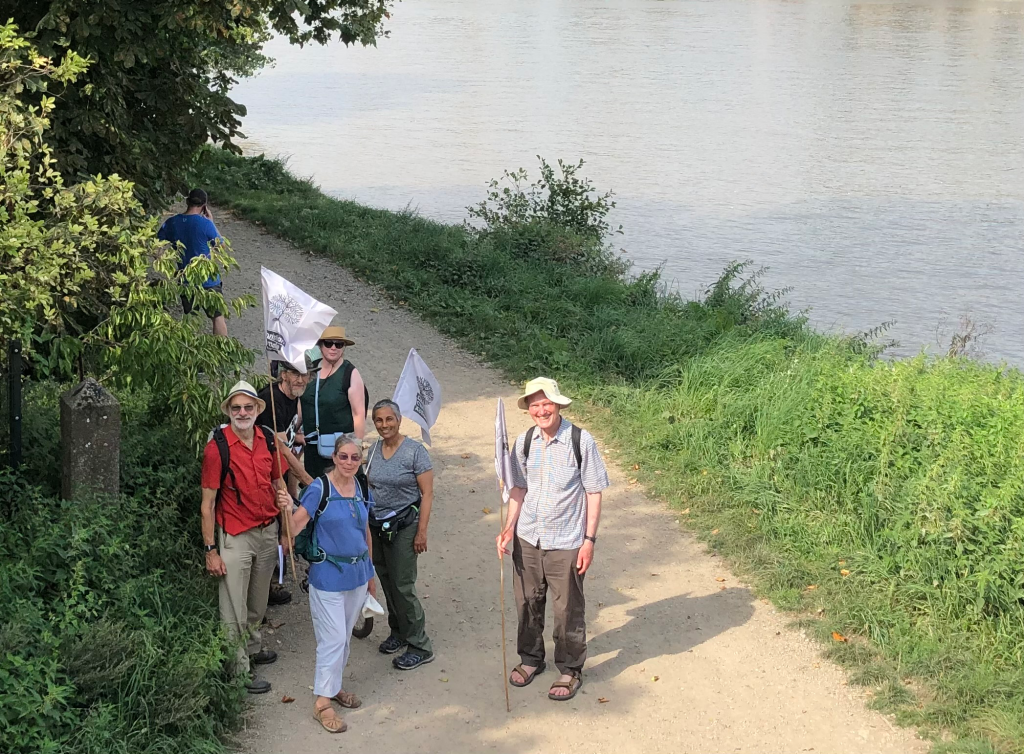
Out of thirteen pilgrimages organised by Christian Climate Action across the country, four took place along the Thames including the one from Putney to Richmond. Our small band of pilgrims were sent off with a blessing and prayers led by John Whitaker, vicar of St Mary’s Putney. As we followed the Thames Path upstream we paused to give thanks for the beauty and benefits of the river and its environment, as well as lament our shortcomings in caring for both its vitality and for our failure to ensure justice for the vulnerable in our local and global communities. pilgrimages organised by Christian Climate Action. Our recurring refrain was Let justice roll on like a river, righteousness like a never failing stream (Amos 5:24 and one of this year’s tag lines for creation-tide. Halfway we benefited from the welcomed hospitality offered by St Mary’s Mortlake as especially with the heat we needed to refill water bottles and enjoy the cool of the church. Exhausted (slightly fewer in number) but exultant we finally reached Richmond Bridge closing with a modern Franciscan blessing:

May God bless us with discomfort at easy answers, half-truths, and superficial relationships, so that we may live deep within our hearts.

May God bless us with anger at injustice, oppression, and exploitation of people, so that we may work for justice, freedom, and peace.

May God bless us with tears to shed for those who suffer from pain, rejection, hunger, and war, so that we may reach out our hands to comfort them and turn their pain into joy.

And may God bless us with enough foolishness to believe that we can make a difference in this world,  so that we can do what others claim cannot be done, to bring justice and kindness to all our children and the poor. Amen. 

For more information about Christian Climate Action visit https://christianclimateaction.org/ where similar events in the future will be advertised. 

Counting on … day1.170

12th September 2023

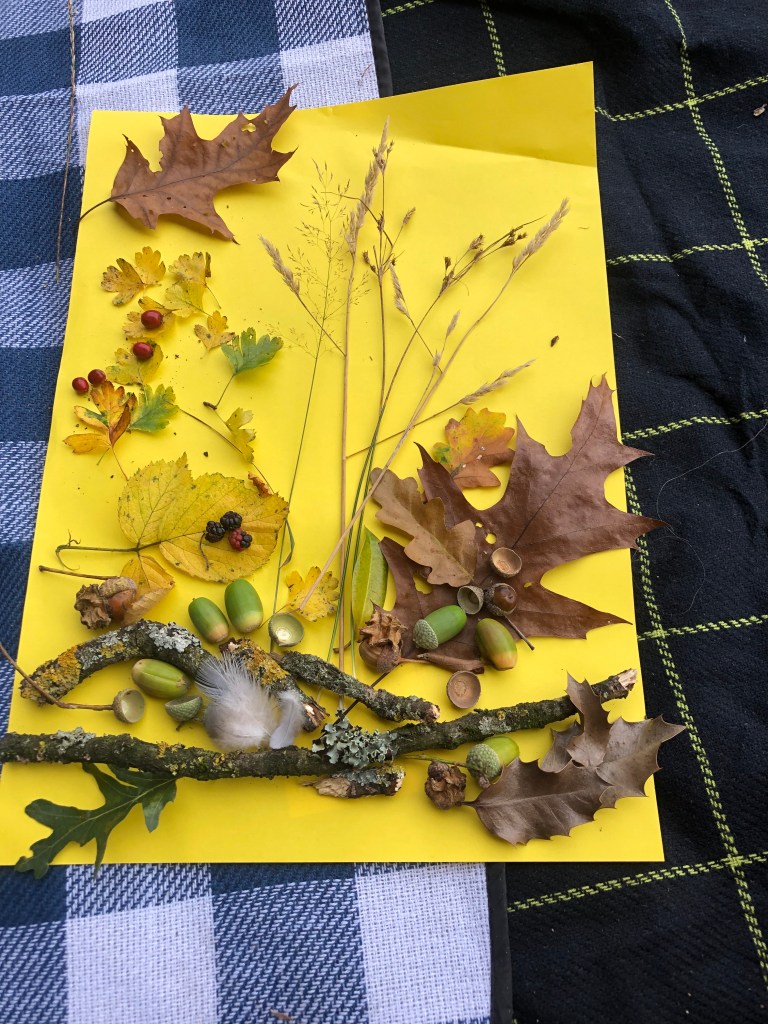
Yesterday I was helping with our local church’s Messy Church which this month was held on Sheen Common. Children with their mums/ carers did a scavenger hunt, made bark rubbings and arranged things they found to make a picture. It was good to see them having such fun whilst getting up close and personal with the natural environment. 

Counting on … day 1.169

11th September 2023

Here in the UK not  everyone has equal access to green spaces, fresh fruit and vegetables, clean air. 

This is a justice issue and one that should be tackled to improve wellbeing for the individuals and for society as a whole. It is something that has been recognised by the Government but how it can be realised and financed is not so clear. 

“Parks and greenspaces in England deliver an estimated £6.6 billion of health, climate change and environmental benefits every year. But with 80% of people now living in towns and cities, one third of people do not have access to good quality green and blue space within 15 minutes of their home. The government’s Environmental Improvement Plan, published [31st January 2023], includes a commitment that the public should be able to access green space or water, such as woodlands, wetlands, parks and rivers, within a 15-minute walk from their home.” https://www.gov.uk/government/news/natural-england-unveils-new-green-infrastructure-framework