Windows of Opportunity 

12th December 2023

Speak up for Activists

Activists and rebels are key ingredients in bringing about change. They bring important issues to the attention of the public, the government, businesses and  organisations. Their constant pushing back stops the issues being sidelined. Often they represent the feelings of a larger groundswell of people who do not feel so free to express their views. The actions of activists should open up the floor for debate, but where there are ingrained fears and invested interests, those with power may try and shut down their voices. 

Here is a report on this topic from the Guardian. “ Emma Thompson, Stephen Fry and Ben Okri have joined the former archbishop of Canterbury Rowan Williams and leading climate scientists to highlight what they describe as a “collective act of madness” that is driving “the destruction of life on Earth”.

A letter signed by more than 100 actors, authors, scientists and academics says the UK government is ignoring the scientific reality of the climate and ecological crisis, pushing ahead with new fossil fuel developments and criminalising peaceful protesters who raise the alarm.

““Rather than listening to reason or scientific fact, the UK government continues to hand out contracts for oil exploration in the name of false ‘energy security’ while steering the UK towards authoritarianism,” the letter states. “In Britain today, it is verging on illegal to urgently and effectively protest for the right of life to survive.”

“Michel Forst, the UN rapporteur on environmental defenders, last month described the situation in the UK as “terrifying”, with protesters having to navigate a draconian new legal environment that includes significant limits on the right to protest.” (1)

(1) https://www.theguardian.com/environment/2023/nov/24/actors-and-academics-criticise-uk-over-climate-madness-and-limits-on-protest?CMP=Share_iOSApp_Other

Green Tau: issue 83

Oil, profits and how to bring about change

14th November 2023

Following on from last week’s Green Tau, it seems that Shell – and other oil and gas companies – have no intention of cutting back on the amount of fossil fuels that they plan to extract and sell. If this becomes a reality, then the planet faces a grim future with rising temperatures and increasingly violent weather patterns that will make large parts of the earth uninhabitable. 

Is there anything that can be done to deflect and reverse this scenario? At present so many systems seem designed to perpetuate the profitability and financial attractiveness of fossil fuels. 

For example,  most buildings are heated via gas fired boilers, most vehicles are powered by petrol. Swopping to a different system of heating and powering vehicles is expensive, with the need for investment in new distribution networks, new manufacturing plants, newly trained staff both to make and maintain the new equipment – plus, of course, the need for customers to have sufficient resources to make the switch. 

Whilst at the same time, oil and gas companies are huge, having grown over many decades into international corporations, dominating our economies and therefore command great influence in the financial worlds – far more so than say a new, still small renewables company. 

There is also the inertia that comes from years practice. Customers, financiers, governments etc have been used to working with the oil and gas industry for so long, that change feels counter intuitive and difficult. The longer we have done something one way, the harder it is for us to imagine there being any other way.

Nevertheless there are ways of changing the system.

Government Action –

1. Remove government subsidies. Many governments, not just here in the UK, subsidise the fossil fuel industries, in part to keep their own economies competitive. But these subsidies are large and distort the market price of fossil energy. Recently 25,000 plus climate protestors in the Netherlands blockaded a motor way for ten days to persuade their government to review its continued payment of subsidies to the Dutch fossil fuel industry. (This is something we too should campaign for).

2. Increase subsidies to support renewable energy and so tip the markets away from fossil fuels. If governments can be persuaded to eliminate fossil fuel subsidies, it would be appropriate to equally ask that that money be diverted to both subsidise renewables, and to support those in our society who are suffering from fuel poverty.

3. Enforce stringent windfall taxes to recoup the money that the fossil fuel industry earns purely because of war and other global uncertainties. These events, because they lead to higher prices for oil and gas but have no effect on the cost of production, enable companies to receive increased profits at zero cost. Such windfall tax revenues should then be used to reimburse those vulnerable communities that have lost most because of the climate crisis.

4. Ban advertising for fossil fuels. Over recent years cigarette advertising has been banned to encourage consumers to make  more healthy choices and to reduce the cost to the NHS of the health issues caused by cigarette smoke. Fossil fuels cause even more damage to health and an even greater costs to society as jobs, homes, infrastructure, farming etc suffer from the adverse effects of the climate crisis.

5. By the same logic there should be a ban preventing fossil fuel companies from sponsoring sporting and cultural events. Such sponsorship has the additional concern that it portrays the sponsors as worthy upholders of what we value as a society – where as in fact their businesses are destroying what we hold dear.

6. Agree and impose a global tax on aviation fuel. At present aviation fuel – unlike petrol and diesel is not taxed. It would be too easy for airlines to avoid the tax if introduced state by state, by refuelling at airports where no tax was imposed.

7. Pro-active government advertising to encourage consumers to reduce consumption of fossil fuels.  Plus Government support to enable consumers to switch to green energy suppliers, to replace gas boilers with heat pumps, to replace car journeys with active travel (walking, cycling) or with public transport etc. 

8. Government legislation to ban internal flights where railways can provide the same connections. The EU is already gradually introducing legislation to achieve this in Europe.

9. Pro active  messaging from the government to show that they are committed to a speedy switch to renewable energy – certainty on the direction and speed of travel is important for the financial markets and those investing in green technologies. 

10. Legislation to require all businesses and organisations to have a net zero transition plan that encompasses scope 1, 2 and 3 emissions. Government support, to enable small concerns to undertake this, would be necessary. 

Businesses and organisations 

1. Pro-actively engaging in drawing up and implementing net zero transition plans to reduce their consumption of fossil fuels and their green house gas emissions.

2. Refusing to promote or advertise fossil fuels companies and products. The Guardian newspaper for example does not carry adverts for airlines. 

3. Cutting ties with companies that support the fossil fuel industries, such as banks, and insurance companies.

4. Supporting, developing and/or investing in renewable energy and zero carbon products. Seeking out alternative materials that can substitute for fossil fuels.

5. Giving support to activist groups seeking to persuade more reluctant organisations to adopt climate friendly policies.

Consumers

1.Wherever we can (depending on our financial position) to opt not to buy fossil fuel products – eg by switching to green energy suppliers, reducing petrol consumption by, for example, walking or cycling, using public transport, car sharing, using an electric car, by not flying, by replacing boilers with heat pumps etc, and by cutting back or avoiding products made from oil – such as plastics but also vinyl products, polyester etc. (For a comprehensive and amazing list see https://www.energy.gov/sites/prod/files/2019/11/f68/Products%20Made%20From%20Oil%20and%20Natural%20Gas%20Infographic.pdf)

2. Use our voting power  to elect a government that is pro the wellbeing of the climate and environment and anti the damaging actions of the fossil fuel industry. This applies to local as well as national elections. In between elections, email your representatives if you feel they are not sufficiently supporting the well-being of the environment.

3. Target all companies with ties to the fossil fuel industry such  as banking and insurance, to urge them to cut their ties and support instead the renewable energy sector.

4. We can as individuals and as campaign groups be vocal in telling the truth about emissions from the fossil fuel industry and so counter their green washing.

5. Switch our bank, pensions, insurance etc to companies who are not supporting the fossil fuel industry.

Counting on …. Day 1.199

23rd October 2023

“Climate activists are sometimes depicted as dangerous radicals.  But, the truly dangerous radicals are the countries that are increasing the production of fossil fuels.” So said the UN Secretary-General António Guterres last year at the launch of the third IPCC report.

Last week the Intercontinental Hotel in Park Lane hosted the Energy Intelligence Forum – an international gathering of influential figures from the oil and financial industries – formerly known as the Oil and Money Conference. These people hold great power with very little reference to either democratic decision making or alternative view points. The decisions they make, and the strategies they plan, will have a big impact on what happens in the world, on the future of wellbeing of people, the environment and the climate. 

In opposition to this Fossil Free London and other groups such as Extinction Rebellion, Greenpeace and Christian Climate Action, organised protests outside the hotel and at selected headquarters of oil and financial institutions across London. With our future at stake, it was imperative right to call out the injustice of what was happening. The IPPC and IEA have both presented the world with the scientific evidence that carbon emissions are causing the climate crisis, and that the urgent response must be cutting back now on fossil fuels extraction and use, as we all transition to net zero. And yet, regardless of this, the oil industry is continuing to expand its operations, and the financial world is continuing to invest in and to insure these projects – using what is ultimately our money.  

On the Monday evening, the eve of the conference, Christian Climate Action held an act of worship out on the street opposite the hotel’s main entrance. Using words from the most recent papal encyclical,  Laudate Deum (Praise God). It is so called, because the Pope says that when human beings claim to take God’s place, they become their own worst enemies. In the worship we bore witness to the injury and injustice that the oil industry is causing in the world, and in between prayerful silences we sang  praises to God using the Taize chant ‘Laudate omens gentes’.

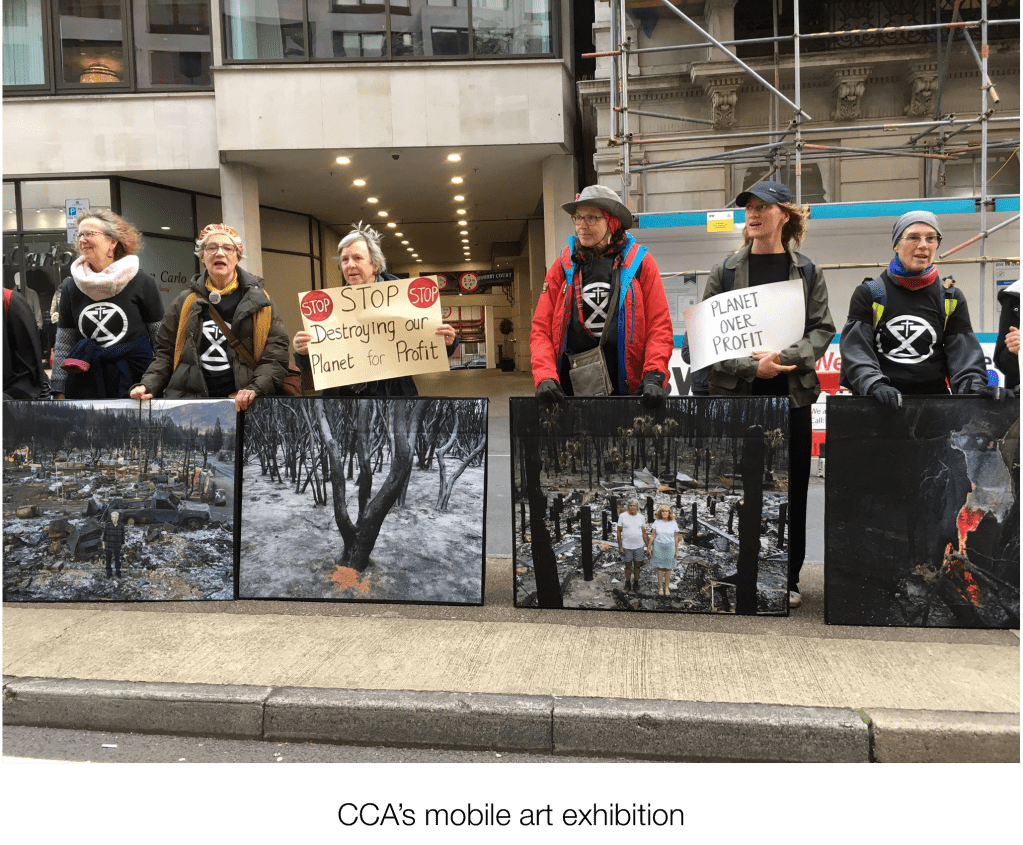
Tuesday CCA again gathered in the street opposite the hotel with a series of photographs – a mobile art exhibition – each an illustration of the effects of wild fire on the environment and people’s lives. Fossil Free London and others blockaded the hotel entrance – the hotel had erected high fences along the whole area restricting the entrance to a meter wide gate way which was  easily blocked by protestors preventing guests from entering or leaving. A samba band played, people sang and chanted, and speeches were delivered – the key speaker was Greta Thunberg. Mid morning a group from Greenpeace abseiled down from a top floor window, unfurling a banner down the front of the hotel. The conference delegates could not have gone unaware of the opposition to their plans for an oil fuelled future. Indeed the CEO of Shell had to make his speech by equivalent of zoom. By the early afternoon the police had imposed a section 14 notice on the street, authorising them to remove all protestors from the site. 

The Christian Climate Action group set off on a pilgrimage around Mayfair stopping to pray at the offices of a number of ‘Earth Wreckers’ – companies involved in financing, supporting or exploiting fossil fuels and thereby directly or indirectly polluting the world with carbon emissions. (For more information about Earth Wreckers visit – http://umap.openstreetmap.fr/en/map/wreckers-of-the-earth-2021_409815#12/51.5222/-0.1234)

On Wednesday action was taken further afield to the City of London. Ten companies associated with the West Cumbrian Coal Mine and the East Africa Crude Oil Pipeline were targeted, to protest against their involvement in funding these highly polluting projects. Christian Climate Action together with representatives of other faiths and a group from XR Scientists, peacefully entered and sat down in the foyer of 52 Lime Street – a modern glass and steel tower block that houses Chaucer, the UK subsidiary of China Re and a potential insurer of EACOP. Sat together in the middle of the space – allowing office workers to continue in and out of the building – we sang Buddhist and faith songs and shared an agape of bread and ‘good’ olive oil. 

Within half an hour the police arrived and stood round us, watching. Then with such joy and hope, we saw the XR procession, that was marching between each of the sites, arrive with hundreds of supporters, flags and banners, and a samba band. They waved to us through the plate glass windows and cheered, and we sang and waved back. When they marched on, a contingent from CCA stayed on outside both protesting and praying. The building’s security staff obviously wished us to leave, but the police having taken advice from the CPS, took the view that as our protest was peaceful, they had no grounds for arresting us. After some discussion within the group, we agreed that we would stay until 3 o’ clock. So at 3 o’ clock we stood up, tidied up our banners and picnic lunch and still singing, walked out. We had made our point. 

Despite the rain, we returned to the Intercontinental Hotel that evening for a further act of worship, this time led by various representatives of the Faith Bridge -Buddhist, Muslim, Jewish, Quaker and Christian.

Christian Climate Action continued with its support of other groups on the Thursday, targeting amongst others, the offices of J P Morgan. I meanwhile held my weekly hour long vigil outside Shell’s headquarters. 

For information about Christian Climate Action visit – https://christianclimateaction.org/

Green Tau issue 82

10th October 2023 

“No one expects the Spanish Inquisition!”

“No one expects the Spanish Inquisition!”- the catch phrase from one of the Monty Python sketches. At bizarre moments in innocent situations the red clothed members of the Spanish Inquisition would suddenly leap out ejaculating “No one expects the Spanish Inquisition!”

The same is true of the climate crisis. No one expects the climate crisis to interrupt their daily life. Yet it does. A sudden torrential storm, a flash flood, an unseasonal heat wave, a spark and a forest fire destroys a town.

No one expected storm Daniel to devastate the farm land of Thessaly, or to inundate the town of Derna in Libya. No one expected a storm to kill 11 in the Western Cape. Olive farmers in Spain did not expect heat waves and droughts to devastate 2/3 of their harvest. Holiday makers on Rhodes did not expect to be surrounded by wild fires. No one expected that wildfires would still be burning in Alberta in October. No one expected more than a month’s rainfall in 36 hours causing flooding across communities as far apart as Greenock and Aviemore. 

Do we think of these extreme weather events as freak events that won’t be repeated? Do we see them as things that happen elsewhere in the world  but not here? Do we see them as something that would never happen to me?

If we don’t expect them, then we are as unlikely to plan for them. That perhaps is too easily the situation in which we and our politicians find ourselves. And so we all carry on as if such extreme weather events will never happen to us and that our lives will not be disrupted. 

How you rate the risk of the likelihood of an extreme weather event probably depends on how much you know about the climate crisis. The more you know, the more you will have come to understand that the risks are high, and are growing each year that we allow carbon emissions to expand. The science is clear. 

It is less easy to predict is when and where these extreme events will happen, but the effects will be significant.  Herein is the problem. How does one convey the degree of risk, the degree of disruption that the climate crisis will cause of one cannot be specific about time and place?

This is why some groups, such as Just Stop Oil, choose actions that will disrupt daily life now. The disruption is a taster on a very small scale of the disruption we, the public, will face when we are the focus of an extreme weather event. Groups like Just Stop Oil are warning us that the climate crisis will cause massive disruption far worse than a 15 minute road delay road or interrupted theatre performance, and that we are doing nothing at the appropriate scale to prevent it. 

We should be demanding that serious action be taken now by the government, by big businesses, by investors. We should be embracing and calling for the carbon budgets and strategies recommended by the Climate Change Committee to be implemented at once and at speed.

For the CCC report of the government’s current progress in meeting tey current Carbon budget, see – https://www.theccc.org.uk/wp-content/uploads/2023/06/Progress-in-reducing-UK-emissions-2023-Report-to-Parliament-1.pdf

For the CCC’s budget for 2033-37 (ie the period for which we should be planning now –  https://www.theccc.org.uk/wp-content/uploads/2020/12/Policies-for-the-Sixth-Carbon-Budget-and-Net-Zero.pdf

For a further article on understanding net zero targets see – https://greentau.org/2023/05/30/green-tau-issue-70/

Counting on … day 1.122

10th July 2023

Over the weekend I was with Christian Climate Action, raising awareness, through prayer and actions, about the urgency of the climate crisis amongst members of the Church of England who were attending the General Synod held in York. On the Saturday the Synod received a report from their National Investment Boards, outlining the strategy by which they make investments in relation to the climate crisis – a strategy created at the request of the General Synod in 2018. The NIBs response has included working with others to create  the Transition Pathway Initiative which examines – and rates – leading companies across all sectors to establish the degree to which they have a business plan compatible with the 2050 net zero emissions target. This year’s report to Synod was particularly focused on their decision to divest from major fossil fuel companies because their business plans are not so aligned – especially in the critical short term of the next few years.

Will NIBs and more importantly the Church of England as a whole now use its voice to urge other investors to follow suit? Will the remaining 6 C of E dioceses (including Southwark) now also divest themselves of  fossil fuel holdings? Will the Government pay attention and review its decision to license new oil and gas exploration and production?

Counting on … day 1.119

7th July 2023

Since April Just Stop Oil have been organising daily slow marches to highlight their demand that the government end all new oil production: fossil fuels are the single biggest contributor to the climate crisis. One protestor, Hilary Bond, wrote in the statement she read out in court: “I really believe that the criminals in this case are not the protesters like me but the people who could give our children and grandchildren a liveable future and refuse to do so.”*

How do we live with our inability to collectively address both the climate and the ecological crises that beset our world if those in power will not listen?

  (https://contemplationandaction564034803.wordpress.com/2023/07/04/consequences/#respond)*

Counting on … day 1.147

22nd June 2023

Yesterday I took part in a prayer vigil outside the Supreme Court. Standing up – or kneeling in prayer – to give support can make a difference.

Inside Kent Council’s decision to grant planning permission for 20 years of oil extraction from the ground beneath Horse Hill was being challenged. In considering the environmental impact of the drilling, Kent Council had on,y consider scope 1 and 2 emissions – ie those directly produced in extracting the oil – and not the scope 3 emissions, being those that would be released when the oil was used. The parallel was drawn between the health impact of making a cigarette and smoking a cigarette. 

Counting on … day 1.119

Counting on …. Day 1.119

23rd May 2023

The campaign group “We Move” believes that politics in Europe needs to put people and planet first, and that it is people who have the power to push for the changes that are needed. 

Here is one of there current campaigns –

“Just 1% of people are responsible for half of all toxic emissions from flying….But here’s the thing: we can do something about it. In fact, the solution is simple – cut emissions from luxury flights. This includes a ban of private jets from European airports, a tax on frequent flyers and an end to frequent flyer programmes. And we know it can be done: Climate activists recently scored a win and managed to ban private jets at Schiphol Airport in Amsterdam. Let’s build on that success and cut down luxury emissions from flying.”

https://act.wemove.eu/campaigns/ban-private-jets-and-luxury-emissions

Counting on … day 1.103

27th April 2023

Reflecting further on The Big One and what it achieved, it showed the positive being that humans can be.

60,000 people gathered to show both their concern for the damage being done in the world and to share their belief that a better world is possible.

60,000 people filled the streets and there were no arrests, no reports of anger or abuse. Well trained and and caring stewards kept everyone self and well looked after.

60, 000 people met and showed respect for each other, welcoming the young and the old, the fit and the not so fit, people of all races and backgrounds, genders and faiths.

60, 000 cooperated, sharing the space and the experience with each other.

60,000 people were entertained and inspired and drew strength from each other’s commitment.

The Big One, for me, demonstrated that a better world is possible and that the counter-cultural characteristics that we read off in the Gospels, the Letters and the Book of Acts is out there for real – and not confined within the walls of the churches.

Counting on … day 1.102

26th April 2023

Why do we need events like The Big One?

Gatherings of scale such as the Big One do 5 things:-

  1. Shows the authorities the size of public opinion
  2. Encourages those taking part that they are not alone in their endeavours
  3. Encourages other to find out more and/or join in the campaign
  4. Gives participants and spectators stories to tell that further the campaign
  5. Brings together and builds links between groups with similar aims.