“Let’s dispense with any idea that climate finance is charity;” runaway climate change is impacting “every single individual in the world one way or another,” Mr. Stiell, the UN climate chief, said on Monday.
Why do poorer nations (in particular) need climate finance? Because it can enable them to:
take action to mitigate against the causes of climate change – eg switching to renewable energy, replacing wood/coal fired cooking stoves with electric ones, greening heavy industry;
take action to adapt to the ongoing effects of climate change – eg insulating buildings against extremes of heat, upgrading flood defences, improving early weather warning systems;
cover the costs of damage caused by extreme weather and other destructive effects caused by climate change.
Adapting lifestyles and infrastructure to cope with the already present aspects of the climate crisis do not come cheaply – although it is definitely (infinitely) cheaper than the cost of making good the damage that would otherwise occur.
Not all countries can afford these essential costs. As a matter of justice and of common human decency we need to count on the world leaders to both agree and – most importantly – to pay their fair contribution to enable all global citizens to be protected.
“Poorer developing nations are struggling to find the money to meet those increasingly urgent challenges, with this week’s Adaptation Gap report putting their annual adaptation needs at $215 billion-$387 billion, against international public funding of about $28 billion in 2022.
Wealthy governments say they’re on track to deliver a goal to double adaptation finance from 2019 levels by 2025, to around $40 billion a year – but that would only reduce the adaptation finance gap by about 5%, the report warned. (1)
Even if we stop adding carbon dioxide to the atmosphere, the CO2 that is already there will not immediately diminish. It will be there for decades to come, meaning that the higher global temperatures that we are already experiencing will also not diminish any time soon. And this means that the extreme weather events that we are now experiencing – floods, droughts, heatwaves, wild fires etc – are not going to diminish either. We therefore need to count on the world leaders at COP29 to agree measures to help us adapt to the changes in the climate that we have already caused – improved flood defences, developing new farming models, conserving water, expanding early weather warning systems, heat proofing buildings etc.
What is the difference between mitigation and adaptation?
“Climate change mitigation means avoiding and reducing emissions of heat-trapping greenhouse gases into the atmosphere to prevent the planet from warming to more extreme temperatures. Climate change adaptation means altering our behaviour, systems, and—in some cases—ways of life to protect our families, our economies, and the environment in which we live from the impacts of climate change. The more we reduce emissions right now, the easier it will be to adapt to the changes we can no longer avoid.” https://www.worldwildlife.org/stories/what-s-the-difference-between-climate-change-mitigation-and-adaptation
The UK government runs a National Adaptation Programme which assesses the risks arising from climate change and how best we can adapt to reduce of cope with these risks – as well as building on any opportunities where we can gain from change. These plans are reviewed and every five years a new National Adaptation Programme is produced. NAP3 covers the period from 2023 to 2028. It includes items such as:
“protecting the natural environment
supporting business in adapting to climate change
adapting infrastructure (for example, our electricity networks and railways)
protecting buildings and their surroundings (for example, from hotter temperatures)
protecting public health and communities
mitigating international impacts on the UK (for example, on food supplies imported from abroad)”
“Julia King, chair of the adaptation subcommittee of the CCC, said: “The evidence of the damage from climate change has never been clearer, but the UK’s current approach to adaptation is not working. The national adaptation plan published last July, known as Nap3, was the third in a series of five-yearly updates in response to an assessment of climate risks, required under the 2008 Climate Change Act, from the Department for Environment, Food and Rural Affairs.
“But the CCC found that although it was an improvement on previous efforts, the new plan was still inadequate and required improvement before the next scheduled update in 2028.
Support climate adaptation projects at home and overseas
The Grantham Institute explains adaptation thus:
“Humans have been adapting to their environments throughout history by developing practices, cultures and livelihoods suited to local conditions – from the Mediterranean siesta to the Vietnamese practice of building homes on stilts to protect against monsoonal rains. However, climate change raises the possibility that existing societies will experience climatic shifts (in temperature, storm frequency, flooding and other factors) that previous experience has not prepared them for. As average global temperatures rise, the impacts of climate change and their associated losses and damage are likely to increase more rapidly and more unpredictably.
“Adaptation seeks to reduce the risks posed by climate changes, and to benefit from any associated opportunities where possible. It is one of two main policy responses to climate change, the other being mitigation – reducing greenhouse gas emissions to address the root causes. Both approaches are necessary because even if emissions are dramatically decreased over the coming decade, further warming is now unavoidable and adaptation will be needed to deal with the climatic changes already set in motion.” https://www.lse.ac.uk/granthaminstitute/explainers/what-is-climate-change-adaptation/
In the UK, adaptation could include insulating buildings so they stay warmer in winter and cooler in summer; planting more trees to provide shade and cooling in summer and to trap rain water to limit flooding; restoring and creating new peat bogs and wetlands areas again to absorb excess water (and carbon too); re-wilding rivers and restoring water meadows to absorb and slow the rate of flow of water to prevent flooding; changing the school timetable and working day to allow people to rest during the middle of the day during heat waves and to work instead in the cooler hours earlier in the day – a siesta; not building on flood plains or close to the coast where rising water levels present a risk; relocating buildings and contents which are at risk of flood damage; growing plants more suited to our new climate including agriculture crops; making good use of solar and wind energy.
As a rich nation we need to help less affluent – and often more critically affected – nations adapt to the changing climate. The options for adaptation will be similar in nature to those for the UK – insulating buildings to protect against extremes of heat; using vegetation and the restoration of natural habitats; adapting agricultural and work practices; harnessing renewable energy.
We can support adaptation projects with funds and/or volunteering with local projects; campaigning to support projects particularly when they are opposed by government or big business; providing funding for overseas projects through charities such as Practical Action and Oxfam, as well as pressing the government to contribute at the scale necessary to make a different and to reflect our moral obligations.
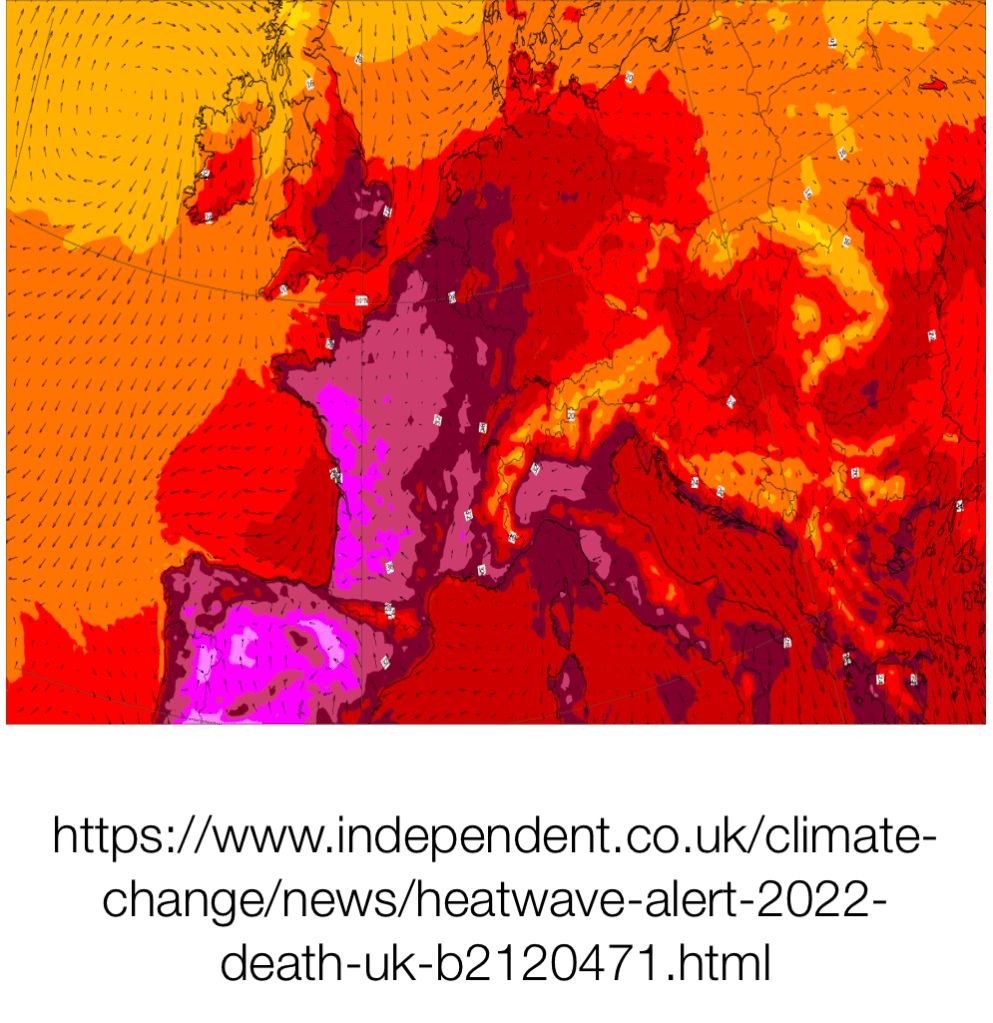
It is only a week since we endured a two day extreme heatwave but is it already passing out mind, out of sight? Let’s continue to talk about climate change and how it is already affecting us. Let’s plan now for how we will help each other cope better during the next heatwave. This may come this summer, or maybe next, but it will certainly come.
The challenge of rising sea levels for Pacific islands.
20th January 2022
Last week the Green Tau focused on Richmond and the likely effects of the increased risk of flooding arising from climate change. This week the focus will be on Tarawa, one of the 33 atolls that makes up the Pacific nation of Kiribati.
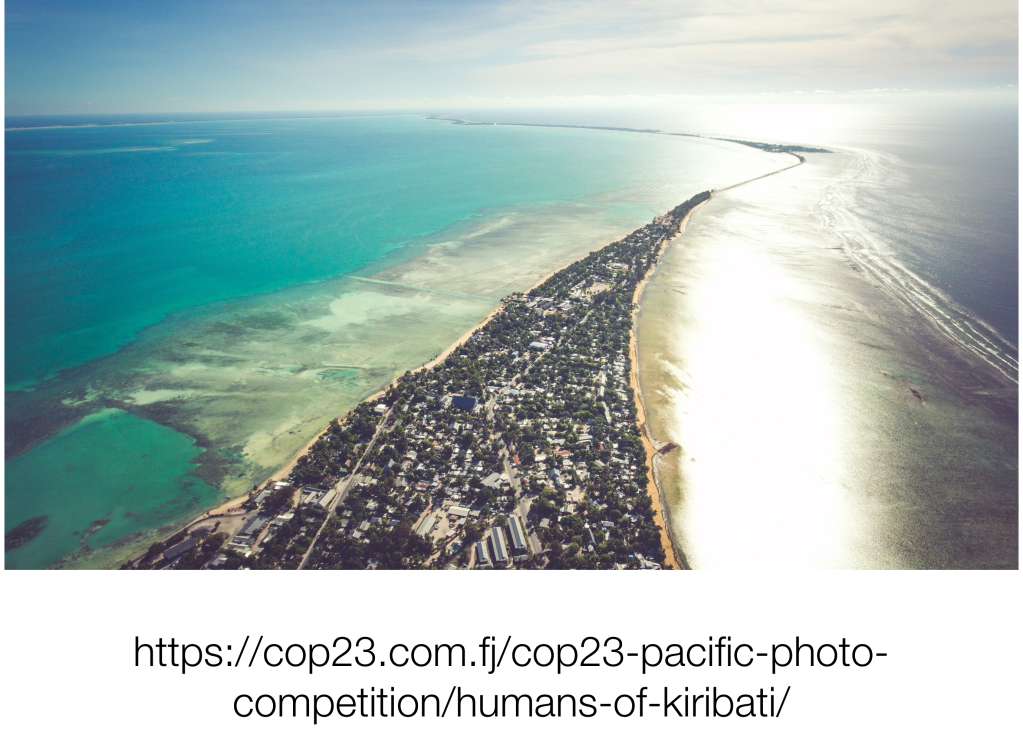
Tarawa is one of the largest of Kiribati atolls and is home to one 60,000 people, about 53% of the total population. Seen from above, Tarawa is a long thin strip of land that curves to form two sides of a triangle, in the middle of which is a lagoon. (Atolls are islands created by volcanic action. The former crater forms a dip in the middle). The third side of the triangle is below sea level and is home to a coral reef. It has a very long coast line in proportion to its land area. The land is flat and low lying, rising to about 2-3m above sea level. Beaches on the lagoon side tend to be wider and shallower than this on the ocean side.
Scientific research suggests that the rise in average sea levels for Tarawa, by 2100, will be between 0.5 (if the global temperature increase is kept below 1.5C) to 1.2m (if the increase in the worst case is 5-6C). Present projections suggest we are on track for a 2.7C temperature rise – and a projected sea level rise for Tarawa of 0.6m. High tide is typically 1.2m above the mean sea level, but is subject to variation. For example tide levels rise during periods when the El Niño weather system is dominant because the high pressure lifts sea levels. Because of its shape, with along coast lines and narrow low lying land mass, Tarawa – like many similar atolls and islands – is very vulnerable to rising seas levels. The people of Tarawa can see that before the end of this century they may no longer have an island on which to live!
Sea levels also rise markedly when drive by cyclones. The Republic of Kiribati used not to be affected by tropical cyclones but with increasing global temperatures and changing weather patterns, this is no longer so. Not only do cyclones produce flooding with high waves, but the strong winds are particularly destructive to low lying lands such as on Tarawa with the winds breaking sea defences, ripping up vegetation and blowing away soil. (Soil depths are already shallow because these volcanic atolls are relatively youthful in geological terms).
Tarawa is located on the Equator and it has a tropical rainforest climate. It rains on average every other day, with a high of rainfall of about 300mm a month in January and a minimum of 100mm in September. This ensures that the water table is regularly topped up. However the land above sea level at Tarawa is narrow, with saline after on both sides. Rising sea levels leads to the contamination of freshwater supplies with salt. This reduces water for drinking etc as well as damaging agricultural crops and plant life generally.
Rising global temperature affect not just the air but also ocean temperatures. Since preindustrial times, global sea surface temperatures have risen by 0.7C. The rate of increase has risen in recent decades and particularly so in the last 6 years. Temperatures rises are not uniform and have been more marked in the southern Pacific waters. The IPCC predicts sea temperatures may rise by 1.2 to 3.2C by 2100 (depending on our ability to reduce carbon emissions). Rising sea temperatures affect marine life generally and reefs in particular. Temperature rises in the region of 1C can cause the bleaching of coral reefs. This draining of colour shows that the coral is stressed, and is likely to die. Associated with heat rises accentuated by El Niño, Tarawa has had repeated incidences of coral bleaching. When coral reefs die and break down, they no longer protect local shores from erosion nor protect lagoons from destructive waves that destroy the particular ecology of those calmer waters. The loss of coral reefs also leads to losses of marine biodiversity.
Tarawa and the rest of the atolls in the Republic of Kiribati are not alone in facing these devastating effects of climate change. In 1990 they and other similarly vulnerable countries formed the Alliance of Small Island States to give themselves collectively a more voluble voice in discussion and proposals around the climate crisis. The AOSIS was a particularly strong presence at the Paris Climate Conference in 2015. Their voice was also heard at the Glasgow COP last year although because of covid fewer delegates were able to attend. One of those unable to travel was the former President of Kiribati, Anote Tong. Speaking from home, he told ITV News that beyond 2030 “our very existence might be in jeopardy”.
In 2012 Tong bought a 2700 hectare estate on the island of Vanue Levu in Fiji as a refuge for the citizens of Kiribati, plus a further 2000 hectares in 2014. Between 2003 and 2015 the Kiribati Adaptation Plan was executed using money raised by the United Nations from wealthy donors such as Australia This included projects such as planting mangrove palms to limit coastal erosion, strengthening sea wall defences, and installing rainwater butts to help safeguard fresh water supplies.
In 2020 the new President of Kiribati, Taneti Maamau, announced plans, in conjunction with China, to artificially build up parts of Tarawa, to raise them above projected sea level rises.
In the mean time other adaptations projects are on going to improve the islanders’ living standards and build up their resilience in the face of flooding. These include encouraging islanders to develop traditional food gardens to protect against sudden food shortages (much of Kiribati’s food is imported), developing fish management schemes to prevent over fishing, and increasing provision shade to protect people from adverse temperatures. Consideration is now being given to using the land bought in Fiji to provide food for Kiribati. It seems that due to poverty, the people of Kiribati are not well equipped to cope with the extra demands and risks of the climate crisis. Equally important are these projects designed to improve their living standards, health and well being.
Today’s agenda at COP26 features adaptation, loss and damage. The extreme weather conditions we have seen in recent years – droughts and wildfires, floods and heat waves, storms and cold snaps – are here to stay as a direct consequence of the 1C warming that has already taken place. Current efforts at COP26 will hopefully constrain further rises in temperature to no more than 1.5C.
Across the globe, communities are and will have to adapt to the changes that are happening in weather patterns. In the UK we need plan how we cope with more frequent and deeper floods, spasmodic heat waves and irregular growing seasons. In the Pacific region where there are many low lying islands and around river deltas such as in Bangladesh, there is the need to plan for rising sea levels which not only submerged land where people live but also salinates water used for drinking and farming. Many sub Saharan regions are faced with prolonged heat waves that make daily life and farming near impossible. Whilst other regions will feel the affects of drought as rivers that are normally fed during the summer by the slow melt of glaciers, dry up as the glaciers disappear altogether.
Time and again, the solution lies with trees, whether that is trees that interrupt, and delay the speed with which falling rain becomes flood water, trees that stabilise coasts vulnerable to erosion, tree shade that reduces experienced daytime temperatures, or trees that provide shade for crops and whose roots retain moisture in the soil.
“Locally, trees provide most of their cooling effect by shading. How warm we feel actually depends less on local air temperature, and more on how much electromagnetic radiation we emit to, and absorb from, our surroundings. A tree’s canopy acts like a parasol, blocking out up to 90% of the sun’s radiation, and increasing the amount of heat that we lose to our surroundings by cooling the ground beneath us.All up, the shade provided by trees can reduce our physiologically equivalent temperature (that is, how warm we feel our surroundings to be) by between seven and 15°C, depending on our latitude. So it’s no surprise that, in the height of summer, people throng to the delicious coolness of the shade provided by London parks, Parisian boulevards, and Mediterranean plazas.
Trees can also cool down buildings – especially when planted to the east or west – as their shade prevents solar radiation from penetrating windows, or heating up external walls. Experimental investigations and modelling studies in the USA have shown that shade from trees can reduce the air conditioning costs of detached houses by 20% to 30%.”
Dress in loose light coloured and light weight clothes. Go bare foot. Wear a sun hat.
Close curtains and open windows to keep the sun out and air moving through the room. But if the outside temperature is warmer than inside, it may be better to keep the windows closed to keep that hot air out! Open windows on different sides of the house and different floors to encourage air to move through the house.
Turn off unused electrical appliances, even those on sleep may be emitting extra heat into the room.
Hang wet towels over or near an open window, or place a bowl of water or ice by the window. Air moving through or across will absorb the moisture and cool the room.
Shade the outside of the window to prevent the glass from heating up and radiating heat into the room. You could use a sheet or towel as an ad hoc shade. Or place a gazebo or sun parasol to shade the window. Longer term consider fixing an awning to shade south facing windows. Or erect a pergola outside and allow climbing plants to shade the window.
Sit with your feet in a bowl of cold water. Keep damp flannels in the fridge for a cool wipe.
Freeze a plastic bottle of water (don’t completely fill the bottle as frozen water expands) and use it as a cold ‘hot’ water bottle. To avoid ice burns wrap in a towel before placing it on your skin. Alternatively place in your bed at night.
Fill a sock with rice, secure the end and place in the freezer. Use as a cold pad or as cold ‘hot’ water bottle in your bed.
Get up early and start your day while it is still cool. Catch up on sleep later with an siesta when its hot.





 The Green Tau