
Green Tau: issue 103

Reshaping how we can talk positively about the climate crisis – part 3:  Transport 

March 2025

How can we talk about the climate crisis in a way that sounds encouraging?

The climate crisis is an existential threat which is certainly not good news. Its causes and impact are diverse and numerous such that it is hard to pin down ‘This is the cause’ or ‘This is the solution’. It is hard to quantify ‘This is how it will effect you’ and ‘This will be the time table.’ 

All this makes it difficult to find a way of talking to people about the crisis and how we might respond.

So here are some thoughts that might help.

Clean Air

Switching from fossil fuels to clean energy* to power road vehicles reduces the amount of pollution that goes into the air we breathe. The pollution from petrol and diesel vehicles includes carbon monoxide, particulate matter and nitrogen oxide and is released into the environment predominately in places where people living, where people are working, where they go to school, where they are simply walking by. Air pollution causes  28,000 and 36,000 early deaths each year in the UK (figures for 2018). Sustrans estimates that road transport is responsible for 80% of roadside NO2 pollution which is where the legal limits are being broken. (1) 

With the growing use of electric vehicles air pollution has fallen …. And without admissions to hospital

In London progressive policies have been put in place to reduce road congestion and more specifically to reduce the air pollution from road vehicles, with the most recent being the expansion of the ultra low emissions zone (ULEZ) to cover all London boroughs in August 2023. Since then pollution from road vehicles across the wool of London has been reduce by 27%. (2) This should lead to a reduction in premature deaths.

Another component of air pollution caused by road vehicles is the fine particulate matter that comes from brake blocks, tyres and even the tarmac. These particles are formed through friction whether that is the brakes slowing the vehicle or the tyres rubbing against the road. Such pollution is known as Non-Exhaust Emissions or NEE. In its report on NNE Defra observed that currently there is no legislation in place to limit this source of air pollution but highlighted possible ways in which such pollution could be reduced, vis:  “The Most effective mitigation strategies for NEE are to reduce the overall volume of traffic, lower the speed where traffic is free-flowing (eg trunk roads and motorways), and promote driving behaviour that rescues braking and higher-speed cornering.”(3)  

As well as ULEZ, London has also benefitted from the widespread introduction of a reduced speed limit for vehicles – from 30 to 20 mph. “An evaluation of 20mph zones in London, carried out by Imperial College, showed slowing traffic had no net negative impact on exhaust emissions. However, in 20mph zones vehicles moved more smoothly, with fewer accelerations and decelerations, than in 30mph zones. This smoother driving style reduces particulate emissions from tyre and brake wear – which still represents a significant cause of air pollution from zero-emission vehicles.” (4)

Switching to electric vehicles, introducing low emissions zones and reduced speed limits, are all contributing to reducing the air pollution that causes so many premature deaths as well as reducing carbon emissions.

Wellbeing 

Active travel includes walking and cycling, and in many cases can replace short car journeys. It can also be combined with the use of public transport (walking to the bus stop or the station) and so replace other longer car journeys. Reducing car journeys reduce carbon emissions and/ or – in terms of electric vehicles – the load on the electric grid. Switching to active travel however also produced significant health benefits (and thus savings for the NHS). 

The Health Foundation notes that “Almost 1,800 early deaths per year could be prevented if activity levels for walking and cycling were to match the most active regions in England.” (5) The most active region was London where people walked and cycled an average of 1.2 miles per day. The Department of Transport estimates that inactivity costs the NHS “up to £1 billion each year, with additional indirect costs of £8.2 billion…” The exercise gained through active travel also has benefits for mental wellbeing. 

The Department for Transport also reports the following further positive benefits of active travel – 

“Increasing active travel will reduce road congestion, particularly at peak times, leading to increased productivity and improved movement of goods and services. Sustrans estimates that congestion costs £10 billion per year in 2009 in urban areas, and that this cost could rise to £22 billion by 2025. Living Streets’ Pedestrian Pound report outlined a range of economic benefits of walking, including that well-planned walking improvements can lead to a 40% increasein shopping footfall.” (6)

Active travel by reducing the amount of road traffic and so reducing air pollution and road congestion, makes for pleasanter local environments – which in itself boosts our sense of wellbeing. . 

*eg electricity produced from renewable energy sources such as wind and solar 
  1. https://www.sustrans.org.uk/our-blog/policy-positions/our-position-on-improving-air-quality/

(2) https://www.standard.co.uk/news/transport/sadiq-khan-ulez-expansion-london-boroughs-biggest-reductions-air-pollution-b1215765.html

(3)  https://uk-air.defra.gov.uk/assets/documents/reports/cat09/1907101151_20190709_Non_Exhaust_Emissions_typeset_Final.pdf

(4) https://www.london.gov.uk/who-we-are/what-london-assembly-does/questions-mayor/find-an-answer/20mph-speed-limit-and-air-pollution

(5) https://www.health.org.uk/evidence-hub/transport/active-travel/health-benefits-of-walking-and-cycling-preventable-early

(6) https://www.gov.uk/government/publications/active-travel-local-authority-toolkit/active-travel-local-authority-toolkit

Green Tau: issue 77

7th September 2023

“Behold how good it is to dwell together in unity.” Ps 133:1

Recently I was sitting outside Parliament as part of the weekly Earth Vigil, praying for the wellbeing of the earth, for wisdom and discernment for those in positions of authority, and relief for those who are suffering. Parliament Square is a regular place of protest – especially on Wednesdays when PMQs takes place. Some protestors come weekly, others sporadically, and their concerns range from the welfare of women in Iran, victims of oppression in Armenia, lack of finance for special educational needs, anti – Brexit complaints, justice for fathers… This particular week the noisiest protest group were the Anti ULEZ campaigners. They came whistles and truck horns, an air raid siren, loud hailers, and – on the streets  – a succession of old non ULEZ compliant vehicles which were driven noisily round and round Parliament Square. As well as being physically noisy, they carried placards which were visually ‘noisy’ calling named individuals as liar and rats, or claiming that Sadiq Khan had blood on his hands. They spoke of the toxic air lies and the death of democracy. They declared ‘Our roads, our freedom’. 

Clearly a significant group of people felt aggrieved by the extension to the ULEZ boundary. How can this situation be remedied if we are to ‘live together in unity’? And what about the competing demands – rights – of those who suffer from the adverse effects of air pollution? Or of the need to reduce carbon emissions to forestall the worsening effects of climate change? Or what about the difficulties faced by those who cannot afford private transport and must rely on public transport? Who is standing up for their needs – their rights?

Dialogue has to be one way forward: being able to listen to the other and in return presenting a well constructed counter argument. And hopefully finding some areas of overlap, adjustment or compromise. (Although we may this hard if we are convinced that we are right).

In this instance, would the aim of the dialogue be to encourage the anti-ULEZ campaigners to see that there are other interests to take into account?  Ie those with health issues, the young and the elderly who are more vulnerable to air pollution – and that taxpayers and society bears the cost of poor health caused by air pollution. (A study carried out in 2020 calculated cost of air pollution in London to be £10.32 billion a year. The research quantified the monetary value of premature death, hospital treatment, lost working days and other health costs caused by particulate matter, ozone and nitrogen dioxide. https://www.theguardian.com/environment/2020/oct/21/london-the-worst-city-in-europe-for-health-costs-from-air-pollution

Would another area of discussion be to explore the use of private vehicles as part of an integrated  transport scheme that would benefit more people? Here do I need to learn more about people’s dependency on private vehicles, the advantages this opportunity gives them, and, if this dependency were to change, how they could best be supported and what alternatives they would be seeking?

And likewise a discussion to explore how private vehicles and an integrated transport scheme can tackle the climate crisis, together with an exploration of how the increasing change in the climate is – and will increasingly continue – affecting people’s lives?

And might there be scope for discussing how decisions are made and how our political system could be improved?

Notes to self:

How easily can people get to my local hospitals by public transport/ active travel?

Ditto dental and GP surgeries 

Ditto churches, crematoria and cemeteries

How easily can people get to local shops and supermarkets by public transport/ active travel? Do shops offer delivery services?

How easily can people get to local parks, recreation centres, swimming pools, green and blue spaces by public transport/ active travel? What about theatres and cinemas, and local visitor destinations – and is this true late into the evening too? 

How easily can people get to local school, colleges, places of learning and libraries by public’s transport/ active travel?

How easily can people get to local places of employment by public transport/ active travel? And is this true late at night and early in the morning? How do people who work in the public transport sector get to work?

What facilities or provision would help tradespeople moving between jobs, or for carers moving between clients? Do we expect midwives to revert back to bicycles or should we see provision of an electric car for them as part of the local infrastructure?

If all these come back with positives for my locality, is the same true of other areas or do I live in a well-serviced area?

I live in an urban area but how would these questions play out in a rural setting?

If I am setting up an event or meeting, do I consider ease of access as an important criteria?

 Counting on… day 318 

24th September 2022

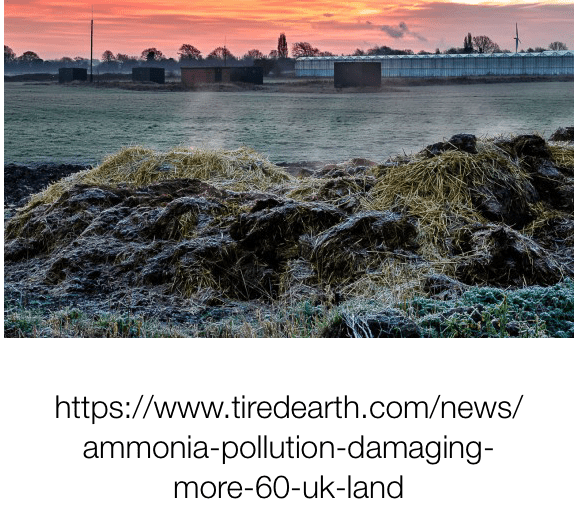
Manure and urine from farm animals is a major source of ammonia: in the UK 87% of ammonia released into the air comes from agriculture. Here ammonia reacts with other compounds in the air to form particulate matter that pollutes the air, irritating lungs and affect people’s breathing.  Ammonia also leads to the creation of smog, and the acidification of water and soil. It is harmful to plants and wildlife as well as humans. 

A particular concern at the moment is the health of the River Wye in Herefordshire. A large number of intensive chicken farms have been established in the Wye valley and the affluent from millions of chickens has created an algal bloom that is destroying the biodiversity of the river. 

This is another good reason for reducing our meat consumption. 

 Counting on …day 251

20th July 2022

There is a proposal to extend London’s ultra low emissions zone to include all of the Greater London area, thus ensuring that everyone in London benefits from the resulting cleaner air. This is particularly important when we consider the extra strain being placed on our bodies by the current heat wave. The move is likely to rescue the number of vehicles being used which will reduce both congestion and fossil fuel consumption. There are exemptions to ensure that people with disabilities, charities etc are not adversely affected. Public consultation is underway, if you would like to express your views –

https://url5523.sg.actionnetwork.org/ss/c/mw31GZsW-tYdpIw-ePlYv9YXu7kMu4z6Uzey9O4F-KaZ42znTgRrq5X1ds_Mi9FilYtWgTDrcjgtPYZK7olrv18Ja0EOg0L5Zx_1AXP1naN9vNcc4jZijuyIz71V47QA-nXwXw6BoU_CFe-jPbtpMr0HpMUT-FslSIrjm7TbRqWx4iE_kVRpRgrgBqZCxRYt5U6gV8cfSNj3t7xp6hEpzdHaWa5nPOlsFGDB9FVFuQakk_HYWpvb89zhE8com6LOMzkMcExPWG5rSqE9vPhBJh1CQpcnleSMkkxj-O5IZxwWi3W02hj-rNkLFvjKvQAZ/3nu/5uip7kYvS4umHBgZlQjzdg/h0/e0EHAqZz-Nwnx2AffxFxeQd0e5KyRe-kzrmuFJp9d_s