Counting on …day 90

18th June 2025

“Shell believes natural gas and LNG have a critical role to play in the energy transition by producing less carbon emissions than coal when used to generate electricity, helping to maintain grid stability as the share of renewable energy grows, increasingly powering transport and shipping, and providing energy security in the coming decades.” (1) 

Is LNG really a green fuel?

Liquid natural gas (LNG) is natural gas that has been made into a liquid so that it can be more readily transported. The liquefaction process involves cooling the gas to -161oC (-259F). The process reduces it to 1/600th of its original un-liquified volume and to half the weight of water. This reduction in volume has made the storage, and the shipping  over significant distances, an economic option. It does of course have to be kept at the required supercool temperature throughout. It is only when it is going to fed into the domestic gas grid that is returned to its gaseous state by warming. 

Before the liquefaction became a practicable option, natural gas was typically used by consumers in the locality – in the UK our gas came from the North Sea. Now gas can be sourced from across the world and can be stored whilst buyers are found. Significant amounts of this gas is shale gas using fracking processes. The United States is the world’s largest producer of LNG, followed by Australia and Qatar. Russia despite the fall in demand from European customers, is the fourth largest producer with large reserves of has in Siberia.

LNG is 85-95% methane and when it is burnt produces water and  carbon dioxide. And the proportion of carbon dioxide produced is 40% less carbon dioxide (CO2) than coal and 30% less than oil (1) allowing LNG to be marketed as a green fuel. However methane is a more harmful greenhouse gas as when it is released into the atmosphere it a greater impact than carbon dioxide in increasing global temperatures. 

However the extraction process, especially by fracking, and leakage during the liquefaction and transportation process, gives rise to substantial leakage of methane. A report produced for the Society of Chemical Industry concluded that 66% of greenhouse gas emissions from LNG were released during these stages with only 34% released during the end-use combustion.(2)

  1. https://www.shell.com/what-we-do/oil-and-natural-gas/liquefied-natural-gas-lng.html
  2. https://www.nationalgrid.com/stories/energy-explained/what-is-liquefied-natural-gas-lng
  3. https://scijournals.onlinelibrary.wiley.com/doi/10.1002/ese3.1934

Counting on … day 75

2nd June 2025

Oil and gas production accounts for approximately 87% of global energy-related greenhouse gas emissions. (1) Yet oil and gas companies present themselves as key players in the transition to net zero. The claims they make to justify the continued extraction and production of oil and gas are questionable. These are issues I am going to explore over the next few days.

One claim is that some sources of oil and gas are more climate friendly than others because they have a smaller – or sometimes it is phrased as cleaner – footprint. This may also be referred to as the (upstream) carbon intensity of the fossil fuel. The reduction being referenced is the reduction in scope 1 and 2 emissions – ie those carbon emissions arising from production, transport and processing of the oil and gas. It does not include the emissions released through the subsequent use of the oil and gas – the scope 3 emissions.

Fossil fuel companies can reduce scope 1 and 2 emissions by: “tackling methane emissions, eliminating all non-emergency flaring, electrifying upstream facilities with low-emissions electricity, equipping oil and gas processes with carbon capture utilisation and storage (CCUS), and expanding the use of low-emissions electrolysis hydrogen in refineries.” (2) Of these cutting methane emissions and flaring can achieve the biggest reductions in emissions.

The Oil and Gas Climate (OGCI) launched its upstream carbon intensity target in 2020. Its aim is to reduce member companies’ aggregate upstream carbon intensity from 23 kg of greenhouse gases per barrel of oil or gas in 2017 to 17 kg by 2025. (3) For comparison scope 3 emissions per barrel are typically 402kg. (4) 

By reducing the carbon intensity of their oil and gas production,  companies may argue that their’s is a better source of fuel. This claim is then used to justify expanding their production of fossil fuels. However they do not along side this make a similar or even greater reduction in production from other sites.

  1. https://www.instituteforenergyresearch.org/international-issues/2023-set-records-in-global-fossil-fuel-use-and-carbon-dioxide-emissions/
  2. https://www.iea.org/reports/emissions-from-oil-and-gas-operations-in-net-zero-transitions

(3) https://www.ogci.com/carbon-intensity-target

(4) https://www.scopegroup.com/dam/jcr:5066dd6f-613a-4ab9-a032-b32b97b28bb7/Scope ESG_IR Oil and Gas Industry.pdf

Green Tau: issue 103

Reshaping how we can talk positively about the climate crisis – part 3:  Transport 

March 2025

How can we talk about the climate crisis in a way that sounds encouraging?

The climate crisis is an existential threat which is certainly not good news. Its causes and impact are diverse and numerous such that it is hard to pin down ‘This is the cause’ or ‘This is the solution’. It is hard to quantify ‘This is how it will effect you’ and ‘This will be the time table.’ 

All this makes it difficult to find a way of talking to people about the crisis and how we might respond.

So here are some thoughts that might help.

Clean Air

Switching from fossil fuels to clean energy* to power road vehicles reduces the amount of pollution that goes into the air we breathe. The pollution from petrol and diesel vehicles includes carbon monoxide, particulate matter and nitrogen oxide and is released into the environment predominately in places where people living, where people are working, where they go to school, where they are simply walking by. Air pollution causes  28,000 and 36,000 early deaths each year in the UK (figures for 2018). Sustrans estimates that road transport is responsible for 80% of roadside NO2 pollution which is where the legal limits are being broken. (1) 

With the growing use of electric vehicles air pollution has fallen …. And without admissions to hospital

In London progressive policies have been put in place to reduce road congestion and more specifically to reduce the air pollution from road vehicles, with the most recent being the expansion of the ultra low emissions zone (ULEZ) to cover all London boroughs in August 2023. Since then pollution from road vehicles across the wool of London has been reduce by 27%. (2) This should lead to a reduction in premature deaths.

Another component of air pollution caused by road vehicles is the fine particulate matter that comes from brake blocks, tyres and even the tarmac. These particles are formed through friction whether that is the brakes slowing the vehicle or the tyres rubbing against the road. Such pollution is known as Non-Exhaust Emissions or NEE. In its report on NNE Defra observed that currently there is no legislation in place to limit this source of air pollution but highlighted possible ways in which such pollution could be reduced, vis:  “The Most effective mitigation strategies for NEE are to reduce the overall volume of traffic, lower the speed where traffic is free-flowing (eg trunk roads and motorways), and promote driving behaviour that rescues braking and higher-speed cornering.”(3)  

As well as ULEZ, London has also benefitted from the widespread introduction of a reduced speed limit for vehicles – from 30 to 20 mph. “An evaluation of 20mph zones in London, carried out by Imperial College, showed slowing traffic had no net negative impact on exhaust emissions. However, in 20mph zones vehicles moved more smoothly, with fewer accelerations and decelerations, than in 30mph zones. This smoother driving style reduces particulate emissions from tyre and brake wear – which still represents a significant cause of air pollution from zero-emission vehicles.” (4)

Switching to electric vehicles, introducing low emissions zones and reduced speed limits, are all contributing to reducing the air pollution that causes so many premature deaths as well as reducing carbon emissions.

Wellbeing 

Active travel includes walking and cycling, and in many cases can replace short car journeys. It can also be combined with the use of public transport (walking to the bus stop or the station) and so replace other longer car journeys. Reducing car journeys reduce carbon emissions and/ or – in terms of electric vehicles – the load on the electric grid. Switching to active travel however also produced significant health benefits (and thus savings for the NHS). 

The Health Foundation notes that “Almost 1,800 early deaths per year could be prevented if activity levels for walking and cycling were to match the most active regions in England.” (5) The most active region was London where people walked and cycled an average of 1.2 miles per day. The Department of Transport estimates that inactivity costs the NHS “up to £1 billion each year, with additional indirect costs of £8.2 billion…” The exercise gained through active travel also has benefits for mental wellbeing. 

The Department for Transport also reports the following further positive benefits of active travel – 

“Increasing active travel will reduce road congestion, particularly at peak times, leading to increased productivity and improved movement of goods and services. Sustrans estimates that congestion costs £10 billion per year in 2009 in urban areas, and that this cost could rise to £22 billion by 2025. Living Streets’ Pedestrian Pound report outlined a range of economic benefits of walking, including that well-planned walking improvements can lead to a 40% increasein shopping footfall.” (6)

Active travel by reducing the amount of road traffic and so reducing air pollution and road congestion, makes for pleasanter local environments – which in itself boosts our sense of wellbeing. . 

*eg electricity produced from renewable energy sources such as wind and solar 

  1. https://www.sustrans.org.uk/our-blog/policy-positions/our-position-on-improving-air-quality/

(2) https://www.standard.co.uk/news/transport/sadiq-khan-ulez-expansion-london-boroughs-biggest-reductions-air-pollution-b1215765.html

(3)  https://uk-air.defra.gov.uk/assets/documents/reports/cat09/1907101151_20190709_Non_Exhaust_Emissions_typeset_Final.pdf

(4) https://www.london.gov.uk/who-we-are/what-london-assembly-does/questions-mayor/find-an-answer/20mph-speed-limit-and-air-pollution

(5) https://www.health.org.uk/evidence-hub/transport/active-travel/health-benefits-of-walking-and-cycling-preventable-early

(6) https://www.gov.uk/government/publications/active-travel-local-authority-toolkit/active-travel-local-authority-toolkit

Counting on … day 202

29th October 2024

About 34% of all our greenhouse gas emissions are food related so looking at what we eat and making changes can be – cumulatively – a very effective way of addressing the climate crisis.(1)

80% of agricultural land is used for feeding and grazing livestock, yet produces only 17% of global calories.(2) Reducing the meat and dairy products we eat, not only reduces the emissions linked directly to the livestock, but also frees up land that could be used to grow plant based foods for humans, and frees up land that could be rewilded to boost both biodiversity and natural carbon capture. 

The Ethical Consumer’s report ‘Closing the Gap 2024’ records that this change in diet in the UK has already started, so let’s carry on and boost this trend even more!

Tips for swopping to a plant based diet – https://greentau.org/2021/10/12/eco-tips-11/

  1. https://www.nature.com/articles/s43016-021-00225-9
  2. https://ourworldindata.org/global-land-for-agriculture

Further reading https://www.unep.org/news-and-stories/story/how-tweaking-your-diet-can-help-save-planet

Counting on … day 194

17th October 2024

Blue carbon is not just the carbon absorbed in the seas around our coasts. It is an ongoing process that encompasses oceans and deep seabeds. However scientists are concerned that the process is being adversely affected by rising temperatures.

“It begins each day at nightfall. As the light disappears, billions of zooplankton, crustaceans and other marine organisms rise to the ocean surface to feed on microscopic algae, returning to the depths at sunrise. The waste from this frenzy – Earth’s largest migration of creatures – sinks to the ocean floor, removing millions of tonnes of carbon from the atmosphere each year.

“This activity is one of thousands of natural processes that regulate the Earth’s climate. Together, the planet’s oceans, forests, soils and other natural carbon sinks absorb about half of all human emissions. But as the Earth heats up, scientists are increasingly concerned that those crucial processes are breaking down….

“Greenland’s glaciers and Arctic ice sheets are melting faster than expected, which is disrupting the Gulf Stream ocean current and slows the rate at which oceans absorb carbon. For the algae-eating zooplankton, melting sea ice is exposing them to more sunlight – a shift scientists say could keep them in the depths for longer, disrupting the vertical migration that stores carbon on the ocean floor.”

Green Tau: Issue 93

21st August 2024

Should we give up flying for the sake of the planet? 

I recently took part in a radio show where this was the topic being discussed. I am someone who for the last 20 years (I think) has deliberately chosen – for environmental reasons – not to fly. The other panellist was a pilot for a charity that flies people and resources in and out of remote islands in Asia. Two extremes but actually we both agreed that there were some instances when flying was a good thing – such as providing medical support for people, which could be for remote islanders in the Pacific, islanders living off the coasts of Scotland or for medical emergencies where an air ambulance can rapidly transfer people to hospital. Equally flying might be a key way of getting resources, food and medicines to areas cut off from other modes of transport after natural and other disasters. 

However such instances do not make up the bulk of air travel across the world, nor are they applicable to the majority of locations worldwide. Most flights are scheduled flights, mostly carrying passengers. 

According to a report by the International Air Transport Association (IATA), in 2023,  there were 36 million aircraft departures, conveying some 4497 million scheduled passengers plus cargo. Measured in terms of revenue, scheduled passengers generated $646 billion and cargo $138 billion. (1)

Aviation accounts for 2.5% of global CO₂ emissions. However  its impact on global warming is even more because of the impact of planes at high altitude affecting the concentration of other atmospheric gases and pollutants. (2) 

If 2.5% of global emissions seems small, we need to remember that these emissions come from just 10% of the world’s population – nine out ten people don’t fly and that is almost always because it is an unaffordable luxury. 

 Yet air travel is predicted to continue to increase – ISTA predicts a 3.8% increase in passenger numbers every year, resulting in 4 billion extra passenger journeys by 2043. (1) Is this sensible – indeed justifiable – given the impact that this would have on the amount of carbon held in the atmosphere and its impact on accelerating the rise in global temperatures and the impact of that on daily life for most people?

Even if planes become more efficient in burning fuel, and even if sustainable aviation fuel (SAF) becomes a reality at scale, can the airline industry increase flights and at the same time reducing emissions? Not so according to the predictions of the consultants Bain and Company:-

“We estimate that the airline industry’s current decarbonisation measures will result in a net 3.4% increase in its global CO2 emissions by 2030 vs. 2019 levels. This is based on the outlook that a 23% reduction in CO2 emissions per RPK (thanks to fleet renewal and sustainable aviation fuel usage) would be more than offset by a 36% increase in global RPK [revenue passenger kilometres – the number of paying passengers multiplied by the total distance traveled]. It would require an additional carbon tax equivalent to 5% of average ticket prices worldwide in order for the industry to maintain its 2019 C02 emissions volume in 2030, according to our forecast.” (3) 

The conclusion must then be that the 10% of us who do fly, should think twice about doing so. We should stop flying to safeguard our own future, to safe guard the future of the next generation, and to safeguard the lives of the 90% who are not even contributing to the problem. As Christians we have the command that we should love our neighbour as ourself which includes each and every neighbour on the other side of the world who does or doesn’t fly. And caring for our neighbour will include conserving aviation fuel for those planes and helicopters providing emergency aid and access for those remote and inaccessible places 

Of course our worry is that while we may make the sacrifice of not flying, no one else will and therefore our actions will not have any safeguarding affect! That is a good reason to sign the Flight Free Pledge (4) to generate a groundswell of people committed to not flying. It also becomes a good reason to talk about not flying, to create then social norm that flying is the exception not the norm, to expound the advantages of travelling instead by train – comfort, legroom, no congested airport lounges, less stress, seeing more of the countryside, sleepers for night travel, on board restaurants…

The other concern is cost. Whilst air travel is prohibitively expensive for most people, train travel can be equally prohibitive. Governments across the world need to be encouraged to impose taxes and operation rules to restrict air travel and to make train travel more affordable. To do so will be cost effective if it enables us to bring down emissions and properly tackle the climate crisis. 

Yes absolutely we should give up flying to save the planet! 

  1. https://www.iata.org/en/iata-repository/publications/economic-reports/global-outlook-for-air-transport-june-2024-report/
  2. https://ourworldindata.org/global-aviation-emissions
  3. https://www.bain.com/insights/air-travel-forecast-interactive/
  4. https://flightfree.co.uk/why_flight_free/

Counting on … day 83

10th April 2024

Carbon Tax – 3

Carbon emissions may be produced outside the country where the final product is consumed. This could be a way of avoiding paying a carbon tax by shifting the emission-producing part of the business elsewhere, or it could equally be a way for a foreign importer to achieve a price advantage over indigenous producers. A good carbon tax needs to be aware of these for means of tax evasion.

The Europe Union is phasing in such a tax avoidance mechanism – it will be 100% in place by 2026.

“The EU’s Carbon Border Adjustment Mechanism (CBAM) is the EU’s tool to put a fair price on the carbon emitted during the production of carbon intensive goods that are entering the EU, and to encourage cleaner industrial production in non-EU countries. By confirming that a price has been paid for the embedded carbon emissions generated in the production of certain goods imported into the EU, the CBAM will ensure the carbon price of imports is equivalent to the carbon price of domestic production, and that the EU’s climate objectives are not undermined. The CBAM is designed to be compatible with WTO-rules.” https://taxation-customs.ec.europa.eu/carbon-border-adjustment-mechanism_en

Just as  domestic carbon taxes can disproportionately affect the poor, so carbon taxes can disproportionately affect poor, less developed countries. Wealthy countries can afford to invest in, for example, electric arc furnaces for producing green steel, or in wind farms to generate green electricity, but poorer countries may struggle to invest to the same degree leaving them stuck with using carbon producing industrial processes and therefore subject to more taxation! Just as poorer households need to be supported with subsidies and grants to  enable them to shift to greener lifestyles, so poorer countries need to be supported with subsidies and grants from the wealthier nations, to enable them  to shift to to greener infrastructures.

Counting on … day 73

25th March 2024

Carbon offsetting is akin to an accounting exercise where the carbon emissions released by one activity are offset – rebalanced – by another activity that sequesters – takes in – carbon dioxide. Typically this might be offsetting the carbon emissions from an air flight by as many planting trees as would absorb that quantity of carbon dioxide. The catch there is one of timing. The air flight produces emissions now but the tree will only absorb the equivalent amount of carbon dioxide over a number – tens of not hundreds – of years and a young sapling may in fact release more carbon dioxide than it absorbs. Another option it to offset the carbon emissions by not felling trees so allowing them to continue to absorb carbon dioxide – but that questions why the trees might have been felled in the first place. 

Further reading – https://www.theguardian.com/environment/2021/may/04/what-is-carbon-offsetting-and-how-does-it-work?CMP=Share_iOSApp_Other

https://www.theguardian.com/environment/2023/mar/30/quality-standards-hold-carbon-offsetting-industry-account?CMP=Share_iOSApp_Other

Counting on … day 60

6th March 2024

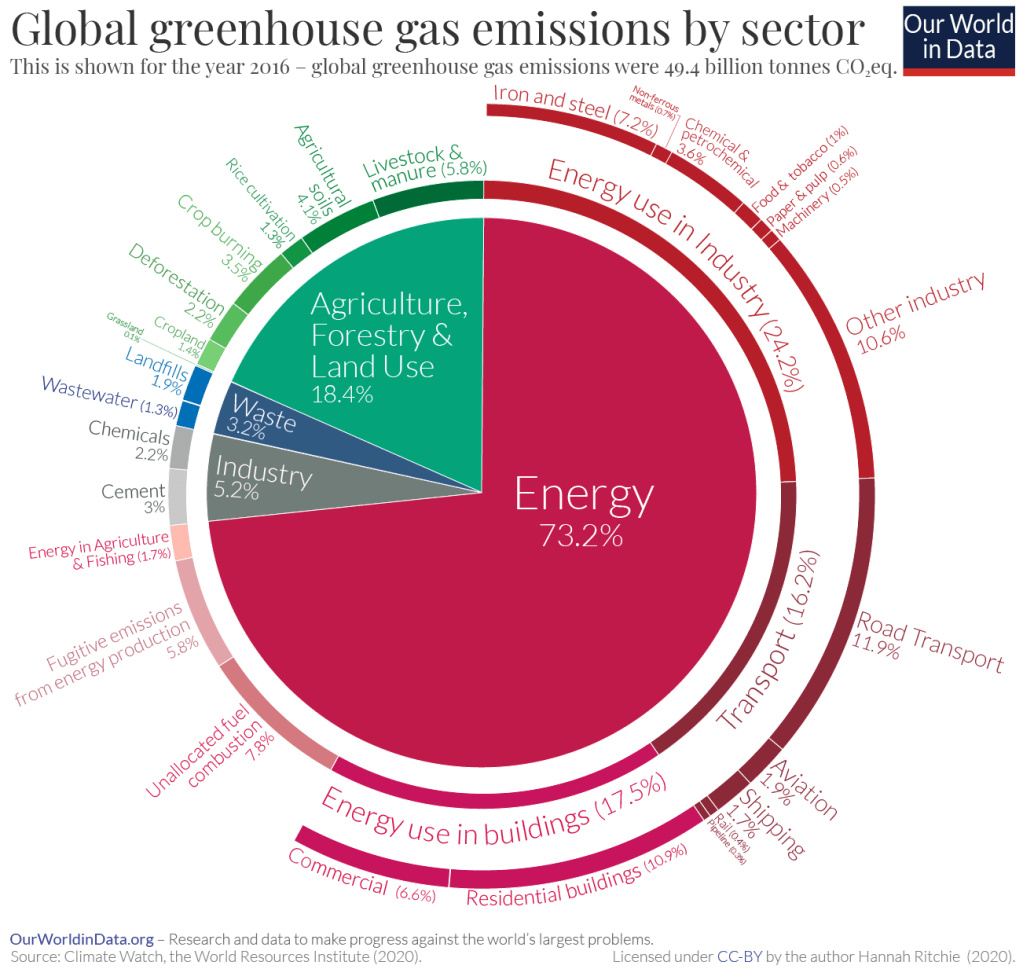
We can also look at carbon emissions by sector.

Not surprisingly energy is the biggest contributor. So much of the energy we use comes from fossil fuels  – which all emit carbon dioxide and other greenhouse gases. And this energy is used in so many different situations – transport, heating or cooling buildings, lighting and cooking, industrial and manufacturing processes, communication etc. 

More worryingly, carbon emissions from fossil fuels are still rising. The International Energy Agency Agency (IEA) reports that energy-related CO2 emissions were 36.3 Gt in 2021; 36.8 Gt in 2022; and 37.4 Gt in 2023. In each year the figure was reported as a new high! Until these emissions start to fall – and fall rapidly – humanity will not be able to avert a worsening climate crisis. 

For more information see – https://ourworldindata.org/ghg-emissions-by-sector

Counting on … day 53

26th February 2024

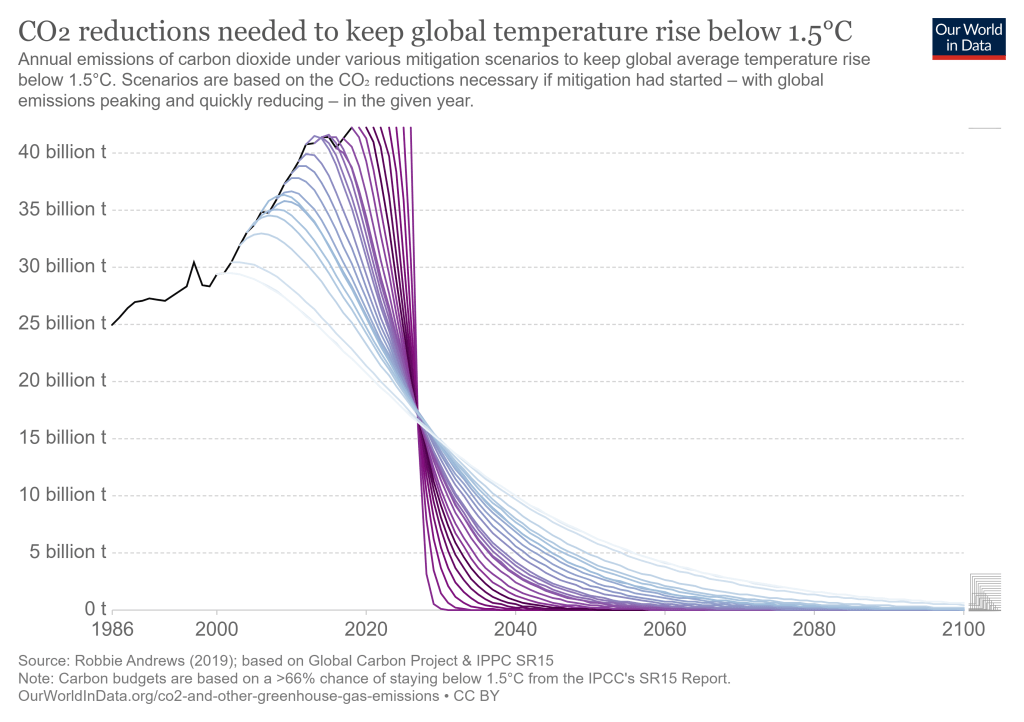
To keep the world within the desired 1.5C of warming, the carbon dioxide concentration in the atmosphere has to be kept below 500ppm. To achieve this the ambition agreed at COPxx in Paris in 2015 is to reduce global carbon emissions by 45% by 2030 and to net zero by 2050. 

In 2015 global carbon dioxide emissions were just over 35 billion tonnes, in 2019 emissions reached 37 billion tonnes, and having dropped back to 35 billion tonnes in 2020 during covid, emissions are again back up at 37 billion tonnes (2022).

Each year that passes without meeting these targets means that to achieve the 2030 and 2050 targets becomes even more difficult as we have to cut back emissions even more steeply. This is vividly shown in the graph below.