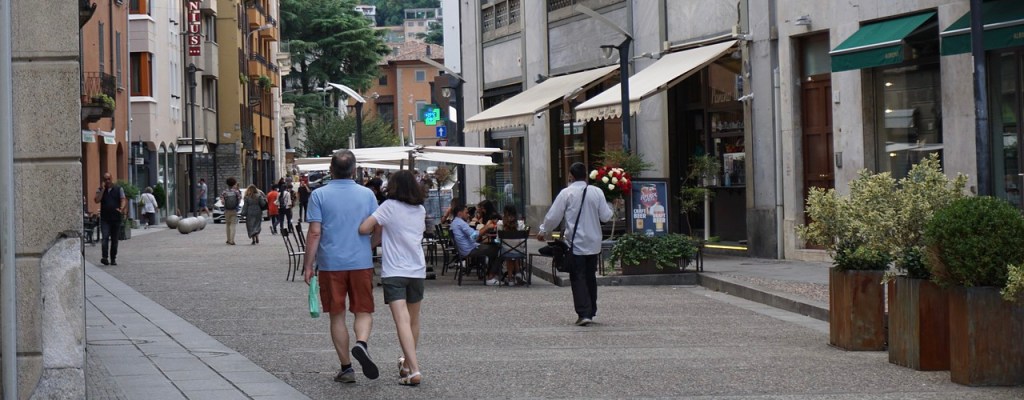
Imagine living in a neighbourhood where everything one needed on a daily basis lay within a fifteen minute journey – on foot or cycle – of one’s home. A neighbourhood where you can safely walk or cycle to the shops, school, medical centre, park, gym, swimming pool, office, cafe, the pub. A neighbourhood with (largely) traffic free streets, where children can cycle safely and those with impaired mobility/ sight/ hearing can easily cross the road. A neighbourhood where you know your neighbour, the barista at the cafe, the coach at the gym. A neighbourhood where you know you are part of the community.
How far can you walk in 15 minutes? 3/4 or even a full mile.
And by cycle? – maybe 2 to 4 miles.
Could you get much further by car?
The average speed of traffic in London is around 7-8mph, suggesting one could travel 2 miles in quarter of an hour. But then one would have to find somewhere to park, so the distance you could travel by car might well be much less than 2 miles.
Imagine a whole city made up of such neighbourhoods and you have the Fifteen Minute City. This concept is being a actively pursued in Paris by the mayor, Anne Hidalgo. Hidalgo proposes to have a cycle lane in every street and to remove 60,000 parking spaces for private cars whilst at the same time spending €1b per year for on greening both streets and school playgrounds. She has already added some 50km of cycle paths and banned high polluting vehicles. Similar projects are being trialed in Milan, Madrid, Seattle and Ottawa, whilst Melbourne and Edinburgh are pursuing twenty minute neighbourhoods.
What are the benefits?
Benefits social cohesion and community strength.
Supports local business and enterprise.
Less time spent commuting. Fewer traffic jams.
Less air pollution. Reduced CO2 emissions.
Option to repurpose road space as green spaces. Greater biodiversity.
Improved levels of mobility for everyone. Better health.
Increased quality of life.
If you want to hear about the Fifteen Minute City from its creator, Carlos Moreno, tune into the following YouTube episode:-
Can we as individuals go some way to creating our own fifteen minute neighbourhood? We can choose to patronise local shops and businesses, use local leisure facilities and green spaces. We can choose to walk or cycle to each destination, and we can seek out routes that green and interesting – and perhaps discover paths we didn’t know existed!
If we become accustomed to walking or cycling 15 minutes on a day to day basis, we will find we can transfer to a lifestyle that doesn’t need a private car. For those longer but less frequent journeys we can as easily walk to the station and take the train, or book a taxi or hire a car. If that becomes the norm just imagine the effect it will have on local neighbourhood and on carbon emissions.
This pictogram shows my 15 minute neighbourhood: why not have a go at drawing one centred on your home?
Transcript of a talk a church group about my experience of being arrested during an XR climate crisis uprising.
Micah 6: 1-8 (abbreviated)
Hear what the Lord says: Rise, plead your case before the mountains, and let the hills hear your voice. Hear, you mountains, the controversy of the Lord, and you enduring foundations of the earth; for the Lord has a controversy with his people, and he will contend with Israel. “O my people, what have I done to you? In what have I wearied you? Answer me! …”
Has he not told you, O mortal, what is good; and what does the Lord require of you? Do justice, love kindness, and walk humbly with your God.
But what is justice?
That is a question I would like you to hold in mind, and I will ask it again at the end.
I have always had a Christian faith and a concern for justice. As a teenager I restricted my diet to 1000 calories a day in solidarity with women in India. When I was at university in the early 80s I was aware that human production of green house gases plus our excessive use of raw materials was damaging the world’s environment. That knowledge together with my Christian faith has shaped the way I lived. As a family – Paul and I have three children, now all grown up – we have constantly been adjusting our lifestyles to try and mitigate the damage we were causing to the earth.
As the internet age developed, so I have signed more petitions, written to and spoken with our local MP, joined marches and protests. Yet nothing seems to change. The world is continuing to grow warmer, extreme weather events occur more frequently, ecosystems are being destroyed, the poor are being disadvantaged – and yet the human output of carbon dioxide and other greenhouse gases continues to rise. I felt that nothing was going to stop this crisis.
In the spring of 2019 I went to Cornwall with my daughter to walk the Celtic Pilgrim Way. We returned on Good Friday when the XR Easter uprising had begun and we stopped off at Marble Arch. Pitched tents, crèche, a stage, workshops, a welcome desk, sunshine, smiling people, even the drivers of vehicles whose routes had been diverted were cheerful. The same in Waterloo Bridge which had been transformed into a garden bridge with trees and pot plants, a skate board ramp, sofas and easy chairs, and story-telling circles. It was all a vision of what the future could be!
When I heard that the October uprising was to include a Faith Bridge I wanted to be a part. The Faith Bridge was conceived as a coming together of different faiths – Buddhist, Muslim, Jewish, Quakers, pagans, Christians – to express our joint concern for the well-being of the earth. We were to occupy Lambeth Bridge for the duration where we would set up a tepee for worship (which would be led by the different faiths throughout the day) a stage for talks and music and drama, places to meet and share with others our hopes and fears, and as the centre piece a large wooden ark.
To secure the bridge we would need a small group of people willing to be arrested whilst a larger group of people set up these bases. Drawing inspiration from both my Christian faith and from the example of the Suffragettes, I volunteered to be an arrestable. For this XR provides training and on going support.
The first day of the uprising dawned – literally -as we gathered by Lambeth Bridge. Initially we blocked the slip roads leading onto the bridge. Another group of protesters were doing the same at the other end. Once the traffic had been brought to a standstill we moved onto the bridge itself. The police had pre-empted us. They were massed in lines across the bridge such that each group of protestors was confined to small area at opposite ends of the bridge. At the same time another group of police saw the ark being delivered in its flat pack state and confiscated each part as it was unloaded.
I am in the blue coat sat in front of the green banner
Undaunted we sat on the tarmac surrounded by banners and prayer flags, facing the police line. We were a mixed group – all ages, backgrounds and faiths – and together we sang and prayed and shared our stories. Faith leaders and CEOs of charities and NGOs came and told us their stories as to why the climate crisis was such a critical issue. And still we sat and sang and prayed. It was a uniquely special experience of being in the presence of God.
Around mid afternoon, the police gave us the option of joining our fellow protestors at the other end of the bridge – provided we walked round the long way, via Westminster Bridge. We gathered up our banners and flags, our musical instruments and the remaining box section of the ark and set off along the road past St Thomas’s hospital, singing as we walked. We must have looked like the Israelites setting off for the promised land. Having negotiated our way through the blockades on Westminster Bridge and we’re almost in sight of the north end of Lambeth Bridge, we were stopped by another group of police who wanted us to divert with the ark to Horseferry Road. Negotiations took place. Whilst we waited we sat and we sang. Then a whisper spread round and looking behind us, a double line of police officers were advancing towards us. On arrestables drew back, the rest of us sat firm holding onto the ark. Arrests began. A police officer tried to persuade me to let go, and when I did not, I was physically lifted up and back, ending up on my back in the road – time send to stand still. Them everyone was crowding round. The police officer cautioned and handcuffed me. The XR legal observer wanted my details. People were shouting abuse at the police; others were cheering and applauding those who were being arrested. My mind went into a blur and my body into shock. My arresting officer was considerate and concerned and helped me across to the pavement where I joined others who had been arrested. We sat there for a couple of hours with our arresting officers whilst police stations were contacted to find spare cells. Four of were loaded into the cage compartments in the back of a police van and taken to Walworth. And still the wait continued, as we waited to be processed by the custody officer. Finally I was put into a police cell, given a vegan meal and a blanket.
At 2 in the morning I was released pending further investigation having been charged with obstructing the highway and causing a public nuisance. As I left the police station I was greeted by an XR volunteer who offered me chocolate and looked up the night bus time table so that I could get home and to bed!
My day in court was delayed by Covid. After numerous postponements, the case was heard in March of this year at the City of London Magistrates Court. I was represented in court by a barrister – the cost of both the barrister and the lawyer were met by XR funds. I could have pleaded guilty – I had indeed been obstructing the highway – but as a matter of principal I wanted to present the counter arguments: that I had been exercising my right of peaceful protest; I had done something that would ordinarily be criminal but in the circumstances it was necessary to draw attention to a greater danger vis the climate crisis. The example usually given is that one would not be prosecuted for breaking a window in order to sound the alarm for a fire. I also wanted to explain that my actions were motivated by my Christian faith and my belief that I – we – have a duty to care for and protect the earth.
The court staff were helpful and courteous. The XR observers were encouraging and supportive. Only the three magistrates seemed to be set against my defence. I was found guilty, fined and given a conditional discharge of 9 months.
Whose rights should have prevailed?
My right to protest or the road users right to use that particular public highway? Had I merely sat on the pavement would anyone have taken notice?
Do road users have an unlimited right to use use the roads? What if the volume of vehicles on the road causes an obstruction either to other vehicles, or to cyclists? What if the volume of vehicles prevents emergency vehicles getting through? What if the volume of traffic creates levels of pollution that endanger people’s lives, or increases the risk of dementia? What if the volume of traffic increases CO2 emissions such that global temperatures keep rising? What then of the rights of people both here and in other parts of the world to live lives not affected by rising sea levels and extreme weather events?
To return to my original question, what is justice?
In Alan Stoppard’s play Jumpers, George Moore, a philosophy professor, muses that at some point in history, the balance of believers versus non believers tipped from the former being the majority to the latter. He suspected it was the decline in woollen socks in preference for nylon ones that precipitated this tipping point: woollen socks kept the wearer in mind of the link between nature and daily life and thus a link between a divine creator and daily life.
We have seen a number of social issues reach a tipping point: the acceptability or not of smoking, the acceptability or not of drink-driving, the use of plastic bags versus reusable versions, and most recently the wearing of face masks. At some point social pressure, social acceptance and/ or social understanding shifted in favour of a new status quo. Social norms are not fixed and what interests me is what initiates and sustains the sequence of changes that lead us to change our patterns of behaviour and belief.
The Intergovernmental Panel on Climate Change is increasingly concerned that the current rate of global warming could reach a number of tipping points. One such scenario centres on the Arctic. As temperatures increase so the frozen soil have melted – not just the surface levels which is ‘normal’ but also the deeper levels of the permafrost. As they melt they release methane locked away for thousands of years ago. This flammable gas has led to outbreaks of wild fires across the Arctic destroying large areas of the tundra’s flora and fauna. Methane is one of the greenhouse gases and has a warming effect on the climate 80 times that of carbon dioxide. The melting of the permafrost in the Arctic disproportionately adds to the heating of the global environment and to the consequential further melting of frozen soils as well as sea ice. In other words the rise in temperatures that allows the Artic to thaw triggers a sequence of events that leads to a further upward spiralling of temperatures.
Other tipping points have also been observed: in Greenland where the more the ice-sheet melts the faster is the rate of melting in subsequent years, leading both to rising sea levels and a likely reversal of the Gulf Stream; in the Amazon the loss of rainforest (due to commercial felling) is expanding the area of land covered by Savannah grass lands causing rising air temperatures and depleting levels of rainfall which both threatened the natural regeneration of the rainforest; in the tropics rising sea temperatures bleach coral reefs as plant and animal life grows more slowly or dies off completely. As these living forms die so they absorb less carbon dioxide which in turn compounds rising air and sea temperatures.
Worryingly the danger presented by such scenarios doesn’t become apparent until the tipping point has been reached! This means preventative action needs to be taken before the affects of the danger are felt. We have in recent months learnt the lesson that the way to limit rocketing covid infections is to follow lockdown procedures before the number of cases becomes unmanageable. Can we do the same to prevent the extreme effects of climate change? Can we as individuals rapidly decarbonise our lifestyles now to safeguard the future for ourselves and our grandchildren? Can we create the social groundswell needed to make a carbon neutral lifestyle the norm? Can we create the popular groundswell to change the direction of our political leaders?
How we solve a problem depends upon aims for the future: are we seeking a short term or a long term fix? The nature of democracies is that governments’ timescales limited to the time remaining until the next election. In the UK that time scale is now 3 1/2 years. In France the next presidential election is less than 12 months away. Governments want to be re-elected so opt for policies that will win the favour of their most important voters. It is not surprising that at the G7 Summit President Macron has shied away from banning the sale of new petrol and diesel vehicles in the near future. The UK’s Department of the Environment released a press statement that “…all [G7] countries committed to reaching net zero carbon emissions by 2050…” but gave few details or commitments as to how that target is to be achieved.
2050 is that beautiful place in the future when all things will be both green and rosey. But if we are to live in that future (or rather if our grandchildren are to live in that future) we need to tackle action now. Like the Covid virus, global temperatures increases and climate change will not hold back until we’re ready to tackle the problems. We need to be radically changing the way we generate energy now, the way we farm – now, the way we use energy to transport our selves and goods – now, the way we heat and/or cool our buildings – now, the way we consume – now! Otherwise our carbon emissions will continue to accelerate global warming and we will have no chance of keeping global temperature rises below 1.5C.
There is a real conflict of interests between politicians with a five year view of the future and the rest of us who see the future as somewhere to enjoy our old age and where our grandchildren will thrive. This is why it is important that we a) make all the changes we can in our own lifestyles, and b) campaign, sign petitions, write to our MPs and do we all we can to make climate change and carbon emission reductions the most important political issue of this Parliament.
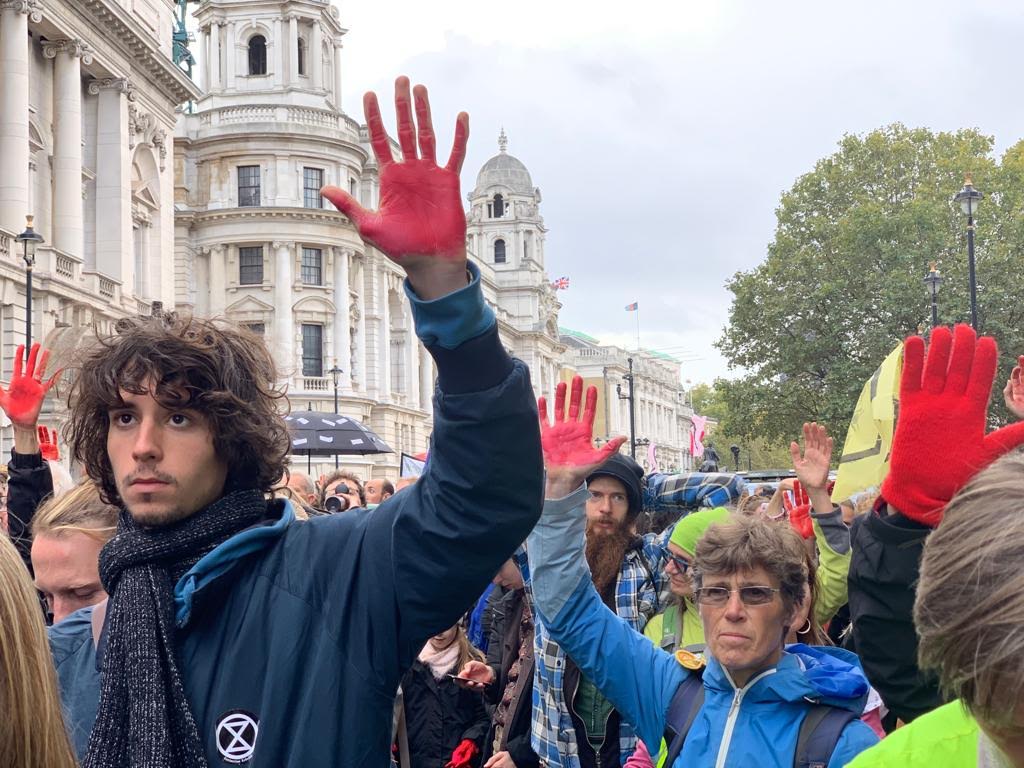
Hands Up! We’re all guilty protest: London October 2019
The G7 2021 summit has come and gone. What did it achieve? Where does it lead us in relation to the COP climate talks in November? Below are some of the outcomes of the talks that relate to the global tackling of the climate crisis.
The G7 committed to accelerating efforts to cut green house gases so as to keep the temperature increases below 1.5 C – ie a commitment to try harder to stick to their previously agreed target.
The G7 agreed to end by 2021 all new government funding for unabated coal fired power stations whilst at the same time Australia plans to continue to support its coal mining industries.
The G7 committed to the phasing out of petrol and diesel fuelled vehicles, although no date was agreed – the UK government has proposed ending the sale of all new petrol and diesel vehicles by 2030, but similar plans in France are proving unpopular at a time when President Macron faces an election in 2022 and the current earliest date for ending the sale of new petrol and diesel vehicles is 2040.
The G7 agreed a 2030 Nature Compact with commitments to lead the transition to sustainable use of natural resources; investing in a nature positive economy; protecting, restoring and conserving nature with a target of 30% of the globe’s lands and oceans by 2030; and prioritising accountability for their commitments to nature. The how and where and finances have yet to be species.
The G7 pledge to provide $100,000 a year to support climate change action is the continuation of an existing pledge. And at the same time India is reluctant to do more to avert climate change without receiving further financial support.
It was the first summit to be net carbon neutral but that example was marred by Boris Johnson’s decision to fly to Cornwall rather than to travel by train.
The G7 Summit may have confirmed the various government’s intentions to tackle the climate crisis but failed to produce any concrete plans as to how these might be achieved. The parable of the two brothers comes to mind. There once was a father who had two sons. He asked both to help him in the vineyard. The first said, Yes I’ll help! but then did nothing more. The second said, No, not me! but later changed his mind and helped in the vineyard. If governments, organisations or individuals say Yes, I’ll help tackled climate change, then can we rest comfortably knowing that the crisis is going to be averted? If governments, organisations or individuals say No, I shan’t do anything – is climate change even real? do we feel that’s our own individual efforts are pointless? Clear leadership is needed! And if such leadership is lacking then we need to encourage one another, being clear about what we can and what we are doing to tackle the crisis. If you cycle rather than using the car, say so. If you take the train rather than the plane, then say so. If you are eating plant based meals, then say so. If you have solar panels, a heat-pump, an energy monitor, then say so. Let’s be outspoken about what we can and are doing!
NB Many organisations such as WWF, Friends of the Earth, the BBC, all offer advise on how we as individuals can take action to tackle climate change.
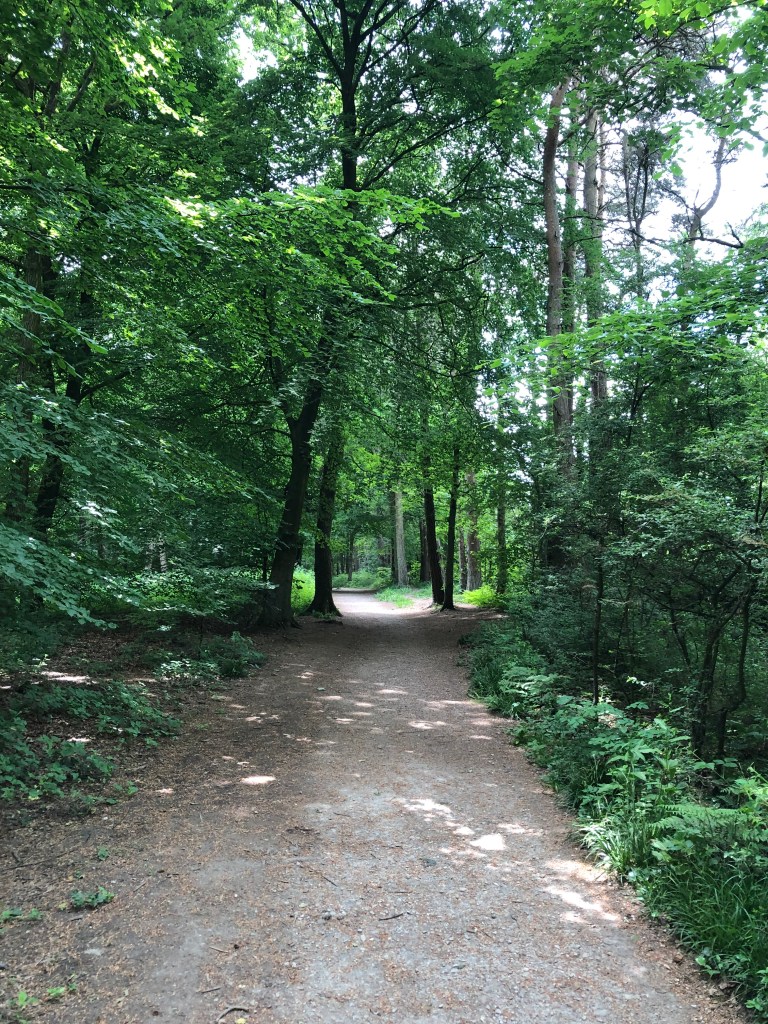
Woodlands are natural carbon stores as well as places for refreshment
COP26 is preceded by the G7 2021 Summit, the 47th such annual meeting. It takes place between 11 – 13th June in Cornwall under the presidency of the United Kingdom. The G7 is an intergovernmental grouping of the leaders of seven industrial nations: UK, USA, Canada, Japan, Germany, France and Italy. The President of the European Union also attends. In addition other leaders are invited as guests – being this year from Australia, India, South Korea and South Africa. The leaders, accompanied by other ministers and advisers, meet for ‘close knit’ discussions on global issues with the aim of coordinating agreements and policies in response to them.
The UK government aims to use “to unite leading democracies to help the world fight and then build back better from coronavirus and create a greener, more prosperous future.” Decisions made here will influence subsequent decisions that will be made at the COP. As with pandemics, the climate emergency is a crisis that needs to be tackled internationally. (It is no good eradicating Covid in the UK if the virus is still spreading and mutating in Cyprus. We are no longer separate islands but part of one global village. Similarly reducing carbon emissions in France but not in the US would not prevent global temperatures escalating still further. This is why it is important that the US has now rejoined the Paris Climate Agreement). The UK Secretary for Business, Kwasi Kwarteng, aims to coordinated G7 action on issues such as carbon border taxes, green finance, phasing out coal power, and helping poorer nations develop zero carbon economies.
But will there be sufficient commitment to the long term future and sufficient cooperation and the willingness to put national well-being below global well-being? It is in all our interests that the government leaders meeting in Cornwall do indeed prioritise the needs of the whole world about national needs, and the future safety of the climate above short term profit. Whilst the G7 Summit may feel remote and irrelevant, we should be telling our own leaders as well as world leaders what we do want! Governments can be swayed by popular opinion and by pressure groups.
Crack the Crises is a coalition of some of the UK’s biggest charities (including Christian Aid, Cafod, Tearfund, Save the Children, Traidcraft, Global Citizen, RSPB, Islamic Relief, the WI, Shelterbox, and Action Against Hunger). Its aim is to tell politicians that we want them to work together for a better world, and in particular, addressing four major crises:
Covid 19
Systemic poverty and injustice
Climate change
Biodiversity decline
In advance of the G7 Summit, Crack the Crises is calling on people to join the “Wave for Hope”. By creating images or photo opportunities using hands we will be waving to catch the attention of our friends and neighbours. By sharing our images on social media we will be waving to catch the attention of world leaders: we want – we need – change!
Cracking the Crises is hopeful that change can happen. Over the past 18 months we have seen how, faced with an overwhelming crisis, people like you and me, people like Captain Tom and Marcus Rushford, the many NHS staff, care home workers and other key workers, neighbourhood groups, churches and mosques…. have all adapted and worked together to support one another, to create good outcomes, to contain the spread of the virus, to keep our spirits up, to give us hope for the future. Human kind is an inherently kind being.
Info recommendation: do watch the BBC’s The People v Climate Change which covers the working of Britain’s first People’s Assembly set up by Parliament to review and recommend actions that should taken in response to the climate change emergency. It’s available on iplayer – https://www.bbc.co.uk/programmes/p097sbzc
Introducing COP26: the 26th United Nations Climate Change Conference of the Parties.
What is its purpose?
“Uniting the world to tackle climate change”
Why? The trajectory of rising global temperatures threatens the health and well being of all living beings on earth. The speed of change is such that most life forms will not be able to evolve fast enough to avoid extinction. The primary cause of these global temperature rises is human activity.
These climate change conferences have been taking place annually since the first in Berlin in 1995. Parties have been working on strategies and agreements to enable world communities to work together to limit the impact of this crisis.
COP3 produced the Kyoto protocol agreeing legally binding target to reduce greenhouse gas emissions to 6-8% below 1990 levels by 2012. This was not fully implemented.
COP17 held in Durban began negotiating a legally binding deal to keep global warming to within a 2C rise compared with pre industrial levels.
COP21 produced the Paris agreement requiring individual countries to produce their own plans (NDC – nationally determined contributions) to mitigate the impacts of global warming and to keep global temperature below a 1.5C rise by 2050 – and at least 45% of these reductions of be achieved by 2030.
Are we on target as we approach COP26 this November? (Deferred from its original date in 2020 because of Covid). No. The UN Emissions Gap Report 2019 notes an ongoing annual 1.5% increase in greenhouse gas (GHG) emissions over the last decade. Global emissions for 2018 reached 55.3 giga-tons. To keep global temperature increases within 1.5C, GHG need to be reduced to 32 Gt.
The World Meteorological Organisation has reported global average temperature rises of 1.1C since the preindustrial age, and of 0.2C for the period 2015-19 above that for 2011-15.
What then are the stated goals of COP26?
Finalise the Paris Rulebook and ensuring transparency
Require all finance, public and private to support the global economy transition to net zero
Protect communities and natural habitats
Keep global temperatures increases within the 1.5C target and keep on target for net zero carbon emissions by 2050
What role can we play?
Adopting sustainable life styles
Using our purchasing power to change business practices
Campaigning to ensure governments and other authorities know what we actual want
Supporting others throughout the world to make changes too
For in this hope we were saved. Now hope that is seen is not hope. For who hopes for what he sees? (Romans 8:24) I cannot see how all the nations, and interested parties will at COP26 make the corporate and individual changes needed to avert the escalation of our climate crisis. Yet I have hope that things will right, and hope is a powerful thing, especially if it shared with others.
‘Hope is Power’ became the new (2019) campaign logo for the Guardian newspaper.
“Hope does not disappoint us, because God’s love has been poured into our hearts through the Holy Spirit that has been given to us” (Romans 5:5).





 The Green Tau