Green Tau issue 48

Lambeth Conference: Environment and Sustainable Development 

12th August 2022

Every ten years (or thereabouts) all the bishops of the Anglican Communion meet together as the Lambeth Conference at the invitation of the Archbishop of Canterbury. Their meeting this year was the 15th such gathering with over six hundred bishops – and spouses – convening from all parts of the globe: Alaska, Australia, Brazil, South Sudan, the Philippines, Scotland, India and the Solomon Islands, and more. (Sadly the bishops of Nigeria, Rwanda Uganda declined to attend).   
The theme of the conference has been ‘God’s Church for God’s World – walking, listening and witnessing together.’  In fact the conference begins before the bishops arrive with the preparation of a document called ‘Lambeth Calls’. On each issue to be discussed at the conference a  paper – or “call” – is drafted by a group made up of bishops, clergy and laity from around the communion led by a Primate or senior bishop. Each Call includes:

  • A declaration, summarising what the Christian Church has always taught about these matters.
  • An affirmation, summarising what the bishops want to say on these matters in the present time.
  • Specific requests (The Calls) to future witness, sharing actions or challenges that the bishops want to give to each other, to fellow Christians and to the world.

Within each ‘Call’ there are be matters to discuss and decisions to be made. It may be that not all bishops will want to add their voices to every element of every call. As has always been the case at every Lambeth Conference bishops will confer together but they will not necessarily agree on everything. And the work of the conference continues after each participant has returned home as matters are taken forwards. https://www.lambethconference.org/programme/lambeth-calls/

The conference itself takes place in Canterbury but midway everyone travels to London for a day at Lambeth Palace. The focus for this day was the Environment and Sustainable Development. You can read the material prepared for this day here, pages 19 to 21 –  https://www.lambethconference.org/wp-content/uploads/2022/07/Lambeth-Calls-July-2022.pdf The Call clearly states the biblical imperative that humans should care for all creation, as well as being honest about the crisis we now face – 

“the triple environmental crisis of climate change, biodiversity loss and pollution is an existential threat to millions of people and species of plants and animals across the globe. The Intergovernmental Panel on Climate Change (IPCC) has warned that it is “code red for humanity”; “It’s now or never, if we want to limit global warming to 1.5°C”. Drastic action is needed in the next three years to bring down greenhouse gas emissions.” 

The Call also addresses the need to take action – “With crisis comes opportunity: for the Church to listen to God’s voice, to imagine how the world could be different, and to help build towards God’s Kingdom” – and is realistic about the lack of time available. “By the next Lambeth Conference, increasing areas of the Communion will be uninhabitable, because of drought, rising sea levels and other impacts as we reach tipping points in climate change. Meanwhile despite these terrible realities, carbon emissions continue to rise and there are over 50,000 new fossil fuel developments in the pipeline. Our oceans and rivers are clogged with plastic and people are choking and dying from polluted air. The web of life is becoming so damaged by the loss of biodiversity that the integrity of creation is under threat.” 

The Call then moves on to action that needs to be taken:-

“We call on world leaders to:

1. Enact bold and urgent policy changes, including:

• achieving net-zero carbon emissions as soon as possible to limit the global average temperature rise to 1.5 degrees above pre-industrial levels.

• fulfilling and substantially increasing their commitments to climate finance, including for loss and damage due to climate change.

• halting new gas and oil exploration.

• protecting and restoring biodiversity and tackling pollution.

2. Challenge wealthier nations and those with greatest responsibility for climate change to take the lead on climate action and just financing for other countries to reduce emissions.”

Those assembled to hear, think and talk about these pressing issues included those from communities already suffering the dire consequences of the climate crisis, those from communities who have historically been most responsible for the causes, those who have most to offer by means of practical and financial help, and those least able. As such the Anglican Communion can, together, speak from a basis of lived experience. This does not make the dilemmas any less tractable. Certainly some of the bishops spoke from experience when they highlighted the dangers of speaking out against the views of both governments and big business. For some communities the idea of living within reliance on fossil fuels seems a near impossible ask. 

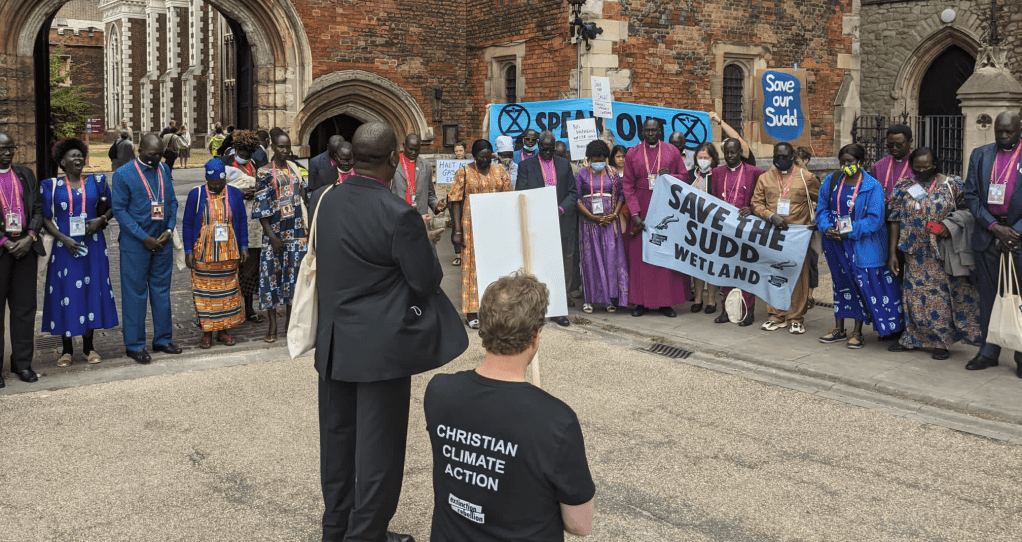
I spent the day outside the Palace with Christian Climate Action actively praying that the outcome of the day would be that bishops would have a clear understanding of the need to end reliance on fossil fuels and to address the global injustices of climate change. In advance of the day, CCA had contacted all the bishops, highlighting these concerns and inviting them to share in a prayerful response. 

One of the bishops from South Sudan in turn asked for support for his campaign to protect Africa’s largest wetland, The Sudd. Fed by the White Nile this area floods each year providing a wetland habitat for a diversity of wildlife as well as provide irrigation and subsequent rainfall for the grasslands surrounding the wetland that supports pastoral farming. The future of this wetland is threatened by a project to build a 300km  canal that bypasses the Sudd, transferring the flood waters to the northerly reaches of the Nile. 

It was encouraging when some of the bishops as they passed on their way into  – and at the end of the day, out off – the Palace diverted to talk with us or wave a hand to show their support. Some revelled in having their photos taken with the CCA banners as a back drop! From those who talked and prayed with us we learnt more of the issues that they face. In seeing such numbers of people – many dressed in brilliant colours reflecting their national identity – we were made aware of the scope and scale of this global crisis.

And the outcome of the day? Bishops spoke of heating at first hand from their colleagues about the effects of the climate. Hopefully it was a means to greater understanding and empathy, and a spur to more incisive action. At a corporate level, the day saw the launch of The Communion Forest – “a global initiative comprising local activities of forest protection, tree growing and eco-system restoration undertaken by provinces, dioceses and individual churches across the Anglican Communion to safeguard creation.”

In the run up to the Lambeth Conference, the Vatican signed up to the call for a Fossil Fuel Non Proliferation treaty  – https://fossilfueltreaty.org/vatican There was perhaps a hope that the Anglican Communion might have taken the opportunity of echoing this. At their conference earlier this year, the call for this treaty was endorsed by various faith groups including the Methodist Church of Great Britain. Other signatories include Green Christian UK, Anglican Church of Southern Africa Environment Network, Interfaith Scotland, North Carolina Council of Churches,  Operation Noah, Quaker Earthcare Witness. 

In his final key note speech Justin Welby said of the Lambeth Calls, “They are not an end in themselves. They are an appeal to each  Church and Province, and  Bishop and Diocese, to every Anglican, to be more visibly the people of God…” This then is where we can take action.As individuals we can sign this call for a Fossil Fuel Non Proliferation treaty; we can ask our churches to sign; we can ask our diocese to sign – and do so with reference to the Lambeth Call for the Environment and Sustainable Development. Step by step, piece by piece we can work together for the care of creation. 

Later in the same speech he said, “The Church, salt and light, courageous in prophetic utterance, gracious yet clear, is not another NGO: it is God’s chosen means of shining light in the darkness…This is not the church getting involved in politics. It’s the church getting involved in God. “
See also https://christianclimateaction.org/2022/08/04/bishops-at-lambeth-conference-join-protestors-calling-for-climate-action-from-the-anglican-church/

 Counting on …day 273

11th August 2022

The effects of the climate crisis could be as dire as that of nuclear war which has prompted various parliamentarians, cities, faith groups, academics, scientists, charities and NGOs to call for a Fossil Fuel Non-Proliferation Treaty:- 

Prevent the proliferation of coal, oil and gas by ending all new exploration and production; 

Phase-out existing production of fossil fuels in line with the 1.5C global climate goal; and 

Fast-track real solutions and a just transition for every worker, community and country.

You can endorse this as an individual or as a group, church,  company or business – https://fossilfueltreaty.org/#endorse

Green Tau issue 47

10th August 2022 

Loss and Damage

Carbon dioxide in the atmosphere acts as an insulator, keeping in the warmth of the sun that is radiated back by the earth. We see a similar affect when clouds act as an insulator. Under a clear night in the winter temperatures will plummet as the radiant heat escapes overnight. Whilst a cloudy night will maintain the temperature at a higher level as cloud cover keeps in more of the heat. Unlike cloud which can dissipate as quickly as it appears, atmospheric carbon dioxide stays put – unless it is absorbed by plants (on land) or by phytoplankton (in oceans).

The latest IPCC report suggests that for every 1000 billion of CO2 emitted temperatures will rise by approximately 0.45C. Since 1850 2500 billion tonnes of carbon dioxide have been released into the atmosphere, and global temperatures have risen by about 1.2C between 1850 and 2020.

These carbon emissions come primarily from the burning of fossil fuels and (to a lesser but still significant extent) making cement. The other notable contributor is change of land use. Where forests have been felled, the loss of CO2 absorbing capacity leads to a measurable increase in emissions. 

Considering cumulative carbon emissions (from fossil fuels, cement and changes in land use) since 1850 the USA has been the largest emitter, accounting for 20% of global emissions. The US is followed by China 11%, Russia 7%, Brazil 5%, Indonesia 4% (both these nations have seen significant deforestation), Germany 3.5%, India 3.4%, United Kingdom 3%,  Japan 2.7% and Canada 2.6%.  The distribution changes when emissions are calculated per capita for each national. Canada is now in top place, followed by the USA, Estonia (which has been heavily reliant on oil sands for energy), Australia, Trinidad and Tobago (having large oil, gas and chemical industries), Russia, Kazakhstan, United Kingdom (8th), Germany and Belgium. https://www.carbonbrief.org/analysis-which-countries-are-historically-responsible-for-climate-change/ 

Another way of looking at the distribution of carbon emissions across the globe, is to compare them with wealth. It was the early industrialisation of many European and North American countries that enabled them to become some of the wealthiest nations.  The richest half of the wealthiest nations account for 86% of the current annual CO2 emissions. Of the remaining nations, the very poorest, representing 9% of the global population account for just 0.5% of CO2 emissions. https://ourworldindata.org/co2-emissions

The very poorest nations that account for the most minimal CO2 emissions, are Burundi, Somalia, Mozambique, Madagascar, Sierra Leone, Afghanistan, Eritrea, Central African Republic, Liberia and Niger. https://worldpopulationreview.com/country-rankings/poorest-countries-in-the-world. These are countries which already face difficult situations and are highly vulnerable to the extremes of drought and floods. For them the effects of climate change will come sooner and with greater intensity than nations with more amenable climates. Their poverty makes them particularly vulnerable to the effects of climate change as they have limited resources with which to either mitigate or adapt. For example  there may be limited funding to build reservoirs and water distribution networks, weather warning systems, food stocks, search and rescue services etc, and limited resources to rebuild when disasters strike.

Another vulnerable group are the Small Islands Developing States which includes low-lying atoll nations in the Pacific like Kiribati and the Marshall Islands, which are only about six feet above sea level. The rising global temperatures that are already locked in mean that ice at both Poles will (as is  already beginning) melt, with a subsequent rises in sea levels, threatening the future existence of some of these islands.

It is clearly apparent that there is great inequality and injustice in the realm of climate change. Those who have contributed most are often the best able to insulate themselves from its effects, whilst those who contributed least are often doubly disadvantaged. 

Human-induced climate change is causing dangerous and widespread disruption in nature and affecting the lives of billions of people around the world, despite efforts to reduce the risks. People and ecosystems least able to cope are being hardest hit, said scientists in the latest Intergovernmental Panel on Climate Change (IPCC) report, 8th February 2022

To address this scenario, wealthy nations at the Copenhagen climate summit (COP25) in 2009,  agreed to provide $100 billion annually by 2020 to help developing countries adapt to climate change and transition to clean, renewable energy like wind and solar. This agreement was reiterated at COP 26 in 2022. It is still a promise that has yet to be met. To date the best year was 2020 when $83.3 bn was raised. Increasing finance for countries worst hit by climate impacts is therefore one of the key goals of Cop27 in Egypt. 

In addition to funding to help the most vulnerable nations to adapt to climate change, a call was made at COP26 for a “Loss and Damage” fund. These are funds that would compensate the worst affected and disadvantaged nations for damage caused by climate change. Like an insurance fund, it would compensate those who accrue loss and damage through events for which they are not responsible. However the developing countries’ proposal for a finance facility to address loss and damage was rejected in favour of a three-year Glasgow Dialogue to discuss funding arrangements – https://oxfamilibrary.openrepository.com/bitstream/handle/10546/621382/bp-fair-finance-loss-and-damage-070622-en.pdf

Who should pay into this fund? Those nations who have contributed most to the climate crisis and those best able to pay. And what of the fossil fuel companies? Certainly taxation and in the current market, further windfall taxes should enable governments to obtain the necessary finance. 

In 2020-21 UN humanitarian appeals to address emergencies arising from climate change topped $20 bn.  Meanwhile the top 25 oil and gas companies generated $205 billion in profits – https://www.accountable.us/wp-content/uploads/2022/03/20220307-UPDATED-Oil-And-Gas-2021-Profits-1.pdf And at the same time, these fossil fuel companies were – and continue – receiving government subsidies. The campaign group Paid to Pollute analysed OECD date showing that between 2016 and 2020 companies received £9.9 billion in tax reliefs for new exploration and production and £3.7 billion in payments towards decommissioning costs.

Thursday 22 September is Loss and Damage Action Day – an international day to stand in solidarity with those living with the worst impacts of climate breakdown, and to call on rich countries and big polluters to pay compensation. 

  • Join Green Christian’s morning prayer event – register on the Green Christian website.
  • Join Make Polluters Pay’s social media action – follow @MakePolluterPay and @FFTCnetwork for details.
  • Hold a vigil for loss and damage. This is a powerful way to publicly show solidarity with those at the sharp end of climate breakdown. A guide to holding an interfaith vigil is available to download (below). More resources are available on the Make Cop Count website, including a leaflet to hand out and placards to display.
  • For more information,- https://ctbi.org.uk/loss-and-damage-action-day-22-sept-2022/

Counting on …day 272

10th August 2022

Last week I began to collect newspaper items about the climate crisis just as I had a year ago. Within a day I had as many as I had collected in week. The climate crisis is certainly a hot topic in the Guardian, and I hope in other news outlets too. This should make it easier to talk about with friends,  neighbours, businesses, MPs and councillors. 


“Climate endgame: risk of human extinction ‘dangerously underexplored’
Scientists say there are ample reasons to suspect global heating could lead to catastrophe”

The Guardian 1-8-2022

Counting on … day 271

9th August 2022

I don’t generally watch much television but have just watched the BBC’s series Big Oil v the world. I  had not realised how little I knew about the power of big oil companies to influence the world’s future. When we talk about about the capacity of humanity to cause climate change, we are shocked and  stunned. It seems we should be doubly shocked at our human capacity to create a deadly future for ourselves.

It is worth watching so as to be more fully informed and hopefully, be more committed to take preventative and mitigating action. If we can count on humans to cause this crisis, we must have the belief that humans have the capacity to reverse it. 

https://www.bbc.co.uk/iplayer/episode/p0cgqlv1/big-oil-v-the-world-series-1-1-denial

Proper 14

– 7th August 2022

Reflection:

“Faith is the assurance of things hoped for, the conviction of things not seen” says the writer of Hebrews. Whilst in the Gospel Jesus says “‘Do not be afraid, little flock, for it is your Father’s good pleasure to give you the kingdom.”

What are ‘things hoped for … things not seen’? Something that will happen or be present or exist in the future? Something good, something desirable? Something that fulfils our dreams? The fulfilment of our heart’s desire?

For me, the things hoped for would be an end of the climate crisis. A rapid replacement of fossil fuels with renewable energy. A cooperative approach by all governments, nations and businesses to take action to half carbon emissions by 2030 and zero them by 2050.  A compassionate and neighbourly sharing of resources – especially finance – to ensure all communities can cope with the climate change that is already built into our future. A concerted undertaking by all parties to use nature friendly solutions, to protect and enhance biodiversity across the planet. I would be hoping for the churches to be taking a significant lead in framing this hope and galvanising all parties into action. And yes from where I am now, this is a hope for something as yet unseen. 

So do I have faith, faith that these are not empty hopes? I am really not sure. It is difficult to have such hope, such faith, when all around the problems of the climate crisis are growing and the actions being taken, diminishing. Here in the UK the current exceptionally hot and dry summer is not leading to urgent action to replace fossil fuels with renewable energy, nor with action to shade and insulate buildings. Instead new permits are being handed out for the further expansion of oil and gas fields. And  money is to be paid to customers to ease for a while the increasingly expensive fuel bills – and perversely that money will maintain both the high prices and the oil companies’ profits. 

The writer of Hebrews refers us to Abraham as an example of someone who lived by faith, having very little in the way of knowing what was the hope that lay ahead. Abraham had faithfully left his family and his home country. He had travelled over mountains and through deserts, faced hunger and the threat of starvation. He had built up wealth for future generations even though he lacked a son. He had continued to pray and to worship an unseen God, a God who offered him as blue print the image that his descendants would be as numerous as the stars in the sky, or as numerous as the grains of sand on the beach – in other words a vision that was too big to comprehend! Abraham had faith and Abraham kept walking along the path that lay before him, living as if that future would happen.

So maybe that is what my faith has to look like – and maybe yours too. Walking and living as if the future God promises – the future where life on earth is lived as it is in heaven – will happen. Living as is necessary for the climate crisis to be tackled. Living as is necessary for resources to be shared freely and fairly. Living as is necessary for biodiversity to be replenished. Living as is necessary for the church to give the lead. 

I shall continue to minimise by carbon footprint. I shall continue to give time and money to support those whose resources are lacking. I shall continue to live gently on the earth, protecting and enhancing the natural environment. I shall continue to speak out and challenge the church to lead the way forwards to God’s kingdom on earth. 

Isaiah 1:1, 10-20

The vision of Isaiah son of Amoz, which he saw concerning Judah and Jerusalem in the days of Uzziah, Jotham, Ahaz, and Hezekiah, kings of Judah.
Hear the word of the Lord,
   you rulers of Sodom!
Listen to the teaching of our God,
   you people of Gomorrah!
What to me is the multitude of your sacrifices?
   says the Lord;
I have had enough of burnt-offerings of rams
   and the fat of fed beasts;
I do not delight in the blood of bulls,
   or of lambs, or of goats. 


When you come to appear before me,
   who asked this from your hand?
   Trample my courts no more;
bringing offerings is futile;
   incense is an abomination to me.
New moon and sabbath and calling of convocation—
   I cannot endure solemn assemblies with iniquity.
Your new moons and your appointed festivals
   my soul hates;
they have become a burden to me,
   I am weary of bearing them.
When you stretch out your hands,
   I will hide my eyes from you;
even though you make many prayers,
   I will not listen;
   your hands are full of blood.
Wash yourselves; make yourselves clean;
   remove the evil of your doings
   from before my eyes;
cease to do evil,
   learn to do good;
seek justice,
   rescue the oppressed,
defend the orphan,
   plead for the widow. 

Come now, let us argue it out,
   says the Lord:
though your sins are like scarlet,
   they shall be like snow;
though they are red like crimson,
   they shall become like wool.
If you are willing and obedient,
   you shall eat the good of the land;
but if you refuse and rebel,
   you shall be devoured by the sword;
   for the mouth of the Lord has spoken.

Psalm 50: 1-8, 23, 24

The mighty one, God the Lord,
   speaks and summons the earth
   from the rising of the sun to its setting.
2 Out of Zion, the perfection of beauty,
   God shines forth. 


3 Our God comes and does not keep silence,
   before him is a devouring fire,
   and a mighty tempest all around him.
4 He calls to the heavens above
   and to the earth, that he may judge his people:
5 ‘Gather to me my faithful ones,
   who made a covenant with me by sacrifice!’
6 The heavens declare his righteousness,
   for God himself is judge.
          Selah 


7 ‘Hear, O my people, and I will speak,
   O Israel, I will testify against you.
   I am God, your God.
8 Not for your sacrifices do I rebuke you;
   your burnt-offerings are continually before me. 

‘Mark this, then, you who forget God,
   or I will tear you apart, and there will be no one to deliver.
Those who bring thanksgiving as their sacrifice honour me;
   to those who go the right way
   I will show the salvation of God.’

Hebrews 11: 1-3, 8-16

Now faith is the assurance of things hoped for, the conviction of things not seen. Indeed, by faith our ancestors received approval. By faith we understand that the worlds were prepared by the word of God, so that what is seen was made from things that are not visible.

By faith Abraham obeyed when he was called to set out for a place that he was to receive as an inheritance; and he set out, not knowing where he was going. By faith he stayed for a time in the land he had been promised, as in a foreign land, living in tents, as did Isaac and Jacob, who were heirs with him of the same promise. For he looked forward to the city that has foundations, whose architect and builder is God. By faith he received power of procreation, even though he was too old—and Sarah herself was barren—because he considered him faithful who had promised. Therefore from one person, and this one as good as dead, descendants were born, ‘as many as the stars of heaven and as the innumerable grains of sand by the seashore.’

All of these died in faith without having received the promises, but from a distance they saw and greeted them. They confessed that they were strangers and foreigners on the earth, for people who speak in this way make it clear that they are seeking a homeland. If they had been thinking of the land that they had left behind, they would have had opportunity to return. But as it is, they desire a better country, that is, a heavenly one. Therefore God is not ashamed to be called their God; indeed, he has prepared a city for them.

Luke 12: 32-40

‘Do not be afraid, little flock, for it is your Father’s good pleasure to give you the kingdom. Sell your possessions, and give alms. Make purses for yourselves that do not wear out, an unfailing treasure in heaven, where no thief comes near and no moth destroys. For where your treasure is, there your heart will be also.

‘Be dressed for action and have your lamps lit; be like those who are waiting for their master to return from the wedding banquet, so that they may open the door for him as soon as he comes and knocks. Blessed are those slaves whom the master finds alert when he comes; truly I tell you, he will fasten his belt and have them sit down to eat, and he will come and serve them. If he comes during the middle of the night, or near dawn, and finds them so, blessed are those slaves.

‘But know this: if the owner of the house had known at what hour the thief was coming, he would not have let his house be broken into. You also must be ready, for the Son of Man is coming at an unexpected hour.’

Counting on …day 263

1st August 2022

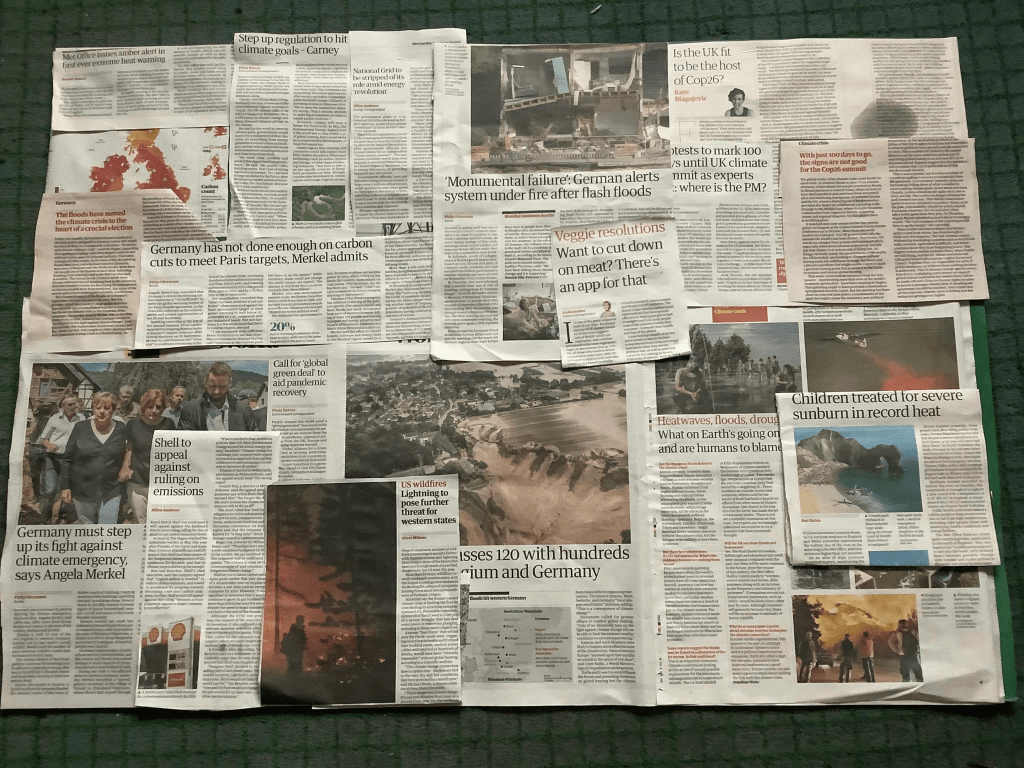
Last year I suggested the following action: “Being self-informed, being curious about what is happening, where and why, helps us to have a better understanding of climate change. This week cut out any articles you find in the newspaper (cut and past if you read on line) about climate change and make a display with them. Looking at the overall picture may give you new insights.”

Below is the collage I produced – it feels as if not much has changed but I’ll do the same this week and see.

Counting on … day 262

31st July 2022

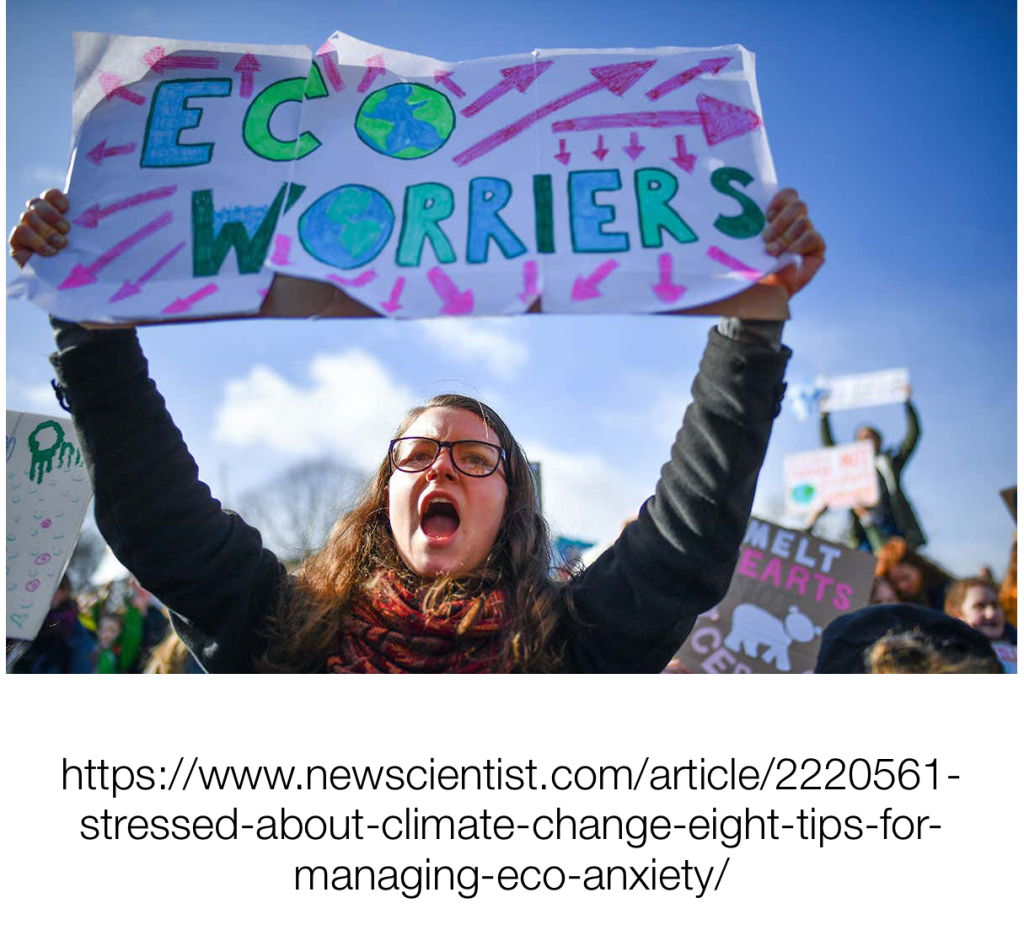
Talking about the climate crisis doesn’t have to be always upbeat and optimistic. There are times when that is not how we feel. Times when we feel anxious, overwhelmed and out of our depth. There may be times when we feel that no one else understands how we feel, that we are alone carrying these worries. Don’t bottle these feelings up but share them with someone you trust, someone who you know will be sympathetic. You might find a locally run climate cafés – https://climatecafes.org/ – or may be form an informal local group. You might talk with your spiritual director (where I live we have https://spidir.org.uk/). You might want to write down your thoughts. You might try or find out more about, the Deep Waters course run by Green Christian – https://greenchristian.org.uk/deep-waters-a-project-of-borrowed-time/

Counting on ….day 261

30th July 2022

Yesterday I added an extra Count Down entry marking 100 days until COP27, and in these next 99 days I will be repeating some of the actions I noted last year. We are relying on governments and big businesses to effect the system change need to address climate change, but such organisations are ultimately responsive to social trends. In the hustings for the new Conservative party leader, we are seeing the two candidates trying to match what they have to offer with what they sense their voters (Conservative party members) want. If we want governments and businesses to take positive action vis a vis the climate crisis, then that needs to be the desire of society at large. As much as we petition and push governments and businesses to change, we must enthuse society in the same direction. Last year’s “action 2” was talking about the climate crisis with friends – raise awareness and interest, make the topic interesting and pertinent, make the need for action desirable. 

Count Down to COP27

Day 100: 29th July 2022

Last year we were counting down to COP26 which was being held at Glasgow with the United Kingdom as host. I posed the following questions:-
Are the nations, the leaders, the civil servants, the interested parties, ready? Are they equipped with ideas and proposals? Are they ready to negotiate and encourage and take bold steps to reach an agreement that will see carbon emissions reduced to net zero by 2050? Will they be sufficiently pragmatic to be generous in funding support to enable poorer countries to be part of the movement to net zero? Will they be clear sighted, seeing the bigger global issues rather than being blinkered or distracted by individual agendas? Are they going to be supported by overwhelming popular support for those policies and actions that safeguard our shared future?

The outcome was perhaps better than might have been feared, but certainly not as proactive as it might have been. One of the outcomes was that, in recognition of the severity of the crisis we face, all parties should meet again a year later to review progress and restate targets to keep the process of net zero on track. Thus it is that in 100 days from now, on 6th November, all the parties will be convening in Sharm El-Sheikh for COP27. This time the hosts will be Egypt. 

Last year I also posed some questions for ourselves and I propose to repeat/ review these this year.

Can we be part of that popular support? Can we also take action regarding our own lifestyle to contribute to the net zero emissions target? Are there 100 actions we can take between now and the Conference?

Action 1: Write to your MP and let them know why you think this Conference is important and why you hope it will be a turning point in addressing the global climate crisis.

NB What does ‘net zero’ mean?
Net zero refers to achieving a balance between the amount of greenhouse gas emissions produced and the amount removed from the atmosphere. There are two different routes to achieving net zero, which work in tandem: reducing existing emissions and actively removing greenhouse gases.

A gross-zero target would mean reducing all emissions to zero. This is not realistic, so instead the net-zero target recognises that there will be some emissions but that these need to be fully offset, predominantly through natural carbon sinks such as oceans and forests. (In the future, it may be possible to use artificial carbon sinks to increase carbon removal, research into these technologies is ongoing.)

When the amount of carbon emissions produced are cancelled out by the amount removed, the UK will be a net-zero emitter. The lower the emissions, the easier this becomes. 
https://www.instituteforgovernment.org.uk/explainers/net-zero-targetAuthor Judith RussenbergerPosted on Categories Count downUncategorizedTags climate crisisenvironmentLeave a comment