Counting on … day 71

23rd January 2022

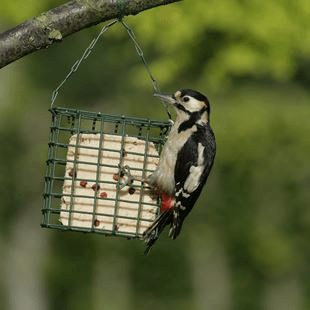
Watching birds come into the garden is a great pleasure. Providing them with food, water and places to shelter (and later to nest) is rewarding. Birds are vulnerable to viruses so it is important to keep clean the places where they are fed. 

https://www.rspb.org.uk/birds-and-wildlife/advice/how-you-can-help-birds/feeding-birds/keep-your-bird-table-healthy/

Epiphany 3

23rd January 2022

Nehemiah 8:1-3, 5-6, 8-10

All the people of Israel gathered together into the square before the Water Gate. They told the scribe Ezra to bring the book of the law of Moses, which the Lord had given to Israel. Accordingly, the priest Ezra brought the law before the assembly, both men and women and all who could hear with understanding. This was on the first day of the seventh month. He read from it facing the square before the Water Gate from early morning until midday, in the presence of the men and the women and those who could understand; and the ears of all the people were attentive to the book of the law. And Ezra opened the book in the sight of all the people, for he was standing above all the people; and when he opened it, all the people stood up. Then Ezra blessed the Lord, the great God, and all the people answered, “Amen, Amen,” lifting up their hands. Then they bowed their heads and worshiped the Lord with their faces to the ground. So they read from the book, from the law of God, with interpretation. They gave the sense, so that the people understood the reading.

And Nehemiah, who was the governor, and Ezra the priest and scribe, and the Levites who taught the people said to all the people, “This day is holy to the Lord your God; do not mourn or weep.” For all the people wept when they heard the words of the law. Then he said to them, “Go your way, eat the fat and drink sweet wine and send portions of them to those for whom nothing is prepared, for this day is holy to our Lord; and do not be grieved, for the joy of the Lord is your strength.”

Psalm 19

1 The heavens declare the glory of God, *
and the firmament shows his handiwork.

2 One day tells its tale to another, *
and one night imparts knowledge to another.

3 Although they have no words or language, *
and their voices are not heard,

4 Their sound has gone out into all lands, *
and their message to the ends of the world.

5 In the deep has he set a pavilion for the sun; *
it comes forth like a bridegroom out of his chamber;
it rejoices like a champion to run its course.

6 It goes forth from the uttermost edge of the heavens
and runs about to the end of it again; *
nothing is hidden from its burning heat.

7 The law of the Lord is perfect
and revives the soul; *
the testimony of the Lord is sure
and gives wisdom to the innocent.

8 The statutes of the Lord are just
and rejoice the heart; *
the commandment of the Lord is clear
and gives light to the eyes.

9 The fear of the Lord is clean
and endures for ever; *
the judgments of the Lord are true
and righteous altogether.

10 More to be desired are they than gold,
more than much fine gold, *
sweeter far than honey,
than honey in the comb.

11 By them also is your servant enlightened, *
and in keeping them there is great reward.

12 Who can tell how often he offends? *
cleanse me from my secret faults.

13 Above all, keep your servant from presumptuous sins;
let them not get dominion over me; *
then shall I be whole and sound,
and innocent of a great offence.

14 Let the words of my mouth and the meditation of my
heart be acceptable in your sight, *
O Lord, my strength and my redeemer.

1 Corinthians 12:12-31a

Just as the body is one and has many members, and all the members of the body, though many, are one body, so it is with Christ. For in the one Spirit we were all baptised into one body–Jews or Greeks, slaves or free–and we were all made to drink of one Spirit.

Indeed, the body does not consist of one member but of many. If the foot would say, “Because I am not a hand, I do not belong to the body,” that would not make it any less a part of the body. And if the ear would say, “Because I am not an eye, I do not belong to the body,” that would not make it any less a part of the body. If the whole body were an eye, where would the hearing be? If the whole body were hearing, where would the sense of smell be? But as it is, God arranged the members in the body, each one of them, as he chose. If all were a single member, where would the body be? As it is, there are many members, yet one body. The eye cannot say to the hand, “I have no need of you,” nor again the head to the feet, “I have no need of you.” On the contrary, the members of the body that seem to be weaker are indispensable, and those members of the body that we think less honourable we clothe with greater honour, and our less respectable members are treated with greater respect; whereas our more respectable members do not need this. But God has so arranged the body, giving the greater honour to the inferior member, that there may be no dissension within the body, but the members may have the same care for one another. If one member suffers, all suffer together with it; if one member is honoured, all rejoice together with it.

Now you are the body of Christ and individually members of it. And God has appointed in the church first apostles, second prophets, third teachers; then deeds of power, then gifts of healing, forms of assistance, forms of leadership, various kinds of tongues. Are all apostles? Are all prophets? Are all teachers? Do all work miracles? Do all possess gifts of healing? Do all speak in tongues? Do all interpret? But strive for the greater gifts.

Luke 4:14-21

Jesus, filled with the power of the Spirit, returned to Galilee, and a report about him spread through all the surrounding country. He began to teach in their synagogues and was praised by everyone.

When he came to Nazareth, where he had been brought up, he went to the synagogue on the sabbath day, as was his custom. He stood up to read, and the scroll of the prophet Isaiah was given to him. He unrolled the scroll and found the place where it was written:

“The Spirit of the Lord is upon me,

because he has anointed me
to bring good news to the poor.

He has sent me to proclaim release to the captives
and recovery of sight to the blind,
to let the oppressed go free,

to proclaim the year of the Lord’s favour.”

And he rolled up the scroll, gave it back to the attendant, and sat down. The eyes of all in the synagogue were fixed on him. Then he began to say to them, “Today this scripture has been fulfilled in your hearing.”

Reflection

Nehemiah, an important official (Cup Bearer to king Artaxerxes I of Persia) had been tasked with re-establishing the city of Jerusalem. He did this physically: rebuilding its walls and thereby asserting its role as a city on the same level as cities of other peoples in the region, such as the Samaritans and the Ammonites. And socially: rebuilding the people there as one community shaped by and bound together by the mosaic law. These residents of Jerusalem were a mixed bunch. There were those who were decedents of those who had not been exiled to Babylon but had remained in Judea. There were those who had over recent years returned from Babylon. And there were others who lived there but had no connection to the God of Moses. There had been tension between the groups and examples of some bullying and prejudice. And there had been examples of people marrying outside the faith and loosing their allegiance to God. 

In today’s passage, the priest Ezra is reading the Law of Moses to the assembled people. It is as if they are hearing it for the first time. They weep as if suddenly aware of their failings, their sinfulness, and are now penitent. They understand now that there is one law that defines the one way in which they are to live if they are to be one people.  They leave blessed and restored, united as the people of God. 

We in the United Kingdom are a divided, mix bunch of people. We know that great inequality exists between the different regions of the country, between different ethnic groups, between rural and urban communities, and between those whose incomes and wealth are growing and those who incomes and wealth are dwindling. We know that divisions exist between those who can afford food, heating, cars, private health care, and those who cannot. We sense that these divisions diminish life for all of us, that they are unsustainable, and will ultimately be destructive of the lives we lead. 

In 2020 as the first wave of covid struck, we suddenly realised how important were the people who stacked the supermarket shelves, who drove trains and buses, who emptied the bins  and cleaned the streets. We realised how much we relied on child care and teachers, and how very important were the medics in our hospitals and the research scientists in the labs. We clapped and praised them. 

We realised how very important our local communities were, how we could help one another, how good it was to know the people in our streets. We discovered what we could achieve when we all became good neighbours. We realised how important it was to have access to green spaces, to have places where we could walk, or run or cycle or just sit. And we rediscovered the pleasure of breathing fresh air, of hearing birds singing, and seeing the landscape clearly without the fog of pollution.

That was two years ago. Do we still remember how it felt? Do we still think that those people, those relationships, those places are important? Or has it all been caught up and lost in the mists of time as more pressing matters have come along? 

What might we learn from today’s reading that could be useful? The passage from Nehemiah tells us of the importance of rules held in common, of a shared sense of what is right and wrong, a shared sense that there is such a thing as the common good. In a multi cultural, multi faith  society it might be hard to find a set of commonly held religious rules, yet can we not all find agreement in the idea of loving our neighbour as ourself, in the importance of justice and fairness and equality? Can we not do all we can to encourage community groups, community focused neighbourhoods, community gardens, community centres and community shops? Can we not all agree that we should level things up so that everyone is on a level playing field and that everyone has equal opportunities? And can we not agree that laws and economic policies and taxation should be designed for the wellbeing of all and not just a few, and that in working for wellbeing this should include the environment?

The exert from Paul’s letter to the Corinthians gives us an apt image for respecting each other as equals. The CEO cannot say to the shelf stacker, I don’t need you, and the banker cannot say to lorry driver, I don’t need you. If we were all pension fund managers, who would clean the streets? If we were all politicians, who would nurse the sick? In all our difference we are equally important, and need to be valued and respected as such. In a world which often equates value with pay, we need to bring a much greater equality in pay – ie to reduce the Gini coefficient. And overhaul our tax system so that it is both fair and so that it rebalances wealth.

The reading from Luke’s gospel gives us the words of Isaiah as Jesus’s manifesto. Empowered by the Spirit, he declares his ambitions for:- 

bringing good news to the poor – good news that must surely include relief from food poverty and fuel poverty;  

release for the captives which must surely include release from impossible debts both here and across the world, both for households and for essential organisations such as the NHS and the educational system, for the BBC and the Environment Agency; 

sight for the blind which must include vision and clarity for administrators and politicians, business leaders and investors;

freedom for the oppressed which must include freedom from individual and institutional racial prejudice, religious prejudice, sexual and gender-based, and prejudice against those with physical and mental disabilities;

a year of the Lord’s favour which must surely include enshrining kingdom values at the heart of society. 

Today’s readings can inspire our vision for a far better world, and being inspired, we should remember that we have been given the gift of the Holy Spirit in various forms so that we can achieve this vision. 

Counting on …day 68

21st January 2022

Today I am posting a message from The Two Minute Action Team: about reducing air craft traffic  – and the pollution that causes – by ending ‘ghost flights’.

“All you have to do is to sign a petition on “ghost flights”. These are empty aircraft flown by airlines to preserve what is often their most valuable asset: permission to land at and take off from, high-demand airports such as Heathrow. These are real flights creating carbon dioxide, air pollution and noise. A good example of how commercial considerations are prioritised over the environment by both government and airlines.

The petition is here: https://petition.parliament.uk/petitions/605749

Please share this with anyone who cares about health or the environment.

Once again thanks for taking action – your support can really make a difference.

Thank you,

The Two Minute Actions Team

The 2 Minute Action group is a coalition of groups campaigning locally on environmental issues, including Richmond and Twickenham Friends of the Earth, Richmond Cycling Campaign, Richmond and Twickenham Green Party, Teddington Action Group, West London Friends of the Earth, Richmond Extinction Rebellion, the Friends of Heathfield Rec and Make Air Safe and Clean (MASC).

If you want to join please sign up here: https://actionnetwork.org/forms/join-2-minute-actions

Green Tau: issue 30

The challenge of rising sea levels for Pacific islands.

20th January 2022

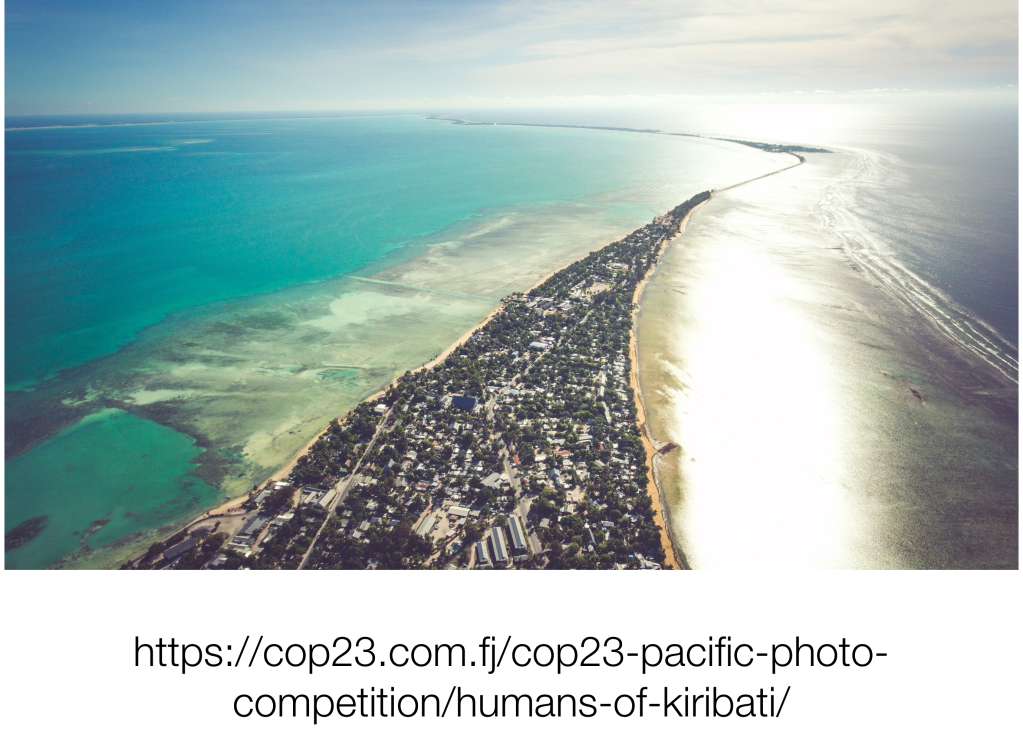
Last week the Green Tau focused on Richmond and the likely effects of the increased risk of flooding arising from climate change. This week the focus will be on Tarawa, one of the 33 atolls that makes up the Pacific nation of Kiribati.  

Tarawa is one of the largest of Kiribati atolls and is home to one 60,000  people, about 53% of the total population. Seen from above, Tarawa is a long thin strip of land that curves to form two sides of a triangle, in the middle of which is a lagoon. (Atolls are islands created by volcanic action. The former crater forms a dip in the middle). The third side of the triangle is below sea level and is home to a coral reef. It has a very long coast line in proportion to its land area. The land is flat and low lying, rising to about 2-3m above sea level.  Beaches on the lagoon side tend to be wider and shallower than this on the ocean side.

Scientific research suggests that the rise in average sea levels for Tarawa, by 2100,  will be between 0.5  (if the global temperature increase is kept below 1.5C) to 1.2m (if the increase in the worst case is 5-6C). Present projections suggest we are on track for a 2.7C temperature rise – and a projected sea level rise for Tarawa of 0.6m. High tide is typically 1.2m above the mean sea level, but is subject to variation. For example tide levels rise during periods when the El Niño weather system is dominant because the high pressure lifts sea levels. Because of its shape, with along coast lines and narrow low lying land mass, Tarawa – like many similar atolls and islands – is very vulnerable to rising seas levels. The people of Tarawa can see that before the end of this century they may no longer have an island on which to live! 

Sea levels also rise markedly when drive by cyclones. The Republic of Kiribati used not to be affected by tropical cyclones but with increasing global temperatures and changing weather patterns, this is no longer so. Not only do cyclones produce flooding with high waves, but the strong winds are particularly destructive to low lying lands such as on Tarawa with the winds breaking sea defences, ripping up vegetation and blowing away soil. (Soil depths are already shallow because these volcanic atolls are relatively youthful in geological terms). 

Tarawa is located on the Equator and it has a tropical rainforest climate. It rains on average every other day, with a high of rainfall of about 300mm a month in January and a minimum of 100mm in September. This ensures that the  water table is regularly topped up.  However the land above sea level at Tarawa is narrow, with saline after on both sides. Rising sea levels leads to the contamination of freshwater supplies with salt. This reduces water for drinking etc as well as damaging agricultural crops and plant life generally. 

Rising global temperature affect not just the air but also ocean temperatures. Since preindustrial times, global sea surface temperatures have risen by 0.7C. The rate of increase has risen in recent decades and particularly so in the last 6 years. Temperatures rises are not uniform and have been more marked in the southern Pacific waters. The IPCC predicts sea temperatures may rise by 1.2 to 3.2C by 2100 (depending on our ability to reduce carbon emissions). Rising sea temperatures affect marine life generally and reefs in particular. Temperature rises in the region of 1C can cause the bleaching of coral reefs. This draining of colour shows that the coral is stressed, and is likely to die.  Associated with heat rises accentuated by El Niño, Tarawa has had repeated incidences of coral bleaching. When coral reefs die and break down, they no longer protect local shores from erosion nor protect lagoons from destructive waves that destroy the particular ecology of those calmer waters. The loss of coral reefs also leads to losses  of  marine biodiversity.

Tarawa and the rest of the atolls in the Republic of Kiribati are not alone in facing these devastating effects of climate change. In 1990 they and other similarly vulnerable countries formed the Alliance of Small Island States to give themselves collectively a more voluble voice in discussion and proposals around the climate crisis. The AOSIS was a particularly strong presence at the Paris Climate Conference in 2015. Their voice was also heard at the Glasgow COP last year although because of covid fewer delegates were able to attend. One of those unable to travel was the former President of Kiribati, Anote Tong. Speaking from home, he told ITV News that beyond 2030 “our very existence might be in jeopardy”. 

In 2012 Tong bought a 2700 hectare estate on the island of Vanue Levu in Fiji as a refuge for the citizens of Kiribati, plus a further 2000 hectares in 2014. Between 2003 and 2015 the Kiribati Adaptation Plan was executed using money raised by the United Nations from wealthy donors such as Australia This included projects such as planting mangrove palms to limit coastal erosion, strengthening sea wall defences, and installing rainwater butts to help safeguard fresh water supplies. 

In 2020 the new President of Kiribati, Taneti Maamau, announced plans, in conjunction with China, to artificially build up parts of Tarawa, to raise them above projected sea level rises.

In the mean time other adaptations projects are on going to improve the islanders’ living standards and build up their resilience in the face of flooding. These include encouraging islanders to develop traditional food gardens to protect against sudden food shortages (much of Kiribati’s food is imported), developing fish management schemes to prevent over fishing, and increasing provision shade to protect people from adverse temperatures. Consideration is now being given to using the land bought in Fiji to provide food for Kiribati. It seems that due to poverty, the people of Kiribati are not well equipped to cope with the extra demands and risks of the climate crisis. Equally important are these projects designed to improve their living standards, health and well being.

Rainwater retention to reduce flooding

There are a number of small ways in which we as householders, and more especially those of us with gardens, can increase the amount of rainwater our domain can retains. This can reduce the risk of flooding in two ways.

  1. By keeping water out of, or by delaying the water entering into, the storm water drains we can help prevent them from overflowing – a common cause of flooding in urban areas. 
  2. By increasing the water absorbency of our grounds, we can delay the time and speed with which rainwater enters  local streams and/ or the water table. This will reduce the pressure on the capacity of local streams and rivers, so reducing the risk of flooding. 

How can we do this?

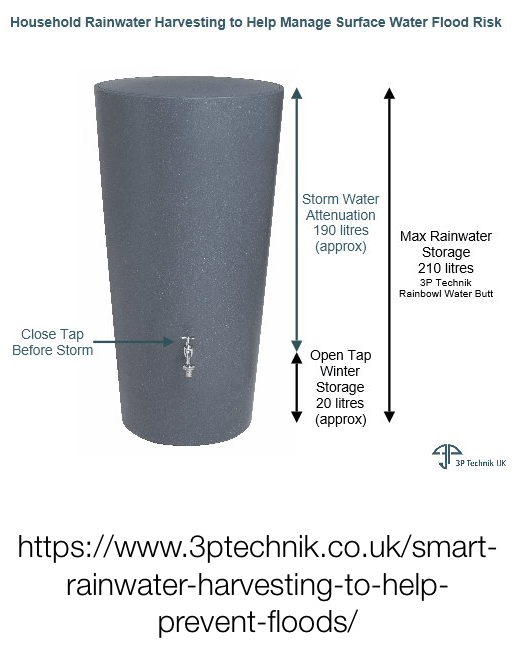
  • Install water butts. These collect water before it enters either the ground of storm water drains. If, advance of heavy rainfall, the butts are empty, then corresponding volumes of water can be held back from entering the ground or drains. Whilst one single butt may not make difference, a 1000 water butts each with a capacity of 200litres can hold back 200,000 litres – 200 cubic meters – of water. This does require some focus by the householder on rain forecasts. A less precise solution would be to leave the water butt tap half open or it to a leaky hose. Either way it is important that you ensure the empty butt is weighted down to stop it blowing over – either leave some water in the bottom or put in some bricks or out a heavy lid on top.
  • The RHS suggests using rainwater from butts to wash cars and paths in the winter and plants in the summer.
  • Avoid areas of bare earth. Ground that is covered with plants will slow the passage of rainwater into the water table. Rainfall will be interrupted by leaves and rainwater will absorbed by roots and by any mulch covering the ground. 
  • Compacted soil is less able to absorb rainwater – where the ground is regularly trafficked create a path that uses porous materials – eg gravel, bark, stepping stones.
  • Ensure a range of planting so that there are always some plants covering the ground and some plants with leaves.
  • Cover areas of bare earth – eg before planting begins or in the autumn after harvesting  – with a mulch or with a quick growing green crop – otherwise known as green manure – such as alfalfa, clover, mustard.  https://www.rhs.org.uk/soil-composts-mulches/green-manures
  • Avoid hard surfaces if possible. Where a hard surface is needed (as a patio, for car parking etc) you can opt for a porous hard surface such as gravel or paving stones spaced out with gaps for drainage. You could also incorporate a soak-away to catch and collect water that runs off the area. 
  • If you have a pond, keep it filled up with rain water. Run a hosepipe from a water butt so that when it rains the pond benefits from rain gathered over a larger area. 

Counting on day 66

19th January 2022

This is the time of year when I start to empty and reshape my compost heaps. I hope to find  inside the compost bins well rotted vegetable matter, with red worms and wood lice wriggling around the edges where the material is not so well decomposed. I scoop out what is ready for use, placing it around the base of fruit trees, under the raspberry canes, around currant bushes and on top of the rhubarb patch. I make sure it is not piled up against the trunks of the trees. Then I leave it for the worms in the soil to  pull the compost down into the soil where it will nourish the plants for the coming season. 

Last year we put in the compost bins the compostable ‘plastic’ bags and compostable ‘plastic’ food bowls. Whilst I can see that they are breaking down, the decay process is much slower than it is for plant materials. What hasn’t decayed has gone back into the bin for a second season. 

If you haven’t the space for a compost bin, you might like to try a worm bin. See the Urban Worm’s website for instructions on making a worm bin and for the offer of free tiger worms to live in it – 

Counting on …day 63

17th January 2022

Recently Londoners we’re given health warnings about air pollution: the elderly and those with breathing difficulties were advised to listen strenuous exercise and to stay inside. A spell of high pressure weather mean that the air over London had remained static for several days: no winds had been moving the air on and bringing in fresh. As the air wasn’t moving nor were the noxious chemicals and small particulates moving. Instead concentration levels of these pollutants were rising. 

Where do these pollutants come from in the first place? Exhausts  from vehicles, dust from brake blocks and tyres, smoke from wood burning fires, exhausts from gas and oil boilers, dust from construction sites, exhausts from waste incinerators and from industrial plants. Of all the sources of pollution generated in London, over 50% comes from vehicles!  It would seem that we Londoners are the cause of much of the problem. Can we drive less? Can we become less reliant on polluting vehicles to deliver goods and services? Can we encourage active travel –  walking and cycling? 

 Counting on …. Day 62

16th January 2022

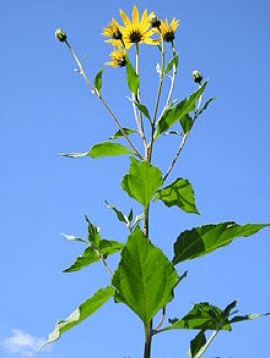
Jerusalem artichokes are in season. These are tubers that in the summer produce tall plants with sunflower like flowers. They are easy to grow. Simply take an existing tuber, even one you have bought from the vegetable shop or supermarket, and plant it in the soil at a depth of about 5cm. The plant may need staking as it grows to stop it blowing over. 

Jerusalem Artichoke Pasta Sauce

Jerusalem artichokes  about 150g per person Cashew nuts about 25g per person Oil Garlic and sage to taste 

Scrub the tubers clean and chop.

Heat the oil and sautée the garlic. 

Add the artichokes and sage. Stir well. Add the cashew nuts. 

Cover the pan and cook gently til soft and golden.

Blitz the mixture adding a little hot water as necessary to achieve a creamy sauce.

Serve with pasta. 

Epiphany 2

16th January 2022

Isaiah 62:1-5

For Zion’s sake I will not keep silent,
and for Jerusalem’s sake I will not rest,

until her vindication shines out like the dawn,
and her salvation like a burning torch.

The nations shall see your vindication,
and all the kings your glory;

and you shall be called by a new name
that the mouth of the Lord will give.

You shall be a crown of beauty in the hand of the Lord,
and a royal diadem in the hand of your God. 

You shall no more be termed Forsaken,
and your land shall no more be termed Desolate;

but you shall be called My Delight Is in Her,
and your land Married;

for the Lord delights in you,
and your land shall be married.

For as a young man marries a young woman,
so shall your builder marry you,

and as the bridegroom rejoices over the bride,
so shall your God rejoice over you.

Psalm 36:5-10

5 Your love, O Lord, reaches to the heavens, *
and your faithfulness to the clouds.

6 Your righteousness is like the strong mountains,
your justice like the great deep; *
you save both man and beast, O Lord.

7 How priceless is your love, O God! *
your people take refuge under the shadow of your wings.

8 They feast upon the abundance of your house; *
you give them drink from the river of your delights.

9 For with you is the well of life, *
and in your light we see light.

10 Continue your loving-kindness to those who know you, *
and your favour to those who are true of heart.

1 Corinthians 12:1-11

Now concerning spiritual gifts, brothers and sisters, I do not want you to be uninformed. You know that when you were pagans, you were enticed and led astray to idols that could not speak. Therefore I want you to understand that no one speaking by the Spirit of God ever says “Let Jesus be cursed!” and no one can say “Jesus is Lord” except by the Holy Spirit.

Now there are varieties of gifts, but the same Spirit; and there are varieties of services, but the same Lord; and there are varieties of activities, but it is the same God who activates all of them in everyone. To each is given the manifestation of the Spirit for the common good. To one is given through the Spirit the utterance of wisdom, and to another the utterance of knowledge according to the same Spirit, to another faith by the same Spirit, to another gifts of healing by the one Spirit, to another the working of miracles, to another prophecy, to another the discernment of spirits, to another various kinds of tongues, to another the interpretation of tongues. All these are activated by one and the same Spirit, who allots to each one individually just as the Spirit chooses.

John 2:1-11

On the third day there was a wedding in Cana of Galilee, and the mother of Jesus was there. Jesus and his disciples had also been invited to the wedding. When the wine gave out, the mother of Jesus said to him, “They have no wine.” And Jesus said to her, “Woman, what concern is that to you and to me? My hour has not yet come.” His mother said to the servants, “Do whatever he tells you.” Now standing there were six stone water jars for the Jewish rites of purification, each holding twenty or thirty gallons. Jesus said to them, “Fill the jars with water.” And they filled them up to the brim. He said to them, “Now draw some out, and take it to the chief steward.” So they took it. When the steward tasted the water that had become wine, and did not know where it came from (though the servants who had drawn the water knew), the steward called the bridegroom and said to him, “Everyone serves the good wine first, and then the inferior wine after the guests have become drunk. But you have kept the good wine until now.” Jesus did this, the first of his signs, in Cana of Galilee, and revealed his glory; and his disciples believed in him.

Reflection 

Today’s gospel is one of my favourite stories as it about enjoying life and creating an abundance out of very little. It is on a par with the feeding of the 5000. And with the two, you have the Eucharist – a story which does not explicitly appear in John’s gospel.

The first reading from Isaiah begins with the voice of the prophet shouting out; not keeping silent. Sometimes we are reluctant to shout out either loud enough or often enough for those in need of salvation? For the people of Afghanistan? For those children in the UK who don’t have beds to sleep in? For people whose wages are so low, they have to rely on food banks? For those struggling with mental ill health because of the pandemic?

In Isaiah’s case there is a back story. Jerusalem had sinned, had erred and strayed from God and had suffered the consequences. Having learnt from their mistakes, the time had now come for the restoration of Jerusalem,  a returning to their union with God. The people had been physically exiled but now they were returning to their God, to their land, to their roots. 

We in the 21st century have strayed from God’s ways, have become separated from the land and are seeing around us the effects of that rift. As we accept that our lifestyles  are the prime cause of the climate crisis, and our greed the prime cause of world wide injustices, so we are able to repent, to make reparations and to seek restoration and reconciliation – with God, with the land and with each other. Isaiah uses the concept of marriage to describe the strength and  joy that comes from the  renewed relationship between and God and the people. It is a relationship that abounds with delight. 

The writer of psalm 36 echoes the same sentiments, extolling the strength and the abundance that come from a relationship built of love and faithfulness. Here is an abundance of good living that delights both humans and beasts. It is a relationship that grows through the gift of  light – or as we might say, wisdom.

Last Sunday we recalled the baptism of Jesus and the moment at which he was filled with the Holy Spirit, a gift that came from above. Paul’s letter to the followers of Jesus  in Corinth reminds them of the gifts they have received through the Holy Spirit: gifts of wisdom and discernment, of healing and miracles, of prophesy and discernment. The gifts of the Spirit are a sign of their union with God; those who speak or live in way that separates them from that relationship, cannot speak well of Jesus and vice versa. It is the gifts of the Spirit that will enable us to live lives that restore the world.

Finally to the Gospel. This story of transformation and abundance, and it is also a story about the celebration of restoration. We are not given any details about the bride and groom, although in a later passage we will hear John referring to Jesus as the bridegroom. The idea of marriage is often used in  the Bible as a metaphor for the relationship between God and people. So we might imagine that this wedding celebrates the restoration of the relationship between God and humanity, manifested in the union between Jesus and the community of those who love him.  It is a celebration that ends up overflowing with wine: each stone jar is filled with upwards of 100 litres of the best wine!

Notice the role Jesus’s mother plays. It is she who points out to Jesus what is needed, and it is she who prompts the servants to play their part. As followers of Jesus we are not automatons, but have differing gifts that we expected to use. And for some of us they may be the gift of observation, of discerning what is needed, of prompting or inspiring  others to action. The good news is about action and  transformation. Here a new use is found for the water jars; their former use may have been for cleansing rituals (maybe outdated rituals) but now they have been upcycled as wine vats. There had been a tradition of serving the best wine first, but now there is a new one: saving the best till last! This wedding reveals the  glory of Jesus. It is a wedding that is not going to be forgotten: indeed it is a union which continues to be celebrated every time we share the Eucharist.

 Counting on …day 61

15th January 2022

We count on the recycling crews to take away our recyclable waste and our landfill waste. To ease their workload we can help by ensuring that what we place in the recycling bin is clean, compacted (squashed, flatten, stacked) to prevent stuff overflowing, and in the correct bin. 

Is there a ‘Maria Kondo’ tidy recycling bin award?