Counting on … day 100

6th May 2024

We are lucky enough to have a good sized garden. Not being successful growers of vegetables, we have chosen to make the garden more of a wildlife haven. We don’t use pesticides, herbicides or fertilisers – other than home made compost. Nor do we use peat. This approach also means we aren’t buying things that come in plastic bottles, bags or containers. 

Over the years we have planted a number of fruit trees – apple, plum, pear, cherry, fig – as well as having raspberries, strawberries, rhubarb, currant and gooseberry bushes and a grape vine. In between the fruit grows a mix of herbs, self seeding salads and green leaf crops, bulbs, and wild flowers. Other flower beds are a mix of roses, herbs, and perennial plants, whilst the lawns remain uncut for most of the year. I have tried to transform these into meadows by transplanting into the grass suitable plants such as buttercups, plantain, ox eye daisies and sorrel etc. The garden also has a pond with flags, buttercups and pond weed, and is home to small pond creatures including dragon fly larvae. Usually there is frogspawn but none this year, which is disappointing. 

We replenish a number of bird feeders daily and have a bee hotel and a dead hedge all to encourage more wildlife.

further reading –

https://greentau.org/tag/gardens

Earth Day – in praise of God

27th April 2024

The earth is the LORD’s and the fullness thereof, the world and those who dwell therein. Psalm 24:1

You Lord, are the source of all good things: 

We praise you.

You call us to tend and care for your creation: 

May we strive to do your will.

You have made us as sisters a d brothers with all that lives: 

May we live together in peace.

A Reading Psalm 8 (The Message )

God, brilliant Lord,
    yours is a household name.

Nursing infants gurgle choruses about you;
    toddlers shout the songs
That drown out enemy talk,
    and silence atheist babble.

I look up at your macro-skies, dark and enormous,
    your handmade sky-jewelry,
Moon and stars mounted in their settings.
    Then I look at my micro-self and wonder,
Why do you bother with us?
    Why take a second look our way?

Yet we’ve so narrowly missed being gods,
    bright with Eden’s dawn light.
You put us in charge of your handcrafted world,
    repeated to us your Genesis-charge,
Made us stewards of sheep and cattle,
    even animals out in the wild,
Birds flying and fish swimming,
    whales singing in the ocean deeps.

God, brilliant Lord,
    your name echoes around the world.

Earlier this week – 22nd April – it was Earth Day. This  globally recognised  event calls on everyone to focus on the needs of the earth. And as Christians we might recall some words of St Paul, ‘As God’s co-workers we urge you not to receive God’s grace in vain. For he says,“In the time of my favour I heard you, and in the day of salvation I helped you.” I tell you, now is the time of God’s favour, now is the day of salvation.’ 2 Corinthians 6:1-2

Glory to God,

Let the earth be glad, and the sea resound: 

Let all that is in it rejoice.

We praise you!

Glory to God, 

Let the fields be jubilant, and everything in them;
 Let all the trees of the forest sing for joy.

We praise you!

The law of the Lord is perfect,
making wise the simple.

Yet we have done our own thing  and despoiled the environment. 

Lord have mercy. 


The commands of the Lord are radiant,
giving light to the eyes.

Yet we have hidden your ways under the cloak of greed,  

making life dark for our fellow beings.

Lord have mercy.

Pause for reflection 


Now is the time! 

Teach us once more to seek your wisdom for the earth.

Now is the time!

Teach us once more how to live in harmony with creation.

Now is the time!

Teach us to be mindful in what we use  and generous in what we give. 


Merciful God, 

forgive us and heals us, 

restore our world to its former glory.

Amen.

Counting on …. Day 94

26th April 2024

Green wash is advertising or marketing that makes out that a product is greener/ more environmentally friendly than it actually is. It is an attempt to delude or deceive the consumer.

TerraChoice has identified ‘seven sins of greenwashing’ –

  1. “Hidden Trade-off”: a claim that a product is “green” based on an unreasonably narrow set of attributes without attention to other critical environmental issues.
  2. “No Proof”: a claim that cannot be substantiated by easily accessible information or a reliable third-party certification.
  3. “Vagueness” is a poorly defined or broad claim that the consumer will likely misunderstand its meaning. “All-natural,” for example, is not necessarily “green.”
  4. “Worshipping False Labels”: a claim that, through words or images, gives the impression of a third-party endorsement where none exists.
  5. “Irrelevance”: a claim that may be truthful but unimportant or unhelpful to consumers seeking environmentally preferable products.
  6. “Lesser of Two Evils”: a claim that may be true within the product category, but risks distracting consumers from the more significant environmental impact of the category.
  7. “Fibbing”: a claim that is simply false.  (https://en.wikipedia.org/wiki/Greenwashing)

The BBC suggests the following certification schemes that can give assurance as to the ethical values of a producer:-

Leaping Bunny – which means that the product has not been tested on animals.

B Corp – means that a business is legally required to do beneficial things for the environment and the people who help create their products.

Carbon Trust – meets a certain standard of carbon emission reduction, meaning the product is trying to minimise its carbon impact.

Fairtrade – the product has been made by people who received a fair wage for their work.

Forest Stewardship Council (FSC) – the product is made using sustainable or responsibly managed wood sources. (https://www.bbc.co.uk/newsround/58465027)

Another source of good advice is Ethical Consumer via their web site or magazine – https://www.ethicalconsumer.org/

In a world where we already consume too much, I can’t help feeling that any advertising that encourages us to consume more than we need, is greenwashing. 

Counting on …. Day 93

25th April 2024

Earth Overshoot Day is the day on which our global ecological footprint exceeds the earth’s bio capacity. (This year’s date has yet to be announced).

“Humanity is living beyond its means, which results in an environmental dilemma – because it is living at the expense of the Earth. Every year, the consumption of resources outstrips the natural regenerative capacity of our planet.” (1) So reports myclimate.org 

The day on which we have consumers one year’s worth of resources and tip into the red, is known as as Earth Overshoot Day. Last year, 2023, it fell on 2nd August, which means that in the whole of that  year we consumed resources that were equivalent to 1.7 earths! Clear this is cannot be sustainable on an ongoing basis. 

To create a sustainable lifestyle that safeguards our future, we need to address three key things: 

“Efficiency: better usage of resources so that goods are produced with less energy and resources.

Consistency: linear production replaced by the circular economy, which minimises waste. Renewable energy is key here.

Sufficiency: A sustainable change in lifestyle under which the economy is geared to moderate consumption of resources rather than constant growth. The goal is to fulfil the wishes and requirements of our society without disproportionate waste or consumption.” (1)  

For further information – 

https://overshoot.footprintnetwork.org/about-earth-overshoot-day

(1) https://www.myclimate.org/en/information/faq/faq-detail/earth-overshoot-day-how-do-we-handle-our-resources/

Counting on … day 92

24th April 2024

Ecological footprints are a measure of how much of the earth’s natural resources needed to sustain human life – ie how much clean water, clean air, soil for growing crops, oceans for fish, trees for timber, water/ wind/ fossil fuels etc for energy, land for buildings, etc needed for each human. This footprint will vary from person to person depending on their lifestyles – how much and what they consume, and how much and what sort of waste they produce. 

The ecological footprint of someone who lives off the grid, growing their own food and recycling their waste, will have a smaller ecological footprint than someone who owns multiple homes, flies and drives a large SUV, eats a meat rich diet, and buys lots of clothes and other consumer goods.

Ecological footprints are also measured in terms of global hectares per capita (see yesterday’s blog).

Using information from https://worldpopulationreview.com/country-rankings/ecological-footprint-by-country, 

USA – 8.04 gha

Australia – 7.77 

Oman – 7.29 

France – 4.6

UK – 4.20

China – 3.71

Brazil – 2.81

India – 1.19

Zimbabwe – 1.03

Democratic Republic of Congo – 0.01

You might like to use an online calculator to estimate your carbon footprint (these can be very rough and ready rather than precise but give a ballpark idea). These calculators are not just measuring your carbon footprint but your ecological footprint – how much of the earth’s resources your lifestyles uses.

https://www.footprintcalculator.org/home

https://footprint.wwf.org.uk

Counting on … day 90

19th April 2024

How sustainable is wind power? 

The following comes from a report by the German broadcaster, Deutsche Welle (DW).

“On average, wind turbines are operated for about 25 years. During this time, they generate 40 times more energy compared to the energy required for the production, operation and the disposal of a wind power plant.

“So-called upstream emissions, generated mostly through the production of carbon-intensive steel and cement, are included in the overall carbon balance of a wind turbine’s life cycle.

An onshore wind turbine that is newly built today produces around 9 grams of CO2 for every kilowatt hour (kWh) it generates, according to according to the UBA. A new offshore plant in the sea emits 7 grams of CO2 per kWh.

“Compared with other technologies, wind power does well in terms of carbon emissions. By comparison, solar power plants emit 33 grams CO2 for every kWh generated. Meanwhile, power generated from natural gas produces 442 grams CO2 per kWh, power from hard coal 864 grams, and power from lignite, or brown coal, 1,034 grams.” (1)

But what about the renewability of the turbines? Can their component parts be recycled so conserving the materials used? Wind turbines have a lifespan of 30+ years. At present the number being decommissioned is small but will grow – DW suggests that by 2050 up to 50,000 wind farms in Germany alone will need replacing. Whilst to some extent the concrete for the bases can be crushed and recycled as hardcore etc, and the steel and other minerals from pylons can be recycled, recycling the blades is less easy as they are a composite of glass fibre, plastic, carbon etc. Old blades may end up in landfill. However – “The first recyclable rotor blades for large offshore plants are currently being produced in Denmark. By 2030, the plant constructor Siemens Gamesa plans to only sell recyclable rotor blades: from 2040 the production of the company’s wind power plants is expected to be completely carbon neutral.” (1)

Nevertheless, wind power is one of the least environmentally damaging sources of energy.

  1. https://www.dw.com/en/how-sustainable-is-wind-power/a-60268971

Counting on … day 87

16th April 2024

Green cement – part 2

As part of the need to reduce all greenhouse gas emissions to address the climate crisis, reducing emissions from cement production is essential. 

50% of the emissions come from the release of carbon dioxide as a byproduct during the clinker making process. One solution is carbon capture- capturing the CO2 before it escapes into the atmosphere, pressurising it to a liquid which is injected into rock strata deep underground.  This technology has yet to be developed for use at an industrial scale. 

Another solution is to replace the limestone with an alternative that produces less CO2 – such as magnesium oxide mixed with magnesium chloride solution. However such alternative cements may not have all the attributes of cement when in use – different construction methods may be needed.

40% of the emissions are attributable to the energy needed to heat the clinker kilns. Switching to renewable energy to replace coal is one solution but requires considerable investment in green electricity production and distribution. 

Using materials other than limestone – such as volcanic rock – that can produce clinker at lower temperatures is another possible solution. Another alternative is to replace a proportion of the cement with an alternative binder such as ground granulated blast furnace slag or pulverised fly ash. Again this may alter the properties of the cement and require different construction methods.

10% of the emissions comes from energy used in mining and transporting the raw materials. Energy efficiency and the use of renewable energy will be a way forward.

Further reading –https://theconversation.com/green-cement-a-step-closer-to-being-a-game-changer-for-construction-emissions-126033

(https://theconstructor.org/concrete/green-cement-types-applications/5568/

Counting on … day 84

11th April 2024

Fossil Fuel Subsidies -1

This overview of fossil fuel subsidies comes from the IMF: “Subsidies are intended to protect consumers by keeping prices low, but they come at a substantial cost. Subsidies have sizeable fiscal consequences (leading to higher taxes/borrowing or lower spending), promote inefficient allocation of an economy’s resources (hindering growth), encourage pollution (contributing to climate change and premature deaths from local air pollution), and are not well targeted at the poor (mostly benefiting higher income households). Removing subsidies and using the revenue gain for better targeted social spending, reductions in inefficient taxes, and productive investments can promote sustainable and equitable outcomes.” (1)

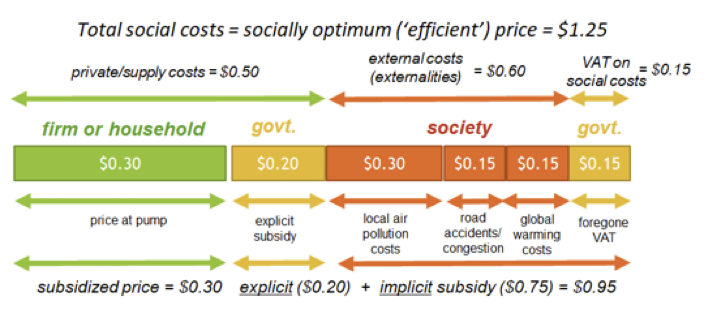
The article goes on to explain the difference between explicit and implicit subsidies, the former being the obvious direct payments to fossil fuel producers to bring down the unit cost of the fuel. The latter is a subsidy that is likely always present, vis in the practice of not charging the fossil fuel producers for the costs of pollution, climate change etc that are a consequence of their business. 

“Implicit subsidies occur when the retail price fails to include external costs, inclusive of the standard consumption tax. External costs include contributions to climate change through greenhouse gas emissions, local health damages (primarily pre-mature deaths) through the release of harmful local pollutants like fine particulates, and traffic congestion and accident externalities associated with the use of road fuels”(1)

By way of example they provide the following bar chart: 

(1) https://www.imf.org/en/Topics/climate-change/energy-subsidies

Counting on … day 72

22nd March 2024

Carbon sequestration is a formal name given to the processes by which carbon is captured from the atmosphere and stored on a long-term basis. Such long-term storage might include peat bogs, forests, kelp beds etc and may be referred to as ‘carbon sinks’.

Carbon sequestration can be used as a means of  mitigating the effects of climate change. This can be biologically by, for example, planting more forests, restoring peat bogs and wetlands, and re-establishing kelp meadows. This natural sequestration can be enhanced, in the case of forests, by using felled timber to make items such as buildings, furniture etc and keeping those items for hundreds of years. However growing trees for timber needs to be carefully managed to a) maximise the carbon captured by the growing tree, and b) to maximise the flourishing of biodiversity.

Carbon can also be sequestered geologically if the CO2 can be captured  eg from a cement factory. Then the CO2 “can be compressed to ≈100 bar into a supercritical fluid. In this form, the CO2 could be transported via pipeline … and  injected deep underground, typically around 1 km, where it would be stable for hundreds to millions of years.” (https://en.wikipedia.org/wiki/Carbon_sequestration)

Counting on … day 71

21st March 2024

The carbon cycle 

The earth’s systems have various ways of absorbing and using carbon dioxide in such a way as to enable life to flourish. Plants absorb carbon dioxide as part of the process of photosynthesis storing the carbon as cellular material  in their leaves, branches etc. Plants release carbon dioxide back into the atmosphere as they respire – breathe. A living growing plant absorbs more carbon dioxide than it releases. When the plant dies, the carbon that has been stored as leaves and branches etc slowly decays – breaks down – and the carbon returns to the atmosphere as carbon dioxide. This is as true of water and marine plants as it is true of land plants. 

 (For a short video describing how trees absorb and use  carbon – https://www.woodlandtrust.org.uk/climate-change/carbon-trees/)

Soil in part is made up of dead plant and animal material which decays slowly overtime. Soil is therefore a storer of carbon.

The seas and oceans also contain carbon dioxide that is dissolved in the water. This carbon dioxide cycles through the water as marine plants take in, store and release the carbon as they grow. Marine waters  and the layers of sediment at the bottom of the seas and oceans store carbon in the same way as does soil. 

This brings us back to an earlier post about how much carbon dioxide there is in the atmosphere (measured in part per million) and the rate at which that concentration is increasing due to human activities – https://greentau.org/2024/02/19/counting-on-day/