Cutting methane emissions is clearly a quick and important way of reducing the short term damaging effect of greenhouse gas emissions, but unless emissions from fossil fuels are also tackled, the climate crisis will only increase. National governments and fossil fuel companies need to legislate and implement (respectively) plans to end fossil fuel production. Yet unbelievably across the world countries are still planning to further expand fossil fuel production!
“The increases in fossil fuel production estimated under the government plans and projections pathways would lead to global production levels in 2030 that are 500%, 31%, and 92% higher for coal, oil, and gas, respectively, than the median 1.5ºC-consistent pathway.” (1)
The International Energy Agency itself reported in 2021 that there was no need for new developments: sufficient oil and gas production is already in place to meet global needs as the world transitions to renewable energy. (2)
Clearly this is an issue that needs to be addressed during COP30.
Vulnerable countries weighed down by debt are often ‘encouraged’ to exploit oil and gas reserves as a way of financing their obligations. Uganda, for example, took a $1 billion loan from the IMF in 2021, using some of the money to build the East Africa Crude Oil Pipeline (EACOP). Whilst Uganda and its neighbour Tanzania, will eventually get some return from this project, the bulk of the profits (70%) will accrue to Total (62%) and China National Offshore Oil Corporation (8%).(2) At the same time farmers have been displaced from their land, villagers evicted, migration routes for wild animals have been blocked, and vast tracts of the Murchison Falls National Park are at risk from damage and pollution. And the burning of the oil extracted (which will not benefit local people as it will be sold on the international market) will generate over 34 million tons of CO2 emissions per year.
You can support the campaign against this oil pipeline and its climate destroying effects here – https://www.stopeacop.net/
One of the low carbon products that Shell – and other companies – deal in are carbon credits. Shell presents these as part of a cascade to reduce emissions:-
Avoid creating emissions
Reduce emissions
Compensate for remaining emissions through the use of carbon credits as not all industries can decarbonise at the same rate, with heavy industry and transport often utilising carbon credits to achieve net-zero goals. We actively participate in carbon markets, and have a diverse portfolio of high-quality carbon credits to help our customers reduce their carbon footprint (1)
“Carbon credits essentially represent metric tons of carbon. Simply put, one carbon credit allows or offsets one metric ton of carbon emissions.
The carbon market is where carbon credits are bought and sold. There are two kinds of carbon markets: Compliance Carbon Markets (otherwise known as Regulatory Markets) and Voluntary Carbon Markets (VCM). While carbon credits for the compliance market are government regulated, carbon offsets for the VCM are not. That doesn’t mean that they’re not vetted – simply that they’re just verified by third parties…Third-party entities are non-profit organizations that ensure that customers receive what they are paying for. They measure the amount of carbon offset through an environmental project and interpret the data, giving any offset project with their seal a green light for approval.” (2)
There are three basic types of carbon credits:
Those from reduced emissions (typically energy efficiency measures)
Removed emissions (carbon capture and planting forests)
And avoided emissions (for example refraining from cutting down rainforests).(3)
Examples of the first can include capturing methane from landfill and agricultural waste and using g it as a biofuel. Or they might include providing disadvantaged families with more fuel efficient cooking or lighting equipment.
Example of the second might include reforestation, restoring peat bogs and wetlands.
Examples of the third might include making payments to farmers not to cut down prime forest but to maintain its carbon absorbing integrity, or paying for farmers to use methods such as no-till.
Shell is one of the biggest investors in carbon credits – these carbon credits are the main way in which they aim to achieve net zero by 2050. Shell can provide (at an appropriate price) their customers with carbon credits that, for example, match the carbon emissions of the fuel they buy from Shell.
The flaw seems to be that carbon credits are being used not to make good those ‘impossible to avoid’ carbon emissions such as in cement production, but as cover to allow the continued production of fossil fuels whose use can be avoided.
Not only do fossil fuel companies promote their oil and gas as being cleaner on the basis of reduced scope 1 and 2 emissions, they also promote themselves as offering the consumer ‘low carbon products.’ For example this from Shell:-
“Shell Low Carbon Solutions offers products and solutions to help customers in heavy transport and industry reduce emissions and deliver more value. Learn about their low-carbon fuels, carbon credits, CCS, DAC, hydrogen, and how they work with partners in aviation…” (1)
But what are low-carbon fuels? For Shell, low carbon fuels include sustainable aviation fuel (SAF), biomethane which is also known as renewable natural gas (RNG) and renewable diesel known also as HVO and HEFA.
SAF is a biofuel meaning that it is produced from plant or animal based materials rather than from fossil fuels. SAF is designed to as a ‘drop in’ fuel for aviation is it can be sued in airplanes without any alteration to the plane’s fuel systems and engines. SAF is seen as low carbon because the carbon dioxide emitted in use is what would have been what as the plant/ animal material had absorbed in its life time. There is of course a carbon footprint in producing SAF which means it would cut emissions compared with tradition jet fuel by 80% rather than 100%.
However at the moment SAF only accounts for about 0.1% of total aviation fuel consumption. Whilst scaling up production facilities is part of the issue, the bigger issue is availability of plant and animal material from which to make SAF. The bio materials used including waste material from farms and forestry work, solid municipal/ household waste (including food waste and packaging), used cooking fat, animal fat, corn/soy/rapeseed/palm oil, sugar cane and beet, aide and other grains, grasses such as miscanthus, algae etc.(2) However the supply of such material is at present insufficient to match the demand for aviation fuel and this raises the conundrum that to supply enough plant and animal material, it would be necessary to set divert agricultural land away from growing food to growing aviation fuel.
The Royal Society has made estimates as to how much biomaterial would be needy to meet UK aviation fuel demand. “Used cooking oil in the UK can be utilised to provide 0.3 to 0.6% of the total amount of jet fuel required every year in the UK. The report also calculated that to meet the 12.3 million tonnes of jet fuel per year will require 42.4 million tonnes of rapeseed biomass per year and 68% of UK’s agricultural land. The report suggests that utilising Miscanthus for alcohol-to-jet in the UK will require 10.3 to 6.2 million hectares to meet UK fuel demand.” (3)
Clearly SAF is not in reality a sustainable option. If net zero is a real ambition, then reducing air miles will have to be a major part of the solution.
Last week leading economists from the University of Oxford, the University of Cambridge and the London School of Economics and Political Science, wrote to the Prime Minister, the Chancellor of the Exchequer and the Secretary of State for Energy Security and Net Zero.
That letter includes the following paragraph re energy security:-
“Maintaining UK fossil production, in contrast, makes little difference to UK energy security; the price of oil and gas is set by the international market, and security is not achieved by modest increases in domestic fossil fuel extraction, such as through the Rosebank oil field. The risks are economic as much as environmental. North Sea oil and gas carry relatively high marginal extraction costs. Such facilities could easily prove uneconomic were the oil and gas price to fall much below present levels as global demand for oil and gas wanes. The government may have to pick up the tab of decommissioning.” (1)
Interestingly the International Energy Agency was set up in 1074 during the then oil crisis with a mandate to ensure oil security. Since then it has expanded that role to include the security of natural gas, electricity and renewable energy supply chains. These supply chains – as experienced in recent years – are at risk from conflicts, embargoes, adverse weather, terrorism, cyberattack, and failures of national and international grid systems.
Amongst other measures, the IEA requires member countries to hold specific stock levels of oil to mitigate against disruption and spikes in cost. 180 million barrels of oil had to be released when Russia launched its invasion of Ukraine. That conflict and its impact on both oil prices and the supply and cost of gas, shook many countries as they became acutely aware of their reliance on these energy sources. In response many countries have sought to increase access to locally produced renewable energy.
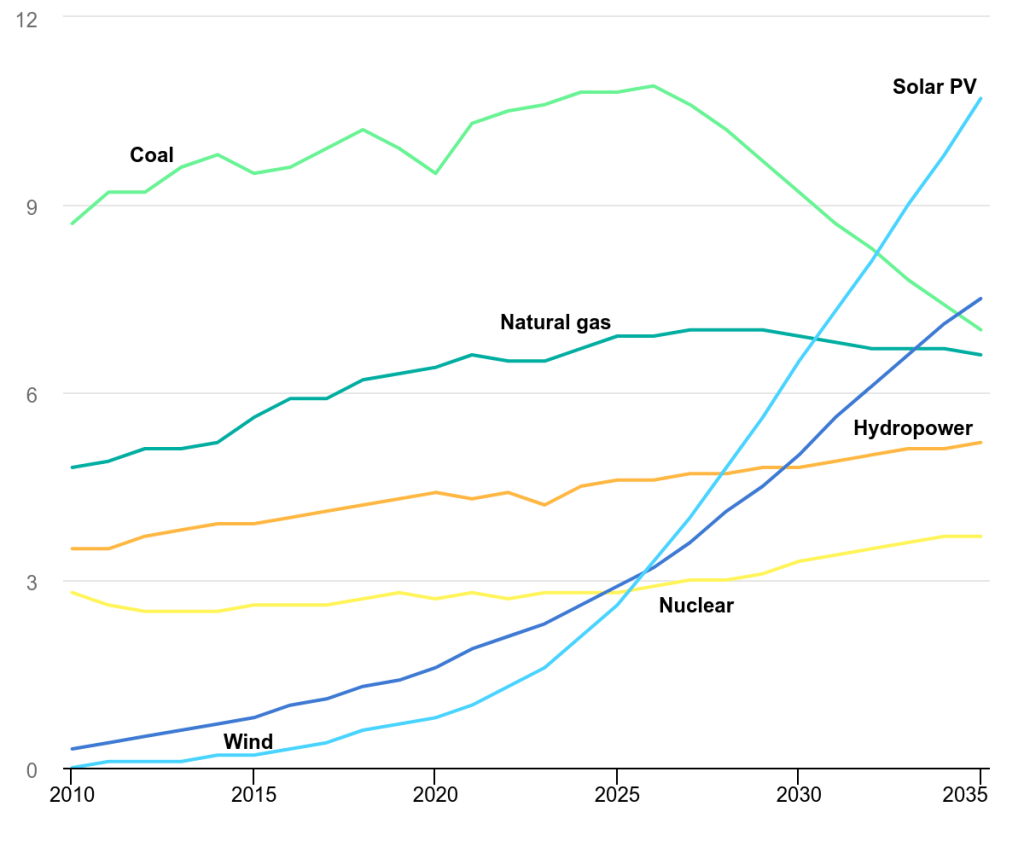
Developing renewable energies – such as wind, solar and hydro – as well as developing large scale battery storage and enhancing the capacity of the grid are key components in ensuring a secure energy supply. This will become all the more important as the demand for electricity increases. The IEA reported this year that “[b]etween now and 2035, electricity demand is set to grow six times as fast as overall energy demand as a result of factors like the adoption of electric vehicles, air conditioning use, the digitalisation of the economy, the uptake of artificial intelligence and progress on expanding electricity access. Its share in final energy consumption is projected to double by 2050.” (1)
In the energy mix needed to secure this demand the IEA predicts that the use of gas will gradually decrease, whilst solar and wind will play a rapidly increasing role. Whilst oil and gas will be part of the global energy mix going forward, it will be so at a diminishing rate. Long term energy security lies with renewables, and faced with increasing demand for electricity, what is essential in making that increased volume secure, is investment now in the renewables sector – generation, storage and grid capacity.
Another claim is that fossil fuels offer a) cheaper energy and b) secure energy (to be discussed later this week). In a YouTube presentation of the Shell Energy Transition Strategy 2024, Wael Sawan promotes Shell as being affordable and reliable energy. (1)
But do fossil fuels provide cheaper energy? According to a report by Our World in Data this is no longer true:-
“Fossil fuels dominate the global power supply because, until very recently, electricity from fossil fuels was far cheaper than electricity from renewables. This has dramatically changed within the last decade. In most places in the world, power from new renewables is now cheaper than power from new fossil fuels.” (2)
Here in the UK the cost of generating electricty from renewable sources has similarly continued to fall, whilst the cost of generating from gas has increased.
“The British government’s assessments of the LCOE* of generation technologies since 2012 show striking reductions in the LCOE of wind turbines and solar PV panels over time, which fell to between £41 per megawatt hour (MWh) and £48/MWh respectively for new developments in 2023. In comparison, the cost of new conventional gas-fired generation (without carbon capture) rose from £103/MWh (including a carbon price of £25/MWh) in 2012 to £124/MWh (including a carbon price of £65/MWh) in 2023.”(3)
*The ‘levelised cost of electricity’ (LCOE) provides a simple means of comparing different technologies for the production of electricity, taking account of capital costs and costs of operation, including maintenance and the purchase of any fuel needed.
On Tuesdays, I and one or two others from Christian Climate Action, hold vigils outside one or more insurance companies in the City of London. We do this to both highlight the degree to which the insurance industry supports and enables the expansion of the fossil fuel industry and its carbon emissions, and to bring the presence of prayer into the situation. Today’s vigils were held outside the offices of Marsh McLennan and of Lloyds of London.
How does the insurance industry work? Insurers and their customers identify risks and calculate both the likelihood of the risk materialising and the likelihood cost for the customer of that materialisation. The insurer calculates a fee and in return – once paid – undertakes to pay out to the customer if or when the destructive event happens. The insurer invests the fee to increase its value against the day when it may have to pay up. To spread the risk and the potential cost of the insurance policy, the insurer will approach other insurance companies to share the fee and the risk. Equally the insurer will formulate and sell a wide range of insurance policies, on the basis that each will earn a fee but only a small number will lead to a financial payout by the insurance company.
In the short term (2 years) damages due to extreme climate events is, according to the World Economic Forum, is seen as the second highest risk. Whilst in the long term (10 years) it is seen as the highest risk.
Insurance companies presumably increase premiums to respond to the increasing risks but is there still not a concern that they may underestimate the risk and end up paying out large sums to affected customers? And equally is there a likelihood that in the face of increased premiums customers may cut back on insurance either internalising the risk or cutting back their business plans?
Is there not also something perverse that these same insurance companies may be increasing the climate risks by, 1) investing income from premiums in fossil fuel industries or 2) providing the necessary insurance that enables oil and gas companies to continue to expand production, and thus through the increase
in greenhouse gas emissions, further accelerating the risks of adverse weather events, and the potential liabilities accruing to the insurers.
The best option for customers and the wider public – not to mention biodiversity and the planet – Would be for insurers to stop insuring oil and gas interests.
Yet looking at the be-suited office staff, is this a reality they have even considered? Or do they just place their trust in business as usual?
Reshaping how we can talk positively about the climate crisis – part 3: Finance
April 2025
How can we talk about the climate crisis in a way that sounds encouraging?
The climate crisis is an existential threat which is certainly not good news. Its causes and impact are diverse and numerous such that it is hard to pin down ‘This is the cause’ or ‘This is the solution’. It is hard to quantify ‘This is how it will effect you’ and ‘This will be the time table.’
All this makes it difficult to find a way of talking to people about the crisis and how we might respond.
So here are some thoughts that might help.
Finance for a Better Future
We are told that one of the most effective ways of tackling climate change is to redirect the money that funds climate damaging industries such as oil and gas production . Make My Money has campaigned on this issue with both humour (short films and ) and straightforward facts and graphics:
“All of these banks refuse to stop funnelling money to the companies pumping new fossil fuels.
They each talk about climate change, but we need less talk and more action on what really matters:
* Immediately stop providing money to new clients who are involved in expanding fossil fuel operations
* End the flow of new money to existing fossil fuel clients who won’t stop the expansion of fossil fuel operations and haven’t published credible plans aligned to a 1.5 degree global warming limit * Set out a clear timeline for cutting ties with existing clients that continue to expand fossil fuel operations”
But despite the ease with which we can switch banks, many of us haven’t bothered to take this simple action. Perhaps because there is no immediately visible result. Stop driving to the shops and you straight away see the benefit of not having to refuel your car. Switch your bank and there is no noticeable reduction in oil production, no financial gain. And anyway aren’t high street customers mere minnows in an ocean of big financial organisations?
Is it also that with banking we see ourselves as customers buying a service, not as patrons providing banks with money and probity? Banks like – need – to be seen as upright, trustworthy and moral institutions: people with whom you can safely entrust your money. That is part of the reason that banks will sponsor sporting and cultural events – it improves their perceived reputation as ‘responsible’ companies. And that is why groups have campaigned against such greenwashing bank relationships eg Barclays and Wimbledon Lawn Tennis/ Live Nation music festivals/ National Trust/ Sadler’s Wells.
Turning the situation round, should we be actively expecting our bank – the bank we support with our money and our patronage – to demonstrate how it is using its financial clout to create better world? By way of example let’s look at Triodos. Triodos scored the top mark in a recent survey by Ethical Consumer, scoring 96 out of a possible 100 points. The big five high street banks – Lloyds, HSBC, NatWest, Santander and Barclays scored 6 or less. (1)
Triodos does not provide finance for fossil fuels, nor fast fashion, nor weapons and warfare, nor gambling. Triodos does provide finance for renewable energy, nature restoration, healthcare, art and culture: “We believe it’s not enough to avoid funding harmful practices, so we actively support those building a better tomorrow. Our commitment goes beyond avoiding harmful investments. We proactively seek out and support initiatives that contribute to a sustainable future, ensuring that every loan and investment aligns with our mission.” (2)
For example, “Ember, the UK’s first all-electric intercity bus operator, has increased its fleet of zero emission coaches with a £5.6m loan from Triodos Bank UK. The electric coach operator, based in Scotland, has a fleet of vehicles designed specifically for intercity travel. These buses are zero-emission, contributing to environmental sustainability by reducing carbon footprints and improving urban air quality.” (3)
Triodos also finances “Copeland Park … a social, cultural and creative hub in Peckham, an area of London that is becoming increasingly known as a haven for artistic individuals and collectives. At Copeland Park, traditional warehouses and industrial buildings have been transformed into workspace for a number of creative businesses. The historic Bussey Building, for example, now provides a home for artists’ studios, theatre groups, live music venues, fitness studios and faith groups – along with incomparable views of London.”
In Wandsworth “Beyond Autism seeks to improve the education and health of children diagnosed with autism and/or related communication disorders. A loan from Triodos Bank allowed Beyond Autism to purchase their facility.”
On Mull “NWMCWC was set up by the local community in 2006 to purchase and manage the Langamull and West Ardhu forests in North West Mull. With 2 Triodos loans, we were able to help with a variety of projects, including helping with the construction of a woodshed for timber felled at the woodland.”
And in Wales “NWMCWC was set up by the local community in 2006 to purchase and manage the Langamull and West Ardhu forests in North West Mull. With 2 Triodos loans, we were able to help with a variety of projects, including helping with the construction of a woodshed for timber felled at the woodland.” (4)
In addition Triodos does not use its profits to pay bonuses to its staff. Rather “Triodos believe all our workers should be paid fairly and our focus should be on impact – for the whole Triodos community.” (2)
Choosing – switching to – an ethical banking really does enable our money to create a better future, and can do so in a clearly transparent way, such that we can be proud of what our patronage can achieve.
The following websites help individuals switch to ethical banks:-
NB the other banks recommended in the Ethical Consumer report included Coop Bank/ Smile, Cumberland Building Society, and Nationwide, all scoring 70 or more.
One of the slogans of climate activism is ‘Make the Polluters Pay’ which feels very right and grounded in what is just – a sort of global scale ‘Rylands and Fletcher’ case: if A uses the land and in so doing damages land belonging to B, then A must pay damages to B. So if Shell’s extracting of oil pollutes the adjoining land, Shell should pay the appropriate sum in damages.
Burning fossil fuels pollutes the atmosphere, increasing levels of carbon dioxide, fuelling climate change and triggering damaging adverse weather events such as floods, droughts, wildfires etc. logically the polluters – those burning the fossil fuels – should pay up. But fossil fuels have been burnt by so many different people – individuals heating their homes, small metal workshops, whole industries, transport systems etc -and over a considerable period of time. The United Kingdom has produced a cumulative total of 79,777,710,000 tonnes of CO2 since 1750. When we then call on the Government to ensure payment of a fair share in climate finance to vulnerable countries in the global south, that payment needs to reflect the scope of the damage our nation has caused.



 The Green Tau