Counting on 2026 … day 13

22nd January

In restoring a sustainable balance vis a vis land use across the globe, whilst most attention is focused on ending deforestation and promoting reforestation, restoring wetlands is also important.  Whilst wetlands (including peatlands, marshes, floodplains and mangrove swamps) may only cover 5-8% of the Earth’s surface, they are critical as absorbers of carbon dioxide, as defences against erosion, and as preventers of excess flooding. They are also areas that have been drained and used for other purposes.

“Wetlands are critically important ecosystems that support biodiversity, climate mitigation and adaptation, food production, freshwater availability, recreation, wellbeing, and so much more. Yet we are losing our wetlands three times faster than forests.” (1)  

In the UK the Fen Lands have been drained so that the peat rich soils can be used as high grade farm land but with the disadvantage that as the land dries out, so it shrinks,  becoming increasingly at risk of flooding,  and with the effect of destabilising the foundations of roads and infrastructure across the region.

Elsewhere in the UK peatlands have suffered from the effects of burning and grouse shooting, overstocking with livestock, planting for commercial forestry, extraction for peat compost, and pollution. (2) Overall some 80% of the UK’s peatlands have been degraded.

One way of restoring peatlands and maintaining their agricultural use, is through paludiculture. Here lowland peatland is rewetted and used to grow crops that thrive in wet conditions such as Norfolk Reed used for thatching; bulrushes (typha) used as a building material, as a bioenergy crop and in clothing; sphagnum moss which can be used as a peat substitute as well as for biomecidal and industrial chemical uses; food crops such as celery, bilberries and cranberries, watercress, sweet grass grains, rice etc. (3) 

  1. https://www.stockholmresilience.org/research/research-news/2022-02-02-we-need-to-talk-about-wetlands-and-how-to-save-them.html
  2. https://www.iucn-uk-peatlandprogramme.org/about-peatlands/peatland-damage
  3. https://naturalengland.blog.gov.uk/2022/09/30/paludiculture-the-future-of-farming-on-peat-soils/ and https://www.paludiculture.org.uk/

Counting on 2026 … day 12

21st January

One of the issues with the loss of a sustainable balance in land use (as highlighted by transgressing this planetary boundary) is the loss of soil fertility – and in some cases the loss of the soil itself, being washed or blown away. One solution is to restore the fertility and structure of the soil of the soil and to adopt farming methods that healthy soil. Regenerative farming is a widely used term to describe this process. This is a broad term and can mean many things in different situations. Unlike organic farming, it doesn’t come with any form of certification.  Nevertheless, any methods that improve soil fertility are to be encouraged. 

Generally regenerative farming will encompass some or all of the following principles:-

  • limiting soil disturbance
  • maintaining soil cover
  • fostering agricultural diversity and rotations
  • keeping living roots in the soil
  • integrating livestock and arable systems (1) 

What regenerative farming does not address is altering the balance of land use to one that is more sustainable – and which as outlined in the previous entry – should include restoring tree cover, as well as restoring peatlands.

  1. https://www.wildlifetrusts.org/blog/vicki-hird/what-regenerative-farming

Counting on … day 19

28th January 2025

When we are thinking of food waste in terms of ensuring we use the Earth’s resources in a sustainable way, we might also want to consider how we use the limited amount of land we all share. Globally 77%of farm land is used to raise animals for meat and dairy products, yet this supplies only 18% of the world’s (human population) calories and 37% of their protein.

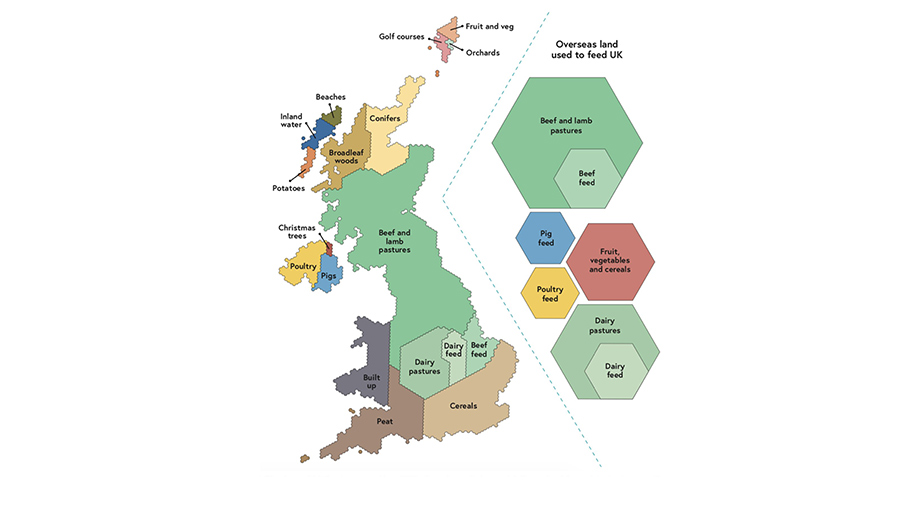
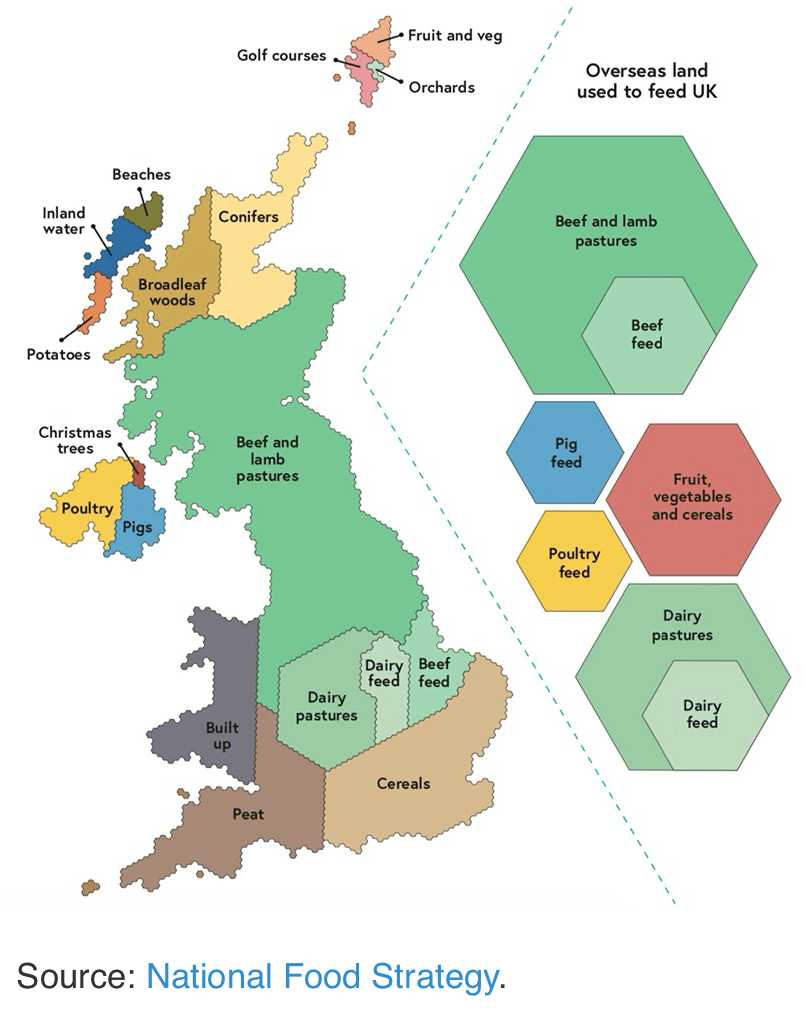
Here in the UK more than half our land is used to rear livestock for meat and dairy products. 

National Food Strategy landuse map

Counting on … day 190

11th October 2024

The left hand half of this diagram shows the amount of land used in the UK for different purposes – from providing grazing for beef cattle and sheep (the largest single use) to land cultivated as orchards (smallest alongside land used for growing Christmas tree!). 

The right hand half shows overseas land that we rely on (effectively use) to produce food stuffs that we import – and again land for beef and lamb production is the largest. 

Even just halving our meat consumption, would free up huge amounts of land that could be better used for rewilded biodiverse rich landscapes, as well as having space for increased horticultural production of a wide range of fruits and vegetables. 

Counting on … day 1.069

12th March 2023 

Last September “Operation Noah today released a report that makes recommendations on ways to reduce and store carbon emissions to one of the country’s largest landowners, the Church of England, which owns approximately 0.5% of the UK’s land. The report … concludes that land owned by the Church of England is currently contributing to the climate and biodiversity emergencies ‘in terms of greenhouse gas emissions and limiting biodiversity within monoculture tree plantations and non-regenerative agriculture.’ While the Church of England has adopted a 2030 Net Zero target, its landholdings are outside the scope of the target. Yet this report finds that agricultural land owned by the CofE is likely to create more greenhouse gas emissions than all CofE church buildings combined; however, it adds, ‘there is also scope for considerable improvement if rapid and radical action is taken.’

The report specifically recommends a programme of tree growing, peat restoration, and providing better support and strategies to those who farm Church-owned land in order to reduce agricultural emissions and store more carbon.” https://operationnoah.org/featured/press-release-operation-noah-report-finds-church-of-england-land-contributes-to-the-climate-crisis-suggests-ways-to-reduce-and-store-emissions/

There is so much scope for change that will create a better world.

The Green Tau: issue 53

23rd September 2022

If we all went vegan what would happen to all the cows? 

This seems to be a frequent concern amongst those who are not vegan. If people didn’t eat meat or drink milk, would cows become extinct? 

The question is one of genuine concern but raises some other questions in response. For example what life does a cow have? Dairy cows will commence their milking life aged 2 when their first calf will be removed from her care within hours of birth.  She will then give birth once year, being milked for ten months producing quantities of milk (on average 8000 litres) greatly in excess of what a calf would consume. After 2.5 -4 years, when her milking yields drop, she will be slaughtered. The usual life expectancy of a cow is 20 years. Of her offspring, males calves will have a limited life to be slaughtered as veal at 5 – 7 months. Of her female calves most will follow in this mother’s footsteps unless they are deformed or ill, in which case they too will be slaughtered. 

Very few farmed cattle enjoy a full life. By contrast cattle kept on re-wilded land, although smaller in number, live a much more natural life. In the Lake District re-wilding projects are in place at Haweswater, Ennerdale and the Lowther Estate, whilst in Sussex there is the now famous Knepp Estate. According to Rewilding Britain 112,166 hectares of land are now part of a re-wilding project. 

So no, cows would not become extinct but would be kept in much smaller numbers – just as rare breeds of many farm animals are being conserved. 

In 2020 there were 9.36 million head of cattle in the UK. It was not always so! Originally there were only the early forebears of cattle, the aurochs. Overtime cattle were domesticated and as the human population of the UK grew so did the number of cattle. Selective breeding improved and diversified the      cattle with some favoured for milk production and others for meat. As the human and domestic animal populations increased, so the amount of uncultivated land and wildlife decreased: the auroch was hunted to extinction in the UK about 3000 years ago; the brown bear became extinct in the 6th century whilst the wolf hung on until the 17th century. What is true for the UK is also true world wide. Whilst once humans and domesticated animals were once nonexistent, they now comprise 36% and 60% of the biomass of all mammals, leaving just 4% as wild animals (biomass measures the quantity of a species by its mass rather than its numerical quantity).

Rather than it being a question of ‘what would happen to all the cows?’ perhaps the question should be ‘what has happened to all the wild animals?’ The State of Nature Report of 2019noted that since the 1970s, 41% of UK wildlife has declined, and that 26% of the UK’s mammals are at risk of becoming extinct. Re-wilding more of our land would help reverse this decline and allow for the reintroduction of lost species such as the lynx and the stork.

Globally 77% of agricultural land is used to feed livestock, including both grazing land and the land used to grow animal feed. In the UK 40% of the land (9.74 million hectares) comprisespermanent grazing, 6%  temporary grazing (1 – 5 years) and 5%  rough grazing. Only 20% of the land is used for arable crops. Even so home grown animal feed is supplemented by imports – somewhere in the region of 50%.

Globally the 77% of land used for grazing and feeding farm animals, produces only 18% of the world’s food calories. At the same time this major land use contributes more than half of the carbon footprint of our global food production. If everyone globally were to eat the same amount of meat as the average British person (approx 85g per day), then the amount of farm land needed would have to increase – putting even more pressure on natural habitats and wildlife. And if everyone were to eat as much meat as the average American, we would run out of land.

Reducing our consumption of meat and dairy products would release more arable land for growing more sustainably a great variety of plant-based proteins with the potential to improve the diets and health of billions of people world wide (subject to a radical improvement of trade and wealth distribution systems). Research the by the UN suggests that with fewer cases of lower coronary heart disease, strokes, type 2 diabetes and some cancers, a global vegan diet would also result in 8.1 million fewer deaths per year worldwide.

Britons have in fact already reduced their meat consumption by 17% over the last decade. The Government’s Food Strategy has the target of reducing that by 30% by 2030. This target has been set  in recognition of the adverse affect meat production has on both climate change and the environment, as well as the link between the consumption of red and processed meat the risk of developing cardiovascular disease, type 2 diabetes and certain types of cancer.

Looking to the future, there will be fewer cows – but hopefully they will be enjoying a happier life – and instead more land used to restore greater biodiversity. 

Further reading