
Counting on …. Day 94

26th April 2024

Green wash is advertising or marketing that makes out that a product is greener/ more environmentally friendly than it actually is. It is an attempt to delude or deceive the consumer.

TerraChoice has identified ‘seven sins of greenwashing’ –

  1. “Hidden Trade-off”: a claim that a product is “green” based on an unreasonably narrow set of attributes without attention to other critical environmental issues.
  2. “No Proof”: a claim that cannot be substantiated by easily accessible information or a reliable third-party certification.
  3. “Vagueness” is a poorly defined or broad claim that the consumer will likely misunderstand its meaning. “All-natural,” for example, is not necessarily “green.”
  4. “Worshipping False Labels”: a claim that, through words or images, gives the impression of a third-party endorsement where none exists.
  5. “Irrelevance”: a claim that may be truthful but unimportant or unhelpful to consumers seeking environmentally preferable products.
  6. “Lesser of Two Evils”: a claim that may be true within the product category, but risks distracting consumers from the more significant environmental impact of the category.
  7. “Fibbing”: a claim that is simply false.  (https://en.wikipedia.org/wiki/Greenwashing)

The BBC suggests the following certification schemes that can give assurance as to the ethical values of a producer:-

Leaping Bunny – which means that the product has not been tested on animals.

B Corp – means that a business is legally required to do beneficial things for the environment and the people who help create their products.

Carbon Trust – meets a certain standard of carbon emission reduction, meaning the product is trying to minimise its carbon impact.

Fairtrade – the product has been made by people who received a fair wage for their work.

Forest Stewardship Council (FSC) – the product is made using sustainable or responsibly managed wood sources. (https://www.bbc.co.uk/newsround/58465027)

Another source of good advice is Ethical Consumer via their web site or magazine – https://www.ethicalconsumer.org/

In a world where we already consume too much, I can’t help feeling that any advertising that encourages us to consume more than we need, is greenwashing. 
Counting on …. Day 28

28th January 2024

Support campaigns that mitigate the climate crisis

We know many of the causes of the climate crisis and by addressing these, we can reduce the scale and impact of the climate crisis. However such  mitigation is not always popular when they threaten vested interests. Solutions are possible but sometimes it is necessary to campaign to win over government support and to give a voice to marginalised groups.  

The biggest contribution to the climate crisis comes from the fossil fuel industry and the burning of its products. Traditionally the fossil fuel industry has produced huge profits for investors, with no obligation to make recompense for the pollution caused. They are multi national organisations which exert great pressure on governments and the public through lobbying and advertising.

Nevertheless campaign groups are able to affect change in the practices of fossil fuel companies that benefit the climate. 

Climate Action Network explains  how they “successfully stopped the Cambo oil field by making Shell pull out of the project. No one act alone stopped this project. From direct action to legal pressure, political lobbying to media scrutiny, local community outreach to online actions – every act added up to force the industry to face a ‘death knell’ for fossil fuel extraction in the North Sea. And we can do it again.” 

Now they are continuing to campaign against the government’s decision to approve the development of the Rosebank oil field – You can support the case by adding your name here.

I am part of Christian Climate Action and regularly campaign against companies, projects and practices that contribute to the climate crisis – https://christianclimateaction.org/

You can also be a campaigner by joining groups such as Friends of the Earth, Greenpeace and the RSPB.

For more information on Rosebank – https://www.theguardian.com/environment/2024/jan/04/uk-government-admits-rosebank-oil-will-not-be-kept-in-uk-to-boost-energy-security?CMP=Share_iOSApp_Other

Counting on …day 6

6th January 2024

Walk, cycle and use public transport

The most environmentally friendly way of getting around is by walking or cycling – and it has the added benefits of being good for our physical and mental health. If you live in an area that is the equivalent of a 15 Minute City (https://greentau.org/2021/07/17/the-green-tau-issue-8-18th-july/) then it is easy to make all your daily journeys to the shops, the doctors, the gym, the school,  the library, the park, the station on foot or by cycling.

Adopting active travel as your default mode of getting around may take a little practice at first. It is also worth sorting out the right clothes and equipment appropriate to different weather conditions, lighting levels and whether you need to carry things like shopping –

Public transport is also an environmentally friendly way of travelling – shared between users it makes best use of resources and road space. Of course it is easier switching from private car to public transport if you live an area with a good public transport network. Maybe experiment with a weekly car-free day or work towards a car-free Lent. 

For further blog entries about active travel – https://greentau.org/tag/active-travel/

The Energy Saving Trust also has a section of its website devoted to active travel – https://energysavingtrust.org.uk/advice/active-travel/

And for thoughts about encouraging active travel for commuters – https://www.cbi.org.uk/articles/returning-to-the-office-five-ways-to-decarbonise-your-team-s-commute/

Counting on …day 263

1st August 2022

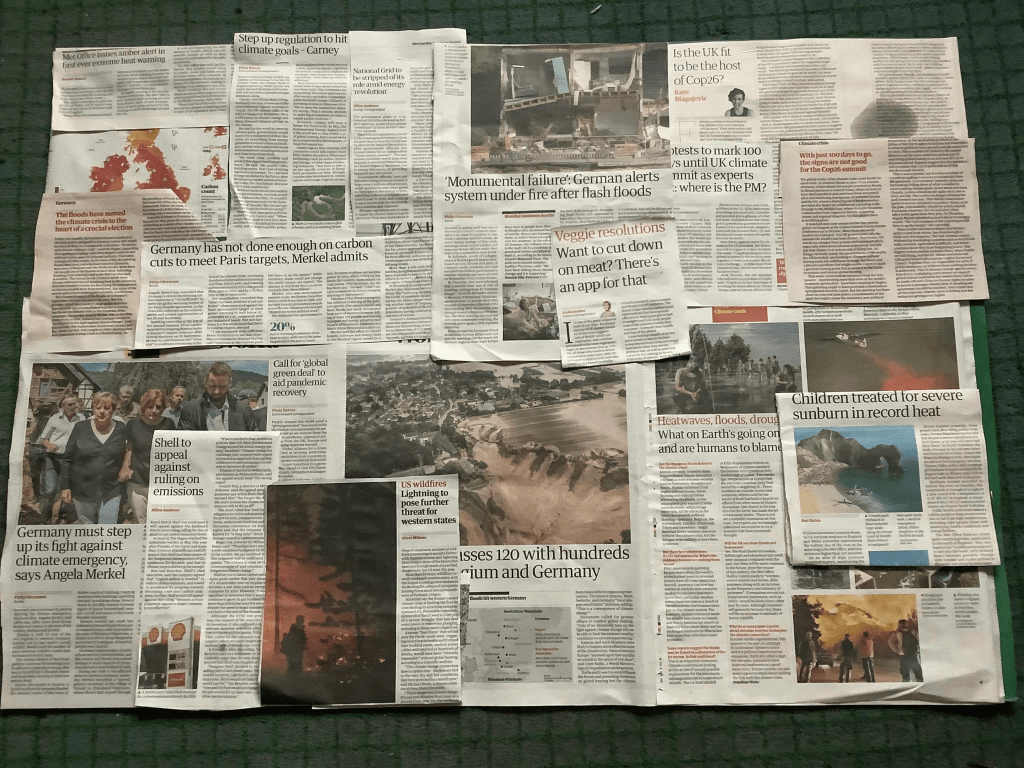
Last year I suggested the following action: “Being self-informed, being curious about what is happening, where and why, helps us to have a better understanding of climate change. This week cut out any articles you find in the newspaper (cut and past if you read on line) about climate change and make a display with them. Looking at the overall picture may give you new insights.”

Below is the collage I produced – it feels as if not much has changed but I’ll do the same this week and see.