Love overcomes hate

10th August 2024

Love never fails. 1 Corinthians 13:8

You Lord, are the source of all good things: 

We praise you.

You call us to tend and care for your creation: 

May we strive to do your will.

You have made us as brothers and sisters with all that lives: 

May we live together in peace.

A reading from Matthew 5:43-47 (The Message)

 “You’re familiar with the old written law, ‘Love your friend,’ and its unwritten companion, ‘Hate your enemy.’ I’m challenging that. I’m telling you to love your enemies. Let them bring out the best in you, not the worst. When someone gives you a hard time, respond with the supple moves of prayer, for then you are working out of your true selves, your God-created selves. This is what God does. He gives his best—the sun to warm and the rain to nourish—to everyone, regardless: the good and bad, the nice and nasty. If all you do is love the lovable, do you expect a bonus? Anybody can do that. If you simply say hello to those who greet you, do you expect a medal? Any run-of-the-mill sinner does that.

Hate or love?

Hate smoulders and burns.

It reduces cheer to ash and clinker..

Love soothes the flaming rage,

And untangles twisted thoughts.

Hate rides roughshod over compassion.

It disregards the truth.

.

Love reads between the lines,

And hears the hidden words of hope..

Hate erects rigid boundaries.

It ring-fences every option.  

Love sees beyond the corner,

And stretches out new horizons.

Hate casts an evil guise over every action.

It masks every sign of joy.

Love lifts the veil, 

And finds the hidden virtue.

Hate feeds on anger. 

Its rapacious appetite knows no limit. 

Love expands with humility, 

And grows with easy care.

Hate is all consuming – 

Till nothing true remains.

Love is all consuming – 

Till only truth remains. 

Prayers

Holy God of love,

Heal the wounds where hate festers.

Renew our trust in one another.

Holy God of love,

Remove the log that blinds the eye. 

Restore our vision of the world aright.

Holy God of love,

Open the ears that are stopped.

Retune our understanding of forgiveness.

Holy God of love,

Cut through warfare and  vengeance –

In streets and cities in the UK.

In Palestine and Isreal.

In Lebanon.

In North  Sudan and Darfor.. 

In Nigeria and the Sahel. 

In Haiti. 

In Kenya.

In Ukraine and in Russia.

Cut through war and vengeance –

wherever it is found.

Replant the seeds of peace,

Water them with  love,  

with compassion, 

and feed them with vigorous determination. 

The Lord’s Prayer

Third  Sunday of Easter

14th April 2024

Reflection – readings follow on below.

The Psalmist expresses my frequent cry: ‘Oh that we might see better times!’ I look at the damage caused by climate change, the damage caused to the environment by greed and over-consumption, the poverty that arises from injustice, the suffering of war and armed conflict – and I despair. 

To which I think Peter would reply, ‘Why do you wonder? Faith that is through Jesus, the Holy and Righteous One, the Author of Life – to whom you are a witness – is the means of healing what is broken!’ 

If we are not following the teachings of Jesus, or if we are not following the will of God in tending and caring for all life – whether consciously through Christian fellowship or intuitively through natural wisdom – then what do we expect?

Nevertheless I do see that the process of healing – of salvation – is a slow process one because  so often we reject what Jesus – God’s chosen one, the Christ – teaches us. That we should love God and in so doing honour God’s creation, and that we should love our neighbour as ourself without reservation. Which makes it all the more important that we do witness to what is going right in the world – those actions which match Jesus’s teaching, which are the Good News – and witness to what is going wrong through ignorance and sin.

Here I want to give three examples.

We can witness to the example of Jesus feeding the 5000 and to the valiant efforts being made to feed thousands in Gaza by groups such as the UN World Food Programme and World Central Kitchen. And we can witness to the actions of the State of Israel in impeding the delivery of such aid.

We can witness to the many examples of Jesus healing people in mind and body, and in restoring people to their communities – such as Legion – and to the work of groups such as the Red Cross and the Red Crescent, and Médecins Sans Frontières in bringing healing to many caught up in war zones. And we can witness to the actions of the suppliers of armaments and armed groups that instigate and perpetuate armed conflict. 

We can witness to the many examples of Jesus challenging those with wealth and skills to use them for the common good, and  to the work of organisations such as Oxfam, Practical Action and Just Money in creating situations where wealth and skills are used to raise up the poor and to bring down the mighty. And we can witness to the actions of corporations such as Barclays and Shell and Amazon in perpetuating policies that disadvantage the poor and vulnerable. 

Just as in the gospel, so today, the risen Jesus says to us ‘Peace be with you’. 

The word in Greek translated as peace is eirḗnē which draws from the verb eirō with the meanings be joined, tie together, make  whole. The peace that Jesus offers us is that which joins us together, as a community, as a team. Together we can support each other and create a whole that is greater than its parts – that which St Paul describes as the body of Christ. As we celebrate Easter and the resurrection,  let us draw on that peace that can – even if slowly –  create the better times we and the whole world wants.

Acts 3:12-19

Peter addressed the people, “You Israelites, why do you wonder at this, or why do you stare at us, as though by our own power or piety we had made him walk? The God of Abraham, the God of Isaac, and the God of Jacob, the God of our ancestors has glorified his servant Jesus, whom you handed over and rejected in the presence of Pilate, though he had decided to release him. But you rejected the Holy and Righteous One and asked to have a murderer given to you, and you killed the Author of life, whom God raised from the dead. To this we are witnesses. And by faith in his name, his name itself has made this man strong, whom you see and know; and the faith that is through Jesus has given him this perfect health in the presence of all of you.

“And now, friends, I know that you acted in ignorance, as did also your rulers. In this way God fulfilled what he had foretold through all the prophets, that his Messiah would suffer. Repent therefore, and turn to God so that your sins may be wiped out.”

Psalm 4

1 Answer me when I call, O God, defender of my cause; *
you set me free when I am hard-pressed;
have mercy on me and hear my prayer.

2 “You mortals, how long will you dishonour my glory; *
how long will you worship dumb idols
and run after false gods?”

3 Know that the Lord does wonders for the faithful; *
when I call upon the Lord, he will hear me.

4 Tremble, then, and do not sin; *
speak to your heart in silence upon your bed.

5 Offer the appointed sacrifices *
and put your trust in the Lord.

6 Many are saying, “Oh, that we might see better times!” *
Lift up the light of your countenance upon us, O Lord.

7 You have put gladness in my heart, *
more than when grain and wine and oil increase.

8 I lie down in peace; at once I fall asleep; *
for only you, Lord, make me dwell in safety.

1 John 3:1-7

See what love the Father has given us, that we should be called children of God; and that is what we are. The reason the world does not know us is that it did not know him. Beloved, we are God’s children now; what we will be has not yet been revealed. What we do know is this: when he is revealed, we will be like him, for we will see him as he is. And all who have this hope in him purify themselves, just as he is pure.

Everyone who commits sin is guilty of lawlessness; sin is lawlessness. You know that he was revealed to take away sins, and in him there is no sin. No one who abides in him sins; no one who sins has either seen him or known him. Little children, let no one deceive you. Everyone who does what is right is righteous, just as he is righteous.

Luke 24:36b-48

Jesus himself stood among the disciples and said to them, “Peace be with you.” They were startled and terrified, and thought that they were seeing a ghost. He said to them, “Why are you frightened, and why do doubts arise in your hearts? Look at my hands and my feet; see that it is I myself. Touch me and see; for a ghost does not have flesh and bones as you see that I have.” And when he had said this, he showed them his hands and his feet. While in their joy they were disbelieving and still wondering, he said to them, “Have you anything here to eat?” They gave him a piece of broiled fish, and he took it and ate in their presence.

Then he said to them, “These are my words that I spoke to you while I was still with you—that everything written about me in the law of Moses, the prophets, and the psalms must be fulfilled.” Then he opened their minds to understand the scriptures, and he said to them, “Thus it is written, that the Messiah is to suffer and to rise from the dead on the third day, and that repentance and forgiveness of sins is to be proclaimed in his name to all nations, beginning from Jerusalem. You are witnesses of these things.”

Proper 25, 21st Sunday after Trinity 

29th October 2023

Reflection (readings below)

To what extent should we take the stories of Deuteronomy – or of Genesis and Exodus – as unchanging, eternally truths, or binding declarations, whereby God gives to one group of people the sole and absolute right to occupy a certain piece of land to the exclusion of all others?
Certainly a large part of the narrative of the Old Testament is about God’s people seeking and finding and inhabiting a land to which God leads them. But that is not the whole story. Their occupation of the land is ringed by caveats and covenants, where by their ability to remain and to flourish on the land, depends upon their willingness to live their lives according to the ways of God.
The larger part of Old Testament  narrative is about the unfolding and developing relationship between God and the people, about repentance and beginning again, about learning what it is to be God’s people – what values and truths, what relationships and actions, are key. The finale of that teaching (for us as Christians) comes with the life and death, ministry and resurrection of Jesus Christ who is the unique living Word of God.
But for everyone reading the scriptures with a desire to understand, there is the importance of distinguishing between story and truth. With a parable we easily understand that the story is the vehicle for conveying the truth. The same is so when we explain a truth by way of an example. The example is just that – something done in a similar way; a what-if; a let’s-suppose. It is not the definitive, never changing, only circumstance, of that truth. Through the example of the story, we see the overarching truth. Prayer and reflection, discussion and meditation, help us discern the truth that is of God. Indeed, all our thinking, our speaking, our actions, need to be rooted in, to come from, God.

So it is that we come to the heart of today’s gospel. Jesus, when asked what is the greatest commandment, replies “‘You shall love the Lord your God with all your heart, and with all your soul, and with all your mind.’ This is the greatest and first commandment. And a second is like it: ‘You shall love your neighbour as yourself.’ On these two commandments hang all the law and the prophets.”

If we love God with all our heart and soul and mind, then we shall be in a good place to read and understand the truth in the scriptures. And if we love God with all our heart and soul and mind, then equally we will find ourselves loving our neighbours as ourselves. If we love our neighbours, we shall want what is good for them, but not just for them as individuals, but for them all – as families, as communities, as peoples, as nations. And when we fail to love, then we create tensions and dis-ease, fear and envy, mistrust and hatred, that affects us all.

The following quote comes from the Guardian’s editorial, 24th October.

“Israelis and Palestinians have been locked into a spiral where each side seeks to avenge a wrong. Even when one side thinks they have got their revenge, the other does not think the score has been evened. The result is never-ending destruction. This has disastrously determined the recent history of bloodshed in the region. But both sides need to see themselves as they see each other so their violence can become part of history rather than part of the present”.

Loving our neighbour is to see them and ourselves through their eyes.

This is something we can practice everyday, and at every distance, from the neighbours who live next door, the neighbours who live at the other end of town, to the neighbours who live on the other side of the world.  By loving our neighbours we are building peace and establishing God’s kingdom – God’s rule or way of living – here on earth just as it happens in heaven.

Deuteronomy 34:1-12

Moses went up from the plains of Moab to Mount Nebo, to the top of Pisgah, which is opposite Jericho, and the Lord showed him the whole land: Gilead as far as Dan, all Naphtali, the land of Ephraim and Manasseh, all the land of Judah as far as the Western Sea, the Negeb, and the Plain—that is, the valley of Jericho, the city of palm trees—as far as Zoar. The Lord said to him, “This is the land of which I swore to Abraham, to Isaac, and to Jacob, saying, ‘I will give it to your descendants’; I have let you see it with your eyes, but you shall not cross over there.” Then Moses, the servant of the Lord, died there in the land of Moab, at the Lord’s command. He was buried in a valley in the land of Moab, opposite Beth-peor, but no one knows his burial place to this day. Moses was one hundred twenty years old when he died; his sight was unimpaired and his vigour had not abated. The Israelites wept for Moses in the plains of Moab thirty days; then the period of mourning for Moses was ended.

Joshua son of Nun was full of the spirit of wisdom, because Moses had laid his hands on him; and the Israelites obeyed him, doing as the Lord had commanded Moses.

Never since has there arisen a prophet in Israel like Moses, whom the Lord knew face to face. He was unequaled for all the signs and wonders that the Lord sent him to perform in the land of Egypt, against Pharaoh and all his servants and his entire land, and for all the mighty deeds and all the terrifying displays of power that Moses performed in the sight of all Israel.

Psalm 90:1-6, 13-17

1 Lord, you have been our refuge *
from one generation to another.

2 Before the mountains were brought forth,
or the land and the earth were born, *
from age to age you are God.

3 You turn us back to the dust and say, *
“Go back, O child of earth.”

4 For a thousand years in your sight are like yesterday when it is past *
and like a watch in the night.

5 You sweep us away like a dream; *
we fade away suddenly like the grass.

6 In the morning it is green and flourishes; *
in the evening it is dried up and withered.

13 Return, O Lord; how long will you tarry? *
be gracious to your servants.

14 Satisfy us by your loving-kindness in the morning; *
so shall we rejoice and be glad all the days of our life.

15 Make us glad by the measure of the days that you afflicted us *
and the years in which we suffered adversity.

16 Show your servants your works *
and your splendour to their children.

17 May the graciousness of the Lord our God be upon us; *
prosper the work of our hands;
prosper our handiwork.

1 Thessalonians 2:1-8

You yourselves know, brothers and sisters, that our coming to you was not in vain, but though we had already suffered and been shamefully mistreated at Philippi, as you know, we had courage in our God to declare to you the gospel of God in spite of great opposition. For our appeal does not spring from deceit or impure motives or trickery, but just as we have been approved by God to be entrusted with the message of the gospel, even so we speak, not to please mortals, but to please God who tests our hearts. As you know and as God is our witness, we never came with words of flattery or with a pretext for greed; nor did we seek praise from mortals, whether from you or from others, though we might have made demands as apostles of Christ. But we were gentle among you, like a nurse tenderly caring for her own children. So deeply do we care for you that we are determined to share with you not only the gospel of God but also our own selves, because you have become very dear to us.

Matthew 22:34-46

When the Pharisees heard that Jesus had silenced the Sadducees, they gathered together, and one of them, a lawyer, asked him a question to test him. “Teacher, which commandment in the law is the greatest?” He said to him, “’You shall love the Lord your God with all your heart, and with all your soul, and with all your mind.’ This is the greatest and first commandment. And a second is like it: ‘You shall love your neighbour as yourself.’ On these two commandments hang all the law and the prophets.”

Now while the Pharisees were gathered together, Jesus asked them this question: “What do you think of the Messiah? Whose son is he?” They said to him, “The son of David.” He said to them, “How is it then that David by the Spirit calls him Lord, saying,

‘The Lord said to my Lord,
“Sit at my right hand,
until I put your enemies under your feet”’?

If David thus calls him Lord, how can he be his son?” No one was able to give him an answer, nor from that day did anyone dare to ask him any more questions.

Counting on … day 1.186

4th October 2023

Today is the Feast of St Francis. He is well known for his insight that all of creation is interconnected and equal in the sight of God. Thus he spoke of brother Sun and sister Mother Earth.  Not surprisingly St Francis is names the patron saint of the environment. St Francis was equally concerned about peace making, calling for peace whether that was between neighbours or between the saracens and the crusaders.  

Caring for the environment and peace making go hand in hand. Failure to care for the environment leads to conflict; conflict damages the environment. 

To be an environmentalist is to be a peacemaker.

Green Tau: issue 78

13th September 2023

Is peace simply the opposite of war?

Recently I took part in a peace vigil outside the DSEI arms fair being held at London’s ExCel centre. Setting aside for a moment the morals of using weapons, there is something deeply uncomfortable about the idea of an arms fair: the idea that just as one can a book fair, or an Ideal Homes exhibition, or a horticultural show, one can have a ‘jolly day out’ walking round stands full of weapons, admiring staged demonstrations, picking up samples and goody bags, whilst enjoying alcoholic and other beverages. There is equally something very disturbing about people making profits out of buying and selling products designed to inflict fear, maim and kill.

But on the other hand are weapons a necessary evil, things that do have at some point to be bought and sold? Would we have wanted  the Ukrainians to be weaponless when the Russians invaded? Perhaps weapons are a necessary evil if we want peace not war? 

The following is not based on academic research, but simply a reflection of wha has been going through my mind. 

Is peace the opposite of war or vice versa? I think that peace is the opposite of war but that the reverse proposition is flawed. Peace is not simply an absence of war. It is far more. 

Peace is justice and equality. 

Peace is freedom. 

Peace is contentment and fulfilment. 

Peace is about the individual and the community. 

Peace is about the present and the future. 

This is a rigorous set of imperatives to meet. But does peace exist anywhere in the world? Here in the UK we are not at war, but do we enjoy the peace described above? I think not.

Justice is unevenly delivered. For those with money to pay for lawyers and the cost of court cases, there can be justice. Indeed for those with money to serve injunctions, injustice can be perpetuated. Justice is uneven delivered depending on one’s colour, race or faith. Activists seeking the right to protest can find their actions constrained by injunctions served on them by big corporations and institutions – and to compound the injustice, may then be billed for the injunction!

Equality is patchy – again depending on your wealth. The more you have, the more the system will work in your favour. If you can afford to go to a good school (whether by living in the right catchment area or paying fees) you will get better qualifications and better employment opportunities. If you can afford a better house – especially one you own rather than rent – you will be healthier, learn better and again  have better employment opportunities. If you are homeless, the chances of being as healthy, of getting good qualifications and a job are much less. If you grow up in a household with two parents, if you grow up in a household where everyone is literate, if you grow up in a household where everyone has a job, then you too will have better educational outcomes and better employment opportunities. Then there are postcode lotteries that affect your access to schools and health care. There are geographical north-south divides that shape your opportunities.

Freedom often depends upon access to money. To be free to travel, you need to be able to pay for transport.  To be free to take a holiday you need a higher enough wage – and/ or holiday pay – to cover your costs of living whilst on holiday. To be free to change career, you need sufficient money to cover re-training costs plus what is need to cover living costs whilst you study. To be free to live where ever you want, you need sufficient funds to match the great variation of costs across the country, from region to region, area to area. 

Contentment and fulfilment will vary from person to person, and some may find them for a very low outlay, but for others the cost may be prohibitive. One may find fulfilment in hillwalking, but another in skiing.  Neither ambition is inherently better but the latter may financially be unobtainable. If one’s contentment  depends upon swimming, fulfilment may depend upon whether your local authority still runs to swimming pools or whether your local water company keeps your rivers clean.

Because of the inequalities so far highlighted, you can see that some individuals in the UK may achieve lives of relative peace, but that as a community, our achievements are limited.

Again, sadly, whilst we may have relative peace for now, the ongoing likelihood of such peace is in the balance. With underfunded health, social care  and educational provision, the inequalities of access becoming increasingly dependent on money, seems likely to increase. And with the lack of investment in renewable energy, energy efficient infrastructure and in infrastructure (including things such as tree planting) to mitigate the  effects of the already changing climate, many people’s hope for future contentment  also looks bleak. Such is the state of peace in the UK. But what about more vulnerable countries?

What about Mali where rival militias tax or destroy rural communities? And where climate change is causing the loss of agriculture land with the expansion of the Sahara?

What about North and South  Sudan and Uganda where control of the water in the Sudd wetlands and the White Nile, is leading to disagreement and conflict?

 What about Pakistan where climate change is both melting glaciers and intensifying the wet and dry seasons, making agriculture less viable, and where rising sea levels are reducing the amount of available farm land? With limited opportunities to make a future at home, where can these farmers and their families go to seek a fulfilled life? Seeking refugee in Europe is increasingly difficult.

What about the people of the Democratic Republic of the Congo, where the race to mine copper and cobalt to make batteries, is driving many local people off their land, whilst at the same time polluting land and water supplies? 

Across the world there are many instances where one can see that peace is not present. These are potential hotspots which could lead to internal or cross border warfare. My contention is that if the money that would be spent on the wars that are likely to erupt, was instead spent on removing the obstacles to peace, we would not need to be investing in the arms trade. Where war is already happening, I do see that a different response is needed, but that is still needs to be one that establishes peace on both sides of the conflict.

I can well imagine that rather than building up resources for future war, building up the resources for peace would be financially cheaper. This peace building would involve establishing justice and systems of maintaining justice – both internally within countries and between them. It would involve removing existing inequalities and rebalancing fairly access to resources and opportunities. It would involve valuing contentment and fulfilment as more important than GDP. It would involve valuing equally the needs of individuals and the needs of communities. 

Not an easy task but one that is biblically mandated, perhaps, as in this passage from Micah.

And many nations shall come and say:
‘Come, let us go up to the mountain of the Lord,
    to the house of the God of Jacob;
that he may teach us his ways
    and that we may walk in his paths.’
For out of Zion shall go forth instruction,
    and the word of the Lord from Jerusalem.

He shall judge between many peoples,
    and shall arbitrate between strong nations far away;
they shall beat their swords into ploughshares,
    and their spears into pruning-hooks;
nation shall not lift up sword against nation,
    neither shall they learn war any more;

but they shall all sit under their own vines and under their own fig trees,
    and no one shall make them afraid;
    for the mouth of the Lord of hosts has spoken.

For all the peoples walk,
    each in the name of its god,
but we will walk in the name of the Lord our God
    for ever and ever. Micah 4:2-5

Here there is justice, for God arbitrates between nations and between peoples. Here there is equality such that  everyone can sit under their own vines and their own fig trees. Here freedom is suggested for  weapons have been turned into gardening tools, and no one makes anyone afraid. Here is (religious) freedom where people walk with their own gods. Here is contentment and fulfilment for all are taught the ways of God. 

Lent Reflection

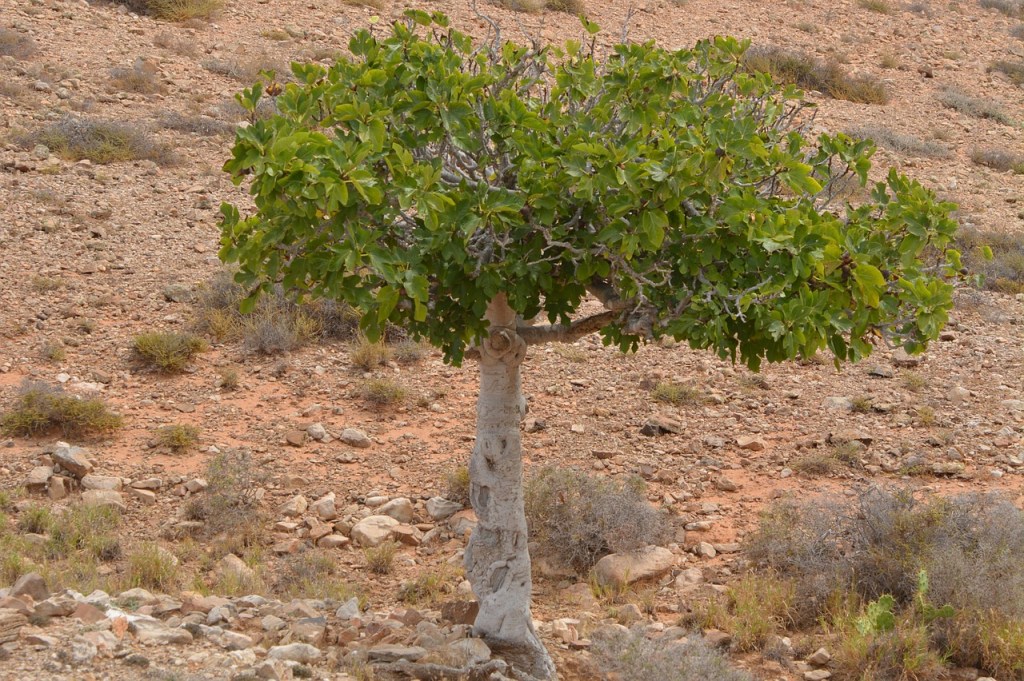
Fig Tree Nature Tree http://www.maxpixel

The fig tree – ficus carica -is native to the Middle East and is a member of the mulberry family. It has been cultivated since ancient times and is now found in many parts of the world. It grows up to 20m in height and has a deep root system that enables it to cope with both dry conditions and poor soils. Overtime it develops a large canopy and, having drawn up plenty of water into its leaves, it creates a cool, shady microclimate that benefits both humans and creatures alike. The fig has been cultivated as a crop since ancient days in the Middle East, predating the cultivation of wheat and barley.

The fig tree in the Bible symbolised Israel and its fruitfulness – or not – the wellbeing spirituality and physically of the community 

.

… nation shall not lift up sword against nation, neither shall they learn war any more; they shall all sit down under their own vines and under their own fig trees …. Micah 4:3b, 4a

Peace is not just the absence of conflict; peace is the creation of an environment where all can flourish, regardless of race, colour, creed, religion, gender, class, caste, or any other social markers of difference. Nelson Mandela