Green Tau: Issue 89

Profit, cost and loss

10th May 2024

Maximising profits seems to be the name of the game, the chief goal of businesses, educational establishments, public services, governments etc. But what are profits and are they intrinsically good?

What is profit?

A profit is an advantage or benefit, or more specifically a financial gain. The word’s meaning comes from the Latin ‘profectus’ meaning growth,  advance, increase, success or progress. From this there comes the idea that to profit  is to benefit.

In business terms profit may be understood as:-

Gross profit = revenue from selling a product or service less costs of materials used in producing it.

Operating profit = gross profits less operating costs such as of labour, machinery, depreciation, rent and utilities.

Net profit = operating profit less all other costs such as taxes and interest payments.

Who benefits from the profit?

  • The business owner who can simply pocket the lot. 
  • The business owner as a return on his/ her investment – possibly a risky investment. 
  • The business if the owner reinvests the profit in the business. Such investment could upgrade the business’s resources, infrastructure, and/or workforce, and so improve productivity. 
  • The shareholders if the profit is shared as a dividend. 
  • The employees if the profit is shared as a bonus.
  • The country may benefit if tax is paid on the profit.

The company and its shareholders may also benefit in other ways. Increasing profits can increase the value of the company’s shares which benefits the share holders (if they choose to sell) and increase the value of the company. The latter can benefit the company if the owner wished to sell or, conversely, protect the company if the owner wished to avoid being bought out. It can also benefit the company by making it easier for it to obtain finance for its operations. Maintaining and indeed improving profits also safeguards the jobs of the senior members of staff.

But are higher profits always better?

Increased profits may not be better for the consumers who may be contributing to these profits through paying higher prices. Last summer UK supermarkets were accused of ‘greed-flation’ as they reported significant profits whilst food price increases peaked at nearly 20%. 

Increased profits may not be better for employees who may face redundancies and pay cuts in order to maintain profits. Labour costs are often the first things a business tries to reduce to improve profitability.

Increased profits may not be better for the environment, if more damaging processes and trading practices are used to reduce costs and increase profits. Some companies transfer operations to other countries where there are lower environmental protection standards – or where there is cheaper labour and/ or lower welfare requirements. 

Increased profits may not be better for the environment if they also increase pollution. Increasing oil production leads to more flaring and more oil leaks damaging the environment. Increasing profits through sales of more takeaway meals, increases the use of single use plastic and the pollution it causes. 

Increased profits may not be better for the environment if the increase comes from the increased production of a product that is intrinsically damaging – whether that is carbon producing fossil fuels, or muck and methane producing cattle/ chickens etc. 

 All the above will also have adverse effects on the local community either though increased local unemployment or through increased pollution. Local communities can also be affected if the increase in profits arises from increases in production leading to increases in delivery traffic. 

If the increase in profits only, or disproportionately, benefits those on high incomes, that can increase environmental damage as those on high incomes tend to have lifestyles with a higher carbon and environmental footprint. It can increase social inequalities that undermine social cohesion and wellbeing. It can create inequalities in power, resulting in the community/ society/ economy being shaped to suit those with most money – further disadvantaging the low paid and unemployed.

The increase in profits may not benefit the host country if the company can arrange its affairs so that its tax is paid elsewhere – probably at a lower rate.

Do markets prevent excess profits? 

According to pure economic theory the movement of the market will prevent excess profits being made. For if a business makes more profits than expected, other companies will enter the market and such competition will continue until profits return to the normal level. In reality markets are not perfect. It can be hard for new or small firms to enter especially of the start up costs are large – eg in the oil industry, in supermarket chains etc. 

It maybe that a company holds an effective monopoly – rivals to ‘X’ cannot offer their customers the same audience base. Ditto for an online market trying to compete with Amazon. 

Information is not perfect. Many consumers may not know that Starbucks does not pay a fair proportion of taxes in the UK, that Shell is not paying for the safe dismantling of its disused oil pipelines, allowing them to leak toxic chemicals into the North Sea, or that their supermarket chicken has come from a factory farm that is polluting the River Wye. If customers knew these facts would they be as willing for pay for the products that generate profits for multi national companies?  Sadly it maybe that many customers have a low income that prevents them making other choices.

Does profit have to be the over riding priority?

No, other business models exist.

  • Charities and not for profit businesses operate in the basis that the prime objective is to pursue the mission of the organisation, and if profits arise, they are to be used to support that. eg The National Trust, the Big Issue, The Peabody Housing Association.
  • Social enterprises which aim to promote, encourage, and make social change. Any profits are reinvested in the enterprise. eg Belu who sell bottled water who donate their profit to Water Aid. Clean For Good is a London based cleaning company that promotes fair and ethical employment of cleaning staff; profits are shared between reinvested, cleaning staff and shareholders (charitable bodies such as  the Parish of St Andrew’s in the Wardrobe, CMS, and the Centre for Theology & Community.
  • Cooperatives are companies owned and controlled by its members so as to meet their shared needs. eg Suma is a workers’ cooperative – its business is owned and run by its employees who then share equally in the profits. Energy 4 All helps develop community owned renewable energy projects. Members receive a fair return on their investment from the sale of green electricity but at a level that is capped so that the balance of the profits can support the community fund enabling more such projects. 
  • Mutuals are companies which are owned by their customers, who share in the profits. eg Scottish Friendly which is a finance services provider whose profits are reinvested in the business. NFU Mutual which is an insurance company for the farming industry. It has 900,000 members and any profits made are shared between them.
  • Impact businesses have two ‘bottom lines’, one being profitably and the other a dedicated issue that could be social, environmental etc. eg Octopus Energy aims both to be profitable and to make the renewable energy transition faster and cheaper for its customers. Hey Girls sells period products using a buy-one-give-one model to end period poverty and improve period health. 
  • B-corps are impact businesses that have been certified by B Lab – a world wide certification body – as meeting specific target levels vis a vis their social impact. eg The Guardian is a B Corp with a commitment to using its profits to support carbon neutral policies, reporting on climate change and, for example, not accepting advertising from fossil fuel extractors. OddBox takes fruit and vegetables that would otherwise go for waste – because they are too many or too few in number, the wrong shape or otherwise unwanted by retailers – and sells them via a veg box scheme.
  • Credit Unions are community-based financial organisations where profits are used to support local initiatives or are repaid to members. Members may have to qualify by living in a certain area or working within a certain industry or for a specific employer. Members are often encouraged to save money with the Credit Union before applying for a loan.  
  • Community share schemes allow people to invest  in a local scheme via ‘withdrawable shares’ – these cannot be sold, traded or transferred, and whilst the share holder may receive interest on their investment, no dividend is paid. All members have an equal vote in shaping the policy of the company. Members can withdraw their share – but only if the company has the funds to buy them back. Community share schemes are used for to support nurseries, pubs, local transport schemes and preserved railways etc.

There are many ways of running businesses that benefit society in ways other than purely financial. These are the truly ‘profitable’ businesses!
Counting on … day 85

12th April 2024

Fossil Fuel Subsidies -2

“Since the Paris Agreement, the government has provided £13.6 billion in subsidies to the UK oil and gas industry. From 2016 to 2020 companies received £9.9 billion in tax relief for new exploration and production, including £15 million of direct grants for exploration, and £3.7 billion in payments towards decommissioning costs.” https://www.ethicalconsumer.org/energy/paid-pollute-fossil-fuel-subsidies-uk-what-you-need-know

Research from 2023 commissioned by the Liberal Democrats showed that between 2015 and 2020 renewable energy received £60bn in subsidies whilst fossil fuels received £80bn. In 2020/1 fossil fuels received £1bn whilst renewable energy received a mere £1m!  https://www.theguardian.com/environment/2023/mar/09/fossil-fuels-more-support-uk-than-renewables-since-2015

Such subsidies are the explicit subsidies. As far as I know, renewable energy generation does not produce pollutants or other harmful side effects. Whereas we as citizens and tax payers are also paying for the implicit subsidy of fossil fuels through ill health caused by pollution from fossil fuels, as well as ill health caused by excess temperatures; through the extra cost thus imposed on the health service; from the extra cost of food as more harvests fail; and the extra cost of repairing buildings and infrastructure affected by extreme wind/ rain and temperatures. 

According to Kisters (an international environmental data and insights organisation that focuses on gathering and reporting data on the water, weather, energy, environment and IT sectors) “the cost of natural disasters in the UK is rising by 11.2 per cent a year, while the UK’s GDP grew by 4.3 per cent in 2022 (according to the Office for National Statistics)…Floods are the most expensive risk the UK faces at present, with the cost of dealing with extreme flooding projected to rise to $217.2bn by 2030-2039 without intervention. But an increasing number of extreme storms also poses a threat. Between 2010 and 2019 storms cost the UK around $1.6bn, but by 2030-2039 this is estimated to rise to $3.8bn. In 2020-29, Kisters predicts the UK government will spend $43.8bn on dealing with the effects of all climate-caused natural disasters.” https://www.newstatesman.com/spotlight/sustainability/climate/2023/12/extreme-weather-natural-disasters-uk-economy-government

Counting on … day 84

11th April 2024

Fossil Fuel Subsidies -1

This overview of fossil fuel subsidies comes from the IMF: “Subsidies are intended to protect consumers by keeping prices low, but they come at a substantial cost. Subsidies have sizeable fiscal consequences (leading to higher taxes/borrowing or lower spending), promote inefficient allocation of an economy’s resources (hindering growth), encourage pollution (contributing to climate change and premature deaths from local air pollution), and are not well targeted at the poor (mostly benefiting higher income households). Removing subsidies and using the revenue gain for better targeted social spending, reductions in inefficient taxes, and productive investments can promote sustainable and equitable outcomes.” (1)

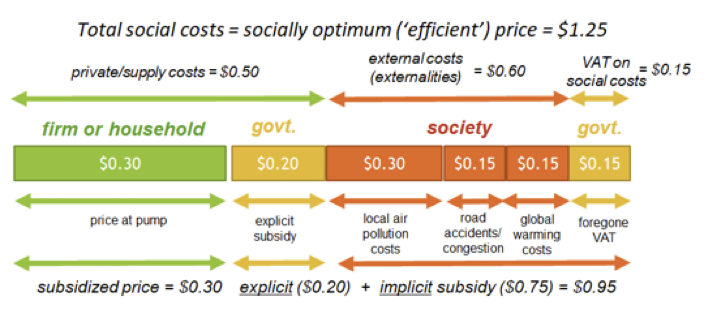
The article goes on to explain the difference between explicit and implicit subsidies, the former being the obvious direct payments to fossil fuel producers to bring down the unit cost of the fuel. The latter is a subsidy that is likely always present, vis in the practice of not charging the fossil fuel producers for the costs of pollution, climate change etc that are a consequence of their business. 

“Implicit subsidies occur when the retail price fails to include external costs, inclusive of the standard consumption tax. External costs include contributions to climate change through greenhouse gas emissions, local health damages (primarily pre-mature deaths) through the release of harmful local pollutants like fine particulates, and traffic congestion and accident externalities associated with the use of road fuels”(1)

By way of example they provide the following bar chart: 

(1) https://www.imf.org/en/Topics/climate-change/energy-subsidies

Counting on … day 1.172

14th September 2023

On Wednesdays I kneel for an hour’s vigil outside Shell’s Headquarters. I first began this when the campaign group Fossil Free London held weekly pickets outside the building protesting at Shell’s continuing exploration and production of oil. At all stages of oil production damages the environment – whether that is the leaking of oil that has pollute the Niger Delta; the noise from underwater explosions that disorientates whales off the coast of South Africa; the flailing of oil wells that releases methane into the atmosphere ( a gas which rapidly increases global warming); leaks from pipelines and tankers that pollute the sea and coat seabirds an oily slick; the air pollution from diesel and petrol engines; the global warming from the release of CO2 when oil is burned as energy; and the pollution of all areas of our planet by fragments of plastic. We need on some many counts to press oil companies to rapidly phase out the production of oil and instead develop renewable energy supplies.

Counting on…day 1.148

14th August 2023

People sometimes think of protecting the environment as being about protecting rural landscapes, keeping them remote and unspoilt. But in reality we cannot separate what we do in urban areas from what do in rural areas or what we do in rural areas from what we do in urban areas,  if we wish to care for the environment. Everything is interconnected. The pollution from our urban areas affects the air and soil in rural areas. Pollution from farming affects air and water ways. The carbon emissions from urban areas contributes to the global heating that affects everyone, everywhere. If we want to keep our landscapes green and rich in biodiversity, then we need to cut back on the amount of energy we use to heat our buildings, to cut back our use of  motorised transport, to make more efficient use of water and other resources, to cut back our use of plastics, and ensure that what we recycle forms a closed loop. And do so wherever we live and work.

Counting on …. Day 1.153

28th June 2023

Take away food packaging constitutes the largest proportion of all plastic waste found in our oceans. https://www.theguardian.com/environment/2021/jun/10/takeaway-food-and-drink-litter-dominates-ocean-plastic-study-shows?CMP=Share_iOSApp_Other

Again it seems that one of the pluses of plastic is also it’s negative. Plastic packaging seems to enable a vast variety of foods to be taken away to be consumed including ready meals, but is it rather than the plastic packaging allows such foods to processed off site and shipped or stored for use elsewhere. Again plastic packaging separates the consumer from the producer. Sandwiches, for example, are made in factory units and dispatched in lorries around the country rather than being freshly made at the counter of a sandwich bar.

Counting on …day 1.114

18th May 2023

The United Nations Environment Programme is called on all countries to reduce their plastic consumption by 80% by 2040. Plastics are problem items because they are made from oil and thus come with an inbuilt unsustainable carbon footprint, and because much of the plastic is not recycled and instead causes pollution – especially in marine areas.

To cut our use of plastics, we will need to cut our dependency on plastic packaging. Our local cafe which also has its own coffee roasting business now supplies beans packaging free. The beans are stored in silos and you simply decant them into your own container (the cafe also sell reusable tins). Simple!

Counting on … day 1.070

13th March 2023 

“Campaigners warned [2019] that the clear waters of the Wye, one of Britain’s best-loved rivers, were being blighted by thick green algae blooms linked to poultry production. Many of the intensive chicken farms in the catchment area of the Wye supply Avara Foods in Hereford, which is the third largest poultry producer in Britain and is jointly owned by the American food business Cargill. It is claimed that vast amounts of manure from chicken farms supplying Avara and other food businesses are washed into the Wye, contaminating the water with excessive phosphate levels that fuel the growth of algae blooms…

Cargill has operated in the UK since 1955 and purchased a major poultry processing plant in Hereford, more than 40 years ago. In 2013 it announced a £35m investment in the plant to increase production of fresh chicken, and five years later it combined its fresh chicken operation in the UK with poultry business Faccenda Foods to form Avara. New intensive poultry units – each housing at least 40,000 chickens – sprung up to meet the demand, and between 2013 and 2017 the number of birds in Herefordshire increased from 13 million to 18 million. 

It is now hoped stricter controls and new practices, supported by Cargill and other operators, will help reduce the Wye pollution. Some farms are installing biomass boilers to generate heat from chicken manure, while other farms are sending the poultry litter to anaerobic digestion plants.” https://www.theguardian.com/environment/2022/sep/25/chicken-farm-giant-linked-to-river-wye-decline-was-sued-over-water-blight-in-us?CMP=Share_iOSApp_Other

How sustainable is our current meat focused diet? Is there scope for change that can create a better world?

Counting on…. Day 294 

30th September 2022

Much of the plastic that ends up polluting the oceans gets there via streams and rivers. And the plastic that ends up in the streams and rivers is either litter that has been thoughtlessly discarded or plastic that has fallen or been blown out of recycling bins. We can help in three ways – firstly not thoughtlessly discarding plastic (which I am sure we wouldn’t). Secondly by picking up litter and disposing of it safely. Thirdly by ensuring that the plastic in our recycling bins is flattened as much as possible and packed (eg stacking similar sized pots or trays together) so that there are no loose pieces that can easily be dislodged. Aim for a neat and condensely  packed  bin. 

Counting on … day 293 

29th August 2022


Pollution of our water system can begin at home. Only three things should go in the toilet – pee, poo and toilet paper. (Other paper, even things like paper serviettes shouldn’t be thrown down the loo – they are not designed to break down quickly and can cause blocked drains). Wet wipes, cotton buds, sanitary products, sticking plasters, dental floss etc should not be discarded via the toilet. NB You can biodegradable dental floss which can go into the compost bin. 

In the kitchen what goes down the drain should be limited to waste water and appropriate amounts of soap and cleaning fluids. Fat and oil (wipe excess up with a paper towel or piece of news paper) and food waste, including coffee grounds, should go into the food waste bin. Food waste and fat can block drains, and chemicals such as white spirit can cause pollution.