Green Tau issue 35

22nd February 2022

What is a circular economy? 

It is easier to describe its opposite. A non circular economy is that takes, makes and throws away. For example, chop down a tree, make its wood into a sheet of paper and then, after a single use, throw the paper away. Another example would be taking oil out of the ground, making it into a plastic cup  and then, after a single use, throwing it away.
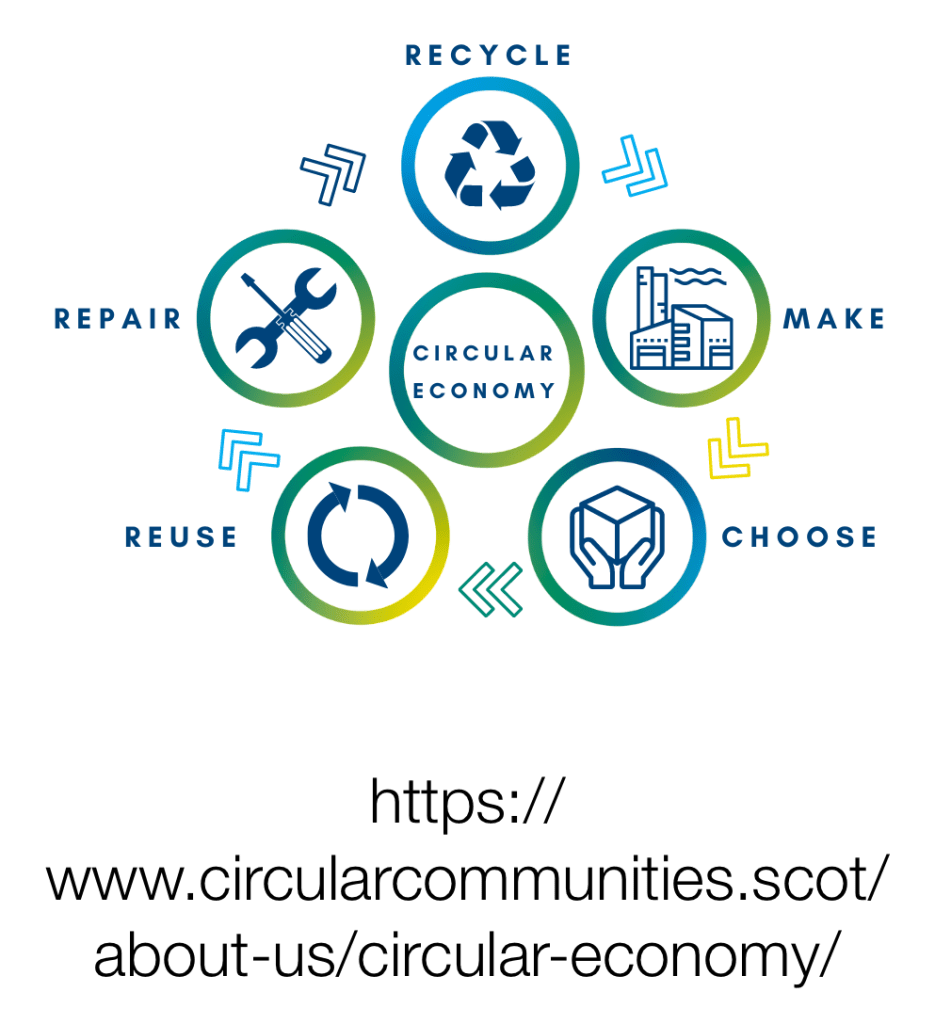
In a circular economy the ‘throw away’ section is discarded. Instead the product is reused or recycled or repurposed so that its value is not lost. In a circular economy the sheet of paper after its initial use, may be reused (writing on the back of it), possible repurposed (used to wrap a parcel) and then recycled. Being recycled the waste paper may become a fresh sheet of (recycled) paper. Going back into the economy that sheet of paper can be recycled 6 or so times before the fibres become too short. At that point the sheet of paper might be recycled as a lower grade material and become a paper bag, a news paper, a cardboard box etc. Ultimately this paper based waste product can be composted and its nutrients returned to the soil. 

In a circular economy the intention is not only to ensure the reuse of waste material (really it is not waste but ‘raw’ material) but also to ensure that there is no waste of energy and water.  Recycling paper uses about 70% less energy and water than making virgin paper and produces about 70% less air pollution. If the paper mill has solar panels, say, it operate with zero loss of energy. If it can clean, reuse and/ or  return its water to the water system, it can operate without loss to the water system.

A circular economy seeks to regenerate natural resources. In the case of paper this would be planting and maintaining woodland to ensure supplies of wood for future generations who wish to make and use paper. Not all resources can be regenerated. Once fossil oil has been extracted from the earth, more cannot be generated. Oil was created 300 million years ago when climatic conditions were particularly suitable for its formation. The formation itself took place over 200 million years during which time climatic conditions were again suitable. Oil is finite resource. 

Is the rate at which we using the earth’s resources sustainable? Bluntly, no! If we compare the amount of resources we use each year against the rate at which those resources can be replaced, then we have not been living within our means since 1970. Each year the Global Footprint Network calculates the resources we use against the capacity of the earth to regenerate its resources and pin points that day in which the two coincide. In 1970 that date was 31st December. Since then this date – Earth Overshoot Day – has rapidly receded global consumption has exceeded the rate of regeneration. In 2021, it fell on July 29. Our current lifestyle is unsustainable. Moving to a circular economy is one way of addressing this problem. 

The development of a circular economy, both globally and locally, is happening. We see it in recycling schemes where plastic bottles are collected, processed and remade into new bottles. We see it with clothing manufacturers where clothes no longer required by the user are returned and either re sold or recycled to create new cloth. There are schemes which reuse and repurpose old furniture. There are even companies that reuse and repurpose unwanted kitchen units. Some projects are small, others large but they are all a step in the right direction. As consumers we need to step up and activity choose to be part of the circular economy.

Further reading: https://www.chathamhouse.org/2021/06/what-circular-economy

Counting on …day 102 

22nd February 202s

Another refill? Did you know that Lush make their black plastic pots from recycled plastic and that each one that is returned, goes to their own reprocessing facility to be remade into a new pot ready to be filled again. And for each one returned 50p is paid back! Lush calls this ‘packaging as a service’! 

Sadly only about 15% of pots are returned. It sounds as if we consumers need to be more proactive participants of the circular economy.  

Counting on …day 97 

17th February 2022

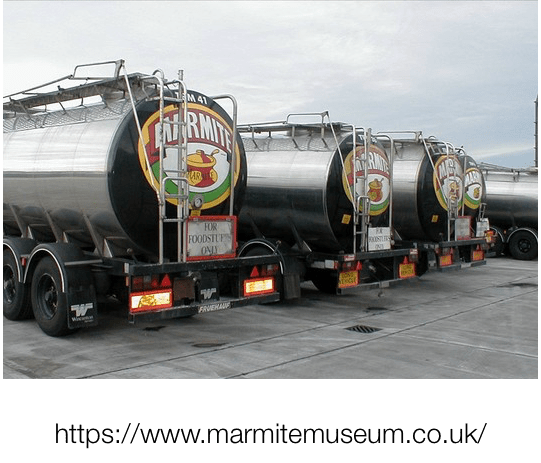
Tanker lorries transport goods other than petrol – even marmite!

Can we expect marmite pumps in our local refill store? 

I suspect the tankers are transporting the yeast extract ‘waste’ – a byproduct  of the brewing industry – en route to the factory where it is transformed into a spread. I equally suspect that the consistency of the spread doesn’t make it a ready candidate for refill stores. But could not the glass jars be returned and refilled as per milk bottles? Maybe write to your preferred yeast extract manufacturer?

Green Tau issue 34 

Fancy a Refill?

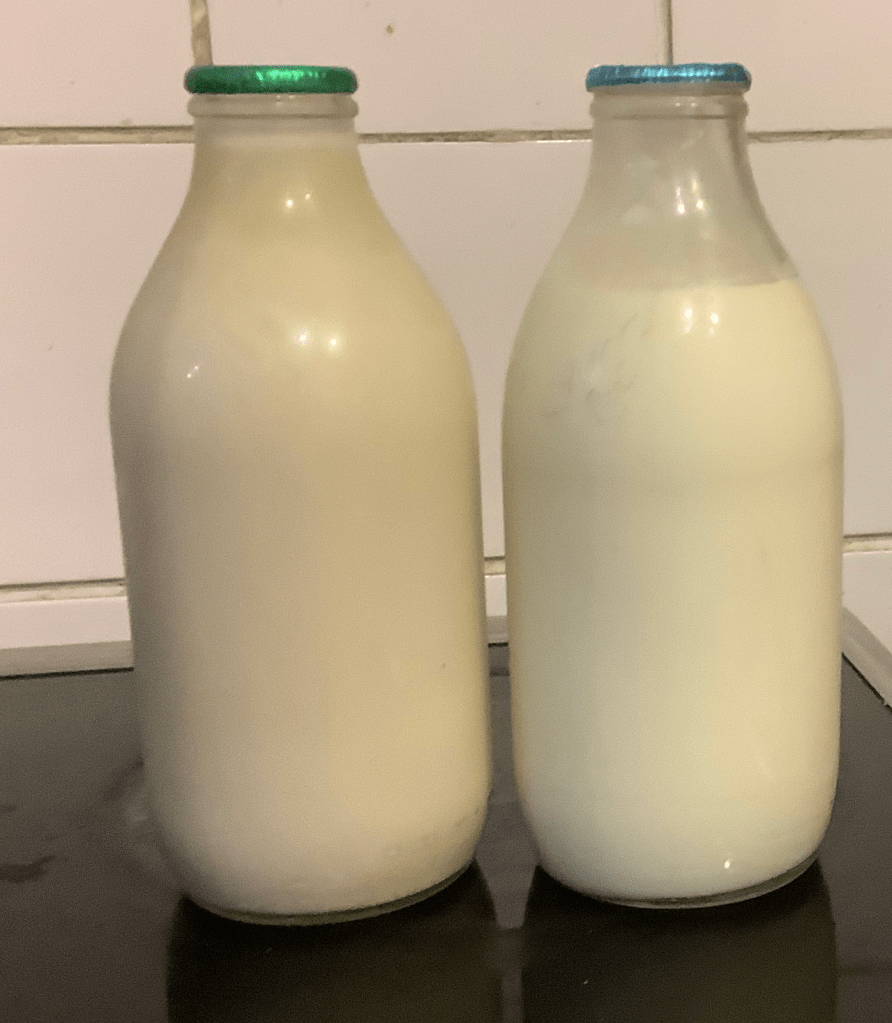
Buying milk in glass bottles that are returned empty and refilled has a long

tradition in the UK. The glass bottles can be used 50 or more times although the average reuse may be closer to 20. The system is facilitated by the door to door delivery of milk and simultaneous collection of the empties, which are then returned to the dairy where they will be cleaned and refilled. 

This refill system avoids the production of waste or hard to recycle materials. It is more efficient than putting milk into plastic containers which are, once empty, collected by a waste collection service, sent to various recycling facilities before being remade – ideally – into a new plastic milk carton. Currently plastic milk cartons are made of 40% recycled plastic and 60% virgin plastic. 

In the past beer and fizzy drinks were sold in bottles with a deposit that was repaid when the bottle was returned. These bottles were returned to the manufacturer and refilled. This practice continues today in countries such as Germany. (Having bought a bottle of beer on a German train, I then found in the corridor a specially designed cupboard into which the empties slotted for their safe return). Whilst we are still waiting for this approach to be reintroduced in Britain, there is a growing number of local outlets where you can refill your bottles with beers, wine and milk etc.

Milk delivery services are branching out and supplying not just dairy milk in refillable bottles but also plant based milks, and fruit juices. Milk and More has partnered with ‘Fill’ to supply refillable bottles of cleaning products: empty bottles are simply returned for reuse along with ones empty milk bottles. Here in Sheen the Micro Beer shop has a changing selection of beers on tap each week – buy one of their beer bottles or take your own sealable 1 litre bottle. Apple and Bees offers red and white refills from Borough Wines. The Source Bulk store in Richmond has oat milk on tap and Gilcombe Farm brings a churn of its raw milk to the Barnes Farmers’ Market – again buy one of their bottles or bring your own.

Can other food stuffs be sold in reusable containers? Yes. 

Tesco has teamed up with Loop. In selected stores customers can buy a range of products sold in reusable containers, paying a deposit which is refunded when the empty container is returned for reuse. The Loop range includes items such as peanut butter and jam, pasta and rice, porridge oats and muesli, tea bags and dishwasher tablets, ketchup and face cream. Abel and Cole offer a similar scheme for their customers, supplying lentils, pasta, rice, oats, dates, quinoa, raisins and chocolate buttons, in returnable reusable containers. 

There are a growing net of refill/ bulk stores which stock terms in bulk allowing customers to decant and buy as much as they want. Typically the store either provides paper bags for the produce or invites consumers to bring their own bags or containers. The latter provides the more desirable zero waste outcome. Various supermarkets (Aldi, Asda, The Central England Cooperative, M&S, Morrisons and Waitrose) are also experimenting with the refill concept – either along the lines of bulk stores with items dispensed into paper bags etc, or wit products sold in returnable containers. 

Local for East Sheen, Culver and Nelson has a refill section for various dry goods. The Source Bulk store in Richmond sells both dry goods,  liquid commodities such as oil, vinegar, maple syrup, and tamari sauce, as well honey and nut butters etc dispensed into reusable jars. Both The Source and Apple and Bees sell liquid cleaning products – washing up liquid, laundry detergent, hair shampoo, liquid soap, toilet cleaner – as refills.

Beyond food there are other items that can be bought as refills such as ink for fountain pens and ink for printers (eg Epson). 

 Counting on…day 91

11th February 2022

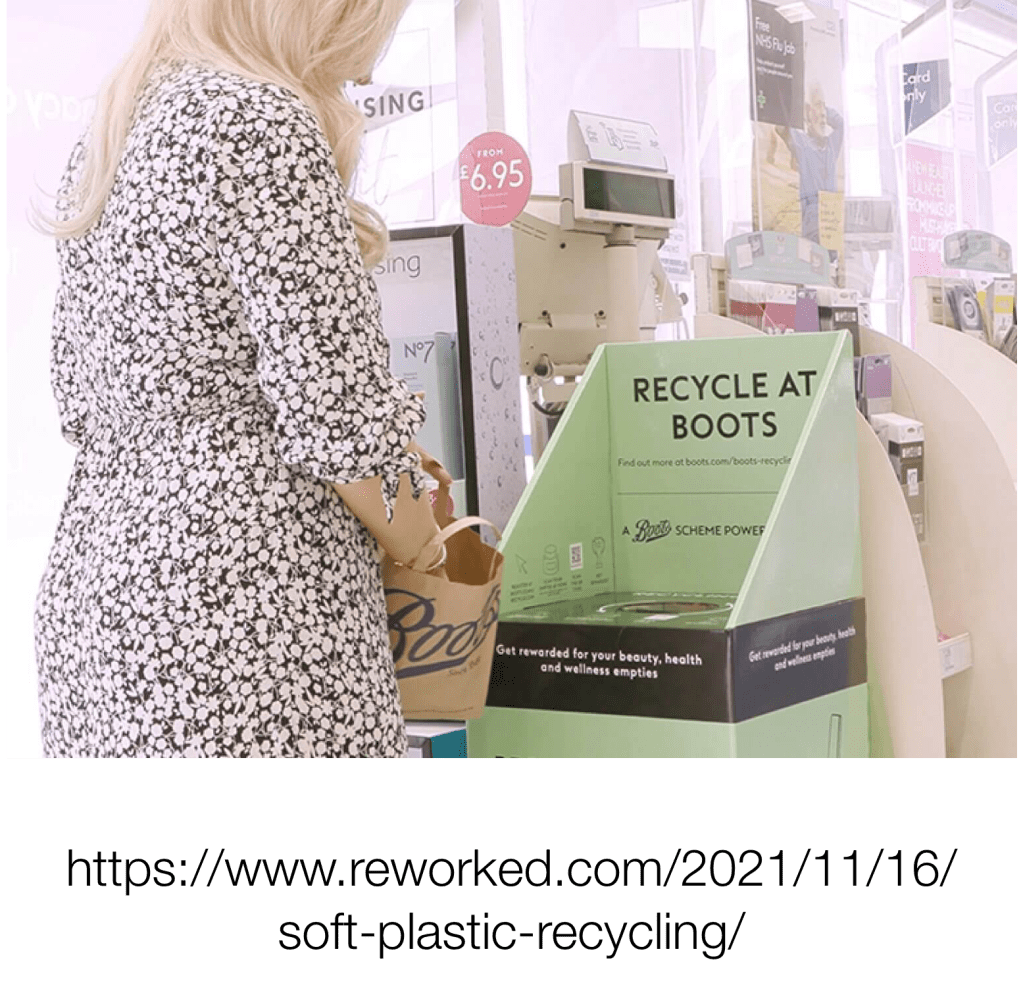
Designated Boots stores have recycling points where you can deposit hard-to-recycle items such as mascara sticks, make-up palettes, compacts, lipsticks, toothpaste tubes, and lotion pumps. (Boots do ask that you don’t use these recycling bins for items that can be recycled via your kerbside recycling service). You do not need to be a Boots customer, but if you are you can earn reward points with your recycling. 

Green Tau issue 33

10th February 2022

What happens to the plastic in our recycling bin?

Each week, here in the Borough of Richmond, our black recycling boxes with their mix of metal glass, metal and plastics are collected and taken away. What happens next?

The collected waste is transported to a materials recovery facility in Mansfield where iron and aluminium, glass and different plastics are extracted via various mechanisms including magnetic drums, weight and size sifting, infra red detection and hand sorting. Once sorted the recyclable plastic is compacted into bales and dispatched on the next stage of its recycling journey.  

At the recycling facility in Leeds, the plastic waste is sorted according to the type of plastic – HDPE (high density polypropylene, PET (Polyethylene terephthalate) – and according to the form of the plastic – bottles or tubs, semi rigid or film. From here the sorted plastic goes to reprocessing plants either in the UK or elsewhere in Europe. The waste plastic is turned into either flakes or pellets which can then be used to make new plastic items, either totally or partially replacing virgin plastic.

From Richmond’s waste, PET bottles are recycled in the UK where they are reprocessed as new PET bottles. HDPE plastic (such as milk cartons) are sent to plants either in the UK or in Belgium where they are reprocessed into moulded items such as containers, pipes or packaging. The semi rigid pots, tubs and trays made of polypropylene (PP)  are recycled either in the UK or elsewhere in Europe. The recycling process includes thoroughly cleaning the plastic to remove any contamination (you should still clean your plastic before putting it in the recycling bin). The recycled plastic are pelleted into a form that can be used to make imitation wooden items such as garden furniture. However new plants are being built which can produce food-grade recycled polypropylene (rPP).

“Packaging producer Berry is building a new polypropylene (PP) recycling facility in Leamington, United Kingdom, that  will produce food-grade materials with a target purity standard of 99.9 percent..Packaging produced from this rPP material will result in 35 percent less CO2 emissions, [&] require 50 percent less water consumption” https://www.recyclingtoday.com/article/berry-uk-polypropylene-recycling-plant/

Soft plastics such as crisp packets, biscuit wrappers, breakfast cereal bags, frozen vegetables bags etc are not – at present -collected by local authorities. Most supermarkets will collect plastic carrier bags for recycling and an increasing number are now also making provision to collect and recycle all soft plastic packaging. These items are made from LDPE (low density poly ethylene). Being lightweight and flimsy they need different recycling equipment from that used for the denser more rigid HDPE. To recycle LDPE new recycling plants are being built.

  “Yes Recycling is currently constructing a new facility in Glenrothes, to specialise in dealing with hard-to-recycle soft plastics – including cellophane, bread wrappers and film lids – which would previously have been added to landfill, burned or exported for processing… Financed in part with a loan from Triodos Bank, the new plant will be capable of processing 15,000 tonnes of soft plastic each year, giving the waste a new life by turning it into plastic flakes and pellets for manufacture, as well as a pioneering alternative to plywood, developed over the past 12 years, that can be used in construction.” https://www.triodos.co.uk/articles/2022/saying-yes-to-recycling—how-a-pioneering-new-facility-is-tackling-plastic-waste  The recycling plant is co-owned by the Morrisons supermarket chain.

To close the loop, we should expect to be able to buy products in bottles and containers made of recycled plastic. As of September 2021 all plastic bottles of 500ml or less for Coca-Cola will be made of  100% recycled plastic and will continue to be fully recyclable. 

Hellman’s squeezable mayonnaise bottles are also made of 100% recycled plastic whilst Persia laundry liquid bottles are made of 70% recycled plastic. Both brands are owned by Unilever. 

As consumers we can ask producers to both supply products in recyclable packaging and ask  that such packaging itself be made from recycled material. Equally we can seek out products that do not require additional packaging or that can be dispensed into refillable containers. This avoids the need to collect and recycle the packaging which – as can be seen above -can involved shipping waste over long distances and through various stages of processing. 

Counting on…day 90 

10th February 2022

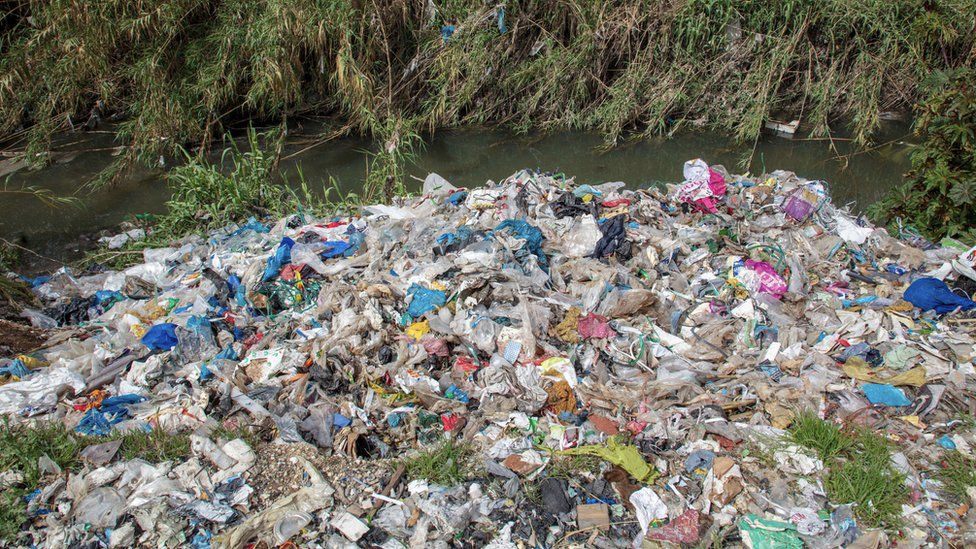
Putting plastic in the recycling bin is only part of the story.  What happens to it next? Greenpeace has reported finding plastic sent from the UK to Turkey for recycling simply discarded in open dumps by roads and rivers.

https://www.bbc.co.uk/news/uk-57139474

In response Greenpeace has set up a petition asking the Government to fix the problems of the  UK’s use and reuse of plastic.

 Counting on ….day 89

9th February 2022

Just as paper handkerchiefs and kitchen towels cannot be recycled, so too is the same for paper napkins/ serviettes. Cafés routinely add a paper serviette to every order. Rather than throwing them straight away, you can use them as a base for growing mustard and cress before finally adding them to your compost heap. 

Replace paper serviettes with washable, reusable cotton ones.

Counting on …day 88 

8th February 2022

Each time paper is recycled, the fibres become shorter and shorter and the potential for further recycling gets less. Paper towels are usually made from fibres that are already very short. For the paper towel recycling is no longer an option. Paper towels  are likely to have absorbed grease, food or other substances, which again makes them unsuitable candidates for recycling. In small numbers they can be added to your compost bin. 

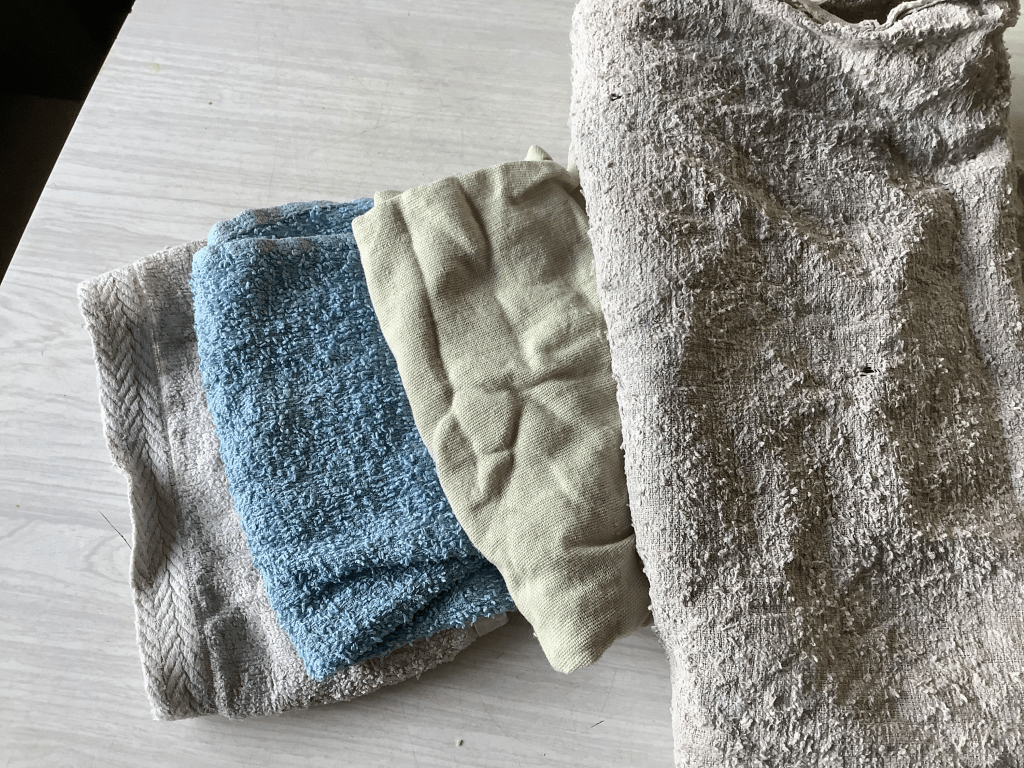
Do we need paper towels in the kitchen? Why not use cloths that can be washed and reused to wipe up spills?  Hand/ bath towels/ tea towels that become to worn for be serviceable, can be cut down and repurposed as cleaning clothes. And when they become too worn, they can go as rags for recycling – charity shops usually welcome bags of rags. 

Green Tau Issue 32

Why Recycle? 

Recycling has over the years become a more topical subject, linked to a growing

awareness of concern for the environment, and in particular concerns about climate change. Over the last decade recycling rates in the Uk have been increasing. In 2010/11 42% of waste (that is waste from households) was recycled. Recycling rates reached a peak in 2019/20 of 45.5% – but last year they fell back to under 44% (a rate last recorded in 2012/13).  2020/21 also saw a small increase (1.3%) in the total volume of household waste.

Why do we seek to recycle more? How does it help the environment? How does it impact on climate change?

Reasons for recycling:

  • Reduces  the space needed for landfill. It is better for the environment if land is kept in its natural state rather than being filled with waste. The experience of the covid pandemic has shown us the value of green spaces.
  • Reduces the risk of pollution. Landfill as a means of waste disposal leads to air and water pollution as obnoxious chemicals and particulates escape. Landfill creates long term pollution as  toxic chemicals remain lodged in the soil. As materials rot, landfill sites become a source of methane one of the more powerful green house gases. Disposing of waste by incineration causes pollution, both from poisonous chemicals and from particulates that cause lung diseases. Incineration also produces greenhouse gas emissions that cause climate change. Un-disposed or improperly disposed waste creates litter. Litter is an eye sore and detracts from people’s quality of life. Litter can harbour and spread desirable bacteria etc. Litter can blocked drains and rivers, leading to flooding. It can be consumed by animals causing injury or death. Through the food chain, micro quantities of plastic are now being found in the bodies of all living creatures, including ourselves. 
  • Recycling conserves limited natural resources. There comes a point at which the supply of natural sources of materials – iron ore, helium gas, lithium etc -will run out. Then we will have to rely on reusing these materials.
  • NB Helium gas cannot be manufactured. It has to be carefully mined as once released into the atmosphere, its light weight means that it floats straight out into the outermost part of the atmosphere. Helium is an essential gas used in the operating of MRI scanners – we cannot afford to use it in party balloons.
  • Recycling conserves energy used in producing raw materials. Aluminium in particular requires large amounts of energy to extract the metal from the bauxite. Far less energy is needed to create fresh aluminium from pre-used aluminium.
  • Recycling can save or earn money. Metals such as gold and aluminium obviously have a high scrap value, but as too do other materials such as glass, plastics, paper and card although the economies of scale vary.
  • Recycling allows for the replenishment of natural resources. Recycling – ie composting – food waste allows the nutrients in the waste to be returned to the soil to maintain its fertility. 
  • Recycling materials can avoid the destruction of habitats. Using recycled paper and cardboard avoids the need to cut down trees and the associated destruction of woodland habitats.
  • Recycling reduces pollution. Using recycled plastic to make a bottle cause far less pollution than would be  involved in first extracting and transporting oil, and  then in processing the oil to  turn it into a plastic ready for making into a bottle.
  • Recycling can save water. Making clothes from recycled cotton uses less water than growing cotton to produce new cotton. Recycling paper uses less water than making paper from timber. 
  • Recycling can reduce transport costs and emissions. If the recycling takes place locally, it avoids the costs of transporting raw materials from further away. The converse is also true. Recycling is not energy efficient of the materials to be recycled are sent far away/ overseas to be recycled before being returned as new products. 
  • Recycling only works if people then buy the recycled product. Recycling paper, but never buying and using recycled paper does not help. Recycling plastic bottles only helps if we then buy drinks/ laundry liquids etc in recycled plastic bottles. Recycling aluminium foil only helps if we then buy recycled aluminium foil. We need to close the loop!

Recycling does benefit the environment and does limit some of our production of carbon dioxide emissions. Why then are recycling rates so low? Can we afford financially and environmentally to throw away more then 50% of our household waste?

See also:-

Recycling eco tips https://greentau.org/2021/12/20/eco-tips-16/

Stewardship of things https://greentau.org/2021/09/20/eco-tips-8/

The ins and outs of packaging https://greentau.org/2021/08/16/eco-tips-packaging/

Zero waste https://greentau.org/2022/01/27/eco-tips-zero-waste/