Sustainability takes many forms one of which concerns morality. Is it morally sustainable for the CEO of a business to take a pay rise approaching 300% whilst denying the basic living wage to those who working on the shop floor? This is a subject that has been taken up by Share Action, a charity that works oh share holders and campaigners to bring about beneficial change in listed companies. https://shareaction.org/news/weve-filed-a-living-wage-resolution-at-sainsburys-heres-why
Consuming less can be eating locally organically grown food rather than imported, intensively produced food. Take strawberries: eaten out of season we are consuming not just the fruit but the extra carbon footprint of importing them – often as airfreight. Additionally we may be consuming excess quantities of water – strawberries grown in Spain are reliant on artificial irrigation which is draining natural aquifers and jeopardising river and wetland habitats. Strawberries are also a labour intensive crop often invoking seasonal workers who are often underpaid and/ or abused. As strawberries become an everyday rather than seasonal treat, so supermarkets put pressure on suppliers to reduce costs. Strawberries often come packed in single use plastic boxes and even though the plastic may recyclable, the punnets themselves are invariably made from virgin plastic.
Sustainable strawberries are a treat to be waited for and savoured – hold out for ones with flavour and aroma! If you have the opportunity, grow and pick your own!
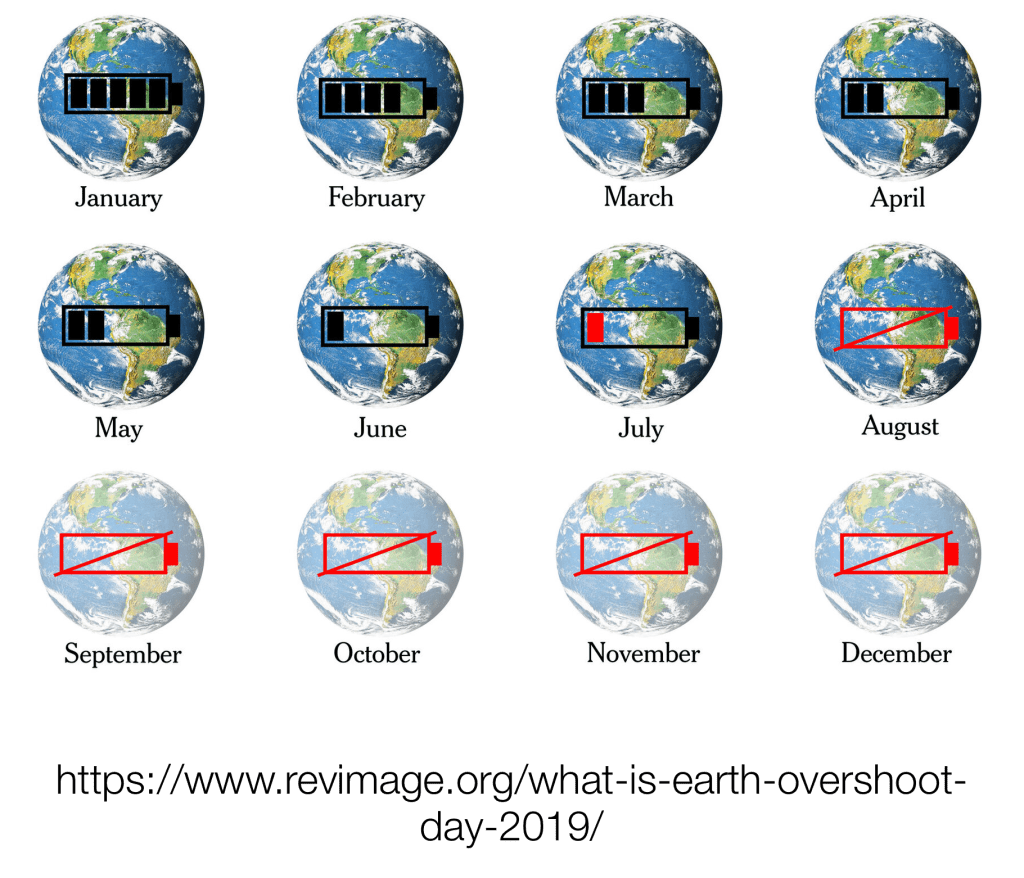
The Cambridge Dictionary defines sustainability as ‘the quality of causing little or no damage to the environment and thereforeable to continue for a longtime.’ Earth Overshoot Day marks the critical point each year when we have consumed that sum of resources that can be replenished in the course of the year. Beyond that point we are consuming more than can be replaced and are therefore indelibly damaging the environment. Last year Earth Overshoot Day fell on 21st July: in seven months we had consumed a year’s worth of resources! The situation can be worse if we look at our individual countries: Earth Overshoot Day for the UK this year was 19th May. Sustainable living for most of us has to focus on consuming less.
Today is World Environment Day, organised by the UN. This year’s strap line is MAKING SUSTAINABLE LIVING THE DEFAULT OPTION. This has to be a motto by which we live: when ever we make a choice, we need to chose that which is most sustainable. Choices will not be clear cut – imported organic carrots versus homegrown non organic ones – but will always be better than options that clearly damage the environment and with it our well being. Is this something we can share with our friends, our neighbours, our employers, the places where we shop? Can users and consumers change the world?
“Make do and mend” works for footwear too. The local shoe repairer renewed the heels on these sandals whilst applying PVA glue has helped prolong the life of the cork bed.
“Make do and mend” reduces the amount we consume, making our lifestyles more sustainable. Repairing a pair of trousers so that they can be worn for a couple more years makes good sense.
In a world where resources are limited, we need to avoid waste them. One way is to ‘make do and mend’. By repairing and maintaining and repurposing things we can prolong their useable lifespan before recycling them. This skilfully repaired dustbin belongs to a neighbour. The less skilfully repaired coffee filter is mine – gaffer tape can mend a lot of things.
Helium is a naturally occurring gas. It is very light and once released it quickly escapes to the edges of the earth’s atmosphere. Where helium has become trapped in rock strata it can be Helium extracted for commercial use. It cannot be chemically manufactured and is therefore a limited finite resource. Helium is is a key component in the operating of MRI scanners.
It is surely irresponsible to use it to fill party balloons?
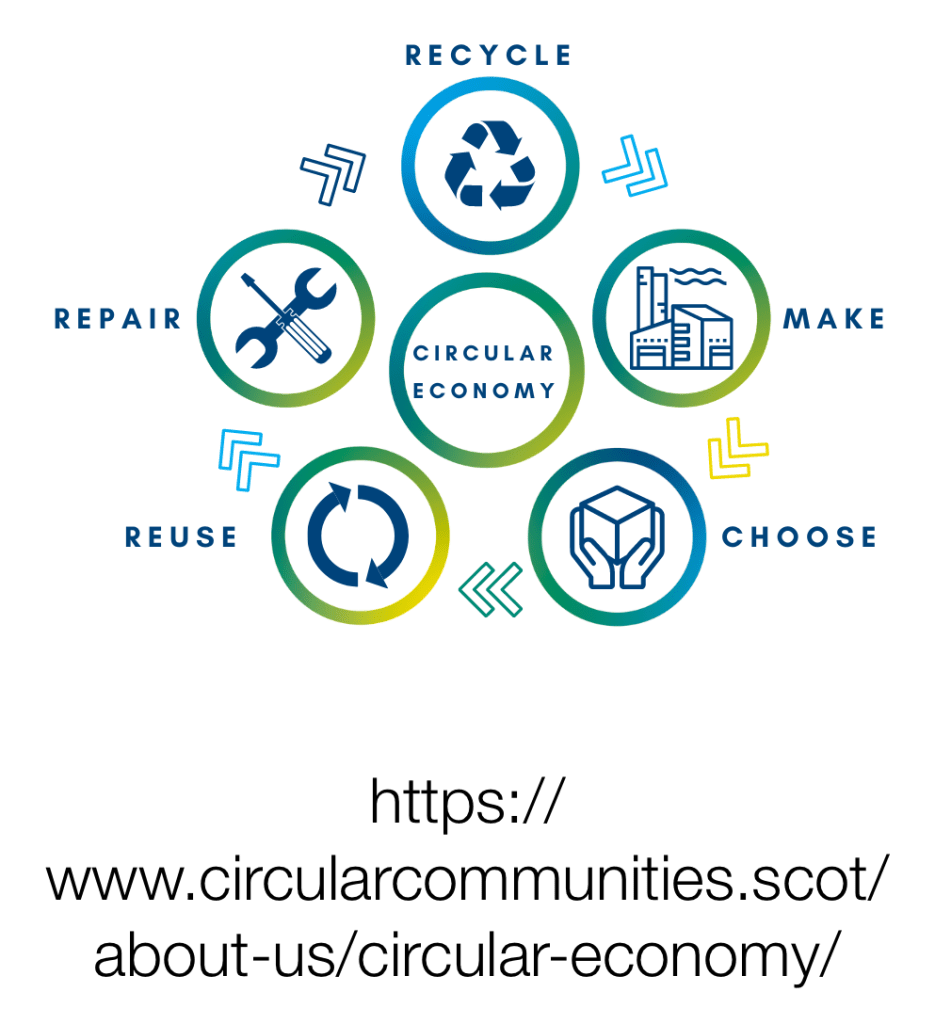
It is easier to describe its opposite. A non circular economy is that takes, makes and throws away. For example, chop down a tree, make its wood into a sheet of paper and then, after a single use, throw the paper away. Another example would be taking oil out of the ground, making it into a plastic cup and then, after a single use, throwing it away.
In a circular economy the ‘throw away’ section is discarded. Instead the product is reused or recycled or repurposed so that its value is not lost. In a circular economy the sheet of paper after its initial use, may be reused (writing on the back of it), possible repurposed (used to wrap a parcel) and then recycled. Being recycled the waste paper may become a fresh sheet of (recycled) paper. Going back into the economy that sheet of paper can be recycled 6 or so times before the fibres become too short. At that point the sheet of paper might be recycled as a lower grade material and become a paper bag, a news paper, a cardboard box etc. Ultimately this paper based waste product can be composted and its nutrients returned to the soil.
In a circular economy the intention is not only to ensure the reuse of waste material (really it is not waste but ‘raw’ material) but also to ensure that there is no waste of energy and water. Recycling paper uses about 70% less energy and water than making virgin paper and produces about 70% less air pollution. If the paper mill has solar panels, say, it operate with zero loss of energy. If it can clean, reuse and/ or return its water to the water system, it can operate without loss to the water system.
A circular economy seeks to regenerate natural resources. In the case of paper this would be planting and maintaining woodland to ensure supplies of wood for future generations who wish to make and use paper. Not all resources can be regenerated. Once fossil oil has been extracted from the earth, more cannot be generated. Oil was created 300 million years ago when climatic conditions were particularly suitable for its formation. The formation itself took place over 200 million years during which time climatic conditions were again suitable. Oil is finite resource.
Is the rate at which we using the earth’s resources sustainable? Bluntly, no! If we compare the amount of resources we use each year against the rate at which those resources can be replaced, then we have not been living within our means since 1970. Each year the Global Footprint Network calculates the resources we use against the capacity of the earth to regenerate its resources and pin points that day in which the two coincide. In 1970 that date was 31st December. Since then this date – Earth Overshoot Day – has rapidly receded global consumption has exceeded the rate of regeneration. In 2021, it fell on July 29. Our current lifestyle is unsustainable. Moving to a circular economy is one way of addressing this problem.
The development of a circular economy, both globally and locally, is happening. We see it in recycling schemes where plastic bottles are collected, processed and remade into new bottles. We see it with clothing manufacturers where clothes no longer required by the user are returned and either re sold or recycled to create new cloth. There are schemes which reuse and repurpose old furniture. There are even companies that reuse and repurpose unwanted kitchen units. Some projects are small, others large but they are all a step in the right direction. As consumers we need to step up and activity choose to be part of the circular economy.
Refilling cars with petrol at a service station is common practice.
What if it was the same with oils for cooking and eating? An olive oil pump? You may find that you can! Refill stores often stock different sorts of oil with which customers refill their bottles. As this grows in popularity, let’s also make a point of asking for organic and fairly traded oils.








 The Green Tau