Counting on … day 1.118

12th May 2023

Interesting comments from RSPB –  “One of the latest experiments is planting wildflower strips and alleys of trees within fields. Research has already shown that planting wildflower strips helps bring beneficial insects into the fields, which is good for pollination and pest control. But this ten-year trial hopes to show the strips with trees can help in other ways too, such as:  

  • A wildlife boom – from earthworms underground to the birds in the treetops to everything in between, we hope the strips will increase beneficial wildlife including beneficial pollinators and natural pest controllers. The trial will also look to see if the trees have a negative impact on any species.  
     
  • Carbon catching trees – we know trees store carbon – but we want to find out accurate figures for how much carbon our trees can capture to help inform future work.
     
  • Make some money –  apple and cobnut trees within the alleys can provide another source of income. We’ll be keeping a close eye on whether these trees bring home the bucks as well as the bugs.”

https://www.rspb.org.uk/get-involved/activities/so-many-ways/explore-more-ways/farm-with-flower-power/

Counting on … day 1.107

1st May 2023

The Woodland Trust reports “Approximately 40% of major new road schemes across England impact irreplaceable ancient woodland wildlife havens, together with ancient and veteran trees. Added to that, associated carbon emissions are eyewatering. The Government’s consultation on its transport infrastructure policy closes on 6 June. Join thousands who have already taken action to help enable a future where nature thrives and carbon stays in the ground”.

They have set up a petition calling for greater protection of our trees which you can sign – https://campaigns.woodlandtrust.org.uk/page/120772/action/1?utm_campaign=3277675_E23COM013_Newsletter_Dynamic&utm_medium=email&utm_source=E23COM016&utm_content=NNNPS&dm_i=2D76,1Y92J,6HXEUF,6VJXU,1

 Counting on … day 324

30th September 2022

Autumn is a good time to plant trees. If you have space why not choose one for

your garden – not all tree are big and fruit trees produce an edible reward too! 

Brogdale in Kent holds the National Fruit Collection and has over 4000 varieties of fruit trees including  apples, pears, quinces, plums , cherries and cobnuts – including many heritage varieties. 

 Counting on ….day 270

8th August 2022

Using trees to provide shade significantly reduces urban temperatures making it easier to cope with heat waves. The Mayor of London proposes increasing London’s tree cover from around 20% to 30% by 2050. Research shows that to be most effective tree cover should be at least 40%. We can contact our local authorities and ask them about planting more trees. And if we have the space, we too can plant trees in our gardens.

Counting on …day 201

2nd June 2022

“The Queen’s Green Canopy (QGC) is a unique tree planting initiative created to mark Her Majesty’s Platinum Jubilee in 2022 which invites people from across the United Kingdom to “Plant a Tree for the Jubilee”. With a focus on planting sustainably, the QGC will encourage planting of trees to create a  legacy in honour of The Queen’s leadership of the Nation, which will benefit future generations.” 

https://queensgreencanopy.org/

If you haven’t a garden or sufficient space for a tree, you can sponsor the planting of  a tree via the National Trust –

https://www.nationaltrust.org.uk/features/plant-a-tree?intcmp=plant_atree_autumn20_inmemorypage_teaser

Or you can sponsor a tree via the NHS where it will form part o the NHS Forest – https://nhsforest.org/get-involved/sponsor-a-tree/

Counting on … day 200  

1st June 2022

Walking in woodlands or even just having a tree to look at when you are ill is known to be beneficial – promoting both mental well-being and speeding up recovery from sickness. 

A report produced last December by Forest Research and funded by the Forestry Commission, Scottish Forestry and the Welsh Government, recorded that visits to the UK’s woodlands do indeed boost mental health and save an estimated £185 million in treatment costs annually. 

Counting on …day 198

30th May 2022

Ancient trees are not only valuable in their own right, they also support a wide and diverse ecosystem – beetles, insects, birds, fungi, small mammals, plants etc – and are key in maintaining biodiversity. The Ancient Tree Forum has a booklet exploring this topic – https://www.ancienttreeforum.org.uk/wp-content/uploads/2015/02/ancient-tree-guide-6-special-wildlife.pdf

Looking after old trees and woodlands matters!

Counting on …day 197 

29th May 2022

We can recognise ancient buildings like castles and cathedrals quite easily. We can probably recognise old houses quite easily too – especially those that are large and grand! We expect such buildings to be protected – perhaps under the auspices of the National Trust or English Heritage, or to be a listed building. But what about trees? The oldest tree in the world is probably a 4m wide  Patagonia cypress in Chile which could be up to 5,484 years old (https://theguardian.com/environment/2022/may/26/worlds-oldest-tree-cypress-chile). And that is older even than the pyramids in Egypt! According to the Woodland Trust, the oldest tree in the UK is said to be the Fortingall yew in Perthshire. It’s estimated to be between 2,000 and 3,000 years old, although some believe it could be 5,000 years old. Such trees are historic landmarks and deserved to be protected in the same way that we protect historic buildings. The Woodland Trust has instigated just such a campaign! 

https://www.woodlandtrust.org.uk/protecting-trees-and-woods/campaign-with-us/tree-protection-campaign/

 Counting on …day 185

17th May 2022

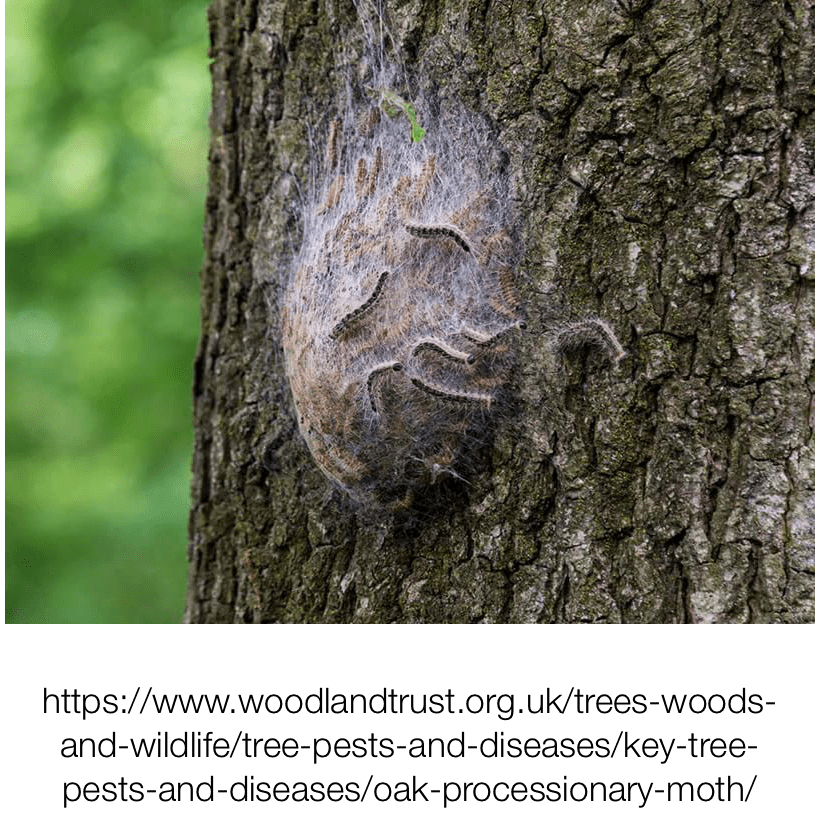
The public are being urged to keep an eye out for any signs of disease in local trees, as the UK launches a hi-tech, £5.8m tree laboratory to fight the spread of pests and diseases. The UK is especially vulnerable to the growing spread of plant pathogens because of warmer, wetter winters, and because it is a hub for global trade. The public can report sightings via the Tree Alert site, and a specialist will come and look at the tree, or send samples for further testing. One pest that affects Richmond Park is the oak procession are moth.

“First identified in London in 2006, it probably arrived on imported live wood. It has since been found in some surrounding counties. The caterpillars will be emerging over the next three months. They are black with long white hairs and move in long nose-to-tail processions, which give them their name. The nests are usually the shape of a dome or teardrop and are around the size of a tennis ball. They strip bark off oak trees and cause them to lose their leaves. The caterpillars can cause rashes and breathing difficulties, and should not be touched.”

https://www.newsbreak.com/news/2602005258609/how-to-spot-bark-beetles-and-deadly-fungus-the-uk-s-new-tree-saving-lab-needs-your-help