Counting on … day 10

14th January 2025

 When I was growing up, households typically had a metal dustbin that that dustmen could lift into their shoulder tipping the contents into the truck. Now domestic dustbins are twice the size with wheels and are designed with handles which the dustbin truck latches onto in order to empty the bin. But not only do we have a much bigger dustbin, each house also has at least two large recycling boxes and a food recycling bin too. In 2022/3, annual waste per household varied from 450kg in the South West of England and 600kg in the North East. (1)

Whilst such waste is only a small portion of the waste we expect the Earth to absorb, domestic waste if something we can control – and curtail. Why not do a survey of what you discard each week? 

Could any of it be reused? 

Did you need to use in the first place?  Might you not need to buy/ acquire it in the first place?

(1) https://www.statista.com/statistics/996467/regional-waste-volumes-england-united-kingdom-uk/

Counting on … day 9

13th January 2025

Bio capacity  (the metric used to calculate Earth Overshoot Day) includes both the biological  productive land and sea area that provides the resources we need and the Earth’s capacity to absorb the waste produced including pollution. 

In this context waste includes sewage, greenhouse gas emissions, excess fertilisers that leak into the water system, exhausts and brake dust from vehicles etc. The limits on the capacity of the Earth to absorb waste and to keep the environment healthy, is something we often forget. Producing waste is just as much about consumption as cutting down trees or catching fish. To live within the resource constraints of the Earth, we need not just to consume less but also to produce less waste.

Counting on … day 130

22nd July 2024

Wanted 

There is no point in buying something you don’t want! Buying something on a whim and then discarding it is a waste of resources. It is not a sustainable approach. 

Equally there is not much point in buying something for someone else (say as a Christmas present) if it’s something they don’t want. One solution might be to agree within your family/ circle of friends that you will buy presents from charity shops with the premise that no one should feel guilty about returning something unwanted back to the charity shop. 

Counting on … day 104

10th May 2024

Having said that we try to minimise waste, should what we recycle be seen as recycled waste? Flour and oats both come in large paper sacks. The sacks are single use which arguable might seem wasteful but they can be recycled. They are good for collecting all the other paper that goes out for recycling. Margerine comes in plastic tubs – again single use but recyclable. 

One reason that our dustbin fills slowly is because we can recycle much of the ‘waste’ that comes into the house. We recycle paper and card, aluminium foil, tins, glass and standard plastics via the Council’s kerb side collection. We take soft plastics to the Coop for recycling, toothpaste tubes to Boots, medical blister packs to Superdrug. There is a recycling bin for small electrical goods at the library and for batteries at Robert Dyas.

Recycling is good and worth doing but it comes with its own consumption of resources and production of emissions. And we know that in reality many things that are labelled as recyclable are not recycled – often because they are not put into the appropriate recycling bin. Greater thought needs to be given by designers and producers to reduce what needs to be recycled and how often. 

The aim becomes not consuming more than you need to consume, buying less and ensuring the best and most efficient use of what we do consume.

Counting on … day 99

3rd May 2024

Food waste is an issue in homes too. We aim to minimise such waste by not buying more perishable food items than we need. Getting used to how much a person eats, and how much makes a serving, helps. As does a shopping list. Additionally as most of our meals are cooked from scratch it is is easy to prepare only as much food as is going to be eaten. If there are leftovers they are refrigerated and become the next day’s lunch. 

Tea bags, coffee grounds, the outer leaves of a cabbage or onion skins all go in the compost heap. Being vegan there are no bones or skins to be disposed. Root vegetables are washed and used, peel on. Apple cores become cider vinegar, and lemon rinds become preserved lemon. Excess amounts of root and cabbage-like vegetables become sauerkraut, and surplus fruit from the garden is bottled, or made into jam or chutney. During the summer the excessive growth of nasturtium leaves and rocket are made into pesto and bottled for use in the winter. 

And it is surprising how many different fruits and vegetables you can use to make a delicious soup!

Further reading – https://wrap.org.uk/resources/report/household-food-and-drink-waste-united-kingdom-2021-22

https://www.lovefoodhatewaste.com

Counting on … day 1.225

28th November 2023

Last week in response to the news that Lidl was renting out Christmas jumpers,  the Guardian noted that “The environmental charity Hubbub reported in 2019 that 12m jumpers were forecast to be bought that year, despite 65m already languishing in UK wardrobes. The novelty jumpers are, the charity said, one of the worst examples of fast fashion, now recognised as hugely damaging to the environment.” (1)

Hubbub’s website lists various ways of avoiding this waste – https://hubbub.org.uk/cheap-sustainable-christmas-jumper-ideas

  1. https://www.theguardian.com/lifeandstyle/2023/nov/23/lidl-christmas-jumper-loan-scheme-nspcc?CMP=Share_iOSApp_Other

Green Tau: issue 50

1st September 2022

There is no ‘away’ in a throw-away society 

We can go away on holiday to the sea side, to the mountains, to a tropical islands or a city of culture. We take away 3 from 5, or 99 from 100, and get a number. When we look away, we look in the  opposite direction. But where is away on a throw-away society?

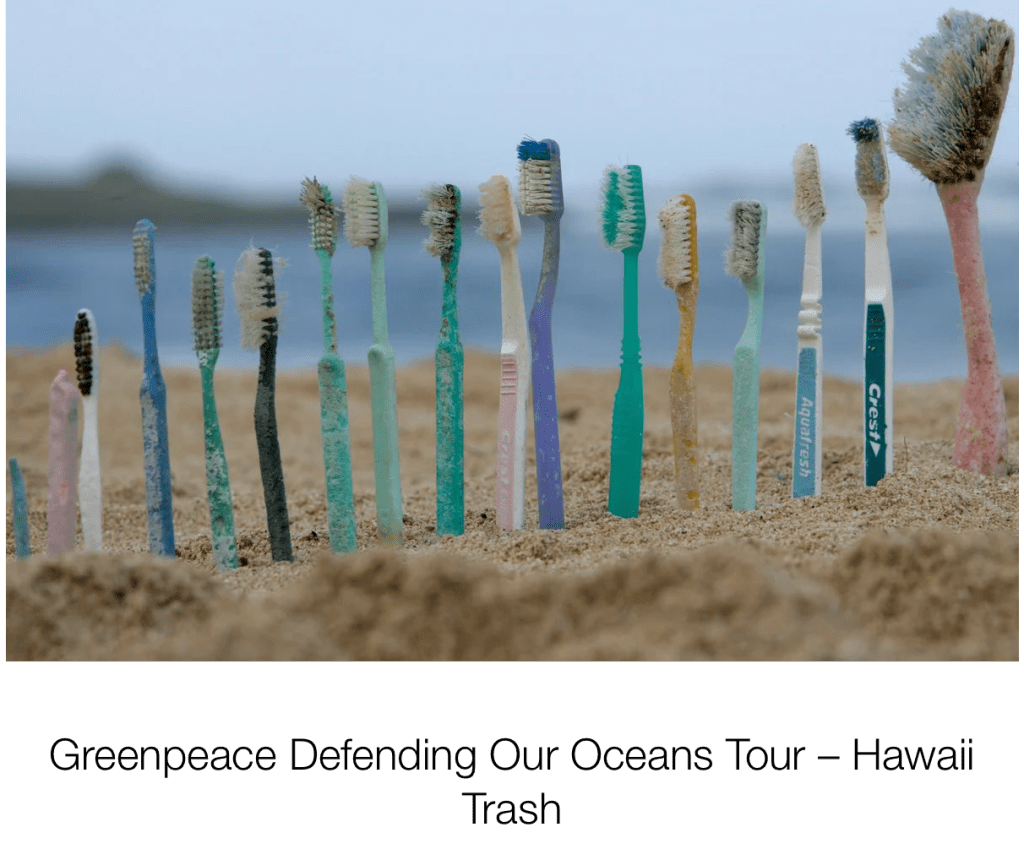
It is said that if Henry VIII had had a plastic toothbrush it would still exist today – plastics take

400-500 years to biodegrade. In the UK we throw away in excess of 200 million toothbrushes every year. These end up in landfill, incinerators or in the ocean. As they degrade they release toxins into the water or – in the case of the incinerator – into the air. 

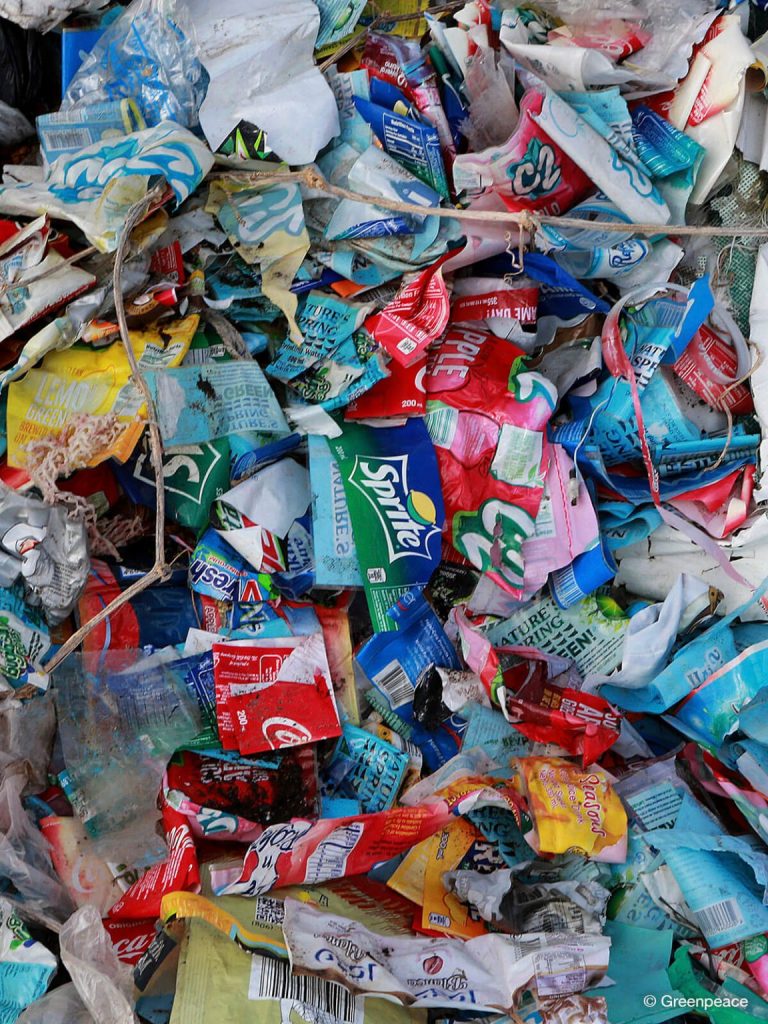
Plastic waste is a global issue even though most of it originates in the developed world. As plastic degrades it breaks into smaller and smaller pieces. These end up in the digestive systems of various creatures, but especially so in sea creatures, in the ice on remote mountains, and in the water we all drinks. Plastic particles can even transfer from mother to foetus through the placenta.  You cannot throw plastic away. It always goes somewhere!  There is nowhere where it can be ‘away’ from us. 

Terracycle and Colgate together offer a recycling scheme for plastic toothbrushes,  toothpaste tubes and caps, floss containers and packaging and electric toothbrush heads. So for any plastic toothbrushes etc that you are currently using, there is at least one means of ensuring that the ‘away’ to which they go is to be recycled into another product rather than polluting the environment meant. Colgate also sells a toothbrush made from 100% recycled plastic with 100% plant-based nylon bristles which maybe helping to close the loop on this product. Hopefully we can all act now – whether by using a recycled or a bamboo toothbrush – to prevent this ‘mound’ of ex-toothbrushes from continuing to grow 

One of the easiest plastics to recycle is PET (polyethylene terephthalate) which is the type of plastic used to make drinks bottles – type 1 plastic as marked inside the recycle triangle. This can be recycled to create another plastic bottle – an rPET bottle. You may be able to find rPET bottles used for Buxton Spa and Evian water and for Coca Cola but most bottles are still made from virgin PET. (PET plastic cannot be recycled indefinitely without the addition of a proportion of new plastic resin so recycling isn’t the complete answer).

It is estimated that an average of 35.8 million plastic bottles are used every day in the UK, but only 19.8 million are recycled (https://www.recyclenow.com/recycle-an-item/plastic-bottles). For a little more than half of PET bottles, ‘away’ means a new life as recycled plastic, but for the remainder ‘away’ may still be landfill, the incinerator or the ocean. 

For other plastics the recycling rates are not as rosey. HDPE plastic – high density poly ethylene – is widely used for plastic bags, milk bottles, shampoo and laundry bottles etc. Whilst it can be recycled into more bottles, drain pipes, plastic sheeting etc, only 12% of all plastic bags are recycled and 28% of milk and water bottles are recycled (https://www.plasticexpert.co.uk/plastic-recycling/hdpe-plastic-recycling/). 

Other plastics are even less likely to be recycled. Polystyrene for example – whilst it can be recycled, there are very few recycling plants (apparently there is one in Cardiff but none in London!) and no kerb side collections. Other plastics can be hard to recycle because they are a composite of several materials which are hard to separate – this has long been the case with coffee cups made from paper and lined with polythene. There are now an increasing number of recycling facilities for such cups. An optimistic estimate suggests that 1 in 25 disposable coffee cups are recycled (https://www.recycling-magazine.com/2019/10/01/reducing-coffee-waste/). But for most coffee cups ‘away’ means landfill, incinerator or the ocean.

Despite all these health threatening ‘aways’ which is where waste most plastic goes, we are still producing more and more new plastic every year. According to the OECD global plastics production doubled between 2000 to 2019 to reach 460 million tonnes. Much of this is used for packaging (146 million tonnes in 2015 (https://ourworldindata.org/grapher/plastic-production-by-sector)

It is a scary thought that there is no real ‘away’ where we can throw what we wish to discard. What happens to all the shoes, the clothes, the half empty paint tins and paint brushes, the punctured inner tubes and bike tyres, car tyres, shower curtains, kitchen sinks, soft toys, the leaky hot water bottle etc that we will throw throw away during our life times. Sometimes there be recycling options but not always and even then one wonders what the end product is. We have a foam mattress bought when we were first married. It is probably coming near to the end of its useful life as a mattress but I do not think there is any safe ‘away’ where we can send it. Were we buying that same mattress now I know we think and choose differently. 

Whenever we acquire new things, we need to consider what will be its destination when it is has ceased to be useful in its current formation. Can this pair of trainers be recycled even though it comprises several materials? Will it just end up as road fill? Can this polyester running shirt be recycled into a new shirt? Can this iron/ kettle/ printer be recycled, its metal,and plastic parts separated and reprocessed? 

Should this be solely our responsibility as consumers? The Extended Producer Responsibility is an approach that says that the manufacture must take on responsibility for their products when they re@ch their end of life. This would refurbishing and/ or recycling the product. Placing the responsibility manufacturer should encourage more sustainable designs and manufacturing processes.  Such policies are slowly be introduced in a number of countries. As a result of current legislation European manufacturers, including British ones, are responsible for taking back and recycling in all batteries, and waste electronics and electrical equipment – The Waste Electrical and Electronic Equipment Directive is the European Community Directive or WEEE. 

I am hoping that such a scheme will be introduced for mattresses (and applied retroactively)

Counting on …day 249

18th July 2022

In May many people took part in the Big Plastic Count organised by Greenpeace. They have now produced the results of survey  and a report in which they highlight that only 12% of plastic household waste is recycled in the UK, as opposed to being buried as landfill, incinerated or sent abroad. This is not a happy state of affairs and not surprisingly they now have set up a petition calling on the government for more responsible action.

Counting on ….day 235 

6th July 2022

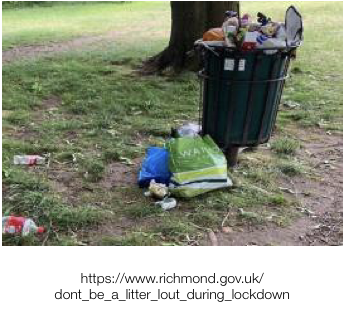
The bins at St Margaret’s fair contrasted with the bins on Sheen Common, our local green space. These were overflowing with discarded picnic waste – plastic wrappers, plastic bottles, cardboard  boxes, plastic bags. Some items could have been taken home and recycled. Better still is to make picnics that involve no waste – sandwiches wrapped in beeswax clothes or packed in lunch boxes.  Water or squash in refill bottles. Fruit loose in a cotton bag. Slices of cake and biscuits packed in a tin. 

 Counting on ….day 234

5th July 2022

Having to think before we discard or throw something away is a good thing. Maybe what we are discarding could be repaired, or reused or at the very least be recycled. Maybe it was surplus to needs and now we know not to get it future. Maybe it is the packaging that is superfluous and next time we can find a different supply that comes with zero waste.