
Counting on 2026 … day 2

8th January 

How do we protect and preserve fresh water supplies – part 3 

Using less water! 

This is something for businesses and farmers and domestic consumers to respond too – and feels particularly pertinent as decisions are made about AI and data centres generally (see tomorrow’s blog).

In the UK at our continued rate of water consumption there will be a daily  shortfall of 5 billion litres (about a third of current consumption) by 2050. This takes into account the need to extract less water from rivers, aquifers etc where it negatively impacts the natural environment, a growing population, the need to cope with increasingly frequent droughts, the impact of climate change (eg changing rainfall patterns) and increased use by businesses. (1) 

Per capita household water consumption in the UK is already falling, from an average of 169.53 litres per day in 2005/2006 to an average of 139.47 litres in 2023/2024. (2) However there is clearly a need for consumption levels to fall further. A survey across Europe in 2020 varied daily domestic consumption varied from 300 litres in Switzerland to 100 litres in Belgium and even less in Estonia and Slovakia. (3) In some instances the difference maybe due to a lower volume toilet flush, or the frequency and duration and rate of flow of showers, or the frequency of use and water efficiency of appliances such as washing machines. 

Websites with water saving tips

This earlier blog is about saving and reusing grey water around the house – https://greentau.org/2025/07/10/counting-on-day-106-3/

And this one about showering less and more efficiently – https://greentau.org/2025/02/13/counting-on-day-31-3/
  1. https://commonslibrary.parliament.uk/research-briefings/cbp-10248/
  2. https://oifdata.defra.gov.uk/themes/natural-resources/E8/
  3. https://smartwatermagazine.com/news/locken/water-ranking-europe-2020

Counting on … day 32

14th February 2025

Grey water is water that has been used for washing hands, bathing, washing clothes, washing vegetables etc. Grey water systems that collect and treat grey water, often combining it with collected rainwater, can be plumbed in to flush toilets but these can be expensive, especially when retrofitted. 

In summer months, we may already practice grey water harvesting – collecting water from showers and washing machines to water the garden. Ideally such water should not be stored from more than a day because pathogens from what we have washed may multiply especially when the water is warm.

The Centre for Alternative Technologies has this advice about washing machine water – “If you wish to irrigate with water from a washing machine then use a low-sodium detergent, because sodium damages plants and degrades soil (liquid detergents usually contain less salt than powders). Avoid phosphorus as well, because this causes algal blooms if it collects in ponds or rivers. Otherwise, the water has only very small and well diluted quantities of pathogens or grease and therefore these should not be of concern.” https://cat.org.uk/info-resources/free-information-service/water-and-sanitation/rain-and-grey-water/

And the RHS says – “Plants can be watered with shower, bath, kitchen and washing machine water (from rinse cycles), collectively referred to as ‘grey’ water. It varies in quality and may contain contaminants such as soap and detergent. Fortunately, soil and potting composts are effective at filtering them out, and the residues can sometimes act as a mild fertiliser. To minimise bacterial growth, grey water should be saved for only 24 hours, unless filtered through a reed bed or professionally designed system. It is best applied by watering can; grease and fibres can clog irrigation systems.” https://www.rhs.org.uk/science/gardening-in-a-changing-world/water-use-in-gardens/using-grey-water

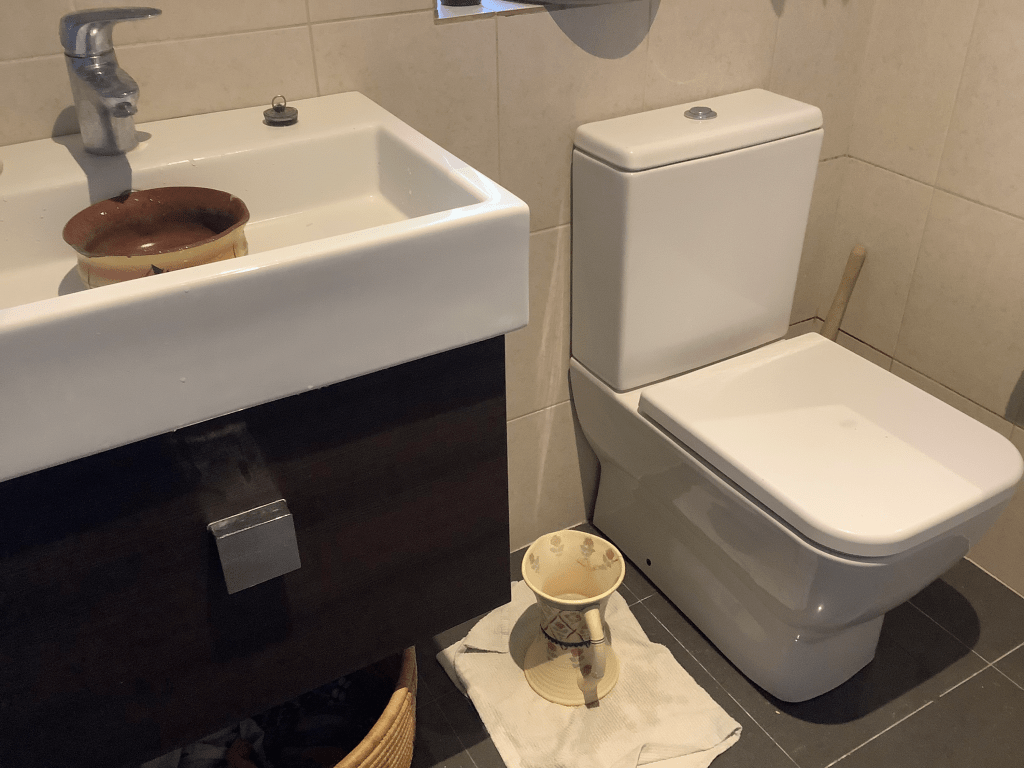
In our home, we collect hand wash water and use it to flush the toilet when ‘yellow’ and use the toilet flush when ‘brown’. 

 Counting on … day 354

20th October 2022

Again to conserve water, we recycle grey water. Water for hand washing collects in a bowl and is saved in a jug and/or flushed down the toilet. Water from flannel washes and from the hot water bottle are also recycled. At more expense you can install a tank, some form of water treatment and a pump to recycle the water to toilet cisterns and/ or a garden tap.