Weekly Green Tau

Taste and see – God is good!

1st August 2026

O taste and see that the Lord is good Psalm 34:8a

You Lord, are the source of all good things: 

We praise you.

You call us to tend and care for your creation: 

May we strive to do your will.

You have made us as brothers and sisters with all that lives: 

May we live together in peace.

A reading from Isaiah 55:1-3 (The Message translation)

Hey there! All who are thirsty,
    come to the water!
Are you penniless?
    Come anyway—buy and eat!
Come, buy your drinks, buy wine and milk.
    Buy without money—everything’s free!
Why do you spend your money on junk food,
    your hard-earned cash on cotton candy?
Listen to me, listen well: Eat only the best,
    fill yourself with only the finest.
Pay attention, come close now,
    listen carefully to my life-giving, life-nourishing words.
I’m making a lasting covenant commitment with you,
    the same that I made with David: sure, solid, enduring love.

A response:

Listen; attune your ears – what do you hear? 

The excited chatter of children,

and the chatter of jackdaws,

wind rustling the leaves,

and feet tapping the road.

Or the drone of cars – too much!

Or the whine of planes – too many!

Look; focus your vision – what do you see?

a lacework of branches against the sky,

and curvaceous clouds,

tawny shades of fallen leaves,

and the tight curl of a snail shell.

Or traffic crawling bumper to bumper – too much

Or discarded tatters of plastic – too many!

Stretch; bare your skin – what do you feel?

The warm caress of the sun, 

the chilly nip of the breeze,

the prickle of grass,

the textured bark of a tree

Or the rasp of exhaust in your throat – too much!

Or the scratch of particulates in your eyes – too many!

Sniff; breathe deeply – what do you smell?

The aroma of fresh coffee,

and the zest of orange juice,

the fragrance of the last rose,

and the warmth of ground spices.

Or the reek of petrol – too much!

Or the sting of pesticides – too many!

Savour; let it linger on your tongue – what do you taste?

The fresh acidity of an apple, 

and the earthy satisfaction of bread,

the squashy sweetness of banana,

and the melting delight of chocolate.

Or the fake sweetness of green wash – too much!

Or the gall of climate injustice- too many !

Merciful God, 

bring us to  our senses.

Help us rebuild a world 

of right experiences.

Amen.

Counting on … day 82

31st July 2026

Knowing where the stop cock for your water supply and the off switch for your electricity and gas supplies is sensible. In the event of a flood all three should be switched off.

The other sensible thing is to make sure they are working. We recently had a dripping tap. When we tried to turn off the water, we discovered the stopcock was not working. When we tried to turn off the water in the street we found that that too was not working! So first we had to get Thames Water to fix the stopcock in the street, and then a plumber to fit a new stopcock inside before we could tackle the tap!!!

Counting on … day 81

30th July 2026

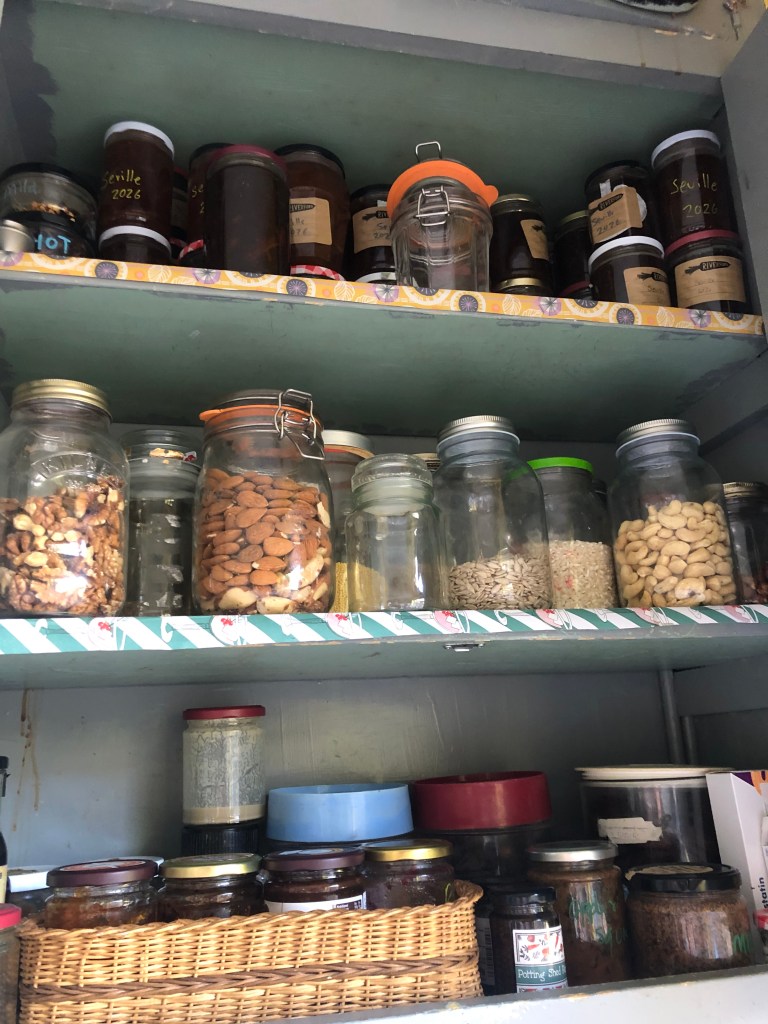
As well as keeping a supply of water to hand, we also keep a supply of food – against a situation where we can’t get to the shops for 3-7 days (which could have been the situation during COVID, but could cover a situation where say power cuts/ internet outages/ floods might disrupt food supplies).

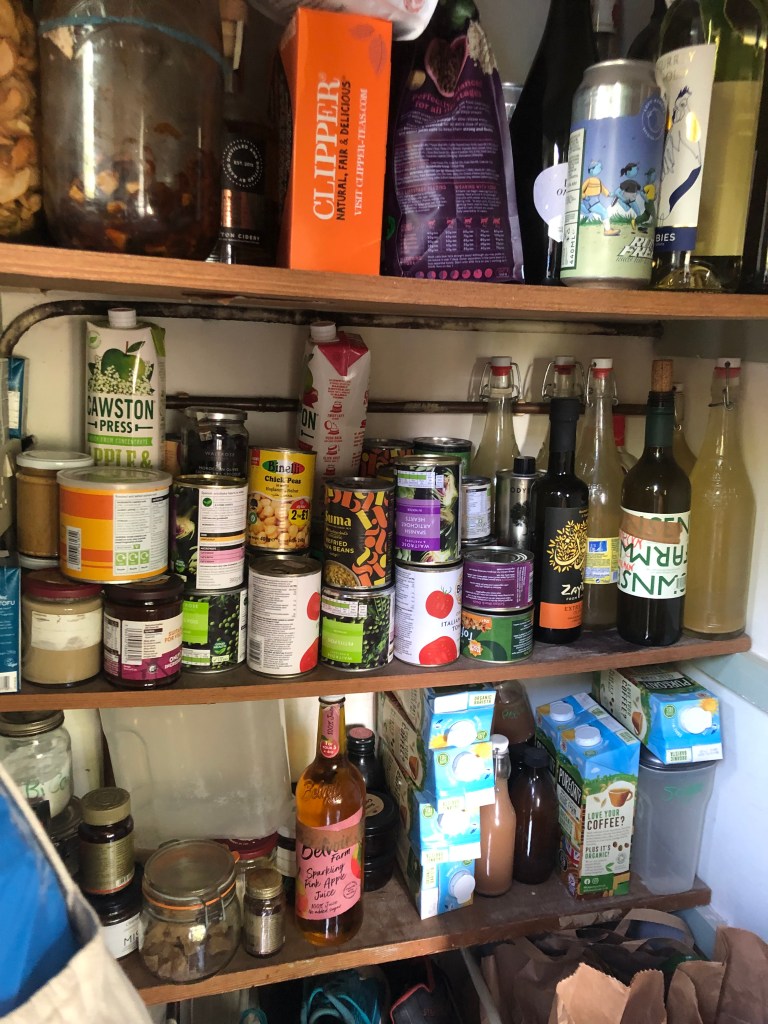
These supplies include dry goods like beans, flour, cereals; tinned foods; preserves such as bottled fruit, jam, chutneys; non perishables such as sugar etc. Having established enough for 3-5 days minimum, now when we use anything, we replace it so maintaining the supplies.

We also keep a 7 day supply of cat food which Hilda (our cat) says is absolutely essential!

Counting on … day 80

29th July 2026

Saving or conserving water is good at any time – emergency or not. 

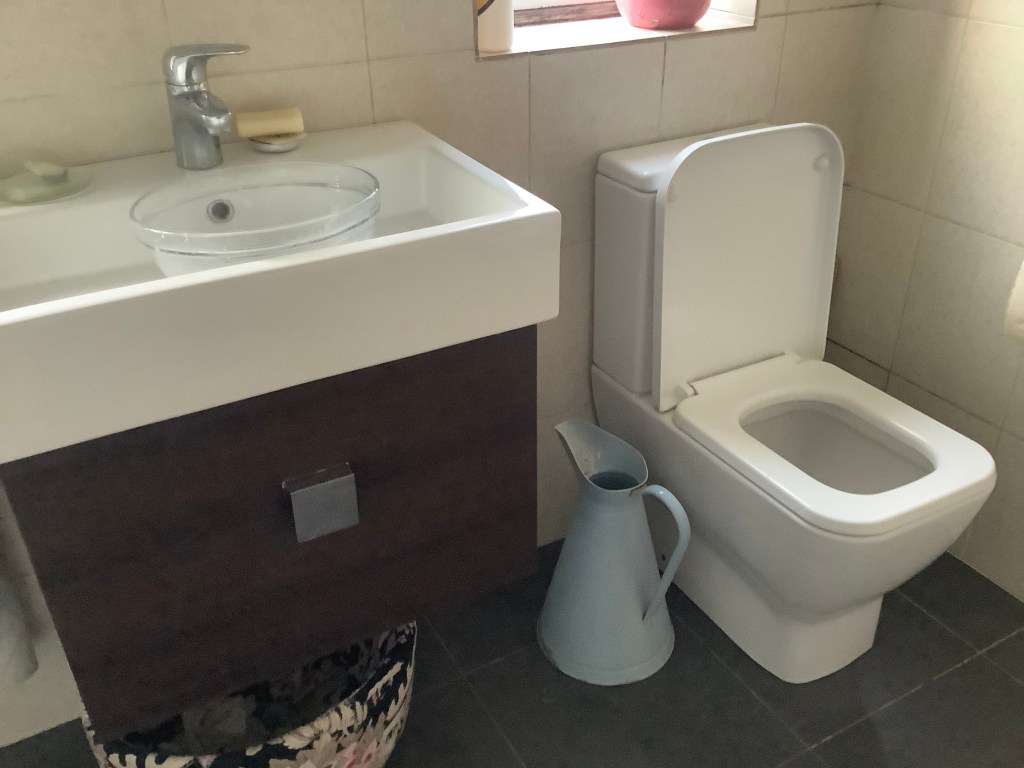
Some eco houses have proper grey water systems that collect waste water. We have a basin in each wash basin, and a jug on the floor. Water from hand washing is collected and is used to flush the toilet of poured in the jug for later toilet flushing. The toilet flush is used when a good flush is needed.

Counting on … day 79

28th July 2026

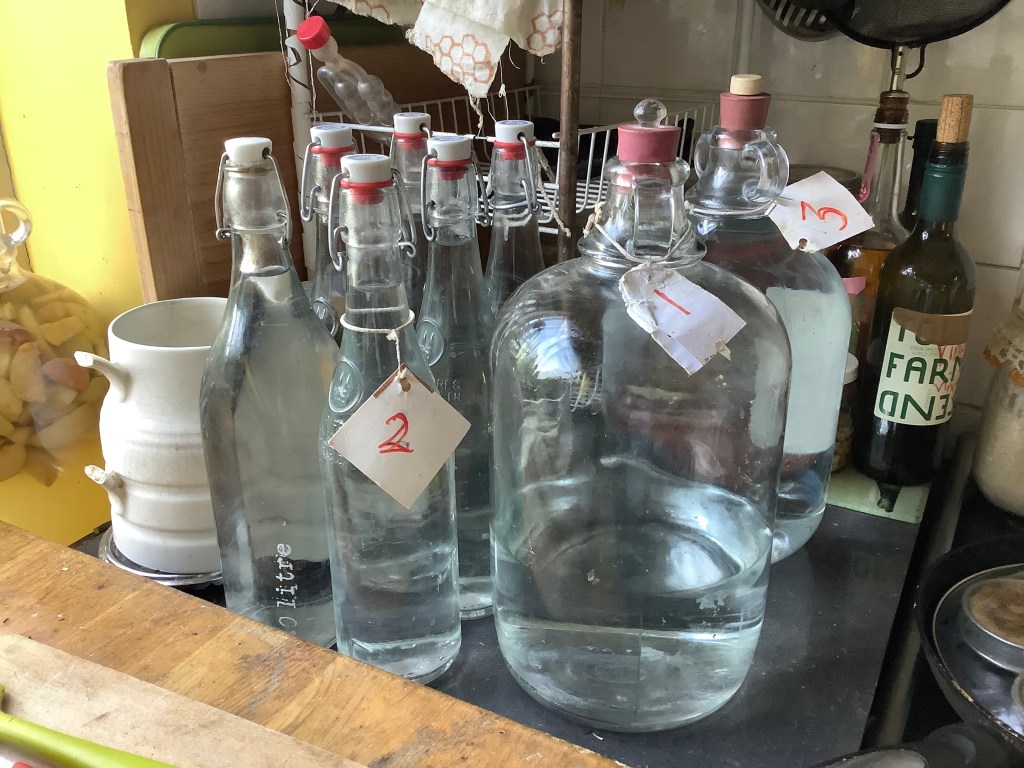
With a few to having a degree of resilience should a crisis cut off our supply of water, we keep stored about 12 -14 litres of water (for a household of three). Rather than opting for a stock of plastic bottled water, we use a mixture of glass bottles and Demi johns, refilling each as we empty them, and rotating them so that they don’t have water more than about a day old. 

We use the water for drinking, cooking and washing up. If the water supply was cut, we would use this bottled water purely for drinking and rely on the water in the header tank in the roof space for washing up etc.

Counting on … day 78

27th July 2026

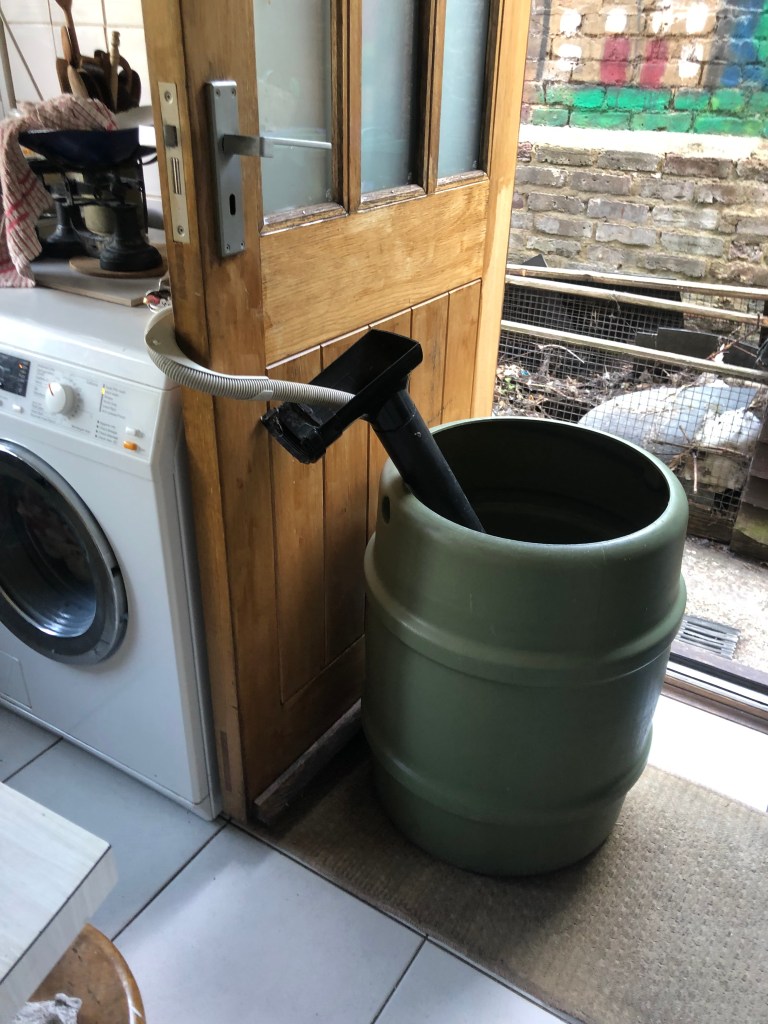
Collecting washing machine water for the garden.

Over the next few days I plan to share a few ways in which our household is trying to be more resilient in the face of the climate – and other associated -crises.

Last week Thames Water introduced a hosepipe ban which didn’t come as a surprise given a) how hot it has been and b) how little rain we have had these past few months. 

Routinely we try to minimise our use of water – water is a scarce and valuable resource. But now that our several water buts have run dry, we have moved one but so that we can use it to collect the water from the washing machine – 50 litres (5 buckets) per wash. At the same time we switched from us in a laundry liquid to an eco egg which produces less soapy water. This water is then used on plants in the garden – fruit bushes, squash plants, rhubarb etc. 

Green tau restoring biodiversity as part of the bigger picture

27th July 2026

“According to the Natural History Museum’s Biodiversity Intactness Index, the UK ranks 189th out of 240 countries and territories for how intact its nature and biodiversity remain. Just 53% of the UK’s original nature is left intact – far below the Index’s safe limit of 90% and the global average of 79%. Each of the four UK nations sits near the bottom of this ranking, with England at 47%, Northern Ireland at 50%, Wales at 51%, and Scotland at 56%.” (1)

Worryingly the government’s State of  Nature Report suggests this decline is still ongoing: “…more indicators are deteriorating or showing no change than improving, over both the long and short term.” And: “No indicators which are deteriorating in the long term, are showing improvement in the short term.” (2) 

19% Across the UK species studied have declined on average by 19% since 1970.

16% Nearly one in six species are threatened with extinction from Great Britain

151 of 10,008 species assessed have already become extinct since 1500 (3)

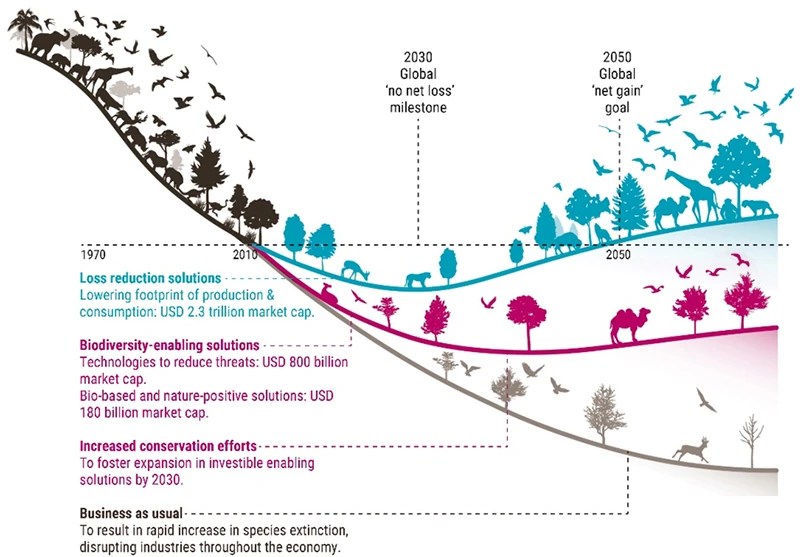
Scientists warn that if we don’t reverse this decline imminently – the Kunming Montreal framework target is protect 30% 2030  – it will become near impossible to reverse. 

https://www.robeco.com/en-uk/insights/2024/07/bending-the-curve-investing-in-biodiversity-as-an-economic-necessity

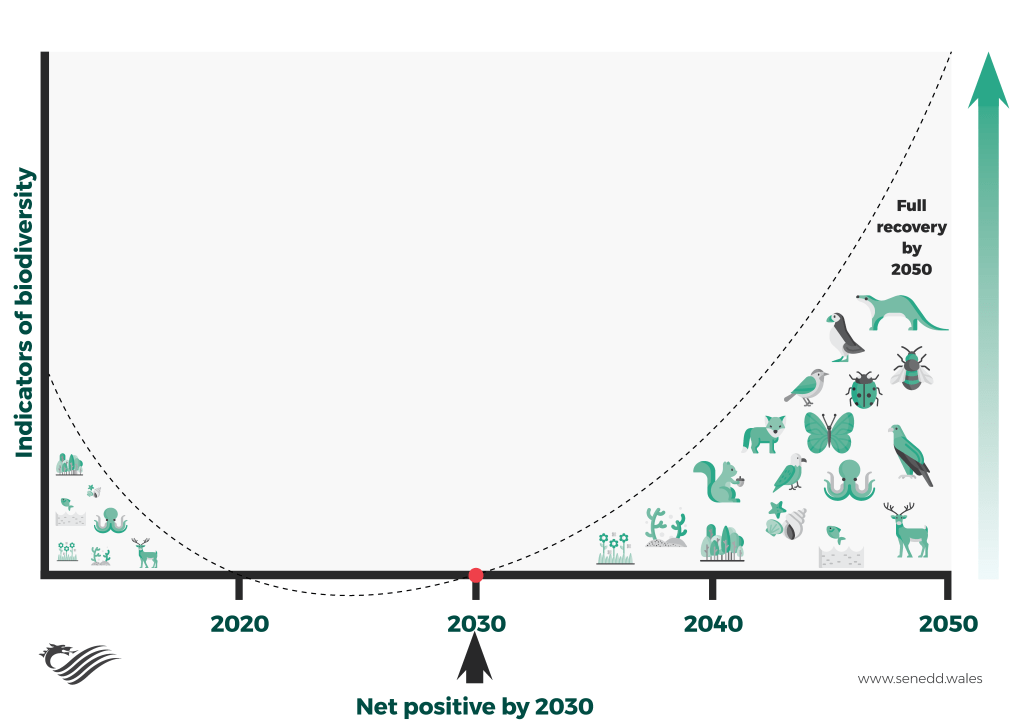
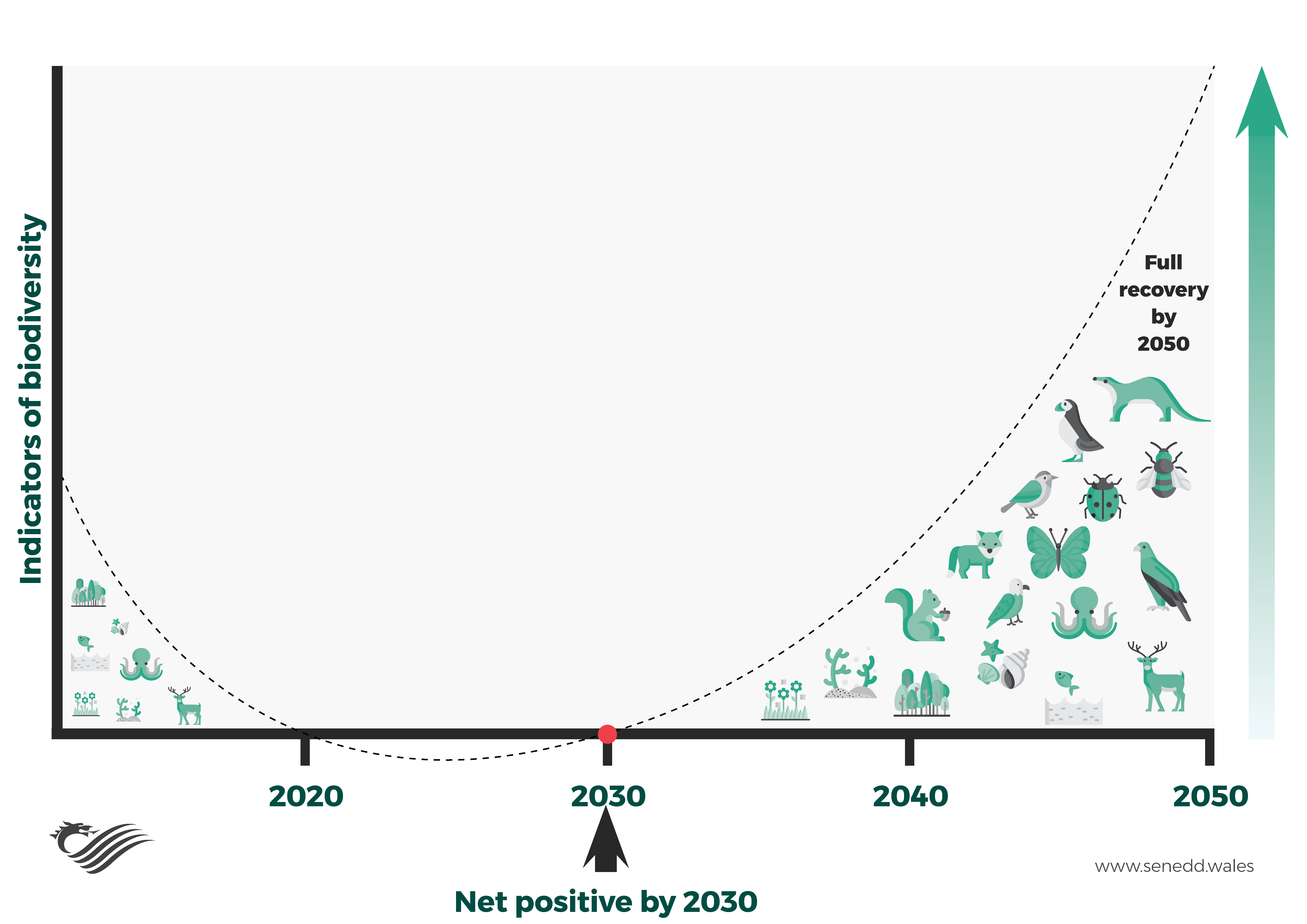
Conversely if we don’t manage to turn the tide by 2030, the prospects for improving biodiversity are good.  

To make a bit of a leap, I’m going to interpret increasing biodiversity as meaning restoring nature. But this too may not be clear cut. To restore nature could mean:  

https://research.senedd.wales/media/z4alhnt5/biodiversity-fig-2-en.png

“In simple terms, restoration means bringing more nature and biodiversity back across different ecosystems, from forests, peatlands and agricultural land, to freshwater, marine and urban ecosystems.

Restoration is a process of assisting the recovery of an ecosystem that has been degraded, damaged, or destroyed. This could be through rewetting wetlands and peatlands, improving degraded soil and agricultural land by adding natural features such as hedgerows and trees, recreating lost natural forests, removing invasive species, planting native vegetation, removing obsolete barriers from rivers, increasing tree coverage in cities, and much more.” (4)

It could mean restoring landscapes to their wild, pre-human state:-

“At Rewilding Britain, we define rewilding as the large-scale restoration of ecosystems to the point where nature is allowed to take care of itself. Rewilding seeks to reinstate natural processes and, where appropriate, missing species – allowing them to shape the landscape and the habitats within. It’s focused firmly on the future although we can learn from the past.

“Rewilding encourages a balance between people and the rest of nature so that we thrive together. It can provide opportunities for communities to diversify and create nature-based economies; for living systems to provide the ecological functions on which we all depend; and for people to reconnect with wild nature.

“Our vision is at least 5% of Britain rewilding, with 25% returned to broader mosaics of nature-friendly land and marine uses — including farming, forestry and fishing. We see this expansion reversing biodiversity loss and enabling nature to bounce back, helping us adapt to climate change as our complex ecosystems find their own answers.” (5)

Or it could be a pragmatic approach:-

  1. Restore nature now – the Government must honour its commitment to manage 30% of land for nature by 2030. That means designating more space for nature and paying our farmers properly to help nature thrive. 
  2. Defend nature and wildlife – stop weakening the laws that protect them. Introduce a strong Water Reform Bill to clean up our rivers, streams and seas, and make polluters pay.  
  3. Build places to be proud of – demand that neighbourhoods are rich in nature and end unfair access to green space, starting by publishing the Government’s long-promised action plan by the end of the year. (6)

However what I want to suggest is that however we set about restoring nature and reversing biodiversity loss, we cannot address this issue in isolation. If we consider why biodiversity has been in such sharp decline, why it is that we have lost to so much of our natural environments, we will see that these losses are linked to:-

  • Expansion of the built environment where buildings, roads and other transport links, mines and quarries, have encroached on land where nature previously existed. Many species are in decline because their habitats are disappearing.
  • Pollution from smoke (causing acid rain), from vehicles exhaust pipes, from industrial processes, and  the run off from farms of slurry, fertilisers etc. 
  • From intensive farming where large fields have resulted in the loss of trees and hedgerows that once provided essential habitats for many species, and the proliferation of monocultures which do not support a diversity of other life forms.
  • Replacing mixed broadleaf woodlands with monocultures of coniferous plantations.
  • Overgrazing of uplands and the replacement of meadows with grass monocultures suited purely for grazing cattle – again reducing habitats for other species.
  • Increasing use of pesticides and herbicides that do what it says in the tin – kills insects and plants.
  • Intensive cultivation of the soil destroying its natural structures and resident populations of insects, grubs, fungi and micro-organisms – and requiring their substitution with fertilisers to maintain the fertility of the soil.
  • Climate change which is human-induced and which has depleted native species who have been unable to adapt or to adapt fast enough to the increasing heat/ floods/ droughts and wildfires.

Unless we can address these issues to, no amount of planting native trees, or sowing wildflower meadows, or reintroducing lost species, is going to work. Restoring nature and improving biodiversity has to involve us in reviewing and reforming our whole way of living. 

For example, we need to review the way we farm and therefore what we eat. Our current agricultural system is designed to produce increasing amounts of meat and dairy, with the parallel need to produce – or import – more  animal feed, which necessitates the intensive farming methods that are widespread. If we wish to reduce that scale and intensity of livestock production we need to eat less meat and dairy products and instead adopt diets that are rich in tasty, diverse UK grown fruits, vegetables, nuts and beans. 

We may want to look at how land is farmed. Would it be better for nature – and for us as communities – if we had more smaller farm units, employing more people and less heavy equipment? Would it be better to have more hedgerows, more ponds and pockets of woodland? Would it be better to have more publicly accessible green spaces? 

Yes there would be a cost – food prices would go up – and that might mean reducing the lower rates of taxation, but that cost would surely be less than the costs of the continued loss of biodiversity and the resulting negative impact on climate change, on floods and droughts, on the fertility of the soil, on clean air and clean waterways, and of the loss of essential pollinators leading to depleted harvests. 

These are all serious issues that we need to consider as a society and which we need to address collectively.

  1. https://policy.friendsoftheearth.uk/insight/how-britain-became-one-most-nature-depleted-countries-world

(2) ditto

(3) https://stateofnature.org.uk/

(4) https://www.restorenature.eu/en/faq-on-nature-restoration#What is nature restoration

(5) https://www.rewildingbritain.org.uk/why-rewild/what-is-rewilding/an-introduction-to-rewilding/defining-rewilding

(6) https://www.nationaltrust.org.uk/our-cause/nature-climate/nature-conservation/nature-is-our-future

Proper 12, 8th Sunday after Trinity 

26th July 2026

Reflection with readings below

I do realise that my reflections may be deemed to minimalise or skip over tough words that are presented to us in the Gospels. But there are some which I feel cannot be taken at their face value as they run counter to the overriding gospel message that God loves us unceasingly and unconditionally, that everything that God has created is good, is blessed and is of value – and therefore God will not hate nor destroy. 

Indeed in the letter to the Romans, we have the famous words of Paul: “that neither death, nor life, nor angels, nor rulers, nor things present, nor things to come, nor powers, nor height, nor depth, nor anything else in all creation, will be able to separate us from the love of God in Christ Jesus our Lord.” 

What the scriptures do reveal is how easily we humans can make mistakes, how easily we can separate ourselves from God’s wisdom – ie that which we find in God’s word,  God’s law and in studying the Book of Nature. When we ignore this wisdom and pursue a different path – often one that seeks self gratification rather than the common good (and here we should remember common includes human and non human interests) –  then suffering and destruction ensues.

The need for God’s wisdom is clearly articulated in today’s readings. It is God’s wisdom that will embed God’s kingdom here in earth as in heaven. In today’s gospel Jesus gives us a series of images or metaphors by which to imagine the kingdom of heaven. The first four delight our imagination.

The kingdom of heaven is something that will grow beyond our expectations! It will become home to more than we can imagine. 

In the kingdom of heaven small things cause huge changes.

The kingdom of heaven once encountered will become our heart’s desire.

The kingdom of heaven is beyond value.

But the fifth parable, that of the net cast into the sea? How do we make sense of it? 

Parables do not have a fixed meaning, but rather niggle at our thought processes time and again, often challenging our traditional view points. Is the kingdom of God the net or the sea? That’s one ambiguity! If the latter, then why the net and vice versa? What do the fish represent?

Does this parable mirror that of the parable of the wheat and tares? Might the sea, like the field, be the space where ‘good’ and ‘bad’ behaviour co-exist in the short term – but where ultimately only good behaviour (that which is in line with God’s wisdom) will prevail. As I reflected last week, sometimes actions to do what is right, are curtailed by systems which currently prohibit or reduce the scope to do what is right.

Seeing the ‘bad fish’ as systems and practices that are not aligned with God’s wisdom that will ultimately be ‘cast out’  maybe a useful reading of this parable. Certainly until we loose such systems and practices, we cannot claim that God’s kingdom has come on earth as in heaven. 

Jesus’s final words point to the importance of people who have studied and focused their attention on learning God’s wisdom so that the whole household – the whole community – can benefit. Such learning and the sharing of such knowledge is critical in supporting and enabling the incoming of the kingdom of God. Improving our knowledge and using it to transform unjust systems – even of our actions seem as small a scrap of yeast – is our challenge as followers of Jesus.

1 Kings 3:5-12

At Gibeon the Lord appeared to Solomon in a dream by night; and God said, “Ask what I should give you.” And Solomon said, “You have shown great and steadfast love to your servant my father David, because he walked before you in faithfulness, in righteousness, and in uprightness of heart toward you; and you have kept for him this great and steadfast love, and have given him a son to sit on his throne today. And now, O Lord my God, you have made your servant king in place of my father David, although I am only a little child; I do not know how to go out or come in. And your servant is in the midst of the people whom you have chosen, a great people, so numerous they cannot be numbered or counted. Give your servant therefore an understanding mind to govern your people, able to discern between good and evil; for who can govern this your great people?” 

It pleased the Lord that Solomon had asked this. God said to him, “Because you have asked this, and have not asked for yourself long life or riches, or for the life of your enemies, but have asked for yourself understanding to discern what is right, I now do according to your word. Indeed I give you a wise and discerning mind; no one like you has been before you and no one like you shall arise after you.” 

Psalm 119:129-136

129 Your decrees are wonderful; *
therefore I obey them with all my heart.

130 When your word goes forth it gives light; *
it gives understanding to the simple.

131 I open my mouth and pant; *
I long for your commandments.

132 Turn to me in mercy, *
as you always do to those who love your Name.

133 Steady my footsteps in your word; *
let no iniquity have dominion over me.

134 Rescue me from those who oppress me, *
and I will keep your commandments.

135 Let your countenance shine upon your servant *
and teach me your statutes.

136 My eyes shed streams of tears, *
because people do not keep your law.

Romans 8:26-39

The Spirit helps us in our weakness; for we do not know how to pray as we ought, but that very Spirit intercedes with sighs too deep for words. And God, who searches the heart, knows what is the mind of the Spirit, because the Spirit intercedes for the saints according to the will of God.

We know that all things work together for good for those who love God, who are called according to his purpose. For those whom he foreknew he also predestined to be conformed to the image of his Son, in order that he might be the firstborn within a large family. And those whom he predestined he also called; and those whom he called he also justified; and those whom he justified he also glorified.

What then are we to say about these things? If God is for us, who is against us? He who did not withhold his own Son, but gave him up for all of us, will he not with him also give us everything else? Who will bring any charge against God’s elect? It is God who justifies. Who is to condemn? It is Christ Jesus, who died, yes, who was raised, who is at the right hand of God, who indeed intercedes for us. Who will separate us from the love of Christ? Will hardship, or distress, or persecution, or famine, or nakedness, or peril, or sword? As it is written,

“For your sake we are being killed all day long;
we are accounted as sheep to be slaughtered.” 

No, in all these things we are more than conquerors through him who loved us. For I am convinced that neither death, nor life, nor angels, nor rulers, nor things present, nor things to come, nor powers, nor height, nor depth, nor anything else in all creation, will be able to separate us from the love of God in Christ Jesus our Lord. 

Matthew 13:31-33,44-52

Jesus put before the crowds another parable: “The kingdom of heaven is like a mustard seed that someone took and sowed in his field; it is the smallest of all the seeds, but when it has grown it is the greatest of shrubs and becomes a tree, so that the birds of the air come and make nests in its branches.” 

He told them another parable: “The kingdom of heaven is like yeast that a woman took and mixed in with three measures of flour until all of it was leavened.”

“The kingdom of heaven is like treasure hidden in a field, which someone found and hid; then in his joy he goes and sells all that he has and buys that field.

“Again, the kingdom of heaven is like a merchant in search of fine pearls; on finding one pearl of great value, he went and sold all that he had and bought it.

“Again, the kingdom of heaven is like a net that was thrown into the sea and caught fish of every kind; when it was full, they drew it ashore, sat down, and put the good into baskets but threw out the bad. So it will be at the end of the age. The angels will come out and separate the evil from the righteous and throw them into the furnace of fire, where there will be weeping and gnashing of teeth. 

“Have you understood all this?” They answered, “Yes.” And he said to them, “Therefore every scribe who has been trained for the kingdom of heaven is like the master of a household who brings out of his treasure what is new and what is old.”
Be with us God, show us the way

25th July 2026

“Never have we so hurt and mistreated our common home as we have in the last 200 years. We are not God. The Earth was here before us and was given to us. The exploitation of the planet has already exceeded acceptable limits and we still have not solved the problem of poverty. We must regain the conviction that we need one another, that we have a shared responsibility for others and the world, and that being good and decent are worth it.” Pope Francis, Laudate Si

When I am tempted to meanness,

Show me your ways, O God,

and teach me your paths.

When I fail to care for your creation,

Show me your ways, O God,

and teach me your paths.

When I am too busy to stand and stare,

Show me your ways, O God,

and teach me your paths.

From Rhythms of Remembering, Hannah Ward and Jennifer Wild, with permission 

Pause for reflection

“But ask the animals what they think—let them teach you;
    let the birds tell you what’s going on.
Put your ear to the earth—learn the basics.
    Listen—the fish in the ocean will tell you their stories.
Isn’t it clear that they all know and agree
    that God is sovereign, that he holds all things in his hand—
Every living soul, yes,
    every breathing creature?
Isn’t this all just common sense,
    as common as the sense of taste? Job 12:7-11

To know you in all things –

Weave a web of your presence around us today.

Be with our hands as they work.

Be with our eyes as they see.

Be with our ears as they hear.

Be with our  tongue as it speaks.

Be with our feelings and our thoughts.

Be with the people we meet.

Be with the trees we walk by and the grass we walk upon.

Be with the birds we hear and the creatures we see.

Be with the things we make and the things we take.

Be with the decisions we address.

Be in and through, over and under all,

so that doing and hearing and seeing, speaking and making and being,

we may glimpse your glory, hear your voice

and joyfully work with you

to create a new heaven and a new earth.

May the Grace of our Lord Jesus Christ 

and the love of God,

and the fellowship of the Holy Spirit 

be with us all.

Amen

Green Tau: Ecosystems, Biodiversity and Sustainability 

24th July 2026

When ecosystems flourish they are rich with biodiversity. Conversely diminishing biodiversity causes ecosystems to fail. Currently biodiversity globally is in decline. In 2022 world leaders met to address this issue and the outcome was the Kunming-Montreal Global Biodiversity Framework (GBF). The headliner was that the national signatories undertook to restore for nature 30% of land and of sea by 2030 – abbreviated to 30by30. This is a huge undertaking – a highly necessary one – but perhaps not surprisingly it is something nations now struggle to meet. 

The whole planet is one large ecosystem in which water flows, plants grow, fish swim, birds fly, carbon  circulates, rocks erode etc etc. Is this a thriving ecosystem? Nine key measures  have been identified by which to assess  the  health of the earth’s ecosystem – and are known as planetary boundaries. One of these boundaries measures fresh water. If we consumer such water at a slower rate than it is replenished by the earth’s ecosystem, we can be assessed as living within the limits of that planetary boundary. If we consume fresh water at a faster rate, then we are assessed as living beyond the limit of that boundary. Not only is this (and we have indeed exceeded this planetary boundary) damaging to the earth’s ecosystem it is also threatens our survival too (or rather the survival of the most vulnerable people). 

The other eight boundaries are – climate change, biosphere integrity (which assesses both biodiversity levels and the rate at which we extract resources such as timber, cereals etc), landuse change (balance between natural and human use), nutrients (particularly nitrogen and phosphorus), ocean acidification, aerosols in the atmosphere, ozone depletion, pollution of novel entities (manmade compounds such as plastics). Of these nine planetary boundaries, we are now living beyond the safe limits of seven – only with respect to ozone depletion and aerosol levels in the atmosphere, are we living within safe limits.

What we also know is that these nine areas are interconnected. Accelerating climate change adversely impacts biodiversity and freshwater systems. Out of balance landuse impacts both climate change and biodiversity. And so on. 

However we have so often seen ourselves as humans as being above and outside these ecosystems. We are the ones who instead control  and manipulate ecosystems to maximise our gains. We are the ones who determine what is good for humans and what is not, who select what should grow and what should be uprooted, who take without giving back. It is this failure to see ourselves as part of and dependent on the multiple layers of ecosystems, that has brought us to situation where we are living outside the safe boundaries of the planet.

Another way of viewing this is by looking at the date of Earth Overshoot Day. This day marks the point in the calendar when we have used up a year’s worth of the planets renewable resources (eg freshwater, clean air, fish, timber ……..) This year Earth Overshoot Day is July 30th. After that we are living in the red. This means for example, vis a vis freshwater, that we will be drawing on our capital of fresh water – water taken from aquifers that cannot be replaced. This means that some people will live with inadequate water supplies, and their crops and livestock will die. This means that wild animals, birds and insects will die.

If this were a financial  issue, we would be obliged to pull in our horns, to spend less and save more. But as we don’t pay – financially for many of these goods and services – there doesn’t seem to be any formalised way in which the global community is addressing this debt crisis. We should also note that this debt is not being shared equally. A large number of the people from the poorest and most remote  communities  are bearing the bulk of the pain, whilst a far small number of people are continuing to live ever increasing lives of wealth – lives, in effect, of decadence. Where do I fit in? It could be as a middle class white western person be in the latter group.

To return to the 30by30 target, it seems obvious that it cannot be tackled in isolation but needs to be part of lifestyle revolution that recognises and works with the understanding that all ecosystems are interdependent and that humans are just one feature of each ecosystem of which they are a part.  I don’t think this observation makes the challenge any easier but it would ensure a greater likelihood that any policies of reform would actually work.

I don’t know of any country that is taking a wholistic approach. Here in the UK the likelihood that we will restore biodiversity to safe, sustainable levels by 2030 seems highly unlikely. Not least because it is not being approached as part of a national ecosystem. 

For example, to restore 30% of land such that nature can flourish, cannot happen without also looking at landuse – how much land can we safely use to graze livestock and grow fodder, as well as growing enough grain, fruit and vegetables to feed our population? If – as we would – have to reduce us the amount of land used to produce meat and dairy products, will we also look at our diets? Will we switch to a diet rich in plants and low in meat and dairy? 

Again will we at the same time look at how we use water? Changing how we use the land could have a positive impact on our use of fresh water supplies. But we should at the same time look at how water is used by industries, and especially by data centres. Conversely will we note that restoring nature across wide tracts of land will improve water retention by the land, improve flood resilience, reduce loss of water via evaporation during heat waves etc? Will we note that restoring nature across wide tracts of land will improve access to green spaces which we know improves mental and physical wellbeing?  Will we note that plant rich diets will significantly improve people’s health? 

It is surely within the capacity of human kind to restore a right relationship with the planet’s ecosystems such that not just our lives but the lives of those with whom we share this planet, can flourish sustainably?