Green Tau Reflection

Good Friday 2022

Ignorant, blinkered or obtuse?

19 Then the high priest questioned Jesus about his disciples and about his teaching. 20 Jesus answered, ‘I have spoken openly to the world; I have always taught in synagogues and in the temple, where all the Jews come together. I have said nothing in secret. 21 Why do you ask me? Ask those who heard what I said to them; they know what I said.’ 22 When he had said this, one of the police standing nearby struck Jesus on the face, saying, ‘Is that how you answer the high priest?’ 23 Jesus answered, ‘If I have spoken wrongly, testify to the wrong. But if I have spoken rightly, why do you strike me?’ John chapter 19

I studied this passage with my Lent group. Jesus rightly tells the high priest, and those in authority with him, that he has spoken openly and that if anyone had wanted to know what he was teaching, they would only have to pay attention. It’s clear from the gospel that both Jesus’s, and, before him, John the Baptist’s, activities have been followed by those in authority. The puzzling question is why is it that those in authority, those who have lived and worked – and worshipped – within the religious establishment, do not realise who Jesus is and do not understand the message of his teaching? 

  • Are they ignorant? In terms of facts, no they cannot be ignorant. Jesus has been teaching openly, and they themselves have been following him. 
  • Are they ignorant in terms of understanding? Do they simply not understand what the facts mean? Do they simply not understand that Jesus is ‘of God’, as a son to a father, and that what he teaches comes straight from God?
  • Are they blinkered? Are they so sure that God cannot inhabit human form, that their minds and eyes are closed to any such possibility? There are certainly many examples of people and cultures that blinkered. In the 19th century explorers who came across the bronze sculptures of Benin, could not imagine that an African could have created such art works and therefore they must have been the work of a lost civilisation. At the same time many women who wished their writing to be accepted, has to assume a male pseudonym.
  • Are they so enmeshed in a culture and system – largely of their own making – that they cannot see or imagine any different way of doing things? Does this culture and system so embrace every part of their life, their past and their future, that there is no room for any alternative?
  • Are they self righteous? Are they so sure that they are right, that their understanding of the world and their interpretation of what is happening is right, that they cannot envisage an alternative view point?
  • Are they obtuse? Do they just not want to hear or believe or countenance anything that involves change?

When Jesus is then brought before Pilate, it seems as if Pilate is at least willing to explore what it is that Jesus represents, what it is that he is about. Pilate does at least lift the edge of the curtain so as to speak, to see what might be happening. Then the opportunity becomes engulfed in matters that Pilate finds more pressing. The discussion is foreclosed. 

The story of Good Friday tells us whilst the obstinacy, the short sightedness and narrow mindedness of those in authority led directly to Jesus’s execution, God’s capacity for salvation exceeded everyone’s dreams. 

God’s kingdom, God’s rule, is present here and now on earth for those who wish to be part of it, yet complete salvation is still a work in progress, and humanity faces many trials and ills. One of the most pressing is the climate crisis. With only a handful of years grace remaining before catastrophes overwhelm us, we sense we have a last chance to transform the ways in which we live so as to truly care for one another and the whole of creation. The message seems so clear. The message has been so oft repeated. The route maps to safety so clearly plotted. How is it then that those in authority do not understand, do not respond, do not take action? How can they be so obstinate, so obtuse, so short sighted? 

Must we brace ourselves for further tragedy? Is our only consolation that Christ will be with us? Let us pray and act for change. Let us strive for conversion. 
Lent Reflection

14th April 2022

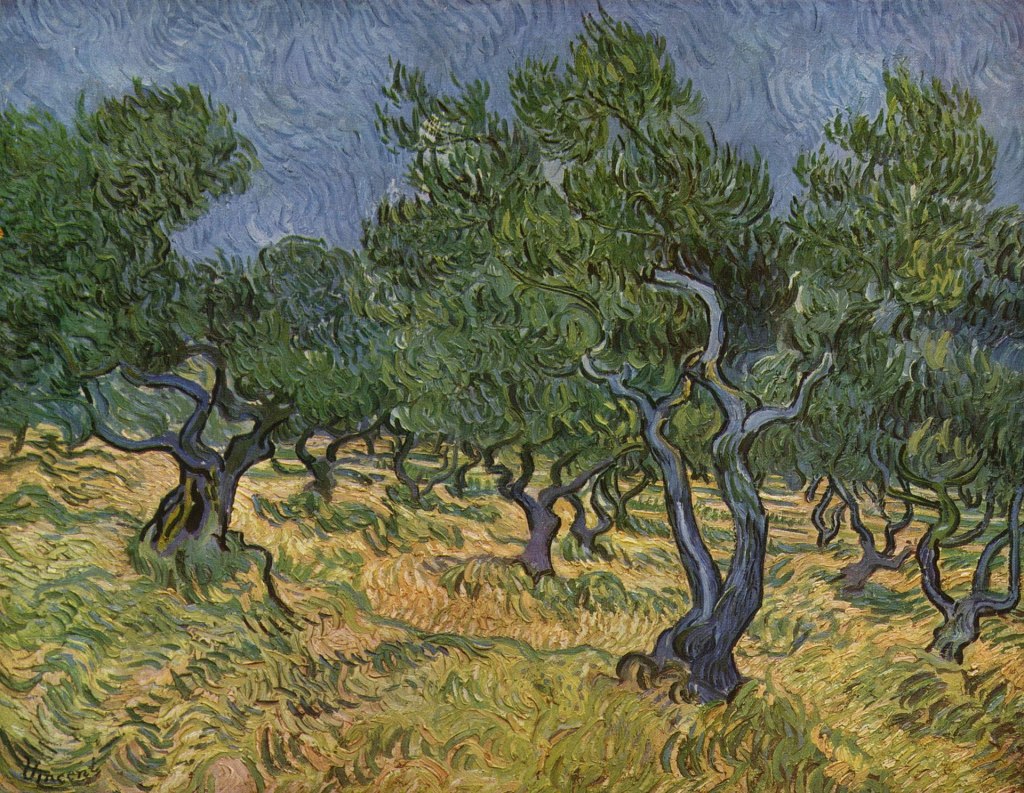
Olive Orchard mid-June 1889 Kröller-Müller Museum, Otterlo, Netherlands

The olive tree – olea europaea – is an evergreen tree growing to a height of 15m, and a life span of 1000 or even 2000 years! It is a native of the Mediterranean and surrounding areas and has been cultivated here since ancient times. It is grown for its fruit and for the oil that produces; the word oil itself derives from its name – oleum in Latin and elaia in Greek. Olive oil has many uses, for cooking, lighting, cleansing and medicinal purposes, for massage and for coating the bodies of athletes in Ancient Greece. It has long been used too for sacred purposes to annoying holy people and holy places. It symbolises abundance, prosperity and peace. Olive branches were given as tokens of benediction and victory, and wreathes of olives leaves crowned the victors. Olive oil is still used for anointing baptism candidates, priests and monarchs.

On the night he was betrayed, Jesus went out to the garden of Gethsemane in the Mount of Olives to pray. Then Jesus said, ‘Father, forgive them, for they know not what they are doing.’ Luke 23:34a

The three most powerful resources you have available to you: love, prayer and forgiveness. 

H Jackson Brown Jr

 Counting on …day 150

13th April 2022

We have just invested in a Rework recycling box for all our otherwise un-recyclable plastic. We will continue to use our kerb side recycling bin for plastic pots and bottles, the soft plastic recycling facility at the Coop, toothpaste tubes at Boots, but this box will be for all the other plastics we cannot otherwise recycle. We can even use it for lateral flow test kits. It should reduce our landfill to nil. 

Lent Reflection

13th April 2022

https://en.wikipedia.org/wiki/Cercis_siliquastrum#/media/File:PikiWiki_Israel_3421_Geography_of_Israel.jpg

The Judas tree – cercis siliquastrum – is a small tree, growing up to 12m whose ranges extends from Southern Europe to Western Asia. It was common in Israel, and its French name ‘arbre de Judée‘,  may give rise to its English name. Other suggestions are that it is so named because Judas hung himself on  this tree. It bears bright pink blossoms in spring which appear before its leaves, which are heart shaped. In the autumn it produces flat seed pods – the seeds themselves are poisonous. The pods are said to resemble a weaver’s shuttle, which in Greek is ‘kerkis’ which gives rise to its botanical name.

Forgive our sins, as we forgive those who sin again us. And do not let us yield to temptation. 

Luke 11.4

For there to be betrayal, there would have to have been first trust. Suzanne Collins, Hunger Games

Lent Reflection

12th April 2022

https://commons.wikimedia.org/wiki/File:Pistacia_palaestina.JPG

The terebinth tree – pistacia terebinthus – is also known as the turpentine tree. It grows to a height of 10m and is a tree of the Mediterranean region. It can love for up to 1000 years, if not disturbed. It is a deciduous tree with glossy leaves, purplish-red flowers and brownish-red pea-like fruits. The whole plant emits a strong odour variously described as bitter or medicinal. It certain,y has many medicinal uses including treating coughs and asthma. It is used to flavour spirits, oils, and bread. It’s leaves are edible and its fruits can be roasted like coffee beans. Turpentine can be produced from its resin, whilst a sweet gum can be made from its bark.

In Hebrew it is named ‘elah’ and ‘elot’ in the plural as opposed to the oak which is named ‘alon’. Often in English translations both words are translated as oak. Although the two types of tree are in many respects very different, the terebinth is, like the oak, said to symbolise strength and endurance. 

So Abram moved his tent and came and settled by the terebinths of Mamre, which are at Hebron, and there he built an altar to the LORD. Genesis 13:18 

To all who mourn in Israel, he will give a crown of beauty for ashes, a joyous blessing instead of mourning, festive praise instead of despair. In their righteousness, they will be like great terebinths that the LORD has planted for his own glory. Isaiah 61:3

Counting on …day 149 

12th April 2022

It may not look much, but I was glad I was wearing my cycle helmet when I collided head on with a car. It took sufficient of the impact to allow me to leave hospital 24 hours later with just a cracked vertebra. 

Safety helmets were designed to protect us in case of accidents. And as accidents do happen, we should always wear them. 

Lent Reflection

11th April 2022

Almond Blossom Bloom Castle Blossom Almond Trees http://www.maxpixel

The almond tree – Prunus amygdalus – is native to the Levant. Its fruit (technically a drupe rather than a nut) is edible. It is said to have been one of the first fruit trees to be cultivated, possibly because it can be grown from seed – no skills in grafting are needed. The tree grows to a height of between 4 and 10m. Its is one of the first trees to produce blossom in the spring and is therefore also associated with new life. 

In Hebrew the word for almond  ‘shaqad’, also has the meaning of watchfulness. When Jeremiah sees the flowering almond, God says that it is a sign that God is watching,  ready to fulfil his word. (Jeremiah 1:11-12)

The steadfast love of the Lord never ceases; his mercies never come to an end; they are new every morning; great is your faithfulness. Lamentations 3:22-23 

In the Bible, the Lord says: I am like the flower of the almond. Why? Because that is the first flower to blossom in the spring. He is always the first! This is fundamental for us: God is always ahead of us! When we think about going far away, to an extreme outskirt, we may be a bit afraid, but in fact God is already there. Pope Francis, The Church of Mercy

Lent Reflection

9th April 2022

In the UK the broom is considered a shrub rather than a tree and in its cultivated forms has decorative yellow and red blooms. Native to North Africa and the Middle East is another member of the broom family known as the retama broom. The retama raetam or white weeping broom, grows to a height of 3m and up to 6m in spread. As well as being able to photosynthesise through its leaves, it can also photosynthesise through its stem which enables it to grow in hot, dry conditions. Its fruits (pea-like) and flowers provide food for goats, and its branches have been used as fuel since ancient times. Its deep roots help stabilise sandy soils.

In the Jewish tradition, the tree under which Hagar leaves Ishmael to die, for they had run out of water, is said to be the broom tree. It is also the broom tree (although alternatively it is said to have been a juniper tree!)  under which the despairing Elijah also lies down having fled from Jezebel’s murderous rage. Both Hagar and Elijah then receive refreshment from God. The broom tree is thus said to symbolise renewal.

Create in me a clean heart, O God, And renew a steadfast spirit within me. Psalm 51:10

Source: https://bible.knowing-jesus.com/topics/Renewal

“What is the scent of water?” “Renewal. The goodness of God coming down like dew.” Elizabeth Goudge, The Scent of Water