Counting on … day 61

7th March 2024

“The International Energy Agency Agency (IEA) is a Paris-based autonomous intergovernmental organisation, established in 1974, that provides policy recommendations, analysis and data on the global energy sector. The 31 member countries and 13[1] association countries of the IEA represent 75% of global energy demand… The core activity of the IEA is providing policy advice to its member states and Associated countries to support their energy security and advance their transition to clean energy.[3] Recently, it has focused in particular on supporting global efforts to accelerate clean energy transition, mitigate climate change, reach net zero emissions, and prevent global temperatures from rising above 1.5 °C.” (https://en.wikipedia.org/wiki/International_Energy_Agency)

It seems strange that the membership does not include any of the oil states from the Middle East, and very few African nations who surely have an equally vested interest in energy security. 

Back in 2021, the IEA declared that the exploitation and development of new oil and gas fields must stop if the world was to stay within safe limits of global heating and meet the goal of net zero emissions by 2050. It is thus worrying that so many countries and so many companies have since then continued to grant licences and develop new oil and gas fields. The UK’s current government is even proposing to increase the frequency with which it issues new licenses!

This message was reinforce in 2023 when, having noted the strong growth in clean energy provision, the IEA reported that whilst there was no longer a need to maintain current investment levels in fossil fuels, investment in oil and gas was in fact twice what would be necessary to achieve net zero emissions targets. (https://origin.iea.org/reports/world-energy-outlook-2023)

On the plus side, the IEA’s report of March this year on clean energy, notes: “The deployment of solar PV, wind power, nuclear power, electric cars, and heat pumps from 2019 to 2023 avoids around 2.2 billion tonnes (Gt) of emissions annually. Without them, the increase in CO2 emissions globally over the same period would have been more than three times larger.” (https://www.iea.org/reports/clean-energy-market-monitor-march-2024

Counting on … day 62

8th March 2024

“Energy Efficiency improves when a given level of service is provided with reduced amounts of energy inputs or services are enhanced for a given amount of energy input.

“Energy Intensity is measured by the quantity of energy required per unit output or activity, so that using less energy to produce a product reduces the intensity.” (https://www.energy.gov/eere/analysis/energy-efficiency-vs-energy-intensity)

Improving energy efficiency has been one way of reducing carbon emissions. At the household level, this has – and is – through improving the insulation of our homes so we need use less energy to keep them warm; through using more energy efficient appliances (++A washing machines for example) and low energy light bulbs. Cars too have become more energy efficient over the decades so that petrol cars can achieve 60mpg in urban conditions whereas in the past those figures would have been in the low tens. However the benefits of improving energy efficiency has often be lost as manufacturers have geared up to make and sell bigger cars, more powerful domestic appliances, or more frequent upgrades encouraging replacement purchases.

Energy efficiency is only of value if it leads to less energy being used and less pollution emitted. 

Green Tau: issue 89

6th March 2024

Drax and the tree of knowledge of good and evil.

Earlier this week I joined an action outside the Department for Energy Security and Net Zero protesting against government plans to continue to subsidise Drax power station. Two key groups campaign against the unsustainable and unethical functioning of this power station – and its smaller sister at Lynemouth. They are ‘Axe Drax’ and ‘Biofuel Watch’. I was invited to speak on behalf of  Christian Action. This is what I said.

“As I come from a faith back ground and am part of Christian Climate Action, I thought I would reference one of the trees from the Bible – the tree of the knowledge of good and evil. We know we humans do not always make good choices, and it was probably not the best of choices that Adam and Eve made when they ate the fruit of the tree of knowledge of gold and evil. 

But once you have the knowledge of good and evil, would you not be very foolish to to make choices that will cause evil?

If you knew the difference between good and evil when it comes to cutting down primary old- growth forests, would you be foolish enough to continue to cut down those trees? Foolish enough to destroy those ancient and biodiverse habitats? Foolish enough to destroy that long term effective carbon sink?

If you know the difference between good and evil when it comes to shipping products half way round the world, would you be foolish enough to burn shipping fuel just to transport tonnes of timber pellets from the west coast of Canada to the east coast of England just to so you could burn them?

If you knew the difference between good and evil when it comes to generating energy, would you be foolish enough to burn anything when you could alternatively use renewable energy from the sun and the wind and the tides?

And would you be foolish enough to do so at a price that diverts £6 billion of tax payers’ money into subsidising those carbon emissions?

And would you be still foolish enough to offer a further £2.5 billion a year of tax payers’ money to continue importing and burning the wood from those precious forests?

Come on Department for Energy Security and Net Zero, think again! Use some common sense!!”

 “Drax Power Station, in North Yorkshire, burns 25 millions trees a year that are shipped in from across the world. In September 2022, it was revealed that Drax’s practices abroad are the cause of large scale environmental racism. Trees are condensed down to pellets in factories placed in predominantly Black communities in the global south. The process is so polluting, people are left struggling to breath and often trapped in their own homes. Drax presents itself as a world leader in using BECCS*, and is the worlds biggest burner of trees. They can only operate because of over £6billion in subsidies taken straight from our energy bills, supposedly for renewable energy.” (Axe Drax)

For more information on Drax and the campaign to end such power stations, see https://axedrax.uk/ and https://www.biofuelwatch.org.uk/axedrax-campaign/

*Bioenergy with carbon capture and storage is the process of extracting bioenergy from biomass and capturing and storing the carbon, thereby removing it from the atmosphere https://en.wikipedia.org/wiki/Bioenergy_with_carbon_capture_and_storage

Counting on … day 60

6th March 2024

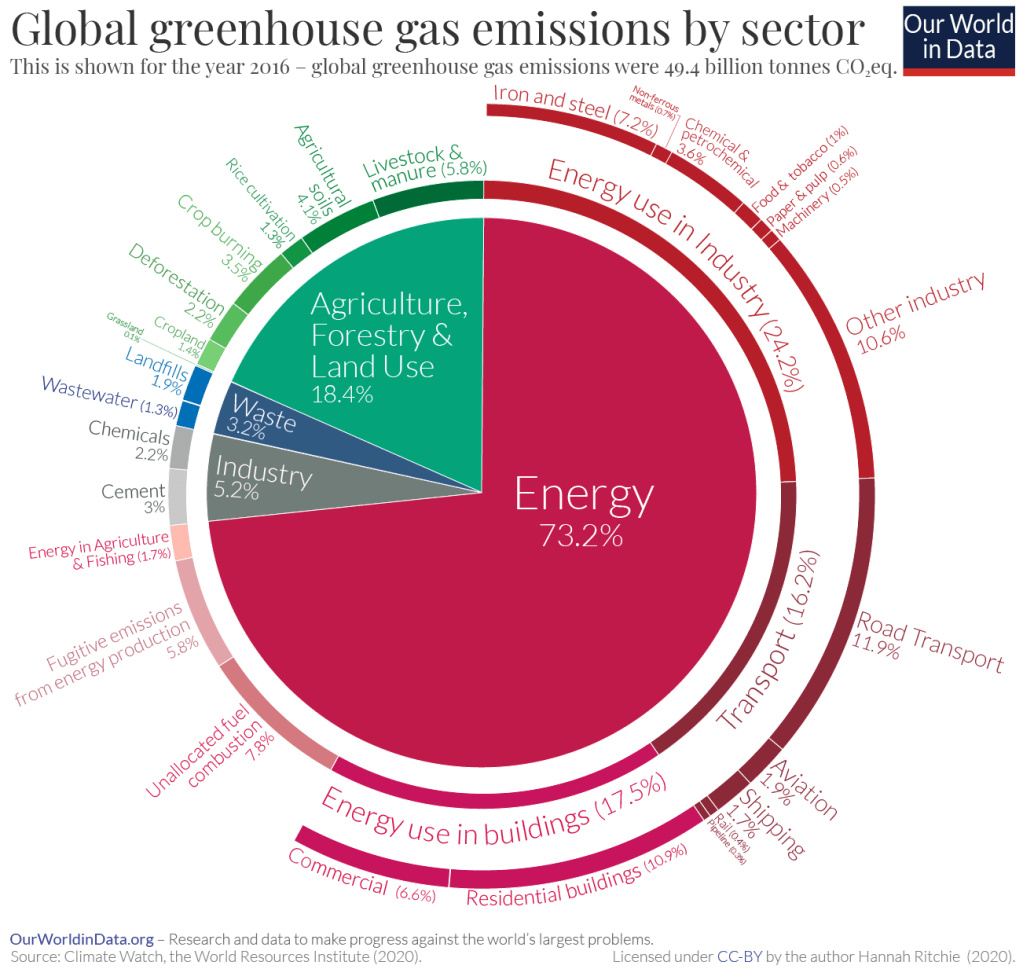
We can also look at carbon emissions by sector.

Not surprisingly energy is the biggest contributor. So much of the energy we use comes from fossil fuels  – which all emit carbon dioxide and other greenhouse gases. And this energy is used in so many different situations – transport, heating or cooling buildings, lighting and cooking, industrial and manufacturing processes, communication etc. 

More worryingly, carbon emissions from fossil fuels are still rising. The International Energy Agency Agency (IEA) reports that energy-related CO2 emissions were 36.3 Gt in 2021; 36.8 Gt in 2022; and 37.4 Gt in 2023. In each year the figure was reported as a new high! Until these emissions start to fall – and fall rapidly – humanity will not be able to avert a worsening climate crisis. 

For more information see – https://ourworldindata.org/ghg-emissions-by-sector

1st Sunday after Epiphany 

14th January 2024

Reflection (readings are below)

In the reading from Genesis tells of divisions but these divisions that shape rather than fragment. The whole is thus greater than the parts. It is God’s physical presence that is the source of this creative process. The reading also tells of a process of naming by which things gain an identity. 

Today’s psalm describes God’s voice – it not only  names, as in Genesis, but makes waters thunder, breaks trees, makes mountains leap, splits flames and makes the wilderness shake. This is a voice that commands awe and wonder. It is also a voice that brings forth blessings. There is no part of creation that is not acted upon by God’s presence. 

Nevertheless I am sure that when the presence of God was made so manifest at Jesus’s baptism – when the effects of God’s presence were so amplified – that those who witnessed it must have been changed for ever. The heavens are split  apart – does this suggest to us that a new phase in the history of creation has begun? For one the first phase when God creates heaven and earth,  is expanded from a formless and dark void,  into a world that has physical framework and timely framework. Is this a point at which the relationship between God and all that has been created is irrevocably changed? 

In the Orthodox world view, Christ’s baptism in the river Jordan, blessed both that river and all other rivers and bodies of water too. This aspect of the baptism is celebrated in Orthodox communities by putting – or throwing – a holy cross into the local river, blessing the water and reminding everyone of its holy nature. 

By the same token, surely all soil is once more made holy as Jesus walked upon the earth, all air made holy as Jesus breathed it in, all homes made holy as Jesus entered them. I am sure it is good for us to be reminded that the world is a holy place, that we should treat each and every part of it with respect and awe and thanksgiving. It must also therefore prompt us to recall with regret and penitence all the times we have misused the earth, the times we have disregarded its holiness, and the times we have sought to avoid sharing its blessings with others. 

Let us celebrate this season of Epiphany by reawakening our awareness of and response to, the holiness of all creation, being ever grateful to our God.

Genesis 1:1-5

In the beginning when God created the heavens and the earth, the earth was a formless void and darkness covered the face of the deep, while a wind from God swept over the face of the waters. Then God said, “Let there be light”; and there was light. And God saw that the light was good; and God separated the light from the darkness. God called the light Day, and the darkness he called Night. And there was evening and there was morning, the first day.

Psalm 29

1 Ascribe to the Lord, you gods, *
ascribe to the Lord glory and strength.

2 Ascribe to the Lord the glory due his Name; *
worship the Lord in the beauty of holiness.

3 The voice of the Lord is upon the waters;
the God of glory thunders; *
the Lord is upon the mighty waters.

4 The voice of the Lord is a powerful voice; *
the voice of the Lord is a voice of splendour.

5 The voice of the Lord breaks the cedar trees; *
the Lord breaks the cedars of Lebanon;

6 He makes Lebanon skip like a calf, *
and Mount Hermon like a young wild ox.

7 The voice of the Lord splits the flames of fire;
the voice of the Lord shakes the wilderness; *
the Lord shakes the wilderness of Kadesh.

8 The voice of the Lord makes the oak trees writhe *
and strips the forests bare.

9 And in the temple of the Lord *
all are crying, “Glory!”

10 The Lord sits enthroned above the flood; *
the Lord sits enthroned as King for evermore.

11 The Lord shall give strength to his people; *
the Lord shall give his people the blessing of peace.

Acts 19:1-7

While Apollos was in Corinth, Paul passed through the interior regions and came to Ephesus, where he found some disciples. He said to them, “Did you receive the Holy Spirit when you became believers?” They replied, “No, we have not even heard that there is a Holy Spirit.” Then he said, “Into what then were you baptised?” They answered, “Into John’s baptism.” Paul said, “John baptised with the baptism of repentance, telling the people to believe in the one who was to come after him, that is, in Jesus.” On hearing this, they were baptised in the name of the Lord Jesus. When Paul had laid his hands on them, the Holy Spirit came upon them, and they spoke in tongues and prophesied— altogether there were about twelve of them.

Mark 1:4-11

John the baptiser appeared in the wilderness, proclaiming a baptism of repentance for the forgiveness of sins. And people from the whole Judean countryside and all the people of Jerusalem were going out to him, and were baptised by him in the river Jordan, confessing their sins. Now John was clothed with camel’s hair, with a leather belt around his waist, and he ate locusts and wild honey. He proclaimed, “The one who is more powerful than I is coming after me; I am not worthy to stoop down and untie the thong of his sandals. I have baptised you with water; but he will baptise you with the Holy Spirit.”

In those days Jesus came from Nazareth of Galilee and was baptised by John in the Jordan. And just as he was coming up out of the water, he saw the heavens torn apart and the Spirit descending like a dove on him. And a voice came from heaven, “You are my Son, the Beloved; with you I am well pleased.”

Counting on … day 11

11th January 2024

Use less water
Using less resources or using them more efficiently is surely good for the environment. One resource which we could use with greater care and efficiency is water. 

Whilst wetter winters may give us a superfluity of water, hotter and dryer summers are also going to be an ongoing feature of the change in our climate. With the increasing use of water meters, using less water should produce a financial saving (at the moment I am not sure how often the meters are read and whether instead bills are based on estimates). 

Another good reason for using less water, is to reduce use the need for water companies to invest in building more reservoirs or in schemes to extract more water from rivers, replacing the water with treated sewage. Both are schemes that have been put forward by Thames Water and are being opposed by local and environmental groups. 

 According to Water Safe, whilst the average UK citizen uses 140 litres of water a day, the  expectation is that we should be able to reduce  this to 100 litres  – or less – per day. (In Denmark water consumption is about 105 litres per day). This could be through taking shorter showers, flushing toilets less, using more  efficient appliances, reusing water – grey water from sinks or from water butts to water plants or flush the loo – or even simply turning off taps when not in use. Their web site has more suggestions

Or see – https://friendsoftheearth.uk/sustainable-living/13-best-ways-save-water

Counting on … day 59

5th March 2024

If we wish, we can calculate our individual – or household –  carbon footprint. Various groups offer online carbon footprint calculators. Some are very quick to work through but are more rough and ready.  More complex calculations will be more precise. We can use this information to identify areas of our lifestyle where we could make adjustments to achieve a more sustainable life style.

Suggested carbon footprint calculators: 

https://footprint.wwf.org.uk

https://www.carbonfootprint.com/calculator.aspx

Generally our carbon footprint is proportionate to our income. Of course it does depend what we buy. Spending £1000 on air travel will have a far higher carbon footprint that spending £1000 on planting a small woodland. Mike Berners Lee has produced a book, “How Bad Are Bananas? The Carbon Footprint of Everything.” This  details the carbon footprint of a wide range of products and  activities and can thus help us choose less carbon-costly lifestyles. 

A report produced by the Guardian in conjunction with Oxfam, the Stockholm Environment Institute and others, reported that “The richest 1% of humanity is responsible for more carbon emissions than the poorest 66%, with dire consequences for vulnerable communities and global efforts to tackle the climate emergency.” https://www.theguardian.com/environment/2023/nov/20/richest-1-account-for-more-carbon-emissions-than-poorest-66-report-says?CMP=Share_iOSApp_Other

Further articles –

Green Tau: issue 88

The climate crisis and insurance companies intersect at three main points.

Climate risks: the risks that insurance companies guard against will include the growing risks associated with extreme adverse weather events. More intense and more frequent floods, wildfires, storms, mud- and landslips will lead to increases in damage to lives and properties. In the short term insurance companies will bear the loss; in the longer term premiums will rise but not necessarily profits.

Underwriting fossil fuel projects: fossil fuel projects – drilling wells, building pipelines, opening mines – need insurance companies who will underwrite the risk of undertaking the project. Ironically these are the very projects that cause climate change and the consequential extreme weather damage for which the insurance companies have to pay out. 

Of course insurance companies can be the hero of the day by not underwriting fossil fuel projects and so preventing them from going ahead.

Investing in climate positive or climate negative: to ensure they have sufficient funds to pay out for insurance claims, insurance companies invest the premiums they receive to generate a return. In the past many insurance companies have invested in the fossil fuel industry. This again can be an ironic choice with their fossil fuel investments adding to the climate crisis and thus the size and number of insurance claims being made. 

Of course, insurance companies do not have to invest in fossil fuels; there are many other investment opportunities in the renewable energy industry, where profits can be made without damaging the environment. 

From 26th February, across the globe, climate activities took part in the week long ‘Insure our Futures’ campaign. The campaign reached out to numerous insurance companies – and groups such as Lloyds of London – inviting them to be the superheroes we need by committing to ensure their company policies exclude the fossil fuel projects that are devastating the world. The campaign was highly creative with dance and song, music and marches and symbolic actions such as forming a human chain around Lloyds of London. Other activists peacefully occupied the offices of key insurance companies whilst passing on information to their staff about the risks of insuring destructive projects such as the East Africa Crude Oil Pipeline (EACOP).  


I took part in one such occupation. Eight of us calmly walked into the foyer of 88 Leadenhall Street which houses the offices of Probitas 1492. We sat quietly on the floor such that we were visible to those coming in and out – but not blocking their passage. We remained there for five hours, praying, singing, reading poems, and hearing once again the speech given by Antonio Guterres, the UN Secretary General, in which he spoke of the urgency of tackling the climate crisis using the famous words that we must now act to do ‘everything, everywhere, all at once.’

Throughout our stay the receptionist and the security staff we polite and pleasant – afterwards we gave them a box of chocolates as a thank you. The police presence (a pair of officers) was also polite: our action was not a criminal offence. 

Today, 4th March, Probitas 1492, has officially confirmed that they have not and will not insure neither  EACOP nor the West Cumbrian Coalmine.  For more details – https://christianclimateaction.org/2024/02/28/christians-occupy-probitas-1492-to-ask-them-not-to-insure-fossil-fuel-projects/

Counting on …. Day 58

4th February 2024

To get a feel for the size or scope of carbon emissions, we can look at how much each nation produces. These figures represent the emissions produced in each country – including for items that are then exported – and does not include the emissions of goods produced in other countries (ie emissions attributed to imports). Nor do the national figures allow for international aviation and shipping so these are shown separately.

  • Global carbon footprint for 2022 – 37.14 giga tonnes;  varying from an average of 37.6 tonnes per person for someone living in Qatar, to 0.1 tonnes for someone living in Malawi, Rawanda or Sierra Leone*
  • UK carbon footprint for 2022 – 318 million tonnes; an average of 4.7 tonnes per person*
  • International aviation 2022 – 425 million tonnes 
  • International shipping 2022 – 625 million tonnes  

For more details see https://ourworldindata.org/co2-emissions

Third Sunday of Lent

3rd March 2024

Reflection – readings are below

“The statutes of the Lord are just and rejoice the heart; the commandment of the Lord is clear and gives light to the eyes.”

The Psalmist reminds us that God’s statutes are there to make us happy.  The psalmist uses statutes as an interchangeable word with commandments, and I think we could add further words which would convey similar meanings: rules, precepts, laws, policies, undertakings, promises etc. All these suggest a relationship and a common understanding between the participants. (Although I can envisage a situation where there may only be one participant: for  example I might promise myself that I will go to bed at ten each day, or go for a daily walk).

In today’s psalm, the Psalmist explores the relationship between God as creator and those bits of creation we might consider to be inanimate – the sun, the stars, the land itself – and how by following the laws of nature, the actions of even inanimate beings praise God. By being true to their identity – that identity God gave them in creating them, they declare the glory of God and testify to the will – the laws – of God. 

Since we too, as humans, are God’s handiwork, and were given our identity – our purpose and calling – by God, then we glorify God and affirm God’s laws – the will of God – by living lives true to that will and calling. 

It is by the power of God – by living according to God’s will, God’s Laws – that we are, says Paul, saved. Contrary wise, if we do not live according to God’s will, God’s laws, but according to the ways of ‘the world’ then we perish. The ways of ‘the world’ in this context do not mean the natural laws, the self sustaining interconnected ways of natural ecosystems. Rather they are the unnatural ways of commodification, commerce, capitalism, self-centred individualism. These do not lead to salvation. They do not ensure flourishing and wellbeing for all. So it is that Paul can parody this perverse set of opposites by saying  ‘God’s foolishness is wiser than human wisdom’!

Humans are easily distracted from following God’s ways, fromliving in accordance with God’s wisdom. We easily think that we are more important than our neighbour, that our rights trump those of others, that it is ok to steal or kill or destroy someone else’s life if it benefits us. We easily measure our importance as being more important than God, of believing our wisdom takes precedence over God’s. 

It is not surprising that the Book of Exodus gives us a set of God-given commandments to live by. It is not surprising that the Psalmist tells us that God’s laws, God’s ways, are “More to be desired … than gold, more than much fine gold, sweeter far than honey, than honey in the comb” and that they will truly enlighten us! It is not surprising that Paul tells us in blunt terms that there is nothing so perverse as human wisdom when compared with that of God.

Paul is quite right to say that God’s wisdom will act like a stumbling block. And it is a good thing to have such a stumbling block, for how else can you turn around someone who is ‘hell-bent’ on ignoring God’s wisdom in favour of worldly wisdom. How else can you break into the mindset that says there is no better way of living than that of capitalism, of commodification, of self interest; that only belief in the world of markets can solve the world’s problems? It is often the case that when someone is so blinkered to other views, so embedded in their own echo chamber, that there needs to be some disruptive action to cause them to halt, to stop and think, to open their eyes to the bigger picture. 

This is often what climate activists are striving to do: to raise the alarm, to wake people and companies, governments and organisations, up to the urgency and scale of the climate crisis. This week across the world, climate activists were raising the alarm for insurance companies. Insurance companies can themselves be directly affected by the impacts of adverse weather events, yet many of them at the same time continue to underwrite fossil fuel projects that will only compound these adverse weather events!

Jesus knew and understood the blinkered and wayward nature of the people he came to save. He saw the ways in which tradition, invested interests, the maintenance of existing power structures, prevented people from following God’s ways, from listening to God’s wisdom, from working with God to tackle the injustices and inequalities that had built up in the world. He saw how misdirection, misplaced values, and corrupted habits, prevented people from truly being the people God had created. How they were prevented from living in harmony with each other and with all of creation. How their lives failed to give glory to God.

In today’s gospel reading we hear how Jesus went into the Temple and disrupted its activities, and that he did so because they were corrupting the relationships between people, between people and other creaturely beings, and between people and God. He disrupted their activities physically and audibly. He allowed his actions to be driven by righteous anger because what was taking place was destructive of human – and creaturely – flourishing and wellbeing. At the same time he did not let his anger run over in to violence to people or to creatures. 

Let us place prayer at the heart of our lives, and let us be zealous in following the ways of God, listening to God’s wisdom and glorifying God through our actions.

Exodus 20:1-17

Then God spoke all these words:

I am the Lord your God, who brought you out of the land of Egypt, out of the house of slavery; you shall have no other gods before me.

You shall not make for yourself an idol, whether in the form of anything that is in heaven above, or that is on the earth beneath, or that is in the water under the earth. You shall not bow down to them or worship them; for I the Lord your God am a jealous God, punishing children for the iniquity of parents, to the third and the fourth generation of those who reject me, but showing steadfast love to the thousandth generation of those who love me and keep my commandments.

You shall not make wrongful use of the name of the Lord your God, for the Lord will not acquit anyone who misuses his name.

Remember the sabbath day, and keep it holy. For six days you shall labour and do all your work. But the seventh day is a sabbath to the Lord your God; you shall not do any work—you, your son or your daughter, your male or female slave, your livestock, or the alien resident in your towns. For in six days the Lord made heaven and earth, the sea, and all that is in them, but rested the seventh day; therefore the Lord blessed the sabbath day and consecrated it.

Honour your father and your mother, so that your days may be long in the land that the Lord your God is giving you.

You shall not murder.

You shall not commit adultery.

You shall not steal.

You shall not bear false witness against your neighbour.

You shall not covet your neighbour’s house; you shall not covet your neighbour’s wife, or male or female slave, or ox, or donkey, or anything that belongs to your neighbour.

Psalm 19

1 The heavens declare the glory of God, *
and the firmament shows his handiwork.

2 One day tells its tale to another, *
and one night imparts knowledge to another.

3 Although they have no words or language, *
and their voices are not heard,

4 Their sound has gone out into all lands, *
and their message to the ends of the world.

5 In the deep has he set a pavilion for the sun; *
it comes forth like a bridegroom out of his chamber;
it rejoices like a champion to run its course.

6 It goes forth from the uttermost edge of the heavens
and runs about to the end of it again; *
nothing is hidden from its burning heat.

7 The law of the Lord is perfect
and revives the soul; *
the testimony of the Lord is sure
and gives wisdom to the innocent.

8 The statutes of the Lord are just
and rejoice the heart; *
the commandment of the Lord is clear
and gives light to the eyes.

9 The fear of the Lord is clean
and endures for ever; *
the judgments of the Lord are true
and righteous altogether.

10 More to be desired are they than gold,
more than much fine gold, *
sweeter far than honey,
than honey in the comb.

11 By them also is your servant enlightened, *
and in keeping them there is great reward.

12 Who can tell how often he offends? *
cleanse me from my secret faults.

13 Above all, keep your servant from presumptuous sins;
let them not get dominion over me; *
then shall I be whole and sound,
and innocent of a great offence.

14 Let the words of my mouth and the meditation of my
heart be acceptable in your sight, *
O Lord, my strength and my redeemer.

1 Corinthians 1:18-25

The message about the cross is foolishness to those who are perishing, but to us who are being saved it is the power of God. For it is written,

“I will destroy the wisdom of the wise,
and the discernment of the discerning I will thwart.”

Where is the one who is wise? Where is the scribe? Where is the debater of this age? Has not God made foolish the wisdom of the world? For since, in the wisdom of God, the world did not know God through wisdom, God decided, through the foolishness of our proclamation, to save those who believe. For Jews demand signs and Greeks desire wisdom, but we proclaim Christ crucified, a stumbling block to Jews and foolishness to Gentiles, but to those who are the called, both Jews and Greeks, Christ the power of God and the wisdom of God. For God’s foolishness is wiser than human wisdom, and God’s weakness is stronger than human strength.

John 2:13-22

The Passover of the Jews was near, and Jesus went up to Jerusalem. In the temple he found people selling cattle, sheep, and doves, and the money changers seated at their tables. Making a whip of cords, he drove all of them out of the temple, both the sheep and the cattle. He also poured out the coins of the money changers and overturned their tables. He told those who were selling the doves, “Take these things out of here! Stop making my Father’s house a marketplace!” His disciples remembered that it was written, “Zeal for your house will consume me.” The Jews then said to him, “What sign can you show us for doing this?” Jesus answered them, “Destroy this temple, and in three days I will raise it up.” The Jews then said, “This temple has been under construction for forty-six years, and will you raise it up in three days?” But he was speaking of the temple of his body. After he was raised from the dead, his disciples remembered that he had said this; and they believed the scripture and the word that Jesus had spoken.