Counting on … day 207

18th December 2025

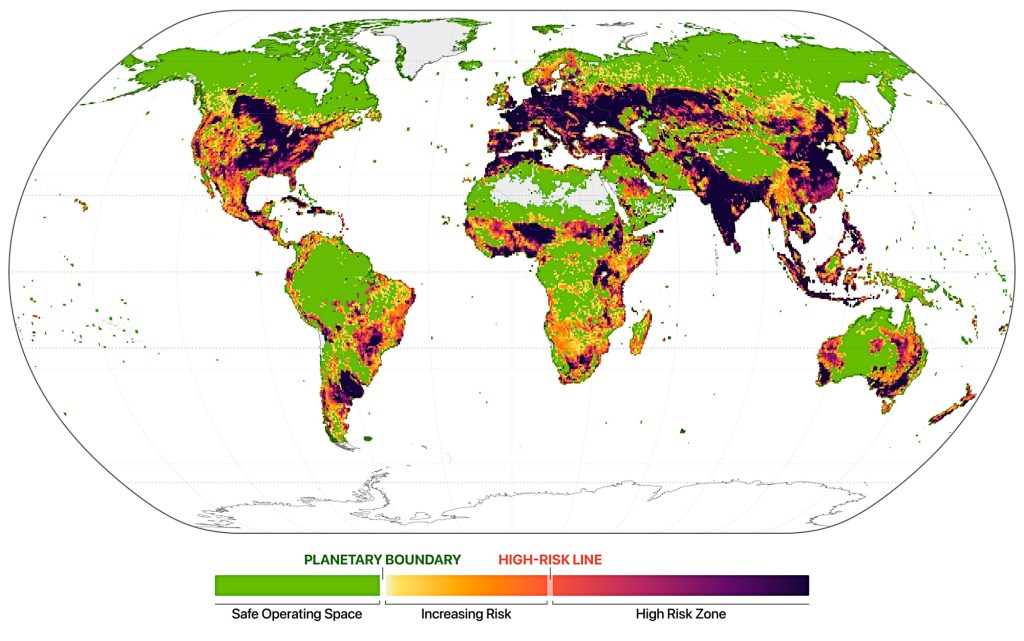
How do we see the impact of exceeding the planetary boundaries for fresh water?

“Climate change has become the main global driver of freshwater disruption. A warmer atmosphere holds more moisture and changes how and where rain falls, leading to more intense floods in some regions and severe droughts in others. These shifts are transforming long-established rainfall and river patterns, creating new and unpredictable hydrological conditions that put pressure on both ecosystems and human societies.” (1)

A disruption in rainfall patterns can mean either more or less rain than usual, or more rainfall but less often so that rainfall is more intense. This can lead to the drying out of wetlands, the lowering of lake and river levels and the disruption of the ecosystems those water features supported. In the Amazon basin we are seeing river levels drop significantly impacting local communities and their livelihoods and destabilisation of the rainforest such that trees, plants and creatures are lost.

Disruption means loss of soil moisture. Not only does this impact plant growth and thus a whole food chains, it also makes landscapes more vulnerable to droughts and wildfires. The UK saw a record number of wildfires this year.

Excessive amounts of rainfall over a prolonged period, or concentrated into a short time frame, causes extreme flooding that disrupts habitats, destroys infrastructure, displaces people, erodes soils and causes devastating landslides. We have seen many examples of this in the recent Asian super typhoons. 

Disruption to normal rainfall patterns leads to water scarcity. A lack of rain depletes water supplies, whilst infrequent intense rainfall runs quickly of the land, again failing to restore water stocks in reservoirs and rivers. Warmer winters diminishes the replenishment of glaciers, and increase the rate at which they melt. Together this reduces the flow of water into rivers during summer periods aggravating water scarcity.  Both in Iran and in South Africa, whole communities are face a complete lack of drinking water as droughts combine with atypical rainfall patterns. 

  1. https://www.planetaryhealthcheck.org/boundary/freshwater-change/

Counting on … day 206

17th December 2025

Only 2.5% of the Earth’s water is fresh water – the rest is salt water found in the seas and oceans.

Fresh water exists in two forms, blue water and green water.

Blue water is the water that is in rivers, lakes , underground aquifers and as frozen water in glaciers and ice sheets. Amazingly about 60% of blue water is locked away as ice.

Green water is the water stored in the soil and drawn up by plants. 

Every year some 500,000km3 of water evaporates from the surface of the oceans, with 450,000km3 returning as precipitation directly back into the ocean(usually within a period of about 9 days) and 50,000km3 falling on land. 

“The highest rate of evaporation from the oceans occurs in winter for both the Northern and Southern Hemispheres. The location of greatest evaporation is found on the east coasts of continents. This is due primarily to winter storms that move off the east coasts of continents, which tend to have strong winds. These winds help carry water vapor away from its source, thereby allowing more evaporation to take place.

“Another factor is the warm ocean currents that move pole-ward along the east coasts of continents. The cold winter-time air masses that move over the water allow for large differences in air and sea temperatures, so evaporation is also large. When these differences in air and sea temperatures are then combined with strong winds, it makes evaporation in these regions very efficient.” (1)

Water molecules from the ocean would struggle to reach the inner parts of the continents. Here precipitation is dependent on moisture that has been released by plants through evaporation, forming clouds etc. Plants provide about 70,000km3 of such precipitation. Vegetation cover is key to ensuring that precipitation spreads right across continents. 

The other key source of water for inland areas is from melting snow and ice: high mountain regions capture precipitation and then release it throughout the year as meltwater-fed rivers. Water molecules that are exist within these frozen states may take a thousand years to complete the journey from precipitation to their return to the ocean! This is also highlights as we loose glaciers because of global warming, they will be hard to replace.

  1. https://www.noaa.gov/jetstream/max-what-cycle

Counting on … day 205

16th December 

Fresh water is essential for life, but are we using it wisely?

A new analysis of freshwater resources across the globe shows that human activity has pushed variation in the planet’s freshwater cycle well outside of its pre-industrial range. The study shows that the updated planetary boundary for freshwater change was surpassed by the mid-twentieth century. In other words, for the past century, humans have been pushing the Earth’s freshwater system far beyond the stable conditions that prevailed before industrialisation.” (1) 

We are seeing more extreme wet and more extreme dry conditions across the globe. Ingo Fetzer at the Stockholm Resilience Centre notes: “Water extremes, such as droughts and flooding, can have significant impacts on ecosystems and biodiversity that function are essential for human societies. However, human activities, including agriculture, urbanisation, and climate change, influence the water cycle and exacerbate extreme events. By understanding and mitigating these factors, we can work to protect and preserve our planet’s vital water resources and maintain biodiversity.” (1)

  1. https://www.stockholmresilience.org/research/research-stories/2024-03-06-freshwater-planetary-boundary-has-been-crossed-since-the-mid-twentieth-century.html

Counting on … day 204

15th December 2025

What is AMOC? 

AMOC, the Atlantic Meridional Overturning Circulation, is a system of ocean currents that help distribute warm water around the world. (1)

I wrote about this last month – https://greentau.org/2025/11/18/counting-on-189/ – but want to recommend Professor Tim Lenton’s address at the National Emergency Briefing which illustrates vividly the impact if AMOC fails: https://youtu.be/tmd6MDiJmQU?si=RcnuJIDqMeJHirD5

Research, which is still on going, suggests that the topping point which will make the collapse of AMOC inevitable could be passed in the next few decades – but the resulting collapse of the system might take another 50-100 years to happen. Even keeping the global temperature rise to the 1.5C Paris target is now predicted to carry a 10-25% risk of reaching this tipping point before the end of the century. It is a risk we cannot afford to take given the impact it will have on the viability of human life – even if that will not effect us now, it will effect future generations, our children and our children’s children. (2)

  1. https://weather.metoffice.gov.uk/binaries/content/assets/metofficegovuk/pdf/research/climate-science/met-office-hadley-centre/amoc-factsheet-update-2025-v3.pdf

(2) https://www.theguardian.com/environment/2025/aug/28/collapse-critical-atlantic-current-amoc-no-longer-low-likelihood-study?CMP=Share_iOSApp_Other

And also https://www.theguardian.com/environment/2024/oct/23/we-dont-know-where-the-tipping-point-is-climate-expert-on-potential-collapse-of-atlantic-circulation?CMP=Share_iOSApp_Other

Counting on … day 203

12th December 2025

Can the acidification of the oceans be reversed? This from Biology Insights

“Reversing ocean acidification involves both natural and engineered approaches. The Earth has self-regulating mechanisms, such as the dissolution of calcium carbonate sediments on the ocean floor and the weathering of rocks on land. These processes release alkaline materials that neutralise acidity, but they operate over thousands of years and are too slow to counteract the current rapid changes.

“Scientists are exploring geoengineering techniques to accelerate this process. One proposal is ocean alkalinity enhancement, which adds alkaline substances like ground olivine or lime to seawater to increase its pH. This method seeks to speed up the natural weathering process to neutralise excess acidity.

“Other methods are more technologically intensive, such as electrochemical approaches that remove acidity directly from seawater. These systems would use electricity to manage ions and reduce acidity, but they face challenges of scale, cost, and energy requirements. The potential for unintended ecological side effects from these engineered solutions is not yet fully understood.” (1)

It is hard to imagine how either the geo engineering or the electrochemical solutions can work at scale. Ditto for proposals that carbon dioxide could be removed from the oceans and stored underground using carbon capture technology.

More promising are projects that focus on planting seaweeds such as kelp and sea grass which as they grow absorb carbon dioxide from the water. (2) At the same time such projects improve marine biodiversity, and indeed are often established as part of Marine Protected Areas. These project are often simply restoring ecosystems that have been degraded by human exploitation. Nevertheless even plants such as seagrass can struggle as temperatures rise and as ecosystems become more unstable. (3) 

Therefore the most important way of protecting our oceans is to to reduce significantly and at speed the amount of carbon dioxide that we emit.

  1. https://biologyinsights.com/is-ocean-acidification-reversible-a-scientific-look/
  2. https://www.mbari.org/news/seagrasses-turn-back-the-clock-on-ocean-acidification/

(3) https://www.mccip.org.uk/sites/default/files/2021-07/mccip-seagrass.pdf

Counting on … day 202

11th December 2025

What is a tipping point?

From the Met Office “In the context of climate science, a tipping point refers to a critical threshold in the earth’s system or related processes which, if passed, can cause sudden, dramatic or even irreversible changes to some of the earth’s largest systems, such as the Antarctic ice sheet or the Amazon rainforest.” (1)

And from the Natural History Museum: “Large areas of the world could soon become unrecognisable if global temperatures continue to rise. From the loss of coral reefs to the shutdown of major ocean currents, shifts in Earth’s climate and ecosystems will have untold consequences for billions of people across the world.” (2)

Tim Lennon, head of the Global Systems Institute at Exeter University p, spoke very eloquently on this issue at the recent National Emergency Briefing. You can see a recording here – https://youtu.be/tmd6MDiJmQU?si=goRIfzf8AhiriESi

Tipping points also work in the opposite direction. Just last year the last coal fired power station closed ahead of schedule as policies that encouraged the phasing out of coal reached that critical tipping point. Similar tipping points can also be seen in the cost fall and expansion of wind farms, solars panels and electric vehicles. 

  1. https://www.metoffice.gov.uk/blog/2023/what-do-we-mean-by-a-climate-tipping-point
  2. https://www.nhm.ac.uk/discover/news/2025/october/we-are-reaching-earths-climate-tipping-points-and-more-are-on-the-way.html

Counting on … day 201

10th December 2025

When planetary boundaries are once crossed, it is still possible to reverse the situation and restore the balance of the Earth’s systems. However the effect of crossing a planetary boundary may irreversibly impact delicate parts of the Earth’s ecosystems such as coral reefs.

These reefs are important because:- 

  • They protect shorelines from strong ocean currents and  prevent coastal erosion
  • They provide sheltered waters for many species of sea life.
  • They filter polluted water ensuring clean water for marine life and clean beaches
  • They sustain local fishing based communities and especially those located on low-lying islands
  • They absorb carbon dioxide

Coral reefs are being damaged by the acidification of the oceans – the depletion of calcium in the structure weakens them. They are also damaged by rising ocean temperatures which stress the corals causing them to expel the symbiotic algae that enable them to feed and which give them their distinctive colours – this is called coral bleaching. (1) 

The multiple causes of damage to the world’s coral reefs has destroyed such a proportion that their future is now jeopardised. These reefs are loss of coral reefs on this scale means that we have passed one of the Earth’s systems tipping points. (2) 

In the Caribbean,  coral reefs have decreased by 48% since 1980. (3) 

Info graphic https://oceanservice.noaa.gov/facts/coralreef-climate.html

(1) https://www.wwf.org.uk/coral-reefs-and-climate-change

(2) https://global-tipping-points.org/case-studies/#coral

(3) https://www.theguardian.com/environment/2025/dec/09/caribbean-reefs-have-lost-48-of-hard-coral-since-1980-study-finds?CMP=Share_iOSApp_Other

Counting on … day 200

9th  December 2026

Ocean health: acidification 

One of the nine planetary boundaries is ocean acidification. If the oceans become too acidic it endangers marine life and therefore the lives of the rest of us who are dependent on healthy oceans. 

The 2025 Planetary Health Check showed that this planetary boundary has been breached: since the start of the industrial era, the oceans’ acidity has increased by 30-40% destabilising this important  Earth systems. (1) 

What is ocean acidification?

“For millions of years, the ocean has acted as Earth’s carbon sponge, quietly absorbing carbon dioxide (CO₂) from the air. But that natural partnership has turned toxic in the age of fossil fuels.

“As humanity has pumped unprecedented levels of CO₂ into the atmosphere, the oceans have taken in more and more of it—now absorbing roughly a quarter of all carbon emissions. But this uptake comes at a cost. When carbon dioxide dissolves in seawater, it undergoes a chemical transformation, forming carbonic acid. That acidification strips the ocean of carbonate ions—essential building blocks for creatures like corals, clams, and countless shell-forming organisms.

“As their calcium carbonate shells thin and weaken, so too do the coral reefs and underwater habitats they support. A weakened foundation means collapsing ecosystems—once-thriving marine gardens reduced to skeletal remains.” (2) 

(1) https://www.stockholmresilience.org/research/planetary-boundaries.html

(2)  https://www.sciencenewstoday.org/parts-of-earths-oceans-have-quietly-crossed-a-dangerous-threshold

Counting On … 198

3rd December 2025

Phosphorus is another key mineral for the health of plants and animals. It derives from rocks and  through erosion finds its way into the soil, where as  soluble phosphates (HPO4 and H20P4) it is absorbed by plants, and through eating plants into plant eating creatures and so up through the food chain. Bacteria in the soil aid the absorption of phosphates.

Organic phosphorus is released back into the soil through defecation and the decay of plants and animals. During the process of decomposition the organic form of phosphorus is converted to an inorganic firm such that it can overtime  be reformed into sedimentary rocks. This comprises the natural phosphorus cycle. 

Because phosphorus improves crop yields it is added as an artificial fertiliser. This input disrupts the cycle. Excess of phosphorus is the primary cause of algal bloom in water sources, reducing the amount of oxygen present and so killing off many plants and creatures. (1)

The following data comes from Planetary Boundaries Science:-

“Before human intervention, phosphorus flows were low ~2.5 Tg P pa (tetragrams of phosphorus per year) from land to freshwater and ~1.3 Tg P pa of export to the ocean. Human activities have increased flows from land to freshwater systems through a global application of mined phosphorus to cropland of around 18.2 Tg P pa and have increased phosphorus flows to the ocean to around 4.4 Tg P pa, largely due to fertiliser use.” 

At the same time, the sage planetary boundary for phosphorus flow is between 6.2 and 11 Tg P pa. (2) 

  1. https://biologyteach.com/phosphorus-cycle/
  2. https://www.planetaryhealthcheck.org/boundary/modification-of-biogeochemical-flows/

Counting on … 197

2nd December 2025

The imbalance of the nitrogen cycle also causes air pollution. Whilst nitrogen based fertilisers in the soil and water are being consumed by various microbes, processing nitrites in to become a nitrates which can be absorbed  by the plants, nitrogen oxide (NO) is released as a bi-product. (1)

Nitrogen oxide, like carbon dioxide, is a greenhouse gas, but with 300 times the warming potential. 

Nitrogen  oxide readily reacts with other gases in the atmosphere to form nitrogen dioxide which is a healthy hazard inflaming airways and increasing susceptibility to respiratory infections and allergens.

Together nitrogen oxide and nitrogen dioxide are nitrous oxides or NOx. (2)

Whilst agriculture is the main source of nitrous oxides, they are also emitted  through the burning of fossil fuels – including from petrol and diesel power vehicles, diesel powered shipping and railway engines,  and from aviation. 

(1) https://www.bbc.co.uk/future/article/20210603-nitrous-oxide-the-worlds-forgotten-greenhouse-gas

(2) https://www.gov.uk/government/statistics/emissions-of-air-pollutants/emissions-of-air-pollutants-in-the-uk-nitrogen-oxides-nox

(3) https://ourworldindata.org/emissions-by-sector