Counting on … day 199

24th October 2024

Globally we can support the Fossil Fuel Non-Proliferation Treaty. This is supported by numerous parliamentarians, cities, faith groups, academics, scientists, charities and NGOs. The Treaty calls for the:- 

Prevention of the proliferation of coal, oil and gas by ending all new exploration and production; 

Phasing-out of the existing production of fossil fuels in line with the 1.5C global climate goal; and 

Fast-track real solutions and a just transition for every worker, community and country.

You can endorse this as an individual or as a group, church,  company or business – https://fossilfueltreaty.org/#endorse

Counting on … day 198

23rd October 2024

Where do we start in addressing the climate and biodiversity crises?

In the UK we can support with the CAN Bill, a private members bill with cross party support, that  aims to establish “a new UK law that addresses the full extent of the climate and nature crisis in line with the most up-to-date science. The Bill is the only proposed legislation before the UK Parliament that ensures a comprehensive and joined-up approach to the emergency.” (1)

You can both sign up as a supporter – https://action.zerohour.uk/join

And write to your MP asking them to support the Bill. It is due a second reading 24th January when it needs the support of 102 MPs (being a Friday this requires a bit more commitment from MPs who might prefer to leave early for their constituencies) – https://action.zerohour.uk/

 (1) https://www.zerohour.uk/climate-and-nature-bill/

Counting on … day 197

22nd October 2024

The United Nations Climate Change COP29 starts on 11th November in Baku, Azerbaijan. Like the Biodiversity COP, the discussions of this gathering of global delegates should be really important, but the fear is that, as with previous COPs, placatory words are easy, following through with both funding and actions is harder – but essential. 

How can we as individuals make any impact? 

Not everyone approves of the actions taken by groups such as Insulate Britain and Just Stop Oil, but if nothing else their actions have lifted the profile of the climate crisis in the media.

What we can all do is talk about the crisis, engage our neighbours in the conversation and make the subject newsworthy.

Counting on … day 196

21st October 2024

Today the United Nations Biodiversity COP16 starts. Hopefully those present will honour the huge value of biodiversity as integral to a full and happy life for all who inhabit this planet, and that realistic and binding outcomes will emerge that will ensure that we reverse at speed the biodiversity loss that is degrading life on earth. 

Counting on … day 195

18th  October 2024

Scientific concern about the adverse affects of climate change in the Earth capacity to absorb carbon dioxide, extends to the land as well as the oceans. 

“In 2023, the hottest year ever recorded, preliminary findings by an international team of researchers show the amount of carbon absorbed by land has temporarily collapsed. The final result was that forest, plants and soil – as a net category – absorbed almost no carbon…

“A paper published in July found that while the total amount of carbon absorbed by forests between 1990 and 2019 was steady, it varied substantially by region. The boreal forests – home to about a third of all carbon found on land, which stretch across Russia, Scandinavia, Canada and Alaska – have seen a sharp fall in the amount of carbon they absorb, down more than a third due to climate crisis-related beetle outbreaks, fire and clearing for timber.

“Combined with the declining resilience of the Amazon and drought conditions in parts of the tropics, the hot conditions in the northern forests helped drive the collapse of the land sink in 2023 – causing a spike in the rate of atmospheric carbon.”

This shortfall or decline in the carbon absorbing capacity of the natural world is a serious concern when we are relying on that capacity to achieve a net zero target. Indeed if this persists, we will have to reduce our human enduced carbon emissions faster and at a greater rate.

Counting on … day 194

17th October 2024

Blue carbon is not just the carbon absorbed in the seas around our coasts. It is an ongoing process that encompasses oceans and deep seabeds. However scientists are concerned that the process is being adversely affected by rising temperatures.

“It begins each day at nightfall. As the light disappears, billions of zooplankton, crustaceans and other marine organisms rise to the ocean surface to feed on microscopic algae, returning to the depths at sunrise. The waste from this frenzy – Earth’s largest migration of creatures – sinks to the ocean floor, removing millions of tonnes of carbon from the atmosphere each year.

“This activity is one of thousands of natural processes that regulate the Earth’s climate. Together, the planet’s oceans, forests, soils and other natural carbon sinks absorb about half of all human emissions. But as the Earth heats up, scientists are increasingly concerned that those crucial processes are breaking down….

“Greenland’s glaciers and Arctic ice sheets are melting faster than expected, which is disrupting the Gulf Stream ocean current and slows the rate at which oceans absorb carbon. For the algae-eating zooplankton, melting sea ice is exposing them to more sunlight – a shift scientists say could keep them in the depths for longer, disrupting the vertical migration that stores carbon on the ocean floor.”

Counting on … day 193

16th October 2024

Blue carbon is carbon that is absorbed and stored in marine environments. The Wildlife Trusts, The RSOB and WWF have put together a useful report on the importance of blue carbon.

“Over the past few decades, great strides have been made

in recognising the importance of carbon storage in terrestrial

environments … but we’ve largely neglected the vast potential of

‘blue carbon’ found in our coastal and marine areas, which cover three

times the land area of the UK. Marine habitats, including seagrass

meadows, saltmarshes, and subtidal sediments like mud and sand on

the seabed, act as incredible stores of carbon.

“Currently blue carbon remains underappreciated and largely

unprotected within Marine Protected Areas (MPAs), and marine spatial

planning processes have held little to no regard for the significant

role our seas play in carbon storage. This, combined with ongoing

human pressures that can affect the ability of our seas to effectively

capture and store carbon, means that we are failing to make the most

of this critical natural resource. … 

“Through effective planning that includes the protection of blue carbon habitats and

important areas for biodiversity, we can support climate mitigation,

protect nature and minimise the impacts of activities at sea such as

bottom-towed fishing gears and offshore development. We also need

investment in coastal blue carbon habitat restoration projects to

increase the environment’s potential to store carbon and help tackle

the climate crisis. 

“Protecting these marine carbon stores matters not just ecologically

but also politically. The UK helped champion the creation and

agreement of the United Nations Convention on Biodiversity’s Global

Biodiversity Framework, which drives the 30×30 commitments to

both protect at least 30%, and to restore at least 30% of nature by

2030.” https://www.wildlifetrusts.org/sites/default/files/2024-09/2024_Blue carbon 12pp_A4_Landscape_New_Digital.pdf

Blue carbon https://www.wildlifetrusts.org/blue-carbon

Counting on … day 192

15th October 2024

Rewilding the sea – seawilding – is as important as rewilding the land. Rewilding Britain explains why. “Britain’s seas used to be home to the biggest creatures on the planet: blue, humpback, fin, sperm, bottlenose and sei whales. Our rich, soupy waters helped fuel a thriving, diverse ecosystem, attracting huge numbers of small fish, and in turn massive balls of herring and whiting, which would bring these ocean giants to our shores to feed. Like the decline of large mammals on land, whales were hunted to near local extinction for their meat and oil. Alongside the decline of these very visible giants, all marine ecosystems are suffering. The UK has lost around 92% of its seagrass meadows, 95% of its native oyster reefs and nearly all its kelp in regions like Sussex where it once was abundant” (1)

In February 2023 three areas of water of the coast of England were given the status of Highly Protected Marine Areas (HPMA) where all activities such as fishing, mining and laying cables that might damage the sea bed, are banned. The aim is to protect marine biodiversity by allowing seaweeds such as kelp and sea creatures to recolonise the sites. That said, these areas cover only 0.5% of English seas. 

There are other projects where a proactive approach has been taken by actively replanting new kelp meadows – such as the Sussex Kelp Recovery Project – or in the Humber Estuary by creating oyster reefs to serve as nurseries for the reintroduction of native oysters (2)

  1. https://www.rewildingbritain.org.uk/why-rewild/what-is-rewilding/examples/introduction-marine-rewilding

(2) https://www.theguardian.com/environment/2023/aug/02/oyster-restoration-project-rebuild-uk-reefs-overfishing-seabed-trawling?CMP=Share_iOSApp_Other

Counting on … day 191

14th October 2024

As important as restoring the biodiversity of our land, is restoring the biodiversity of our coasts. In particular this can include restoring wetland areas which can receive the varying inflow of water, whether tidal or flooding from rivers. These are liminal areas which can support a diversity of plants, birds, animals and sea creatures – many of which are only to be found in these areas of water flow and retreat. 

Salt marshes are wetlands that are regularly inundated by sea water, of which WWT Stewart Marshes in Somerset is an example. Steart Marshes are part of an ongoing rewilding project that aims “to recreate natural wetland features that would protect the area against flooding, restore biodiversity, provide a place for people to enjoy nature and mitigate for climate change. The area has already attracted otters, egrets, owls and spoonbills, as well as providing grazing for locally produced saltmarsh lamb and beef.” (1)

In the Thames Estuary another rewilding project has been evolving. “RSPB Wallasea Island is a stunning landscape of marshland, lagoons, ditches and sea. The landscape has been restored through a managed realignment project. This ambitious project used more than three million tonnes of earth from the tunnels and shafts created by the Crossrail project in London. The material has allowed the project to create a new 115 ha intertidal area of saltmarsh, mudflats and islands. This has created an important habitat for a wide range of species – from plants, to birds and invertebrates. The whole area now supports an abundance of species rich habitat. Grazing animals on site provide an income stream to the farmer. The project offers guided walks and nature trails, and this increase in visitors has benefitted local shops. (2) 

  1. https://www.wwt.org.uk/discover-wetlands/wetlands/saltmarsh/
  2. https://www.rewildingbritain.org.uk/rewilding-projects/wallasea-island

Counting on … day 190

11th October 2024

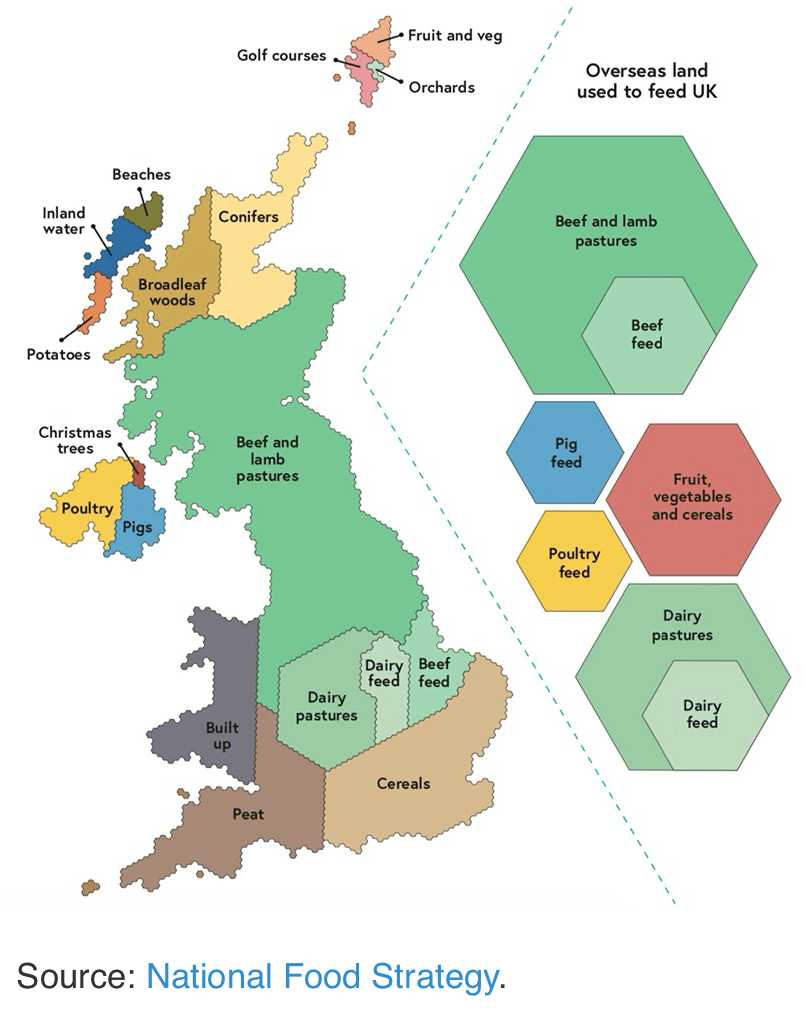
The left hand half of this diagram shows the amount of land used in the UK for different purposes – from providing grazing for beef cattle and sheep (the largest single use) to land cultivated as orchards (smallest alongside land used for growing Christmas tree!). 

The right hand half shows overseas land that we rely on (effectively use) to produce food stuffs that we import – and again land for beef and lamb production is the largest. 

Even just halving our meat consumption, would free up huge amounts of land that could be better used for rewilded biodiverse rich landscapes, as well as having space for increased horticultural production of a wide range of fruits and vegetables.