34% of the world’s mammals (by weight – biomass) are humans, 4% are wild animals and a staggering 62% are livestock – cows, pigs, sheep etc. ie most of the mammals on earth are there because we are going to eat them. (Of course a small number of those animals will be draught animals and some breeding stock, but equally the numbers don’t include poultry). It would be logical to think that we should be reducing the proportion of livestock we keep so as to maintain space for wild animals – and that would be a boost for biodiversity.
Out of a total of 42 Church of England dioceses, only seven now still maintain investments in the fossil fuel industry – Chichester, Guildford, Hereford, Peterborough, Southwark, Southwell and Nottingham, and York. Change is happening. Bright Now reports ‘Since the start of 2023, the Church of England Dioceses of London, Lichfield and Rochester have all announced their divestment from fossil fuel companies.’
Euronews reports: “A housing block in Wales has been fitted with a ‘world-first’ solar system that connects all the flats to the same rooftop panels.
The residents of Odet Court in Cardiff are set to save 50 per cent off their energy bills thanks to the new technology, which can meet up to 75 per cent of each flat’s electricity demand.
Australian manufacturer Allume Energy claims that its ‘SolShare’ model is the only technology that enables solar energy from a single rooftop system to be shared by multiple homes in the same building. Allume Energy General Manager for Europe Jack Taylor says he hopes the Welsh project “will serve as a template for governments and social housing providers in the UK to [upgrade] multi-unit residences.” Odet Court has 24 flats, so without a way of connecting them, developers would have had to install 24 separate sets of panels, inverters and batteries. As well as saving money on hardware, the company says that SolShare has boosted solar use by more than 25 per cent. The new system is suitable for retrofit projects as well as new builds, as it does not require any changes to existing supply and metering infrastructure.” https://www.euronews.com/green/2023/02/18/live-in-an-apartment-this-new-solar-technology-cut-could-your-bills-in-half
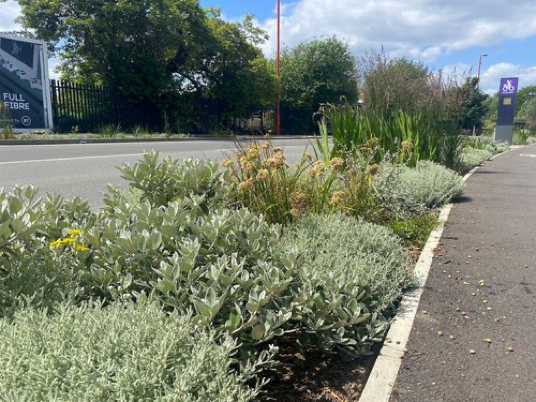
Streets can be places of plants, trees and biodiversity when they include planters and green verges, trees and parklets. Such streets are cooler in the summer and help absorb heavy rainfall. Meristem Design who design street features such as parklets and rain gardens, comments ‘In urban areas, we use many non-permeable materials (such as our roads). This means that water cannot drain naturally through the ground. In order to manage this, we have developed drainage systems that use pipes and sewers to redirect water. Sustainable drainage systems (SuDS) modify surface water flow at more natural rates, reducing the impact of urbanisation flooding by allowing vegetation and plants to absorb the majority of the rainwater. Too much surface rainwater in our cities often leads to a rising water table, causing our riverbanks to overflow and leads to devastating floods and damage to nearby properties. With climate change creating wetter winters and more frequent rainfalls, the level of surface water available will only increase, making the traditional drainage methods less and less effective. Creating rain gardens across our cities and towns is one part of the solution to this problem:https://www.meristemdesign.co.uk/suds-planters-rain-gardens
The Guardian today reports ‘UK droughts already threaten disastrous breeding year for frogs….Fortunately, wildlife groups and suburban gardeners are increasingly aware of the declining populations of frogs, newts and toads and are providing new habitats – the most important being our garden ponds.’
Pedal power for delivery vehicles is already happening. Cycle courier services have been around for many years now as bikes are often far quicker than any other vehicle for short urban journeys – and of course have been used by Royal Mail for centuries. Likewise Co-op’s use of bikes for grocery deliveries is not new. Freddie’s flowers – a weekly flower delivery service is also fulfilled by bike. Cycle delivery services such as Peddle Me, carryout same day deliveries for a variety of clients including coffee roasters, breweries, flower suppliers, film companies, local authorities, community kitchens, charities, restaurant chains and numerous food suppliers – “You name it, we deliver it”! They also offer a taxi service for people too!
Hammersmith and Fulham Council have set up ‘Parcels not Pollution’ – a delivery service that uses an e-cargo bike for business deliveries in Hammersmith and Shepherds Bush town centres.
Tradespeople people carrying out repairs, redecorations, window cleaning, laundry services etc are also making use of cycle power.
Shop local. When we walk and cycle more and drive less, it is local shops and businesses that benefit!
The Living Streets report, The Pedestrian Pound (updated 2018), noted that If more space is given for walking and cycling and less to cars, the absence of customers arriving by car is more than compensated by people arriving on foot or by bike. For example, in San Francisco, the first trial ‘parklet’ increased pedestrian traffic in the area by 37% on weeknights and increased people walking with bikes at the weekend by 350%. A similar scheme in Shoreditch, London, increased takings in an adjacent shop by 20%.
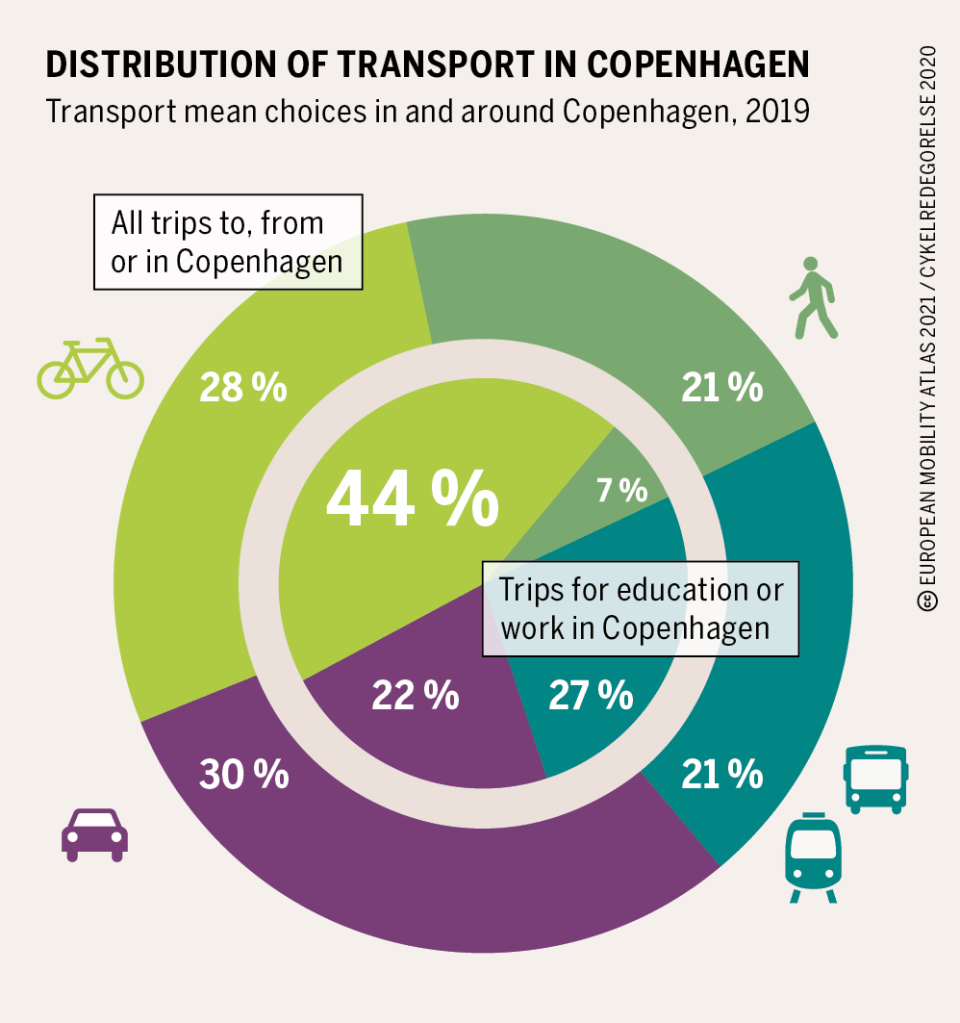
In Copenhagen the bicycle has become the most important means of transport. The goal is for 50 percent of all trips to work and education in Copenhagen to be made by bike by 2025. In 2018, they reached 49 percent. Out of all trips made to, from and in the City of Copenhagen, 28 percent were in 2018 made by bicycle (32 percent by car, 21 percent walking and 19 percent public transport). In the inner city, bicycles outnumbered cars in 2016.
The backbone of the city’s design for cycling is a network of protected bike lanes. In Denmark, unidirectional bike lanes are separated from both the pavements and the road by a kerb. Protected bike lanes are a must when the volume and speed of vehicle traffic is high.
‘When Waltham Forest Council received funding from Transport for London to create a low-traffic neighbourhood, local residents and campaigners worked hard to explain the benefits of low traffic neighbourhoods to the community.
At first some residents weren’t too keen on introducing low-traffic neighbourhoods and were worried that it would be difficult to access homes and businesses.
They also thought that it would lead to an increase in traffic on the main roads and might force traffic outside of schools.
However, they soon saw the improvement in the area, and counts on main roads in Waltham Forest have shown that traffic is now more spread out across the day and maximum peak hour flows are lower on the main roads.
Walthamstow Village is now one of London’s most advanced liveable-neighbourhood schemes and traffic levels have fallen by over 90% on some streets and by 56% on average. The scheme has made people think twice about using their car for shorter journeys and within a year, there was an increase in the number of people walking in the area, with residents walking 32 minutes and cycling on average nine minutes more per week. It’s now easier to cross the road and safer for cyclists and there’s a lot less air pollution.
“Bristol City Council is committed to making Bristol’s streets safer for everyone living, working and visiting the city. An area of priority are the streets outside our schools – we want to make the journey to school safer and healthier for children and their families, and help to make it a nice environment for everyone living and working there.
One of the ways we are doing this is through the introduction of School Streets, whereby the street or streets immediately outside the school entrance are closed to non-essential vehicles at school opening and closing times.
Only people walking, wheeling, cycling and scooting are permitted access to the School Street zone while the restriction is in place, with exemptions given to emergency vehicles and Blue Badge holders. In some cases, permits will be given to residents and businesses living or working within the zone – this varies from scheme to scheme and is decided on an individual basis.
Aims of the School Street scheme:
The aim of a School Street is to make it easier and safer for children and their parents to walk, wheel, cycle and scoot to school.
Reducing the use of private car journeys to and from school should lead to:
Less road danger from traffic
Less anti-social behaviour from inconsiderate parking and dangerous driving
More children walking, wheeling, cycling and scooting to school
Reduced congestion and local pollution from idling vehicles”



 The Green Tau