Leviticus 25 explains that the land should have a sabbath rest every seventh year. In that year no crops would be sown and the people would live off the surplus of previous years. Farmers over the millennia have learnt that you cannot constantly expect the land to keep on producing crops year on year without fail. The land either needs to lay fallow (rest), or it needs to be sown with a restorative crop such as nitrogen fixing beans or clover, or it needs the input of artificial fertilisers, so that it may recuperate its productivity. It is a lesson we are sometimes reluctant to heed. The Dust Bowl disaster of 1930s in the USA destroyed vast acres of farm land because farming practices did not maintain the fertility of the soil. An equivalent story can be told about the Aral Sea. This inland lake, once the fourth largest area of fresh water in the world, has been reduced to nothing because more water has been extracted year on year – to irrigate local cotton crops – than the rate at which water flowing in fills the lake.
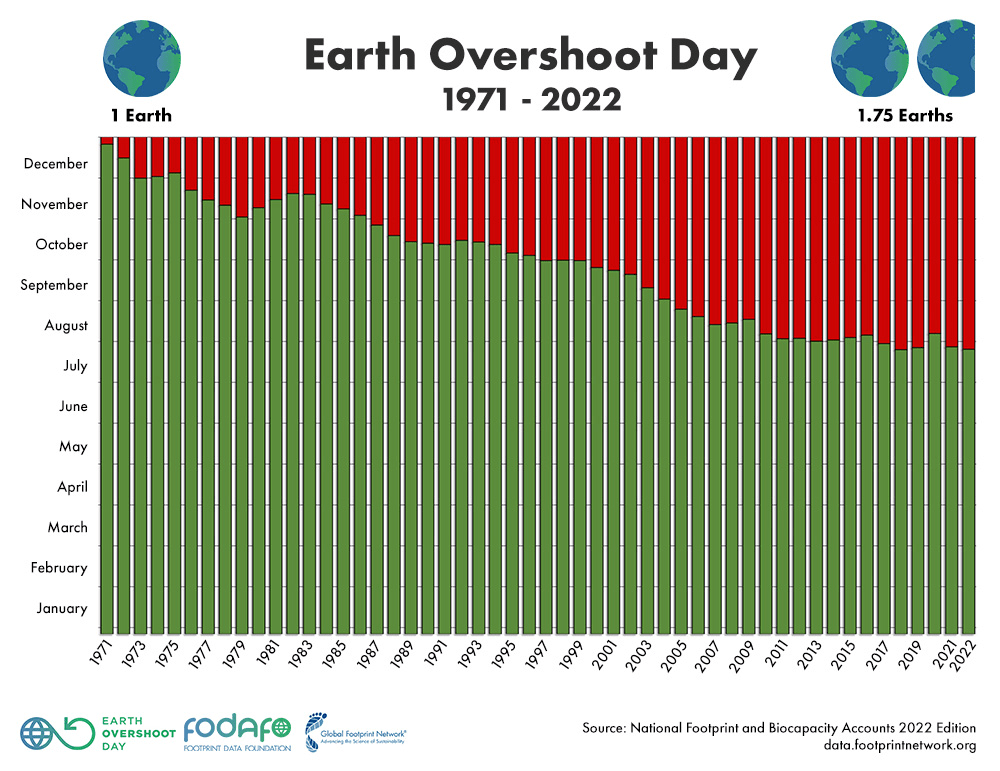
Ideally what we consume from the natural world – crops, timber, drinking water, clean air, energy – is balanced by the earth’s ability to regenerate. Prior to 1970 that was the case. Since then we have been using up the earth’s renewable resources at a rate faster than they are replenished. Scientists each year calculate that point when we pass from credit to deficit. This is called Earth Overshoot Day. This year the predicted date is 28th July. Seven months into the year and we have already – globally – consumed as much as the earth can replenish in one year!
Surely this state of affairs can not continue? What can we do about it and why aren’t we doing it?
Since 1970, Earth Overshoot Day has been falling earlier and earlier each year. Only in 2020 did it reverse: the reduction in world wide consumption because of Covid gave the earth a three week reprieve. Consuming less has to be the answer which means consuming more carefully and more sustainably. If we could do that in 2020 whilst coping with a pandemic, surely we could do it every year?
The Earth Overshoot website has details of various ways in which the global community could do this. https://www.overshootday.org/ Meantime we as individuals can make changes to our own lives and patterns of consumption. And we can ask or push for our churches, places of work, sports clubs, local authorities, museums, retailers, and government, to make similar reductions in consumption. We need change to happen at all levels.
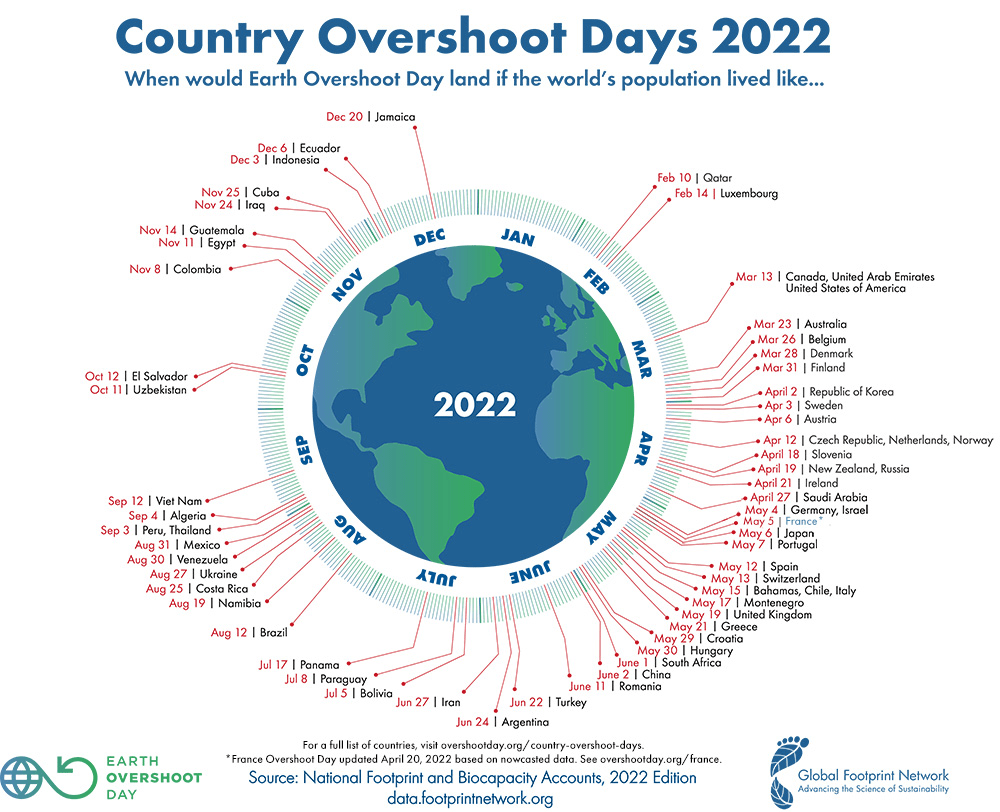
28th July is 2022’s Earth Overshoot Day at the global level. That date is the average of each nation’s own Overshoot Day. These dates range from 20th December for Jamaica (ie Jamaica pretty much balances its books, consuming only slightly more than it can regenerate in a year) to 10th February for Qatar. The UK’s Overshoot Day was 19th May. We would need three United Kingdom’s to satisfy our current consumption levels, whereas in reality we rely on other countries to help make up the shortfall.
Not only should we be addressing the conservation and safe use of resources here in the UK, we should also be offering support to those other countries on whom we rely to ensure we don’t deplete their resources and rather enable them to develop economies that benefit their own ecosystems.
On Sunday (17th July) with a focus on the environment, we looked at the plight of five creatures threatened by our human lifestyle choices. And it is not just these creatures whose futures are threatened but ours too as we all part of one interconnected ecosystem.
What action can we take to change these prospects?
“Orang-utans live in great tropical forests. They depend upon the forests for food and shelter, as a well as a place to live and to play. But the forests where they live are being chopped down and cleared away to make space for acres and acres of palm oil plantations to make lipsticks and margarine, shampoo and pet food, sunscreen and bio diesel. When the forests go, the orang-utans have no where else to live. It seems as if we are saying to the orang-utans ‘Go away you don’t belong here’.”
By carefully choosing what we do and don’t buy we can reduce the pressure on forests such as those where orang-utans live. We can avoid products that use palm oil or we can seek out producers who follow a code of conduct that requires them to protect indigenous wild life and farming communities.
It takes a bit of effort but research via the internet and especially using web sites created by ethical and environmental groups such as The Ethical Consumer and the Fair Trade movement can gives us the information we need to make better choices. We may conclude that some of things we have been buying are not really essential and that buying less is another way of taking action. We can also investigate the sourcing of other crops such as cocoa, sugar cane and soya which can be equally detrimental to the environment. NB the vast expansion of soya beans as a crop goes not to create soya milk, but as fodder for the world’s escalating meat farms.
“Polar bears live in the Arctic where they go hunting across the ice. They dive into cracks and holes in the ice to catch fish and seals. But climate change is making the world hotter and the ice is melting. Without the ice the polar bears cannot hunt fish and seals. Instead they and their cubs starve. It seems as if we are saying to the polar bears, ‘If you can’t cope with climate change and melting ice caps, then we don’t need you.’”
“Sand martins spend the winters in Africa and the summers in Europe. In the spring they fly thousands of miles across the Sahara to Britain and in the autumn they fly the same thousands of miles back. But climate change is making the world hotter and when they fly over the Sahara Desert, the air is so hot that many martins simply cannot cope and they fall to the ground. It seems as if we are saying to the sand martin ‘If you can’t cope with climate change, then there’s no place here for you any more.’”
The climate crisis is rapidly increasing and is causing and exacerbating many other problems. We can each take action by changing our lifestyle to reduce our carbon footprint. There are many books and web sites on ways and means. The principal areas of change we can make in our individual lives are in Transport: not flying, rescuing significantly our dependence on cars and instead using public transport, cycling and walking.
Food: eating locally produced, seasonal, organic food, and replacing meat with plant based meals
Heat and electricity: reducing demand by insulating our homes (which also helps keep them cool in the summer) and turning down the thermostat, using renewal sources of energy, reducing the frequency with which we wash ourselves and our clothes, and reducing our dependence on so many high energy consuming appliances
Consumption: the things we buy and consume all have a carbon footprint. We can consume less including less packaging, we can repair and reuse what we do have, when we do buy new we can seek out things that are ecologically and ethically made, and we can make sure that everything is recycled at the end of its lifecycle.
But we won’t be able to make the necessary reduction in carbon emissions on our own. We are locked into systems that make it impossible – rail travel is made more expensive than air travel through taxation, regions outside London and especially rural areas are inadequately provided with public transport, people’s incomes are often too low to allow for investment in insulation and home improvements that would reduce energy costs, large fossil fuel companies across the globe continue receive tax subsidies, manufacturers are not required to pay for the cost of collecting and recycling their products, the true value of nature is not included in investment decisions, our pensions fund not only fossil fuel investment but also the destruction of forests for palm oil and soya crops … the list goes on. We need to engage with and support environmental groups that call for system change.
“Around the world in different oceans live whales. Whales get caught up in fishing tackle and crashed into by shipping. They are disoriented by noise from oil exploration. Every year fewer and fewer whales are born. It is as if we are saying to the whales, ‘Go away, we don’t need you’.”
But we do need whales! They are amazing creatures. In the oceans there tiny tiny things called phytoplankton that, like leaves on trees, convert carbon dioxide and sunlight into oxygen and energy. And phytoplankton provide food for slightly bigger plankton and the plankton provides food for all manner of other sea creatures – including whales. But there is one thing that phytoplankton needs and that is iron. And do you know where that iron comes from? Whale poo! If oceans are to remain healthy with phytoplankton providing oxygen and energy for plankton and seaweed, and fish and other sea animals, then we need whales.”
“What about bees? Bees live in lots of different parts of the world feeding on nectar from plants. But we have been getting rid of wild plants and hedgerows, and spraying fields with herbicides so that there is not enough food for the bees. And we have been spraying crops with pesticides that kill not just the ‘pests’ but the bees too. Every year there are fewer and fewer bees. It is as if we are saying to the bee, ‘Go away, we don’t need you.’
But we do need bees. Without bees to fertilise crops we won’t have apples and pears, or strawberries and cherries, or figs and kiwi fruits, or almonds, avocados, mangos …. the list goes on and on.”
The loss of biodiversity is immense and accelerating. We can support biodiversity locally by the way we use our gardens, growing wild life friendly plants, providing food and water for birds and insects, by avoiding the use of pesticides and herbicides and peat. We can help by supporting local and international organisations that protect and conserve biodiversity. And as above, we can use our spending money to influence change.
Saving the environment is a numbers game, so talk about the actions you take with friends and family, with shopkeepers and suppliers, with local councillors and MPs, and encourage them to take action too.
What is sustainable living? And how do we go about it? Something that is sustainable is something that can keep on going for a lengthy period of time without diminishment. We might look at household budget and apply the Micawber principle:
“Annual income twenty pounds, annual expenditure nineteen, nineteen and six, result happiness. Annual income twenty pounds, annual expenditure twenty pounds ought and six, result misery.”
As long as the required input is equal or less than output, the budget is sustainable. When what is consumed exceeds what is coming in, the budget is no longer sustainable. Sustainable living is the same: our lifestyle is sustainable if what we consume is equal to or less than resources we use.
Let’s us taking heating for our homes as an example.
If say we were to heat our homes with a wood burning stove, for that to be sustainable, we would need sufficient mature woodland to produce each year the wood we would burn. (This is not taking into account the cost to society of the pollution to the air).
What if we hear our homes with oil and gas? That is ‘sustainable’ only in the short term as both these fossil fuels are non renewable. Once they are gone, they are gone. They cannot be replaced. Aside from air pollution, the major problem with soil fuels is the amount of carbon dioxide that they release into the atmosphere. It is a rate that far exceeds the rate at which it can be absorbed by the planet. This is why heating our homes with fossil fuels is not sustainable in either the short or long term.
The most sustainable way of heating our homes is not to use any fuel but rather to build/ refurbish them with insulation levels that make extra heat (over and above our own body heat) unnecessary. Houses equipped to this standard are known as a “passivhaus” – https://www.passivhaustrust.org.uk/
Retrofitting is not without its financial cost which puts it out of reach for many people. (Sadly our government doesn’t understand that the whole nation would all benefit if insulating homes was state funded). Nevertheless any improvement we can make to the insulation of our homes will reduce our carbon footprint and energy bills and therefore makes heating our homes more sustainable: https://energysavingtrust.org.uk/insulating-your-home-back-to-the-basics/
A related area to that of heating, is electricity. What determines the sustainability of electricity?
Electrical production can be divided into two categories, renewable and non-renewable. Non-renewable electricity comes from power stations powered by coal/ gas/ oil. These fossil fuels are finite and cannot be replaced. Because of the scale of their carbon emissions, using them is highly destructive due to the adverse effects they cause of climate change and air pollution. Electricity produced by a fossil fuel driven generator is similarly non-renewable.
Renewable electricity is produced using wind, solar, tidal or geothermal energy. These sources of energy are not diminished through use; they are available on an ongoing basis. In other words, they are sustainable.
Less easy to define is electricity produced using nuclear energy and that produced using biofuels such as wood chips, sugar cane etc. The amount of nuclear fuel needed in proportion to the energy generated is minuscule which is why nuclear power is often included along side renewables, but there are huge problem surrounding the safety of nuclear power stations and the disposal of nuclear waste that raises questions about its sustainability.
Wood chips and sugar cane are both renewable resources but using them as an energy source is questionable. In a world where many go hungry and where more and more of the world’s natural or wild landscape is being lost, is it sustainable to use scarce land resources to grow crops for fuel rather than food?
Questions around the sustainability of energy sources also apply to the sustainability of different forms of transport. The most sustainable means of transport is walking. It’s what we are designed for and uses no more energy than that required to feed us. The same is true of cycling, although according to Mike Berners Lee in his book, How Bad are Bananas, suggests that, depending on whether our diet is made up of beef burgers or bananas, a battery powered bicycle may have a lower carbon footprint! As above any transport reliant on fossil fuels – whether that is a petrol car, a diesel train or a plane – is not sustainable. Electric powered transport where the source of electricity is renewable is more sustainable but there are downsides to consider. Electric vehicles rely on batteries which are made from non renewable minerals such as lithium and cobalt – and cobalt in particularly comes predominantly from mines where employee welfare is minimal.
In sparsely populated areas, transport systems that rely on buses or trains may need to develop on-demand rather than time-tabled services, in order to make their use of limited resources sustainable.
Plants are a naturally renewable resource but that doesn’t make all food equally sustainable. Factors to take into account include water, fertilisers, transport to markets, food waste, and whether the plants are feeding us directly or indirectly. Some crops such as rice, strawberries, blue berries and almonds, require large amounts of water. In water sensitive regions irrigating such crops may divert water away from supplies used by local people for growing staple foods, as well as for drinking. It may also divert water away from aquifers and wetlands regions thus damaging local flora and fauna. In such circumstances, these crops cannot be classified as sustainable.
Fertilisers, especially artificial ones, use up limited non-renewable mineral resources, as well as contributing large amounts of carbon dioxide to the atmosphere. In addition the run off from fertilisers damages water courses and kills plants and creatures, compounding existing biodiversity losses.
Where foods are imported over longer distances – and especially so when the mode of transport includes airfreight -will consume more resources and in particular will increase the food’s carbon footprint. Imported Spanish strawberries, out of season avocados and air freighted asparagus are a few examples of unsustainable foods. In some instances the sustainability of a product becomes questionable when it takes over land used to grow staple foods for the local population or where it involves the clearance of indigenous wild vegetation such as the clearance of tropical rainforest to grow sugar cane.
The majority of farm land globally is used not to feed people directly but to grow food for animals intended for human consumption. It takes 100 x more land to produce 1kg of beef than to produce the equivalent in plant based food. In terms of feeding the global population a diet with high levels of meat consumption is not sustainable.
Plants as a renewable resource are also used for making things – clothes and fabrics, paper and furniture, rubber, paints etc. As with plants brown for food, similar questions about sustainability arise. Cotton for example is a heavy user of water – water abstracted for cotton growing was the major factor causing the disappearance of the Aral Sea. The growth in demand for palm oil used in products as diverse as lipstick and margerine, has led to the clearance of vast areas of natural habitat including mangroves. Demand for paper has seen naturally biodiverse forests replaced with monoculture pine plantations.
The sustainability of every product we use needs to be measured in terms of renewability, carbon footprint, water footprint, impact on biodiversity, impact on local populations, the working conditions for those who grow, produce or sell, transport footprint, and the ease with which at the end of its life it can be recycled or disposed. Sustainability may begin as a question about individual lifestyle but quickly becomes a question about global sustainability.
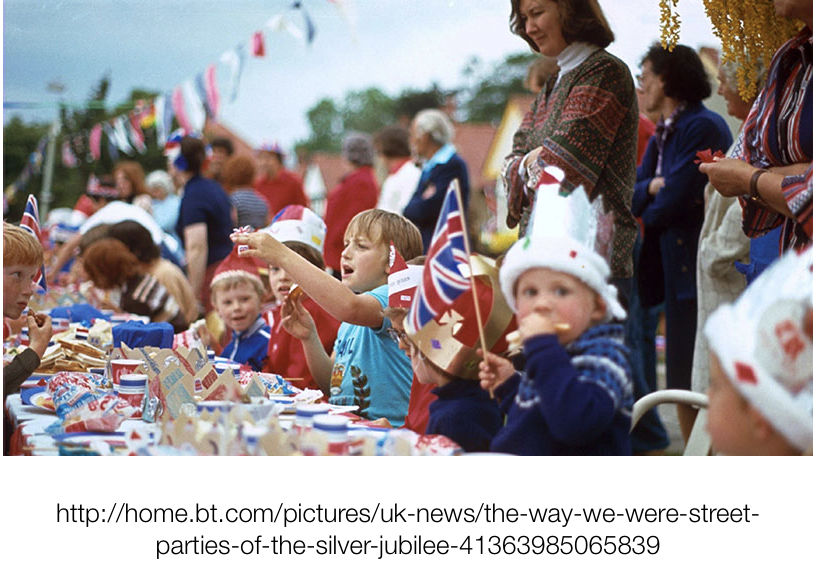
Britain – or at least the corner where I live – is awash with Union Jack bunting, flags, and pending street parties. Shops promote jubilee wares – foods and drink, books and decorations – and unicorns in coronets and corgis with collars peep round the displays. This jubilee celebrates the Queen’s 70 year reign – longer than any previous British monarch.
But what is it that we are celebrating with our street parties and Union Jacks? Maybe we celebrating that for 70 years there has been one constant in our national life, a constant largely – if not entirely without upsets or disputes. May be we are celebrating our national pride – but of what is it that we’re proud? Maybe we are celebrating a chance to look back with nostalgia to the memories of the good old days, when life seemed simple and innocent. Maybe we are enjoying the challenge of creating our own entertainment with party games and a sing-song and traditional tea-party foods – plus the challenge of dicing with the vagaries of the British weather. Maybe we are wanting to pass on these British traditions to a next generation. Maybe we want for a few hours at least to feel that we do know our neighbours, that we are part of a local community. Maybe we’re enjoying the chance to reclaim our streets, to take them over as a public space where we walk and play, or sit and chat. The chance to stop the traffic, to stop work, to step away from the screens. Maybe its the chance to feel part of a national family. Maybe its a chance to building on the relationships that evolved during the pandemic.
Biblically the jubilee marked a once in a lifetime break at which time debts were cancelled, slaves freed, land restored, and arable land furloughed. It was a time when the mercies of God were made manifest. A time of rest and restoration, a levelling up of resources and of opportunities.
If we were cancelling debts and restoring life and well being to both people and the land (land in its fullest sense of an ecosystem); if we were seeking God’s mercy (by which I mean acknowledging and living a life of holiness and righteousness) then yes I feel we would have a jubilee to celebrate and a nation to be proud of. Can we transform our nation, can we effect this change?
If we did maybe street parties would be our national monicker: a gathering that takes place in a public space where everyone sits as equals, where neighbours look out for each other, eating foods that everyone could afford- sandwiches and scones with jam and cups of tea!
Over the last 24 hours I spent about 6 hours supporting the Christian Climate Action vigil outside the Methodist Central Hall, the venue for this year’s Shell AGM. I didn’t stay overnight as some brave souls did but came and went in stints. My companions were deeply committed to the environmental cause: that we humans need to wake up to the damage we are causing to the wonderful creation God has provided and of which we are an integral part: truly we are brothers and sisters, kith and kin with every other living thing. Yet our human unabated consumption of fossil fuels is producing carbon dioxide in such quantities that we are changing the climate, wiping out plant and animal species, melting ice caps and glaciers, and consigning our fellow humans to poverty, ill health and death.
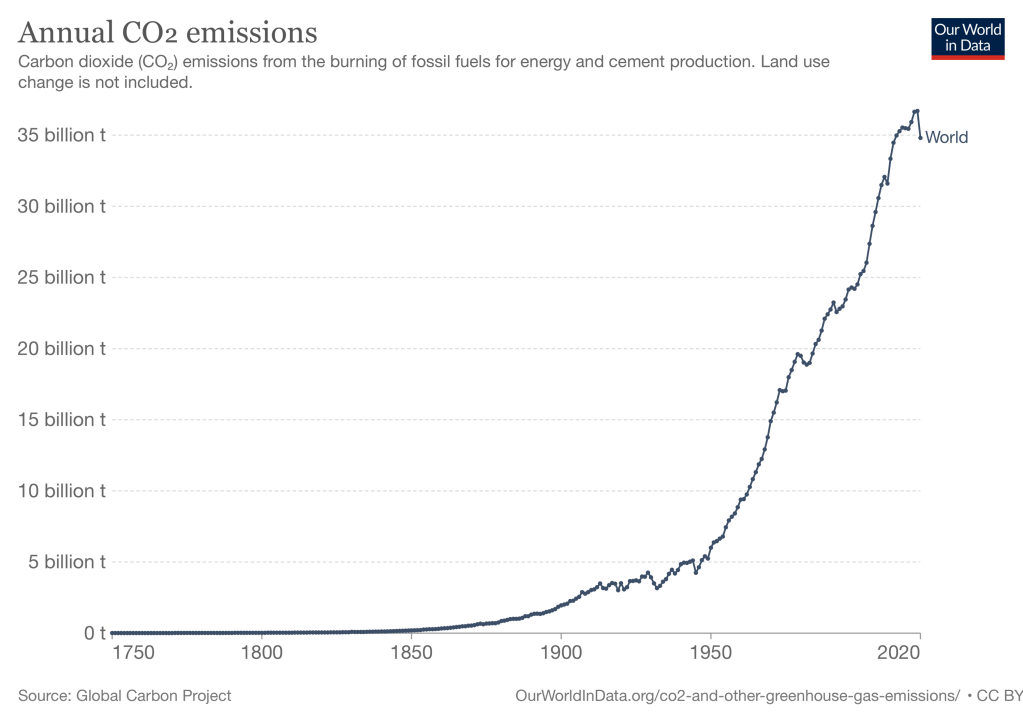
Our presence, as well as being peaceful and prayerful, was intended to raise people’s awareness of the climate crisis and the role that large oil companies, such as Shell, play. To put this in context, CO2 emissions for the entire globe in 2021 were 36.3 bn tonnes, and of this Shell contributed 1.299 bn tonnes. To avert the worsening affects of climate change, CO2 emissions need to be reduced by 43% by 2030, and to zero by 2050. This is a huge challenge for us all but one which will be hard to achieve if the fossil fuel industries continue to invest in expanding oil and gas production rather than shifting to the production of renewable energy.
As I prayed, I admit I had little hope that my prayers were going to effect an about-turn on the plans that Ben van Beurden, the Shell CEO, has for the company. However I did have a slither of hope that our prayers and our presence might influence the hearts and minds of the shareholders. Perhaps there might be a stirring in their conscience about the effects that fossil fuel are having on the planet. Perhaps they might begin to ask questions about the sense of pursuing profits from oil if it results in a world that becomes uninhabitable. Perhaps they might question why the company was not protecting their future by investing in renewable energy. Perhaps they would question the leadership being offered when such a large CO2 producer choose not to follow the global strategy agreed at COP26?
So I prayed. In my mind I envisaged the Holy Spirit like a dove flying around above the heads of the shareholders in the Methodist Central Hall, perhaps pausing to whisper in someone’s ear. I envisaged a scene similar to that of Pentecost, of the room where all the disciples were gathered, with the wind of the Spirit inspiring and energising those present. I imagined little flames might hover above people’s heads and that they might have the experience of the disciples on the road to Emmaus, of something warm burning within them.
Outside the building drums and the call and reply of protestors rose and fell like a storm. Inside the hall, the sound would, I guess, be deadened and I thought of the still small voice in the storm encounter by Elijah. And I thought of the story of Jonah and the storm he encountered and which manhandled him (with the help of a whale) to the shores of Nineveh. There to his surprise and chagrin, the people listened to the message and repented.
And I prayed. I envisaged the call of the evangelists, repent and believe. Repent – a change of heart, a turning around of the way we think, a conversion of the way we do things – and believe. Believe that there is a better future, that we can look forward to a new and brighter future, where things will be green and beautiful, just and fair, where we will live in peace together. As well as seeking a new way of living – repentance – we need to offer a vision of the better world in which we can all live: the kin-dom of God.
The term carbon bomb has been widely used in climate circles for the past decade to describe large fossil fuel projects or other big sources of carbon, but more recently has been given a more specific definition: projects capable of pumping at least 1bn tonnes of CO2 emissions over their lifetimes.
To put this figure in context, just before Covid, annual CO2 emissions peaked at about 36bn tonnes.
The IPCC report on Mitigation of Climate Change published on 4 April, specifies that emissions should peak no later then 2025 and be reduced by 43% by 2030 if we are to contain climate change and global heating at tolerably safe level. If that peak in 2025 is, say, 40bn tonnes, then globally we would need to be reducing carbon emissions by 4bn tonnes per year.
The International Energy Agency has already stated that the existing oil, gas and coal fields already in operation will provide all that is necessary to meet our demands for fossil fuels. In other words, if we are to meet our emissions reduction targets there is no need to open up new fields. This surely begs the question why anyone is investing money in expanding fossil fuel extraction or in exploring new fields? In part it may the fear of being the first to opt out – will they be exposed to risk? Will they loose out on profits? If everyone moved together it would be safer and fairer.
A recent report by the Guardian estimates that the current expansion plans of the fossil fuel industry includes 195 carbon bombs, and that the dozen biggest oil companies are on track to spend $103m a day for the rest of the decade exploiting new fields of oil and gas that cannot be burned if global heating is to be limited to well under 2C. These companies – and those investing in them – are betting that by 2030 governments will not have achieved the 43% reduction in emissions and will still be in the market to buy oil and gas. If their bet wins the world temperatures will have risen by more than 2C and we will all be suffering the worst impacts of the climate crisis. https://www.theguardian.com/environment/2022/may/18/carbon-bombs-inside-the-20-may-guardian-weekly
On the other hand what could $103m a day achieve if it were invested in renewable energy? How many wind farms? How many tidal energy schemes? How many solar panels on buildings? How many heat pumps? What could it achieve if invested in climate adaptation projects? How many buildings could be insulated (against heat as well as the cold)? How many trees could be planted to absorb water and lower temperatures? How many efficient public transport schemes? How many new farming techniques, new varieties of seeds, and advanced weather ?
It seems to me that food production in the UK is caught between two objectives: that food should be produced as cheaply as possible, and that profits for the shareholders should be maximised. Producing food as cheaply as possible has been seen as a way of ensuring everyone can afford to eat. However producing food cheaply doesn’t necessarily make it affordable.
Reducing the cost of food can be achieved in various way:-
Industrialising processes whether that is the Chorleywood method of making bread or factory farming livestock
Large scale monoculture farming where land is cleared to grow single crops on a large scale – including the clearing of rain forests.
Intensified farming where animals are kept in barns and fed high protein diets rather than having a free range lifestyle, foraging and grazing as they go – low intensive free range animal foraging requires a much greater area of land. On the other hand, eg high protein diets fed to indoor animals has to be grown somewhere.
Intensive use of pesticides, herbicides and fertilisers to maintain high crop yields. This can become an expensive option when the cost of these inputs rise.
Keeping costs down by paying low wages and/ or by employing people on a seasonal or zero hours basis only. This applies throughout the food industry from the farmhand to the supermarket check out.
Automation of processes whether that is robots picking crops or automated diary parlours miking cows.
Importing food from countries where labour costs are even lower. is of course a flaw here.
Many of these cost saving practices involve reducing wages and/ jobs. As wages and jobs fall so the need for even cheaper food rises. There seems to be a flaw in the system!. Recently Ranjit Singh Boparan, the UK’s biggest poultry supplier of chicken, queried how it was that his industry could producing chickens that sold for less that a pint of beer – and whether such low prices could be maintained. In part he was questioning whether there were any ways in which costs can be cuts. Yet even at £2.66 (Tesco’s) for a chicken, chicken is still of the menu for a lot of people.
People who have to resort to food banks to eat, are not just people who are unemployed. They are also those who, because of disabilities and illness, receive disability benefits, those who are elderly and living on state pensions, those who are employed on zero hours contracts, and even those who are in full employment. The current minimum wage is £8.91 per hour for those over the age of 21. The Job Seekers Allowance is £77 a week for those 25 and over – depending on circumstances, this may be supplemented by Universal Credit. The full basic State Pension is £141.85 per week. All of these are less than the minimum wage recommended by Living Wage Foundation – £9.90 (£11.05 in London). Whether even this figure will be sufficient at a time of sharply rising fuel costs (and the knock on effect that will have an all products) is yet to be seen.
We have created an economy that does not provide the poorest with the necessary financial resources to enable them to buy the daily food they need – let alone enough to pay for heating, period products, housing, travel etc. Why is this so? Because the economic model we use says that profits must take priority. If costs rise such that they risk profits, then costs must be reduced – even if that means reducing wages and employment opportunities. As a fig leaf, a vague promise is proffered that, by maintaining profits and ensuring that the economy continues to grows, the trickle down effect will – ultimately – increase the wealth of even the poorest in society. No where does our economic system suggest that goods should be priced at a level that allows the workforce to be paid a genuinely fair wage – a wage such that they could afford the essentials of life including chicken and a pint of beer.
If everyone was paid at levels of pay (including benefits and pensions) that allowed them to eat properly, heat their homes, pay for their accommodation etc, then yes prices of some goods (such as chicken) would go up. And of course that proposed ‘fair’ level of pay would have to be sufficient for the recipients to pay those higher food (and other) prices. There would be a knock on for those already on higher incomes in that their day to day living costs too would go up – but usually the higher our income the smaller the proportion we spend on essentials such as food so the impact would be smaller the higher one’s income. Would we not all feel more comfortable as a society knowing that everyone was being properly fed and that no one was benefiting because someone else was being underpaid?
This reinvisiging of the economy is not a pipe dream but is to be found in the shape of Doughnut Economics. In her book, Doughnut Economics: Seven Ways to Think Like a 21st-Century Economist, Oxford University’s Kate Raworth argues for a radical overhaul of our traditional economic models: “Humanity’s 21st century challenge is to meet the needs of all within the means of the planet,” she says. “In other words, to ensure that no one falls short on life’s essentials … while ensuring that collectively we do not overshoot our pressure on Earth’s life-supporting systems, on which we fundamentally depend.”
Doughnut Economics challenges our existing profit orientated economics that sees economic growth as the only way forwards. Doughnut Economics argues that we can have a more caring and more sophisticated economic model which has two key objectives. First that everyone should have a comfortable standard of living – one that meets all seven priorities of the UN Sustainable Development Goals. Second that all economic activity should be sustainable and not cause irreparable damage to life on earth – ensuring a stable climate, fertile soils, healthy oceans, a protective ozone layer, ample freshwater and abundant biodiversity. https://doughnuteconomics.org/about-doughnut-economics
This economic model would not only prioritise the needs of the 2 million in the UK who cannot afford to eat on a daily basis; it would also prioritise the needs of the 3 billion globally who are malnourished. And it would prioritise the well-being of chickens that are reared for less than the cost of a latte!
19 Then the high priest questioned Jesus about his disciples and about his teaching. 20 Jesus answered, ‘I have spoken openly to the world; I have always taught in synagogues and in the temple, where all the Jews come together. I have said nothing in secret. 21 Why do you ask me? Ask those who heard what I said to them; they know what I said.’ 22 When he had said this, one of the police standing nearby struck Jesus on the face, saying, ‘Is that how you answer the high priest?’ 23 Jesus answered, ‘If I have spoken wrongly, testify to the wrong. But if I have spoken rightly, why do you strike me?’ John chapter 19
I studied this passage with my Lent group. Jesus rightly tells the high priest, and those in authority with him, that he has spoken openly and that if anyone had wanted to know what he was teaching, they would only have to pay attention. It’s clear from the gospel that both Jesus’s, and, before him, John the Baptist’s, activities have been followed by those in authority. The puzzling question is why is it that those in authority, those who have lived and worked – and worshipped – within the religious establishment, do not realise who Jesus is and do not understand the message of his teaching?
Are they ignorant? In terms of facts, no they cannot be ignorant. Jesus has been teaching openly, and they themselves have been following him.
Are they ignorant in terms of understanding? Do they simply not understand what the facts mean? Do they simply not understand that Jesus is ‘of God’, as a son to a father, and that what he teaches comes straight from God?
Are they blinkered? Are they so sure that God cannot inhabit human form, that their minds and eyes are closed to any such possibility? There are certainly many examples of people and cultures that blinkered. In the 19th century explorers who came across the bronze sculptures of Benin, could not imagine that an African could have created such art works and therefore they must have been the work of a lost civilisation. At the same time many women who wished their writing to be accepted, has to assume a male pseudonym.
Are they so enmeshed in a culture and system – largely of their own making – that they cannot see or imagine any different way of doing things? Does this culture and system so embrace every part of their life, their past and their future, that there is no room for any alternative?
Are they self righteous? Are they so sure that they are right, that their understanding of the world and their interpretation of what is happening is right, that they cannot envisage an alternative view point?
Are they obtuse? Do they just not want to hear or believe or countenance anything that involves change?
When Jesus is then brought before Pilate, it seems as if Pilate is at least willing to explore what it is that Jesus represents, what it is that he is about. Pilate does at least lift the edge of the curtain so as to speak, to see what might be happening. Then the opportunity becomes engulfed in matters that Pilate finds more pressing. The discussion is foreclosed.
The story of Good Friday tells us whilst the obstinacy, the short sightedness and narrow mindedness of those in authority led directly to Jesus’s execution, God’s capacity for salvation exceeded everyone’s dreams.
God’s kingdom, God’s rule, is present here and now on earth for those who wish to be part of it, yet complete salvation is still a work in progress, and humanity faces many trials and ills. One of the most pressing is the climate crisis. With only a handful of years grace remaining before catastrophes overwhelm us, we sense we have a last chance to transform the ways in which we live so as to truly care for one another and the whole of creation. The message seems so clear. The message has been so oft repeated. The route maps to safety so clearly plotted. How is it then that those in authority do not understand, do not respond, do not take action? How can they be so obstinate, so obtuse, so short sighted?
Must we brace ourselves for further tragedy? Is our only consolation that Christ will be with us? Let us pray and act for change. Let us strive for conversion.
On Monday the IPCC produced the third and final part its reports assessing where we are as world vis a vis the climate crisis. The news is not good. “It’s now or never, if we want to limit global warming to 1.5C,” said Prof Jim Skea, a co-chair of the report. “Without immediate and deep emissions reductions across all sectors, it will be impossible.”
Clearly what is needed is system change. As previously discussed (https://greentau.org/2022/04/05/the-green-tau-issue-40/) governments are seldom willing – outside of emergencies such as war – to make system changes unless they feel that is the direction in which the voters have already moved. System change needs social change – and that means a change of heart at the level of the individual, ie the average person on the street. Is the average person on the street ready to accept the changes in lifestyle that ‘immediate and deep emissions reductions across all sectors’ will entail? And if not how can we bring about a change of heart?
Issue 40 looked at civil action which, whilst making demands of government, seeks also to stimulate a pro-active response from the public. The action of groups such as XR and Just Stop Oil may raise awareness of the immediacy and scale of the crisis. Their action may embolden others to join in – reassuring them that they are not lone voices crying out in the wilderness. Certainly previous XR protests have seen support for the movement grow. But is it enough? Has it brought about the widespread change of heart needed? Are there other ways?
‘Be the change you wish to see in the world’ – to paraphrase Gandhi. If we live our lives as would be necessary to achieve net zero, making the cuts and changes that makes our life sustainable, then we are a living example of how a life could look – and others may follow.
Walk the talk – a phrase used by John Gummer, the chair of the UK’s Climate Change Committee, reflecting in the aftermath of COP26. We can only be credible in asking others to respond actively to the crisis, if we are already doing so.
Climate anxiety, which notably is growing amongst children and young people, can only be genuinely assuaged by us if we are walking the talk. If we are not, then we are effectively deriding their concerns.
Bucking the trend – be proud, be confident that you are doing the right thing and more people will be interested in what you are doing. Don’t hide your light under a bushel but be upfront about the changes you are making to your lifestyle and why.
Have a dream – think, imagine, envisage what the ideal world world look if those ‘deep emissions reductions across all sectors’ had taken place. What would be the highlights, the sources of pleasure, the things of beauty?
Take strength from knowing that, even if not else is, at least you are doing the right thing. Living a counter-cultural life does need strength and confidence. For many it is where their Christian faith brings its own courage.
If no one changed, change would never happen. There has to be the first one to take the first step, to set out on a new path – if it’s you, congratulations, you’re a star! You are the beacon for others to follow.
Strength in numbers – find others who are changing their lifestyle, maybe informally or through an existing climate/ creation care organisation. Support and encourage one another, gain strength from being part of a group, part of a community, part of a movement.
Who can we make what we are doing attractive to others? How can we engage others in the conversation? How can we enthuse and encourage others?
Talking about it – with friends and family, with neighbours and colleagues, with shop staff and sales people, with teachers and parents at the school gate, with people in church, at the gym, in clubs and pubs – any time we might engage in conversation. Be a story teller. Write about it, share it on social media. Post photos. Wear it as a badge on your sleeve, lapel, bag, hat.
Flaunt it!
Frequently we will find our efforts stymied by the system. When we are, we need to needle those who can effect change. Ask for the change needed when shopping. Contact the managers, the suppliers, the producers. Even if they can’t effect change immediately, the constant reminder that change is needed will spur them on. And when change does happen, acknowledge it gratefully and make sure others also know. Write to your MP and your local councillors. The more an issue is raised, the greater will be the incentive for them to take note and push for the system change we need.
Is it enough? I know I often feel that what I do is ineffectual, that it is energy expended for no positive outcome. Should I give up and just look after the plants and creatures that live in our garden while I can, and simply wait for the disaster that is coming?
A limited amount of press coverage has been given to the Just Stop Oil movement which is currently blockading various oil refineries and terminals around the UK. Just Stop Oil are using the tactics of civil disobedience rather than civil resistance to push the government to stop permitting any new oil production. Explaining what this shift would look like, one supporter told the Guardian last month that it would mean “stopping pointing out what the government should or shouldn’t be doing [and instead] actively stopping government doing what they shouldn’t be”. The campaign, which has involved protesters being glued to roads, suspended on bamboo tripods, and locked on to oil drums and each other, is taking place in defiance of a temporary high court injunction banning protests outside oil terminals. Just Stop Oil has vowed to continue “civil resistance” protests until the government agrees a moratorium on all new fossil fuel projects and claims it has more than 1,000 supporters willing to be arrested for taking part. “We need the government to stop funding new oil projects and we need it now! Our only means of highlighting this issue is mass civil resistance,” they said in a post on Instagram. https://www.theguardian.com/environment/2022/apr/04/protesters-block-oil-depot-near-heathrow-as-action-enters-fourth-day , https://www.theguardian.com/environment/2022/apr/01/environmental-protesters-block-oil-terminals-across-england
Why is Just Stop Oil so committed to and adamant about, their demand?
In August last year, the first part of the IPCC’s latest assessment (each assessment is the product of five to seven years by three different working groups) was published. This part of the assessment focused on the physical science aspects of climate change, and concluded that the world had on,h a narrow chance of limiting global heating to 1.5C (We are already at 1.1C). This limited window of opportunity needs everyone – governments, businesses, industries, farming etc – to stick to what their agreed 2030 targets.
The second part of the assessment focused on the effects of climate change, such as extreme weather, droughts, floods and temperature rises, and how humanity can adapt to these. This was published in February when it was sadly overshadowed by the invasion of Ukraine. It reported that 3.5 billion people are highly vulnerable to climate impacts and half the world’s population will suffer severe water shortages at some point each year. One in three people are exposed to deadly heat stress, and this is projected to increase to 50% to 75% by the end of the century. Half a million more people are at risk of serious flooding every year, and a billion living on coasts will be exposed by 2050. Rising temperatures and rainfall are increasing the spread of diseases in people, such as dengue fever, and in crops, livestock and wildlife. If global heating continues and little adaptation is put in place, 183 million more people are projected to go hungry by 2050.
The climate crisis is an imminent and highly dangerous. The task of averting this catastrophe relies on us all achieving net zero carbon emissions by 2050 and at least halving them by 2030. Just Stop Oil is not demanding that the government stop all consumption of oil overnight. They are demanding that the government stops our increasing use of oil, and takes action to cut back our use of oil so that we meet our 2030 and our 2050 net zero targets.
The war in Ukraine has highlighted our unhappy dependency on fossil fuels, especially those we import from other parts of the world whose regimes are corrupt and un-humanitarian. The solution to this short term problem should be increasing renewable energy capacity – through investment in wind, tidal and solar energy – combined with a comprehensive programme to insulate homes and other properties. Yet there is a risk that the government will opt to escape this problem by allowing more oil exploration in the North Sea. To do so would make meeting our 2030 net zero targets an impossibility, consigning us to trauma of accelerating climate change.
For Just Stop Oil what is needed is system change. A change from the current oil based system where the government (through taxation and policies) and businesses ( through investment and practices) perpetuate the use of oil as the main source of energy and the mainstay of production. Consumers find themselves trapped in the system. Gas heating is cheaper than any other form of heating, flying is cheaper than travelling by train, driving is cheaper than public transport, imported food is cheaper than domestically grown, virgin plastic is cheaper than recycled etc etc. It is a system stacked against the environmentally concerned individual.
Is it surprising then that for many environmentally concerned individuals the only option is civil disobedience? And where does that leave the more fainted hearted environmentalist?
Governments are seldom willing to make system changes unless they feel that is the direction in which the voters have already moved – in recent history one might include the over turning of the poll tax, reining back on nuclear weapons development, and gay weddings. Outside times of severe crisis such as war, system change also needs social change – and that means a change of heart at the individual, ie the average person on the street. Is the average person on the street ready to accept the changes in lifestyle that reducing our dependency on oil and achieving the halfway 2030 net zero targets demands?