Christ is risen: alleluia! 

6th April 2026

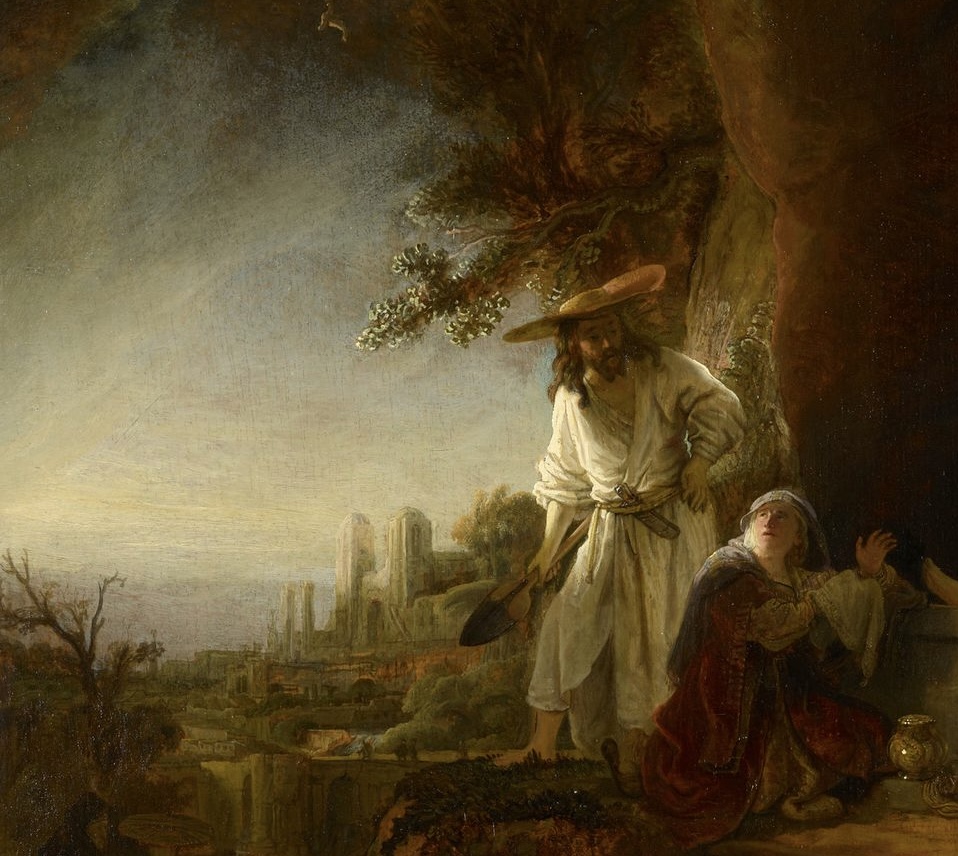
This is part of a larger picture by Rembrandt. It is dawn on Easter morning. Few people see the dawn every day; most of us are either still asleep or busy working. Few people saw Jesus that morning, and quite likely only a few of those recognised that it was Jesus – the risen Jesus!

Jesus’s resurrection happens quietly, secretly, and is revealed personally only to a few. And even those few, who indeed are his followers, struggle to understand what has happened. It takes time to process it’s Jesus’s resurrection and therefore his gospel message. For the early disciples, the resurrection becomes a vindication of both Jesus’s message and their own continued faith as his followers. Jesus’s resurrection becomes a focal point about which his followers gather. And with Ascension and Pentecost, it becomes the spark that creates the church empowering his followers as a community of strength, wisdom and fellowship that seeks to live and share the gospel values.

Jesus’s death and resurrection, like the seed that dies and becomes a fruitful plant, invigorating new life. As Rowan Williams wrote in his book ‘Resurrection’, “to believe in the risen Jesus is to trust that the regenerative power of God is active in the human world” and he continues  “it can only be experienced as transformation and recreation and empowerment…”

Yet when we look around the world we see a mix of images and stories. 

In our gardens we observe the blooming of tulips and daffodils, the jewelled presence of lady birds, the songs of birds that are busy matin and nesting. Over the Easter weekend gatherings with family and friends and with happy congregations in our churches, allow us to celebrate new life.  While chocolate eggs and other culinary delights provide a culinary marker. 

At the same time however others are traumatised by war, by persecution, by the loss of homes and livelihoods. And others struggle with hunger, poverty and economic and environmental impacts of a world in crisis.

Where now is the Easter message? The encouragement to be joyful?

Is it rather an indicator of the ongoing need for salvation? Not just the personal salvation that reassures me that I am loved by God, but the salvation of the world that seeks to establish God’s will here on earth as in heaven? The latter is – and always has been – a work in progress; a work that relies on the cooperation of humans with God. A work that is enhanced when we let God’s spirit work through us. 

John’s gospel is full of glimpses of glory – times and instances when God’s glory (salvation) is glimpsed. Jesus’s message is presented through metaphors and riddles. It is a message that implies that the kingdom is something that is going to emerge over time, that it will be a work in progress, that it will be worked at by people, but those people can find strength through the gifts that Jesus offers – such as enlightenment, live-giving water, the bread of life, community.

Jesus’s resurrection is still to be celebrated as a vindication of the life giving power of his gospel – and as a reminder that we his disciples are the means by which salvation can become a reality. 

“So Christ is risen!

Risen again 

in the midst of it all – 

that in some amazing way 

we too may be a people of hope 

who walk in the light, 

imbued with the Spirit.” Peter Millar

Easter Day

5th April 2026

A small thought on a glorious day!

John’s gospel doesn’t have parables but metaphors. 

One is that unless a seed dies it will not bear fruit. The grain of wheat sown ceases to be a seed but morphs into a root and a shoot from which a whole new plant grows, bearing a rich head of multiple grains.

This is a metaphor for Jesus’s own death.

The earth-bound Jesus is one person. From his death comes the resurrection and the growth of a new form of Jesus which is that community of Christians – Christ -bearers – that we call both church and the body of Christ. 

It is also a metaphor for us as individuals. Time and again through out John’s gospel Jesus challenges people to see things differently, to let go of old life destroying ways and embrace new life enriching ways.

We are called to let go of – to discard – ways of living, traditions and habits that constrain and restrict and maybe even fossilise us, so that we can receive the life giving force of the risen Jesus and become fruitful ourselves.

In us is the seed of resurrection – of Christ – the seed that will grow and multiply: love flourishing.

Jeremiah 31:1-6

At that time, says the Lord, I will be the God of all the families of Israel, and they shall be my people.

Thus says the Lord:

The people who survived the sword
found grace in the wilderness; 

when Israel sought for rest,
the Lord appeared to him from far away. 

I have loved you with an everlasting love;
therefore I have continued my faithfulness to you.

Again I will build you, and you shall be built,
O virgin Israel! 

Again you shall take your tambourines,
and go forth in the dance of the merrymakers. 

Again you shall plant vineyards
on the mountains of Samaria; 

the planters shall plant,
and shall enjoy the fruit. 

For there shall be a day when sentinels will call
in the hill country of Ephraim: 

“Come, let us go up to Zion,
to the Lord our God.” 

Psalm 118:1-2, 14-24

1 Give thanks to the Lord, for he is good; *
his mercy endures for ever.

2 Let Israel now proclaim, *
“His mercy endures for ever.”

14 The Lord is my strength and my song, *
and he has become my salvation.

15 There is a sound of exultation and victory *
in the tents of the righteous:

16 “The right hand of the Lord has triumphed! *
the right hand of the Lord is exalted!
the right hand of the Lord has triumphed!”

17 I shall not die, but live, *
and declare the works of the Lord.

18 The Lord has punished me sorely, *
but he did not hand me over to death.

19 Open for me the gates of righteousness; *
I will enter them;
I will offer thanks to the Lord.

20 “This is the gate of the Lord; *
he who is righteous may enter.”

21 I will give thanks to you, for you answered me *
and have become my salvation.

22 The same stone which the builders rejected *
has become the chief cornerstone.

23 This is the Lord’s doing, *
and it is marvellous in our eyes.

24 On this day the Lord has acted; *
we will rejoice and be glad in it.

Acts 10:34-43

Peter began to speak to Cornelius and the other Gentiles: “I truly understand that God shows no partiality, but in every nation anyone who fears him and does what is right is acceptable to him. You know the message he sent to the people of Israel, preaching peace by Jesus Christ–he is Lord of all. That message spread throughout Judea, beginning in Galilee after the baptism that John announced: how God anointed Jesus of Nazareth with the Holy Spirit and with power; how he went about doing good and healing all who were oppressed by the devil, for God was with him. We are witnesses to all that he did both in Judea and in Jerusalem. They put him to death by hanging him on a tree; but God raised him on the third day and allowed him to appear, not to all the people but to us who were chosen by God as witnesses, and who ate and drank with him after he rose from the dead. He commanded us to preach to the people and to testify that he is the one ordained by God as judge of the living and the dead. All the prophets testify about him that everyone who believes in him receives forgiveness of sins through his name.”

John 20:1-18

Early on the first day of the week, while it was still dark, Mary Magdalene came to the tomb and saw that the stone had been removed from the tomb. So she ran and went to Simon Peter and the other disciple, the one whom Jesus loved, and said to them, “They have taken the Lord out of the tomb, and we do not know where they have laid him.” Then Peter and the other disciple set out and went toward the tomb. The two were running together, but the other disciple outran Peter and reached the tomb first. He bent down to look in and saw the linen wrappings lying there, but he did not go in. Then Simon Peter came, following him, and went into the tomb. He saw the linen wrappings lying there, and the cloth that had been on Jesus’ head, not lying with the linen wrappings but rolled up in a place by itself. Then the other disciple, who reached the tomb first, also went in, and he saw and believed; for as yet they did not understand the scripture, that he must rise from the dead. Then the disciples returned to their homes.

But Mary stood weeping outside the tomb. As she wept, she bent over to look into the tomb; and she saw two angels in white, sitting where the body of Jesus had been lying, one at the head and the other at the feet. They said to her, “Woman, why are you weeping?” She said to them, “They have taken away my Lord, and I do not know where they have laid him.” When she had said this, she turned around and saw Jesus standing there, but she did not know that it was Jesus. Jesus said to her, “Woman, why are you weeping? Whom are you looking for?” Supposing him to be the gardener, she said to him, “Sir, if you have carried him away, tell me where you have laid him, and I will take him away.” Jesus said to her, “Mary!” She turned and said to him in Hebrew, “Rabbouni!” (which means Teacher). Jesus said to her, “Do not hold on to me, because I have not yet ascended to the Father. But go to my brothers and say to them, ‘I am ascending to my Father and your Father, to my God and your God.’” Mary Magdalene went and announced to the disciples, “I have seen the Lord”; and she told them that he had said these things to her. 

Holy Saturday 

4th April 2026

He will swallow up death for ever. 

Hallelujah 

The Lord God will wipe away the tears from all their faces.

Hallelujah.

The disgrace of his people he will take away. 

Hallelujah.

(Isaiah 25:8)

A reading from Matthew 27:57-61

As evening approached, there came a rich man from Arimathea, named Joseph, who had himself become a disciple of Jesus.  Going to Pilate, he asked for Jesus’ body, and Pilate ordered that it be given to him.  Joseph took the body, wrapped it in a clean linen cloth,  and placed it in his own new tomb that he had cut out of the rock. He rolled a big stone in front of the entrance to the tomb and went away.  Mary Magdalene and the other Mary were sitting there opposite the tomb.

Holy Saturday.

A day of waiting.

A day when the story pauses, 

holds its breath,  

readies itself and …

But below the surface, 

hidden from view, 

in another timeframe … 

maybe ….

another chapter is unfolding.

Jesus does not rest.

He descended to the dead –

To break apart the prison bars.

To split open gates that are locked.

To smash the chains that bind.

To harrow the stony ground of hell.

Jesus will not rest 

till the dead are raised

and the prisoners released, 

till the oppressed go free 

and hell is razed.

Hallelujah!

The Grace

Thoughts during Holy Week.  

What we know as Holy Week must have been a rollercoaster for the disciples. During the time they had spent following Jesus, they must have been both buoyed up by their belief that Jesus was the Messiah, cheered by the radical and positive things he said and did, but equally aware that Jesus wasn’t everyone’s cup of tea and that many opposed both his teachings and him as a person. And more, that there were some who wanted him dead and gone.

Then comes Passover, the greatest feast of the calendar when as many as can go up to Jerusalem, to celebrate God’s mercy and power as witnessed by the escape of God’s people from the powers of evil, from the hand of pharaoh, from the constraints of slavery and their release into a new era of freedom and prosperity. Each year, even if only with a small fraction of their minds, the worshippers must have been hoping that this would be the year for a repeat performance.  And if nothing else, this was always a time to celebrate their certainty that they were God’s chosen people, that they had a long history of a special relationship with God.

The disciples must have felt the joy and fervour and anticipation of this feast too – and in part of their minds must have thought this is when Jesus will reveal to everyone the special relationship he had with God, and that God would reciprocate with such acts of power and wonder that life would never be the same again! And then their they are, retrieving a donkey as part of some prepared plan, and following Jesus into Jerusalem at the head of such a throng of pilgrims, all waving branches, laying their cloaks on the road and shouting out loud that this – Jesus – is the Son of David – the Messiah! Not even the Pharisees could stop them.

But at the same time, there may also have been the sneaking fear in their minds that this could all go wrong. Jesus is turning over the tables in the Temple, challenging the long held sacramental practices of the Temple. He is openly challenging the religious authorities with his teachings and pronouncements. Is he poking the bees nest rather too rashly? 

Would the disciples have been questioning their own faith? Surely if their trust is in Jesus they must trust that these risks have to be taken?  And accept their share of the risk? But equally are they not Jesus’s chosen team? Their commitment to Jesus maybe teetering in a knife edge. Is this really going to work out well – or not? Is this really God’s plan?

The meal in the upper room, Jesus’s words about the bread as ‘My Body’, the wine as ‘My Blood’, must have sharpened these  tensions. The prayers in the Garden of Gethsemane, the arrival of the soldiers, Jesus’s arrest. What will happen next? 

Will it be a dramatic dénouement of Jesus’s real identity and power? Or will it be crushing denouement of the vulnerability of the whole movement?

If the former, when will it happen? It doesn’t happen when Jesus is arrested. It doesn’t happen when he is brought before Herod – the so called King of the Jews – nor when he is brought before Pilate – the representative of the power of the ungodly empire? It doesn’t happen when Pilate offers the people a choice between Jesus and Barabbas. It doesn’t happen on the slopes of Golgotha. If not now, then when? 

As the disciples watched Jesus die, their hopes must have drained away, their blood chilled, their hearts crushed. Would they be next? Had they all been over optimistic, too ahead of themselves, too ready to believe that now was the time? Should they have tried to rescue Jesus before it as too late? Should they not have come to Jerusalem at all? Could they have dissuaded Jesus?

I don’t think anything Jesus could have said could have fully prepared them for this. And yet it is a place we often find ourselves today: looking at a world where everything seems to be going wrong, where all our hopes appear unfounded, when all our efforts seem fruitless. It can be all too easy to doubt, loose hope and give up.

I can understand the two disciples who choose to up sticks and return home (travelling via Emmaus). I can equally understand Mary Magdalene who wants to do the only do thing she can do – sit in the garden by the tomb, be as close to his remains as possible and simply be. 

For none of the disciples is it obvious that Jesus’s death is not the end. None of them is prepared for the resurrection and, even when it happens, they are still filled with doubts and fears. It takes time for them to get a grasp of what is happening, of what it means for Jesus to rise from the dead. And maybe that is where many of us are.

Jesus’s resurrection did not change the world. Life for most people continued on the Sunday just as it had on any previous day. The sun still rose and set. The Romans were still in power. The pilgrims were still celebrating Passover. Trade and daily life went on as usual. 

But for those who knew Jesus, those who were part of his community, those who met the risen Jesus, life did change. It may have taken a few days,  few weeks even, to embrace what had happened and later  – with the gift of the Holy Spirit – to be able to fully inhabit this new life. But since then the number and influence of those who have become part of the resurrection story has increased exponentially. 

So what is the message of the cross? That life is not straight forward, that it is a roller coaster as kindness comes up against callousness, as generosity of heart comes up against greed, as wisdom comes up against ignorance, as life enhancing actions compete with life diminishing actions, as ‘good’ comes up against ‘evil’. But nevertheless God’s love will prevail. That nevertheless empowered by God’s love, individuals and communities can make a difference; that the way of life that Jesus inhabited is one that we can live; that we will not live this life alone but with and in the living, lively presence of the risen Jesus. For as in baptism we are joined with Christ, so in the resurrection we are  imbued with Christ. We are part of the presence of Christ on earth. Like Jesus we live lives that can be like a roller coaster but they are, nevertheless, lives with a purpose and a direction. Lives that bring to life the kingdom of God here on earth. Lives that speak of change, of love and joy and mercy. There will be times when we feel bereft or defeated or inadequate. There will be times when we feel invigorated, overjoyed and elated. Through all we will always be held in the love of God

Liturgy of the Palms

28th March 2026

Reflection with readings below

Today’s Gospel highlights Jesus’s radical leadership style – one that will also be witnessed latter this week on Maundy Thursday.

Last week we saw Sarah Mullally walking from London to Canterbury where she was installed as the new arch bishop. By walking, Sarah demonstrated a radical style of leadership – one that put her on a level with and accessible to those she will serve. Jesus does the same thing when he rides into Jerusalem on a donkey.

This approach is the converse of big businesses such as Shell and  Barclays. Here the CEO and other company executives hide behind plate glass, card-swipe doors and security guards. They chose not to meet or engage with the person in the street.  They only listen to big money shareholders and financiers. Their interests limited to the making of yet more profits. 

And significantly, they – the CEOs and corporate business leaders are the ones that have the ear of government ministers.  But as ordinary voters, we should not neglect our right to go to Parliament and ask to speak to our MP – a process called green carding. (Your request is recorded in a green slip and if your MP isn’t available they are required to send you a written reply instead).

Throughout the Gospels we Jesus walking amongst and alongside with people, listening  to the. and asking them “What do you want?” He did not tuck himself away in a palace or villa. He didn’t separate  himself from the ordinary people with a vanguard of vigilant disciples. He didn’t limit his acceptance of invitations to just those of the rich and influential. He didn’t limit his conversations to just those who were ‘proper’ Jews. Rather he made a point of turning no one away, of listening to people’s concerns, of entering into dialogue with those who opposed him.

Jesus’s leadership style of inclusivity, of attentive listening, of genuine engagement and genuine concern, is one that needs to be emulated by others in leadership roles if we are to create and maintain resilient, caring and proactive communities. 

The Green Party recent successes is in part because their candidates have been willing to walk the streets meeting ordinary people and listening to their concerns. 

When recently three bishops went and spent time in the occupied territories and speaking with and listening to the Palestinian inhabitants, they came away with a different stance on the conflict. Where at the synod in July the church had not wanted to to debate the Palestinian issue, now these three bishops spoke out 

The alternative leadership style of exclusivity and othering of domination and suppression, is destructive of communities and community values. It devalues ordinary individuals, using them as pawns, It increases the divide between rich and poor, between the haves and have nots. We see this leadership styles in figures such as Putin and Trump and Netanyahu – and maybe too in the remote leadership figures in Iran – people who are narcissistic, who surround themselves with yes people, who don’t walk amongst the ordinary people, who place national (and personal) status above the wellbeing of the ordinary people, who disregard the ideals of the common good. 

Today’s psalm with its reference to the rejected stone which becomes the chief cornerstone reminds us how God’s wisdom is often counter cultural! 

What of the crowds in today’s Gospel story, the ones who lined the streets, who waved palm branches, laid their coats on the road, the ones who went with Jesus from Bethphage and those who join in en route, those who shouted out slogans and sang chants, praising God and celebrating a new era? They too are central to today’s story. 

Yesterday I was in London for the Together Alliance March – a coming together of numerous groups and communities, all united in the desire for a nation that does not divide people, that does not disparage the outsider or those of us who are different. The march was preceded by a service at the Oasis Church with a full to capacity congregation of some 260 people – and a dog.  The front of the church was decked out with flags and banners made by church members – Jesus Loves, Love Resists, Prince of Peace, Love Thy Neighbour, Love Drives Out Fear – whilst the energy and excitement of the congregation was palpable. 

They too are march itself assembled along Park Lane with an interfaith block. Here even more banners were on display along with placards and flags – and in the centre of the block the Coat of Hopes. This coat, with extra long tails such that at least two people have to carry it, is covered with patches embroidered and appliquéd by hundreds of well wishers sharing signs of hope. The coat was first made for a pilgrimage from London to Glasgow for the COP.

Here too were a crowd of people, followers of Jesus, asserting their belief that a better world is possible and, indeed, is what the Gospel preaches.

Palm Sunday calls us to stand up and follow Jesus. To stand up for the mission of the Gospel which Jesus declared using the words of Isaiah: ‘to bring good news to the poor, to proclaim release to the captives and recovery of sight to the blind, to let the oppressed go free, and to proclaim the year of the Lord’s favour.’ (Luke 4:18-19)

Matthew 21:1-11

When Jesus and his disciples had come near Jerusalem and had reached Bethphage, at the Mount of Olives, Jesus sent two disciples, saying to them, “Go into the village ahead of you, and immediately you will find a donkey tied, and a colt with her; untie them and bring them to me. If anyone says anything to you, just say this, `The Lord needs them.’ And he will send them immediately.” This took place to fulfil what had been spoken through the prophet, saying,

“Tell the daughter of Zion,
Look, your king is coming to you,
humble, and mounted on a donkey,
and on a colt, the foal of a donkey.”

The disciples went and did as Jesus had directed them; they brought the donkey and the colt, and put their cloaks on them, and he sat on them. A very large crowd spread their cloaks on the road, and others cut branches from the trees and spread them on the road. The crowds that went ahead of him and that followed were shouting,

“Hosanna to the Son of David!
Blessed is the one who comes in the name of the Lord!
Hosanna in the highest heaven!”

When he entered Jerusalem, the whole city was in turmoil, asking, “Who is this?” The crowds were saying, “This is the prophet Jesus from Nazareth in Galilee.”

The Psalm

Psalm 118:1-2, 19-29

1 Give thanks to the Lord, for he is good; *
his mercy endures for ever.

2 Let Israel now proclaim, *
“His mercy endures for ever.” 

19 Open for me the gates of righteousness; *
I will enter them;
I will offer thanks to the Lord.

20 “This is the gate of the Lord; *
he who is righteous may enter.”

21 I will give thanks to you, for you answered me *
and have become my salvation.

22 The same stone which the builders rejected *
has become the chief cornerstone.

23 This is the Lord’s doing, *
and it is marvellous in our eyes.

24 On this day the Lord has acted; *
we will rejoice and be glad in it.

25 Hosannah, Lord, hosannah! *
Lord, send us now success.

26 Blessed is he who comes in the name of the Lord; *
we bless you from the house of the Lord.

27 God is the Lord; he has shined upon us; *
form a procession with branches up to the horns of the altar.

28 “You are my God, and I will thank you; *
you are my God, and I will exalt you.”

29 Give thanks to the Lord, for he is good; *
his mercy endures for ever.

Prayers for the ecosystems of North America

28th March 2026

Happy are those  who do not follow the advice of the wicked. They are like trees planted by streams of water, which yield their fruit in its season,  their leaves do not wither. In all that they do, they prosper. Ps 1:1a,3

You Lord, are the source of all good things: 

We praise you.

You call us to tend and care for your creation: 

May we strive to do your will.

You have made us as brothers and sisters with all that lives: 

May we live together in peace.

A Reading Proverbs 22:16-18

Oppressing the poor in order to enrich oneself, and giving to the rich, will lead only to loss. The words of the wise: Incline your ear and hear my words, and apply your mind to my teaching; for it will be pleasant if you keep them within you  if all of them are ready on your lips.

Each week during Lent I am  focusing on a different continent; this week North America

North America extends from the tiny Aleutian Islands in the northwest to the Isthmus of Panama in the south. The continent includes the enormous island of Greenland in the northeast and the small island countries and territories that dot the Caribbean Sea and western North Atlantic Ocean. In the far north, the continent stretches halfway around the world, from Greenland to the Aleutians. But at Panama’s narrowest part, the continent is just 50 km across. North America can be divided into five physical regions: the mountainous west, the Great Plains, the Canadian Shield, the varied eastern region, and the Caribbean. Mexico and Central America’s western coast are connected to the mountainous west, while its lowlands and coastal plains extend into the eastern region. Within these regions are all the major types of biomes in the world. https://www.nationalgeographic.org/encyclopedia/north-america-physical-geography/

Glory to God 

Creator of successions of mountains ranges:

We praise you for the awe and wonder of these regions, 

their reminder that we are but humans.

We marvel at the power of water to carve out canyons 

and the power of water to generate energy.

Glory to God

Creator of forests and plains:

We praise you for the richness of their biodiversity, for tall prairie grasses and even taller trees; 

for the smallest grasshoppers to the mighty bison, 

for the whistling marmots and black bears that huff and grunt.

Glory to God

Creator of rivers, lakes and wetlands:

We praise you for the Great Lakes and the fresh water they contain, 

for the Mississippi River and the fertile soil it nurtures, 

and for the wetlands of the Everglades, the 360 plus species of bird  

and the plump grandeur of the manatees.

Glory to God, 

Creator of tundra and ice: 

We praise you for the ingenuity of life that adapts to the extremes of climate and geography.

We marvel at the diversity of life – lichens and moss, polar bears and caribou, 

and the many migrating birds such as the Arctic tern.

Merciful God,

Creator of human kind, 

Forgive our greed that has mined land and sea for fossil fuels, jeopardising our future.

Forgive our greed that industrialises farming, destroying soils and draining lakes. 

Forgive our greed that turns animals into commodities and disregards their sentient nature. 

Forgive our greed for consumer goods that strips the earth’s reserves.

Merciful God,

Creator of our brothers and sisters:

Forgive the casualness with which we let the rich grow richer 

and the poor poorer.

Forgive the casualness with which we let the rich break the laws 

and yet still penalise the poor.

Forgive the carelessness with which we discard what we buy 

ignoring the meagre pay of those who labour. 

Guiding God,

Source  of all wisdom, 

Transform our hearts and minds, turn the direction of our hands and feet 

so that with alacrity and commitment we will reform our lives 

and live only in harmony with your creation. 

Amen.

The Grace

Fifth Sunday in Lent

22nd March 2026

Reflection with readings below 

We often talk about ‘breathing life’ back into a building or a community. It is as if we can sense that it is not just the physical structures – the bricks and mortar – that makes something real, but that essential ‘something else” that makes them alive. There needs to be a presence of spirit: the spirit of the place, the community spirit. 

Ezekiel realises this is what is needed by the exiled community of God’s people. To be who they are, they need to be filled with God’s spirit – perhaps most importantly they need to be open to receiving that spirit. Openness to God’s spirit comes through prayer and worship, through maintaining a daily pattern of life that is focused on God and the community of God’s people. 

Refugees – and foreigners – in a new land have to find a balance between maintaining customs and practices that maintain their identity, and between adapting to, and living, within the customs and practices of their new home. 

That balance of maintaining traditions and adapting to the new, also applies to each generation. We can’t just stick with the old, traditional ways, just replicating the way things have always been done – refusing to embrace new ideas, new methods, new science. But nor should we disregard traditional practices just because they’re not modern, nor discard old wisdom just because it’s old. We have to consider the needs of the next generation and the generations to com. We need to find the balance that that keeps our communities alive, ensuring that they are lively spaces – not just bare bones.

In John’s Gospel Jesus is trying to present to the people a vision – an understanding – of a new way of living, one that shines through and through with God’s glory. This is a way of living – a kingdom – where it is the best wine that is enjoyed, where all water is life giving, where the blind (physically and spiritually) see, where the hungry (physically and spirituality) are fed and there’s food to spare, where the dead (physically and spirituality) are rejuvenated by God’s spirit.

It is in this aliveness that God’s glory is revealed. 

Jesus’s vision – his gospel – is something that still needs to be shared and spread. It needs to declared in our streets and churches, in our places of government and of business, in our farms and in places of commerce. For a different way of life is possible and to be desired. At the moment for too many people life is unjust and unkind, cruel and fearful. At the moment too many of the things we do sap the life out of the natural world, creating places of desertion and hopelessness and death. 

The disastrous war in the Middle East is wreaking havoc on a global scale. Is this conflict the result of our global failure to address issues of food and water poverty? Issues of energy monopolies that disadvantage the poor and pollute the environment? Issues of distrust and prejudice towards people who are different? A lack of information and learning that informs us of the truth rather than sowing disinformation and lies? A lack of a desire to seek the common good, to agree and stick to rules and policies that would ensure social and environmental wellbeing across the world? 

So many institutions and governments and way of thinking have become stale and introverted. We need to be open to receiving a fresh breath of life, a new inspiration of God’s Spirit, to resurrect life on earth – to establish God’s kingdom here on earth as in heaven.

Ezekiel 37:1-14

The hand of the Lord came upon me, and he brought me out by the spirit of the Lord and set me down in the middle of a valley; it was full of bones. He led me all around them; there were very many lying in the valley, and they were very dry. He said to me, “Mortal, can these bones live?” I answered, “O Lord God, you know.” Then he said to me, “Prophesy to these bones, and say to them: O dry bones, hear the word of the Lord. Thus says the Lord God to these bones: I will cause breath to enter you, and you shall live. I will lay sinews on you, and will cause flesh to come upon you, and cover you with skin, and put breath in you, and you shall live; and you shall know that I am the Lord.” 

So I prophesied as I had been commanded; and as I prophesied, suddenly there was a noise, a rattling, and the bones came together, bone to its bone. I looked, and there were sinews on them, and flesh had come upon them, and skin had covered them; but there was no breath in them. Then he said to me, “Prophesy to the breath, prophesy, mortal, and say to the breath: Thus says the Lord God: Come from the four winds, O breath, and breathe upon these slain, that they may live.” I prophesied as he commanded me, and the breath came into them, and they lived, and stood on their feet, a vast multitude.

Then he said to me, “Mortal, these bones are the whole house of Israel. They say, ‘Our bones are dried up, and our hope is lost; we are cut off completely.’ Therefore prophesy, and say to them, Thus says the Lord God: I am going to open your graves, and bring you up from your graves, O my people; and I will bring you back to the land of Israel. And you shall know that I am the Lord, when I open your graves, and bring you up from your graves, O my people. I will put my spirit within you, and you shall live, and I will place you on your own soil; then you shall know that I, the Lord, have spoken and will act,” says the Lord. 

Psalm 130

1 Out of the depths have I called to you, O Lord;
Lord, hear my voice; *
let your ears consider well the voice of my supplication.

2 If you, Lord, were to note what is done amiss, *
O Lord, who could stand?

3 For there is forgiveness with you; *
therefore you shall be feared.

4 I wait for the Lord; my soul waits for him; *
in his word is my hope.

5 My soul waits for the Lord,
more than watchmen for the morning, *
more than watchmen for the morning.

6 O Israel, wait for the Lord, *
for with the Lord there is mercy;

7 With him there is plenteous redemption, *
and he shall redeem Israel from all their sins.

Romans 8:6-11

To set the mind on the flesh is death, but to set the mind on the Spirit is life and peace. For this reason the mind that is set on the flesh is hostile to God; it does not submit to God’s law– indeed it cannot, and those who are in the flesh cannot please God.

But you are not in the flesh; you are in the Spirit, since the Spirit of God dwells in you. Anyone who does not have the Spirit of Christ does not belong to him. But if Christ is in you, though the body is dead because of sin, the Spirit is life because of righteousness. If the Spirit of him who raised Jesus from the dead dwells in you, he who raised Christ from the dead will give life to your mortal bodies also through his Spirit that dwells in you. 

John 11:1-45

Now a certain man was ill, Lazarus of Bethany, the village of Mary and her sister Martha. Mary was the one who anointed the Lord with perfume and wiped his feet with her hair; her brother Lazarus was ill. So the sisters sent a message to Jesus, “Lord, he whom you love is ill.” But when Jesus heard it, he said, “This illness does not lead to death; rather it is for God’s glory, so that the Son of God may be glorified through it.” Accordingly, though Jesus loved Martha and her sister and Lazarus, after having heard that Lazarus was ill, he stayed two days longer in the place where he was. 

Then after this he said to the disciples, “Let us go to Judea again.” The disciples said to him, “Rabbi, the Jews were just now trying to stone you, and are you going there again?” Jesus answered, “Are there not twelve hours of daylight? Those who walk during the day do not stumble, because they see the light of this world. But those who walk at night stumble, because the light is not in them.” After saying this, he told them, “Our friend Lazarus has fallen asleep, but I am going there to awaken him.” The disciples said to him, “Lord, if he has fallen asleep, he will be all right.” Jesus, however, had been speaking about his death, but they thought that he was referring merely to sleep. Then Jesus told them plainly, “Lazarus is dead. For your sake I am glad I was not there, so that you may believe. But let us go to him.” Thomas, who was called the Twin, said to his fellow disciples, “Let us also go, that we may die with him.”

When Jesus arrived, he found that Lazarus had already been in the tomb four days. Now Bethany was near Jerusalem, some two miles away, and many of the Jews had come to Martha and Mary to console them about their brother. When Martha heard that Jesus was coming, she went and met him, while Mary stayed at home. Martha said to Jesus, “Lord, if you had been here, my brother would not have died. But even now I know that God will give you whatever you ask of him.” Jesus said to her, “Your brother will rise again.” Martha said to him, “I know that he will rise again in the resurrection on the last day.” Jesus said to her, “I am the resurrection and the life. Those who believe in me, even though they die, will live, and everyone who lives and believes in me will never die. Do you believe this?” She said to him, “Yes, Lord, I believe that you are the Messiah, the Son of God, the one coming into the world.” 

When she had said this, she went back and called her sister Mary, and told her privately, “The Teacher is here and is calling for you.” And when she heard it, she got up quickly and went to him. Now Jesus had not yet come to the village, but was still at the place where Martha had met him. The Jews who were with her in the house, consoling her, saw Mary get up quickly and go out. They followed her because they thought that she was going to the tomb to weep there. When Mary came where Jesus was and saw him, she knelt at his feet and said to him, “Lord, if you had been here, my brother would not have died.” When Jesus saw her weeping, and the Jews who came with her also weeping, he was greatly disturbed in spirit and deeply moved. He said, “Where have you laid him?” They said to him, “Lord, come and see.” Jesus began to weep. So the Jews said, “See how he loved him!” But some of them said, “Could not he who opened the eyes of the blind man have kept this man from dying?” 

Then Jesus, again greatly disturbed, came to the tomb. It was a cave, and a stone was lying against it. Jesus said, “Take away the stone.” Martha, the sister of the dead man, said to him, “Lord, already there is a stench because he has been dead four days.” Jesus said to her, “Did I not tell you that if you believed, you would see the glory of God?” So they took away the stone. And Jesus looked upward and said, “Father, I thank you for having heard me. I knew that you always hear me, but I have said this for the sake of the crowd standing here, so that they may believe that you sent me.” When he had said this, he cried with a loud voice, “Lazarus, come out!” The dead man came out, his hands and feet bound with strips of cloth, and his face wrapped in a cloth. Jesus said to them, “Unbind him, and let him go.”

Many of the Jews therefore, who had come with Mary and had seen what Jesus did, believed in him. 

Prayers for the ecosystems of Asia

21st March 2026

Happy are those  who do not follow the advice of the wicked. They are like trees planted by streams of water, which yield their fruit in its season,  their leaves do not wither. In all that they do, they prosper. Ps 1:1a,3

You Lord, are the source of all good things: 

We praise you.

You call us to tend and care for your creation: 

May we strive to do your will.

You have made us as brothers and sisters with all that lives: 

May we live together in peace.

A Reading – Psalm 95: 1-5

O come, let us sing to the Lord;
    let us make a joyful noise to the rock of our salvation!

Let us come into his presence with thanksgiving;
    let us make a joyful noise to him with songs of praise!

For the Lord is a great God,
    and a great King above all gods.

In his hand are the depths of the earth;
    the heights of the mountains are his also.

The sea is his, for he made it,
    and the dry land, which his hands have formed.

Each week during Lent these prayers focus on a different continent; this week Asia. 

Asia (the eastern half of the Eurasian supercontinent) is the largest of the world’s continents, covering approximately 30 percent of the Earth’s land area. It is also the world’s most populous continent, with roughly 60 percent of the total population. It comprises five major physical regions: mountain systems; plateaus; plains, steppes, and deserts; freshwater environments; and saltwater environments. The Himalayas are so vast that they are composed of three different mountain belts. The northernmost belt, known as the Great Himalayas, has the highest average elevation and includes Mount Everest, which stands at 8,849m. The glaciers of the Tibetan Plateau contain the largest volume of ice outside the poles and feed Asia’s largest rivers. Approximately 2 billion people depend on the rivers. Lake Baikal is the deepest lake in the world, containing 20 percent of the world’s unfrozen freshwater. It is also the world’s oldest lake, at 25 million years old.  https://www.nationalgeographic.org/encyclopedia/asia/

Glory to God 

Creator of mountains and glaciers:

We praise you for the awe and wonder of these regions, 

their reminder that we are but humans.

We thank you for the life giving water they provide for peoples far below.

Glory to God

Creator of rivers and wetlands:

We praise you for the Tigris and the Euphrates, 

for the Fertile Crescent and the roots of human civilisation.

We praise you for the  Ganges and Brahamaputra rivers, 

and for the biodiversity of the Sundarban wetland with its huge mangrove forest. 

Glory to God, 

Creator of Steppes and deserts:

We praise you the ingenuity of animals and peoples, adapting to the extremes of climate.

We praise you for yaks and bactrian camels and for livelihoods sustained by trade.

Glory to God, 

Creator of flora and fauna:

We praise you for rich diversity of flora, for the many fruit trees – oranges and peaches –

and the beautiful flowers of China – roses and camellias, peonies and hibiscus. 

We praise you for  the wildlife of the Sundarban wetlands  – birds and  monkeys, monitor lizards and Bengal tigers. 

Merciful God,

Creator of human kind, 

Forgive our greed that destroys ancient forests in favour of logging for timber and wood pulp. 

Forgive our greed that destroys biodiverse rain forests in favour of oil palm plantations.

Merciful God,

Creator of our brothers and sisters:

Forgive the casualness with which we ignore their plight when faced with war and oppression, 

their poverty  when corporate greed takes away their livelihoods 

and their hunger when climate change decimates their crops.

Merciful God, 

Creator of climates and seasons,

Forgive our foolishness that creates both drought and flood.

Forgive our foolishness that destroys mangroves that protect shorelines 

and the forests that stabilise soils and lock in carbon

Guiding God,

Source  of all wisdom, 

Transform our hearts and minds, turn the direction of our hands and feet 

so that with alacrity and commitment we will reform our lives 

and live only in harmony with your creation. 

Amen.

The Grace

Green Tau reflection

The Great Commandments

17th March 2026

When asked what was the greatest commandment, Jesus replied ‘Love the Lord your God with all you being and love your neighbour as yourself’. On the surface they sound simple. In practice they are not. We might think prayer and worship address the first part. But that may not be enough – if we love God absolutely, we also need to love and respect all of creation. We would not say to a young child, I love you absolutely and then tear apart their beloved teddy bear. To love God is to actively – proactively – love what God loves.
Loving our neighbour is to give them care and respect. But who is my neighbour?

The one in need, those I encounter in my everyday – those I encounter physically and those I encounter virtually via news channels, the internet etc. For some it maybe all that I can offer is prayer.

And is my neighbour just my human neighbour? Or is my neighbour all my brothers and sisters in creation?

Loving my neighbour is to care and and respect not just people but plants and animals, birds and insects, and indeed whole ecosystems. We cannot not both act and pray.

We can’t react to every situation in need of attention but we can each actively discern where we focus our attention. Individually we are single stones but together we are the House of God

Fourth Sunday of Lent

15th March 2026

Reflection with readings below

The gospel of John is full of signs. They are signs that invite to see beyond what has just happened.  Jesus wants us to see the signs as a stepping stone to understanding something fundamental about the kingdom  of God. At Cana we are invited not just to see that water has been turned into wine, but that generosity and transformation are key characteristics of God’s kingdom. In today’s story we are invited not just to marvel at the healing of a blind man, but to question our own ability to see. Our ability to see determines our ability to engage with the ways of the kingdom of God. 

It seems to us curious that anyone would think that blindness would be a result of sin – particular the sin of a parent – where is the justice in that? But what do we mean by sin? 

A starting point might be to understand sin as that which separates us from God or which separates us from our fellow brothers and sisters (and the two are interlinked. To love God is to love our brothers and sisters; to love our brothers and sisters is to love God). Nothing separates Jesus from God, and nothing separates him from his love for this fellow human. In that love, God’s glory is to be revealed.

The man does as Jesus directs and as he washes at the Pool of Siloam, finds that he has been healed. However it is a change of circumstances in which others do not seem able to rejoice. They don’t seem to feel that he is deserving of healing, and keep questioning him – and then question the validity of his healing: maybe he wasn’t really blind in the first place! Not surprisingly the man born blind is getting somewhat annoyed. He has been healed, he is grateful to Jesus for what he has done. He understands Jesus to be a prophet who has through the power of God healed him. He senses that Jesus is closer to God than the Pharisees. 

When Jesus seeks him out, his faith in Jesus as the promised messiah is completed.

Jesus declares his mission –  that he has come “that those who do not see may see, and those who do see may become blind.” It seems clear that the Pharisees whilst their eyes see – indeed pry – they are the ones who are blind: blind to God’s presence and purpose. The response of those Pharisees who hear Jesus, is ambiguous but maybe some who were unable to see the truth now come to understand their blindness and repent accordingly.

In response to the line in Amazing Grace, “Once I was blind but now I see”, Nadia Bolz-Weber said, “Once I was blind blind, now I see badly!” I think in her answer there is a lot of honesty. We are not good at seeing clearly. We are often struggle to see what it is that is obstructing our vision.

When I buy a coffee, am I blind to the low pay received by the barista? Am I blind to the poor price paid to the coffee grower? Am I blind to the vulnerability of coffee growing areas to the impact of climate change?

It is easy to be blinded by a prevailing expectation that a cup of coffee should be cheap; the belief that free markets always ensure fair prices; the common understanding that climate change is a future – not a present – worry. We only see badly. Like the Pharisees, we don’t look beyond the norms we have grown up with, to see what God might really be wanting.

And it is not just in buying cups of coffee, but in so many other parts of our lives that we are – perhaps unwittingly – going along blind and indifferent to the plight of our brother and sisters and so failing at the same time to love God.

The Pharisees are surprised when Jesus suggests they cannot see: they are surely inherently good people, following the laws of God. And I am sure each in their own way did love their chosen neighbour and did in their own way love God. Yet they are blind to so much. The culture and system in which they live perpetuates this blindness, this inability to see what is separating them from all their neighbours, from the expansive eternal nature of God.

This can be true for us. Our blindness to the suffering of neighbours – both human and creaturely – happens because we are trapped in a culture and system that is inherently unjust and unsustainable. Simply paying for a more expensive, fair trade, coffee or recycling all our plastic, will not at scale restore justice or ensure sustainability. We need system change – salvation – so that we can live in harmony together with all our brothers and sisters, in harmony with God. 

This radical transformation – this healing of our blindness to the – is what Jesus declares and offers to us. How will our lives be if we accept his healing? 

1 Samuel 16:1-13

The Lord said to Samuel, “How long will you grieve over Saul? I have rejected him from being king over Israel. Fill your horn with oil and set out; I will send you to Jesse the Bethlehemite, for I have provided for myself a king among his sons.” Samuel said, “How can I go? If Saul hears of it, he will kill me.” And the Lord said, “Take a heifer with you, and say, ‘I have come to sacrifice to the Lord.’ Invite Jesse to the sacrifice, and I will show you what you shall do; and you shall anoint for me the one whom I name to you.” Samuel did what the Lord commanded, and came to Bethlehem. The elders of the city came to meet him trembling, and said, “Do you come peaceably?” He said, “Peaceably; I have come to sacrifice to the Lord; sanctify yourselves and come with me to the sacrifice.” And he sanctified Jesse and his sons and invited them to the sacrifice.

When they came, he looked on Eliab and thought, “Surely the Lord’s anointed is now before the Lord.” But the Lord said to Samuel, “Do not look on his appearance or on the height of his stature, because I have rejected him; for the Lord does not see as mortals see; they look on the outward appearance, but the Lord looks on the heart.” Then Jesse called Abinadab, and made him pass before Samuel. He said, “Neither has the Lord chosen this one.” Then Jesse made Shammah pass by. And he said, “Neither has the Lord chosen this one.” Jesse made seven of his sons pass before Samuel, and Samuel said to Jesse, “The Lord has not chosen any of these.” Samuel said to Jesse, “Are all your sons here?” And he said, “There remains yet the youngest, but he is keeping the sheep.” And Samuel said to Jesse, “Send and bring him; for we will not sit down until he comes here.” He sent and brought him in. Now he was ruddy, and had beautiful eyes, and was handsome. The Lord said, “Rise and anoint him; for this is the one.” Then Samuel took the horn of oil, and anointed him in the presence of his brothers; and the spirit of the Lord came mightily upon David from that day forward. Samuel then set out and went to Ramah. 

Psalm 23

1 The Lord is my shepherd; *
I shall not be in want.

2 He makes me lie down in green pastures *
and leads me beside still waters.

3 He revives my soul *
and guides me along right pathways for his Name’s sake.

4 Though I walk through the valley of the shadow of death,
I shall fear no evil; *
for you are with me;
your rod and your staff, they comfort me.

5 You spread a table before me in the presence of those who trouble me; *
you have anointed my head with oil,
and my cup is running over.

6 Surely your goodness and mercy shall follow me all the days of my life, *
and I will dwell in the house of the Lord for ever.

Ephesians 5:8-14

Once you were darkness, but now in the Lord you are light. Live as children of light— for the fruit of the light is found in all that is good and right and true. Try to find out what is pleasing to the Lord. Take no part in the unfruitful works of darkness, but instead expose them. For it is shameful even to mention what such people do secretly; but everything exposed by the light becomes visible, for everything that becomes visible is light. Therefore it says, 

“Sleeper, awake!  Rise from the dead, and Christ will shine on you.” 

John 9:1-41

As Jesus walked along, he saw a man blind from birth. His disciples asked him, “Rabbi, who sinned, this man or his parents, that he was born blind?” Jesus answered, “Neither this man nor his parents sinned; he was born blind so that God’s works might be revealed in him. We must work the works of him who sent me while it is day; night is coming when no one can work. As long as I am in the world, I am the light of the world.” When he had said this, he spat on the ground and made mud with the saliva and spread the mud on the man’s eyes, saying to him, “Go, wash in the pool of Siloam” (which means Sent). Then he went and washed and came back able to see. The neighbours and those who had seen him before as a beggar began to ask, “Is this not the man who used to sit and beg?” Some were saying, “It is he.” Others were saying, “No, but it is someone like him.” He kept saying, “I am the man.” But they kept asking him, “Then how were your eyes opened?” He answered, “The man called Jesus made mud, spread it on my eyes, and said to me, ‘Go to Siloam and wash.’ Then I went and washed and received my sight.” They said to him, “Where is he?” He said, “I do not know.”

They brought to the Pharisees the man who had formerly been blind. Now it was a sabbath day when Jesus made the mud and opened his eyes. Then the Pharisees also began to ask him how he had received his sight. He said to them, “He put mud on my eyes. Then I washed, and now I see.” Some of the Pharisees said, “This man is not from God, for he does not observe the sabbath.” But others said, “How can a man who is a sinner perform such signs?” And they were divided. So they said again to the blind man, “What do you say about him? It was your eyes he opened.” He said, “He is a prophet.” 

The Jews did not believe that he had been blind and had received his sight until they called the parents of the man who had received his sight and asked them, “Is this your son, who you say was born blind? How then does he now see?” His parents answered, “We know that this is our son, and that he was born blind; but we do not know how it is that now he sees, nor do we know who opened his eyes. Ask him; he is of age. He will speak for himself.” His parents said this because they were afraid of the Jews; for the Jews had already agreed that anyone who confessed Jesus to be the Messiah would be put out of the synagogue. Therefore his parents said, “He is of age; ask him.” 

So for the second time they called the man who had been blind, and they said to him, “Give glory to God! We know that this man is a sinner.” He answered, “I do not know whether he is a sinner. One thing I do know, that though I was blind, now I see.” They said to him, “What did he do to you? How did he open your eyes?” He answered them, “I have told you already, and you would not listen. Why do you want to hear it again? Do you also want to become his disciples?” Then they reviled him, saying, “You are his disciple, but we are disciples of Moses. We know that God has spoken to Moses, but as for this man, we do not know where he comes from.” The man answered, “Here is an astonishing thing! You do not know where he comes from, and yet he opened my eyes. We know that God does not listen to sinners, but he does listen to one who worships him and obeys his will. Never since the world began has it been heard that anyone opened the eyes of a person born blind. If this man were not from God, he could do nothing.” They answered him, “You were born entirely in sins, and are you trying to teach us?” And they drove him out.

Jesus heard that they had driven him out, and when he found him, he said, “Do you believe in the Son of Man?” He answered, “And who is he, sir? Tell me, so that I may believe in him.” Jesus said to him, “You have seen him, and the one speaking with you is he.” He said, “Lord, I believe.” And he worshiped him. Jesus said, “I came into this world for judgment so that those who do not see may see, and those who do see may become blind.” Some of the Pharisees near him heard this and said to him, “Surely we are not blind, are we?” Jesus said to them, “If you were blind, you would not have sin. But now that you say, ‘We see,’ your sin remains.”