Many creatures – and plants – create niche environments that benefit their well being. For example, many birds make nests as a safe place to raise their young; beavers build dams to create deep waters where they can build a lodge (home) where they will be safe from predators such as wolves and bears; termites build mounds to both protect their underground nests from predators and to ensure cool fresh air for their nest.
Likewise humans have from early days created niche environments that have helped them thrive – building houses on platforms in a lake to protect them from predators; burning wooded areas to create open spaces where they could graze animals and sow crops; obstructing rivers to trap fish. And we continue to do this! One new venture could be in creating 15 minute cities where we can live more independently of cars and improve social communication.
Recently most of my backlog of articles on the icloud disappeared except bizarrely for the Green Tau issue no. 8 on 15 Minute Cities – so I thought I would revisit that topic.
At the time we were emerging from the experience of covid and covid lock downs. Many of us though that what we had learnt during the pandemic would irreparably change our lives and the shape of our towns and cities. Whilst some people do still work from home, we still live in cities where people commute some distance into work, where roads are still ultra congested during the rush hour (with noticeable peaks during wet or very hot weather, and during term time). What has gone is the queue of cars outside the supermarket car park as more and more items are bought online and delivered to our front door. The number of cafes, dog related shops, and barbers has increased. Maybe the time we are not spending in supermarket queues is now down time for a coffee.
Again a fruit of the pandemic, some areas now have more parklets, cycle paths and road calming measures reducing rat runs and making streets more accommodating for pedestrians. Here in Sheen closing the gate into Richmond Park to through traffic, has significantly reduced the amount of vehicles driving down local roads en route to the south circular.
More recently there has been an outbreak of (orchestrated) rage directed at the 15 minute city concept. In Oxford where narrow streets and historic buildings, and large numbers of tourists, give rise to traffic congestion and with it poor air quality, the Council, after consultation, proposed a series of local traffic schemes. These were designed to divert non local traffic away from local and residential streets, and at the same time, to encourage walking cycling and the use of public transport. However opponents ( of the scheme or of the authorities?) claimed the schemes were ‘climate lockdowns’ which would imprison residents in certain areas of the city and prevent free movement into and across the city.
It maybe that part of the anger comes from fear. At a time when the cost of living is rising steeply – including the cost of driving – and when jobs feel insecure, that anything that appears to make getting around more difficult/ more expensive or that might threaten the viability of local businesses and jobs, are such fears justified?
For example, do local traffic schemes, discourage people from using local services because they cannot drive straight there or cannot easily park? Do such schemes rather encourage people to drive to out of town centres with large, free, car parks?
No – rather encouraging walking and cycling, favours the use of local shops and business. A reduction in traffic makes a shopping street more attractive, makes it a place where people can enjoy a wander or enjoy sitting at a street cafe. With large shopping chores being done online, the smaller – more frequent – shopping trips are then easily made on foot. With people walking, rather than driving, past local shops they are more likely to make local purchases. As footfall increases, so more business may be encouraged to expand into the locality. Contrari wise, for people who cannot afford or do not have access to cars, gain from having livelier and better supported local amenities.
As local businesses thrive, so the opportunity for local jobs increases.
But do 15 Minute Cities reinforce the deprivation of deprived areas? If the amenities in a local area are already challenging (perhaps because of a lack of investment or because local incomes are limited), are the problems a) just compounded, and b) easier to ignore as being just a localised pocket of deprivation?
In London, Newham Council “is aiming to transform some of its most deprived areas through the creation of ’15-minute neighbourhoods’ – where people can access all basic needs within walking or cycling distance from their homes. This includes housing, grocery shops, childcare, schools, healthcare facilities, public open spaces, recreation, and frequent, affordable public transport.”
“We have a unique core strategic objective to create a local economy which places the livelihood, wellbeing and happiness of our residents’ as prime measures of Newham’s economic success. The [15-minute] concept links to our community wealth-building agenda, which focuses on supporting communities to create wealth and retain more of the benefits of economic growth emerging locally. It also supports our 50 Steps to our Healthier Newham health and wellbeing strategy”
The 15 minute concept becomes a focus for what a local community needs and should have, and become an impetus to introducing those things that are lacking. At present across the UK many communities lack local services such as bank, a GP’s surgery and a pharmacy. Establishing additional amenities in a locality creates local jobs and opportunities for local businesses, whilst at the same time keeping money circulating within the community. In Newham, the 15 minute scheme is expected to deliver benefits in the the region of £170 million.
Does the 15 Minute City diminish or threaten the traditional city centre? Will city centres become lifeless?
The amenities offered by a local centre – school, pharmacy, GP surgery, store selling food and other daily/ weekly necessities/ niceties, gym, park, railway station, post office etc – are not the same as those one expects from a city centre (unless you are a resident of a city centre). Rather the amenities expected of a city centre will include mainline railway and bus stations, national or regional museums and art galleries, national or regional theatres and cinemas, cathedrals, flagship retail outlets, specialist shops, significant cultural meeting places such as it provided by Trafalgar Square. This can be envisaged as a the central hub of a network of local 15 Minute cities. Maybe the 15 Minute City might be better termed a 15 Minute neighbourhood.
Does 15 Minute City concept ignore those who live in rural areas?
Is it an inappropriate concept with its reliance on walking, cycling and public transport? Or rather is it a challenge to central and local government to ensure that rural areas have an equal access to public transport – and to broadband? (This later is important if rural areas are to develop as places for remote working). There are alternative models of public transport that provide a more frequent and flexible service for remote communities.
The Department for Transport has a tool kit for demand responsive transport. This is a public transport service that instead of following a rigid timetable along a specific route, provides a service that picks people up at times and places of their choosing to take them to a range of destinations of their choosing. It is not a taxi service and passengers have to manage a degree of flexibility in terms of timings and routings: a passenger may have to leave a little earlier than they might choose and might go via a more circuitous route as other passengers are dropped off. Such schemes already exist for, example, with Dial a ride bus services but could be provided more widely and and more comprehensively in rural areas.
With public transport in place for amenities not immediately available in a rural community – such as say a dental surgery, cinema or swimming pool – can rural communities themselves grow by investing in and supporting local amenities such as a corner shop, primary school, gym, cafe, post office etc? Before car ownership became widespread, rural communities had many such or similar facilities. Might some services be provided in a mobile basis – mobile library, mobile bank, mobile takeaway pizza truck etc? (By mobile I means van that is converted into a library on wheels as opposed to a library in your mobile phone).
If the 15 minute neighbourhood became the accepted standard, would that provide the impetus to change, invest and develop such communities where ever people live – whether that is in towns, cities or villages?
Recent data from a YouGov survey shows string support for the concept. “New YouGov data shows that a majority of the public (62%)would support their local authority making it a target to make their area a 15-minute neighbourhood, including three quarter of Labour (73%) and over half Conservative voters (57%). However, many think this could be a challenge. Around half of Britons (48%) believe that it would be easy to make their area into a 15-minute neighbourhood, compared to 42% who think it would be hard, but this largely depends on how rural or urban an area they live in. Those describing their areas as “very urban” or “somewhat urban” are more likely to say that it would be easy to achieve in their area, at 65% and 57% respectively, compared to just 21% in “somewhat rural” areas and only 8% among “very rural” respondents.” https://yougov.co.uk/topics/society/articles-reports/2023/03/06/most-britons-would-their-area-become-15-minute-nei
Having written all this, and whilst appreciating the valuable input the national and local governments can make, the biggest contributor to creating 15 minute neighbourhoods comes from the will or mindset of individuals. Often we do have the choice as to whether to use our local shops or drive further afield. We often have the choice as to whether to use the local cinema/ library/ post office/ bus service etc. We often have the choice whether to walk to the local gym or drive, to walk or drive to church, to walk or drive our children to school. Maybe successful neighbourhoods are where 60+% of the people do make those choices.
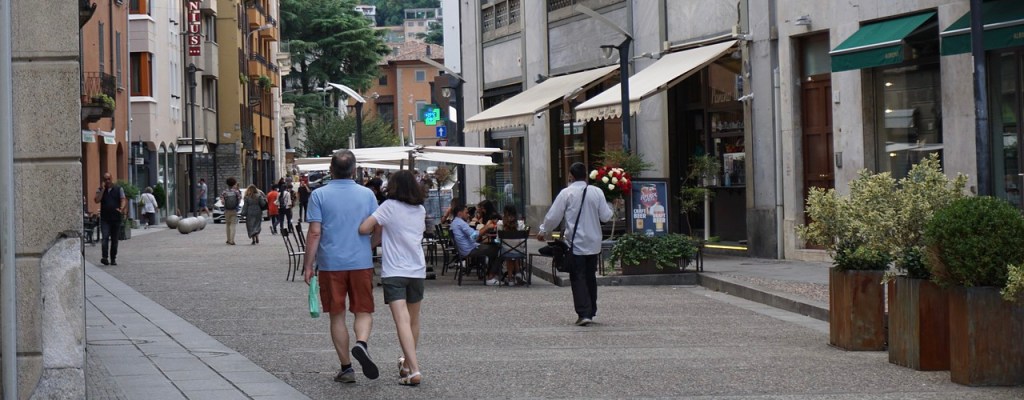
Imagine living in a neighbourhood where everything one needed on a daily basis lay within a fifteen minute journey – on foot or cycle – of one’s home. A neighbourhood where you can safely walk or cycle to the shops, school, medical centre, park, gym, swimming pool, office, cafe, the pub. A neighbourhood with (largely) traffic free streets, where children can cycle safely and those with impaired mobility/ sight/ hearing can easily cross the road. A neighbourhood where you know your neighbour, the barista at the cafe, the coach at the gym. A neighbourhood where you know you are part of the community.
How far can you walk in 15 minutes? 3/4 or even a full mile.
And by cycle? – maybe 2 to 4 miles.
Could you get much further by car?
The average speed of traffic in London is around 7-8mph, suggesting one could travel 2 miles in quarter of an hour. But then one would have to find somewhere to park, so the distance you could travel by car might well be much less than 2 miles.
Imagine a whole city made up of such neighbourhoods and you have the Fifteen Minute City. This concept is being a actively pursued in Paris by the mayor, Anne Hidalgo. Hidalgo proposes to have a cycle lane in every street and to remove 60,000 parking spaces for private cars whilst at the same time spending €1b per year for on greening both streets and school playgrounds. She has already added some 50km of cycle paths and banned high polluting vehicles. Similar projects are being trialed in Milan, Madrid, Seattle and Ottawa, whilst Melbourne and Edinburgh are pursuing twenty minute neighbourhoods.
What are the benefits?
Benefits social cohesion and community strength.
Supports local business and enterprise.
Less time spent commuting. Fewer traffic jams.
Less air pollution. Reduced CO2 emissions.
Option to repurpose road space as green spaces. Greater biodiversity.
Improved levels of mobility for everyone. Better health.
Increased quality of life.
If you want to hear about the Fifteen Minute City from its creator, Carlos Moreno, tune into the following YouTube episode:-
Can we as individuals go some way to creating our own fifteen minute neighbourhood? We can choose to patronise local shops and businesses, use local leisure facilities and green spaces. We can choose to walk or cycle to each destination, and we can seek out routes that green and interesting – and perhaps discover paths we didn’t know existed!
If we become accustomed to walking or cycling 15 minutes on a day to day basis, we will find we can transfer to a lifestyle that doesn’t need a private car. For those longer but less frequent journeys we can as easily walk to the station and take the train, or book a taxi or hire a car. If that becomes the norm just imagine the effect it will have on local neighbourhood and on carbon emissions.
This pictogram shows my 15 minute neighbourhood: why not have a go at drawing one centred on your home?


 The Green Tau