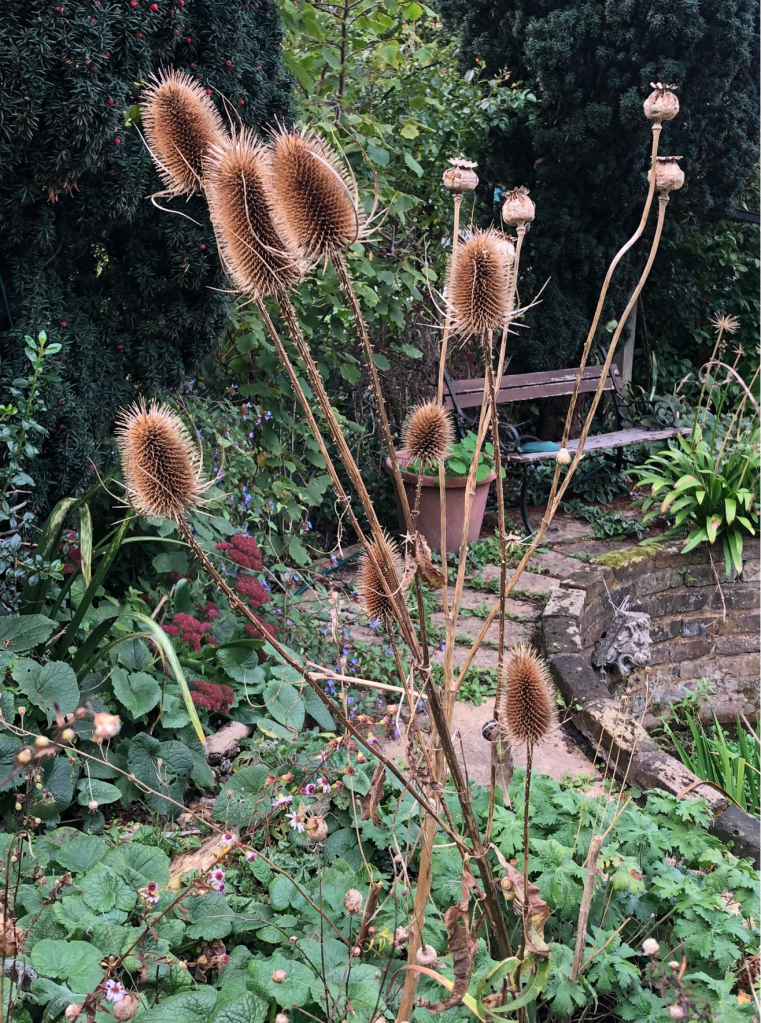
Don’t cut back all plants now autumn is here – especially those like teases and poppies, fennel, sedum and honesty. Their dry stems and heads can be things so beauty as well as being places for small insects to over winter or as seed source for birds. Goldfinches are partial to tease and lavender seeds.
Don’t cut back penstemon or hydrangeas as the old stems will protect the plants from potential frost damage.
Don’t cut back autumn fruiting raspberries either: leave these till the spring when pruning will encourage the growth of new canes for next autumn.
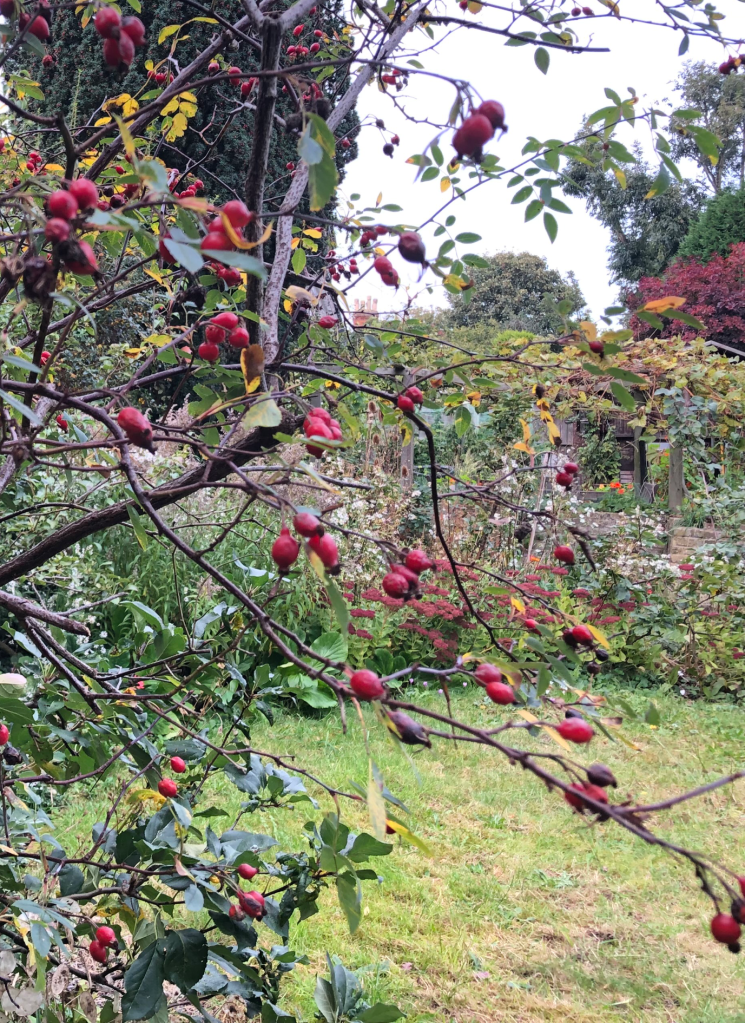
As roses come to the end of their flowering season, let them form hips which birds may then enjoy.
Do prune plants such as grape vines and wisteria. Save the prunings to either create basket-work supports for floppy plants or to supplement dead hedges. (See Count Down Actions 87 and 88).
If you haven’t got one, get a compost bin. This could be made using bamboo canes and chicken wire. To keep the compost extra warm, line the sides with flatten out cardboard boxes. You can also use cardboard or a piece of old carpet as a lid. For lots of compost bin ideas see: https://thearchitecturedesigns.com/diy-compost-bin-ideas-for-your-gardening/
Do cut back soggy or rotting plant matter and add to your compost bin.
Rake up leaves from lawns and either add to your compost bin or create a separate bin just for leaves – these will take a few years to decay but will produce leaf mould which can be used as compost for seeds. https://www.rhs.org.uk/advice/profile?PID=478
If you are pruning shrubs etc to keep them in shape, use the prunings to create a dead hedge. Larger branches can be used to create a log pile. Both of these will provide places of shelter and safety for wild life such as beetles, insects, frogs/ toads etc.
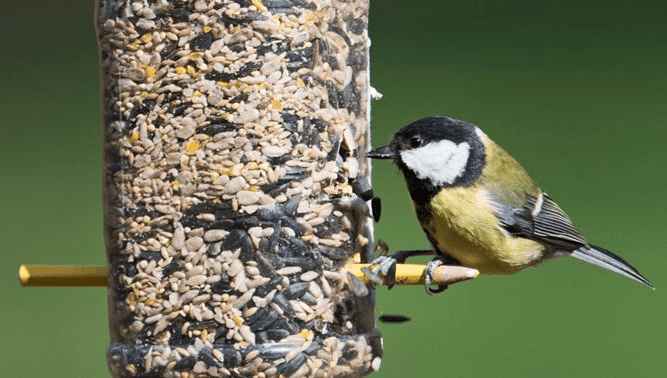
If you have a bird feeder and/ or bird bath, take time to clean them regularly to guard against bacteria and viruses that might harm birds, and keep them topped up.
If you have an existing compost heap, now might be a good time to empty it and use the compost as a mulch around fruit trees and bushes, roses etc, or to cover areas of bare earth. During the winter worlds and beetles will draw the compost down into the soil improving its structure and fertility.
Avoid over digging the garden: regenerative soil management recommends avoid exposing the soil to the air which release lock away carbon dioxide, and rather that ground cover should be maintained over the soil in the form of planting (even if it is a just an annual crop such as lambs lettuce) or a layer of compost.
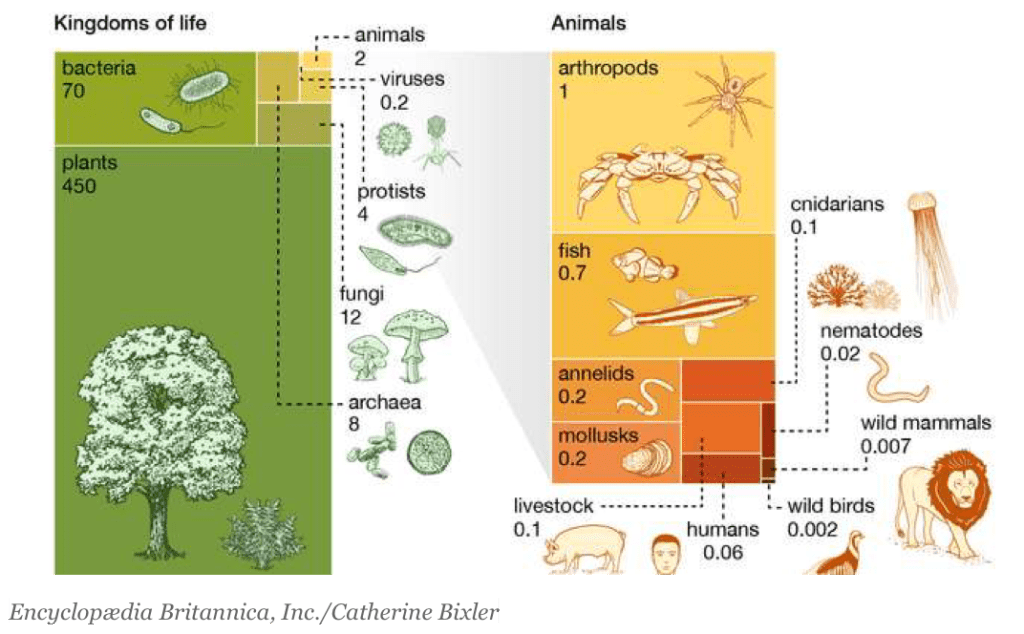
The WWF defines it as ‘all the different kinds of life you’ll find in one area—the variety of animals, plants, fungi, and even microorganisms like bacteria that make up our natural world. Each of these species and organisms work together in ecosystems, like an intricate web, to maintain balance and support life. Biodiversity supports everything in nature that we need to survive: food, clean water, medicine, and shelter.’
The pictogram shows the relative proportions of different life forms (in shades of green on the left) and from within that the relative proportions of animals (in shades of orange on the right). All these life forms have been measured in terms of their carbon mass, otherwise known as biomass. It creates a surprising image! Humankind appears to be almost insignificant. Yet we are increasingly aware that this is not so. Humans are highly significant because they are dramatically and drastically altering life on earth.
What is the issue?
The WWF estimates that since 1970 there has been a 60% decline in the number of animal species on the planet. Mass extinction on this scale has not been seen since the age of the dinosaurs. Almost all the causes are man-made: destruction of natural habitats; forests clearances for agriculture and industrial use; road and rail building programmes; overfishing; pollution of air, water and soils; degradation and erosion of soils; over extraction of water and loss of rivers and lakes; tourism; introduction of invasive alien species; mining operations; climate change etc.
It is not just large creatures such as polar beers, tigers and rhinos that are threatened with extinction – only two white northern rhino still exist and they are other female – but smaller ones too. In Australia the Bramble Cay Melomys, a small rodent, is the first mammal whose extinction is due to climate change. Here in the UK creatures at risk of extinction include the Scottish wildcat, a cicada native to the New Forest (no sightings have been recorded since 2000), the natterjack toad, the turtle dove, dormice, the Cosnard net-winged beetle, and 30 or more species of solitary bee (13 are now already extinct). Each species lost is in itself a loss of biodiversity but also diminishes the eco system of which it was apart and potentially puts other creatures that prey or otherwise rely on it, at risk. That risk extends to humans too. Many of our food crops (apples, strawberries, tomatoes, green beans, coffee and cocoa, kiwi fruits, avocado, cashew nuts, to name but a few) rely on bees and other insects to pollinate them. In the UK there has been a 30% decline in pollinating insects since 1980.
A recent report, The State of the World’s Trees, concludes that 30% of trees are at risk of extinction. With each species that is lost, there is a knock-on threat to other plants and creatures that rely on its unique ecosystem. The biggest threat for trees is deforestation for agricultural purposes. Disease also plays a role and here in the UK ash trees are under threat from ‘ash die back’. This fungus originates from Asia where indigenous ash trees have a natural resistance to it. It is likely it was inadvertently introduced here with imported saplings, but now it is could destroy up to 80 or 90% of our native ash trees.
Why is biodiversity important?
Protection of food supplies (as mentioned above)
Protection of ecosystems: loss of one species can radically change or destroy an ecosystem, so the effect can be cumulative
Many species are key contributors maintaining the well being of the planet:
keeping soils fertile – eg earth worms
controlling pests – eg ladybirds and wasps
keeping water clean – eg oxygenating plants
removing decaying material – eg slugs and snails, crows and vultures
keeping the air clean – eg trees
keeping oceans healthy – eg sea grass which absorbs CO2 and provides food for fish etc
Source of medicines, many of which have perhaps yet to be discovered
Green and blue spaces – ie nature – is good for mental health and well being
Aesthetic and cultural values – eg oak trees are symbolic of England, tigers are culturally significant in India, as are reindeer for the Sami. Even here in London biodiversity is embedded geographically: eels must once have swum through Eel Brook Common, beavers once lived along Beverly Brook and presumably nightingales once sang in Berkeley Square.
And above all, because it’s out there, it’s amazing and it’s God-given.
Slowly work is being undertaken to restore and protect the world’s biodiversity. It will feature as part of the forth coming COP26 climate change conference as well as being the subject of its own COP15 conference which should take place April 2022 in China. More immediately here in the UK the Government’s Environment Bill which will set binding targets for the recovery of biodiversity. After it’s third reading in the House of Lords on 13th October it will return to the House of Commons for a final reading. Do write to your MP and ask them to vote down any amendments that attempt to water down this Bill.
Action 46: Set up a bird feeding station in your garden. Use a selection of bird feeders that will hold different sorts of bird food – suet cakes, seeds, peanuts etc. These will need to be hung from a pole or the branches of a tree. You can include a bird table for those birds prefer to eat from a flat surface but you may find everything gets eaten by pigeons – try a table with a roof to lift access. Locate your bird feeders where they cannot readily be accessed by cats but can be accessed by you, as you will need both to keep them filled and to regularly take them down for a good clean. Mouldy food is not good for birds. The RSPB has instructions for DIY bird feeders: https://www.rspb.org.uk/fun-and-learning/for-kids/games-and-activities/activities/make-a-recycled-bird-feeder/
Also include a shallow bowl for water. Birds need fresh drinking water.
Action 39: Don’t over tidy your garden. Leave seed heads, dead leaves and old branches to provide both food and safe havens for birds, insects and other creatures. Goldfinches, for example, will enjoy feasting on lavender seeds later in the autumn.
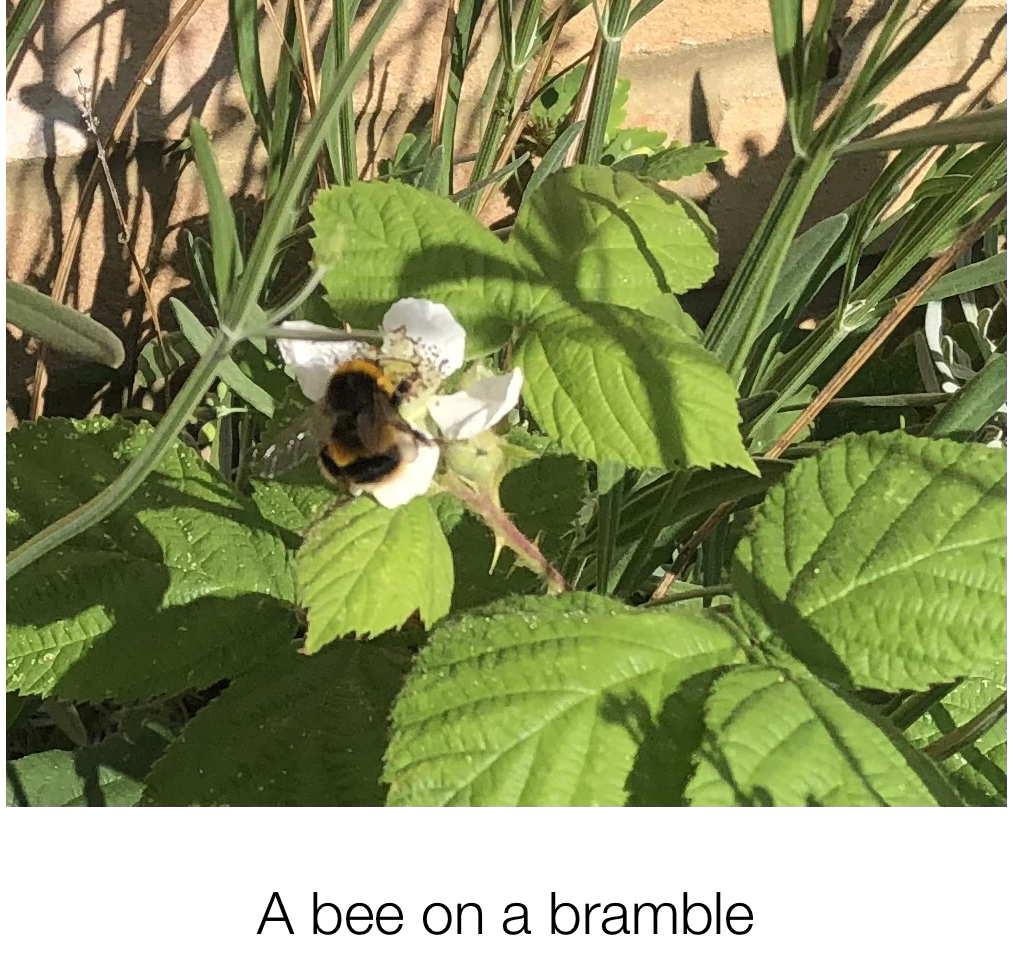
Action 12: The COP26 climate conference will also be addressing the issues declining biodiversity. Those of us with gardens can be part of the solution. Bee numbers have fallen by an average of 7% in the last ten years, part of an ongoing decline. Europe wide 1 in 10 wild bee species are facing extinction. Grow bee friendly plants. Ensure accessible fresh water. Provide places where bee can overwinter or shelter – varying from areas of long grass to purpose made bee hotels. The following web site is useful: https://beefriendlytrust.org/creating-a-bee-friendly-space/
And God said, “Let there be lights in the dome of the sky to separate the day from the night; and let them be for signs and for seasons and for days and years, and let them be lights in the dome of the sky to give light upon the earth.” And it was so. God made the two great lights—the greater light to rule the day and the lesser light to rule the night—and the stars. God set them in the dome of the sky to give light upon the earth, to rule over the day and over the night, and to separate the light from the darkness. And God saw that it was good. And there was evening and there was morning, the fourth day. (Genesis 1:14-19)
The writer of Genesis tells us that the climate and its seasons, shaped by the sun, is a key part of the world God created. Both creation stories in Genesis give humankind a key role in occupying and caring for and tending the world that God created. Humans are given a role of responsibility vis a vis the fish of the sea, the birds of the air and all living things that move on the earth. They are given the task of cultivating the land and the plants which God intended should transform the earth from the bare form with which it began. And they are instructed to multiply and be fruitful ensuring generations of humans to come.
Have we looked after all the fish, the birds and living things? The decline in biodiversity with a third species threatened with extinction, suggests not.
Have we cultivated the earth and maintained its greenness? The expansions of deserts, the destruction of rainforests and temperate woodlands, and the loss of native plants suggest not.
Have we provided for the well being of generations to come? Currently the world is on track for an increase in global temperatures of some 3 to 5°C by the end of the century which would render large parts of the earth uninhabitable for humans – so no!
If we were to hold up a plumb line to measure how upright our living on the earth has been, we would see a world that is on the verge of collapse, a world which will be in a worst state than when we inherited it, and a world in which life for our children and grandchildren would be very bleak.
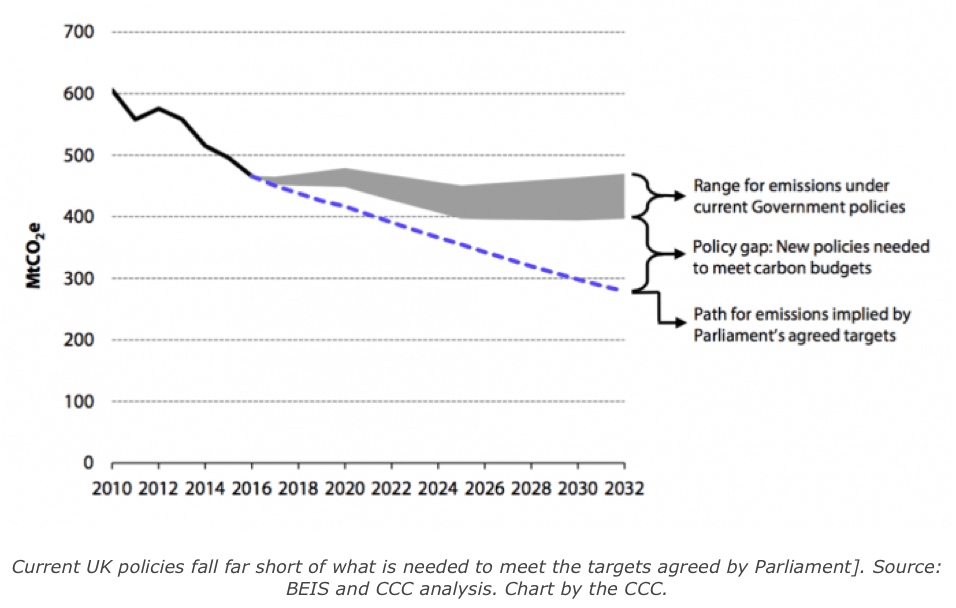
The diagram below is the equivalent of Amos’s plumb line. It was put together by the government’s Climate Change Committee an independent, statutory body established under the Climate Change Act 2008) is part of their review of the progress being made tickling the climate crisis. It shows with a blue dotted line the target reduction in carbon emissions agreed by Parliament. The grey band shows the levels of emissions that current policies will achieve. The gap between the two is the shortfall where new, firmer polices are needed. Just as plumb line measure how true a wall is, so this diagram shows how adrift we are of doing what is right for the climate and the world.
Prophets like Amos and Jeremiah called out to those in power when they were not meeting God’s standards. They also called out examples of wrong behaviour by merchants/ business leaders and those who abuse their power to oppress the vulnerable. They also called out those who falsely prophesied that all would be well and that no one need to repent and amend their patterns of behaviour!
Climate justice requires us to call our government and business leaders to account when policies and actions fail to address the climate crisis and rather allow the state of the earth to decline. We can write to our MPs and our local councillors asking what they are doing to avert the climate crisis, asking not just for wishful statements, but for concrete actions with measurable results. We can write to businesses, both multi nationals and our small, local businesses and ask what they are doing to achieve net zero carbon by 2050. Kiss the Hippo, coffee roasters in Richmond is a carbon negative coffee company – https://kissthehippo.com/blogs/news/good-news-we-ve-gone-carbon-negative we can sign petitions and join one of the many groups campaigning on the climate crisis issue – eg Friends of the Earth, XR, 350.org .
Climate justice requires us to look at our own lifestyles and measure whether they improve or damage the earth and the heritage that we will pass onto future generations. There are numerous suggestions on the internet about what we can do. This will be the topic of the next issue of the Green Tau.i





 The Green Tau