Counting on … day 79

4th April 2024

Bioenergy can also be obtained from trees – the timber is burnt to  either as direct form of heat from a stove of fire, or in a power station to  drive steam turbines that generate electricity.  Burning timber is the most common form of bioenergy used in the UK. Whilst it can be claimed that only waste timber is used – cuts and shavings from timber plants – the reality is that power stations such as Drax import timber which already starts to add to its carbon footprint. International rules imported timber is zero carbon as the emissions are counted in the country where the trees are harvested. In fact these emissions are often not recorded at all. And whilst the timber arrives here as preformed pellets, the timber intact comes from whole trees  from mono culture plantations or from virgin forests.

In reality burning timber as a bioenergy is not a zero carbon option. The carbon stored in the timber is going to be released at some point in the future but if that tree is left to grow, and in its own good time, die, that carbon is locked in longer. Even better as the tree decays in its natural environment it will take years to decay during which time it will provide a habitat for a great variety of different plants and creatures.  Further a large part of the carbon will be absorbed into the soil, again storing it away. If on the other hand the tree, having been felled, is used to make doors, floor boards, paper, furniture etc so the carbon is locked away for many more years to come. 

For further reading – https://www.rspb.org.uk/helping-nature/what-we-do/influence-government-and-business/nature-protection-and-restoration/bioenergy

Carbon capture and storage CCS for the ongoing burning of fossil fuels to generate energy – https://www.theguardian.com/environment/2024/mar/26/tone-deaf-fossil-gas-growth-in-europe-is-speeding-climate-crisis-say-activists?CMP=Share_iOSApp_Other

Counting on … day 77

2nd April 2024

Land management is key in reducing damaging emissions and improving biodiversity. This is acknowledged by the Government but not always pursued.

“Globally, around a quarter of GHGs come from land management activities, including deforestation and agriculture. However, terrestrial and marine ecosystems take up carbon dioxide equivalent to over half of the emissions caused by people.  The challenge is to reduce anthropogenic emissions and increase uptake by ecosystems, storing carbon in soils, sediments and vegetation….

“In the UK our land, coast and seas have been managed for millennia to provide food and other resources for people.  Some patterns of management were sustainable over the centuries, supporting biodiversity and storing carbon as well as providing for the needs of people.  However, there has also been habitat destruction and degradation, leading to declining biodiversity and substantial emissions of carbon to the atmosphere. 

“Repairing this damage to stop emissions and capture more carbon is an essential element of achieving net zero, alongside deep cuts in emissions from other sectors such as energy and transport. The Climate Change Committee estimates that 20% of agricultural land will need to be released before 2050 to deliver actions that reduce emissions and sequester carbon. Such a shift in land use change will require us to prioritise opportunities that also deliver wider co-benefits for climate change adaptation, biodiversity, water management, air quality and soil health.” 

Windows of Opportunity 

7th December 2023

30:30 Biodiversity target

“Biodiversity is essential for the processes that support all life on Earth, including humans. Without a wide range of animals, plants and microorganisms, we cannot have the healthy ecosystems that we rely on to provide us with the air we breathe and the food we eat.” (1) 

Just as importantly biodiverse rich habitats are more resilient in the face of extreme weather events than less biodiverse habitats, and often incorporate their own protective mechanisms. In other words, biodiverse rich habitats provide us with the safest place to be.

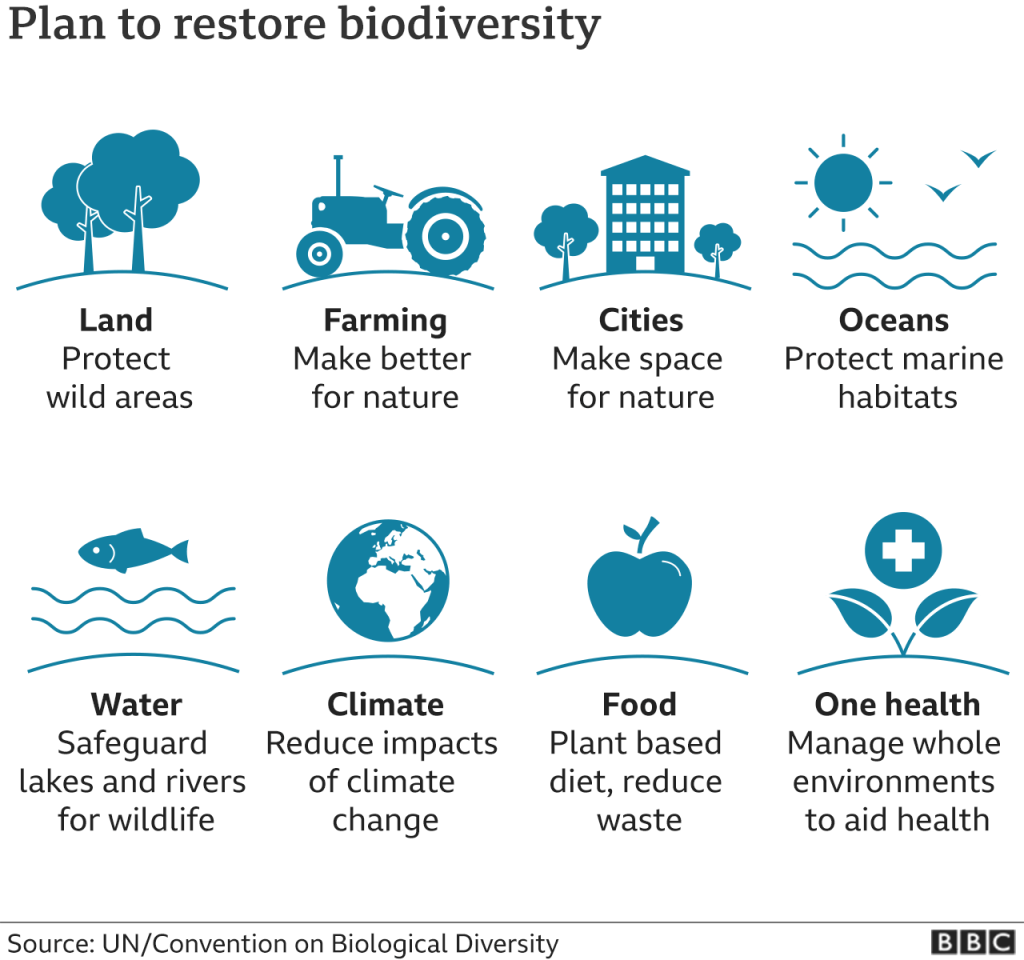
The Convention of Biological Diversity at COP15 agreed that globally we should aim to protect at least 30% of land and sea for nature by 2030. The UK is one of more than 100 nations who signed up to this target. 

So far there is considerable scope for improvement. The British Ecological Society’s report, 2020, warned that the UK was on track to miss a pledge to protect 30% of its land and sea by 2030, with some analyses warning just 5% of the nation’s land is effectively protected.  The report recommended that protected habitats under the 30×30 pledge need to put biodiversity first and foremost…To achieve this, a wide range of different habitat types need to be protected, with many existing areas requiring stronger protections than they currently have. National parks and areas of outstanding natural beauty could be included in this, if they are reformed to prioritise biodiversity…Connections between sites which allow wildlife to move are important to link up the relatively disparate network of protected areas in the UK. This could consist of physical corridors, stepping stones between them, or by improvements to non-protected land. (2)

(1) https://royalsociety.org/topics-policy/projects/biodiversity/why-is-biodiversity-important/

(2). https://www.nhm.ac.uk/discover/news/2022/april/uk-set-miss-pledge-protect-30-of-territory-2030.html

Counting on …day 1.213

10th November 2023

A Rocha reminds us: ‘Prepare now and give a bird a home in 2024. It might seem to be a strange time to be thinking about bird boxes, but this is the season in which many of our resident birds slowly begin the process of looking for nest sites for next year. Therefore, it is a really good idea to get as many new boxes up as you can, before the end of the autumn season, as it will make it more likely for boxes to be used next spring. See here for more nest box tips.’ 

Also if you have any bug or bee hotels, move them into a sheltered spot lest exposure to particularly cold temperatures kills the inhabitants.

 Counting on … day 1.185

3rd October 2023

One approach to help us improve biodiversity might be to pursue “the 3-30-300 rule”: that everyone should have sight of three trees, every neighbourhood should have 30% canopy cover, and everyone should live within 300 metres of a park or green space. This concept is the work of a group crammed Creat Streets and last month they published a report on Greening Up our streets – https://www.createstreets.com/wp-content/uploads/2023/09/Greening_Up_Executive_Summary.pdf

The report is full of facts illustrating the health and well-being effects of green urban areas, and outlines policies and ideas that would promote the greening of our streets. Such greening also has  benefits in tackling the climate crisis and in mitigating some of the effects of climate change.

Green Tau issue 80

Restore Nature Now! How? 

29th September 2023

The annual State of Nature report was issued 27th September, revealing that 1 in 6 species in the UK is threatened with extinction. On average the abundance of land and freshwater species in England has declined by 32% since 1970.

The National Biodiversity network  noted: “The State of Nature report also found that out of the assessed habitats which are important for wildlife, only one in seven (14%) were found to be in a good condition and only one in fourteen (7%) woodlands and a quarter (25%) of peatlands were assessed to be in a good ecological state. Due to habitat damage from fishing gear, none of the seafloor around the UK was found in good condition…Despite recent moves towards more nature-friendly land and sea use, as yet only a fifth of farmland is now in agri-environment schemes with only some of that helping nature, just 44% of woodland is certified as sustainably managed and only half of fish stocks are sustainably harvested. While all three measures have improved markedly over the past 20 years, there is still a very long way to go.” (1)

Beccy Speight, the RSPB’s chief executive, said: “The UK’s wildlife is better studied than in any other country in the world and what the data tells us should make us sit up and listen. What is clear is that progress to protect our species and habitats has not been sufficient and yet we know we urgently need to restore nature to tackle the climate crisis and build resilience.

“We know that conservation works and how to restore ecosystems and save species. We need to move far faster as a society towards nature-friendly land and sea use, otherwise the UK’s nature and wider environment will continue to decline and degrade, with huge implications for our own way of life. It’s only through working together that we can help nature recover.” (2)

The Soil Association’s head of Farming Policy Gareth Morgan yesterday said: “It is deeply concerning to see this detailed report on the state of nature in the UK but sadly it does not come as a huge shock. Farmland makes up 70% of Britain and we can’t fix the decline in nature without a transformation in food and farming. Many farmers are working with nature and many more are keen to do so. But we remain too dependent on over-intensive, chemical-reliant methods such as industrial livestock systems fed on imported soy. The evidence shows some success for recovery in small protected areas but we cannot ignore what happens in the rest of our countryside where we need a renewed focus on producing good food in harmony with nature.” (3)

Just as switching from fossil fuels to renewable energy sources will be key to achieving net zero for carbon emissions, so it would seem that switching from what might be termed industrial farming to regenerative farming will be key to achieving the restoration of nature. 

(1) https://nbn.org.uk/news/state-of-nature-2023/

(2) https://www.theguardian.com/environment/2023/sep/27/species-risk-extinction-great-britain-wildlife-state-of-nature-report?CMP=Share_iOSApp_Other

(3)https://www.soilassociation.org/news/2023/september/27/state-of-nature-we-can-save-wildlife-by-transforming-farming/

Previous issues of Green Tau have explored biodiversity –

Counting on … day 1.181

27th September 2023

It is not just butterflies that are declining in number but all insects. If you can go that far back, do you remember how in the 1970s car windscreens would have to be washed after each journey to remove the insects splattered across the glass? That is no longer a problem for drivers and that is not just because of more aerodynamically designed vehicles. A study carried out by Bug Life and Kent Wildlife Trust in 2022 reported a 60% declines in insect numbers since 2002. This is worrying because many plants rely on insects for pollination and because other creatures – especially birds – rely on insects for food. What might be causing the decline? The use of pesticides and herbicides on crops and in gardens; climate  change; habitat loss and fragmentation. 

Can we be part of the solution? As gardeners we can create insect friendly habitats; we can support wild life organisations; we can opt for organic produce; we can ask our local council not to use pesticides and herbicides; we  can campaign for government action.

For further info – https://www.nhm.ac.uk/discover/news/2022/may/uks-flying-insects-have-declined-60-in-20-years.html

Counting on … day 1.179

25th September 2023

‘Mutilating the tree of life’ said the Guardian’s headline. It was reporting on a study that found that at least 73 species groups (genera) have become extinct since 1500. Without human impact the extinction rate would probably have been just two such groups. Prof Ceballos, who led the research said “By losing all these genera, we are losing the foundations of the planet to have life in general and human life in particular. If you have a wall made of bricks, if you lose some, it won’t collapse but it won’t be as strong. If you lose many bricks, eventually it will collapse. The combination of the gases in the atmosphere that allows us to have life on the planet depends on plants, animals and organisms…”

https://www.theguardian.com/environment/2023/sep/19/mutilating-the-tree-of-life-wildlife-loss-accelerating-scientists-warn?CMP=Share_iOSApp_Other

The biodiversity crisis is as much a threat to the wellbeing of life on earth as the climate crisis. Both need to be addressed of either crisis is to be averted.

You might like to support the Zero Hour campaign which does focus on both crises – https://www.zerohour.uk/bill/

Counting on …. Day 1.154

21st August 2023

Sometimes it is difficult to tell whether a beautiful rural landscape is the ‘natural’ one as being in its primordial state, or whether it is a ‘natural’ one this is the fusion of human activity in harmony with nature. The two may look very different eg moorlands covered with forests versus moorlands covered with grass and sheep; or low-lying land that is marshy or low-lying land that has been drained and cultivated for arable crops.

The following comments come from the Natural History Museum.

 “’What we repeatedly see in our models is that agriculture is one of the main drivers of strong biodiversity declines,’ says Katia. ‘Even when we consider different human pressures, such as human population density and road development, we always find that the most shocking biodiversity declines are across agricultural sites.

‘That is the key point, the fact is that we need to find a way to slow down agricultural expansion.’

The continued spread and intensification of farming and development in the UK over the last 200 years has meant that most landscapes have not escaped some form of human influence.

The fact that this started such a long time ago means that in some cases we think of these altered landscapes as being their natural state, when in reality they were already heavily depleted of their wildlife’”. https://www.nhm.ac.uk/discover/news/2020/september/uk-has-led-the-world-in-destroying-the-natural-environment.html

Counting on …. Day 1.152

18th August 2023

In the high alpine meadows of Switzerland there is a rich biodiversity of flowering plants and insects (various bees, flies, grasshoppers, ants) spiders, butterflies and moths – far more than I have seen in the UK. Is this richness a result of the alpine dairy farming? Quite probably so. Without the cows, the vegetation is tends to shrub and forest, which though totally natural is less biodiverse rich. Away from the steep slope, dairy farming is more intense and doesn’t support the same richness of plant and insect life. Even on the alpine slopes, repeated cutting of grass for silage reduces the biodiversity.  

Our human presence can have a positive effect on the natural environment.