Living more sustainably has also become about campaigning to create a sustainable world for everyone. This we do through supporting charities and organisations that operate in this field
– such as the RSPB, WWT and National Trust – which aim to conserve and improve the natural environment and biodiversity because such environments are key to sustainability;
– such as the London Cycling Campaign and Sustrans which focus on particular issues within sustainability- vis active travel;
– such as Friends of the Earth which both campaign and develop educational resources for living sustainably;
– such as Practical Action and Christian Aid which campaign and give support to those who are suffering because of the current lack of justice and sustainability globally;
and Christian Climate Action Green Christian which bring the Christian ethic to campaigning.
Support campaigns that mitigate the climate crisis
We know many of the causes of the climate crisis and by addressing these, we can reduce the scale and impact of the climate crisis. However such mitigation is not always popular when they threaten vested interests. Solutions are possible but sometimes it is necessary to campaign to win over government support and to give a voice to marginalised groups.
The biggest contribution to the climate crisis comes from the fossil fuel industry and the burning of its products. Traditionally the fossil fuel industry has produced huge profits for investors, with no obligation to make recompense for the pollution caused. They are multi national organisations which exert great pressure on governments and the public through lobbying and advertising.
Nevertheless campaign groups are able to affect change in the practices of fossil fuel companies that benefit the climate.
Climate Action Network explains how they “successfully stopped the Cambo oil field by making Shell pull out of the project. No one act alone stopped this project. From direct action to legal pressure, political lobbying to media scrutiny, local community outreach to online actions – every act added up to force the industry to face a ‘death knell’ for fossil fuel extraction in the North Sea. And we can do it again.”
Now they are continuing to campaign against the government’s decision to approve the development of the Rosebank oil field – You can support the case by adding your name here.
I am part of Christian Climate Action and regularly campaign against companies, projects and practices that contribute to the climate crisis – https://christianclimateaction.org/
You can also be a campaigner by joining groups such as Friends of the Earth, Greenpeace and the RSPB.
People often comment, ‘I am concerned about the climate crisis but I don’t know what to do!’
There is a whole range of things we can do, from at one end changing our lifestyle, right through to making acts of civil disobedience at the other. To say this is a range is not to say it is a progression and that having started with changes to lifestyle one must then progress down the line to acts of civil disobedience. Nor is it to say that either end of the range is better or more worthwhile. However from the viewpoint of integrity one hopes that those who engage in campaigning and actions are also prepared to adapt their lifestyles.
Within each type of activity there will again be a range of responses. People choosing to change their diet for example may choose to have a meat free day each week or to become fully vegan.
What is the purpose of doing something?
It is to minimise, halt or reverse the adverse effects we humans have on the environment and to help, support or improve, the lives of others (both human and non-human) who are adversely and/or unfairly affected by the crisis.
What can we do?
Change our lifestyle to reduce the impact of our footprint on the earth and its impact on the lives of others.
Whilst it may feel that changing one person’s lifestyle will not make a difference, it does. Each person who makes the change shows that change is possible. This will encourage others to follow suit. And each person making these changes is creating a new – climate friendly – normal. We will only get to net zero when everyone has made changes to their lifestyle and the sooner we started the better.
Swop to a largely plant based diet – a plant based diet can reduce your carbon footprint by at least 60%; opt for local, organic, fair trade and animal friendly foods; minimise food waste – https://greentau.org/2021/08/09/eco-tips-4/
Opt for active travel (walking and cycling) and public transport in preference to driving; avoid flying – sign the Flight Free Pledge https://flightfree.co.uk/
Reuse, repair, recycle; minimise single use items; buy good quality long life products – The Ethical Consumer has helpful guides; buy second hand; borrow or hire for occasional use. Don’t buy what you don’t need – enjoy what you have!
Avoid waste by seeking out zero waste options for what you use in and around your home – eg milk that comes in refillable glass bottles, loose fruit and veg, various (numerous) groceries you can get from refill shops, from pasta to raisins, coffee beans to spices. Carry a keep cup for take away drinks and a bottle for water refills.
Green your finances – use banks, insurance and pension providers etc that take an ethical and environmentally responsible approach to their investments – https://makemymoneymatter.co.uk/
* Re wild part of your garden; plant trees or hedges; plant insect friendly plants; install a water butt, a compost heap and maybe a pond.
Support B-corps – companies that undertake to do that bit more for the environment and for society. Avoid supporting companies that disregard the environment, don’t pay all their taxes, and/ or don’t pay their staff a fair or living wage.
Support environmental charities financially and/ or as a volunteer. Support social well being charities.
Read up on climate science, and on the ways and benefits of adapting our lifestyles.
* Find a like minded group of friends for encouragement; set up a green group in your church; join Green Christian.
Campaign for change.
Whilst individuals can make significant changes to their lifestyle, there are somethings they personally cannot change. As an individual you cannot change the tax system that doesn’t tax aviation fuel. As an individual you cannot implement a subsidy scheme that would make public transport cheaper than private car travel. As an individual you cannot change legislation that discourages the building of on-shore wind turbines and solar farms. As an individual you cannot require all local councils to adopt a common recycling policy. And the list goes on – as an individual you might wish to see an expansion of nature reserves, of rewilding landscapes, of implementing nature based flood defences, of ensuring all homes and commercial premises are adequately insulated against extremes of temperature, the provision of safe cycle routes through and between all urban areas, an end to the discharging of sewage into seas and rivers, curbs on industrial farming and fishing etc.
Where we can’t effect changes as an individual, we may find we can as a group – the more people in the group, the stronger their collective voice. As individuals we can address issues of climate, biodiversity and social justice in various ways.
Becoming an active supporter of an action group
Donating to support an action group.
Signing petitions addressed to local and central government, to big business and to multi nationals.
Writing individually to lobby MPs, local councillors, business leaders etc.
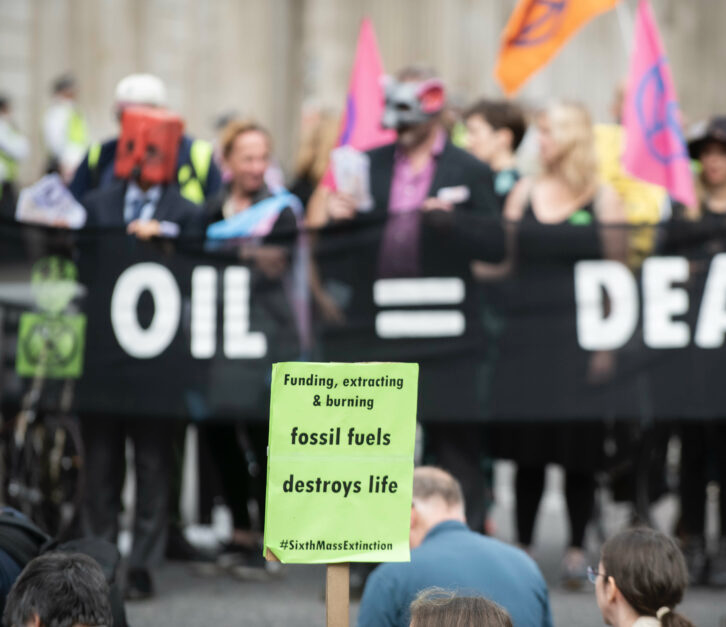
Joining organised marches and demonstrations.
As with changing lifestyle, read up on climate science and what changes we can make as a society to safeguard the environment and protect lives.
Non-violent direct action
Martin Luther King Jr wrote that the goal of non-violent direct action was to “create such a crisis and foster such a tension” as to demand a response. Non-violent direct action has come to the fore in climate issues because of the lack of response from, in particular, the government and the oil industry.
Non-violent direct action may include sit-ins, strikes, blocking roads, climbing onto significant structures, and boycotts. It may extend to include damaging property such as graffiti, breaking windows or letting down car tyres. Often these acts of civil disobedience may be classed as criminal acts (and probably increasingly so as the government introduces stricter laws limiting the right to protest) but in court protestors can present the arguments to the judge and jury that there is a legal defence can be made, justifying such action. Other non-violent direct actions, such as strikes and vigils, are lawful.
In terms of the climate crisis, non-violent direct action is being used to demand a response from government, from the oil industry, from banks and financial institutions, from churches (asking them to divest from fossil fuels*), from charities (asking the National Trust to bank with somewhere other than Barclays) to actions that target consumerist products such as private jets and SUVs. (2024 – all but two C of E dioceses have now divested showing that activism is effective).
Within groups that engage in non-violent direct action, there will be different roles for people – some of which will involve the risk of being arrested, whilst others will not.
Climate action groups also focus on educating and informing the wider society about the issues and how they can be addressed, with the hope of increasing the number of supporters. The greater the number of supporters, the louder their voice will be.
Read up on the climate science and what changes we can make as a society to safeguard the environment and protect lives. Be informed about how government, local councils, and businesses work – and the media. Join a group for support and so that your voice becomes part of a greater whole. It is especially important that if you are considering putting yourself in a position where you might be arrested that you fully understand what that entails and are sure that you can cope with the consequences. It is really important to be part of a group that offers advise, training and support. Christian Climate Action would be one such group – https://christianclimateaction.org/
‘Climate change is a threat to human well-being and planetary health. Any further delay in concerted anticipatory global action on adaptation and mitigation will miss a brief and rapidly closing window of opportunity to secure a liveable and sustainable future for all’ – from February’s IPCC report.
The time is now and we need to take action. Earlier this month Extinction Rebellion wrote to the Government highlighting the situation: ‘Every day the UK government fails to act makes our common future more bleak, our prospects more terrifying.’ Extinction Rebellion is calling for an end of the fossil fuel economy and is inviting everyone to take part and join in the demonstrations taking place on 9th April.
Action 45: Sign the ‘Time is Now’ petition. Join the UK’s largest climate action campaign group – a mix of individuals plus over 130 charities and climate change organisations. “Use your voice to tell politicians that you want a cleaner, greener, fairer future at the heart of plans to rebuild a strong economy.”

 The Green Tau