Falling in Love 15


A woodland path in the Yorkshire Dales, spring time. What can be more relaxing than to wander beneath a lacy canopy of lime green leaves, over a carpet of dappled shade and bluebells? Weather worn stones and ageing tree trunks alongside fresh grass and spring growth: both old and new are intrinsically part of life.

The world around us is full of curious, beautiful and amazing things. As small children our curiosity and our amazement knew no bounds. Every day would produce novelties- things to see, things to chew or eat, things to grab and hold, things to poke and explore. 

As we have grow older we have often lost that sense of wonder. Things that were new have become mundane. In the rush to be busy, small things flop below the radar. Decorum dictates that we shouldn’t prod or lick things and, unless we’re wine tasters, swirling stuff around our mouth and spitting are frowned upon. Stopping suddenly just to look is discouraged – it interrupts the flow of traffic. Daily routines take over. 

And our love for the world wains and falters. 

The season of creation-tide runs from 1st September till 4th October, the Feast of St Francis. Let’s fall in love again with creation. 

Falling in Love 12

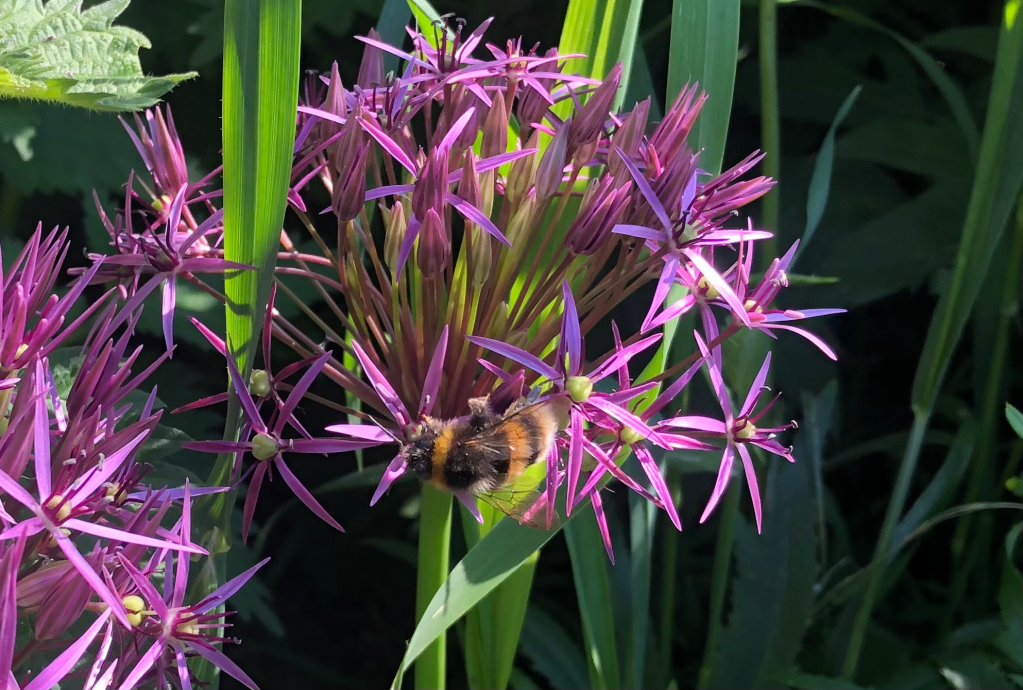
This is probably a buff-tailed bumblebee. These are sociable bees. Each year a new queen is hatched and she alone will sit out the winter. She will be one of the large bumblebees we see seeking out winter flowering plants such as mahonia and crocuses. In the spring she will feed up on pollen and nectar such that she has the renewed strength to begin a new, small, colony. Initially the larvae will develop as female workers but as the summer progresses some will emerge as males. One will successfully mate and so the cycle will begin again. 

Such persistence!

The world around us is full of curious, beautiful and amazing things. As small children our curiosity and our amazement knew no bounds. Every day would produce novelties- things to see, things to chew or eat, things to grab and hold, things to poke and explore. 

As we have grow older we have often lost that sense of wonder. Things that were new have become mundane. In the rush to be busy, small things flop below the radar. Decorum dictates that we shouldn’t prod or lick things and, unless we’re wine tasters, swirling stuff around our mouth and spitting are frowned upon. Stopping suddenly just to look is discouraged – it interrupts the flow of traffic. Daily routines take over. 

And our love for the world wains and falters. 

The season of creation-tide runs from 1st September till 4th October, the Feast of St Francis. Let’s fall in love again with creation. 

Green Tau Reflection

Life choices that bring blessings 

“You have heard that it was said, ‘An eye for an eye and a tooth for a tooth.’ But I say to you, Do not resist an evildoer. But if anyone strikes you on the right cheek, turn the other also;  and if anyone wants to sue you and take your coat, give your cloak as well; and if anyone forces you to go one mile, go also the second mile. Give to everyone who begs from you, and do not refuse anyone who wants to borrow from you. Matthew 5:38-42

The above comes from the Beatitudes: Jesus’s teaching to the crowds on the approach to life that would bring its own blessings. 

An eye for an eye and a tooth for a tooth sounds very mercenary. A contractual arrangement in which neither side looses out. A fair’s fair deal that leaves no space for argument not for generosity. It has the feel of a fixed price market. Anyone who tried to pay more than the asking price would be a fool. Yet Jesus invites the listener to be that fool. To pay more than the asking price. To give more that is required or demanded. To act in a way that undermines the normal way of doing business. It is a radical counter-cultural way of being that will bring its own blessings.

In the world of the climate crisis, old ways of doing things will have to change, old traditions and  old  norms will be replaced by new ways. Heating homes with gas will be history; the supermarket run in the car and the lift to school will disappear; holidays won’t start at the airport; strawberries will be a treat for the summer not Christmas.

Change like this can be hard to accept. After a life time in which cars have become the default means of transport, it is hard to rethink in terms of walking times. After a life time in which air travel has become part and parcel of the holiday package, it is hard to rethink in terms of trains and local destinations. After a life time in which seasonal food describes food linked to sporting/ social events, it is hard to re shape our eating round a annual cycle of what is currently in peak production: raspberries in June, plums in August, avocados in February. 

Change can be expensive as new practices, new products are scaled up and developed. The bonus of economies of scale take time to kick in, the benefits of lower energy bills will be felt gradually over the years whilst the initial cost of new equipment – heaters, electric cars, solar panels – may be steep.  

Following Jesus’s teaching, we can become trend setters, living a new lifestyle, adopting ways that will curb GHG emissions and restrain the climate crisis. We can lead by example and do things that are not the norm, that are not (yet) fashionable. We can choose to walk or cycle that bit further than usual rather than going by car. We can refuse to buy the plastic wrapped fruit or sandwich. We can explore the UK rather than the world. We can decline avocados in summer and strawberries in winter. 

Those of us with money can invest in carbon neutral technology, we can buy the eco friendly products and services, and we can do so generously, supporting producers as well as the climate. Train travel can be more expensive that going by car or plane, but we can choose the climate friendly option. Organic food may be more costly – now – but we can choose it over cheaper products that are less environmentally friendly.

Jesus asks that when we choose how to live, that we choose to think of the needs of others and be ready to meet their needs first. The results? A transformed world!

If …

Soil Plant Hands Growth Environment Nature Dirt

If we are called us to beat swords into plough shares,  

we are also called to turn military jobs into green ones.

If we seek to establish peace,

we must generously offer both love and practical gifts. 

If we shift from passive to active travel, from cars to cycles,

we shall need cycle paths and secure shelters.

If we replace petrol engines with electric motors, 

we must also turn petrol stations into recharging points.

If we swop meats for a vegan diet, 

we must also turn beef farms into arable farms,

sheep fells into woodlands,

dairies into nut fromageries.

If we switch to green electricity,

our pension funds must invest in renewable energy.

If we green our pensions, 

surely we will green our banks too.

Creator God, help us to see the changes we must make,

Give us the wisdom to support them, 

the energy to achieve them 

and the joy to celebrate them.

Amen.

Falling in Love 7


Acorns are small but have a look of completeness. Their smooth skin and rounded shaped topped with its own little cap. That little cap is such a perfect fit! Once the acorn has fallen, its cap discarded, its skin broken, the journey of growth begins and over the years, that acorn will be transformed  from seed to majestic oak. There are oak trees in Richmond Park that were acorns back in the days of Henry VIII.

The world around us is full of curious, beautiful and amazing things. As small children our curiosity and our amazement knew no bounds. Every day would produce novelties- things to see, things to chew or eat, things to grab and hold, things to poke and explore. 

As we have grow older we have often lost that sense of wonder. Things that were new have become mundane. In the rush to be busy, small things flop below the radar. Decorum dictates that we shouldn’t prod or lick things and, unless we’re wine tasters, swirling stuff around our mouth and spitting are frowned upon. Stopping suddenly just to look is discouraged – it interrupts the flow of traffic. Daily routines take over. 

And our love for the world wains and falters. 

The season of creation-tide runs from 1st September till 4th October, the Feast of St Francis. Let’s fall in love again with creation. 

Keeping Warm in Winter

  1. Wear layers of clothes. Each layer will trap air that is warmed by your body. Every layer is another layer of insulation. 
  2. Wear thermal underwear or alternatively wear extra leggings and T-shirts which will save having to buy more clothes.  
  3. Outside wear a hat, gloves and scarf – and why not do the same inside? Historically people have often worn hats inside – neat bonnets, Tudor caps,  Monmouth caps, smoking hats, head squares and scarves, beanies and berets. 
  4. Cosy socks and slippers are pluses too – make sure your winter shoes and boots are big enough to allow for warm/ thick socks. If you have thin socks, double up and wear two pairs.
  5. Close curtains and pull down blinds at dusk, for once  the sun sets temperatures will drop. Drawing your curtains will keep the warmth in the room. The more layers between you and the outside, the better the insulation. You might have blinds and curtains for example. Alternatively you can get extra thermal linings to hang behind your curtains. 
  6. If overnight your bedroom has remained warm, allow that warmth to permeate the rest of the house before opening the windows to air the room.
  7. If windows are draughty, you can seal the gaps with a proprietary stick on strip.  
  8. If your doors are draughty or if they are not very thermally efficient (maybe with lots of glass) you can hang a curtain to pull across at night time. You can make a sausage shaped door stop  to prevent draughts that come under a door, or if it is an external door you could fix on a draught excluder. 
  9. Take exercise – it will warm you up. If you get cold through sitting still, even running up and down the stairs a few times will help. 
  10. Wrap up well and have a brisk walk. 
  11. Have plenty of hot drinks and at least one hot meal a day. 
  12. Use a hot water bottle in bed – you can also use one if you are sitting down for a while, either under your feet or on your lap. Equally if you are sitting still for a while, have a blanket to put over your knees. Or if you are watching TV you might  wrap yourself in a blanket.
  13. Make a hand warmer – this could be a cotton bag filled with uncooked rice  that you heat for a few seconds in a microwave. You will find plenty of DIY instructions on line. Or you could use a small heat resistant bottle or jar, fill it with hot water and wrap it in a sock. 
  14. Our own body heat will  heat up a room. Plan your day so that you spend most of it in one room rather than heating up several spaces. 
  15. With all these measures, you should be able to turn your thermostat down so reducing your carbon footprint. Similarly use the controls on your heating to limit the number of hours you need the heating on. During the day, especially if the sun is shining, or if you are active, you will not need extra heating.

Falling in love 6


The oak tree is so embedded in our past that we associate it with the essence of Englishness: strong, resilient, with luxuriant growth. Yet the oak tree is native across the whole of Europe and the virtues of strength, resilience and abundant life are equally widespread.

The world around us is full of curious, beautiful and amazing things. As small children our curiosity and our amazement knew no bounds. Every day would produce novelties- things to see, things to chew or eat, things to grab and hold, things to poke and explore. 

As we have grow older we have often lost that sense of wonder. Things that were new have become mundane. In the rush to be busy, small things flop below the radar. Decorum dictates that we shouldn’t prod or lick things and, unless we’re wine tasters, swirling stuff around our mouth and spitting are frowned upon. Stopping suddenly just to look is discouraged – it interrupts the flow of traffic. Daily routines take over. 

And our love for the world wains and falters. 

The season of creation-tide runs from 1st September till 4th October, the Feast of St Francis. Let’s fall in love again with creation. 

Count Down

Action 46: Knit something warm for winter: wrist warmers and beanies are  easiest if you are a beginner. You could try a beret, leg warmers, scarf or, if you have the time, a jumper. You might like to use yarn made from recycled cotton (t-shirts!) linen or silk,  or wool that comes from one of Britain’s rare breeds of sheep. 

Count Down

 Action 45: Sign the ‘Time is Now’ petition. Join the UK’s largest climate action campaign group – a mix of individuals plus over 130 charities and climate change organisations. “Use your voice to tell politicians that you want a cleaner, greener, fairer future at the heart of plans to rebuild a strong economy.”

https://thetimeisnow.uk/

Falling in Love 4


Dark oppressive rain clouds warn us to put up our umbrellas, to hasten our pace and shelter inside where we can shut out the unwanted elements.

Stop. Pause. Look. See how the clouds blossom and bloom, how their mass grows. Contemplate the intensity of colour, the shades of blue and grey, shifting  and rolling as the occupy the sky. See the trailing edges where rain is already falling, the veils of water that wash across the air. 

The world around us is full of curious, beautiful and amazing things. As small children our curiosity and our amazement knew no bounds. Every day would produce novelties- things to see, things to chew or eat, things to grab and hold, things to poke and explore. 

As we have grow older we have often lost that sense of wonder. Things that were new have become mundane. In the rush to be busy, small things flop below the radar. Decorum dictates that we shouldn’t prod or lick things and, unless we’re wine tasters, swirling stuff around our mouth and spitting are frowned upon. Stopping suddenly just to look is discouraged – it interrupts the flow of traffic. Daily routines take over. 

And our love for the world wains and falters. 

The season of creation-tide runs from 1st September till 4th October, the Feast of St Francis. Let’s fall in love again with creation.