Counting on …day 144

7th April 2022

Hope is a great gift. It gives us the confidence to smile and keep going, even

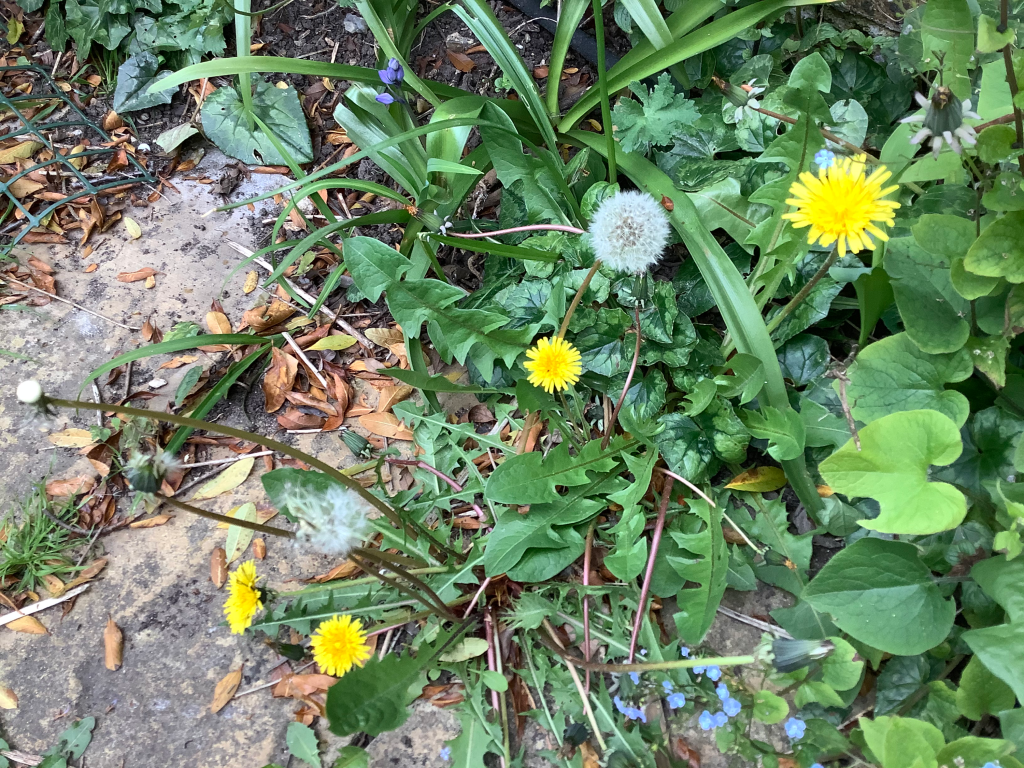
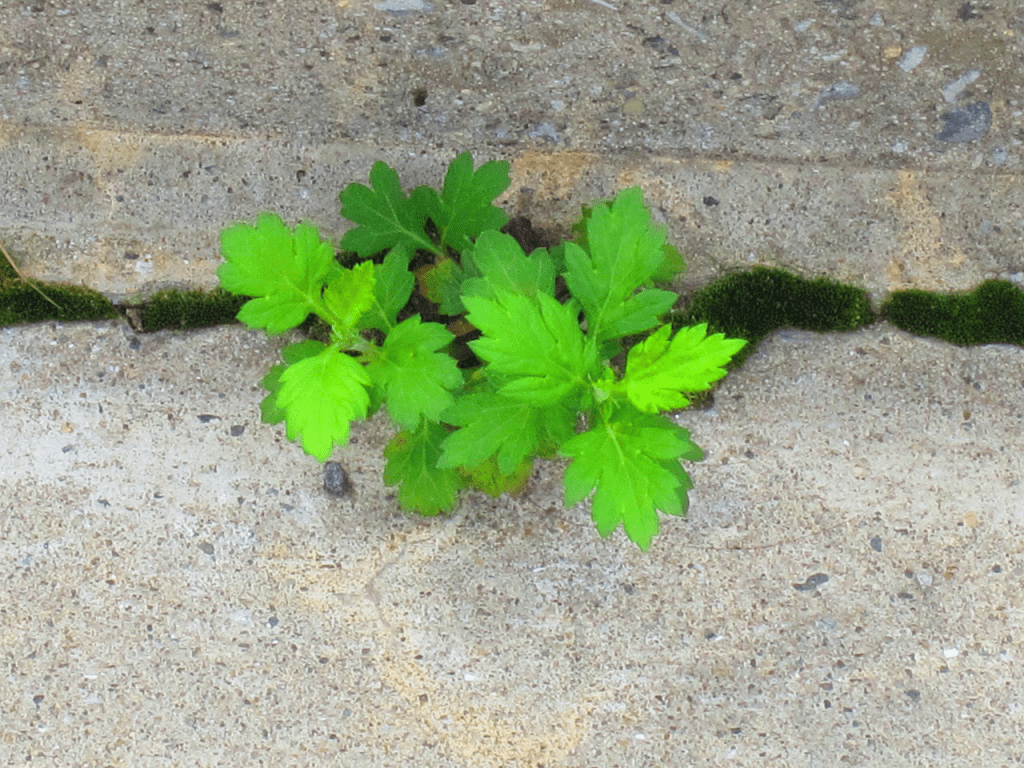
when the odds seem stacked against us. Hope is often to be found in small things. A weed, against the odds, pushing up between the paving stones.  Spotting a first ladybird. Taking time to enjoy the aroma of a fresh cup of coffee. 

The Green Tau: issue 41 

6th April 2022

On Monday the IPCC produced the third and final part its reports assessing where we are as world vis a vis the climate crisis. The news is not good. “It’s now or never, if we want to limit global warming to 1.5C,” said Prof Jim Skea, a co-chair of the report. “Without immediate and deep emissions reductions across all sectors, it will be impossible.” 

Clearly what is needed is system change. As previously discussed (https://greentau.org/2022/04/05/the-green-tau-issue-40/) governments are seldom willing – outside of emergencies such as war – to make system changes unless they feel that is the direction in which the voters have already moved. System change needs social change – and that means a change of heart at the level of the individual, ie the average person on the street. Is the average person on the street ready to accept the changes in lifestyle that ‘immediate and deep emissions reductions across all sectors’ will entail? And if not how can we bring about a change of heart?

Issue 40 looked at civil action  which, whilst making demands of government, seeks also to stimulate a pro-active response from the public. The action of groups such as XR and Just Stop Oil may raise awareness of the immediacy and scale of the crisis. Their action may embolden others to join in – reassuring them that they are not lone voices crying out in the wilderness. Certainly previous XR protests have seen support for the movement grow. But is it enough? Has it brought about the  widespread change of heart needed? Are there other ways?

  • ‘Be the change you wish to see in the world’ – to paraphrase Gandhi. If we live our lives as would be necessary to achieve net zero, making the cuts and changes that makes our life sustainable, then we are a living example of how a life could look – and others may follow. 
  • Walk the talk – a phrase used by John Gummer, the chair of the UK’s  Climate Change Committee, reflecting in the aftermath of COP26. We can only be credible in asking others to respond actively to the crisis, if we are already doing so. 
  • Climate anxiety, which notably is growing amongst children and young people, can only be genuinely assuaged by us if we are walking the talk. If we are not, then we are effectively deriding their concerns.
  • Bucking the trend – be proud, be confident that you are doing the right thing and more people will be interested in what you are doing. Don’t hide your light under a bushel but be upfront about the changes you are making to your lifestyle and why.
  • Have a dream – think, imagine, envisage what the ideal world world look if those ‘deep emissions reductions across all sectors’ had taken place. What would be the highlights, the sources of pleasure, the things of beauty?
  • Take strength from knowing that, even if not else is, at least you are doing the right thing. Living a counter-cultural life does need strength and confidence. For many it is where their Christian faith brings its own courage. 
  • If no one changed, change would never happen. There has to be the first one to take the first step, to set out on a new path – if it’s you, congratulations, you’re a star! You are the beacon for others to follow.
  • Strength in numbers – find others who are changing their lifestyle, maybe informally or through an existing climate/ creation care organisation. Support and encourage one another, gain strength from being part of a group, part of a community, part of a movement. 

Who can we make what we are doing attractive to others? How can we engage others in the conversation? How can we enthuse and encourage others? 

Talking about it – with friends and family, with neighbours and colleagues, with shop staff and sales people, with teachers and parents at the school gate,  with people in church, at the gym, in clubs and pubs – any time we might engage in conversation. Be a story teller. Write about it, share it on social media. Post photos. Wear it as a badge on your sleeve, lapel, bag, hat.

Flaunt it! 

Frequently we will find our efforts stymied by the system. When we are, we need to needle those who can effect change. Ask for the change needed when shopping. Contact the managers, the suppliers, the producers. Even if they can’t effect change immediately, the constant reminder that change is needed will spur them on. And when change does happen, acknowledge it gratefully and make sure others also know. Write to your MP and your local councillors. The more an issue is raised, the greater will be the incentive for them to take note and push for the system change we need.

Is it enough? I know I often feel that what I do is ineffectual, that it is energy expended for no positive outcome. Should I give up and just look after the plants and creatures that live in our garden while I can, and simply wait for the disaster that is coming?

Counting on … day 143 

6th April 2022

Yesterday the IPCC produced the third and final part its reports assessing where we are as world vis a vis the climate crisis. The news is not good. “It’s now or never, if we want to limit global warming to 1.5C,” said Prof Jim Skea, a co-chair of the report. “Without immediate and deep emissions reductions across all sectors, it will be impossible.”

Write to your MP and to your local Council – how are they going to respond? What immediate and deep emissions reductions will they make possible? Ask the same question of businesses. And we must ask the same question of ourselves.

The Green Tau: issue 40  

5th April 2022 

‘Just Stop Oil’?

A limited amount of press coverage has been given to the Just Stop Oil movement which is currently blockading various oil refineries and terminals around the UK.  Just Stop Oil are using the tactics of civil disobedience rather than civil resistance to push the government to stop permitting any new oil production. Explaining what this shift would look like, one supporter told the Guardian last month that it would mean “stopping pointing out what the government should or shouldn’t be doing [and instead] actively stopping government doing what they shouldn’t be”. The campaign, which has involved protesters being glued to roads, suspended on bamboo tripods, and locked on to oil drums and each other, is taking place in defiance of a temporary high court injunction banning protests outside oil terminals. Just Stop Oil has vowed to continue “civil resistance” protests until the government agrees a moratorium on all new fossil fuel projects and claims it has more than 1,000 supporters willing to be arrested for taking part. “We need the government to stop funding new oil projects and we need it now! Our only means of highlighting this issue is mass civil resistance,” they said in a post on Instagram. https://www.theguardian.com/environment/2022/apr/04/protesters-block-oil-depot-near-heathrow-as-action-enters-fourth-day , https://www.theguardian.com/environment/2022/apr/01/environmental-protesters-block-oil-terminals-across-england

Why is Just Stop Oil so committed to and adamant about, their demand? 

In August last year, the first part of the IPCC’s latest assessment (each assessment is the product of five to seven years by three different working groups) was published. This part of the assessment focused on the physical science aspects of climate change, and concluded that the world had on,h a narrow chance of limiting global heating to 1.5C (We are already at 1.1C). This limited window of opportunity needs everyone – governments, businesses, industries, farming etc – to stick to what their agreed 2030 targets.

The second part of the assessment focused on the effects of climate change, such as extreme weather, droughts, floods and temperature rises, and how humanity can adapt to these. This was published in February when it was sadly overshadowed by the invasion of Ukraine. It reported that  3.5 billion people are highly vulnerable to climate impacts and half the world’s population will suffer severe water shortages at some point each year. One in three people are exposed to deadly heat stress, and this is projected to increase to 50% to 75% by the end of the century. Half a million more people are at risk of serious flooding every year, and a billion living on coasts will be exposed by 2050. Rising temperatures and rainfall are increasing the spread of diseases in people, such as dengue fever, and in crops, livestock and wildlife. If global heating continues and little adaptation is put in place, 183 million more people are projected to go hungry by 2050.

Nikki Reisch, the director of the energy and climate programme at the Center for International Environmental Law, said governments should be clear: “There is no room for more oil and gas full stop. [Some businesses] want to perpetuate the myth that we can carry on using fossil fuels. But we need a just transition away from fossil fuels, not techno-fixes.” https://www.theguardian.com/environment/2022/apr/03/scientists-urge-end-to-fossil-fuel-use-as-landmark-ippc-report-readied

The climate crisis is an imminent and highly dangerous. The task of averting this catastrophe relies on us all achieving net zero carbon emissions by 2050 and at least halving them by 2030. Just Stop Oil is not demanding that the government stop all consumption of oil overnight. They are demanding that the government stops our increasing use of oil,  and takes action to cut back our use of oil so that we meet our 2030 and our 2050 net zero targets. 

The war in Ukraine has highlighted our unhappy dependency on fossil fuels, especially those we import from other parts of the world whose regimes are corrupt and un-humanitarian. The solution to this short term problem should be increasing renewable energy capacity – through investment in wind, tidal and solar energy – combined with a comprehensive programme to insulate homes and other properties. Yet there is a risk that the government will opt to escape this problem by allowing more oil exploration in the North Sea. To do so would make meeting our 2030 net zero targets an impossibility, consigning us to trauma of accelerating climate change. 

For Just Stop Oil what is needed is system change. A change from the current oil based system where the government (through taxation and policies) and businesses ( through investment and  practices) perpetuate the use of oil as the main source of energy and the mainstay of production. Consumers find themselves trapped in the system. Gas heating is cheaper than any other form of heating, flying is cheaper than travelling by train, driving is cheaper than public transport, imported food is cheaper than domestically grown, virgin plastic is cheaper than recycled etc etc. It is a system stacked against the environmentally concerned individual. 

Is it surprising then that for many environmentally concerned individuals the only option is civil disobedience? And where does that leave the more fainted hearted environmentalist?

Governments are seldom willing to make system changes unless they feel that is the direction in which the voters have already moved – in recent history one might include the over turning of the poll tax, reining back on nuclear weapons development, and gay weddings. Outside times of severe crisis such as war, system change also needs social change – and that means a change of heart at the individual, ie the average person on the street. Is the average person on the street ready to accept the changes in lifestyle that reducing our dependency on oil and achieving the halfway 2030 net zero targets demands? 

To be continued in issue 41

The Green Tau: issue 39

4th April 2022

If gardens became nature reserves

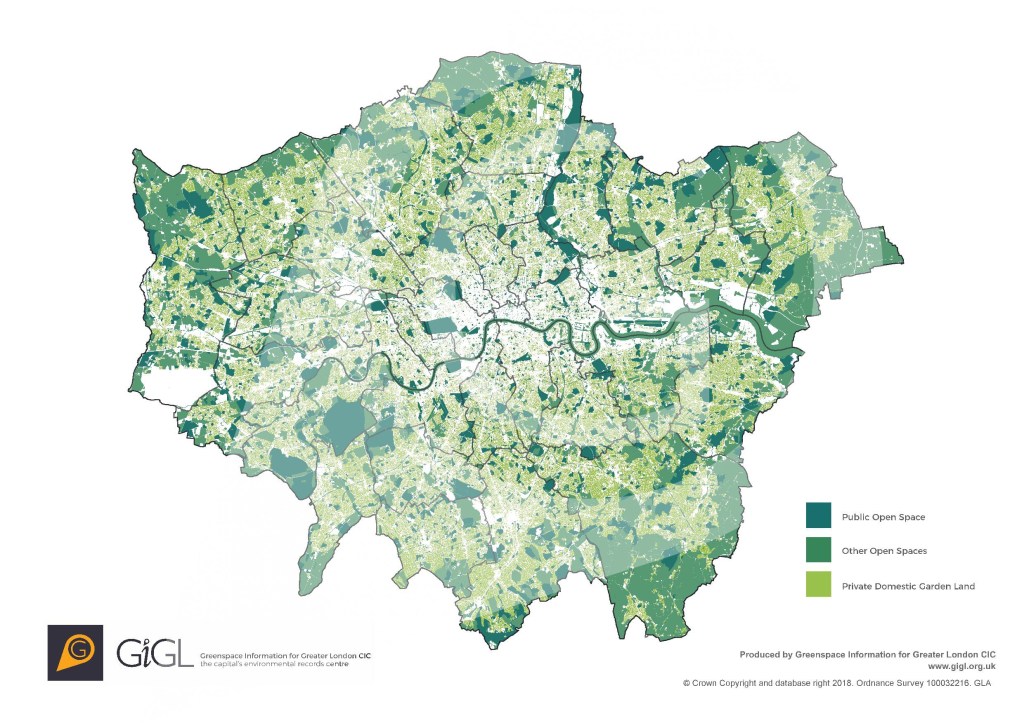
Did you know that the ordinary domestic garden makes up one third of all green space in London? 

According to Greenspace Information for Greater London, GiGL roughly  47% of Greater London is ‘green’, of which 33% is natural habitats within open space and an additional 14% is estimated to be vegetated private, domestic garden land. https://www.gigl.org.uk/keyfigures/ This is not just true of London, but for the whole country. According to the RHA ‘Private garden space in Britain cover about 728,900 hectares so their potential as a haven for wildlife is considerable’.   If each garden were actively managed as a nature reserve just think what an impact that would have on biodiversity and environmental wellbeing!

https://www.gigl.org.uk/wp-content/uploads/OpenSpace-POS-PrivateGardens2018.jpg

Domestic gardens can offer a diversity of plants and micro habitats making them ideal environments for a wide diversity of insects and beetles, birds and other small creatures. 

A diverse range of plants can not only provide food and shelter for a great number of birds, insects and other creatures, they can also be chosen to provide a year round supply of blooms that ensure  constant supply of food for insects – and a good supply of insects will ensure food for other creatures further up the food chain.

A variety of height and density of plants and planting, including trees and bushes, climbers and creepers, ground cover and grasses will again meet the needs of diverse range of fauna. Areas of both shade and sun, warm hollows and places giving shelter from the wind will be appreciated. Further micro habitats can be provided with the addition of ponds or bog gardens, log piles and dry stone walls.

Encouraging wildlife is also about avoiding things that can cause damage such as pesticides, herbicides and slug pellets, and the use of peat which comes at the expense of peat bogs which are an exceedingly valuable habitat in their own right. 

Many creatures will need more than the space offered by one garden. Their normal habits maybe to move or roam over a wide area – hedgehogs for example can travel up to 2km as part of their nighttime forays. Whilst robins may guard one garden as their territory, other birds such as swallows, long tail tits, and jackdaws will feed across a much wider area. Gardens can act as corridors and stepping stones linking one garden to the next as well as linking into wider green spaces such as parks and commons. Small holes at ground level will allow hedgehogs to travel from one garden to the next, whilst trees, shrubs and climbers will provide safe stopping off places for small birds.

Gardens also benefit our own well being. The National Open Gardens Scheme identifies 5 ways in which we can benefit from our gardens – https://ngs.org.uk/gardens-and-health-week/

  1. Do something (physical) – gardening itself, or playing, doing yoga, making a bug hotel, painting
  2. Do nothing! Spend time relaxing, just observing what’s there, de-stressing 
  3. Be alone – your garden can be an escape form the  demands of world and work. Find a quiet corner that is your personal retreat.
  4. Be sociable – share the garden with friends, chat over the fence, take tea together, eat meals outside, play games 
  5. Go natural – look at the shapes and colours, absorb the scents, feel the textures, listen to the sounds

For those without gardens, house plants can be equally beneficial and rewarding – https://ngs.org.uk/a-haven-of-houseplants/

Gardens are places to grow food and make us aware of the journey from fork to plate. Growing food encourages us to eat more healthily. Growing your own salads, herbs and soft fruits can significantly reduce the carbon footprint of what you eat.

Gardens can also protect us from some of the effects of the climate crisis. Gardens with plenty of vegetation will add moisture to the air making it feel comfortable during hot weather and trees of course provide shade as do climbing plants trained over pergolas. Climbing plants can shade walls from the sun and keep the building cooler, whilst plants trained around windows can cast shade that cools the room inside.  Gardens are good at both absorbing rainwater especially if there plenty of soft areas – lawns, flowerbed and vegetable plots – rather than hard surfaces such as pavements, patios and compressed soil. Gardens with plenty of plants are good at slowing the rate at which water drains into the water table as leaves and roots trap and delay the rain. Longer grass is better in this respect than short grass, and will equally better withstand periods of drought. Both absorbing and delaying the rate of water  flow reduces the risk of flooding. You can even be proactive by emptying water butts in advance of heavy rainfall. 

Gardens are natural carbon sinks. Trees, plants and lawns all absorb carbon as they grow. So does a well tended soil. This is a soil that is not over worked or compacted but rather is well supplied with hummus that makes the soil home for a multitude of worms, beetles, bugs, bacteria and fungi, all busily absorbing carbon and releasing nutrients into the soil. Further ideas for reducing the carbon footprint of your garden include composting garden and uncooked vegetable food waste, recycling canes and flower pots etc, growing plants from seeds, and using hand rather than power tools – https://www.gardenersworld.com/how-to/grow-plants/how-to-reduce-your-carbon-footprint-in-the-garden/ Or visit the RHS web site https://www.rhs.org.uk/gardening-for-the-environment/low-carbon-gardening/the-low-carbon-garden 

“When we garden, not only do we make the world a more beautiful place, we also improve local biodiversity, cool overheated cities, mop up pollution and mitigate against flooding, all while improving our own health and well-being, which together have been shown to directly determine how effectively our society functions. Plants are key solutions to pretty much every major problem that faces our species today.” https://www.theguardian.com/lifeandstyle/2022/feb/26/green-planet-how-gardening-can-save-the-world

Gardens as nature reserves

4th April 2022

Gardens are our very own nature reserve right on our doorstep!  

There are many ways in which we can boost their biodiversity and make them even more environmentally friendly (space permitting).

  • Let your garden grow wild at the edges
  • Choose plants so that there is always something in flower throughout the year.
  • Create different habitats with trees and shrubs, ground-cover and climbers
  • Maintain plant cover over all the soil to protect; have different layers of planting. 
  • Use intercropping techniques, sowing fast growing vegetables between those that need more space, eg radishes between cabbages, or eggplant daises between leeks. 
  • Install a water butt 
  • Leave seeds heads and dead stalks in place over winter
  • Use hand tools rather than power tools 
  • Plant some soft fruit bushes or strawberries or rhubarb

P

  • Plant a fruit tree

Counting on …day 140 

3rd April 2022

Nature is good for us. Being out in nature, taking note of the natural world around us help us maintain a sense of proportion. The Conversation recently posted this article suggesting five short walks to help us address our climate crisis fears. 

5th Sunday of Lent

3rd April 2022

Isaiah 43:16-21

Thus says the Lord,
who makes a way in the sea,
a path in the mighty waters,

who brings out chariot and horse,
army and warrior;

they lie down, they cannot rise,
they are extinguished, quenched like a wick:

Do not remember the former things,
or consider the things of old.

I am about to do a new thing;
now it springs forth, do you not perceive it?

I will make a way in the wilderness
and rivers in the desert.

The wild animals will honour me,
the jackals and the ostriches;

for I give water in the wilderness,
rivers in the desert,

to give drink to my chosen people,
the people whom I formed for myself

so that they might declare my praise.

Psalm 126

1 When the Lord restored the fortunes of Zion, *
then were we like those who dream.

2 Then was our mouth filled with laughter, *
and our tongue with shouts of joy.

3 Then they said among the nations, *
“The Lord has done great things for them.”

4 The Lord has done great things for us, *
and we are glad indeed.

5 Restore our fortunes, O Lord, *
like the watercourses of the Negev.

6 Those who sowed with tears *
will reap with songs of joy.

7 Those who go out weeping, carrying the seed, *
will come again with joy, shouldering their sheaves.

Philippians 3:4b-14

If anyone else has reason to be confident in the flesh, I have more: circumcised on the eighth day, a member of the people of Israel, of the tribe of Benjamin, a Hebrew born of Hebrews; as to the law, a Pharisee; as to zeal, a persecutor of the church; as to righteousness under the law, blameless.

Yet whatever gains I had, these I have come to regard as loss because of Christ. More than that, I regard everything as loss because of the surpassing value of knowing Christ Jesus my Lord. For his sake I have suffered the loss of all things, and I regard them as rubbish, in order that I may gain Christ and be found in him, not having a righteousness of my own that comes from the law, but one that comes through faith in Christ, the righteousness from God based on faith. I want to know Christ and the power of his resurrection and the sharing of his sufferings by becoming like him in his death, if somehow I may attain the resurrection from the dead.

Not that I have already obtained this or have already reached the goal; but I press on to make it my own, because Christ Jesus has made me his own. Beloved, I do not consider that I have made it my own; but this one thing I do: forgetting what lies behind and straining forward to what lies ahead, I press on toward the goal for the prize of the heavenly call of God in Christ Jesus.

John 12:1-8

Six days before the Passover Jesus came to Bethany, the home of Lazarus, whom he had raised from the dead. There they gave a dinner for him. Martha served, and Lazarus was one of those at the table with him. Mary took a pound of costly perfume made of pure nard, anointed Jesus’ feet, and wiped them with her hair. The house was filled with the fragrance of the perfume. But Judas Iscariot, one of his disciples (the one who was about to betray him), said, “Why was this perfume not sold for three hundred denarii and the money given to the poor?” (He said this not because he cared about the poor, but because he was a thief; he kept the common purse and used to steal what was put into it.) Jesus said, “Leave her alone. She bought it so that she might keep it for the day of my burial. You always have the poor with you, but you do not always have me.”

Reflection

The passage from Isaiah tells us that war and military strength are not the solution to problems in the kingdom of God. They are not solutions that bring in God’s reign. God’s way is new, is different, says the prophet. Perhaps not new to God but new to humans who are slow to perceive it! Wake up humans! God’s way inhabits the natural world, creating what is needed for life – water in dry areas, paths where it’s rough, things that bring life to creatures and people alike. The psalmist knows that when we recognise these occasions of restoration and transformation – those occasions when we align our ways with God’s ways – they will be times of joy and laughter and flourishing. 

How is it that we can seem to slip in and out of God’s kingdom, or more accurately, in and out of being aligned with God’s reign, God’s way? 

Paul in his letter to the Christians in Philippi, recalls how in the past he had closely cherished his Jewish heritage and assiduously followed its practices which he had been taught would keep him in alignment with God. But all that guarantee he has now forgone having found something even better: the life he knows through Jesus Christ. Faith in Christ brings resurrection – and resurrection means new life, means a new way of experiencing life, means a new way of living. It is a life not limited to this world and our mortal time frame. 

The story related In John’s Gospel takes place on the eve of Palm Sunday, on the eve of the most momentous week. Jesus, in John’s gospel, is a figure confident of his own destiny, who sees and understands how that destiny is going to pan out. Jesus has already raised  Lazarus from the dead; Jesus has declared, “I am the resurrection and the life. Anyone who believes in me will live, even after dying. Everyone who lives in me and believes in me will never ever die”. This is the eve of the week in which Jesus will ride publicly in to Jerusalem; in which he will continue to  declare his message that he is the light of the world; that through belief in him, people will have eternal life – new life which is not of this world; that he will be raised up for all to see in what will be his culminating hour of glory.  It is a week that will end with his burial. 

In the scene John depicts, there are two contrari protagonists. On the one hand Mary who it seems understands how this week will unfold, and Judas who it seems is either oblivious, or wilfully ignoring, what the state of play. Mary recognises the importance of what is going to happen and pours out this expensive ointment as her best acknowledgement of who Jesus is and of what he represents. It is her expression of adoration and love. It witnesses to her belief that what is to come will be worth so much more than this perfume. Judas, on the other hand, just wants to come across as the good guy – the one standing up for the poor. What Judas has failed to understand is that what the poor need is not just extra alms now, but system change. 

“I am the way and the truth and the life”: Jesus is the true system change. 

System change is what the world still needs. In the UK where an increasing number of people are facing poverty, what is needed is not just increased benefits, but a system change in which everyone is  awarded a wage on which they can genuinely live, in which goods are produced and sold at a price that reflect their true cost, in which animals reared as food are given genuinely good lives, in which taxes paid genuinely reflect the person/ company’s ability to pay, in which the real cost of fossil fuels is recognised and in which economic policies really do focus on zero carbon emissions. 

System change is about aligning the world’s systems to God’s ways – not just some of the time, but all of the time!

Counting on day 139

2nd April 2022

Why not use your window, gate post, car windscreen to host a poster to support the demand for action to  address the climate crisis? It may spark interesting conversations; it may give others like you the feeling of solidarity; it will demonstrate how widespread is the concern. 

XR has various posters – https://extinctionrebellion.uk/act-now/resources/art-group/ – but equally you might want to find other sources on line or create your own. 

Prayers for the ecosystems of Asia

Week of 1st April

Happy are those  who do not follow the advice of the wicked. They are like trees planted by streams of water, which yield their fruit in its season,  their leaves do not wither. In all that they do, they prosper. Ps 1:1a,3

You Lord, are the source of all good things: 

We praise you.

You call us to tend and care for your creation: 

May we strive to do your will.

You have made us as brothers and sisters with all that lives: 

May we live together in peace.

A Reading Psalm 95: 1-5

O come, let us sing to the Lord;
    let us make a joyful noise to the rock of our salvation!

Let us come into his presence with thanksgiving;
    let us make a joyful noise to him with songs of praise!

For the Lord is a great God,
    and a great King above all gods.

In his hand are the depths of the earth;
    the heights of the mountains are his also.

The sea is his, for he made it,
    and the dry land, which his hands have formed.

Each Friday during Lent we will focus on a different continent; this week Asia. 

Asia (the eastern half of the Eurasian supercontinent) is the largest of the world’s continents, covering approximately 30 percent of the Earth’s land area. It is also the world’s most populous continent, with roughly 60 percent of the total population. It comprises five major physical regions: mountain systems; plateaus; plains, steppes, and deserts; freshwater environments; and saltwater environments. The Himalayas are so vast that they are composed of three different mountain belts. The northernmost belt, known as the Great Himalayas, has the highest average elevation and includes Mount Everest, which stands at 8,849m. The glaciers of the Tibetan Plateau contain the largest volume of ice outside the poles and feed Asia’s largest rivers. Approximately 2 billion people depend on the rivers. Lake Baikal is the deepest lake in the world, containing 20 percent of the world’s unfrozen freshwater. It is also the world’s oldest lake, at 25 million years old.  https://www.nationalgeographic.org/encyclopedia/asia/

Glory to God 

Creator of mountains and glaciers:

We praise you for the awe and wonder of these regions, 

their reminder that we are but humans.

We thank you for the life giving water they provide for peoples far below.

Glory to God

Creator of rivers and wetlands:

We praise you for the Tigris and the Euphrates, 

for the Fertile Crescent and the roots of human civilisation.

We praise you for the  Ganges and Brahamaputra rivers, 

and for the biodiversity of the Sundarban wetland with its huge mangrove forest. 

Glory to God, 

Creator of Steppes and deserts:

We praise you the ingenuity of animals and peoples, adapting to the extremes of climate.

We praise you for yaks and bactrian camels and for livelihoods sustained by trade.

Glory to God, 

Creator of flora and fauna:

We praise you for rich diversity of flora, for the many fruit trees – oranges and peaches –

and the beautiful flowers of China – roses and camellias, peonies and hibiscus. 

We praise you for  the wildlife of the Sundarban wetlands  – birds and  monkeys, monitor lizards and Bengal tigers. 

Merciful God,

Creator of human kind, 

Forgive our greed that destroys ancient forests in favour of logging for timber and wood pulp. 

Forgive our greed that destroys biodiverse rain forests in favour of oil palm plantations.

Merciful God,

Creator of our brothers and sisters:

Forgive the casualness with which we ignore their plight when faced with war and oppression, 

their poverty  when corporate greed takes away their livelihoods 

and their hunger when climate change decimates their crops.

Merciful God, 

Creator of climates and seasons,

Forgive our foolishness that creates both drought and flood.

Forgive our foolishness that destroys mangroves that protect shorelines 

and the forests that stabilise soils and lock in carbon

Guiding God,

Source  of all wisdom, 

Transform our hearts and minds, turn the direction of our hands and feet 

so that with alacrity and commitment we will reform our lives 

and live only in harmony with your creation. 

Amen.

The Grace