The LORD is a shelter for the oppressed, a refuge in times of trouble. Psalm 9:9
You Lord, are the source of all good things:
We praise you.
You call us to tend and care for your creation:
May we strive to do your will.
You have made us as brothers and sisters with all that lives:
May we live together in peace.
A reading: Psalm 10:1-6, 12
Why, O Lord, do you stand far off? Why do you hide yourself in times of trouble? In arrogance the wicked persecute the poor— let them be caught in the schemes they have devised.
For the wicked boast of the desires of their heart, those greedy for gain curse and renounce the Lord. In the pride of their countenance the wicked say, ‘God will not seek it out’; all their thoughts are, ‘There is no God.’
Their ways prosper at all times; your judgements are on high, out of their sight; as for their foes, they scoff at them. They think in their heart, ‘We shall not be moved; throughout all generations we shall not meet adversity.’
Rise up, O Lord; O God, lift up your hand; do not forget the oppressed.
Response based on Daniel 9:4-10
Great and awesome God,
keeper of promises
and steadfast in love,
we have sinned and done wrong:
our greed has made paupers of those we should love,
our desire for more has taken away even the little they had,
we have despised and oppressed our brothers and sisters.
Great and awesome God,
keeper of promises
and steadfast in love,
we have acted wickedly and rebelled:
we have carved out our paths
and ignore the ways of your creation
leaving behind us a trail of devastation.
Great and awesome God,
keeper of promises
and steadfast in love,
we have turned aside from your commandments:
we over-grazed the land, over fished the seas,
we have decimated the forests and polluted the waterways,
we have taken more than we can restore.
Great and awesome God,
keeper of promises
and steadfast in love,
we have not listened to your prophets, who speak in your name:
Scientific concern about the adverse affects of climate change in the Earth capacity to absorb carbon dioxide, extends to the land as well as the oceans.
“In 2023, the hottest year ever recorded, preliminary findings by an international team of researchers show the amount of carbon absorbed by land has temporarily collapsed. The final result was that forest, plants and soil – as a net category – absorbed almost no carbon…
“A paper published in July found that while the total amount of carbon absorbed by forests between 1990 and 2019 was steady, it varied substantially by region. The boreal forests – home to about a third of all carbon found on land, which stretch across Russia, Scandinavia, Canada and Alaska – have seen a sharp fall in the amount of carbon they absorb, down more than a third due to climate crisis-related beetle outbreaks, fire and clearing for timber.
“Combined with the declining resilience of the Amazon and drought conditions in parts of the tropics, the hot conditions in the northern forests helped drive the collapse of the land sink in 2023 – causing a spike in the rate of atmospheric carbon.”
This shortfall or decline in the carbon absorbing capacity of the natural world is a serious concern when we are relying on that capacity to achieve a net zero target. Indeed if this persists, we will have to reduce our human enduced carbon emissions faster and at a greater rate.
Blue carbon is not just the carbon absorbed in the seas around our coasts. It is an ongoing process that encompasses oceans and deep seabeds. However scientists are concerned that the process is being adversely affected by rising temperatures.
“It begins each day at nightfall. As the light disappears, billions of zooplankton, crustaceans and other marine organisms rise to the ocean surface to feed on microscopic algae, returning to the depths at sunrise. The waste from this frenzy – Earth’s largest migration of creatures – sinks to the ocean floor, removing millions of tonnes of carbon from the atmosphere each year.
“This activity is one of thousands of natural processes that regulate the Earth’s climate. Together, the planet’s oceans, forests, soils and other natural carbon sinks absorb about half of all human emissions. But as the Earth heats up, scientists are increasingly concerned that those crucial processes are breaking down….
“Greenland’s glaciers and Arctic ice sheets are melting faster than expected, which is disrupting the Gulf Stream ocean current and slows the rate at which oceans absorb carbon. For the algae-eating zooplankton, melting sea ice is exposing them to more sunlight – a shift scientists say could keep them in the depths for longer, disrupting the vertical migration that stores carbon on the ocean floor.”
Rewilding the sea – seawilding – is as important as rewilding the land. Rewilding Britain explains why. “Britain’s seas used to be home to the biggest creatures on the planet: blue, humpback, fin, sperm, bottlenose and sei whales. Our rich, soupy waters helped fuel a thriving, diverse ecosystem, attracting huge numbers of small fish, and in turn massive balls of herring and whiting, which would bring these ocean giants to our shores to feed. Like the decline of large mammals on land, whales were hunted to near local extinction for their meat and oil. Alongside the decline of these very visible giants, all marine ecosystems are suffering. The UK has lost around 92% of its seagrass meadows, 95% of its native oyster reefs and nearly all its kelp in regions like Sussex where it once was abundant” (1)
In February 2023 three areas of water of the coast of England were given the status of Highly Protected Marine Areas (HPMA) where all activities such as fishing, mining and laying cables that might damage the sea bed, are banned. The aim is to protect marine biodiversity by allowing seaweeds such as kelp and sea creatures to recolonise the sites. That said, these areas cover only 0.5% of English seas.
There are other projects where a proactive approach has been taken by actively replanting new kelp meadows – such as the Sussex Kelp Recovery Project – or in the Humber Estuary by creating oyster reefs to serve as nurseries for the reintroduction of native oysters (2)
Saturday 21st September: Hammersmith Bridge to Teddington Lock
The ancient practice of pilgrimage, honoured by many of the world’s great faiths, has a renewed focus in this age of climate and ecological emergency. Walking together with intention, mindfulness and prayer proclaims a different pace and place in relationship to the earth; and with each other. We become fellow travellers, learning again to ‘tread lightly’ on the earth. Pilgrimage invites a renewal of body, mind and spirit, while offering a visible sign of a different way of living and travelling.
We meet to start our journey in the community garden at Holy Trinity, Barnes – to leave by 10.30am following these opening prayers
Most High, all powerful, good Lord, To you we offer praise and glory, the honour and blessing. All creation – all that lives and breathes and moves – praises you.
All the elements praise you –
Brother Sun radiant with light and energy, beautiful and awesome,
And who with Sister Moon, establishes day and night, tides and seasons.
All praise to God!
Brother Wind and air, calm and serene, powerful and fearsome,
Bringer of weather, and source of energy.
All praise to God!
Sister Water, humble yet precious, simple and beautiful,
fluid energy and source of life.
All praise to God!
Brother Fire, playful, robust and strong,
offering warmth and comfort, yet to be handled with care!
All praise to God!
Sister-Mother Earth who sustains us and governs us,
And produces plants and minerals, sustaining life in all its rich diversity.
All praise to God!
All the elements praise you
and so too all that lives and breathes within your creation!
All praise to God!
In your bountiful love,
forgive our carelessness, our greed and our destructive acts.
Lord have mercy
Forgive our selfishness, and our failure to show compassion.
Lord have mercy
Forgive our heartlessness, our narrowness of vision and our failure to act justly.
Lord have mercy
Forgive our self-certainty, our disregard for your wisdom and our failure to learn.
Lord have mercy
With humility and contrition, we praise you
and ask your blessing on our endeavours.
May we serve you with humility,
seeking justice and showing loving care for all creation.
To you be all honour and power, praise and glory.
Amen.
Pauses for prayer.
1. Hammersmith Bridge – this bridge reminds us of the importance of rivers as means of transport and also the obstacle they can present if no bridges are available. The current bridge was designed to allows ships and boats to pass underneath as well as allowing pedestrians, cyclists and until recently, other vehicles, to cross over the river. Weaknesses in the structure have resulted in the bridge being closed to vehicular traffic since 2019. During the heat wave in July 2022, the chains were wrapped in foil and cooled with air-conditioning to 13°C to prevent further cracking – a reminder that climate change presents us with many unforeseen concerns.
We give thanks for bridges and sustainable means of transport that enable us to travel to school and work, to visit friends and family, to send and receive goods and services.
Yet we lament our human perverseness in developing and using modes of transport that damage the environment and disrupt life .
Lord have mercy:
Let justice flow on like a river, righteousness like a never failing stream.
2. Leg of Mutton reservoir – Built in 1838, the Leg o’ Mutton Reservoir supplied water until its decommission in 1960. After much toing and froing, it avoided becoming a house estate and in 1990, became a local nature reserve. The reservoir hosts a wealth of wildlife including over wintering teal and shovelers, Common terms, Pochards and Little Grebes, whilst the reed beds are home to various warblers and dragon flies.
We give thanks for these small but biodiverse rich pockets of wild habitat, that remind us of the beauty and interconnectedness of the natural world. We give thanks for the work and dedication of volunteers and staff who enable such places to flourish.
Yet we lament the relentless pursuit of profit which inhibits more widespread development of such sites, and we lament the ease with which we humans expect to dominate over nature and land use.
Lord have mercy:
Let justice flow on like a river, righteousness like a never failing stream.
3. Black poplar tree – the native black poplar is a rare tree in the UK so it is surprising and delightful to find that a number of them have been identified here along the tow path. They are a floodplain species that thrives in waterlogged habitats, but with many natural wetland areas being drained and cleared for other uses, the loss of habitat has contributed to their decline. To ensure their continued survival, cuttings have been taken allowing some 300 saplings to be planted both here and in suitable sites across the country.
We give thanks for the diversity of trees and plants in creation, each one uniquely special, and acknowledge that it is the diversity of flora that enables humans and other species to thrive.
We lament our shortsightedness in reducing the range of habitats that exist both here in the UK and across the world, and the knock on effect that has on the health and well being of so many human lives.
Lord have mercy:
Let justice flow on like a river, righteousness like a never failing stream.
4. Mortlake – here in the 17th century the famous Mortlake tapestries were woven by Flemish weavers. Some of the master weavers were granted English citizenship, whilst orphaned boys from the City of London were taken on as apprentices.
Following the potato famine in the 1840s many Irish people sought work in the market gardens that then abound in Mortlake, and this gave rise to the building of Mortlake’s first Roman Catholic Church – St Mary Magdelene’s.
This riverside location has also attracted other migrants; we passed by the Swedish school in Barnes, and further upstream we will pass the German school at Petersham.
We give thanks for the diverse people who have settled along the Thames enriching the lives of their local communities.
Yet we lament the failure of governments to assist those fleeing from climate disasters and the failure of harvests, and those fleeing from wars and conflicts inflamed by climate change.
We lament our failure to offer all in need safe passage and a warm welcome.
Lord have mercy:
Let justice flow on like a river, righteousness like a never failing stream.
5. Chiswick Bridge – where the Oxford and Cambridge boat race has its finishing line. The participating crews then celebrate or commiserate at the boathouse opposite home to the Quintin Boat Club and the University of Westminster Boat Club. Much of the land on the north bank is used for various sporting and fitness activities.
We give thanks for joy that the Thames provides a place for sport recreation both in, on and by the water, and for the health giving benefits of exercise.
We lament the inequalities of our society that precludes everyone having easy access to open spaces and sporting facilities. We lament the loss of school playing fields and youth clubs.
Lord have mercy:
Let justice flow on like a river, righteousness like a never failing stream.
6. Kew Gardens – which has a plant collection of some 17,000 species from around the world. Kew Gardens also carries out research into climatechange-resistant crops, zero-carbon fertiliser, and plant- and cell – based foods products. Yet even Kew Gardens is not free from the threat of climate change. A recent report has found that some 50% of Kew’s trees are threatened by rising temperatures, whilst plans are in place to relocate Kew’s herbarium to Reading to avoid the risk of flooding.
We give thanks for the rich diversity of plants that exists around the world, and for the research being done to protect and enhance plants, habitats and food supplies.
Yet we lament the industrialisation of farming and the over grazing and exploitation of land to satisfy our desire for meat. We lament the economic models that leave many in the world with inadequate and poor diets .
Lord have mercy:
Let justice flow on like a river, righteousness like a never failing stream.
Lunch break!
7. Richmond Lock. The Thames is still tidal here and the lock helps maintain water levels between here and Teddington Lock. Even so during high tides and/ or times of heavy rain land either side of the river can flood and the risk is growing as a result of the climate crisis with both rising sea levels and extreme weather systems. To ease this, work is being carried out in the Old Deer Park to create creeks and swales, allowing the land to become once again a real floodplain.
We give thanks for the natural capacity of the soil, trees and plants to absorb rainfall. We give thanks for the diversity of habitats that enhance sustainable ecosystems.
Yet we lament the pressure we are placing on the environment to cope with the climate crisis that we have caused. We lament the threat that rising sea levels causes for so many small nations.
Lord have mercy:
Let justice flow on like a river, righteousness like a never failing stream.
8. Water meadows and parks – between roughly Barnes/ Mortlake and upto Kingston /Weybridge, this section of the river is known as Arcadian Thames. It’s a leafy green environment with, as here, real water meadows, and a number of country houses whose grounds stretch down to the river side. These homes were built by past generations of the rich and influential who sought a rural retreat – and the area is still one of desirable and expensive housing. This stretch of the Thames forms part of a scheme called Rewilding Arcadia which seeks to restore the natural, intrinsic functioning of the flood plain as a means of reducing the risk and effects of flooding. Flooding will be – and indeed already is – an increasing problem due to the climate crisis. Rewilding the river allows new and better relationships between people and their lives, the river and its ecosystems.
We give thanks for the beauty of the Arcadian riverine environment, its green spaces and its relaxing atmosphere. We give thanks for the enhanced biodiversity that it supports, and we give thanks for the restorative and health-giving capacities of these blue and green spaces.
Yet we lament the thoughtless creep of urbanisation that can destroy such beauty. We lament the pollution that seeps into the river from roads and homes, from commercial and industrial sites. We lament the careless use of plastic in all its guises which so easily ends up in rivers and waterways.
Lord have mercy:
Let justice flow on like a river, righteousness like a never failing stream.
9. Teddington Lock – here the powers of the Port of London Authority give way to those of the Environment Agency. The locks allow the passage of boats of various sizes whilst the weir regulates the level of water upstream. A scheme to replace part of the weir with a hydro electric plant was turned down in 2016 because of the objections of the nearby Lensbury Club.
More recently this area is the subject of controversial proposals by Thames Water, involving extracting large volumes of water from the river for use by customers, and replacing it with treated sewage which would be released into the river, adversely affecting the biodiversity of this unique location where the tidal river meets the freshwater river.
Meanwhile the construction work involved would severely damage the special habitats that form the Ham Lands Local Nature Reserve.
Better alternatives would include fully treating sewage at the Mogden and Beckton treatment plants such that the water could be reused to fill key reservoirs, mending the leaks which account for the loss of some 600 million litres of water a day, and encouraging customers (both domestic ones like us and commercial customers) to use less water. Domestic use in the UK averages 140 litres per person whilst in Denmark it is 104 litres per person.
We give thanks for the gift of clean water for drinking and washing. We give thanks for gift of rain and for the streams and rivers which flow through each river basin bringing life and vitality to the environment. We give thanks for the diversity of plants and wildlife that these waters support.
We lament our folly when we let good water run to waste, when we let pollution damage our waterways, when we fail to value what is so precious. We lament our selfishness when we use water as if it was an endless supply, when we use more than we need, putting other lives at risk. We lament the economic system that allows water to be sold, profiting share holders at the expense of the vulnerable.
Lord have mercy:
Let justice flow on like a river, righteousness like a never failing stream.
10. St Richard’s, Ham
Let us make a final pause here at the end of our pilgrimage. Having begun our journey with a variation of St Francis’s Canticle of the Creatures, let us end with a modern Franciscan blessing.
May God bless us with discomfort at easy answers, half-truths, and superficial relationships, so that we may live deep within our hearts.
May God bless us with anger at injustice, oppression, and exploitation of people, so that we may work for justice, freedom, and peace.
May God bless us with tears to shed for those who suffer from pain, rejection, hunger, and war, so that we may reach out our hands to comfort them and turn their pain into joy.
And may God bless us with enough foolishness to believe that we can make a difference in this world, so that we can do what others claim cannot be done, to bring justice and kindness to all our children and the poor.
Amen.
Christian Climate Action – we are a community of Christians who support each other to take meaningful action in the face of imminent and catastrophic anthropogenic climate breakdown. We are inspired by Jesus Christ and guided by the Holy Spirit. Following the example of social justice movements of the past, we carry out acts of public witness, nonviolent protest and civil disobedience to urge those in power to make the changes needed. We also work to engage and mobilise people to take action.
In 2019 London declared itself to be the first National Park City, to enable residents to live greener, healthier and ‘wilder’ lives, as well as promoting new business opportunities. (1) Already green and blue spaces cover 49.7% of the land.
The fact that an area of land is designated as a National Park does it always mean that it will be used or cared for in such a way as to promote biodiversity. (2)
On the other hand plenty of organisations work really hard to achieve this. In London many organisations are drawing up and implementing biodiversity action plans, including the City of London, the Royal Parks, the Greater London Authority, various London Boroughs, as well as organisations such as the Wildlife and Wetlands Trust, the South East Rivers Trust, Barnes Common Limited, and many more, both smaller and larger. Positive change is possible!
Many of the things for which urban trees offer us protection are at the same time threats to the tree themselves.
Urban trees suffer from:
constricted and compacted soil, especially where they share the soil with pipes, drains and foundations, and where the soil is heavily trafficked by feet and wheels
Damage to roots caused by excavations, damage to branches caused by high vehicles
Strong wonders where buildings form wind tunnels
Extremes of heat and cold, as well as ‘burns’ when sunlight is reflected off glass surfaces onto their leaves
Air pollution affecting their leaves and bark
Water-born pollution affecting the whole tree
Artificial light which can disrupt normal photosynthesis, and disrupt the signals by which the tree knows when to sprout leaves in the spring and shed them in the autumn.
Lack of light because of shading from tall buildings
Lack of water especially where hard surfaces channel rain water away into drains
Practising the same environmentally friendly habits on holiday as we do at home. This can include using active travel over cars for getting around; carrying a keep cup to avoid single use takeaway cups; using a refillable water bottle; showers rather than baths – and if we are somewhere where there are water shortages such as in Sicily, being very careful not to waste water.
This approach might also include not buying things we don’t need. A souvenir that simply gathers dust when we come home is not always the best way of remembering a holiday. There is a saying that we should ‘Take nothing but pictures and leaven nothing but footprints’.
At the same time we may want to support the local economy where we are staying – which could be by using the local cafe or bar.
After travel and accommodation, food maybe the next consideration. We can, whether eating out or self catering, make our diet more or less environmentally friendly depending on what we choose to eat. Choosing a plant based diet will have a lower environmental impact than one based on dairy and/or meat. “Avoiding meat and dairy products is one of the biggest ways to reduce your environmental impact, according to scientific studies” (1)
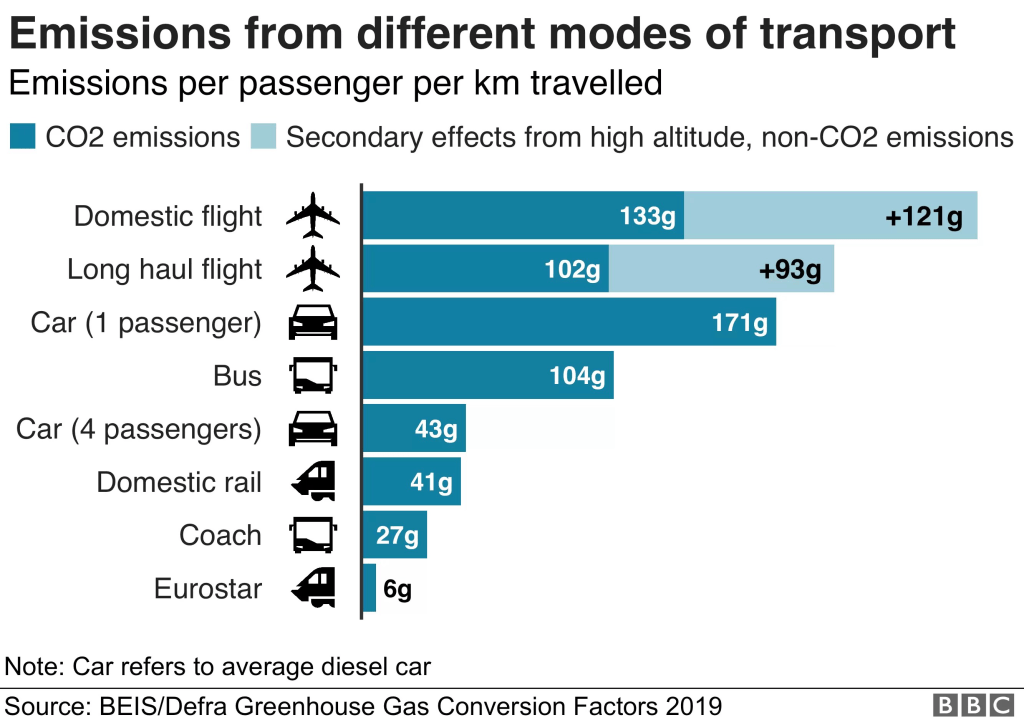
Do our holidays adversely impact on the environment? Googling eco friendly holidays, I am surprised how many website focus on the eco credentials of the destination but not the mode of travel. This is not always the case and some websites do give advice on flight free holidays. Nevertheless the transport element of our holidays usually contributes most to its environmental impact.
“Global tourism accounts for about 8% of total greenhouse gas emissions and transport between origin and destination explains three quarters of this impact” (1) Cutting out flying will benefit the environment most. After that saving has been made, cutting back on the distance travelled will also have an impact. (2)


 The Green Tau