Action 50: Half way! Children are most at risk from the effects of climate change. Their age makes them vulnerable to diseases and heat stress, but more importantly they will living for longer with the consequences of the climate crisis. Sign UNICEF’s petition asking Governments to act on the behalf of children.
“You have heard that it was said, ‘An eye for an eye and a tooth for a tooth.’But I say to you, Do not resist an evildoer. But if anyone strikes you on the right cheek, turn the other also; and if anyone wants to sue you and take your coat, give your cloak as well; and if anyone forces you to go one mile, go also the second mile. Give to everyone who begs from you, and do not refuse anyone who wants to borrow from you. Matthew 5:38-42
The above comes from the Beatitudes: Jesus’s teaching to the crowds on the approach to life that would bring its own blessings.
An eye for an eye and a tooth for a tooth sounds very mercenary. A contractual arrangement in which neither side looses out. A fair’s fair deal that leaves no space for argument not for generosity. It has the feel of a fixed price market. Anyone who tried to pay more than the asking price would be a fool. Yet Jesus invites the listener to be that fool. To pay more than the asking price. To give more that is required or demanded. To act in a way that undermines the normal way of doing business. It is a radical counter-cultural way of being that will bring its own blessings.
In the world of the climate crisis, old ways of doing things will have to change, old traditions and old norms will be replaced by new ways. Heating homes with gas will be history; the supermarket run in the car and the lift to school will disappear; holidays won’t start at the airport; strawberries will be a treat for the summer not Christmas.
Change like this can be hard to accept. After a life time in which cars have become the default means of transport, it is hard to rethink in terms of walking times. After a life time in which air travel has become part and parcel of the holiday package, it is hard to rethink in terms of trains and local destinations. After a life time in which seasonal food describes food linked to sporting/ social events, it is hard to re shape our eating round a annual cycle of what is currently in peak production: raspberries in June, plums in August, avocados in February.
Change can be expensive as new practices, new products are scaled up and developed. The bonus of economies of scale take time to kick in, the benefits of lower energy bills will be felt gradually over the years whilst the initial cost of new equipment – heaters, electric cars, solar panels – may be steep.
Following Jesus’s teaching, we can become trend setters, living a new lifestyle, adopting ways that will curb GHG emissions and restrain the climate crisis. We can lead by example and do things that are not the norm, that are not (yet) fashionable. We can choose to walk or cycle that bit further than usual rather than going by car. We can refuse to buy the plastic wrapped fruit or sandwich. We can explore the UK rather than the world. We can decline avocados in summer and strawberries in winter.
Those of us with money can invest in carbon neutral technology, we can buy the eco friendly products and services, and we can do so generously, supporting producers as well as the climate. Train travel can be more expensive that going by car or plane, but we can choose the climate friendly option. Organic food may be more costly – now – but we can choose it over cheaper products that are less environmentally friendly.
Jesus asks that when we choose how to live, that we choose to think of the needs of others and be ready to meet their needs first. The results? A transformed world!
Action 47: Green your pension: this article comes from The Guardian There’s an estimated £2.6tn invested in UK pensions. You might not know it, but much of it funds environmentally harmful industries and activities such as fossil fuels or deforestation. Your pension may not seem like a powerful eco tool, but according to research by Make My Money Matter, Aviva and Route2, getting a green pension can be 21 times more effective in cutting your carbon footprint than giving up flying, going veggie, and switching to renewable energy combined. In fact, this research shows it’s the most powerful step an individual can take to reduce their carbon. And it’s not just a high-impact activity – it’s also popular. More than two-thirds of us want our money to support people and the planet. By pressuring your provider to invest more sustainably, or finding a more climate-friendly option, you’ll be able to sleep easier knowing your pension is now a force for good.
Action 45: Sign the ‘Time is Now’ petition. Join the UK’s largest climate action campaign group – a mix of individuals plus over 130 charities and climate change organisations. “Use your voice to tell politicians that you want a cleaner, greener, fairer future at the heart of plans to rebuild a strong economy.”
This week saw a stand off between Christian climate activists and the clergy in St Paul’s cathedral over the Church of England’s continued investment in companies profiting from fossil fuels. It has distressed me greatly.
Woe to you … you tithe mint and rue and other herbs, and neglect justice and the love of God; it is these you ought to have practiced, without neglecting the other. (Luke 11: 42)
Medicinal Plant Herb Bee Pasture Plant Mint Plant
Is it that the Pharisees that Jesus was addressing have become so bogged down in the minutiae that they can’t see the bigger picture? Had they become so concerned that all the ‘t’s be crossed and the ‘i’s dotted that they could no longer read what the writing said? They could only see the spelling mistakes but not the story.
Is it that they found it is easier to address the needs of personal hygiene than issues of social justice, poverty and victimisation that were prevalent ills of the world in which they lived? Did they find it easier to keep washing their hands before meals than to address the luxury lifestyle enjoyed by Herod Antipas at the expense of the rural poor.
Is it that by observing the smaller and easier religious requirements, that they could to all outward appearances be seen as upright exemplars of their faith and so earn the honour and respect of their fellow believers. Perhaps the observances of small things gave the impression of great integrity – if they so routinely practice these small religious acts how much more must they be observing the full law?
Yet Jesus sees through the outer show. He has seen that inside the polished exterior they are full of greed and wickedness (Luke 11:40). He is critical of them for their lack of love and disregard for justice. Whilst they have sought the best seats in the synagogue and respectful greetings in the market place, Jesus has been focused on the work of feeding the hungry, healing the sick, releasing the imprisoned, validating the forgotten, turning social expectations upside down, calling for a turning away from unsustainable lifestyles – and bringing in the kingdom of God.
Jesus and his disciples knew from experience that doing God’s will meant getting hands dirty, getting down alongside the sick, withstanding jeers, taking the lower place, and ultimately to be self sacrificing. Such a lifestyle is not always easy, and do we not all want some degree of love and respect? Yet equally experience tells us that if we have confidence in God, even when we are ill-treated, scorned, marginalised, we will still find joy in doing God’s will.
Notice that in Jesus’s reply he reminds the Pharisees that doing the small things should have been an ‘and also’ to the exercise of love and justice. Paying attention to the small things as well as the large is about integrity. For this reason we see Jesus coming to be baptised alongside his fellow country folk. We see Jesus going regularly to the synagogue and taking his turn to read the scripture. We see Jesus observing the traditions of Passover. But for Jesus outward actions do not take the place of an inward commitment to the kingdom of God.
At the present time the single most overwhelming disaster facing the world – God’s world – is human-made climate change. The effects of the rise in global temperatures is already being felt, and the accelerating affect that ongoing temperature rises will create is predictable. Plants and creatures unable to adapt are rapidly becoming extinct. Humans too are struggling and failing to adapt.
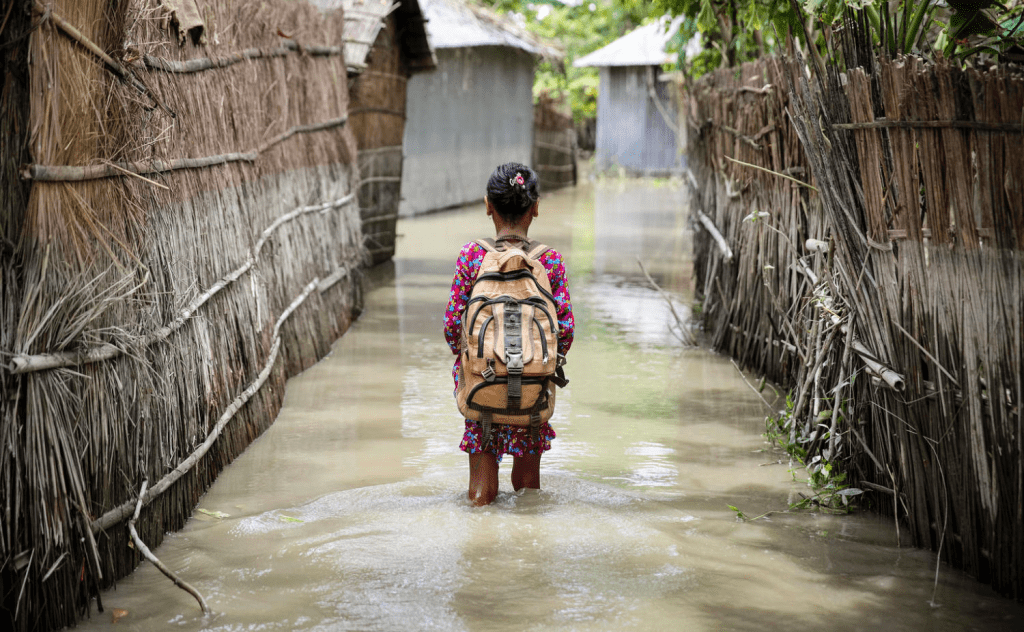
The elderly cannot readily cope with extremes of temperature and death rates are rising. The poor cannot afford to adapt their homes to improve insulation levels nor can they afford house insurance against flooding and fires as these becomes more frequent. Not can the poor readily move to more amenable climes. Islanders and those living along river deltas cannot stop rising sea levels from destroying their homes. Farmers cannot adapt practices quick enough to cope with extreme weather conditions. Young children cannot survive as drinking water supplies dwindle to nothing.
All this because we did not pay heed to the warnings, we did not stop polluting the atmosphere with more and more carbon dioxide. Instead we have kept our focus on our everyday habits – school run refuel the car, laundry in the tumble dryer, Sunday lunch roast beef, half term holiday in the sun- and ignored the long term direction of the climate crisis. We have not wanted to admit our responsibility for climate change, not even accepting that we might have been unknowingly guilty of causing harm. Nor have we wanted to change our lifestyles, our habits of a life time – to forgo our metaphorical seats in the synagogue – or loose the respectful comfort of western citizenship.
Surely, we said, this problem is so big it must be a problem for governments, big businesses and world organisations to deal with? It must be their responsibility not ours. And if they act as if there is no emergency, no urgency to act, should we not follow their lead and let things sort themselves out?
We are happy to do the small things, to reuse our plastic carrier bags, recycle the newspapers, buy an eco friendly hammock for the garden and make sure our new T-shirt is made from organic cotton. But to address the big problem, to seek love and justice for the earth and all its inhabitants, is beyond what we can even imagine.
But in the background there have been people calling for and working for change. People who see the problem for what it is and see the scale and urgency of the changes needed. People who are prepared to stand up and stand out and say it like it is.
And where in all this is the church? Where in all this are those who are followers of Christ? Where is the leadership, the penitence, the will to turn things round? Why are we still counting out our tithe of mint and rue whilst supporting a vast carbon producing, fossil fuel dependent economy?
Proper 17: Deuteronomy 4:1-2, 6-9, Psalm 15, James 1:17-27, Mark 7:1-8, 14-15, 21-23
Reflection
Today’s passage from Deuteronomy talks in terms of statutes and ordinances, but what the people are being urged to do is to embrace the Torah as the key non negotiable summation of their life. Whilst we often translate the word ‘Torah’ as law it is something more fluid in meaning than the rigidity that law suggests. The word in Hebrew has the meaning of instruction or guidance, or of teaching – of that which flows, say, from the teacher to the disciple, from the parent to the child or above all, from God to God’s people. It can be seen as a concept that describes the relation between God and God’s people. Through the Torah God’s expresses the desire that people should live lives that are good, happy, loving, wise and productive.
The Torah is also used to name the first five books of the Hebrew Bible: Genesis, Exodus, Leviticus, Numbers and Deuteronomy. These five books lay out the story of Gods early relationships with the earth and with human kind and with the Hebrew people in particular. As well as describing this history, it includes laws – statutes and ordinances – that concern both daily life and community life, worship and relationships with God, farming practices, justice etc. Further on in Deuteronomy we hear of the very practical requirements such as setting aside a portion of all they produced – a tithe – to support the vulnerable in their communities and those unable to provide for themselves (Deut 14:28-29). And we hear very spiritual commands: You shall love the Lord your God with all your heart and with all your soul and with all your might. (Deut 6:4)
Whilst today’s passage talks about statutes and rules as if they were rigid, un-moveable, it helps in our understanding of the overarching nature of the Torah, if we remember that the Book of Deuteronomy is itself a revision of the laws written in Exodus, Leviticus and Numbers, written for the needs of the nation in the 8th century BCE. It is the loving relationship that God desires that is eternal, whilst the nature of rules is to evolve. In today’s psalm the Psalmist looks at how one finds a right relationship between God and human by observing the characteristics of a person who is living close to Go’s. That person is the one who live ‘a blameless life and does what is right, who speaks the truth from his heart’. The Psalmist then adds some flesh to this describing how this person lives their life.
Here we might also recall from last week’s Gospel the words of Simon Peter, “Lord, to whom can we go? You have the words of eternal life. We have come to believe and know that you are the Holy One of God.”
This thought is echoed in the words of the Letter of James, for ‘every generous act of giving, with every perfect gift, is from above, coming down from the Father of lights, with whom there is no variation or shadow due to change. In fulfilment of his own purpose he gave us birth by the word of truth, so that we would become a kind of first fruits of his creatures’. The gifts of loving and learning and all that shapes our lives, flows to us from God so that we may live as God’s intended creation.
James sees this as a gift that is only of benefit if it is acted upon, if it is built into the fabric of life. If it remains just as words, its benefit is non-existent. This seems to be at the nub of the argument between Jesus and his opponents in today’s gospel. If the law is honoured just as a set of words, but has no impact on the quality of life, has no positive impact on the way we love one another, has no benefit in sustaining our creation as God’s people, the it is of not being observed in the way God intends. The gift that comes from God is pure and undefiled and when received and acted upon, produces blessings. It is how the gift is received and acted upon that is important and when we hear the passage from Mark’s Gospel that is the difference between Jesus’ response and that of his opponents.
It is when we spurn God’s gifts, ignore God’s teaching, that our lives become compromised by fornication, theft, murder, adultery, avarice, wickedness, deceit, licentiousness, envy, slander, pride and folly. It is when we see other humans, and other creatures, as opportunities for profit, that we cease to feel God’s love. It is when we ignore the needs of the vulnerable – the orphan and the widow, the refugees and the migrant, the wild bee and the tiger, the bluebell and the Amazon rainforest, the contract worker and the carer – that we see lives destroyed and habitats lost; deceit and prevarication in government and big businesses; short term economic policies that fail to address the climate crisis; a lack of vision and determination create polices that ensure protection of the environment, or set up a sustainable care system.
Holy God, through Jesus you show us how to truly live life, how to fill our hearts with love so that love may shape the world in which we live, so bringing your kingdom on earth to be as it is in heaven.
Someone in the crowd said to him, “Teacher, tell my brother to divide the inheritance with me.”
So begins the conversation that leads to Jesus’s parable about the greedy farmer.
Is it that the brother has kept all the inheritance for himself? Or maybe has palmed off his sibling with a pittance? Maybe the inheritance was a house that could not easily be divided between two? Maybe it was a farm that might be uneconomic to run if halved in size?
Certainly for what ever reason, the sibling feels short changed and wants a fair share of the inheritance, indeed wants justice.
Jesus doesn’t ask for clarification, nor does he suggest ways in which the inheritance might be divided, or ways in which to engage the brother in talks about what might be a just and fair solution to the problem. Instead Jesus tells the sibling to be wary of greed – and not just any greed but “all kinds of greed.” Jesus then tells the crowd a parable.
There was once a rich and successful man – so successful that his annual harvest was more than his warehouse could hold. So the man tore down the first warehouse and built an even bigger one, assuring himself that with all this great wealth he would certainly be able to retire and enjoy the good life. And yet that night he died having failed to enjoy any of his gains.
I wonder what the sibling thought? How was this an adequate answer to what must have seemed a valid request? Did the sibling conclude that Jesus was criticising his brother for wanting to keep all the inheritance rather than sharing it? Or did the sibling sense Jesus saying that there were more important things in life than accumulating wealth and maybe especially so if it was inherited wealth for which one had perhaps not even worked?
What might this passage have to say to us as we wrestle with finding a just settlement of the climate crisis? Is there a global inheritance that needs to be divided? Is there a rich harvest being garnered that is more than one person’s need?
The natural wealth of the world is certainly something inherited by each generation. A rich inheritance of resources: lands, birds and animals, rivers and lakes full of drinking water, forests burgeoning with timber, minerals, numerous plants with which to feed ourselves and from which to create clothes and medicines, energy from the sun, irrigation from the rains, power from winds and thermal energy, a multitude of mini beasts that keep the solid rich and fertile, insects that pollinate crops, oceans that shift heat around the planet, and so on and so on. It is a vast wealth that should satisfy all our needs.
Earth Overshoot Day marks the date when humanity’s demand for ecological resources and services in a given year exceeds what Earth can regenerate in that year. in 2021 Earth Overshoot Day fell on 29th July. Since then we have as a global population been living beyond our means. We have been consuming resources faster than they can be replenished and instead have been accumulating excess waste, particularly of carbon dioxide. Something is wrong! And it’s wrong on two counts.
Firstly as a global population we cannot carry on living beyond our means. To do so leads to disaster. Or as Mr Micawber in ‘David Copperfield’ explains it: ‘Annual income 20 pounds, annual expenditure 19 pounds 19 shillings and sixpence, result happiness. Annual income 20 pounds, annual expenditure 20 pounds nought and six, result misery.’ For those of on earth in the 21st century the misery we face is most readily seen in the climate emergency: excess amounts of carbon dioxide and other greenhouse gases, is so markedly changing the climate that wild fires, floods, droughts, heat waves and storms that might be once in a life time events are now annual occurrences. The changing climate is simultaneously changing the landscape, expanding deserts, shrinking ice caps, shrinking the tundra, narrowing the temperate Alpine zone, draining river basins such as the Amazon and the Po, rising sea levels and the loss of islands and coastal lands. This misery is not limited to the climate but is also found in rapidly declining biodiversity of the planet. Over the last 40 years the world’s wild life population – animals, plants, birds etc – has declined by more than 60% and some 10-30% of all species now face imminent extinction. And in the declining availability of essential resources such as fresh drinking water.
On the second count, the overshoot is bad because its pain is not being shared equally across the global populace. For many of us in the west life remains safe, comfortable and affordable but for many more, especially those in the global south human life is extremely vulnerable and painful. In the UK we face from time to time shortages of items such as cauliflowers or potatoes, people elsewhere face life threatening shortages. In Ghana last year the staple crop of maize was 60% below average. This year heat waves in Bangladesh have destroyed about 20% of their staple rice harvest.
We should be hearing this as demand from our siblings to divide the world’s inheritance and to do so fairly.
Those of us currently enjoying western lifestyles need to reassess what we consume of the earth’s resources and undertake to consume less, and to share – to give – a greater proportion to the underprivileged. Such levelling up needs to take place both globally and nationally. Here in the UK in 2018, the richest fifth of the population had incomes 12 times that of the poorest fifth, whilst a quarter of all wealth is held by just 1% of the populace. Globally the richest 1% hold 43.4% of all wealth.
Unlike the rich man in Jesus’s parable, we do not see many of the rich and wealthy dying overnight. Rather we see them (and us) contributing the greater amount of carbon dioxide and other waste products that are the cause of climate change and biodiversity loss. It is not rich individuals who are dying unfulfilled. It is our global family that is dying prematurely and unfulfilled. If we did but live within our means and did so equitably across the globe, life would be richer and sweeter and peaceable.
This is the message that should be heard at COP26 and should be the model for the agreements made there. It is also be the message we individually should hear and act upon.









 The Green Tau