Windows of Opportunity 

14th December 2023

Cut down on meat and dairy

“[T]he climate impact of plant-based foods is typically 10 to 50 times smaller than that of animal products, it follows that switching from a largely meat-based diet to a vegetarian or vegan diet could help to reduce emissions…According to the analysis, a switch to veganism could save almost 8bn tonnes of CO2e a year by 2050, when compared to a “business-as-usual” scenario. (By comparison, all food production currently causes around 13.7bn tonnes of CO2e a year.) The second highest emissions savings would be delivered by a global shift to vegetarianism which, in the analysis, still includes around one serving of meat or fish a month. An adoption of this diet could save 6bn tonnes of CO2e a year by 2050, according to the analysis”. (1)

And change is possible: “As attendees break for meals between meetings, negotiations, and panel discussions, they may notice one striking difference between COP28 and past UN climate conferences: There won’t be much meat on the menu. After a months-long effort by the youth-led Food@COP coalition, the United Arab Emirates environment minister, Mariam Almheiri, announced last month that two-thirds of the food served at the event will be plant-based.”(2)

Universities are also moving to 100% plant based foods for campus catering. So far this includes the Universities of Warwick, Stirling, Cambridge, Birmingham, Kent, London Metropolitan, Queen Mary University of London, and University College London. This has in part been a response to the Plant-Based Universities campaign –  https://www.plantbaseduniversities.org/about-4

Local councils are also voting to adopt plant-based policies (eg to serve only plant-based food and drink at catered events and meetings – Oxford City Council, Oxfordshire County Council, Cambridge City Council, and Exeter City Council. (3) There is, however, a fight-back against this by livestock farming groups.  
(1) https://interactive.carbonbrief.org/what-is-the-climate-impact-of-eating-meat-and-dairy/

(2) https://www.vox.com/future-perfect/2023/11/30/23981529/cop28-meat-livestock-dairy-farming-plant-based-united-nations-dubai-uae

(3) https://smartercommunities.media/uk-councils-and-universities-adopt-a-plant-based-future/ See also – https://www.vegansociety.com/sites/default/files/uploads/downloads/Catering_For_Everyone_Report_2023_TVS.pdf

Counting on … day 1.220

21st November 2023

Following on from yesterday’s post, another area where we as individuals can make a difference is in our choice of diet. Cutting back on meat and dairy can both reduce pressures vis a vis deforestation, and directly reduce emissions arising from farm livestock. 

In particular, when cutting back on meat and dairy, we may want to review the provenance of what meat and dairy we do eat. We may want to investigate how and where the relevant livestock are reared – whether they are fed on imported grain, whether they are intensively farmed, whether they are grass fed and have access to outdoor spaces, whether they are reared organically, whether they are reared in the UK or elsewhere, and even what provision is made for the safe disposal of their sewage. Effluent from industrial sized chicken farms are severely polluting the River Wye.

For more information on the merits of meat-based, vegetarian and vegan diets see – https://www.ethicalconsumer.org/food-drink/climate-impact-meat-vegetarian-vegan-diets

Counting on …. day 1.189

9th October 2023

Vegan Plum Tart

Make shortcrust pastry with 125g flour and 60g vegan butter and use to a flan or tart dish.

Half and stone enough plums to cover the base of the tart. Or use apricots dried or fresh, or figs or sliced pears.

Soak 1 tablespoon of chia seeds in hot water

Melt 100g vegan butter.

Add in 4 tablespoons sugar, 75g ground nuts (eg almond, Brazil, walnut), 1 or 2 tablespoons flour with raising agent, 1 tablespoon custard powder, and the chia seeds.

Mix well, adding 1 tablespoon brandy/ whiskey (optional) and a little water to loosen if the mixture is stiff.

Spread this mixture over the plums and fill the tart.

Bake 180C for about 30 minutes until lightly browned and firm to touch. Allow to cool a little before serving.

Counting on … day 1.163

1st September 

Another source of plant based protein is nuts. These can be enjoyed, plain or roasted, chopped or ground into flour. They can be used in these different forms when baking and cooking. For example ground nuts can be added to vegetables to make a pasta sauce or to a creamy soup, as well as enriching cakes and biscuits. Ground nuts can be used to coat vegetables for roasting.  Whole nuts can be added to casseroles, stir fry’s, cakes and deserts. Chopped nuts can be used in vegetable pies, nut roasts, stuffings, risottos, as well as cakes and deserts.

For more tips on swopping to a plant based diet – https://greentau.org/2021/10/12/eco-tips-11/

Counting on … day 1.162

31st August 2023

Seeds are also a good source of protein as well as various minerals and vitamins. Try chia seeds, linseed or – the wild version – camelina seeds, pumpkin, sunflower, poppy, sesame and hemp seeds. You can add seeds to muesli or porridge, salads and mix them into bread dough. 

You can use chia or linseeds as an egg replacement mixing one table spoon of seeds with 2 tablespoons of warm water, leaving it for a short time while the seeds thicken and produce a jelly-like texture.

You can use pumpkin or sunflowers seeds instead of pine nuts to make pesto. 

You can also add seeds to hummus either blitzing them with the chickpeas or adding them whole for a different texture.

Counting on …day 1.161

30th August 2023

Peas and beans can also be used ground up as flour. (Again you can buy different flours from Hodmedod’s).

Pea and bean flour can be used to replace some of the wheat flour in things such as bread, cakes, pastry and pasta, adding more protein to these foods. Pea and bean flour can be used to replace egg in foods such as frittata, pancakes and Yorkshire puddings. (Experiment with vegan recipes for these).

Pea and bean flour can be used to thicken liquids and to make sauces. Mix with a little water as if it were corn flour and add in/into the hot liquid. (You can make these sauces in a microwave to to save energy).

Counting on … day 1.159

28th August 2023

What often worries people when swopping to a plant-based diet is getting enough protein. We have been brought up understanding that we need protein and that meat, fish and dairy are all good sources of protein. The recommended daily protein consumption is 55.5 grams per person for adult men and 45 grams per person for adult women which ideally would be spread throughout the day. 100g of chicken or beef equates to about 30g of protein, 100g salmon about 25g, 1/2 litre of milk about 15g and 50g of cheese about 12g. As in addition a couple of slices of bread can contain 6g of protein, 100g  of rice 10g it is not surprising that many people consume more than the recommended amount.  https://www.nutrition.org.uk/healthy-sustainable-diets/protein/?level=Consumer

As well as bread and rice, protein can be found in beans, pulses and tofu  – about 8g per 100g (cooked weight); nuts and seeds about 5g per 25g (a tablespoon of peanut butter is about 4g); in green vegetables such as cabbage and broccoli about 3g per 100g. Combining beans/ pulses/ peanut butter  with grains such as rice/bread/pasta provides an optimal mix of amino acids present in protein.  This makes simple dishes such as beans on toast, a peanut butter sandwich, hummus and pitta bread, rice and dhal an excellent source of nutrition. 

Counting on … day 1.157

24th August 2023

If agricultural expansion is to be reversed, it will need the combined efforts and cooperation of governments, farmers, consumers, commodity  traders, financiers, retailers, and environmental scientists. One of the most important areas to change will be that of meat production. 

‘Of all the world’s land surface, approximately 71% is ‘habitable land’; half of this land is used for agriculture. Currently, pastures used for grazing and land used to grow crops for animal feed account for 77% of agricultural land, thus comprising nearly 30% of the total land surface of the planet…If we combine pastures used for grazing with land used to grow crops for animal feed, livestock accounts for 77% of global farming land. While livestock takes up most of the world’s agricultural land it only produces 18% of the world’s calories and 37% of total protein.’ https://ourworldindata.org/global-land-for-agriculture

Across Europe governments are, to a greater or lesser extent, aiming to reduce meat production on farms and meat consumption amongst populations. The Irish government for example, is looking to reduce its dairy herd by 65000 animals per year over the next three years. The Dutch government is planning to reduce its cattle numbers for 30% by 2030. The Climate Change Committee in the UK has recommended livestock cuts  of 20-50% for  beef and lamb, whilst at the same time recommending a 20% reduction on meat and dairy in the UK diet.

Reducing cattle numbers will free up more land for plant crops and so feed more people and/ or rewilding which will boost biodiversity.

Over the next few days I will be looking at easy ways of adapting to a more focused plant based diet.

For further info in farming, land use and biodiversity see

Counting on … day 1.136

31st July 2023

To keep sourdough starters healthy they need regularly depleting and refreshing – often more frequently than the demand for more bread. The sourdough starter can be used for things other than bread – such as crumpets.. It can also be used to provide the acidic element for soda bread or soda scones.

Soda farls made with sour dough starter

Heat a heavy frying pan. 

Mix 200g of plain flour with a two generous tablespoons of sourdough starter.  

Add 1/2 teaspoon of bicarbonate of soda and some grated nutmeg.

Stir in a handful of raisins. 

Mix with enough oat milk to a soft dough. 

Brush the frying pan with oil. Scope the dough out and into pan and Pat it with the back of a spoon to a roundish even shape – about 2cm deep.

Once the bottom is cooked and the edges are beginning to form, slide the soda bread onto a plate. Invert the pan on top, flip over so that the uncooked side of the soda bread is now face down in the pan.
Cook the second side.

You can vary the flavour by using dried cranberries, dried chopped apricots, diced apple etc instead of the raisins. And you can use cinnamon or cardamom instead of nutmeg.

Counting on … day 1.117

11th May 2023

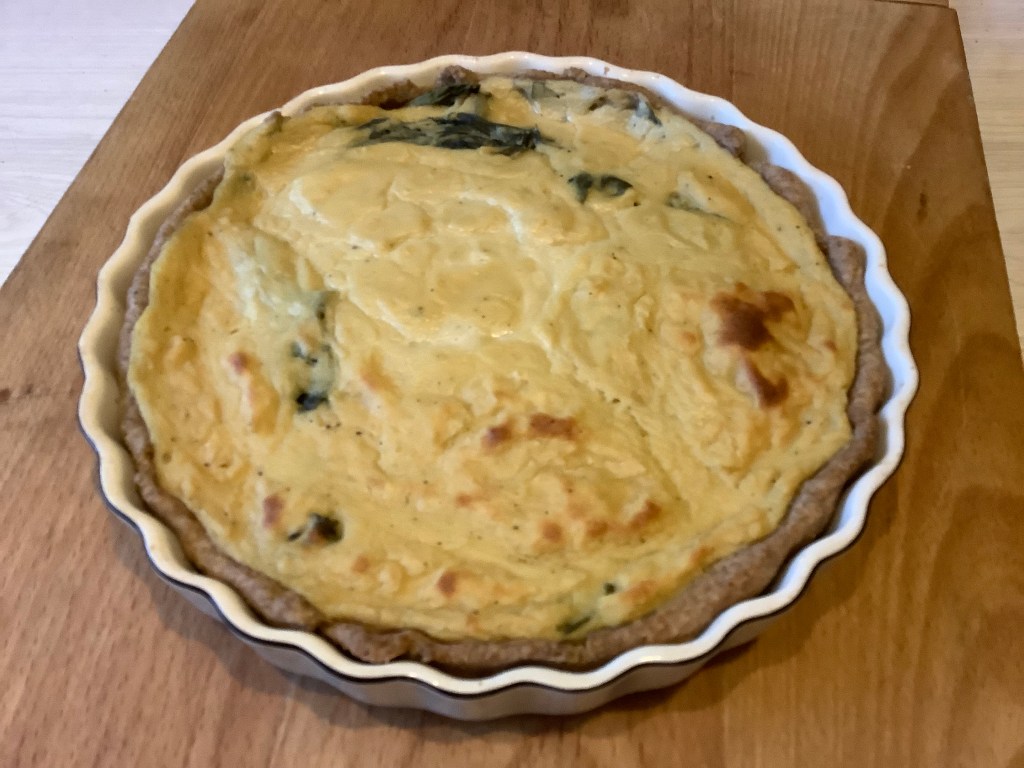
Vegan Quiche

Make a short crust pastry with 200g flour and 100g vegan butter. Use this to line a flan dish

Lightly cook a colander  full of green leaves (spinach, chard, dandelion, herbs etc).  This can be done easily in a microwave.

Make a white sauce using 3 level tablespoons of yellow pea flour and about 500ml of oat milk. (Again this can be done in a microwave). Flavour with yeast flakes and black pepper.

Sautée an onion in some oil. 

Place the onion in the encase of the flan, add the green leaves and pour the sauce over the top.

Bake at 200C for about half an hour or until the quiche is golden and the middle firm.