Living Sustainably; Protecting the Earth; Loving God
Author: Judith Russenberger
Environmentalist and theologian, with husband and three grown up children plus one cat, living in London SW14.
I enjoy running and drinking coffee - ideally with a friend or a book.
Action: One of the key ways in which we can reduce our carbon footprint is by eating more plant based foods and less meat and dairy products. Swopping plant based milk and butter in baking is one easy way to make the change without even noticing. I am always surprised that even though most cafes offer plant based milk, very few offer a selection of – or even just one – vegan cakes!
So here I a recipe for vegan rock buns.
Ingredients
250g raising flour ( I use wholemeal flour plus baking powder)
75g vegan butter (unlike margarine this has the hard texture of butter)
1tsp grated nutmeg
1 tsp egg replacement powder (eg Free and Easy)
50g sugar
75g dried fruit – eg raisins
Oat milk
Method
Cut the butter into cubes and rub into the flour.
Add remaining dry ingredients and mix.
Add just enough milk to bind the whole into a stiff mix. (If it is too soft, the buns will look more like cookies than rocky buns).
Place in rough spoonfuls onto a greased baking tray. It will make about 10 or 12.
Bake in a pre-heated oven at 175C for 15 to 20 minutes until lightly brown.
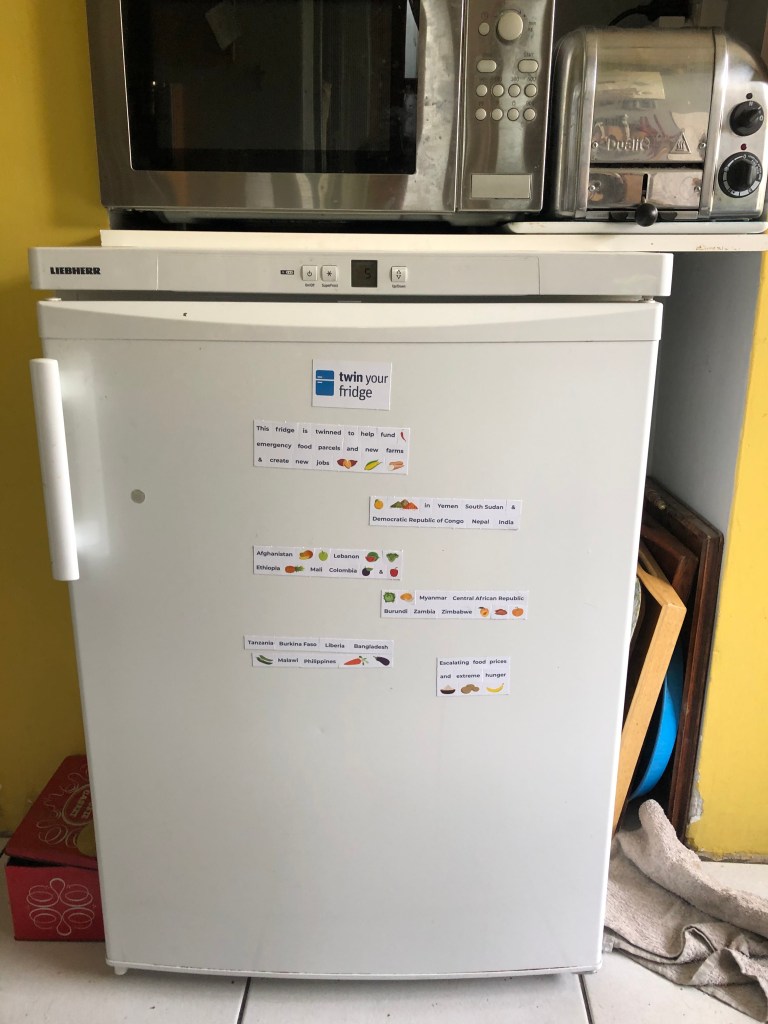
This week we twinned our fridge (having already through the auspices of TearFund twinned out toilets and rubbish bins). Our fridge is never unintentionally empty, there is always enough food in the house for us to eat. We have never experienced the hunger that comes from not knowing where your next meal will come from. Twinning our fridge is a reminder to us that we are in world terms, exceptionally fortunate and that at the very least we should be willing to contribute towards the cost of feeding those who know real hunger.
Hunger world wide is often not the result of over population, nor even of drought or floods – although this is increasing as countries increasingly experience the impacts of climate change. Most hunger arises from war (as we are seeing currently in Tigray, Syria and Yemen) and from unequal access to and sharing of, resources. Since the mid 1960s all parts of the world have been producing sufficient food to allow every person in every country to have 2000 calories a day. However within many countries the sharing of that food means that between a third and a half of the population do not receive that fair share.
Even here in the UK people go hungry, not because there is not enough food to go round, but because they do not have enough money. Their lack of money stems from a unequal sharing of the nation’s wealth. UK households waste 4.5m tonnes of food a year that could have been eaten, worth £14bn – ie the average family spends £700 a year on food it does not eat, whilst 1 in 8 people go hungry. In the last year 2.5 million people used on of the UK’s food banks.
What is the problem?
Today’s psalm tells how all God’s works – ie everything human and creaturely that God has created – praises God. In praising God, these ‘works’ reveal the glory of God’s kingdom and God’s power. And they do this so that the people may know God’s power and recognise God’s dominion. The Psalmist sees dominion as being of God – not of humans – and that because of God’s power and dominion there is food enough for all to eat. Any problems due to food shortages are not God’s problem.
The reading from 2 Kings about Elisha was one I was completely unfamiliar with. It is a story brimming with interest. It begins with a person bringing to Elisha, a man of God, their first fruits in the shape of twenty loaves of barley bread and a sack full of ears of grain – barley? The first fruits were those first to be harvested, and as is clear here, it is the barley crop that is first to be harvested. According to Leviticus 23:20, the first fruits would be given to the priest who would offer them to God. This offering was a way of thanking God, the ultimate provider of food. So here the farmer is bringing bread and grain to give thanks for God’s generosity.
Normally such food would then be available for the priests to eat. But here Elisha – who probably in the context of the Book of Kings counts as a priest – does not keep the bread and the grain for himself. Rather he shares them with the people. Food offered to God, is eaten not just by God’s holy man but by everyone – or according to the servant, by a minimum of 100 people. This a sharing of God’s food with God’s people and there is more than enough.
The writer of the letter to the Ephesians is equally bowled over by the riches of God’s glory. It is a glory which manifests itself in the power experienced by the believers in Ephesus through the Spirit and through the presence of Christ in their hearts which allows them to grow in love and faith. The writer, like the Psalmists, talks of every family on earth – every being – as being in a relationship with God. It is a parental relationship in which they may experience the fullness of God which is exemplified by the height, length and depth of Christ’s love.
John’s gospel does not have a specific description of the blessing and sharing of bread and wine at the last supper. Rather these actions are present within many of the episodes throughout the gospel. Today’s story takes place on the verge of the feast of Passover and concerns the blessing and sharing of bread. A large crowd that needs to be fed. Philip – and maybe some of the other disciples too – sees the problem as one of money. Andrew looks at what food they have to hand – the packed lunch of one small boy – and likewise sees a shortfall. And note, the writer of John’s gospel is quite specific that these are loaves of barley bread. In Jesus’s hands this offering does indeed feed the crowd – crowd not 100 but 5000! There is enough food – and more to spare – to feed God’s people.
The problem of hunger is not a lack of money nor a lack of food but a failure to share both these resources in a God-given way – with thanksgiving. When we share bread together at the Eucharist is should remind us not just of God’s love and generosity to us, giving us both food and the gift of Christ the living bread, but also that we too are meant to ensure everyone is fed.
A question of justice: what is climate justice? Part 1
What is justice?
The Central Criminal Court of England and Wales, more commonly known as
the Old Bailey, is surmounted by a statute of Lady Justice. In one hand she holds a sword, and in the other, a set of scales. The scales remind us that justice requires the evidence of the case to be weighed and only if the evidence of guilt is more than the opposing evidence, is the accused found guilty. The sword symbolises the implementation of the judgement made – ie what punishment or reparations are due. Many images of Lady Justice also show her wearing a blindfold as a reminder that justice if to be given impartially, ie favouring no one person more than another.
But how do you know when an offence has been committed, something that requires the salve of justice? Most/all? countries have laws: laws that lay down what is right or wrong, what is acceptable or unacceptable. Typically such laws will embrace not killing or injuring people, not stealing from others nor damaging what belongs to someone else.
Laws exist to both prevent certain actions and to prompt certain actions: driving at excess speeds and buying car insurance. Laws exist to protect rights and to impose obligations: House owners have the right to forbid someone to enter their property but if they do invite someone in, they have a responsibility to ensure their safety. Laws exist to protect those who would otherwise have no rights: refugees have a right to safety, wives have the right to be protected against abusive husbands (and vice versa). Laws exist not just to protect the rights of humans: animals, plants, buildings can all be given legal protection.
Justice is the process by which laws are enforced. Justice judges whether or not, on the balance of evidence whether a law has been broken and whether or not the accused is guilty of that offence. Justice serves to maintain harmony in a nation by ensuring that the law of the land is followed. But what if those laws have been chosen by a minority and applied to a majority who do not favour them? Will sticking to such laws create a contented society? Will they work to achieve the good of all society? What if those laws are out of date and support a social order that no longer exists. What if these laws support an economic system that is no longer viable? Good laws are as important as justice. Good laws tell us what is right.
The Greek word for justice, ‘dikaiosyni’, also has the meaning of equity and righteousness. Hebrew has two words that can be translated as justice, ‘mispah’ and ‘tzedaqah’. Mispah has more the meaning of executing justice or giving judgement, whilst tzedaqah has the meaning of righteousness and fairness. In a similar way in English justice can also have the meaning of fairness.
In the Old Testament justice and righteousness are frequently paired together as if you can’t have one without the other.:-
But let justice roll down like waters, and righteousness like an ever-flowing stream. (Amos 5:24)
Righteousness and justice are the foundation of your throne; steadfast love and faithfulness go before you. (Ps 89:14)
The days are surely coming, says the Lord, when I will raise up for David a righteous Branch, and he shall reign as king and deal wisely, and shall execute justice and righteousness in the land. (Jer 23:5).
I think that righteousness means God’s laws, God’s standards. Not just – or not even always – the laws laid down in the Old Testament, for they were laws given at a certain time and to a certain group of people – but something far greater than that. God’s laws are holistic, an everlasting set of principles that are shaped by God’s love and rightness. They can be summarised, as Jesus did, as loving God and loving one’s neighbour – including all that is commensurate with love, and that takes a life time to discern!
Here I would like to backtrack to the idea that justice might have the meaning of fairness. Lady Justice wears a blindfold to ensure fair and impartial justice. With her blindfold on, her judgement is not influenced by the character or background of one on trial. Whether the accused is rich or poor, popular or despised, low class or high class, the judgement made, the justice received will be the same. But is impartiality the same as fairness? No, which is why when it comes to sentencing, the character and circumstances of the accused are taken into account. It is why fines may be proportionate to the accused’s income. This partiality is applied when sentencing not during the trial when the evidence is weighed in the scales. Justice can thus remain impartial – and I would like to suggest – sometimes unfair.
If a person is so deficient in funds that they cannot buy food but instead steal, justice will find them guilty of theft. But if one were concerned with fairness, one might want to weigh in and ask why the person is so deficient of funds that they cannot afford to eat? And to ask in all fairness, how it is that society allows someone to go hungry when edible food is daily thrown away as waste?
God’s righteousness would suggest something very different. God’s righteousness would expect us to ensure that everyone has the means of earning or deserving sufficient funds, and would expect that come what may, all would be fed.
Thus says the Lord: Maintain justice, and do what is right, for soon my salvation will come, and my righteousness will be revealed. (Isaiah 56:1) The word given as justice is mispah, and the words given as right and righteousness are tzedaqah.
What then is justice from a theological or God-viewpoint? If secular justice is represented by Lady Justice and her weighing scales, then the biblical image of justice is, I think, the plumb line. A simple tool comprising a string and a weight which when suspended vertically uses gravity to show whether or not the things being judged – usually a wall – is true and upright and not in danger of collapsing. Amos sees this image as God shows him the short comings, the wrong doings of the nation of Israel.
Here justice is not just a case of weighing up the evidence to see if the accused is guilty, but of measuring the quality of the accused’s behaviour. Has their behaviour been upright, morally correct, righteous even? Have they followed the precepts and the tenor of God’s will? Justice only has value if it is linked to a divine standard – an uprightness – of behaviour. Justice is doing what is right in accordance with God’s righteousness.
“I will make justice the measuring line and righteousness the plumb line” (Isaiah 28:17).

Action 2: Have a talk with your best friend about the climate and your concerns. The more we talk with each other, the greater the awareness will be of the problems and the solutions and the more prominent the climate will be as a national issue. And that will prompt politicians and business leaders to take notice.
Last year we were counting down to COP26 which was being held at Glasgow with the United Kingdom as host. I posed the following questions:- Are the nations, the leaders, the civil servants, the interested parties, ready? Are they equipped with ideas and proposals? Are they ready to negotiate and encourage and take bold steps to reach an agreement that will see carbon emissions reduced to net zero by 2050? Will they be sufficiently pragmatic to be generous in funding support to enable poorer countries to be part of the movement to net zero? Will they be clear sighted, seeing the bigger global issues rather than being blinkered or distracted by individual agendas? Are they going to be supported by overwhelming popular support for those policies and actions that safeguard our shared future?
The outcome was perhaps better than might have been feared, but certainly not as proactive as it might have been. One of the outcomes was that, in recognition of the severity of the crisis we face, all parties should meet again a year later to review progress and restate targets to keep the process of net zero on track. Thus it is that in 100 days from now, on 6th November, all the parties will be convening in Sharm El-Sheikh for COP27. This time the hosts will be Egypt.
Last year I also posed some questions for ourselves and I propose to repeat/ review these this year.
Can we be part of that popular support? Can we also take action regarding our own lifestyle to contribute to the net zero emissions target? Are there 100 actions we can take between now and the Conference?
Action 1: Write to your MP and let them know why you think this Conference is important and why you hope it will be a turning point in addressing the global climate crisis.
NB What does ‘net zero’ mean? Net zero refers to achieving a balance between the amount of greenhouse gas emissions produced and the amount removed from the atmosphere. There are two different routes to achieving net zero, which work in tandem: reducing existing emissions and actively removing greenhouse gases.
A gross-zero target would mean reducing all emissions to zero. This is not realistic, so instead the net-zero target recognises that there will be some emissions but that these need to be fully offset, predominantly through natural carbon sinks such as oceans and forests. (In the future, it may be possible to use artificial carbon sinks to increase carbon removal, research into these technologies is ongoing.)
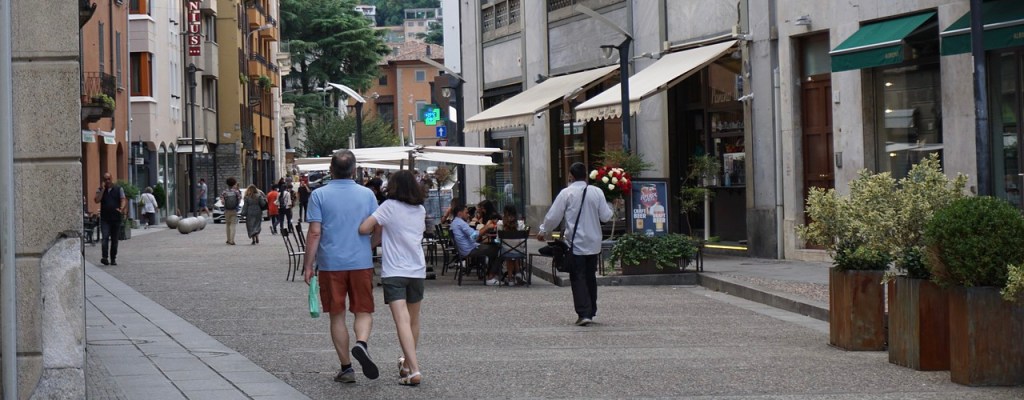
Imagine living in a neighbourhood where everything one needed on a daily basis lay within a fifteen minute journey – on foot or cycle – of one’s home. A neighbourhood where you can safely walk or cycle to the shops, school, medical centre, park, gym, swimming pool, office, cafe, the pub. A neighbourhood with (largely) traffic free streets, where children can cycle safely and those with impaired mobility/ sight/ hearing can easily cross the road. A neighbourhood where you know your neighbour, the barista at the cafe, the coach at the gym. A neighbourhood where you know you are part of the community.
How far can you walk in 15 minutes? 3/4 or even a full mile.
And by cycle? – maybe 2 to 4 miles.
Could you get much further by car?
The average speed of traffic in London is around 7-8mph, suggesting one could travel 2 miles in quarter of an hour. But then one would have to find somewhere to park, so the distance you could travel by car might well be much less than 2 miles.
Imagine a whole city made up of such neighbourhoods and you have the Fifteen Minute City. This concept is being a actively pursued in Paris by the mayor, Anne Hidalgo. Hidalgo proposes to have a cycle lane in every street and to remove 60,000 parking spaces for private cars whilst at the same time spending €1b per year for on greening both streets and school playgrounds. She has already added some 50km of cycle paths and banned high polluting vehicles. Similar projects are being trialed in Milan, Madrid, Seattle and Ottawa, whilst Melbourne and Edinburgh are pursuing twenty minute neighbourhoods.
What are the benefits?
Benefits social cohesion and community strength.
Supports local business and enterprise.
Less time spent commuting. Fewer traffic jams.
Less air pollution. Reduced CO2 emissions.
Option to repurpose road space as green spaces. Greater biodiversity.
Improved levels of mobility for everyone. Better health.
Increased quality of life.
If you want to hear about the Fifteen Minute City from its creator, Carlos Moreno, tune into the following YouTube episode:-
Can we as individuals go some way to creating our own fifteen minute neighbourhood? We can choose to patronise local shops and businesses, use local leisure facilities and green spaces. We can choose to walk or cycle to each destination, and we can seek out routes that green and interesting – and perhaps discover paths we didn’t know existed!
If we become accustomed to walking or cycling 15 minutes on a day to day basis, we will find we can transfer to a lifestyle that doesn’t need a private car. For those longer but less frequent journeys we can as easily walk to the station and take the train, or book a taxi or hire a car. If that becomes the norm just imagine the effect it will have on local neighbourhood and on carbon emissions.
This pictogram shows my 15 minute neighbourhood: why not have a go at drawing one centred on your home?
Transcript of a talk a church group about my experience of being arrested during an XR climate crisis uprising.
Micah 6: 1-8 (abbreviated)
Hear what the Lord says: Rise, plead your case before the mountains, and let the hills hear your voice. Hear, you mountains, the controversy of the Lord, and you enduring foundations of the earth; for the Lord has a controversy with his people, and he will contend with Israel. “O my people, what have I done to you? In what have I wearied you? Answer me! …”
Has he not told you, O mortal, what is good; and what does the Lord require of you? Do justice, love kindness, and walk humbly with your God.
But what is justice?
That is a question I would like you to hold in mind, and I will ask it again at the end.
I have always had a Christian faith and a concern for justice. As a teenager I restricted my diet to 1000 calories a day in solidarity with women in India. When I was at university in the early 80s I was aware that human production of green house gases plus our excessive use of raw materials was damaging the world’s environment. That knowledge together with my Christian faith has shaped the way I lived. As a family – Paul and I have three children, now all grown up – we have constantly been adjusting our lifestyles to try and mitigate the damage we were causing to the earth.
As the internet age developed, so I have signed more petitions, written to and spoken with our local MP, joined marches and protests. Yet nothing seems to change. The world is continuing to grow warmer, extreme weather events occur more frequently, ecosystems are being destroyed, the poor are being disadvantaged – and yet the human output of carbon dioxide and other greenhouse gases continues to rise. I felt that nothing was going to stop this crisis.
In the spring of 2019 I went to Cornwall with my daughter to walk the Celtic Pilgrim Way. We returned on Good Friday when the XR Easter uprising had begun and we stopped off at Marble Arch. Pitched tents, crèche, a stage, workshops, a welcome desk, sunshine, smiling people, even the drivers of vehicles whose routes had been diverted were cheerful. The same in Waterloo Bridge which had been transformed into a garden bridge with trees and pot plants, a skate board ramp, sofas and easy chairs, and story-telling circles. It was all a vision of what the future could be!
When I heard that the October uprising was to include a Faith Bridge I wanted to be a part. The Faith Bridge was conceived as a coming together of different faiths – Buddhist, Muslim, Jewish, Quakers, pagans, Christians – to express our joint concern for the well-being of the earth. We were to occupy Lambeth Bridge for the duration where we would set up a tepee for worship (which would be led by the different faiths throughout the day) a stage for talks and music and drama, places to meet and share with others our hopes and fears, and as the centre piece a large wooden ark.
To secure the bridge we would need a small group of people willing to be arrested whilst a larger group of people set up these bases. Drawing inspiration from both my Christian faith and from the example of the Suffragettes, I volunteered to be an arrestable. For this XR provides training and on going support.
The first day of the uprising dawned – literally -as we gathered by Lambeth Bridge. Initially we blocked the slip roads leading onto the bridge. Another group of protesters were doing the same at the other end. Once the traffic had been brought to a standstill we moved onto the bridge itself. The police had pre-empted us. They were massed in lines across the bridge such that each group of protestors was confined to small area at opposite ends of the bridge. At the same time another group of police saw the ark being delivered in its flat pack state and confiscated each part as it was unloaded.
I am in the blue coat sat in front of the green banner
Undaunted we sat on the tarmac surrounded by banners and prayer flags, facing the police line. We were a mixed group – all ages, backgrounds and faiths – and together we sang and prayed and shared our stories. Faith leaders and CEOs of charities and NGOs came and told us their stories as to why the climate crisis was such a critical issue. And still we sat and sang and prayed. It was a uniquely special experience of being in the presence of God.
Around mid afternoon, the police gave us the option of joining our fellow protestors at the other end of the bridge – provided we walked round the long way, via Westminster Bridge. We gathered up our banners and flags, our musical instruments and the remaining box section of the ark and set off along the road past St Thomas’s hospital, singing as we walked. We must have looked like the Israelites setting off for the promised land. Having negotiated our way through the blockades on Westminster Bridge and we’re almost in sight of the north end of Lambeth Bridge, we were stopped by another group of police who wanted us to divert with the ark to Horseferry Road. Negotiations took place. Whilst we waited we sat and we sang. Then a whisper spread round and looking behind us, a double line of police officers were advancing towards us. On arrestables drew back, the rest of us sat firm holding onto the ark. Arrests began. A police officer tried to persuade me to let go, and when I did not, I was physically lifted up and back, ending up on my back in the road – time send to stand still. Them everyone was crowding round. The police officer cautioned and handcuffed me. The XR legal observer wanted my details. People were shouting abuse at the police; others were cheering and applauding those who were being arrested. My mind went into a blur and my body into shock. My arresting officer was considerate and concerned and helped me across to the pavement where I joined others who had been arrested. We sat there for a couple of hours with our arresting officers whilst police stations were contacted to find spare cells. Four of were loaded into the cage compartments in the back of a police van and taken to Walworth. And still the wait continued, as we waited to be processed by the custody officer. Finally I was put into a police cell, given a vegan meal and a blanket.
At 2 in the morning I was released pending further investigation having been charged with obstructing the highway and causing a public nuisance. As I left the police station I was greeted by an XR volunteer who offered me chocolate and looked up the night bus time table so that I could get home and to bed!
My day in court was delayed by Covid. After numerous postponements, the case was heard in March of this year at the City of London Magistrates Court. I was represented in court by a barrister – the cost of both the barrister and the lawyer were met by XR funds. I could have pleaded guilty – I had indeed been obstructing the highway – but as a matter of principal I wanted to present the counter arguments: that I had been exercising my right of peaceful protest; I had done something that would ordinarily be criminal but in the circumstances it was necessary to draw attention to a greater danger vis the climate crisis. The example usually given is that one would not be prosecuted for breaking a window in order to sound the alarm for a fire. I also wanted to explain that my actions were motivated by my Christian faith and my belief that I – we – have a duty to care for and protect the earth.
The court staff were helpful and courteous. The XR observers were encouraging and supportive. Only the three magistrates seemed to be set against my defence. I was found guilty, fined and given a conditional discharge of 9 months.
Whose rights should have prevailed?
My right to protest or the road users right to use that particular public highway? Had I merely sat on the pavement would anyone have taken notice?
Do road users have an unlimited right to use use the roads? What if the volume of vehicles on the road causes an obstruction either to other vehicles, or to cyclists? What if the volume of vehicles prevents emergency vehicles getting through? What if the volume of traffic creates levels of pollution that endanger people’s lives, or increases the risk of dementia? What if the volume of traffic increases CO2 emissions such that global temperatures keep rising? What then of the rights of people both here and in other parts of the world to live lives not affected by rising sea levels and extreme weather events?
To return to my original question, what is justice?
Readings for proper 11: Jeremiah 23:1-6; Psalm 23; Ephesians 2:11-22; Mark 6:30-34, 53-56
Reflection
“Woe to the shepherds”. What is the role of the shepherd, what do they do?
They look after the sheep, providing them with food, water and health care. Hopefully there is empathetic care such that shepherds see them not as any old sheep, but as their sheep. Shepherd as provide security, protection from danger: wild animals, thieves, bad weather. Shepherds hopefully plan ahead, ensuring that when they move their flock they will be moving them to new pasture with plenty of grass, or in the winter plenty of shelter and in the summer plenty of shade. Shepherds need to pre-empt situations requiring extra input: lambing time, shearing, the rut. Shepherds need to keep their flocks together, not letting the sheep stray apart, becoming lost or isolated.
Good shepherds do all this with love and willing self-sacrifice (because it is their raison d’etre). Bad shepherds on the other hand are uncommitted to their flock, distracted by self-interest and easily loose the plot. The message that Jeremiah preaches is that God sees the short-comings, the wickedness of the bad shepherds and their treatment of God’s flocks. And in response God will raise up new, good shepherds and God’s flocks will be revived and will flourish.
In the next paragraph, Jeremiah’s words speak of the coming messiah, the one we know as Jesus who is the ultimate good shepherd. This image of good shepherding is reprieved in today’s psalm.
But what does good shepherding look like today? Who are our shepherds? What if our shepherds were our political leaders?
Do our political leaders ensure that everyone has enough food and healthy food? Or do they let some people go hungry and malnourished? Why are there so many food banks? What standards of nutrition are provided in schools, hospitals, prisons etc?
Do they ensure we all have access to clean water and do they ensure safe disposal of sewage (even if they have contracted this out to the private sector)?
Do they ensure everyone who is ill, whether physically or mentally, receives prompt treatment? Do they provide preventative treatments and programmes to promote well being?
Do they ensure the security of their ‘flock’? Do they have resources in place to prevent race and hate crime, to prevent traffic accidents, house fires – and fires in tower blocks? Do they maintain a properly funded system of law and order that offers everyone the right to justice?
Do they plan for the future? For the knowns such as climate change, and the unknowns such as pandemics?
Are they motivated by self interest or by a desire to care for their flock? What is the source of their motivation, their vocation?
Maybe it is not just politicians that are our shepherds, what about our business leaders, our civil servants, diplomats? The police and emergency services, the armed forces, medics and Carers, GPs? What if they are our farmers, environmentalists, teachers, researchers and scientists? What if they are our neighbours – and if so are we their ‘shepherds?
I rather suspect that God must look on us with dismay. If in Jeremiah’s day, God called out prophets to speak the truth, to expose the shortcomings of those in power, I am sure that God is today calling out to those willing to become prophets. Those prophets maybe you and me, for even if onl9y in small ways, we can call out the short comings of those in leadership roles, we can sign petitions, join marches, we can create prophetic actions in the tradition of the Hebrew prophets and in the tradition of the actions of Jesus – who fed the hungry, healed the sick, questioned the authorities and challenged unjust interpretations of the law.
If in Jeremiah’s day, God was promising to raise up new, good shepherds, ones who would be in due time be followers of the Son of David, then I am even more sure that today God is still seeking out and raising up new leaders who will follow the example of Jesus, who are willing to commit body and soul to the well being of their fellow beings – both humans and creatures, flora and fauna. And it may well be that you and I are being called to be such leaders or shepherds, even if only in small ways. A Shepherd is perhaps the better image as it links us back to the calling that God gave Adam in Genesis 2, to tend and care for the earth and all that it contains.
The passage to the Ephesians reminds us of the importance of inclusivity. Jeremiah talks of God bringing together disparate, scattered flocks to create one unified whole. When we look around us, we see the damage caused by separating people into them and us groups, of pushing people into haves and and have-not groups, of working against each other rather than cooperating, of seeking self interest rather than the common good. So it is good to be reminded that it is by working together that we create God’s dwelling place on earth.
The passage from Mark’s gospel records how the disciples returned, having completed their mission to preach and bring healing to the inhabitants of the neighbouring towns and villages – of which we heard a couple of weeks ago, when they went out in pairs with neither purse nor spare clothes. It would seem that they return tired but perhaps also with lots of stories and questions that they want to share with Jesus. So Jesus takes them away to a quiet place – admittedly they don’t get long there before their rest is interrupted – as however much we want to be good shepherds, good missioners, good disciples, we are not superhuman, we need time to rest and recharge, to unload our burdens and to be refreshed.
Take time to unburden yourself with God – as in today’s psalm, God wishes to let you rest in green places and walk by quiet waters.
Dress in loose light coloured and light weight clothes. Go bare foot. Wear a sun hat.
Close curtains and open windows to keep the sun out and air moving through the room. But if the outside temperature is warmer than inside, it may be better to keep the windows closed to keep that hot air out! Open windows on different sides of the house and different floors to encourage air to move through the house.
Turn off unused electrical appliances, even those on sleep may be emitting extra heat into the room.
Hang wet towels over or near an open window, or place a bowl of water or ice by the window. Air moving through or across will absorb the moisture and cool the room.
Shade the outside of the window to prevent the glass from heating up and radiating heat into the room. You could use a sheet or towel as an ad hoc shade. Or place a gazebo or sun parasol to shade the window. Longer term consider fixing an awning to shade south facing windows. Or erect a pergola outside and allow climbing plants to shade the window.
Sit with your feet in a bowl of cold water. Keep damp flannels in the fridge for a cool wipe.
Freeze a plastic bottle of water (don’t completely fill the bottle as frozen water expands) and use it as a cold ‘hot’ water bottle. To avoid ice burns wrap in a towel before placing it on your skin. Alternatively place in your bed at night.
Fill a sock with rice, secure the end and place in the freezer. Use as a cold pad or as cold ‘hot’ water bottle in your bed.
Get up early and start your day while it is still cool. Catch up on sleep later with an siesta when its hot.
The energy that creates weather comes from the sun. The sun’s heat warms land, sea and air where differences in temperature create ocean currents and air currents – winds. When air moves across the seas it picks up moisture which ultimately becomes rain. The hotter the air the more water is taken up and held in the air. Again heat becomes a determinate of rain fall patterns – both quantity and intensity of rain fall (or snow etc) – eg monsoons in India after their hot season.
Air, land and sea are all heated directly by the sun. They are also heated indirectly by radiant heat from the earth. During the course of a day, in the absence of cloud cover, air temperatures will rise further as the heat from the sun is supplemented by heat radiating back from the earth. If the lack of cloud cover persists overnight, the radiant heat is lost into the upper atmospheres and the air temperatures drop. If however it is a cloudy night, the cloud will act like insulation keeping in the warmer temperatures.
Given that the sun has always been there, why are temperatures now increasing at a rate that are creating extreme weather events?
The Earth’s atmosphere is a mix of oxygen, nitrogen, carbon dioxide plus smaller quantities of other gases. Of these carbon dioxide is particularly good at absorbing heat and thus preventing extremely low temperatures when the earth’s surface is not receiving direct sunlight. Since the beginning of the Industrial Age we humans have been burning increasingly large amounts of fossil fuels such as coal, oil and gas. As these burn they release carbon dioxide. As levels of carbon dioxide in the atmosphere have increased so the insulating effect has also increased, and with it global temperatures – and with that an increase in extreme weather events.
Global annual average temperature (as measured over both land and oceans) has increased by more than 1.5°F since 1880 (through 2012). Red bars show temperatures above the long-term average, and blue bars indicate temperatures below the long-term average. The black line shows atmospheric carbon dioxide (CO2) concentration in parts per million (ppm), indicating a clear long-term global warming trend.
(Figure source: 2014 National Climate Assessment, updated from Karl et al. 2009)
The UN reported that across the world, between 2000-2019, there were 7,348 major disasters, claiming 1.23 million lives, affecting 4.2 billion people and causing £2.3tn in economic losses. Whilst in the UK flooding affected the Midlands and northern England in 2019 after the wettest November on record, and again in 2020 affecting Wales and southern England. The freezing temperatures of the ‘Beast from the East’ in February 2018 were followed by a heat wave from May to July with wild fires in areas near Manchester.
Since 1950 carbon levels in the atmosphere have risen from 311 parts per million to the current level of 414 ppm whilst average global temperatures have risen by just under 1C. The Paris Agreement set out to keep global temperature rises below 2C max and ideally below 1.5C, requiring global carbon dioxide emissions must be reduced to net zero by 2050. As this is not going to reduce temperatures below where they are now, extreme weather events are something we have to accept and adapt to.
Adapting to our new climate is one issue that will be addressed at the COP26 climate conference. It is also something that we can work at too. Insulating homes not only keeps them warmer in colder months, it also keeps them cooler in hot months. Win win plus reduces energy needs for cooling / heating. Planting trees creates shade and because of the way they ‘breathe’ reduce temperatures further by absorbing heat. In Rotterdam a 10% increase in tree cover produced a 1.3C reduction in temperatures ( Klok et al. 2012). Trees also lock away carbon dioxide and slow the rate at which rain water fills soils and drains so reducing the risk of flooding. A further win win solution.
Urban areas heat up faster than others because they have large areas of concrete and tarmac which readily radiate the sun’s heat back into the atmosphere. Reducing these or replacing them with grass or vegetative cover again reduces high summer temperatures. Creating cool areas around buildings with verandas, planting in trellises and planting in general will cool the air coming into the buildings as well as providing areas of shelter from the heat.