Counting on … day 203

12th December 2025

Can the acidification of the oceans be reversed? This from Biology Insights

“Reversing ocean acidification involves both natural and engineered approaches. The Earth has self-regulating mechanisms, such as the dissolution of calcium carbonate sediments on the ocean floor and the weathering of rocks on land. These processes release alkaline materials that neutralise acidity, but they operate over thousands of years and are too slow to counteract the current rapid changes.

“Scientists are exploring geoengineering techniques to accelerate this process. One proposal is ocean alkalinity enhancement, which adds alkaline substances like ground olivine or lime to seawater to increase its pH. This method seeks to speed up the natural weathering process to neutralise excess acidity.

“Other methods are more technologically intensive, such as electrochemical approaches that remove acidity directly from seawater. These systems would use electricity to manage ions and reduce acidity, but they face challenges of scale, cost, and energy requirements. The potential for unintended ecological side effects from these engineered solutions is not yet fully understood.” (1)

It is hard to imagine how either the geo engineering or the electrochemical solutions can work at scale. Ditto for proposals that carbon dioxide could be removed from the oceans and stored underground using carbon capture technology.

More promising are projects that focus on planting seaweeds such as kelp and sea grass which as they grow absorb carbon dioxide from the water. (2) At the same time such projects improve marine biodiversity, and indeed are often established as part of Marine Protected Areas. These project are often simply restoring ecosystems that have been degraded by human exploitation. Nevertheless even plants such as seagrass can struggle as temperatures rise and as ecosystems become more unstable. (3) 

Therefore the most important way of protecting our oceans is to to reduce significantly and at speed the amount of carbon dioxide that we emit.

  1. https://biologyinsights.com/is-ocean-acidification-reversible-a-scientific-look/
  2. https://www.mbari.org/news/seagrasses-turn-back-the-clock-on-ocean-acidification/

(3) https://www.mccip.org.uk/sites/default/files/2021-07/mccip-seagrass.pdf

Counting on … day 202

11th December 2025

What is a tipping point?

From the Met Office “In the context of climate science, a tipping point refers to a critical threshold in the earth’s system or related processes which, if passed, can cause sudden, dramatic or even irreversible changes to some of the earth’s largest systems, such as the Antarctic ice sheet or the Amazon rainforest.” (1)

And from the Natural History Museum: “Large areas of the world could soon become unrecognisable if global temperatures continue to rise. From the loss of coral reefs to the shutdown of major ocean currents, shifts in Earth’s climate and ecosystems will have untold consequences for billions of people across the world.” (2)

Tim Lennon, head of the Global Systems Institute at Exeter University p, spoke very eloquently on this issue at the recent National Emergency Briefing. You can see a recording here – https://youtu.be/tmd6MDiJmQU?si=goRIfzf8AhiriESi

Tipping points also work in the opposite direction. Just last year the last coal fired power station closed ahead of schedule as policies that encouraged the phasing out of coal reached that critical tipping point. Similar tipping points can also be seen in the cost fall and expansion of wind farms, solars panels and electric vehicles. 

  1. https://www.metoffice.gov.uk/blog/2023/what-do-we-mean-by-a-climate-tipping-point
  2. https://www.nhm.ac.uk/discover/news/2025/october/we-are-reaching-earths-climate-tipping-points-and-more-are-on-the-way.html

Counting on … day 201

10th December 2025

When planetary boundaries are once crossed, it is still possible to reverse the situation and restore the balance of the Earth’s systems. However the effect of crossing a planetary boundary may irreversibly impact delicate parts of the Earth’s ecosystems such as coral reefs.

These reefs are important because:- 

  • They protect shorelines from strong ocean currents and  prevent coastal erosion
  • They provide sheltered waters for many species of sea life.
  • They filter polluted water ensuring clean water for marine life and clean beaches
  • They sustain local fishing based communities and especially those located on low-lying islands
  • They absorb carbon dioxide

Coral reefs are being damaged by the acidification of the oceans – the depletion of calcium in the structure weakens them. They are also damaged by rising ocean temperatures which stress the corals causing them to expel the symbiotic algae that enable them to feed and which give them their distinctive colours – this is called coral bleaching. (1) 

The multiple causes of damage to the world’s coral reefs has destroyed such a proportion that their future is now jeopardised. These reefs are loss of coral reefs on this scale means that we have passed one of the Earth’s systems tipping points. (2) 

In the Caribbean,  coral reefs have decreased by 48% since 1980. (3) 

Info graphic https://oceanservice.noaa.gov/facts/coralreef-climate.html

(1) https://www.wwf.org.uk/coral-reefs-and-climate-change

(2) https://global-tipping-points.org/case-studies/#coral

(3) https://www.theguardian.com/environment/2025/dec/09/caribbean-reefs-have-lost-48-of-hard-coral-since-1980-study-finds?CMP=Share_iOSApp_Other

Counting on … day 200

9th  December 2026

Ocean health: acidification 

One of the nine planetary boundaries is ocean acidification. If the oceans become too acidic it endangers marine life and therefore the lives of the rest of us who are dependent on healthy oceans. 

The 2025 Planetary Health Check showed that this planetary boundary has been breached: since the start of the industrial era, the oceans’ acidity has increased by 30-40% destabilising this important  Earth systems. (1) 

What is ocean acidification?

“For millions of years, the ocean has acted as Earth’s carbon sponge, quietly absorbing carbon dioxide (CO₂) from the air. But that natural partnership has turned toxic in the age of fossil fuels.

“As humanity has pumped unprecedented levels of CO₂ into the atmosphere, the oceans have taken in more and more of it—now absorbing roughly a quarter of all carbon emissions. But this uptake comes at a cost. When carbon dioxide dissolves in seawater, it undergoes a chemical transformation, forming carbonic acid. That acidification strips the ocean of carbonate ions—essential building blocks for creatures like corals, clams, and countless shell-forming organisms.

“As their calcium carbonate shells thin and weaken, so too do the coral reefs and underwater habitats they support. A weakened foundation means collapsing ecosystems—once-thriving marine gardens reduced to skeletal remains.” (2) 

(1) https://www.stockholmresilience.org/research/planetary-boundaries.html

(2)  https://www.sciencenewstoday.org/parts-of-earths-oceans-have-quietly-crossed-a-dangerous-threshold

Second Sunday of Advent

7th December 2025

Reflection with readings below

This week saplings that have been grown from seeds collected from the sycamore gap tree after it was rudely felled, have been distributed around the country. Places chosen to receive these symbols of new life have included the Alder Hey Children’s Hospital, the Woodcraft Folk’s youth campsite, the West End Women and Girls Centre in Newcastle, the Treetops Hospice, Rhiwbina Primary School, the Goan Welfare Society, and Thames Valley Police HQ. The constituent parts of a good society are varied and diverse. 

Today’s reading from Isaiah also talks about a new shoot – a sign of new growth, of life springing up a new.  This shoot Isaiah foretells, will create a new era,  a new society where life will flourish. This new  will be shaped by justice,  equity, peace and harmony. Who wouldn’t want such a future for them and their children and their children’s children?

This last week has seen two different aspects of the climate crisis. One was the National Emergency Briefing held in London when ten top scientists and other experts addressed an audience of MPs (sadly only 80 turned up), peers, faith leaders, members of the press and others. Over the three hours concise arguments were presented as to why the government and those in authority should be paying serious attention to the emergency we are facing and to address the crisis with the same urgency and comprehensive engagement that was used during the Second World War. For anyone wanting to hear what was said, a full recording of the morning is available on YouTube.

The other were the horrendous floods and mudslides in Indonesia, Thailand, and Sri Lanka that have engulfed so many communities, washing away so many homes and livelihoods and depriving over 1300 people of their lives. This and similar highly destructive storms in the preceding weeks that affected the Philippines, Jamaica, Haiti and Cuba, have all been intensified by climate change. 

Whether it is here in the UK or in the tropical parts of the world, we need to rebuild and reshape the infrastructure of our lives and economies. We need to build for greater resilience and we need to dismantle our dependency on oil and gas. We need to ensure strong caring communities. We need to ensure economic justice and equity. We need to restore harmony with the Earth, living sustainably within its natural limits.

We need to hear afresh the words of John the Baptist, “Prepare the way of the Lord!”

Isaiah 11:1-10

A shoot shall come out from the stump of Jesse,
and a branch shall grow out of his roots. 

The spirit of the Lord shall rest on him,
the spirit of wisdom and understanding,
the spirit of counsel and might,
the spirit of knowledge and the fear of the Lord. 

His delight shall be in the fear of the Lord.

He shall not judge by what his eyes see,
or decide by what his ears hear; 

but with righteousness he shall judge the poor,
and decide with equity for the meek of the earth; 

he shall strike the earth with the rod of his mouth,
and with the breath of his lips he shall kill the wicked. 

Righteousness shall be the belt around his waist,
and faithfulness the belt around his loins. 

The wolf shall live with the lamb,
the leopard shall lie down with the kid, 

the calf and the lion and the fatling together,
and a little child shall lead them. 

The cow and the bear shall graze,
their young shall lie down together; and the lion shall eat straw like the
ox. 

The nursing child shall play over the hole of the asp,
and the weaned child shall put its hand on the adder’s den. 

They will not hurt or destroy
on all my holy mountain; 

for the earth will be full of the knowledge of the Lord
as the waters cover the sea.

On that day the root of Jesse shall stand as a signal to the peoples; the nations shall inquire of him, and his dwelling shall be glorious.

Psalm 72:1-7, 18-19

1 Give the King your justice, O God, *
and your righteousness to the King’s Son;

2 That he may rule your people righteously *
and the poor with justice;

3 That the mountains may bring prosperity to the people, *
and the little hills bring righteousness.

4 He shall defend the needy among the people; *
he shall rescue the poor and crush the oppressor.

5 He shall live as long as the sun and moon endure, *
from one generation to another.

6 He shall come down like rain upon the mown field, *
like showers that water the earth.

7 In his time shall the righteous flourish; *
there shall be abundance of peace till the moon shall be no more.

18 Blessed be the Lord God, the God of Israel, *
who alone does wondrous deeds!

19 And blessed be his glorious Name for ever! *
and may all the earth be filled with his glory.
Amen. Amen.

Romans 15:4-13

Whatever was written in former days was written for our instruction, so that by steadfastness and by the encouragement of the scriptures we might have hope. May the God of steadfastness and encouragement grant you to live in harmony with one another, in accordance with Christ Jesus, so that together you may with one voice glorify the God and Father of our Lord Jesus Christ.

Welcome one another, therefore, just as Christ has welcomed you, for the glory of God. For I tell you that Christ has become a servant of the circumcised on behalf of the truth of God in order that he might confirm the promises given to the patriarchs, and in order that the Gentiles might glorify God for his mercy. As it is written,

“Therefore I will confess you among the Gentiles,
and sing praises to your name”;

and again he says,

“Rejoice, O Gentiles, with his people”;

and again,

“Praise the Lord, all you Gentiles,
and let all the peoples praise him”;

and again Isaiah says,

“The root of Jesse shall come,
the one who rises to rule the Gentiles;
in him the Gentiles shall hope.”

May the God of hope fill you with all joy and peace in believing, so that you may abound in hope by the power of the Holy Spirit.

Matthew 3:1-12

In those days John the Baptist appeared in the wilderness of Judea, proclaiming, “Repent, for the kingdom of heaven has come near.” This is the one of whom the prophet Isaiah spoke when he said, 

“The voice of one crying out in the wilderness:
‘Prepare the way of the Lord,
make his paths straight.’” 

Now John wore clothing of camel’s hair with a leather belt around his waist, and his food was locusts and wild honey. Then the people of Jerusalem and all Judea were going out to him, and all the region along the Jordan, and they were baptised by him in the river Jordan, confessing their sins.

But when he saw many Pharisees and Sadducees coming for baptism, he said to them, “You brood of vipers! Who warned you to flee from the wrath to come? Bear fruit worthy of repentance. Do not presume to say to yourselves, ‘We have Abraham as our ancestor’; for I tell you, God is able from these stones to raise up children to Abraham. Even now the ax is lying at the root of the trees; every tree therefore that does not bear good fruit is cut down and thrown into the fire. 

“I baptise you with water for repentance, but one who is more powerful than I is coming after me; I am not worthy to carry his sandals. He will baptise you with the Holy Spirit and fire. His winnowing fork is in his hand, and he will clear his threshing floor and will gather his wheat into the granary; but the chaff he will burn with unquenchable fire.”

Counting on … day 199

4th December 2025

Given that humanity has exceeded the safe planetary boundaries with respect to nitrogen and phosphorus flows, what can be done to restore a safe balance? Part of the answer lies in changing the food system – how and what food is produced and how it is distributed. Producing less meat would require less land to be dedicated to growing animal feed – both grass and grain – substantially reducing the need for nitrogen and phosphorus rich fertilisers. At the same time adapting agricultural practices such that less fertiliser is needed to grow crops, and where it is used, to ensure limited run-off onto the soil and water. And furthermore reducing food waste at all stages between field and plate.

Adopting worldwide the Eat-Lancet planetary health diet would go along way to achieving this. Will governments implement this and ensure that farmers are helped financially to make the transition?

Counting On … 198

3rd December 2025

Phosphorus is another key mineral for the health of plants and animals. It derives from rocks and  through erosion finds its way into the soil, where as  soluble phosphates (HPO4 and H20P4) it is absorbed by plants, and through eating plants into plant eating creatures and so up through the food chain. Bacteria in the soil aid the absorption of phosphates.

Organic phosphorus is released back into the soil through defecation and the decay of plants and animals. During the process of decomposition the organic form of phosphorus is converted to an inorganic firm such that it can overtime  be reformed into sedimentary rocks. This comprises the natural phosphorus cycle. 

Because phosphorus improves crop yields it is added as an artificial fertiliser. This input disrupts the cycle. Excess of phosphorus is the primary cause of algal bloom in water sources, reducing the amount of oxygen present and so killing off many plants and creatures. (1)

The following data comes from Planetary Boundaries Science:-

“Before human intervention, phosphorus flows were low ~2.5 Tg P pa (tetragrams of phosphorus per year) from land to freshwater and ~1.3 Tg P pa of export to the ocean. Human activities have increased flows from land to freshwater systems through a global application of mined phosphorus to cropland of around 18.2 Tg P pa and have increased phosphorus flows to the ocean to around 4.4 Tg P pa, largely due to fertiliser use.” 

At the same time, the sage planetary boundary for phosphorus flow is between 6.2 and 11 Tg P pa. (2) 

  1. https://biologyteach.com/phosphorus-cycle/
  2. https://www.planetaryhealthcheck.org/boundary/modification-of-biogeochemical-flows/

Counting on … 197

2nd December 2025

The imbalance of the nitrogen cycle also causes air pollution. Whilst nitrogen based fertilisers in the soil and water are being consumed by various microbes, processing nitrites in to become a nitrates which can be absorbed  by the plants, nitrogen oxide (NO) is released as a bi-product. (1)

Nitrogen oxide, like carbon dioxide, is a greenhouse gas, but with 300 times the warming potential. 

Nitrogen  oxide readily reacts with other gases in the atmosphere to form nitrogen dioxide which is a healthy hazard inflaming airways and increasing susceptibility to respiratory infections and allergens.

Together nitrogen oxide and nitrogen dioxide are nitrous oxides or NOx. (2)

Whilst agriculture is the main source of nitrous oxides, they are also emitted  through the burning of fossil fuels – including from petrol and diesel power vehicles, diesel powered shipping and railway engines,  and from aviation. 

(1) https://www.bbc.co.uk/future/article/20210603-nitrous-oxide-the-worlds-forgotten-greenhouse-gas

(2) https://www.gov.uk/government/statistics/emissions-of-air-pollutants/emissions-of-air-pollutants-in-the-uk-nitrogen-oxides-nox

(3) https://ourworldindata.org/emissions-by-sector

Green Tau Issue 121

1 December 2025

Emergency resilience part-  1

How would – how will  – we cope with an emergency? The increasing scale of the climate and biodiversity – and the crisis in social injustice – means we may well be faced with any number of different and probably overlapping emergencies.

  • flooding that effects us and our homes directly or flooding that interrupts the services we rely upon – sewage disposal, clean drinking water, electricity, transport, access to shops, schools, medical centres, etc
  • Storms that damage our homes directly or which bring down trees blocking roads, cutting off power supplies and telephone cables, preventing access to shops, schools, medical centres etc. Storms are not limited to the winter months, and in summer months trees in full leave may catch more wind and be at a greater threat of falling. Hot, dry spells can put trees under stress increasing the likelihood that they may fall or loose branches. Whilst many parts of the UK now receive less rain than previously, it can more often come in a very intense rainfall where a significant amount of rain falls within a short time frame, and so trigger flooding.
  • Snow that likewise might disrupt services including electricity, transport, access to schools, shops, medical centres etc; which might actually block in our homes; and which when it may cause flooding and further disruption.
  • Cold snaps that can be particularly concerning for the old, the young and the frail, as people find it hard to keep warm. This will also be a particular concern for those with limited incomes who cannot afford to heat their homes. Like snow, frost and ice can make it more dangerous for people getting out and about – and again affecting particularly the old and frail. 
  • Heat waves are a particular concern for, again, the old, the young and the frail, whose bodies are less able to cope with high temperatures. And again people with limited incomes, living in small homes which may not have the capacity for through air currents or which may have large glass windows filling the majority of an outside wall, may particularly struggle to keep their homes cool. Such households are also less likely to have access to a garden and less likely to live in areas where tree-lined streets maintain lower temperatures.
  • Pandemic outbreaks are also more likely threats as global temperatures rise. Having experienced Covid we know how such an outbreak can create nationwide difficulties.

How will we know if an emergency is on the horizon? How much warning will we get? 

Keeping a check on the news and weather forecasts is a practical starting point.

You can sign up for weather alerts from the Met Office and from the UK Health Security Agency which can flag up weather conditions (such as heat waves) that may be a particular health risk. And everyone with a mobile 

phone will receive alerts from the Government in the case of  major emergencies. For more information visit the government webpage https://prepare.campaign.gov.uk/get-prepared-for-emergencies/alerts/

Emergency planning – local authorities will have emergency plans in place. Use a web search to find out what your local authority has in place. 

You will find that they in turn suggest that each household also prepares an emergency plans – what are the specific risks and difficulties that you might face? What is the best escape route from your home? Do you know where to turn off the water/ electricty/ gas supplies in your home? Who should you phone in an emergency?

If you get separated from other household members, where will you meet up? Are there two different places where you know you could be offered temporary accommodation? (And can you offer the same in reverse?) Do you have a first aid kit, emergency supplies, a Grab and Go bag? Are there neighbours you should look out for? Is there a community hub that would be a place to seek refuge?

Emergency planning will likely need to cover three different scenarios.

  1. Having to stay put in the home with no access to outside support. This might be the scenario if there were a heavy fall of snow or a period of very cold/ very hot weather, or the outbreak of a pandemic.
  2. Having to evacuate one’s home with little or no notice. This might be the scenario if there were a flash flood, a wild fire or a chemical leak.
  3. Not being able to get back home ( eg for those at work, at school, visiting friends etc) because transport has been disrupted by weather events or power outages etc.

The first scenario of staying put has given rise to the advice – given both here in the UK (low key) and across Europe (more loudly) – that households should maintain a stock of supplies that would meet their needs for 72 hours – three days.

The second scenario of having to leave in a rush, has given rise to the advice of preparing a Grab and Go bag.

The third scenario of not being able to get home is less often considered, but would probably give rise to something similar to the preparation of a Grab and Go bag – but who would want to carry that around? For those who regularly use a car, keeping a Grab and Go bag there would be a more convenient option. Maybe this option should be the Have to Hand kit?

72 Hour supplies – what might this include?

Food – this needs to be food with a long shelf life – dried and tinned as opposed to frozen (freezers don’t work during power cuts. If there were a power cut, it would also be sensible to ensure that much of the food is such that can be eaten with little or no cooking. Most tinned food can be eaten cold although some options may be more palatable than others. Oats can be eaten raw or after soaking. Dried fruit would be excellent as would biscuits, crackers and oat cakes, plus jam, yeast extract, nut butters etc. if you have a camping stove you would be able to make hot drinks and cook simple foods such as pasta, millet and quinoa. UHT milk and fruit juice, and tetrapacs of tofu and cream would be another addition. Pickles and saurkraut have a long shelf life, and you could also store bottled fruits and vegetables – maybe jars of olives? Dried food is another option – provided you have enough water. And a couple of bars of chocolate may be very welcome in an emergency!

To buy everything you need in one go might be too expensive but you could build up your stores over time. When you finish something you regularly use, replace it with two then you will have one to use and spare in hand. To ensure everything is in date, do use and replace what you have in your store cupboard on a regular basis. 

Hopefully even if you have to rely on your 72 hour supplies, there won’t be a power cut, and it would be sensible then to keep in your stores things you regularly use and enjoy. You might make sure you always have enough onions, root vegetables, apples and bananas to hand, packets of tea and coffee etc. If you do a big shop every week try and make sure that even on the day before you do that shop, you still have enough food to last 72 hours. Think of this as keeping a well maintained pantry! 

If you have pets, include in your stores enough food for them too.

Water – a minimum of 2.5-3 litres of drinking water per person per day is recommended by the World Health Organisation. You may also want to store extra water for washing etc – say 10 litres per person. You may have a cold water tank in your house that feeds the bathroom and toilets – if you don’t use the shower/ bath and only use waste water (eg washing up water) you may well have enough water there for hand and dish washing to last three days. But for drinking water you might store bottled water (make sure you keep checking it is  in date, or might refill clean demijohns with sufficient water for three days, and rotate and refill these on a daily basis. 

Another item you might add to your supplies would water sterilising tablets in case there is a risk that your tap water is temporarily tainted.

Medication – make you sure you always have at least three more day’s worth of any medication you take regularly. At the same time make sure you keep an upto date first aid kit, plus supplies of whatever painkillers, antihistamines, indigestion tablets, sore throat medications etc that you would normally use. As well as keeping an upto date first aid kit, add in a first aid manual and if you can, undertake some first aid training.

Torches and radio – in the event of a power cut, having fully charged torches and a radio will be useful and either spare batteries or opt for a windup torch/ radio. A fully charged power bank for recharging mobile phones would  also be useful. You might consider a solar powered power bank.

 Clothes etc –  you might want to stock up on extra layers so that in case of a power cut and/ or cold snap, you can keep warm – fleeces, woollen hats, extra thick socks, blankets and sleeping bags,  thermal underwear etc. Equally you may already have enough in your cupboards. Assuming you not coping with a power cut, but cold weather, hot water bottles are good for warming beds and making people feel cosy.

Wellington boots would be good and maybe a snow shovel.

In the summer, wet towels to hang over the windows can help cool your home – as can closing both curtains and windows in the morning before it gets hot and opening them in the evening to allow in cool air. Maybe some traditional paper fans would also be useful.

Hygiene – make sure you have a sufficiency of toilet paper, hygiene products, toothpaste etc to last three days – which perhaps really means don’t leave replenishing your normal stocks until the last minute. A bucket would be useful for collecting waste water from any washing of hands or plates, or for rainwater which can be used to flush toilets if the is an outage/ shortage of water. Another addition for your stores, would be hand wipes and sanitiser – again do check their dates and use and replace them as necessary. 

Entertainment – maintaining mental as well as physical health is important. Being stressed is wearing and doesn’t always help us to make good decisions. If we are housebound for three days we may also get bored. Books, playing cards, jigsaws are all self sufficient when it comes to electricity. Telling stories, playing words games, charades etc are also good options. And maybe pencils and paper for more games, doodles etc.

Grab and Go bag – what might that contain? The following suggestions come from West Berkshire Council.(1) 

Ideally they should fit into an easy to carry rucksack.

  • essential/prescribed medication, plus asthma and respiratory aids
  • hearing aids
  • glasses/contact lenses
  • useful phone numbers – have these as a paper copy in case your phone runs out of battery 
  • mobile phone and charger
  • house and car keys
  • money and credit cards
  • first aid kit
  • basic toiletries (for example: toothbrush and toothpaste, sanitary towels)

Other essential items (this will vary according to your needs and the weather):

  • supplies for babies and small children
  • food, milk formula, drinks you use, food bowls, sterile bottles, sterilising tablets
  • change of clothing
  • nappies and wipes
  • toys, books and activities
  • food and water (canned or dried food, snacks, bottled drinking water)
  • special food needs
  • clothing and equipment
  • warm, wind and rainproof clothing
  • strong shoes for outdoors
  • waterproof torch and spare batteries (check regularly)
  • radio and spare batteries (check regularly) (perhaps you could consider getting wind-up torches and radios)

Other items to consider:

  • copies of insurance documents
  • anti-bacterial hand wipes/gel
  • blankets and sleeping bags
  • sun hats and sunscreen
  • rubbish bags
  • thermos flask

The  Red Cross also suggests a whistle and pencil and paper. 

Another useful item might be a high viz vest. 

Some of these items I would keep permanently in handy bag – and check and replace items on a regular basis – but I’m not sure I would be able to justify keeping a separate set of waterproofs, clothes, phone charger etc there too. Maybe I could use the Grab and Go bag to store my phone charger when I’m not using it. Maybe I could keep the bag next to where I keep my waterproofs. Maybe I could keep spare blankets, sleeping bags etc in with my 72 hour supply pantry so that everything is one place ready to grab. 

Have to Hand kit – this sounds like it would be a subset of the Grab and Go bag, and might therefore contain some of the following.

  • essential/prescribed medication, plus asthma and respiratory aids
  • hearing aids, glasses/contact lenses – I always wear my varifocals. What I will do is put my spare glasses in the Grab and Go bag.
  • useful phone numbers – I will put these into my diary which I always take when going 
  • mobile phone and charger – these I do routinely carry when going out
  • house and car keys – ditto but for car keys substitute bike keys
  • money and credit cards – ditto
  • first aid kit – this I think would be more than I want to carry daily. When I am out and about in London I feel I can rely on there being first aid kits in shops, offices, stations etc.
  • basic toiletries (for example: toothbrush and toothpaste, sanitary towels) – 
  • Waterproofs if rain is forecast, and/or sunhat and sunscreen in summer
  • strong shoes for outdoors
  • waterproof torch and spare batteries (check regularly)
  • radio and spare batteries (check regularly) (perhaps you could consider getting wind-up torches and radios)
  • Snack and refillable bottle of water – plus the reuse cup I carry for coffee.
  • Pen 

( 1) https://www.westberks.gov.uk/article/40632/Creating-an-Emergency-grab-bag

Counting on … 196

1st December 2025

“Biogeochemical cycles are the pathways through which chemical elements move and are recycled through both the living and nonliving components of Earth’s systems. The term “biogeochemical” combines “bio” (living organisms), “geo” (Earth’s geological aspects like rocks, air, and water), and “chemical” (elements and compounds). These interconnected processes ensure the continuous availability of elements essential for sustaining life on our planet. Through these cycles, elements like carbon, nitrogen, and water are exchanged between the atmosphere, oceans, land, and all forms of life.” (1) 

Biogeochemical cycles include the water cycle (water from the oceans evaporates, is carried up into the atmosphere, moves with the wind, forms clouds and fall as rain creating rivers that flow back into the seas) , the carbon cycle (carbon dioxide from the atmosphere is absorbed by plants via photosynthesis, the plants are eaten by creatures building up their bodies; when either plants or creatures die, the carbon in their body is realised by the processes of decay and returns to the atmosphere); nitrogen cycles (relying on specialised plants such as peas and beans, as well as bacteria in the soil,, that can capture nitrogen from the atmosphere as well as in the case of bacteria and fungi, return nitrogen from decaying bodies back into the soil: nitrogen is important for promoting growth in plants) etc

These cycles are important for ensuring the health of all living things. If the cycles are disrupted it leads to environmental problems. So if humans use synthetic nitrogen and phosphorus fertilisers to boost plant growth, the runoff into the soil and water causes an imbalance in the local ecosystems. Too much of these chemicals  produces algal blooms that  damaging other life forms, rivers become dead and soils loose their fertility.

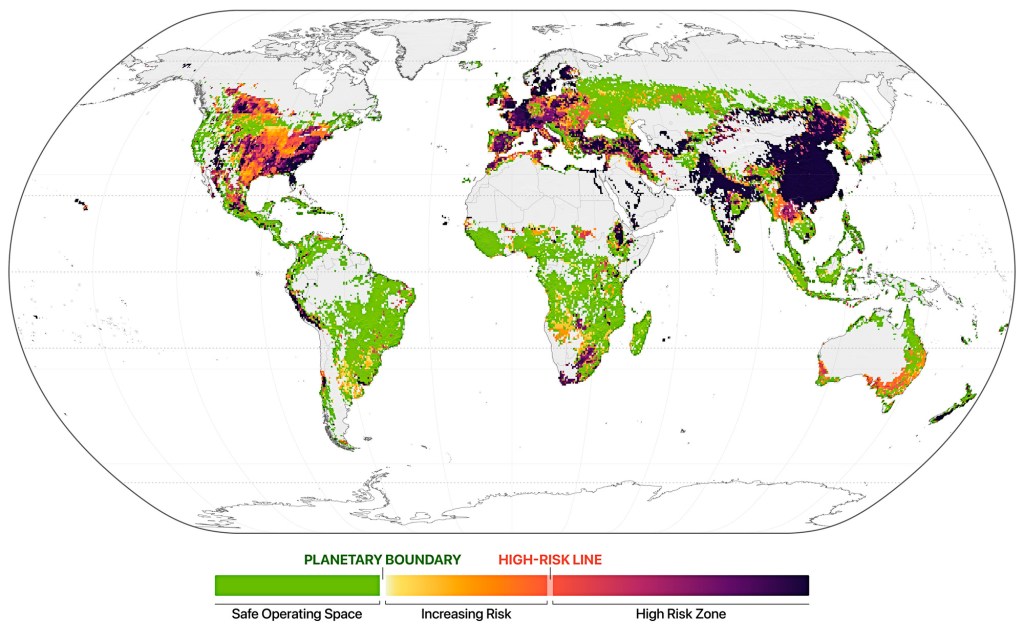
Widespread use of phosphorus and nitrogen based fertilisers to boost crop yields – including grass and  crops grown to feed livestock – has exceeded safe planetary boundaries severely  damaged clean water supplies, the health of our soils and biodiversity. Agricultural practices need to change! 

“Nitrogen use in agriculture has exceeded safe ecological limits in several regions of the world, particularly in parts of Asia and Europe, indicating significant environmental risks.

The regional boundary status is calculated based on agricultural nitrogen surplus in the year 2020 and estimates of regional surplus boundaries. Values range from within the Safe Operating Space (green; no exceedance of regional surplus boundaries) to the Zone of Increasing Risk (orange), and extend to the High-risk zone (red/purple). Based on data from model runs with IMAGE-GNM, using the methodology of Schulte-Uebbing et al. (2022).” (2)

  1. https://biologyinsights.com/what-are-biogeochemical-cycles-and-why-are-they-important/
  2. https://www.planetaryhealthcheck.org/boundary/modification-of-biogeochemical-flows/