Counting on …. Day 56

9th January 2022

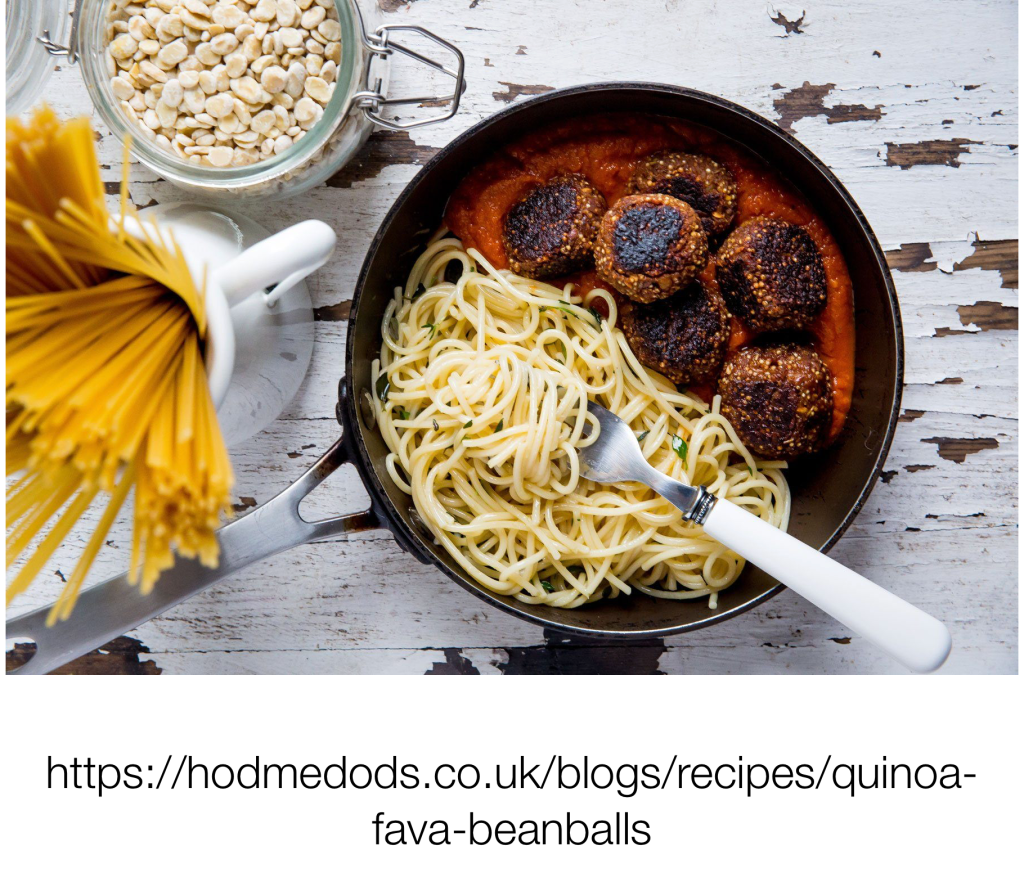
Eating beans and pulses instead of meat and dairy products is a good way of reducing our carbon footprint. The Ethical Consumer’s Climate Gap Report lists  a top ten of things we can do as individuals to reduce our carbon footprint (https://www.ethicalconsumer.org/climate-gap-report) of which the top two are reducing meat consumption by 20% and dairy by 20%.

You can use beans to make soups and stews; you can blitz them to make pasta sauces or use lentils in  place of mince for lasagnes; hummus is made from chick peas and you can use other beans to make a variates of other spreads or pates. Chick peas are used in making falafel and split peas for dhal and again you can adapt these recipes for to the beans and pulses. Flour made from dried peas and beans can be used in making pastries and pasta, as well as a variation of a frittata. Soya beans and peas are being used to make alternative milks. 

Try the Hodmedod website for lots of recipes – https://hodmedods.co.uk/blogs/recipes/tagged/vegan

Counting on … day 54

7th January 2022

Real (as opposed to plastic) and rootless Christmas trees will  probably now be on their way for recycling. Most local authorities provide a collection service, taking the trees to be ‘chipped’ into small pieces which can then be turned into compost or used as a mulch.  Sometimes the trees may be put to  alternative uses such as securing sand dunes or stabilising river banks. You can recycle them at home,  leaving them in a corner of the garden where overtime they will decay and in the meantime may provide a shelter for birds and insects. Or you can speed up the process by chopping off the branches and – once the needles have gone brown – use them as mulch around plants that like an acid soil – eg raspberries. 

The trunk you can use to make, or to add to, a log pile for garden wild life. For more nature friendly ideas for the garden see – https://greentau.org/2021/10/04/eco-tips-10/

Counting on …. Day 53

6th January 2022

Today is the Feast of the Epiphany, the celebration of the visit by the wise men to the infant Jesus.  Given the large number of traditional foods we have on Christmas Day when the shepherds visited to  the Christ Child, we have very few for the Epiphany. The French have their Gateau des Rois which is something I copy in a simpler form – ie a cake made by sandwiching a layer of marzipan, flavoured with madeira, between two rounds of puff pastry. All the constituent parts can be made with plant-based ingredients.


We also mark the day by chalking a blessing over the lintel of our front door – https://greentau.org/2022/01/06/marking-epiphany/

Counting on … day 52

5th January 2022

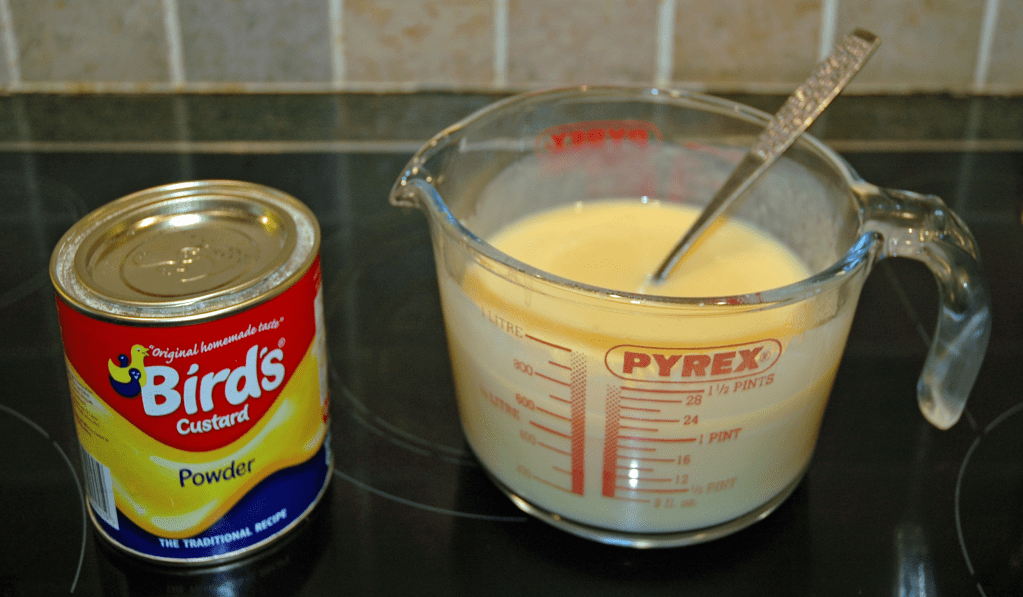
The Ethical Consumer’s Climate Gap Report highlights the importance of we as individuals making changes now so that we will as a nation be able to achieve net zero by 2030. One area where  significant change is needed is our diet. We may not all  need to become vegan, but we will all need to reduce our consumption of meat and dairy products. Substituting oat milk and vegan butter in our cooking is an easy option. Use oat milk for custard and white sauces etc. use vegan butter in cakes and pastries. 

Bird’s Custard is an egg free custard that was originally developed because Alfred Bird’s wife had an allergy to eggs. Make it with oat milk and it is vegan custard.

Counting on … day 51

4th January 2022

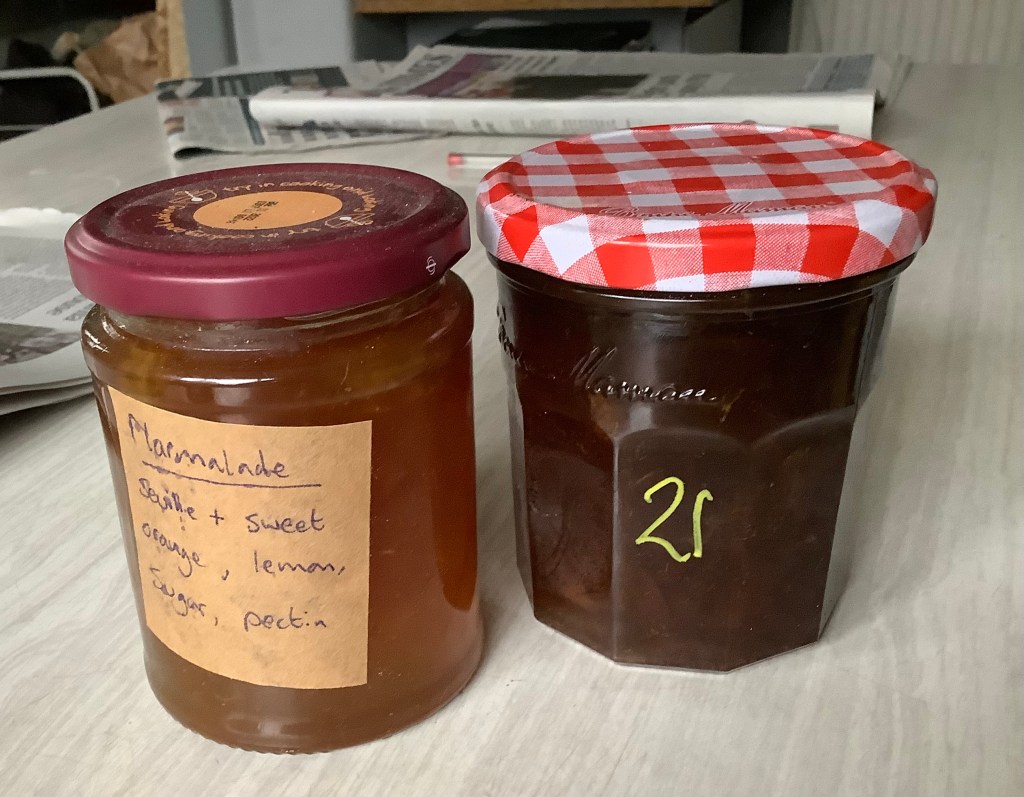
Seville oranges that are the key ingredient of marmalade are now in the shops and as they are a seasonal crop, now is the time to buy them and make marmalade. This recipe is adapted from one belonging to my great aunt.

7 Seville oranges

1 sweet orange

2 lemons

3kg sugar with pectin

Cut fruit into quarters and boil until skin is soft. If you have a slow cooker this is ideal – just put the fruit and 5 pints of water into the slow cooker, cover with its lid and leave gently simmering for 4 to 6 hours as necessary. If you are using a large saucepan, cover fruit with 7 pints of water and bring to the boil, uncovered. You will find the 2 pints of additional water will evaporate during the boiling.

Allow fruit to cool, slice the fruit thinly discarding all the pips as you find them. 

Put sliced fruit, the strained water/ juice and sugar into a large pan, bring to the boil whilst stirring (to prevent the sugar from burning). Boil, stirring frequently until setting point is reached. If possible use a jam thermometer. Otherwise test by dripping a small amount onto a cold plate. As it cools the mixture should form jelly like surface that wrinkles when pushed. 

Pour into sterilised jars and seal. 

Counting on … day 50

3rd January 2022

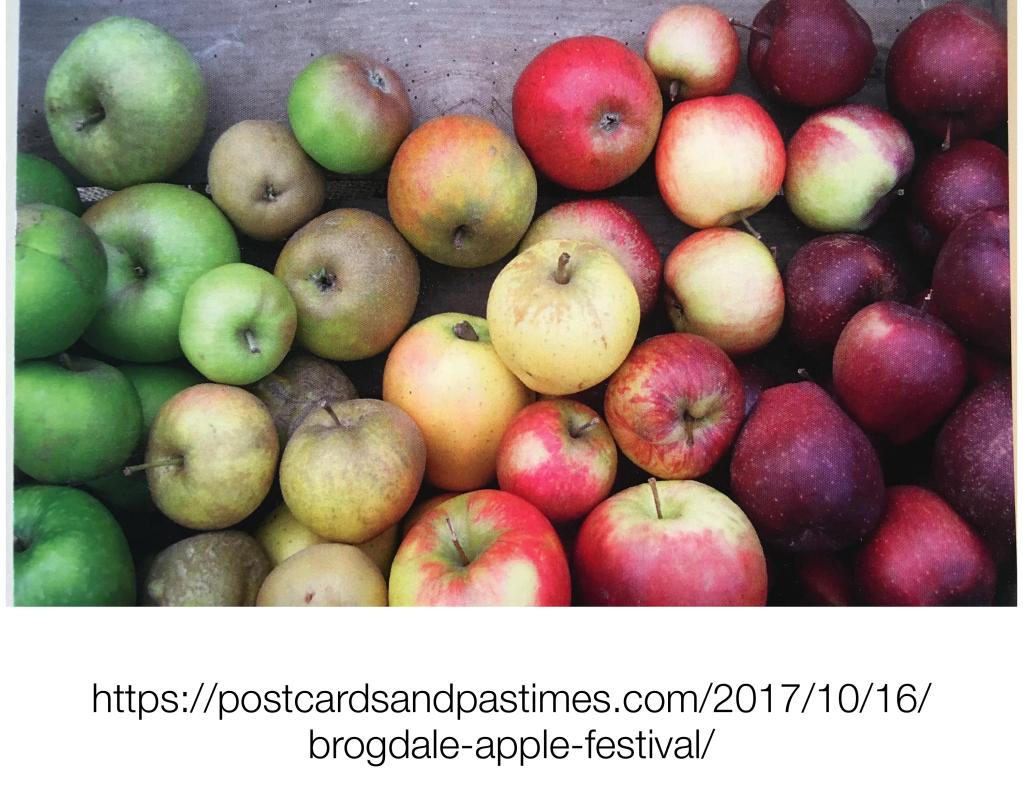
The National Fruit Collection is held at Brogdale in Kent. Of all their collections, the apple is the largest  – 2131 varieties that come from across the UK and from across the world too. There is here a rich diversity in size, taste, texture, colour and use. Diversity is good both for the pleasure it gives us as eaters of apples but also as a means of protecting apple trees against viruses and other calamities. 

Why not contact your local supermarket and ask them to stock a greater range of varieties of British grown apples? (And ideally not in plastic packaging!!)

Counting on … day 49

2nd January 2022

Winter is a time for pruning various plants including apple and pear trees. Pruning helps them stay healthy and concentrates the plant’s energy for the coming year. It also helps maintain a manageable shape.  Traditionally this accompanied by wassailing – blessing the trees and making loud cheerful music to re awaken them so that they would produce plenty of fruit. 

It is a good reminder that we do count on the fertility of fruit trees and their successful pollination by  bees and other insects to ensure a rich and varied diet.


Counting on … day 48

1st January 2022 

A day to give thanks for the charities and activist movements that we are counting on to make our lives more sustainable and the earth a happier place. 

For Friends of the Earth, the WWF, the National Trust, the Woodlands Trust, A Rocha, the RSPB , Green Christians, Practical Action, the UN, Traid Craft, the Climate Coalition, the Wildlife Trust, Christian Climate Action, Cafod, Christian Aid, the Wetlands Trust,  Extinction Rebellion and more.

Counting on …. Day 47

31st December 2021

Whilst we are still in 2021 some countries in the global south will already be in 2022.
One of the first is Kiribati a nation in the Pacific Ocean comprising 33 islands, and rising, at present, not much more than 2m above sea level. As the climate crisis and rising sea levels escalates so the future of life here diminishes – the islands  may be largely uninhabitable by 2030. The government of Kiribati has bought land in Fiji to safe guard some future for the islanders.  New Zealand permits 75 islanders a year to  settle there. But what the people really want is financial support for desalination plants to ensure fresh water, flood resistant seeds and plants, early storm warning systems, housing that can withstand periodic inundation, and support to preserve and maintain their special culture and language. Kiribati has made a negligible contribution to the climate crisis but stands to be its first victim. Reparations are needed now from those nations that have both created and benefitted from the fossil fuelled climate crisis. One agency that is giving support is the United Nations Pacific Office.

 Counting on ….day 46

30th December 2021

As well as counting on ourselves, as consumers, to make changes, we should be counting on our  government and councils to make changes too. Chose a topic close to your heart (re-wilding, cycle lanes, biodiversity etc) and write to your local council and/MP and ask them how they are going to effect the change to a more sustainable world.