Plant based milks: some have added vitamins, typically A, D, B2, and B12, as well as various minerals like calcium and iron; protein levels are much less than in dairy milk but few western diets are deficient in this; choose milks that are produced from plants grown in Europe as this minimises their carbon footprint; if the milk splits when added to hot drinks, you might want to choose a barista grade milk; you can buy oat milk in glass bottles and reduce packaging – eg from Milk and More. 1 litre of oat milk has a carbon footprint of 0.9kg as opposed to 3kg for dairy milk. Oat milk also uses less water and less land than dairy milk.
Plant based substitutes for yogurt, Greek style yogurt, crème fraîche, double and single creams, are also available and can be used for cooking too.
As well as margarine, you can also buy vegan butter. This has a similar taste and texture to butter and is good for baking where the recipe calls for dairy butter.
Vegan mascarpone can be made by blending a 300g block of silken tofu with a carton of Oatly whippable custard.
Plant based cheeses are varied. Violife feta style cheese has a pleasant taste as does their mature cheddar. The latter can be grilled but tends to shrink as it is bubbles. Nut based cheeses can better mimic the texture of cheese and have a better nutritional value than many vegan cheeses.
Coconut milk adds a pleasant taste to soups and curries and gives a silky creamy texture. Coconut milk also makes for a good rice pudding.
Aqua faba – the water in which dried beans have been cooked – has a gelatinous texture and can be used as an egg substitute. It works well for making mayonnaise and meringues. You may sometimes need to add a little xanthan gum for extra stiffness.
To replace eggs in baking, use commercially made egg replacement powder (eg from Super Cook), aqua faba or chia seeds mixed with water (1:3 per egg). The chia seeds swell and become glutinous. That said there are various cake recipes that don’t need eggs or egg substitutes – scones, flapjack, muffins, fruitcakes etc.
Silken tofu can make an acceptable substitute for scrambled eggs but needs suitable flavourings such as pepper, fine herbs etc. For a frittata mix bean flourBean with a water/ oat milk and spices (eg turmeric/ black pepper/ paprika etc) and a little baking powder and cook as per an egg based frittata.
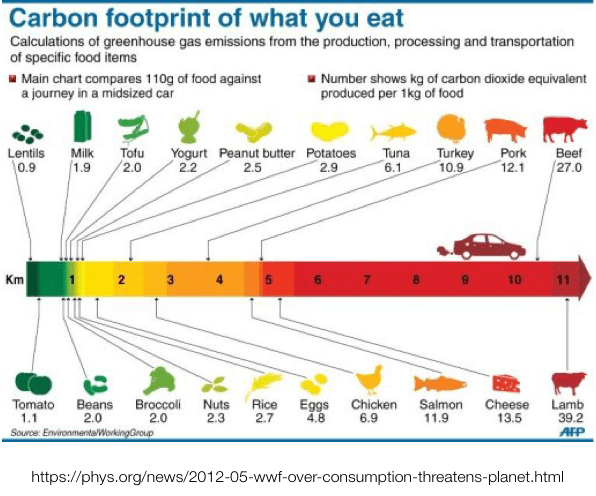
Replace meat protein with a variety of beans, peas, pulses and nuts. You will spoilt for choice: in our cupboard at present we have whole and split yellow peas, ditto green peas, blue peas, Carlin peas, black badger peas, split faba beans, green and orange lentils, cashew nuts, walnuts, almonds, Brazil nuts and pistachios. The beans, peas and pulses are UK grown sourced and sold by Hodmedod’s. Lentils have a carbon footprint of 0.9 per kg compared with 6.9kg for chicken and 27kg for beef – and needs less land and water.
Lentils make a good substitute for mince. Puréed peas or beans make a good sauce to mix with pasta or vegetables.
Combine beans and pulses with grains – eg wheat, rice, corn – or with grain-based foods such as pasta and bread. The different amino acids from each will combine to give a better overall quality protein intake.
Replace meat or fish with tofu (made from soya beans) or seitan (made from wheat protein). These products offer a variety of different textures to meals.
Include yeast extract and yeast flakes in your cooking to ensure a good intake of vitamin B. Opt for ones that include B12 which is hard to obtain from plant sources. For iron eat beans and legumes, dark green leafy vegetables, dried fruits, nuts and seeds, and wholegrain cereals and breads. For calcium eat nuts (especially almonds) and seeds (esp. chia), figs, leafy greens, beans and pulses.
For vitamin D you may wish to consider a supplement. Sunshine is a good source of vitamin D but even so many people in the UK – vegan or otherwise – are deficient.
Vegetables and fruit are always important for flavour, texture and nutrition. But not all fruit and vegetables are equal. Out of season strawberries, blue berries, and asparagus for example are not sustainable and are often brought in by air. Avocados and mangoes, amongst others, consume vast amounts of water as they grow, and such crops divert water from other essential uses.
Eat food that is in season and try out unusual items such as salsify, cardoons, quinces etc.
Organically produced ingredients is preferable to non organic if only because the the excess nitrates from fertilisers runs off the fields and polluted water ways. And insecticides and herbicides are a real threat to biodiversity – including in our own gardens.
Locally produced food is again preferable, reducing air/lorry miles and reducing the length of the supply chain.
Banks are key players in ensuring the flow of finance through global and national economies. As such they can influence which industries and companies receive funds and grow, and which do not. One of the greatest threats to life is the climate crisis which is primarily driven by emissions from fossil fuels. The International Energy Agency (IEA) has already told us that if we are to keep emissions and hence global warming at a tolerably safe level, we should not open up any new oil and gas projects. Yet this is precisely what the fossil fuel industry is doing, with funding secured by a – still – large number of banks.
Make My Money Matter has long been urging us to direct our money so that it supports action to tackle the climate crisis, rather than allowing it to fill the coffers of those who perpetuate the problem.
“The fossil fuel industry cannot exist without banks, yet our high street banks are continuing to pump money into them. So our message is simple – don’t bank on fossil fuel expansion. Banks must act and you can drive that change. ” https://makemymoneymatter.co.uk/
Another such platform advocating and enabling change is Switch it Green.
“Together, we will move £7 billion out of fossil fuel support this year; pressuring banks to phase out their climate-harming investments.
And coming from a specifically Christian focus there is Just Money which provides information and leads campaigns on issues of money and justice.
“The money that we put into a bank helps it to do its work. A growing movement of Christians want to bank more ethically and campaign for a fairer, greener banking sector…Some banks are good news for people and planet. As Christians we can champion these, and support ethical alternatives, like credit unions.” https://justmoney.org.uk/
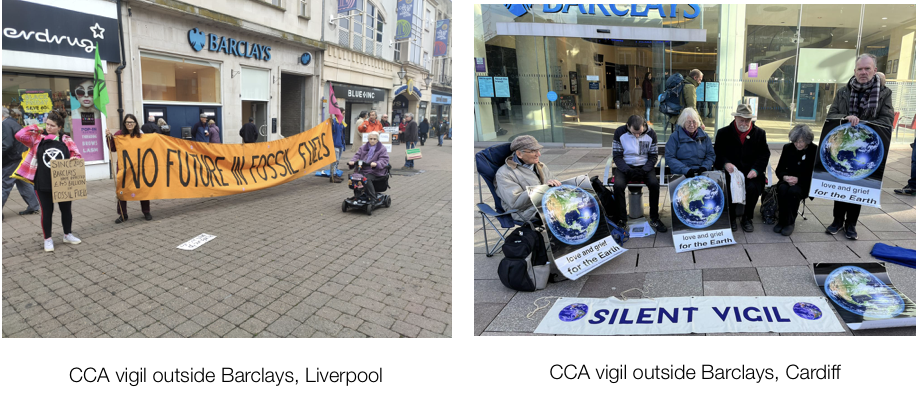
I am involved with Christian Climate Action and their campaign to highlight the harmful practices of Barclays Bank – the largest European funder of the fossil fuel industry (2016-2022) – and to encourage both individuals but also organisations and charities to switch to greener, more ethical banks.
Actions taken by CCA include regular vigils held outside local branches of Barclays. This is done by local CCA groups often in conjunction with other groups concerned about justice and the environment. See CCA’s event page for more details – https://christianclimateaction.org/events/
CCA has also written to and met with organisations – such as Christian Aid, Oxfam and The National Trust – and have held prayerful vigils outside their headquarters.
CCA is also liaising with those Church of England dioceses that bank with Barclays, and recently organised a workshop for diocese to share and explore how they can switch to a better bank. (For more information about CCA’s campaign with dioceses – https://christianclimateaction.org/2023/11/14/urging-church-to-drop-barclays/
Success is being achieved. Christian Aid, Greenbelt, Sheffield Cathedral and Oxfam have all undertaken to switch away from Barclays.
Exploring (and hopefully understanding) the terminology and acronyms of the investment world used in and around the issue of climate change. Many of the changes we are going to need to both reduce and to live with, the impacts of climate change require considerable sums of money. If that money doesn’t come through government from taxation, it has to come from the financial markets.
“Climate change is having an ever-increasing impact on global capital markets. It presents a wide and complex range of risks from physical impacts such as flooded factories, to regulation risk such as the imposition of expected carbon taxes, litigation risk and transition risk as company cash flows and profits are affected by the move to a low-carbon economy. There is also mounting evidence that companies who care about their broader eco-systems, tend to financially outperform those who do not. ” https://www.transitionpathwayinitiative.org/investors
IPCC – Intergovernmental Panel on Climate Change, organised by the United Nations. The UN currently has a membership of 193 nations.
COP – conference of the parties being “the supreme governing body of an international convention (treaty, written agreement between actors in international law). It is composed of representatives of the member states of the convention and accredited observers. Scope of the COP is to review the “implementation of the Convention and any other legal instruments that the COP adopts and take decisions necessary to promote the effective implementation of the Convention” https://en.wikipedia.org/wiki/Conference_of_the_parties
The 28th United Nations Climate Change Conference will take place in Dubai in November this year and is commonly referred to as COP28. Other COPs also take place such as the 15th United Nations Biodiversity Conference which met in Montreal in December 2022.
Paris Agreement (sometimes referred to as the Paris Accords) – “an international treaty on climate change. Adopted in 2015, the agreement covers climate change mitigation, adaptation, and finance. The Paris Agreement was negotiated by 196 parties at the 2015 United Nations Climate Change Conference in Paris. The Paris Agreement’s long-term temperature goal is to keep the rise in mean global temperature to well below 2 °C above pre-industrial levels, and preferably limit the increase to 1.5 °C, recognising that this would substantially reduce the effects of climate change. Emissions should be reduced as soon as possible and reach net-zero by the middle of the 21st century. To stay below 1.5 °C of global warming, emissions need to be cut by roughly 50% by 2030. This is an aggregate of each country’s nationally determined contributions.” https://en.wikipedia.org/wiki/Paris_Agreement
Net zero targets – a zero target would reduce carbon/ greenhouse gas emissions to absolute zero. Net zero would reduce emission on balance to zero – ie remaining emissions that could not be avoided being offset by processes that absorb unwanted emissions. If the desired effect of curtailing global warming is be achieved, these offset amounts need to be minimal.
Offsetting – a process whereby one invests in a project that will remove greenhouse gas emissions from the atmosphere and absorb them in such a way that they are not re-released. This removal might be achieved through planting trees which over their life time will absorb CO2 (the main greenhouse gas) from the atmosphere via their leaves and ‘lock’ them away in the trunk, roots and branches of the tree. It might equally be achieved by growing other plants including seaweeds. Greenhouse gases can also be ‘locked’ into the soil by developing peat bogs, by creating grasslands (that will not be tilled as this will release the gases from the soil) or by pursuing regenerative methods of farming. Some offsetting projects don’t plant new forests but rather concentrate on maintaining existing forests where trees will not be routinely cut for timber. This may particularly apply in regions of virgin rainforest where the investment can be an alternative income to that obtained from clearing the forest for agriculture. The idea behind offsetting is that where emissions from an operation cannot be reduced to zero, that the residual amount of produced by the operator is offset by an equivalent re- capturing of gases. To be of value, carbon offsetting schemes need to be scientifically proven to be effective, and to be certified so that the offsetting cannot be resold. Offsetting should always be a last resort.
Climate Transition Plan – an action plan that outlines how an organisation will develop or change its use of assets and resources, and its entire business plan to meet agreed climate targets – typically halving greenhouse gas emissions by 2030 and reducing them to net zero by 2050. In November 2021 the UK Government set up a Transition Plan Taskforce (TPT). As of 2023 listed UK companies are required to publish transition plans with guidance from the TPT using rules agreed with the Financial Conduct Authority (FCA) – although apparently it doesn’t have to have net zero as its target.
Just Transition – “ A ‘just transition’ means moving to a more sustainable economy in a way that’s fair to everyone – including people working in polluting industries.“ Greenpeace. In the financial world the Impact Investment Institute this year produced a set of Just Transition Criteria to enable investors make better judged investments that will fulfil the objectives of a just transition – https://www.impactinvest.org.uk/wp-content/uploads/2023/05/Just-Transition-Criteria.pdf (This pdf is an interesting read)
IEA – International Energy Agency is an “autonomous intergovernmental organisation, established in 1974, that provides policy recommendations, analysis and data on the entire global energy sector. The 31 member countries and 13association countries of the IEA represent 75% of global energy demand. The IEA was set up under the framework of the Organisation for Economic Co-operation and Development (OECD) in the aftermath of the 1973 oil crisis to respond to physical disruptions in global oil supplies, provide data and statistics about the global oil market and energy sector, promote energy savings and conservation, and establish international technical collaboration on innovation and research. Since its founding, the IEA has also coordinated use of the oil reserves that its members are required to hold.” https://en.wikipedia.org/wiki/International_Energy_Agency. In May 2019 the IEA reported that investors should not fund new oil, gas and coal supply projects if the world wants to reach net zero emissions by mid-century – “The pathway to net zero is narrow but still achievable. If we want to reach net zero by 2050 we do not need any more investments in new oil, gas and coal projects,” said Fatih Birol, the IEA’s executive director. “It is up to investors to chose whatever portfolio they prefer but there are risks and rewards.”
Transition Pathway Initiative (TPI) – supported by research from the LSE and the Grantham Research Institute, this scheme assesses the performance of major companies using publicly available data so as to rate the companies on their Management Quality (ie how well their business plans relate to measuring and controlling their greenhouse gas emissions) and Carbon Performance (how well their business plans align with the UN Paris Agreement goals). This information is then made available to anyone who is interested and in particular to investors who want to ensure that the companies they invest in are transitioning appropriately to net zero. https://www.transitionpathwayinitiative.org/
NIBs – National Investment Bodies – the Church of England has three such bodies comprising:-
Church of England Pensions Board – “We provide retirement housing and pensions, set by the Church of England, for those who serve or work for the Church. We assist over 42,000 people across almost 700 employers with their pensions, carefully stewarding the funds under our care of around £3.2 billion.
Church Commissioners for England – “ The Church Commissioners manages a £10.3bn investment fund. The money it makes from those investments contributes to the cost of mission projects, dioceses in low-income areas, bishops, cathedrals, and pensions. The Church Commissioners also provides administrative support for the Church. We contribute about £1.2bn every three years to various parts of the Church of England, around 20% of the Church’s annual running costs, which makes us one of the largest charitable givers in the UK.”
CBF funds which are managed by CCLA (Churches, Charities and Local Authorities (CCLA) Investment Management Limited). These are the fund managers who look after most parish investment monies.
Fiduciary Duty – A fiduciary is someone who has undertaken to act for and on behalf of another in a particular matter in circumstances which give rise to a relationship of trust and confidence — Lord Millett, Bristol and West Building Society v Mothew A fiduciary duty in terms of finance sense exist to ensure that those who manage other people’s money act in their beneficiaries’ interests, rather than serving their own interests. (https://en.wikipedia.org/wiki/Fiduciary) For example, money given by its congregations and other donors must be managed for the benefit of the Church of England, and within that for example, many given to the Pensions Investment Board must be managed to benefit present and future C of E pensioners.
TCFD – Task Force on Climate-related Financial Disclosures: when buying and selling investments one needs accurate information that enable you to assess the risk of making or loosing money. A new risk is that of climate change, and investors need accurate and standardised information so that they can fairly value what they are buying and selling. Ensuring such information is forthcoming – is disclosed – is the function of the TCFD. https://www.fsb-tcfd.org/about/
Climate Action 100+ is a group of 700 global investors – including the Church of England Pensions Board – who undertake to to engage with the major companies* that will play a significant role in the transition to a net-zero emissions economy. Individual or small groups of these investors engage with a particularly company to monitor performance, and develop and implement company specific strategies that will ensure they meet the necessary targets on the route to net zero. https://www.climateaction100.org/about/
Paris Aligned Investment Initiative -“ Paris Aligned Asset Owners are a global group of 56 asset owners, with over $3.3 trillion in assets. They have committed to transitioning their investments to achieve net zero portfolio GHG emissions by 2050, or sooner, drawing on the Net Zero Investment Framework to deliver these commitments”. The Church of England Pensions Board is a member of this group. https://www.parisalignedassetowners.org/ The Initiative is delivered by four investor networks covering the different regions of the globe. The network for Europe is The Institutional Investors Group on Climate Change (IIGCC).
Net Zero Investment Framework – The Net Zero Investment Framework, published in March 2021, provides a common set of recommended actions, metrics and methodologies through which investors can maximise their contribution to achieving global net zero global emissions by 2050 or sooner. Its primary objective is to ensure investors can decarbonise investment portfolios and increase investment in climate solutions, in a way that is consistent with a 1.5°C net zero emissions future.
Net Zero Climate – an Oxford University based which “brings together principles and policies, practical tools, and progress tracking to help businesses and policymakers achieve that [net zero emissions] goal.” https://netzeroclimate.org/ As well as hosting the Net Zero Asset Owners alliance, they provide tools for organisations including ‘How to set a net zero target’ :
1. Pledge at the head-of-organization level to reach net zero GHGs as soon as possible, and by mid-century at the latest, in line with global efforts to limit warming to 1.5C. Recognise that this requires phasing out all unabated fossil fuels as part of the transition.
Set an interim target to achieve in the next decade, which reflects maximum effort toward or beyond a fair share of the 50% global reduction in CO2 by 2030.
Targets must cover all GHGs, including Scopes 1, 2, and 3 for businesses and other organisations, all territorial emissions for cities and regions, all portfolio/financed/facilitated/insured emissions for financial entities, and all land-based emissions.
2. Plan Within 12 months of joining, publicly disclose a Transition Plan, City/Region Plan, or equivalent which outlines how all other Race to Zero criteria will be met
Include what actions will be taken within the next 12 months, within 2-3 years, and by 2030.
3. Proceed Take immediate action through all available pathways toward achieving net zero, consistent with delivering interim targets specified.
Where relevant, contribute to sectoral breakthroughs.
4. Publish Report publicly both progress against interim and long-term targets, as well as the actions being taken, at least annually.
Report in a standardised, open format, and via platforms that feed into the UNFCCC Global Climate Action Portal.
5. Persuade Within 12 months of joining, align external policy and engagement, including membership in associations, to the goal of halving emissions by 2030 and reaching global net zero by 2050.
Net Zero Engagement Initiative – launched by this Initiative expands the number of companies with whom investors are actively engaging vis a vis net zero targets beyond the Climate Action 100+ list. This should enable mot investors to develop portfolios where an even greater number of the companies they invest in, are aligned with the Paris Agreement. For more details visit their website – https://www.iigcc.org/resource/net-zero-engagement-initiative/
Net Zero Standard for Oil and Gas – Convened by members of IIGCC and informed by the Transition Pathway Initiative (TPI), this standard “sets minimum expectations for what must be included in net zero transition plans from oil and gas companies, to create a level playing field in corporate reporting and meet investor expectations for credible and comparable company net zero transition plans.” https://www.iigcc.org/resource/net-zero-standard-for-oil-and-gas-companies/
The standard notes “time is very much against all of us and we need to accelerate the pace and scale of commitments… These calls to action from industry groups and scientists alike, must translate into real, drastic, and immediate emissions reductions in all sectors. Emissions reductions across the board means significant fossil fuel demand destruction… Therefore it is essential that oil and gas company boards know that those with credible independently verified net zero* strategies will be supported by their investors. Equally important sis that this without will be challenged.” *Further on the standard specifies that these net zero strategies should include scope 3 emissions as well as scopes 1 and 2.
Particularly relating to food, you might choose to reduce – or cut out completely – animal products from your diet. You might choose to only what is in season to avoid importing food over long distances. https://greentau.org/2021/08/14/green-tau-issue-12/
You might support charities such as Practical Action that help poorer farmers change their practices to adapt to the new and more extreme climates – https://practicalaction.org/
3. Paying a fair price for the food we eat. You might buy direct from a farm or a group of farms, or via a local vegetable box scheme. You might support a local farmers’ market. You might buy from a local independent green grocer. Similarly you might buy milk etc from a milk round where the price reflects the cost to the farmer. For cheeses, look to buy from small scale producers via a local cheese shop. And again buying fair trade options for imported foods can help ensure a fair price for the producer. Alternatively look out for products – coffee beans and chocolate in particularly – that have been sourced directly from the grower. These are often available through local independent shops and cafés.
Another option would be to subscribe to the OddBox fruit and veg scheme which buys food stuffs that would otherwise go to waste because they are misshapen, because the supermarket doesn’t want the crop, or because the crop has been too large or too small for the supermarket buyer – https://www.oddbox.co.uk/
4. Buying from local producers and local retailers helps to improve local supply chains.
5. Again the best approach to improving global food security and ensuring there is enough food for everyone is to reduce – or cut out completely – animal products.
The financial value of a gift is not the same as the value of the gift, nor does the financial value equate to the amount of love you have for the recipient.
You might agree with friends and family to source all your presents from charity shops – the charities gain, and if anyone receives something they can’t use, it is easy to pass it on again via another charity shop without feeling guilty.
You might opt to give charity gifts such as sponsoring a puffin, planting a tree, twinning a toilet or equipping a child with warm winter clothes.
Reuse last year’s wrapping paper ( or make a note to keep this year’s for reuse next year).
Reuse brown paper (often comes as a space filler in delivery boxes) which you could decorate with potato prints. Equally newspaper with coloured string is effective (choose sheets with a nice picture or pages from the colour supplement).
Use eco friendly/ non plastic sticky tape or use string as that can be reused.
Make gift tags from last year’s recycled cards or simply buy some coloured card and cut it into squares or rectangles.
If you make your own Christmas cards why not make them as postcards avoiding the need for envelopes. Email news letters rather than printing out ‘round robins’. Add a picture and make your email into an e-Christmas card.
Make your own decorations. Cut up coloured paper (pages from colour magazines, strips of reused wrapping paper etc) to make paper chains or pleated chains.
If you collected autumn leaves earlier in the season, strings these together to make a decorative chain.
Tie together pine cones, decorative twigs and to make vertical hanging decorations.
Make pleated paper angels, origami stars, reindeer, or Father Christmases. For a series of activities making Christmas theme decorations you can watch this YouTube Advent calendar – https://youtu.be/HhSwBrGRqJE
Rather than buying a tree collect some decorative branches and arrange them in a large vase (add stones to ensure it is bottom heavy) and then add your tree decorations.
Make a wreath from greenery from your garden or tie into a bunch with a cheerful ribbon (door decorations don’t have to be circular).
We tend to generate most food waste over the Christmas season. Make a list of what you need and stick to it. If you do add in extra potatoes etc – just in case – make sure you use them before buying more. (We dread not having enough but perhaps forget that by Boxing Day plus 1 many shops will be reopening).
If you like a tradition roast bird, try and source one that has been compassionately reared, ideally organic. Maybe this could be the year to investigate a vegan alternative complete with all the trimmings of roast potatoes and parsnips, sprouts, cranberry sauce and stuffing. Cook enough to have left overs to enjoy on Boxing Day.
If you haven’t yet made mincemeat there is still time and it is very easy. Making your own mince pies will avoid a lot of waste and/ foil and plastic. https://greentau.org/2021/09/09/count-down-47/
Christmas puddings are also easy to make. If the 7 hours of steaming puts you off, you can steam then in a slow cooker half filled with hot water.
Plan for a walk on Christmas Day in a local green space – the exercise and fresh air is a good tonic and it is a chance to reconnect with the natural world.
People often comment, ‘I am concerned about the climate crisis but I don’t know what to do!’
There is a whole range of things we can do, from at one end changing our lifestyle, right through to making acts of civil disobedience at the other. To say this is a range is not to say it is a progression and that having started with changes to lifestyle one must then progress down the line to acts of civil disobedience. Nor is it to say that either end of the range is better or more worthwhile. However from the viewpoint of integrity one hopes that those who engage in campaigning and actions are also prepared to adapt their lifestyles.
Within each type of activity there will again be a range of responses. People choosing to change their diet for example may choose to have a meat free day each week or to become fully vegan.
What is the purpose of doing something?
It is to minimise, halt or reverse the adverse effects we humans have on the environment and to help, support or improve, the lives of others (both human and non-human) who are adversely and/or unfairly affected by the crisis.
What can we do?
Change our lifestyle to reduce the impact of our footprint on the earth and its impact on the lives of others.
Whilst it may feel that changing one person’s lifestyle will not make a difference, it does. Each person who makes the change shows that change is possible. This will encourage others to follow suit. And each person making these changes is creating a new – climate friendly – normal. We will only get to net zero when everyone has made changes to their lifestyle and the sooner we started the better.
Swop to a largely plant based diet – a plant based diet can reduce your carbon footprint by at least 60%; opt for local, organic, fair trade and animal friendly foods; minimise food waste – https://greentau.org/2021/08/09/eco-tips-4/
Opt for active travel (walking and cycling) and public transport in preference to driving; avoid flying – sign the Flight Free Pledge https://flightfree.co.uk/
Reuse, repair, recycle; minimise single use items; buy good quality long life products – The Ethical Consumer has helpful guides; buy second hand; borrow or hire for occasional use. Don’t buy what you don’t need – enjoy what you have!
Avoid waste by seeking out zero waste options for what you use in and around your home – eg milk that comes in refillable glass bottles, loose fruit and veg, various (numerous) groceries you can get from refill shops, from pasta to raisins, coffee beans to spices. Carry a keep cup for take away drinks and a bottle for water refills.
Green your finances – use banks, insurance and pension providers etc that take an ethical and environmentally responsible approach to their investments – https://makemymoneymatter.co.uk/
* Re wild part of your garden; plant trees or hedges; plant insect friendly plants; install a water butt, a compost heap and maybe a pond.
Support B-corps – companies that undertake to do that bit more for the environment and for society. Avoid supporting companies that disregard the environment, don’t pay all their taxes, and/ or don’t pay their staff a fair or living wage.
Support environmental charities financially and/ or as a volunteer. Support social well being charities.
Read up on climate science, and on the ways and benefits of adapting our lifestyles.
* Find a like minded group of friends for encouragement; set up a green group in your church; join Green Christian.
Campaign for change.
Whilst individuals can make significant changes to their lifestyle, there are somethings they personally cannot change. As an individual you cannot change the tax system that doesn’t tax aviation fuel. As an individual you cannot implement a subsidy scheme that would make public transport cheaper than private car travel. As an individual you cannot change legislation that discourages the building of on-shore wind turbines and solar farms. As an individual you cannot require all local councils to adopt a common recycling policy. And the list goes on – as an individual you might wish to see an expansion of nature reserves, of rewilding landscapes, of implementing nature based flood defences, of ensuring all homes and commercial premises are adequately insulated against extremes of temperature, the provision of safe cycle routes through and between all urban areas, an end to the discharging of sewage into seas and rivers, curbs on industrial farming and fishing etc.
Where we can’t effect changes as an individual, we may find we can as a group – the more people in the group, the stronger their collective voice. As individuals we can address issues of climate, biodiversity and social justice in various ways.
Becoming an active supporter of an action group
Donating to support an action group.
Signing petitions addressed to local and central government, to big business and to multi nationals.
Writing individually to lobby MPs, local councillors, business leaders etc.
Joining organised marches and demonstrations.
As with changing lifestyle, read up on climate science and what changes we can make as a society to safeguard the environment and protect lives.
Non-violent direct action
Martin Luther King Jr wrote that the goal of non-violent direct action was to “create such a crisis and foster such a tension” as to demand a response. Non-violent direct action has come to the fore in climate issues because of the lack of response from, in particular, the government and the oil industry.
Non-violent direct action may include sit-ins, strikes, blocking roads, climbing onto significant structures, and boycotts. It may extend to include damaging property such as graffiti, breaking windows or letting down car tyres. Often these acts of civil disobedience may be classed as criminal acts (and probably increasingly so as the government introduces stricter laws limiting the right to protest) but in court protestors can present the arguments to the judge and jury that there is a legal defence can be made, justifying such action. Other non-violent direct actions, such as strikes and vigils, are lawful.
In terms of the climate crisis, non-violent direct action is being used to demand a response from government, from the oil industry, from banks and financial institutions, from churches (asking them to divest from fossil fuels*), from charities (asking the National Trust to bank with somewhere other than Barclays) to actions that target consumerist products such as private jets and SUVs. (2024 – all but two C of E dioceses have now divested showing that activism is effective).
Within groups that engage in non-violent direct action, there will be different roles for people – some of which will involve the risk of being arrested, whilst others will not.
Climate action groups also focus on educating and informing the wider society about the issues and how they can be addressed, with the hope of increasing the number of supporters. The greater the number of supporters, the louder their voice will be.
Read up on the climate science and what changes we can make as a society to safeguard the environment and protect lives. Be informed about how government, local councils, and businesses work – and the media. Join a group for support and so that your voice becomes part of a greater whole. It is especially important that if you are considering putting yourself in a position where you might be arrested that you fully understand what that entails and are sure that you can cope with the consequences. It is really important to be part of a group that offers advise, training and support. Christian Climate Action would be one such group – https://christianclimateaction.org/
It can seem as if all the things we could or should do to tackle the climate crisis, involve discomfort, hard work, extra complications etc and yet only produce a potential benefit that will accrue some years in to the future.
A happy husband warm in a preloved duffel coat enjoying a breakfast treat!
So instead here are some things that are fun, easy, enjoyable, rewarding, and/ or have an immediate effect.
Declutter your home. Having just the things you want and need is liberating and those things you don’t need or like can be re-liberated via a charity shop, second hand sites etc.
Going for a walk through green spaces (although just at the moment they may look a little on the yellow side – in 2022 we had a drought whilst 2024 is providing to be wet and therefore green)
Alternate days swop your shower for a wash – you will still be clean but it will noticeably save both water and energy
Visit a local museum or art gallery – many are free but you may want to support them with a donation or by buying something you like in their shop/ café.
Go and see a film or play at your local cinema/ theatre: paying for experiences rather than things is likely to have a lower environmental impact. Theatres and cinemas can both make significant steps to reduce their impact on the environment – https://juliesbicycle.com/our-work/creative-green/
According to the London Borough of Richmond’s web site, plastic is recycled as follows:-
After initial sorting first in Twickenham and then in Mansfield Derbyshire, plastics are transported for further sorting at a plant in Leeds: this plant separates high Density Polyethylene (HDPE) and Polyethylene Terephthalate (PET, a type of polyester) bottles from PET pots, tubs and trays and any plastic films present.
HDPE plastic flakes are recycled in either UK or Belgium becoming injection moulded products including plastic packaging and containers, and cable protection covers.
Mixed plastic bottles are recycled in Turkey, Germany, and Spain where they maybe recycled into plastic bags and other plastic products.
PET bottles are recycled as fresh bottles.
Pots, tubs and food trays are recycled in the UK or else where in Europe where they may become imitation wood products e.g. garden furniture and other plastic products
Only PET bottles are solely recycled here in the UK, having been on quite a journey around England. These PET bottles are recycled as new plastic bottles – known as closed loop recycling. This is not to say that we should rush out and buy drinks in PET bottles. How many of the plastic bottles on the shelves are actually made of recycled plastic (rPET)? Most still are made from virgin plastic.
Consider the alternatives. You could refill your own refill bottle from the tap which would be both economical and ecological. You could be given the option of buying a drink in a refillable glass or plastic bottle, perhaps one with a deposit to encourage reuse. (Heavy duty PET bottles can be refilled as per a glass milk bottle).
Greenpeace is petitioning the Government on the following points.
Set a target for eliminating single use plastics by 2037 and halving such use by 2025. (There would be exemptions such as for medical items).
Ban on the export of plastic recycling by 2025, including an immediate ban on their export to non OECD countries.
Implement a deposit return scheme for bottles
Moratorium on expanding incineration capacity in the UK.
*We can contact our local council and ask for them to reconsider where their plastic recycling goes. We can ask them to ban single use plastics within their organisation.
*We can contact manufacturers and suppliers and ask them to reduce single use plastic, ditto cafes and food outlets.
We can avoid single use plastics by using our own keep cup/ flask for coffee etc, water bottle for drinks, sandwich box for pack lunches etc
*We can simply not buy things that use or come packed in plastic.
What does sustainability look like in daily life? I thought I would share my experiences.
Previous pages have looked at the use of heating and energy, food and travel for which it is generally easier to calculate one’s carbon footprint and assess the sustainability of alternative choices. Today I am going to reflect on the none food things I buy such as books, clothes, things for the house and garden. These all have a carbon footprint and have more or less sustainable credentials. Here are some of the ways I try to ensure that I use stuff sustainably.
*Not acquiring things that I don’t actually need. It is surprising how often we are tempted – or encouraged by advertising – to buy things we don’t need. Do I really need it? Do I need to buy it now or could I wait and see if I still need it at a later date? Have I got something similar that will fulfil the same purpose?
* Research – find out what choices are available: which product is most sustainably, how long it will last and, if electrical, its energy efficiency. The internet is useful, as is Ethical Consumer which has both a web site and a magazine. When we needed a new printer, we bought a more expensive Epson model that instead of using disposable cartridges (which hardly last any time at all) has an economical refill system – and 8 months later we have yet to need to refill these.
Buying second hand – or more endearingly, preloved – items allows existing resources to be reused rather than consuming even more fresh resources. I buy clothes and books from charity shops with the plus of funding a worthwhile cause. Sometimes I can also find household items here too – such as a saucepan or a pestle and mortar – but then I do have to be patient as what a charity shop stocks is not predictable! I bought my mobile phone and iPad from Music Magpie – an online second hand site. When I need a particular book I try web sites such as World of Books and Oxfam – I avoid Abe Books and The Book Depositary being subsidiaries of Amazon. If I buy new books, I use our local independent book shop.
* Repairing rather than replacing. When something breaks, see if it can be repaired – either at home or via a specialist. Years ago, I bought a Globe Trotter suitcase because of their reputation for quality. When the handle broke, I was able to take it back and have a new one fitted. I frequently darn socks and T shirts, patch up tears, glue broken items in the kitchen, mend punctured tyres, takes shoes to the cobbler, and buy spare parts from the manufacturer.
Up cycling – sometimes rather than buying, I can make what I need from something I already have. Eg pillow cases from worn sheets, plant pots from have cartons, a seed sprouted from a jam jar and a piece of muslin. Old inner tubes become garden ties, and shoe laces are reused as string. Old trousers become shorts, and trouser legs bags for root vegetables.
Making do with – enjoying! – what I have: I could buy a food processor but instead I use the knife and the ballon whisk I already have. We have an old kettle whose automatic switch no longer works but since the rest functions, we continue to use it.
* Lending and borrowing: do I need to buy something if I am only go to use it occasionally? As well as libraries for books and videos, there are libraries for things. I prefer to rent skis knowing that they are going to be well used, as opposed to buying skis that would become obsolescent before they wore out.
* If I can, I look for options that will make a positive contribution to someone else: eg choosing a fair trade or organic option, supporting a local producer, buying from a B corp.
Packaging – I often make choices dependant on packaging, choosing not to buy something because it comes wrapt in plastic. For example buying a pencil I might choice the pencils sold loose over those pre-packed in plastic.
I prefer to spend money on doing rather than having: going to a cafe for a coffee and a cake rather than buying a magazine, going to the theatre rather than buying clothes, buying membership for a nature reserve (eg The Wetlands Centre) rather than cosmetics.
What does sustainability look like in daily life? I thought I would share our (me and my husband) experiences.
The single biggest issue that affects the sustainability of travel is the use of fossil fuels. Fossil fuels are used directly in the form of petrol and diesel to fuel cars, motor bikes, farm vehicles, lorries … as aviation fuel for planes, diesel for trains where there is no overhead or third rail electrical current, the low grade petrol or bunker fuel used for ships. In addition fossil fuels are used indirectly where electric powered transport uses electricity made from non renewable sources. World wide transport contributes around one-fifth of global carbon dioxide emissions. (https://ourworldindata.org/travel-carbon-footprint)
Sustainable travel has to be that which minimises the use of fossil fuels.
Setting aside the means of transport used to get products from farms and factories to our homes and tables, and leaving aside the transport used by the emergency services etc. I shall focus on the transport solutions we use to get from A to B.
We live in a suburban part of London. We have good range of local shops for food, books, bikes, paper and craft materials*, tools and timber, household and homewares. There are also schools, churches, gym, library, GP, green spaces all within a mile of our house. (Sadly this shop closed 2024)
Our main mode of transport is walking. Cotton bags and rucksacks provide carrying capacity, waterproofs and umbrellas protection against the elements.
Second to this would be cycling. This makes the dentist, swimming pool, theatre, cinema, shoes shops and department easily accessible – all within a half hour cycle.
When I both worked and studied in central London, cycling was quick, reliable and enjoyable. A well maintained bike, panniers or rucksack, waterproof clothing, lights and a helmets are essential.
Next comes the bus for short trips, plus the train and the underground network. This gets us all over London.
Trains also provide long distance travel both here in the UK and across Europe, for holidays, visiting friends and families, etc. Starting off in London makes this easier: when we visit places less well served with public transport we do have to rely on family or a taxi to drive the last leg of the journey. Did you know you can go from London to Berlin or the Swiss Alps by train in a day? London to Glasgow or Edinburgh can be an overnight journey.
Flying we avoid. One year we would like to visit North America and would look to travel with one of the passenger- carrying cargo ships.
There are some trips which we do choose to make by car. For example when my husband volunteers on a steam railway in Hampshire, or when transporting a model railway to exhibitions. At other times we use a taxi for my mother who struggles with escalators on the underground.
A rough calculation of the carbon footprint of the journeys I make annually by bus and train comes to 0.56 tonnes of CO2. If I were to make those journeys by car (even a reasonably fuel efficient one, 52 mpg) it would have produced 1.52 tonnes of CO2. If I had flown that same distance, it would have produced 2.27 tonnes CO2.
What I haven’t calculated is what my carbon footprint would have been if I had made all my local journeys by car rather than on foot. If say I normally walk 4 miles a day but instead make those journeys by car, I would produce a further 0.43 tonnes of CO2.
A further advantage of walking or cycling in terms of sustainability, is the low capital outlay or expenditure of resources. In the case of walking that would be resources used in making a pair of shoes, or for cycling, that of making a bike. Both will be significantly less than is needed to make a car. The resources needed to build a bus or train are considerable but when apportioned across the number of users and the life time of the vehicle, is probably less than the equivalent for a private car (which will often carry a single passenger as well as spending 95% of its life parked on a drive).








 The Green Tau