Third Sunday of Easter

21st April 2024

Reflection with readings below.

Easter comes to us as the season of eggs (real and chocolate), of fluffy chicks and frolicking lambs, of spring flowers and blossom and all such signs of new life. (I often wonder how it would feel to celebrate Easter when it is a time of autumn leaves, nuts and berries).  And of course new life is what we understand by the resurrection. Yet it seems as if that initial froth and joy of Easter Day is quickly subsumed by the down to earth realities of daily life. 

Two of today’s readings contain sheep and shepherds. And a sheep’s life can seem very humdrum too. Eat and sleep, sleep and eat. Maybe a change of scenery if you are moved to fresh pastures. Yet Psalm 23 reminds us, the shepherd is the sheep’s constant companion, ensuring daily needs are met (even those that seem mundane). A companion who is there when things are not going well, when life is scary and threatening – and when life is going well – for those times of feasting and celebration. 

And isn’t that what we want from God? A daily reassuring presence however mundane our routine, a tower of strength when times are tough, and a cloud of happiness when there’s something to celebrate?

John’s gospel reminds us of the intimacy with which we are known. We are not just part of a crowd, nor a number in the system. And we are invited to reciprocate, to respond to Jesus as someone who knows that they are precious and loved. We may have to attune our ears to hear Jesus, to refocus our eyes to see, to readjust our way of thinking – just as Mary Magdalene had to in the garden that first Easter morning. 

Easter does change things. The story of the resurrection brings new life, new energy, a new sense of purpose. The stories from Acts over the past few Sundays show us how the resurrection changed the way the disciples lived, how they formed a new community with a new relationship with money and resources, new ways of showing their love for each other, new ways of reaching out to those around them – especially those who were sick and in need of healing – but also towards those in authority who had misunderstood God’s word. They demonstrated a new energy, a new power that spoke of  God. 

We know from the stories that sheep can go astray, that they do get lost. And that each time the lost sheep needs to be brought back into its rightful relationship with the shepherd. We too often get lost – lost in the despondency of thinking that nothing changes, that life is merely a humdrum repetition of pointless activities. 

And that is why we need to celebrate Easter each year and go through that process of remembering and re-embracing the resurrection story. The letter of John reminds us that ‘God is greater than our hearts’ – God’s love is more than we can comprehend. This is the love that Jesus demonstrates for us, shares with us and commands us to share. This is the love that makes us alive! This love is power!  Life is not just the same old, same old. Life is not merely humdrum. It is vibrant and expanding. Easter reminds us of that. Easter refreshes us, revitalises us, renews us – for we are part of the resurrection story, we are joined in union with Christ through the power of the Holy Spirit. Perhaps we sometimes need to make the effort to hear and feel and re-embrace the Easter story – perhaps that is why we have Sundays!

We may nevertheless feel at times that we are walking through the valley of the shadow of death, that the world is still a place of aggression and war, persecution and oppression. But we are not walking alone. And there are people of faith who will stand up and protest, who work to feed the hungry and heal the sick, who challenge wrong doing and will not be silenced. 

This week hundreds of people have stood silently outside every single crown court, protesting the importance that our juries make their decision according to their conscience. 

Over the last few months thousands of people have marched through the streets of London calling for a resolution of crisis in Gaza. 

Over the last few years thousands have made donations to food banks to fill the gap where government support has fallen short. Thousands have spoken up over the injustices faced by the poor and the vulnerable. Thousands have campaigned about the need to address the climate crisis that unrestrained human activity is accelerating. 

Easter is so much more than chocolate eggs and fluffy chicks. It is about the ongoing renewal of life that is bringing in the rule of God here on earth as in heaven, that is spreading far and wide the loving power of God demonstrated through the life and resurrection of Jesus.

Acts 4:5-12

The rulers, elders, and scribes assembled in Jerusalem, with Annas the high priest, Caiaphas, John, and Alexander, and all who were of the high-priestly family. When they had made the prisoners stand in their midst, they inquired, “By what power or by what name did you do this?” Then Peter, filled with the Holy Spirit, said to them, “Rulers of the people and elders, if we are questioned today because of a good deed done to someone who was sick and are asked how this man has been healed, let it be known to all of you, and to all the people of Israel, that this man is standing before you in good health by the name of Jesus Christ of Nazareth, whom you crucified, whom God raised from the dead. This Jesus is

`the stone that was rejected by you, the builders;
it has become the cornerstone.’

There is salvation in no one else, for there is no other name under heaven given among mortals by which we must be saved.”

Psalm 23

1 The Lord is my shepherd; *
I shall not be in want.

2 He makes me lie down in green pastures *
and leads me beside still waters.

3 He revives my soul *
and guides me along right pathways for his Name’s sake.

4 Though I walk through the valley of the shadow of death,
I shall fear no evil; *
for you are with me;
your rod and your staff, they comfort me.

5 You spread a table before me in the presence of those who trouble me; *
you have anointed my head with oil,
and my cup is running over.

6 Surely your goodness and mercy shall follow me all the days of my life, *
and I will dwell in the house of the Lord for ever.

1 John 3:16-24

We know love by this, that he laid down his life for us– and we ought to lay down our lives for one another. How does God’s love abide in anyone who has the world’s goods and sees a brother or sister in need and yet refuses help?

Little children, let us love, not in word or speech, but in truth and action. And by this we will know that we are from the truth and will reassure our hearts before him whenever our hearts condemn us; for God is greater than our hearts, and he knows everything. Beloved, if our hearts do not condemn us, we have boldness before God; and we receive from him whatever we ask, because we obey his commandments and do what pleases him.

And this is his commandment, that we should believe in the name of his Son Jesus Christ and love one another, just as he has commanded us. All who obey his commandments abide in him, and he abides in them. And by this we know that he abides in us, by the Spirit that he has given us.

John 10:11-18

Jesus said, “I am the good shepherd. The good shepherd lays down his life for the sheep. The hired hand, who is not the shepherd and does not own the sheep, sees the wolf coming and leaves the sheep and runs away—and the wolf snatches them and scatters them. The hired hand runs away because a hired hand does not care for the sheep. I am the good shepherd. I know my own and my own know me, just as the Father knows me and I know the Father. And I lay down my life for the sheep. I have other sheep that do not belong to this fold. I must bring them also, and they will listen to my voice. So there will be one flock, one shepherd. For this reason the Father loves me, because I lay down my life in order to take it up again. No one takes it from me, but I lay it down of my own accord. I have power to lay it down, and I have power to take it up again. I have received this command from my Father.”

Counting on … day 90

19th April 2024

How sustainable is wind power? 

The following comes from a report by the German broadcaster, Deutsche Welle (DW).

“On average, wind turbines are operated for about 25 years. During this time, they generate 40 times more energy compared to the energy required for the production, operation and the disposal of a wind power plant.

“So-called upstream emissions, generated mostly through the production of carbon-intensive steel and cement, are included in the overall carbon balance of a wind turbine’s life cycle.

An onshore wind turbine that is newly built today produces around 9 grams of CO2 for every kilowatt hour (kWh) it generates, according to according to the UBA. A new offshore plant in the sea emits 7 grams of CO2 per kWh.

“Compared with other technologies, wind power does well in terms of carbon emissions. By comparison, solar power plants emit 33 grams CO2 for every kWh generated. Meanwhile, power generated from natural gas produces 442 grams CO2 per kWh, power from hard coal 864 grams, and power from lignite, or brown coal, 1,034 grams.” (1)

But what about the renewability of the turbines? Can their component parts be recycled so conserving the materials used? Wind turbines have a lifespan of 30+ years. At present the number being decommissioned is small but will grow – DW suggests that by 2050 up to 50,000 wind farms in Germany alone will need replacing. Whilst to some extent the concrete for the bases can be crushed and recycled as hardcore etc, and the steel and other minerals from pylons can be recycled, recycling the blades is less easy as they are a composite of glass fibre, plastic, carbon etc. Old blades may end up in landfill. However – “The first recyclable rotor blades for large offshore plants are currently being produced in Denmark. By 2030, the plant constructor Siemens Gamesa plans to only sell recyclable rotor blades: from 2040 the production of the company’s wind power plants is expected to be completely carbon neutral.” (1)

Nevertheless, wind power is one of the least environmentally damaging sources of energy.

  1. https://www.dw.com/en/how-sustainable-is-wind-power/a-60268971

Counting on … day 89

18th April 2024

How Renewable are Renewables?

Many things are renewable as in they can be naturally replaced – timber is a renewable resource in that for every tree used/ consumed, another tree can be grown. Water is a renewable resource in that once used it can be recaptured and reused: this might be through the natural water cycle of evaporation, transpiration, condensation and rainfall, or through collecting and cleaning waste water for further use. Fish for use as food is a renewable resource – this supply of food is maintained through the natural reproductive processes of the fish. 

However the renewability of things isn’t necessarily limitless. 

If oceans are overfished, the rate at which new fish are born and mature will not keep pace with the rate at which fish are caught. Eventually there will be no fish.

If trees are felled faster than the rate at which new trees reach maturity – which can be  40 to 150+ years depending on the species – the landscape will become deforested. 

If an ecosystem is not maintained, more can be lost through evaporation in a locality than falls as rain. Without forests in the middle of large continents, rainfall in these areas would be negligible reducing the landscape to desert. If rainforests are cleared, rainfall in those areas will be diminished reducing the landscape to bare earth.

Solar energy is a renewable energy source – the sun is constantly producing heat – as is wind, as the earth’s weather system continues to be generate wind. (Sometimes resources such as sunshine, wind, tides and geothermal energy are known as perpetual resources).

 But whilst solar and wind energy are constant/ renewable, the means by which we capture that energy may not be as readily replaced. Solar panels that convert the sun’s energy into electricity are  made of non-renewable minerals – silicon, silver, aluminium, and copper. Wind turbines that capture the wind’s energy converting it into electricity are made of large amounts of non renewable materials such as steel and carbon fibre.

The source of the energy is renewable but not always the means by which we capture the energy.

Here is an interesting blog describing how solar panels are made – https://blog.ucsusa.org/charlie-hoffs/how-are-solar-panels-made/

and wind turbines – https://blog.ucsusa.org/charlie-hoffs/how-are-wind-turbines-made/

Counting on … day 88

17th April 2024

Green steel and cement alternatives 

Steel, cement and concrete are major contributors to global climate emissions using manufacturing process that are challenging to green. Therefore one approach to safeguarding the environment is to reduce the use of new steel, cement and concrete. 

This could be by not wantonly discarding things before the end of their lifespan. Where I live, it is not infrequently that someone will buy a house only to knock it down and replace it with a new one. This unnecessarily adds to local carbon emissions. The same can also be true of commercial buildings. Simply demolishing an office building to replace it with another is a poor use of resources. 

Where buildings or other structures are of necessity demolished, the prudent use of resources would see the different building materials being salvaged and reused. Equally before demolishing a structure, consideration could be given to re-purposing the building – upcycling!

The same approach of making full use of an item over its lifespan could equally apply to vehicles, domestic appliances, etc. 

When building new structures, alternative materials with a lower carbon footprint can be used. This might be using timber for beams and columns, straw for insulation, compressed clay for bricks as well as recycling materials from other buildings. However if using naturally renewable resources such as timber, there has to be an awareness of the time frame and forwarded planning needed to ensure an ongoing supply of such materials. Trees may need to be up to 80 years old before being used to create    structural building elements – and that timescale also implies large areas of land being set aside for trees (which is not a bad thing but needs to be planned). 

Did you know you can buy bicycles made with a bamboo frame?  – https://www.nethambamboobikes.co.uk/

Further reading:

https://www.weforum.org/agenda/2021/11/sustainable-mass-timber-green-building

https://www.bbc.co.uk/news/science-environment-61580979

Counting on … day 87

16th April 2024

Green cement – part 2

As part of the need to reduce all greenhouse gas emissions to address the climate crisis, reducing emissions from cement production is essential. 

50% of the emissions come from the release of carbon dioxide as a byproduct during the clinker making process. One solution is carbon capture- capturing the CO2 before it escapes into the atmosphere, pressurising it to a liquid which is injected into rock strata deep underground.  This technology has yet to be developed for use at an industrial scale. 

Another solution is to replace the limestone with an alternative that produces less CO2 – such as magnesium oxide mixed with magnesium chloride solution. However such alternative cements may not have all the attributes of cement when in use – different construction methods may be needed.

40% of the emissions are attributable to the energy needed to heat the clinker kilns. Switching to renewable energy to replace coal is one solution but requires considerable investment in green electricity production and distribution. 

Using materials other than limestone – such as volcanic rock – that can produce clinker at lower temperatures is another possible solution. Another alternative is to replace a proportion of the cement with an alternative binder such as ground granulated blast furnace slag or pulverised fly ash. Again this may alter the properties of the cement and require different construction methods.

10% of the emissions comes from energy used in mining and transporting the raw materials. Energy efficiency and the use of renewable energy will be a way forward.

Further reading –https://theconversation.com/green-cement-a-step-closer-to-being-a-game-changer-for-construction-emissions-126033

(https://theconstructor.org/concrete/green-cement-types-applications/5568/

Counting on … day 86

15th April 2024

Green cement? Part 1

Cement is made by heating limestone and clay together at very high temperatures. The clay and limestone is converted to a dried out material called clinker, whilst at the same time releasing large amounts of carbon dioxide. The clinker when ground to a powder is what we know as cement. 

The production of cement has a very high carbon footprint arising from a) the energy needed to roast the clay and limestone which invariably comes from fossil fuels, and b) the carbon dioxide released during manufacture. Each tonne of cement produces up to 622kg carbon dioxide. 

Cement is widely used in large quantities across the globe in the construction of buildings, roads, drains and various other types of infrastructure. CO2 emissions from cement account for 7% of all global emissions – 1605 tonnes per year. Here in the UK cement produces about 4b tonnes CO2.

https://www.bbc.co.uk/news/science-environment-46455844

Third  Sunday of Easter

14th April 2024

Reflection – readings follow on below.

The Psalmist expresses my frequent cry: ‘Oh that we might see better times!’ I look at the damage caused by climate change, the damage caused to the environment by greed and over-consumption, the poverty that arises from injustice, the suffering of war and armed conflict – and I despair. 

To which I think Peter would reply, ‘Why do you wonder? Faith that is through Jesus, the Holy and Righteous One, the Author of Life – to whom you are a witness – is the means of healing what is broken!’ 

If we are not following the teachings of Jesus, or if we are not following the will of God in tending and caring for all life – whether consciously through Christian fellowship or intuitively through natural wisdom – then what do we expect?

Nevertheless I do see that the process of healing – of salvation – is a slow process one because  so often we reject what Jesus – God’s chosen one, the Christ – teaches us. That we should love God and in so doing honour God’s creation, and that we should love our neighbour as ourself without reservation. Which makes it all the more important that we do witness to what is going right in the world – those actions which match Jesus’s teaching, which are the Good News – and witness to what is going wrong through ignorance and sin.

Here I want to give three examples.

We can witness to the example of Jesus feeding the 5000 and to the valiant efforts being made to feed thousands in Gaza by groups such as the UN World Food Programme and World Central Kitchen. And we can witness to the actions of the State of Israel in impeding the delivery of such aid.

We can witness to the many examples of Jesus healing people in mind and body, and in restoring people to their communities – such as Legion – and to the work of groups such as the Red Cross and the Red Crescent, and Médecins Sans Frontières in bringing healing to many caught up in war zones. And we can witness to the actions of the suppliers of armaments and armed groups that instigate and perpetuate armed conflict. 

We can witness to the many examples of Jesus challenging those with wealth and skills to use them for the common good, and  to the work of organisations such as Oxfam, Practical Action and Just Money in creating situations where wealth and skills are used to raise up the poor and to bring down the mighty. And we can witness to the actions of corporations such as Barclays and Shell and Amazon in perpetuating policies that disadvantage the poor and vulnerable. 

Just as in the gospel, so today, the risen Jesus says to us ‘Peace be with you’. 

The word in Greek translated as peace is eirḗnē which draws from the verb eirō with the meanings be joined, tie together, make  whole. The peace that Jesus offers us is that which joins us together, as a community, as a team. Together we can support each other and create a whole that is greater than its parts – that which St Paul describes as the body of Christ. As we celebrate Easter and the resurrection,  let us draw on that peace that can – even if slowly –  create the better times we and the whole world wants.

Acts 3:12-19

Peter addressed the people, “You Israelites, why do you wonder at this, or why do you stare at us, as though by our own power or piety we had made him walk? The God of Abraham, the God of Isaac, and the God of Jacob, the God of our ancestors has glorified his servant Jesus, whom you handed over and rejected in the presence of Pilate, though he had decided to release him. But you rejected the Holy and Righteous One and asked to have a murderer given to you, and you killed the Author of life, whom God raised from the dead. To this we are witnesses. And by faith in his name, his name itself has made this man strong, whom you see and know; and the faith that is through Jesus has given him this perfect health in the presence of all of you.

“And now, friends, I know that you acted in ignorance, as did also your rulers. In this way God fulfilled what he had foretold through all the prophets, that his Messiah would suffer. Repent therefore, and turn to God so that your sins may be wiped out.”

Psalm 4

1 Answer me when I call, O God, defender of my cause; *
you set me free when I am hard-pressed;
have mercy on me and hear my prayer.

2 “You mortals, how long will you dishonour my glory; *
how long will you worship dumb idols
and run after false gods?”

3 Know that the Lord does wonders for the faithful; *
when I call upon the Lord, he will hear me.

4 Tremble, then, and do not sin; *
speak to your heart in silence upon your bed.

5 Offer the appointed sacrifices *
and put your trust in the Lord.

6 Many are saying, “Oh, that we might see better times!” *
Lift up the light of your countenance upon us, O Lord.

7 You have put gladness in my heart, *
more than when grain and wine and oil increase.

8 I lie down in peace; at once I fall asleep; *
for only you, Lord, make me dwell in safety.

1 John 3:1-7

See what love the Father has given us, that we should be called children of God; and that is what we are. The reason the world does not know us is that it did not know him. Beloved, we are God’s children now; what we will be has not yet been revealed. What we do know is this: when he is revealed, we will be like him, for we will see him as he is. And all who have this hope in him purify themselves, just as he is pure.

Everyone who commits sin is guilty of lawlessness; sin is lawlessness. You know that he was revealed to take away sins, and in him there is no sin. No one who abides in him sins; no one who sins has either seen him or known him. Little children, let no one deceive you. Everyone who does what is right is righteous, just as he is righteous.

Luke 24:36b-48

Jesus himself stood among the disciples and said to them, “Peace be with you.” They were startled and terrified, and thought that they were seeing a ghost. He said to them, “Why are you frightened, and why do doubts arise in your hearts? Look at my hands and my feet; see that it is I myself. Touch me and see; for a ghost does not have flesh and bones as you see that I have.” And when he had said this, he showed them his hands and his feet. While in their joy they were disbelieving and still wondering, he said to them, “Have you anything here to eat?” They gave him a piece of broiled fish, and he took it and ate in their presence.

Then he said to them, “These are my words that I spoke to you while I was still with you—that everything written about me in the law of Moses, the prophets, and the psalms must be fulfilled.” Then he opened their minds to understand the scriptures, and he said to them, “Thus it is written, that the Messiah is to suffer and to rise from the dead on the third day, and that repentance and forgiveness of sins is to be proclaimed in his name to all nations, beginning from Jerusalem. You are witnesses of these things.”

Counting on … day 85

12th April 2024

Fossil Fuel Subsidies -2

“Since the Paris Agreement, the government has provided £13.6 billion in subsidies to the UK oil and gas industry. From 2016 to 2020 companies received £9.9 billion in tax relief for new exploration and production, including £15 million of direct grants for exploration, and £3.7 billion in payments towards decommissioning costs.” https://www.ethicalconsumer.org/energy/paid-pollute-fossil-fuel-subsidies-uk-what-you-need-know

Research from 2023 commissioned by the Liberal Democrats showed that between 2015 and 2020 renewable energy received £60bn in subsidies whilst fossil fuels received £80bn. In 2020/1 fossil fuels received £1bn whilst renewable energy received a mere £1m!  https://www.theguardian.com/environment/2023/mar/09/fossil-fuels-more-support-uk-than-renewables-since-2015

Such subsidies are the explicit subsidies. As far as I know, renewable energy generation does not produce pollutants or other harmful side effects. Whereas we as citizens and tax payers are also paying for the implicit subsidy of fossil fuels through ill health caused by pollution from fossil fuels, as well as ill health caused by excess temperatures; through the extra cost thus imposed on the health service; from the extra cost of food as more harvests fail; and the extra cost of repairing buildings and infrastructure affected by extreme wind/ rain and temperatures. 

According to Kisters (an international environmental data and insights organisation that focuses on gathering and reporting data on the water, weather, energy, environment and IT sectors) “the cost of natural disasters in the UK is rising by 11.2 per cent a year, while the UK’s GDP grew by 4.3 per cent in 2022 (according to the Office for National Statistics)…Floods are the most expensive risk the UK faces at present, with the cost of dealing with extreme flooding projected to rise to $217.2bn by 2030-2039 without intervention. But an increasing number of extreme storms also poses a threat. Between 2010 and 2019 storms cost the UK around $1.6bn, but by 2030-2039 this is estimated to rise to $3.8bn. In 2020-29, Kisters predicts the UK government will spend $43.8bn on dealing with the effects of all climate-caused natural disasters.” https://www.newstatesman.com/spotlight/sustainability/climate/2023/12/extreme-weather-natural-disasters-uk-economy-government

Counting on … day 84

11th April 2024

Fossil Fuel Subsidies -1

This overview of fossil fuel subsidies comes from the IMF: “Subsidies are intended to protect consumers by keeping prices low, but they come at a substantial cost. Subsidies have sizeable fiscal consequences (leading to higher taxes/borrowing or lower spending), promote inefficient allocation of an economy’s resources (hindering growth), encourage pollution (contributing to climate change and premature deaths from local air pollution), and are not well targeted at the poor (mostly benefiting higher income households). Removing subsidies and using the revenue gain for better targeted social spending, reductions in inefficient taxes, and productive investments can promote sustainable and equitable outcomes.” (1)

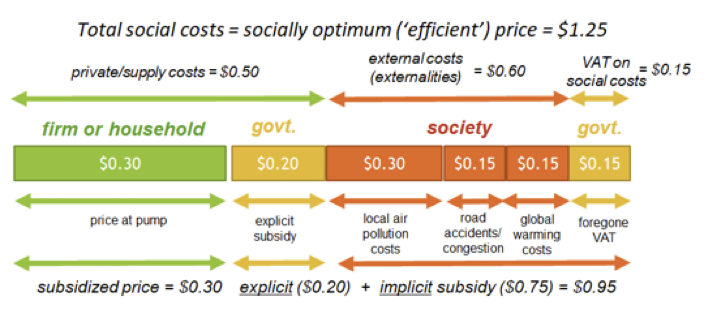
The article goes on to explain the difference between explicit and implicit subsidies, the former being the obvious direct payments to fossil fuel producers to bring down the unit cost of the fuel. The latter is a subsidy that is likely always present, vis in the practice of not charging the fossil fuel producers for the costs of pollution, climate change etc that are a consequence of their business. 

“Implicit subsidies occur when the retail price fails to include external costs, inclusive of the standard consumption tax. External costs include contributions to climate change through greenhouse gas emissions, local health damages (primarily pre-mature deaths) through the release of harmful local pollutants like fine particulates, and traffic congestion and accident externalities associated with the use of road fuels”(1)

By way of example they provide the following bar chart: 

(1) https://www.imf.org/en/Topics/climate-change/energy-subsidies

Green Tau issue 88

10th April 2024

The law, juries and justice 

In the UK laws are made by Parliament. The Parliamentary process  should involve in-depth scrutiny and widespread consultation with those likely to be affected to ensure that laws are both fair and effective. 

(I use the word ‘should’ because the reality at the moment is that often such scrutiny is lacking. The following comes from a Legal Action Group report: “Speaking at the annual Bingham Lecture, Lord Judge, who now sits in the House of Lords, observed that parliament produces around 3,000 pages of primary legislation a year, along with 12–13,000 pages of secondary legislation. Disturbingly, he expressed doubts about how much of this was even ‘read, just read’ by parliamentarians, ‘let alone scrutinised’.” https://www.lag.org.uk/article/201782/parliamentary-scrutiny-of-our-legislation-is-being-lost-to-misused-executive-power)  

Once passed, the laws are enforced by the legal system, including the courts where the interpretation of the law can be explored. 

The English legal system is renowned for it jury trials – trials where the defendant’s guilt or innocence is determined by twelve of their fellow citizens. The jury hears the evidence, for and against, and then retires to deliberate amongst themselves as to whether or not they think that the defendant is or is not  guilty. At the outset each witness, including the defendant, swear that they will tell the truth, the whole truth and nothing but the truth. This ensures that the jury has all the relevant evidence. 

The role of the judge is to make sure that the case is conducted in accordance with the law. They use their knowledges and experience in interpreting the law, elucidating for the court what they believe the law says or means. The judge can also determine which evidence is relevant to the case and can therefore be heard in court. When the evidence has been heard, the jury – not the judge – gives the verdict of guilty or not guilty. In this way the democratic process is brought to bear upon the legal system: it is the decision of twelve randomly chosen fellow citizens who determine whether or naturally a law has been broken by the defendant. Having heard the juries’ verdict, the judge – of the defendant has been found guilty -determines the sentence that concludes the case. Again this is done within the guideline laid down by law.

Judges have to be impartial ensuring that everyone – defendants, witnesses and jurors, are treated equally and fairly. 

Jurors too have to be impartial and must make their decisions about the case purely on the basis of the evidence that they hear whilst in court. They must not look for information elsewhere – be that via the internet, the media, friends or family etc. Rather they must only discuss the evidence they hear in court with – and only when all twelve are present – their fellow jurors. They must determine on each count whether or not the defendant is guilty or not guilty.  Their decision must be one that reflects their joint thinking. Their decision is one of conscience based on the evidence that they have heard. Jurors do not – and  indeed must not – explain what they discussed and how they have reached their decision. 

At The Old Bailey there is a plaque beating the following text:

“Near this site William Penn and William Mead were tried in 1670 for preaching to an unlawful assembly in Grace Church Street. This tablet commemorates the courage and endurance of the jury, Thos Vere, Edward Bushell and ten others who refused to give a verdict against them although locked up without food for two nights and were fined for their final verdict of not guilty. The case of these jurymen was reviewed on a Writ of Habeas Corpus and Chief Justice Vaughan delivered the opinion of the Court which established”The Right of Juries” to give their verdict according to their convictions.”

It concerns a trial in which the jury was not willing to find the defendants, William Penn and William Mead,  guilty. The judge then ruled that the jury must find defendants guilty. When they refused, the judge had them locked up without food and water for two days. When they still would not find the defendants guilty, the judge fined the jury members. Those who refused to pay were imprisoned.  Edward Bushell appealed to a higher court that he was being unlawfully imprisoned. The Chief Justice released him and declared that jurors could only be punished if they behaved improperly and not because they came to a decision that did not suit the judge or appeared contri to the evidence. 

This right that juries should convict according to their conscience is now the subject of debate, following the arrest of Trudi Warner – for holding up a placard bearing that same inscription as depicted on the plaque inside The Old Bailey – for contempt of court. 

Not surprisingly there has been a strong reaction to this and a group called Defend Our Juries has been coordinating actions outside Crown Courts (where jury cases are heard) where individuals have become human billboards,  sitting in silence outside the court holding a replica sign summarising the words from the Old Bailey. 

For more information about these issues – https://defendourjuries.org/