Green Tau Reflection

Inheritance and Greed

Someone in the crowd said to him, “Teacher, tell my brother to divide the inheritance with me.”

So begins the conversation that leads to Jesus’s parable about the greedy farmer.

Is it that the brother has kept all the inheritance for himself? Or maybe has palmed off his sibling with a pittance? Maybe the inheritance was a house that could not easily be divided between two? Maybe it was a farm that might be uneconomic to run if halved in size? 

Certainly for what ever reason, the sibling feels short changed and wants a fair share of the inheritance, indeed wants justice. 

Jesus doesn’t ask for clarification, nor does he suggest ways in which the inheritance might be divided, or ways in which to engage the brother in talks about what might be a just and fair solution to the problem. Instead Jesus tells the sibling to be wary of greed – and not just any greed but “all kinds of greed.” Jesus then tells the crowd a parable. 

There was once a rich and successful man – so successful that his annual harvest was more than his warehouse could hold. So the man tore down the first warehouse and built an even bigger one, assuring himself that with all this great wealth he would certainly be able to retire and enjoy the good life. And yet that night he died having failed to enjoy any of his gains. 

I wonder what the sibling thought? How was this an adequate answer to what must have seemed a valid request? Did the sibling conclude that Jesus was criticising his brother for wanting to keep all the inheritance rather than sharing it? Or did the sibling sense Jesus saying that there were more important things in life than accumulating wealth and maybe especially so if it was inherited wealth for which one had perhaps not even worked?

What might this passage have to say to us as we wrestle with finding a just settlement of the climate crisis? Is there a global inheritance that needs to be divided? Is there a rich harvest being garnered that is more than one person’s need?

The natural wealth of the world is certainly something inherited by each generation. A rich inheritance of resources: lands, birds and animals, rivers and lakes full of drinking water, forests burgeoning with timber, minerals, numerous plants with which to feed ourselves and from which to create clothes and medicines, energy from the sun, irrigation from the rains, power from winds and thermal energy, a multitude of mini beasts that keep the solid rich and fertile, insects that pollinate crops, oceans that shift heat around the planet, and so on and so on. It is a vast wealth that should satisfy all our needs. 

Earth Overshoot Day marks the date when humanity’s demand for ecological resources and services in a given year exceeds what Earth can regenerate in that year. in 2021 Earth Overshoot Day fell on 29th July. Since then we have as a global population been living beyond our means. We have been consuming resources faster than they can be replenished and instead have been accumulating excess waste, particularly of carbon dioxide. Something is wrong! And it’s wrong on two counts. 

Firstly as a global population we cannot carry on living beyond our means. To do so leads to disaster. Or as Mr Micawber in ‘David Copperfield’ explains it: ‘Annual income 20 pounds, annual expenditure 19 pounds 19 shillings and sixpence,  result happiness. Annual income 20 pounds, annual expenditure 20 pounds nought and six, result misery.’ For those of on earth in the 21st century the misery we face is most readily seen in the climate emergency: excess amounts of carbon dioxide and other greenhouse gases, is so markedly changing the climate that wild fires, floods, droughts, heat waves and storms  that might be once in a life time events are now annual occurrences. The changing climate is simultaneously changing the landscape, expanding deserts, shrinking ice caps, shrinking the tundra, narrowing the  temperate Alpine zone, draining river basins such as the Amazon and the Po, rising sea levels and the loss of islands and coastal lands.  This misery is not limited to the climate but is also found in rapidly declining biodiversity of the planet. Over the last 40 years the world’s wild life population – animals, plants, birds etc – has declined by more than 60% and some 10-30% of all species now face imminent extinction. And in the declining availability of essential resources such as fresh drinking water. 

On the second count, the overshoot is bad because its pain is not being shared equally across the global populace. For many of us in the west life remains safe, comfortable and affordable but for many more, especially those in the global south human life is extremely vulnerable and painful.  In the UK we face from time to time shortages of items such as cauliflowers or potatoes, people elsewhere face life threatening shortages. In Ghana last year the staple crop of maize was 60% below average. This year heat waves in Bangladesh have destroyed about 20% of their staple rice harvest.

We should be hearing this as demand from our siblings to divide the world’s inheritance and to do so fairly. 

Those of us currently enjoying western lifestyles need to reassess what we consume of the earth’s resources and undertake to consume less, and to share – to give – a greater proportion to the underprivileged. Such levelling up needs to take place both globally and nationally.  Here in the UK in 2018, the richest fifth of the population had incomes 12 times that of the poorest fifth, whilst a quarter of all wealth is held by just 1% of the populace. Globally the richest 1% hold 43.4% of all wealth.

Unlike the rich man in Jesus’s parable, we do not see many of the rich and wealthy dying overnight. Rather we see them (and us) contributing the greater amount of carbon dioxide and other waste products that are the cause of climate change and biodiversity loss. It is not rich individuals who are dying unfulfilled. It is our global family that is dying prematurely and unfulfilled. If we did but live within our means and did so equitably across the globe, life would be richer and sweeter and peaceable. 

This is the message that should be heard at COP26 and should be the model for the agreements made there. It is also be the message we individually should hear and act upon. 
Hallowed be your Name

NB hallow is an older word that means holy. 

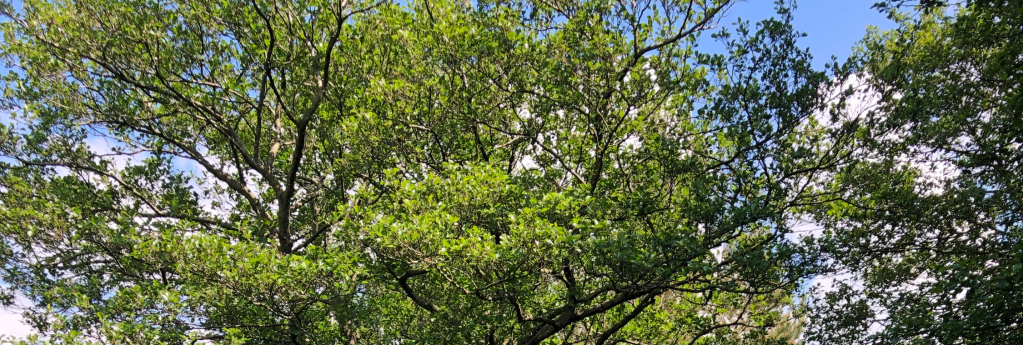
Tree canopy, near Skipton


Amongst the woods and forests,

between oaks and cedars,

God’s name is holy.

In the seas and oceans,

with whales and sea urchins,

God’s name is holy.

Across the moors and meadows,

with curlews and plovers,

God’s name is holy.

By riverbanks and streams,

following eels and kingfishers,

God’s name is holy .

High up on mountain peaks and glaciers,

sheltering in cwms and gullies,

God’s name is holy .

Gathered in barns and hives,

buzzing with bees and bats,

God’s name is holy .

Hidden under stones and snuck into crevices,

lying low with lizards and spiders,

God’s name is holy .

In all corners of the world

and where ever life exists,

God’s name is holy!

Amen

Sunday Reflection

22nd August 2021 – Proper 16: Joshua 24:1-2a,14-18, Psalm 34:15-22, Ephesians 6:10-20, John 6:56-69


The passage from Joshua comes towards the end of the book and towards the end of Joshua’s own life. The Israelites have settled in the promised land, each tribe in its own territory and peace has been established. Joshua calls together all the tribes and their leaders for one last exhortation that they live according to the ways ordained by God. It is as if they are again standing for the first time on the threshold of a new land, on the threshold of a new life. They are enjoined to leave behind old ways of living, old gods and old allegiances.  

Do we need to reimagine ourselves as being on the threshold of a new beginning, a new of life? Is this how we should be approaching the COP26 climate conference? Then nations and NGOs, communities and other parties, will gather to make agreements about new ways of living in a carbon neutral world, to affirm ways of ensuring worldwide biodiversity, setting up funds to enable everyone to be part of the new future. We will all need to stand alongside one another as let go of old ways of doing things, as we leave behind of old habits, and forsake our reliance on fossil fuels. 

If so should we not now be reassessing our lives, preparing how we can make and sustain the necessary changes we must make, and encouraging and supporting each other, and above all celebrating with joy our new greener, cleaner, kinder future?

May God bless our endeavours – for “The righteous cry, and the Lord hears them and delivers them from all their troubles.”

I would not wish to say that the current climate crisis is either the work of God or the work of the ‘devil’. The world God has created is beautiful and complex. It is a world in which things evolve and continue to re create in new and diverse forms. It is a world in which cause and consequence exist. It is a world which is continuing to develop over time. It is a world in which God has created humankind as a being with intelligence, imagination, determination, and with an awareness of right and wrong. It is a being with unique skills and possibilities, and it is a being which can choose to have an affinity with God. 

Depending how we use these attributes, we are capable of doing great good or of doing great harm. When we – and/ or others – are not in tune with God, our actions can become so mired in greed, dishonesty, hatred, apathy, and prejudice, we can describe our situation as being evil and bedevilled. We can feel as if we are struggling with forces or powers beyond our comprehension. Perhaps this is when we need to put on the armour of God, to refurnish our lives with the gifts of God, to be open to God in prayer and to be constant in seeking channels through which God’s Spirit can flow. 

If this seems hard to grasp, we need to recall the words of Simon Peter, “Lord, to whom can we go? You have the words of eternal life. We have come to believe and know that you are the Holy One of God.”

Green Tau Reflection

Life choices that bring blessings 

“You have heard that it was said, ‘An eye for an eye and a tooth for a tooth.’ But I say to you, Do not resist an evildoer. But if anyone strikes you on the right cheek, turn the other also;  and if anyone wants to sue you and take your coat, give your cloak as well; and if anyone forces you to go one mile, go also the second mile. Give to everyone who begs from you, and do not refuse anyone who wants to borrow from you. Matthew 5:38-42

The above comes from the Beatitudes: Jesus’s teaching to the crowds on the approach to life that would bring its own blessings. 

An eye for an eye and a tooth for a tooth sounds very mercenary. A contractual arrangement in which neither side looses out. A fair’s fair deal that leaves no space for argument not for generosity. It has the feel of a fixed price market. Anyone who tried to pay more than the asking price would be a fool. Yet Jesus invites the listener to be that fool. To pay more than the asking price. To give more that is required or demanded. To act in a way that undermines the normal way of doing business. It is a radical counter-cultural way of being that will bring its own blessings.

In the world of the climate crisis, old ways of doing things will have to change, old traditions and  old  norms will be replaced by new ways. Heating homes with gas will be history; the supermarket run in the car and the lift to school will disappear; holidays won’t start at the airport; strawberries will be a treat for the summer not Christmas.

Change like this can be hard to accept. After a life time in which cars have become the default means of transport, it is hard to rethink in terms of walking times. After a life time in which air travel has become part and parcel of the holiday package, it is hard to rethink in terms of trains and local destinations. After a life time in which seasonal food describes food linked to sporting/ social events, it is hard to re shape our eating round a annual cycle of what is currently in peak production: raspberries in June, plums in August, avocados in February. 

Change can be expensive as new practices, new products are scaled up and developed. The bonus of economies of scale take time to kick in, the benefits of lower energy bills will be felt gradually over the years whilst the initial cost of new equipment – heaters, electric cars, solar panels – may be steep.  

Following Jesus’s teaching, we can become trend setters, living a new lifestyle, adopting ways that will curb GHG emissions and restrain the climate crisis. We can lead by example and do things that are not the norm, that are not (yet) fashionable. We can choose to walk or cycle that bit further than usual rather than going by car. We can refuse to buy the plastic wrapped fruit or sandwich. We can explore the UK rather than the world. We can decline avocados in summer and strawberries in winter. 

Those of us with money can invest in carbon neutral technology, we can buy the eco friendly products and services, and we can do so generously, supporting producers as well as the climate. Train travel can be more expensive that going by car or plane, but we can choose the climate friendly option. Organic food may be more costly – now – but we can choose it over cheaper products that are less environmentally friendly.

Jesus asks that when we choose how to live, that we choose to think of the needs of others and be ready to meet their needs first. The results? A transformed world!

We shall not comply

When advertisers exhort us to drive ever larger fast cars –

We shall not comply.

When fashion houses entreat us to buy clothes for the beach and more for barbecue, clothes for lounging and more for reclining – 

We shall not comply.

When top chefs urge us to buy tropical fruits and exotic grains, to eat strawberries in January and avocados in September –

We shall not comply.

When your companies tout trips to the Tropics, all flights included, 
or city breaks by air –

We shall not comply.

When weekend magazines promote this season’s new colour schemes wall paper and furnishing, out with the old and in with the new –

We shall not comply.

When tech industries unveil this year’s new phone, the upgraded tablet and irreparable head sets –

We shall not comply.

When governments tell us  that coal mines are good and ask for our vote –

We shall not comply.

When trend setters define the next must-have accessory and deride what was last season’s in thing – 

We shall not comply.

When politicians tell us national needs are all important and foreigners must wait – 

We shall not comply.

Holy God, 

keep awake in us a true love for the earth, 

its flora and fauna, our brothers and sisters.

Strengthen our resolve to live within our means, 

to act with compassion, and following your will –

We shall COMPLY!

Love and Cherish

Love and cherish not some of the earth but all; 

Not just your back yard, but mine too;

Not just your local wood but the rainforests too;

Not just your home town but the favelas too.

Love and cherish not some creatures but all;

Not just pandas and tigers, but the vulture and bat too;

Not just bees but wasps and spiders too;

Not just elephants but slugs and snails too.

Love and cherish not some landscapes but all;

Not just meadows but peat bogs too;

Not just ancient woodlands but hedgerows too

Not just national parks but grass verges too.

Love and cherish not some people but all;

Not just city bankers but street cleaners too;

Not just business leaders but refugees too;

Not just home owners but travellers too.

For if we do not, we are all diminished.

If we do not we shall all suffer

from droughts and floods,

rising sea levels and declining water supplies,

from infectious diseases and resistant bacteria. 

We are one world, one family,

one eco system, one interdependent 

and interwoven creation. 

God, our creator, redeemer and sustainer,

Bring us to our senses! 

Now!

The Green Tau: issue 10

A question of justice: what is climate justice? Part 2

What then of climate justice?  What is the upright behaviour, the righteousness behaviour that God expects us to show vis a vis the climate?

Photo by Tobias Bju00f8rkli on Pexels.com

And God said, “Let there be lights in the dome of the sky to separate the day from the night; and let them be for signs and for seasons and for days and years, and let them be lights in the dome of the sky to give light upon the earth.” And it was so. God made the two great lights—the greater light to rule the day and the lesser light to rule the night—and the stars.  God set them in the dome of the sky to give light upon the earth, to rule over the day and over the night, and to separate the light from the darkness. And God saw that it was good.  And there was evening and there was morning, the fourth day. (Genesis 1:14-19)

The writer of Genesis tells us that the climate and its seasons, shaped by the sun, is a key part of the world God created. Both creation stories in Genesis give humankind a key role in occupying and caring for and tending the world that God created. Humans are given a role of responsibility vis a vis the fish of the sea, the birds of the air and all living things that move on the earth. They are given the task of cultivating the land and the plants which God intended should transform the earth from the bare form with which it began. And they are instructed to multiply and be fruitful ensuring generations of humans to come. 

Have we looked after all the fish, the birds and living things? The decline in biodiversity with a third  species threatened with extinction, suggests not. 

Have we cultivated the earth and maintained its greenness? The expansions of deserts, the destruction of rainforests and temperate woodlands, and the loss of native plants suggest not. 

Have we provided for the well being of generations to come? Currently the world is on track for an increase in global temperatures of some 3 to 5°C by the end of the century which would render large parts of the earth uninhabitable for humans – so no!

If we were to hold up a plumb line to measure how upright our living on the earth has been, we would see a world that is on the verge of collapse, a world which will be in a worst state than when we inherited it, and a world in which life for our children and grandchildren would be very bleak. 

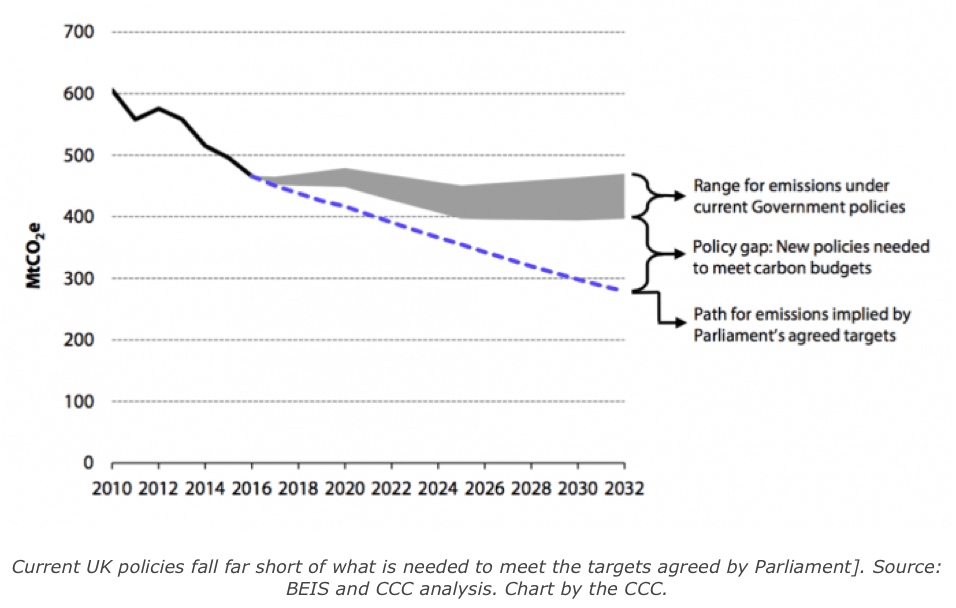
The diagram below is the equivalent of Amos’s plumb line. It was put together by the government’s Climate Change Committee  an independent, statutory body established under the Climate Change Act 2008) is part of their review of the progress being made tickling the climate crisis. It shows with a blue dotted line the target reduction in carbon emissions agreed by Parliament. The grey band shows the levels of emissions that  current policies will achieve. The gap between the two is the shortfall where new, firmer polices are needed. Just as plumb line measure how true a wall is, so this diagram shows how adrift we are of doing what is right for the climate and the world. 

Prophets like Amos and Jeremiah called out to those in power when  they were not meeting God’s standards. They also called out examples of wrong behaviour by merchants/ business leaders and those who abuse their power to oppress the vulnerable. They also called out those who falsely prophesied that all would be well and that no one need to repent and amend their patterns of behaviour! 

Climate justice requires us to call our government and business leaders  to account when policies and actions fail to address the climate crisis and rather allow the state of the earth to decline. We can write to our MPs and our local councillors asking what they are doing to avert the climate crisis, asking not just for wishful statements, but for concrete actions with measurable results. We can write to businesses, both multi nationals and our small, local businesses and ask  what they are doing to achieve net zero carbon by 2050. Kiss the Hippo, coffee roasters in Richmond is a carbon negative coffee company – https://kissthehippo.com/blogs/news/good-news-we-ve-gone-carbon-negative we can  sign petitions  and join one of the many groups campaigning on the climate crisis issue – eg Friends of the Earth, XR, 350.org

Climate justice requires us to look at our own lifestyles and measure whether they improve or damage the earth and the heritage that we will pass onto future generations. There are numerous suggestions on the internet about what we can do. This will be the topic of the next issue of the Green Tau.i

Far away and near at hand

The floods were far away

Now there near at hand. 

How long before I wet my feet 

and take a stand?


The heat was far away.

Now it’s close to home.

How long before I own the fact 

and finally begin to act?


Hurricanes were tropical.

Now they’re topical.

How long before I feel my guilt 

and understand the world we’ve built? 


Our climate is changing –

Far away and near at hand. 

Holy God, redeem our failings

and strengthen our resolve:

far away and near at hand.