Counting on…day 396

3rd December 2022

Today is Small Business Day.

According to the Borough of Richmond “Much of what you’ll find in shops across the borough is sourced and crafted locally and only a short distance by foot, cycle or public transport. Shopping locally is a great way to limit your carbon footprint, improve the air quality in our borough through active travel and reduce the delivery miles spent ordering goods to your home.”

 Counting on …day 395

2nd December 2022 

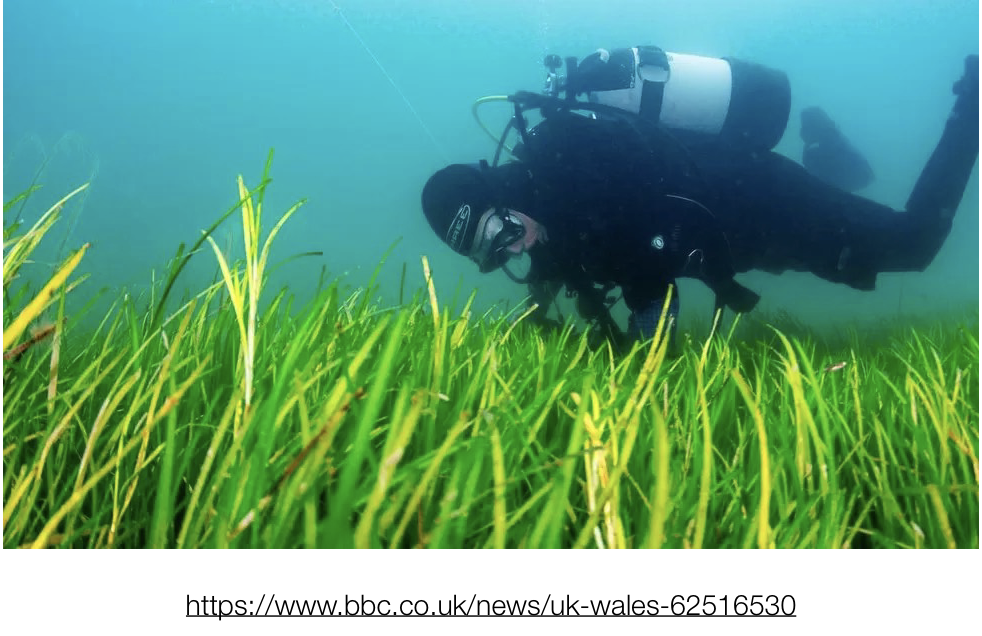
Seagrass, the only flowering marine plant, grows in the shallower waters of our seas and oceans as it is reliant on sunlight  for photosynthesis. Where it is well established it forms meadows where its roots stabilises sediment on the seabed preventing erosion. Its roots also oxygenate the sediments supporting many burrowing organisms. As it grows it sequesters carbon dioxide and does so at rates 10 to 40 higher than that of forests! It provides food, breeding grounds and nurseries for many marine species – from seahorses to seals, dog fish and octopus. 

However world wide seagrasses are under threat. These marine meadows are damaged and destroyed by  sewage and chemical effluents, by algal blooms that restrict sunlight penetrating the water and so preventing  photosynthesis,  by mechanical damage from anchor chains, marine vessels, and dredging  as well as from over-fishing which disturbs the balance of the ecosystem. It is estimated that the UK has lost 95% of its seagrass meadows. 

The Segrass Ocean Rescue project is planting 5 million seagrass seeds off the Llŷn Peninsula in Gwynedd and Anglesey, with the aim of creating 10 hectares (25 acres) of seagrass meadow by the end of 2026.

Advent 2

December 2022

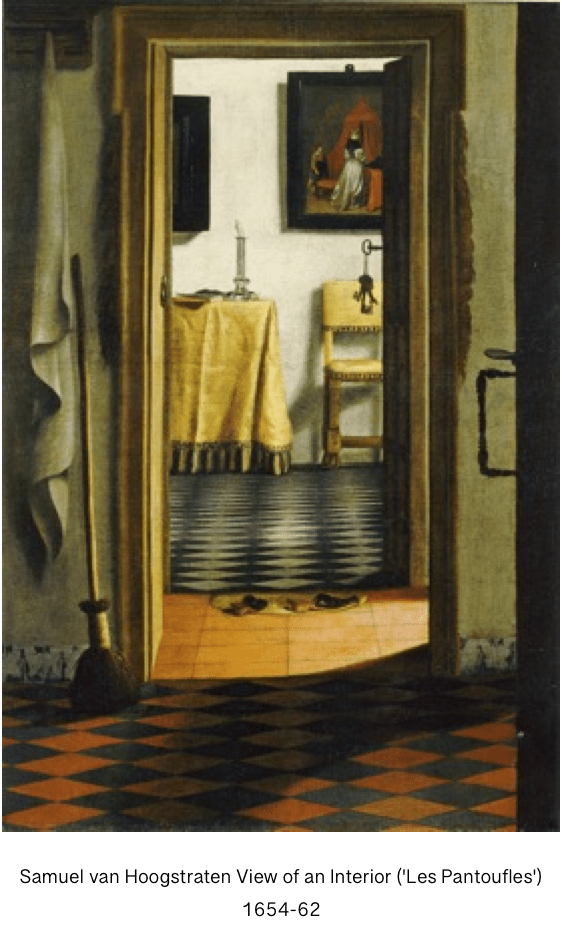
We are looking from one room to another, with a corridor in between. The first room is a  kitchen or scullery – a mop and a towel suggest domestic tasks. The room beyond is more refined. A set of keys suggests a desire to protect the security of this room. On the table is an open book. By it is a large candle now extinguished; maybe the book was being read in the early hours before day break. There is an atmosphere of tranquility and peace about this scene, as well as a sense of patient waiting. Is the room waiting for the reader to return to the book?

The angel said to them, ‘Do not be afraid; for see—I am bringing you good news of great joy for all the people: to you is born this day in the city of David a Saviour, who is the Messiah, the Lord. This will be a sign for you: you will find a child wrapped in bands of cloth and lying in a manger.’ … Mary treasured all these words and pondered them in her heart.

Luke 2:10,11,12,19

Can we find words to treasure and ponder whilst we wait this Advent?

Advent 1

Do you remember the excitement of opening the little doors on an old fashioned Advent calendar to see the miniature picture behind it? We always knew that behind door 24 would be a crib and a baby Jesus, but what was behind the other doors would be a surprise – a mystery. Is that true of Advent itself? We know where we will end up on 24th December but our journey there and our encounters on the way may be full of surprises  and mystery.

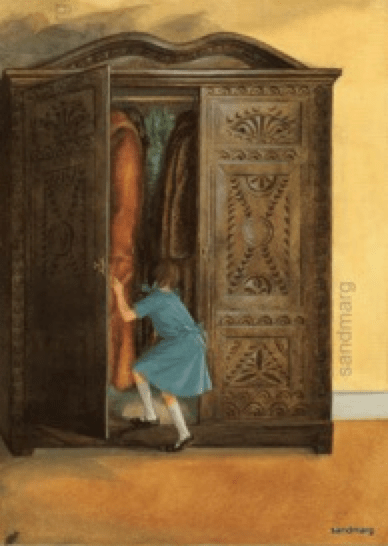
This first door is from The Lion, the Witch and the Wardrobe by C S Lewis. Lucy climbs in to hide and finds that the wardrobe leads into a parallel world, a world of challenge and adventure, fear and excitement. If we could choose to step through a door into another world this Advent, would we be hoping to step back into the world of childhood Christmases? A time when everything is exciting, the ground is always covered with snow, Christmas trees are tall and everyone is full of love and laughter. When we excitedly unwrap ribbons and paper to find we have been given our hearts desire. 

Or would we hope to step into a parallel world of spiritual well-being? Where prayer comes easily. Where our hearts sing with joyous anticipation. Where every hour we feel close to God. Where our minds are free of worries about turkeys and presents. Where each day takes us a step closer to heaven. 

Or would we fear stepping into a world of endless Christmas bling? Never ending shopping opportunities. Snake-like checkout queues, canned carols and dancing reindeer, fake snow and luminous snowmen.

‘Prepare the way for the Lord; make straight paths for Him.’

Luke 3: 4

O taste and see that the Lord is good; happy are those who take refuge in him. 

Psalm 34:8

Green Tau: issue 58

30th November 2022

Who benefits from fossil fuel investment? 

The big oil companies are expanding their exploitation of gas and oil reserves in response to the short falls in supply from Russia. The rapid rise in gas prices is prompting some African nations to consider developing the gas reserves under their land. To  explore and develop these reserves investment is needed and, it seems, is  readily available from western investors. 

In some ways it is not illogical. If you are a company whose raison d’être is finding, extracting and selling oil, that if you hear of new oil deposits, you go after them. Ditto if you are an investment company that has always invested in oil because it has always earns large dividends, then that is what you keep on doing. People and companies are wary of change, or perhaps become so immersed in the comfort of where they are, that they don’t look outside their own silo to be aware that change is already happening. This can be short sighted. Vis a vis oil, there are two black clouds on the horizon. Peak oil – that point in. Time when demand for oil will start to drop and co to use to drop. Many commentators suggest that we have already passed peak oil back in 2019. The decline in oil use arises when cars switch from petrol to electrical power (something that is happening aster than expected), as more plastics are made from recycled plastic rather than virgin oil, as users of oil become more efficient in their use of an expensive raw material,  and as users find renewable energy is cheaper. The second dark cloud is the climate crisis. As concern about the crisis takes root more people, companies and countries are going to be cutting back on their use of oil in an attempt to limit global temperature rises. If such moves are not successful then the world will experience rising sea levels, widespread drought, extremes of weather and widespread loss of life and incomes. And this of itself will severely reduce demand for oil. Either way it seems that long term the future for the oil industry is not good – but for in the short term their dominance of the global economic systems shields them. This has been highlighted by the war in Ukraine.  So the oil industry continues to be heavily subsidised by governments. “Since the Paris Agreement, the government has provided £13.6 billion in subsidies to the UK oil and gas industry. From 2016 to 2020 companies received £9.9 billion in tax relief for new exploration and production, including £15 million of direct grants for exploration, and £3.7 billion in payments towards decommissioning costs.” https://www.ethicalconsumer.org/energy/paid-pollute-fossil-fuel-subsidies-uk-what-you-need-know

So we are seeing large numbers of oil companies and oil investors focusing on exploring and  extracting oil and gas from the African continent. Despite the long term risks of declining demand, these companies seem convinced that there is money to be made. The idea of making rich profits from oil is certainly seen as attractive by some governments in Africa – oil would seem to offer rewards in licence fees and taxes. But who will benefit? Possibly governments, big businesses, banks and the like. Probably not the ordinary person in the street, the small scale farm or business, and definitely not the rich biodiverse  natural environment. 

Given the high price of oil, the availability of more oil will more likely benefit the big users of oil in the western world, not the person on the street in Luganda or Accra or Windhoek, not the small farm and the rural villager, nor the small businesses. What they need is cheap and accessible electricity , electricity that can be produced locally without reliance on an expensive national grid, electricity that comes from local wind turbines and solar panels? What they need is a move away from polluting vehicles and power plants. What they don’t need is the pollution and disturbance caused by drilling for oil,  building pipeline and running oil refineries. 

What the nations of Africa do need is investment in renewable energy. Ideally not in large projects such as hydro electric dams but in multiple smaller scale projects that will connect to and supply local towns and communities. 

“The potential for wind and solar is 400 times larger than Africa’s total fossil fuel reserves and it comes pollution-free and creates more jobs, but there is finance gap…That is why there is so much attention at this COP to changing the global capital allocation system,” Mr Gore

What the nations of Africa need is protection for their remaining areas of natural habitat – rain forests, wetlands and savannahs. Again this is an area in need of large scale investment that will protect habitats and provide sustainable incomes for local people. 

 “The area of land allocated to oil and gas activity in Africa is set to quadruple, threatening critical forests that help combat climate change, according to a new report by two environmental groups. Rainforest Foundation UK and Sacramento, California-based Earth InSight used mapping technology to show that gas and oil blocks overlap with about 30% of the continent’s dense tropical forests and more than a third of the Congo Basin, the world’s second-largest rainforest after the Amazon. The Democratic Republic of Congo, which accounts for about 60% of the basin, launched a bidding round  in July for 30 oil and gas permits, several of which overlap with the basin. Congo, one of the world’s poorest countries, has defended its right to explore for oil and develop its economy.” KBloomberg UK 

Can the big fossil fuel companies reinvent themselves? Can they recalibrate their raison d’être as energy companies?  Can they become suppliers of renewable energy technology that can enable communities to control their own energy sources? Can they create new business models that can invest the money from our banks, pensions funds and insurers, to protect and enhance the natural environment? 

Counting on … day 393

30th November 2022

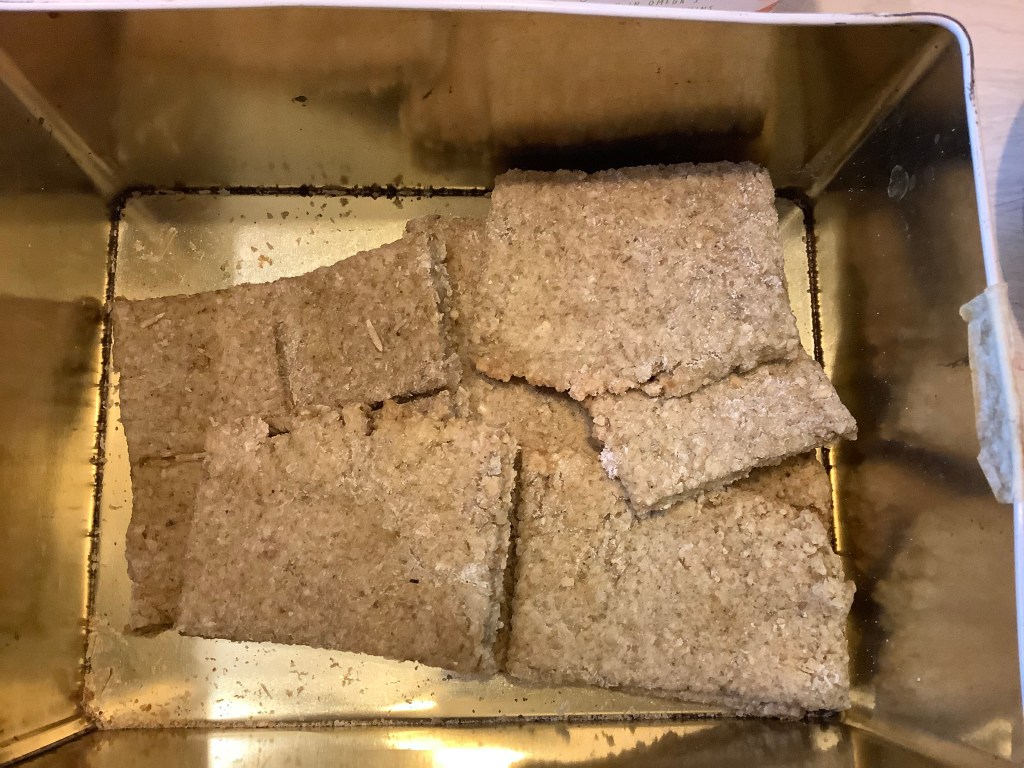
Another food associated with Scotland are oatcakes. I make these on the days when I am baking bread as they can go in the oven whilst the oven is warming up to the high temperature needed for the bread.

Oatcakes

In a bowl mix 2 tablespoons of flour (white, wholemeal, spelt or rye) and 8 tablespoons of oatmeal. Add a half teaspoon of bicarbonate of soda and a generous tablespoon of oil. If you wish, add a little salt/ black pepper/ chopped rosemary. 

Add sufficient boiling water to bind to a stiff dough.

Grease a baking tray and spread out the dough into a large rectangle (about 30x25cm) either patting it with well floured hands or using a rolling pin. 

Cut the dough into about 16 pieces (you don’t need to separate them as the mixture doesn’t spread).

Bake for 20 minutes or until firm at about 160-200C. Cool on the tray before removing to any air tight tin.

As a variation you incorporate sunflower or chia seeds etc. 

Counting on …. Day 392

29th November 2022

Tomorrow is the feast of St Andrew, patron saint of Scotland. Here is a recipe for vegan haggis, not entirely my own, but  having no note of the original recipe, I cannot credit its creator.

Haggis. Serves 2-3

50g  Puy lentils

50g pearl barley

oil 

1 large onion, finely chopped

1 large carrot, finely chopped

75g portobello mushrooms, finely chopped

½ tsp ground allspice

 ½ tsp ground black or white pepper

90g pinhead oatmeal

½ tbsp marmite

1½ tbsp brown sauce or treacle

Sauté the onion and carrot in a little oil till soft. Add the mushrooms and the spices. If need be add a little more oil.

Add the barley and lentils. Add about 400ml hot water and yeast extract. Feel free to add a sprig of thyme. 

Simmer until the mixture is very thick, adding more water if necessary. 

Heat the oven to 180C/350F/gas mark 4.

Stir in the oatmeal and brown sauce and tip into a greased loaf tin and cover with foil. Bake for 30 minutes, then remove the foil and bake for another 30. 

Leave for five minutes, then turn out and serve.

Counting on … day 392

28th November 2022 (this is rerun of a post from last year)

Bike is best!” Whether you are young or old or somewhere in between.  Whether you are able bodied  or disabled. Whether you are super fit or just starting out. Whether it’s simply  for leisure or for  getting from A to B. Whether it is for deliveries or commuting or the school ‘run’.  

Active travel reduces carbon emissions, improves air quality and aids healthy living. What’s not to like?

And what is included in active travel? – walking, wheeling and cycling. The following extract comes from Wheels of Wellbeing, a charity  that promotes cycling for people with disabilities.

Walking:  foot/pedestrian-based mobility that may incorporate the support of aids to mobility such  as stick/s, cane/s, crutch/es, the arm of another person and/or assistance animal/s.

Wheeling: an equivalent alternative to foot/pedestrian-based mobility. Includes wheeled mobilities such as manual self- or assistant-propelled wheelchairs, including wheelchairs with power attachments or all-terrain attachments (such as the “Freewheel”), powered wheelchairs, mobility scooters (three and four-wheeled) and rollators. Some people rely on their cycle to move (at a pedestrian’s pace) through pedestrianised environments when it is not physically possible to walk/push their cycle. Some people use their cycle as a walking aid, by leaning on it (do not use crutches but need to lean in order to walk, due to pain etc. – they can dismount but cannot park their cycle). Some people use e-scooters (with or without a seat), to wheel/scoot through pedestrianised environment if they cannot walk unaided.

We recommend never using ‘walking’ on its own (as it likely reinforces ableist stereotypes in people’s minds) but always using ‘walking/wheeling’ together. Both words represent the action of moving at a pedestrian’s pace, whether or not someone is standing or sitting, walking/wheeling unaided or using any kind of aid to mobility, including walking aids / wheeled aids, personal assistants or support animals.

Cycling:  incorporates the action of moving at speed on a wide range of pedal- powered wheeled transport that may be powered with hands and/or feet, may transport one or more person, may or may not include e-assist and usually have between 2 and 4 wheels. 

https://wheelsforwellbeing.org.uk/walking-wheeling-and-cycling-definitions/embed/#?secret=7xNzMjwypv

First Sunday of Advent 

26th November 2022

Reflection (readings follow on below)

Is Advent just a precursor for Christmas or is it a season with its own focus and purpose?

Advent Sunday marks the beginning of the Church’s year. Whilst with the secular New Year one focuses on new beginnings, fresh starts, transformative resolutions, the traditional themes for Advent are death, judgement, heaven, and hell. Another view of Advent is to see it as a time to ‘Prepare  the way of the Lord’ with a focus on both the nativity of Jesus and his second coming. Other themes that Christians observe are hope, peace, joy, and love. 

Maybe Advent is both a time to make a fresh start – to repent and realign our daily lives with God – and a time of hope for the coming of Jesus through whom we once again receive the good news of the coming of the kingdom of God. And in just under a year’s time we will again celebrate the feast of  – and our allegiance to – Christ the King. 

Kingdoms centre round a castle or palace or capital city from which the rule of the kingdom extends. It is the place from where justice is meted out. It is the place of learning and fashion that shapes the culture of the kingdom. The passage from Isaiah talks of the mountain as the Lord’s house – the pinnacle from which God’s presence is spread abroad. This mountain has become the highest point – now everyone and every nation can see where God dwells and feel the influence of God’s rule. This renewed prominence draws the people to God in their desire to learn God’s ways which encompass peace and justice and reconciliation. 

Jesus in his ministry drew people to himself as he preached the good news of the coming rule of the kingdom of God. His message was radical and transformative, calling on people to renew and reform their lives, following in the ways of God. Jesus also spoke about a day of judgement, a day of denouement when the success or failure of our lives will be tested. This day does not sound pleasant; it sounds as if it will come with pain and tears and suffering. Jesus likens it to the time of Noah and the flood. There was life after that catastrophic flood, a new beginning. There have been other times too when humanity as a whole or in various areas of the world, has faced similar cataclysmic situations – war, floods, hurricanes, financial collapse, pandemics – which have become a time of reckoning and from which life has re-emerged, often wisely, and hopefully with a renewed understanding of the right ways of Godly living. These times of reckoning will continue to occur as we continue to wrestle with our human inclination to trust in greed and self interest. So maybe each season of Advent should be seen as a challenge to face up to our unwholesome inclination, and a time to refocus on the right ways of living in harmony with God and God’s creation.

The passage from Isaiah has words of hope that God will arbitrate between peoples and nations to establish justice, such that the weapons of war can be reformed as tools of peace and prosperity. In our time our greatest threat comes from the use of fossil fuels and the release of excessive quantities of greenhouse gases into the atmosphere causing global warming and climate change on a catastrophic scale. If we do not curtail this decisively and speedily, we know we face a near future in which vast numbers of plants, animals and people will suffer and die. It will be a a doomsday of our own making. The weapons that enable this crisis, are our patterns of consumption and our patterns of investment. We need to transform these to create sustainable and equitable patterns of consumption and to invest in renewable and sustainable technologies. 

Advent is a season to reflect upon and amend the relationship we have with creation, with technology, with society, and with all that shapes our daily live. We need to focus on those ways which will establish a way of live that reflects God’s will, and to share that so that it is a world wide transformation. 

We should not wait for the climax to be reached before we reform our lives in line with God’s way. Now is the time to be ready. Now is the time to ‘put on the Lord Jesus Christ’!

Isaiah 2:1-5

The word that Isaiah son of Amoz saw concerning Judah and Jerusalem.

In days to come
the mountain of the Lord’s house

shall be established as the highest of the mountains,
and shall be raised above the hills;

all the nations shall stream to it.
Many peoples shall come and say,

‘Come, let us go up to the mountain of the Lord,
to the house of the God of Jacob;

that he may teach us his ways
and that we may walk in his paths.’

For out of Zion shall go forth instruction,
and the word of the Lord from Jerusalem.

He shall judge between the nations,
and shall arbitrate for many peoples;

they shall beat their swords into ploughshares,
and their spears into pruning-hooks;

nation shall not lift up sword against nation,
neither shall they learn war any more.

O house of Jacob,
come, let us walk
in the light of the Lord!

Psalm 122

1 I was glad when they said to me, *
“Let us go to the house of the Lord.”

2 Now our feet are standing *
within your gates, O Jerusalem.

3 Jerusalem is built as a city *
that is at unity with itself;

4 To which the tribes go up,
the tribes of the Lord, *
the assembly of Israel,
to praise the Name of the Lord.

5 For there are the thrones of judgment, *
the thrones of the house of David.

6 Pray for the peace of Jerusalem: *
“May they prosper who love you.

7 Peace be within your walls *
and quietness within your towers.

8 For my brethren and companions’ sake, *
I pray for your prosperity.

9 Because of the house of the Lord our God, *
I will seek to do you good.”

Romans 13:11-14

You know what time it is, how it is now the moment for you to wake from sleep. For salvation is nearer to us now than when we became believers; the night is far gone, the day is near. Let us then lay aside the works of darkness and put on the armour of light; let us live honourably as in the day, not in revelling and drunkenness, not in debauchery and licentiousness, not in quarrelling and jealousy. Instead, put on the Lord Jesus Christ, and make no provision for the flesh, to gratify its desires.

Matthew 24:36-44

Jesus said to the disciples, “But about that day and hour no one knows, neither the angels of heaven, nor the Son, but only the Father. For as the days of Noah were, so will be the coming of the Son of Man. For as in those days before the flood they were eating and drinking, marrying and giving in marriage, until the day Noah entered the ark, and they knew nothing until the flood came and swept them all away, so too will be the coming of the Son of Man. Then two will be in the field; one will be taken and one will be left. Two women will be grinding meal together; one will be taken and one will be left. Keep awake therefore, for you do not know on what day your Lord is coming. But understand this: if the owner of the house had known in what part of the night the thief was coming, he would have stayed awake and would not have let his house be broken into. Therefore you also must be ready, for the Son of Man is coming at an unexpected hour.”

Counting on … day 391

26th November 2020

My apologies for yet another link to a petition but the situation feels grave.

This one is calling in the Government to stop the development of the Rosebank oil field in the North Sea. Personalising your letter does help as you can relate the letter to,your own fears and concerns. Mine included my daughter’s assertion that she does not think she will reach the age my husband has because the climate crisis will, through widespread famine, so disrupt life on earth.